- Base Value(2025): 13.1 Bn
- Estimated Value(2026): 13.8 Bn
- Forecast Value (2036): 23.5 Bn
- CAGR (2026 - 2036): 5.5%
Gum Hydrocolloid Market Forecast Fact.MR
In 2025, the gum hydrocolloid market was valued at USD 13.1 billion. Based on FMR analysis, demand for gum hydrocolloids is estimated to grow to USD 13.8 billion in 2026 and USD 23.5 billion by 2036. Fact MR projects a CAGR of 5.5% during the forecast period.
The absolute dollar growth from 2026 to 2036 is USD 9.7 billion. This growth reflects steady expansion in food processing, pharmaceuticals, and personal care formulations where hydrocolloids function as stabilizers, thickeners, and emulsifying agents. Increasing demand for processed foods and functional ingredients supports adoption across beverage, dairy, and bakery applications. Growth remains incremental because feedstock availability, agricultural yield variability, and regulatory scrutiny on food additives influence supply stability and formulation choices.
Germany leads with a CAGR of 9.1%, supported by strong demand from food processing and industrial ingredient manufacturing. Japan follows with 8.2%, driven by advanced food formulation technologies and high demand for stabilizing agents. Australia grows at 7.8%, supported by expanding processed food production and ingredient exports. India records 6.3%, reflecting growth in packaged foods and dairy processing. The United States grows at 4.7% and China at 3.4%. These mature markets generate replacement demand rather than rapid expansion, constrained by ingredient substitution pressure and regulatory oversight on food additives.
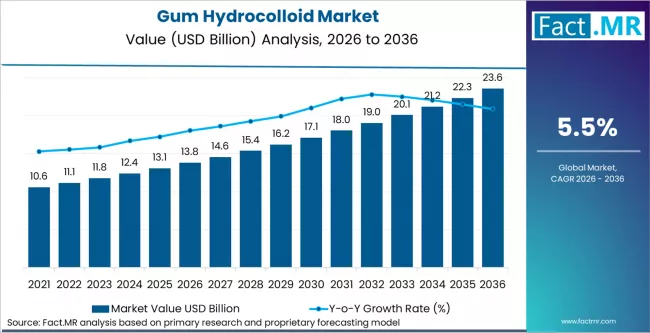
Gum Hydrocolloid Market Market Value Analysis | Source: Fact.MR
Gum Hydrocolloid Market
| Metric | Value |
|---|---|
| Estimated Value in (2026E) | USD 13.8 billion |
| Forecast Value in (2036F) | USD 23.5 billion |
| Forecast CAGR (2026 to 2036) | 5.5% |
Source: Fact.MR analysis. Updated Mar 13, 2026
Gum Hydrocolloid Market Definition
The Gum Hydrocolloid Market involves the production and sale of water soluble or water dispersible polysaccharide gums used as thickening, stabilizing, gelling, and emulsifying agents in food, pharmaceutical, and industrial formulations. These hydrocolloids are derived from plant, microbial, seaweed, or synthetic sources and form viscous solutions or gels when dispersed in water. Their primary industrial function is to control texture, viscosity, moisture retention, and stability in formulated products. Key end uses include processed foods, beverages, pharmaceuticals, personal care products, and certain industrial formulations where controlled rheology and stabilization are required.
Market Inclusions
This report covers global and regional market sizes for gum hydrocolloids over a defined forecast period. It includes segmentation by product type such as xanthan gum, carrageenan, pectin, guar gum, locust bean gum, alginates, agar, gum arabic, and other functional hydrocolloids. Application segments covered include food and beverages, pharmaceuticals, personal care, and industrial formulations. The report also evaluates supply dynamics across plant, microbial, seaweed, animal, and synthetic sources used in hydrocolloid production.
Market Exclusions
The scope excludes starch based thickeners and cellulose derivatives that are not classified as gum hydrocolloids. It also excludes finished food and pharmaceutical products where hydrocolloid content is present but not measured as a separate ingredient market.
Research Methodology
- Primary Research: Interviews were conducted with hydrocolloid producers, food ingredient formulators, application scientists, and supply chain specialists.
- Desk Research: Data was sourced from food ingredient industry publications, trade statistics, and chemical industry association reports.
- Market-Sizing and Forecasting: A hybrid model combining top down food ingredient demand projections with bottom up production and sales data from hydrocolloid manufacturers was used.
- Data Validation and Update Cycle: Findings were validated through expert consultations and cross checked with recent production volumes, trade flows, and industry performance indicators.
Summary of the Gum Hydrocolloid Market
- Market Definition
- The Gum Hydrocolloid Market involves the production and commercial supply of water soluble or water dispersible polysaccharide gums used as thickening, stabilizing, gelling, and emulsifying agents in industrial formulations. These hydrocolloids are derived from plant, microbial, seaweed, animal, and synthetic sources and form viscous solutions or gels when dispersed in water. Their functional role includes controlling viscosity, stabilizing emulsions, retaining moisture, and improving texture in formulated products. Major end use sectors include food processing, pharmaceutical formulations, personal care products, and selected industrial applications where rheology control and product stability are required.
- Demand Drivers
- Expansion of processed food manufacturing requiring stabilizing and texturizing ingredients.
- Increasing demand for functional ingredients used in dairy, bakery, and beverage formulations.
- Rising use of hydrocolloids in pharmaceutical formulations as binding and suspension agents.
- Growth of personal care products requiring viscosity control and stabilization systems.
- Adoption of hydrocolloid blends to achieve targeted texture and stability characteristics in food formulations.
- Key Segments Analyzed
- Product Type: Gelatin, Xanthan Gum, Carrageenan, Alginates, Agar, Pectin, Guar Gum, Locust Bean Gum, Gum Arabic, Carboxymethylcellulose, Microcrystalline Cellulose.
- Source: Plant sources lead with 35% share in 2026, followed by Microbial, Animal, Seaweed, and Synthetic sources.
- Application: Food and Beverages dominate with 55% share in 2026, followed by Pharmaceuticals, Personal Care, and Industrial Applications.
- Geography: Europe and East Asia represent major demand centers. Germany records the highest CAGR at 9.1%, followed by Japan at 8.2%, Australia at 7.8%, India at 6.3%, United States at 4.7%, and China at 3.4%.
- Analyst Opinion at Fact MR
- Shambhu Nath Jha, Principal Consultant, Fact MR, opines, "In this updated edition of the Gum Hydrocolloid Market report, industry participants will observe that value creation is shifting from commodity hydrocolloid ingredients toward customized stabilizer systems used in modern food and pharmaceutical formulations. Food manufacturers increasingly require ingredient blends that provide precise viscosity control, moisture retention, and texture consistency across large scale processing operations. Hydrocolloid suppliers that invest in application specific formulation expertise, stable agricultural supply chains, and specialty ingredient development will strengthen their position in global ingredient markets. The convergence of food formulation science and industrial ingredient engineering defines the competitive landscape through 2036."
- Strategic Implications or Executive Takeaways
- Expand development of customized hydrocolloid blends designed for specific food and beverage applications.
- Strengthen agricultural sourcing networks to stabilize supply of plant derived hydrocolloid feedstocks.
- Invest in application laboratories that support formulation testing for food and pharmaceutical manufacturers.
- Develop specialty hydrocolloids that support plant based foods and advanced processed food formulations.
- Maintain regulatory compliance across food safety frameworks governing ingredient approval and labeling.
- Methodology
- Primary Research: Interviews conducted with hydrocolloid manufacturers, ingredient formulators, food scientists, and supply chain specialists.
- Desk Research: Data compiled from food ingredient industry publications, trade statistics, and chemical industry association reports.
- Market Sizing and Forecasting: Hybrid model combining top down food ingredient demand projections with bottom up production and sales analysis from hydrocolloid manufacturers.
- Data Validation: Findings validated through expert consultations and cross checked with recent production volumes, trade flows, and industry performance indicators using Fact MR forecasting models.
Segmental Analysis
Gum Hydrocolloid Market Analysis by Application
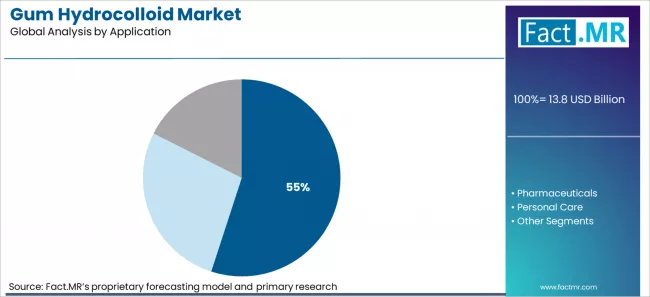
Gum Hydrocolloid Market Analysis By Application | Source: Fact.MR
Market Overview: Food and beverages are expected to capture 55% of the market share by 2026. Gum hydrocolloids are widely used in food formulations as stabilizers, thickeners, emulsifiers, and gelling agents. They play a critical role in improving texture, viscosity, and shelf stability in products such as dairy items, sauces, beverages, and processed foods.
Demand Drivers:
- Wide Functional Properties: Hydrocolloids help control texture, moisture retention, and stability in food products, making them essential ingredients in modern food processing.
- Growth of Processed and Convenience Foods: Increasing consumption of packaged and ready-to-eat foods drives demand for hydrocolloids that enhance product quality and consistency.
- Product Formulation Flexibility: Food manufacturers rely on hydrocolloids to achieve desired textures and mouthfeel in diverse formulations including beverages, dairy, and bakery products.
Gum Hydrocolloid Market Analysis by Source
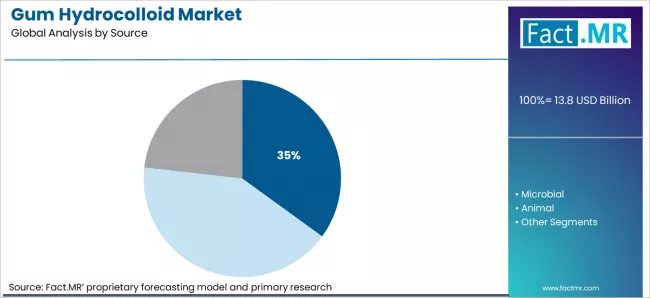
Gum Hydrocolloid Market Analysis By Source | Source: Fact.MR
Market Overview: Plant-based sources are projected to hold 35% of the market share by 2026. Plant-derived hydrocolloids such as guar gum, pectin, and locust bean gum are widely used due to their natural origin and compatibility with food applications.
Demand Drivers:
- Preference for Plant-Derived Ingredients: Food manufacturers increasingly adopt plant-based hydrocolloids to meet demand for natural and clean-label ingredients.
- Versatile Functional Performance: Plant hydrocolloids provide thickening, stabilizing, and gelling properties suitable for various food and beverage formulations.
- Growing Use in Diverse Applications: Plant-based gums are widely used in dairy products, beverages, sauces, and bakery items, supporting strong market demand.
Gum Hydrocolloid Market Drivers, Restraints, and Opportunities
Fact MR analysis indicates that historical demand for hydrocolloid gums developed alongside the industrialization of processed food manufacturing. Hydrocolloids function as stabilizers, thickeners, and texture modifiers in products where consistent viscosity and shelf stability are required. The current market valuation reflects the scale of global packaged food production, where hydrocolloids such as xanthan gum, carrageenan, pectin, and guar gum remain essential functional ingredients. Large food processing industries in dairy, bakery, and beverages continue to rely on these compounds to maintain product texture during large-scale manufacturing and distribution.
A structural shift is occurring as traditional commodity gums face price pressure due to supply volatility in agricultural feedstocks such as guar and locust bean gum. Food manufacturers are increasingly adopting blended hydrocolloid systems that combine multiple stabilizers to achieve specific texture profiles and cost efficiency. These customized ingredient systems carry higher formulation value even when total gum usage volumes remain stable. Growth in value therefore reflects the transition from single hydrocolloid ingredients toward specialty functional blends designed for processed foods, plant-based formulations, and industrial food processing systems.
- Food Processing Dependence: Industrial food manufacturers rely heavily on hydrocolloids to stabilize emulsions, control viscosity, and maintain product consistency in dairy, bakery, and beverage production lines.
- Food Safety Standards: Regulatory frameworks such as the U.S. Food and Drug Administration (FDA) food additive regulations and the European Food Safety Authority (EFSA) additive approval system govern the use of hydrocolloids in commercial food formulations.
- Asia Processing Growth: China and India continue expanding packaged food manufacturing capacity, increasing demand for stabilizing agents used in large-scale food processing and beverage production facilities.
Regional Analysis
The market analysis covers key global regions, including North America, East Asia, South Asia, Europe, and Oceania. It is segmented geographically, with specific market dynamics for each region. The full report provides a detailed market attractiveness analysis.
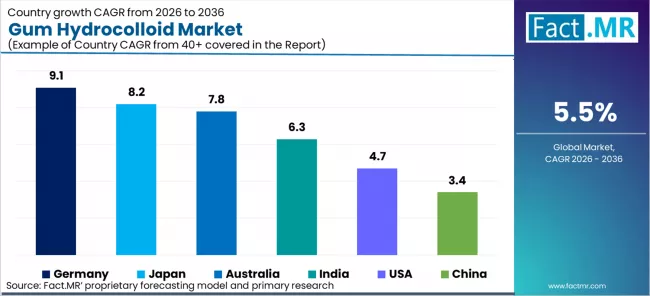
Gum Hydrocolloid Market Cagr Analysis By Country | Source: Fact.MR
| Country | CAGR (2026-2036) |
|---|---|
| USA | 4.7% |
| Japan | 8.2% |
| Germany | 9.1% |
| Australia | 7.8% |
| China | 3.4% |
| India | 6.3% |
Source: Fact.MR analysis. Updated Mar 13, 2026
Source: Fact MR (FMR) analysis, based on proprietary forecasting model and primary research
North America
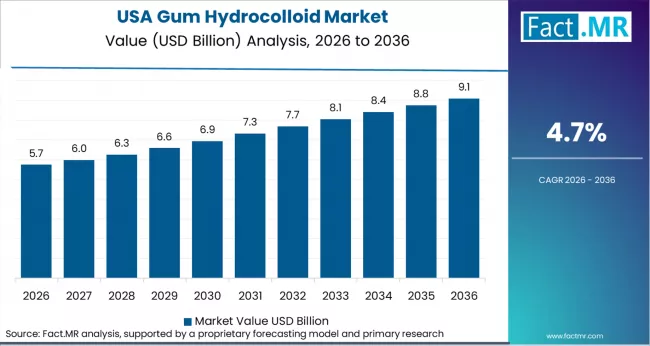
Gum Hydrocolloid Market Country Value Analysis | Source: Fact.MR
The USA represents an important market supported by demand from food processing, pharmaceuticals, and personal care manufacturing. Key companies include Cargill, Incorporated, Ingredion Incorporated, and Archer Daniels Midland Company.
- USA: Demand for gum hydrocolloids in the U.S. is projected to rise at 4.7% CAGR through 2036. Growth is supported by expansion of food ingredient production by Cargill, Incorporated (05-2025) and increased use of stabilizers in processed foods by Ingredion Incorporated (09-2025).
East Asia
Japan and China represent major markets supported by food processing industries, functional ingredient demand, and pharmaceutical formulation applications.
- Japan: Demand for gum hydrocolloids in Japan is projected to rise at 8.2% CAGR through 2036. Growth is supported by food formulation research programs promoted by the Ministry of Agriculture, Forestry and Fisheries (03-2025) and expansion of specialty ingredient production by Kerry Group plc (08-2025).
- China: Demand for gum hydrocolloids in China is projected to rise at 3.4% CAGR through 2036. Growth is supported by processed food production expansion (04-2025) and ingredient manufacturing investments by CP Kelco (07-2025).
South Asia
India is a growing market supported by processed food production, dairy product demand, and pharmaceutical manufacturing.
- India: Demand for gum hydrocolloids in India is projected to rise at 6.3% CAGR through 2036. Growth is supported by food processing initiatives promoted by the Ministry of Food Processing Industries (05-2025) and expansion of ingredient supply networks by Ingredion Incorporated (09-2025).
Europe
Germany is a leading market supported by food ingredient manufacturing, pharmaceutical applications, and specialty chemical production.
- Germany: Demand for gum hydrocolloids in Germany is projected to rise at 9.1% CAGR through 2036. Growth is supported by food ingredient innovation programs (03-2025) and regional ingredient manufacturing expansion by DSM Firmenich AG (08-2025).
Oceania
Australia represents an important market supported by dairy processing, beverage manufacturing, and food ingredient imports.
- Australia: Demand for gum hydrocolloids in Australia is projected to rise at 7.8% CAGR through 2036. Growth is supported by expansion of food processing facilities (04-2025) and distribution expansion by Tate & Lyle PLC (07-2025).
Fact MR's analysis of the gum hydrocolloid market in North America, East Asia, South Asia, Europe, and Oceania consists of country-wise assessments that include the USA, Japan, Germany, Australia, China, and India. Readers can find detailed trends, regulatory updates, and company-specific investments shaping market growth in these countries.
What is the Competitive Structure and Buyer Behavior in the Gum Hydrocolloid Market?
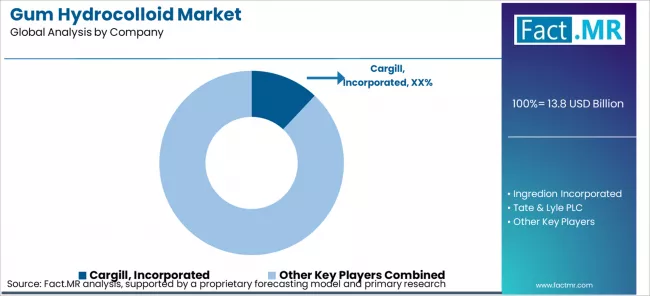
Gum Hydrocolloid Market Analysis By Company | Source: Fact.MR
The gum hydrocolloid market is moderately concentrated, with major global ingredient manufacturers holding a significant share of supply. Companies such as Cargill, Incorporated, Ingredion Incorporated, Tate & Lyle PLC, DuPont de Nemours, Inc., Kerry Group plc, DSM Firmenich AG, Archer Daniels Midland Company, and Ashland Inc. operate across multiple hydrocolloid categories including xanthan gum, pectin, carrageenan, and guar derivatives. Specialized producers such as CP Kelco U.S., Inc. and FMC Corporation maintain strong positions in selected hydrocolloid segments through proprietary processing capabilities and application expertise. Competition in this market is driven primarily by product functionality, consistency in viscosity and texture performance, formulation compatibility, and the ability to support complex food and pharmaceutical applications. Companies with vertically integrated supply chains and global manufacturing networks hold structural advantages because they can ensure stable raw material sourcing and maintain consistent product quality across large production volumes.
Large food and beverage manufacturers represent the primary buyers and exert considerable leverage during procurement. These companies typically qualify multiple hydrocolloid suppliers and negotiate long term supply agreements tied to performance specifications and price stability. To reduce supply risk, buyers often maintain diversified sourcing strategies across regions and vendors while standardizing functional performance requirements within their product formulations. This purchasing behavior limits individual supplier pricing power and shifts competitive emphasis toward application support, technical expertise, and reliable supply continuity rather than price alone.
Key Players of the Gum Hydrocolloid Market
- Cargill, Incorporated
- Ingredion Incorporated
- Tate & Lyle PLC
- DuPont de Nemours, Inc.
- CP Kelco U.S., Inc.
- Kerry Group plc
- FMC Corporation
- DSM Firmenich AG
- Archer Daniels Midland Company
- Ashland Inc.
Report Scope
| Metric | Value |
|---|---|
| Quantitative Units | USD 13.8 billion (2026) to USD 23.5 billion (2036), at a CAGR of 5.5% |
| Market Definition | The gum hydrocolloid market includes production, processing, and trade of hydrocolloid ingredients derived from plant, microbial, animal, and seaweed sources used for thickening, gelling, stabilizing, and texturizing across food, pharmaceutical, personal care, and industrial applications. |
| Product Type | Gelatin, Xanthan Gum, Carrageenan, Alginates, Agar, Pectin, Guar Gum, Locust Bean Gum, Gum Arabic, Carboxymethylcellulose, Microcrystalline Cellulose |
| Source Segmentation | Plant, Microbial, Animal, Seaweed, Synthetic |
| Application Coverage | Food & Beverages, Pharmaceuticals, Personal Care, Industrial Applications |
| Key Companies Profiled | Cargill, Incorporated, Ingredion Incorporated, Tate & Lyle PLC, DuPont de Nemours, Inc., CP Kelco U.S., Inc., Kerry Group plc, FMC Corporation, DSM Firmenich AG, Archer Daniels Midland Company, Ashland Inc. |
| Forecast Period | 2026 to 2036 |
| Approach | Hybrid top-down and bottom-up market modeling validated through interviews with hydrocolloid producers and ingredient distributors, supported by production capacity benchmarking, trade data analysis, and application demand assessment. |
Source: Fact.MR analysis. Updated Mar 13, 2026
Bibliographies
- [1] U.S. Food and Drug Administration. (2025). Food additive status list - hydrocolloids.
- [2] European Food Safety Authority. (2023). Re-evaluation of carrageenan, xanthan gum, and guar gum.
- [3] Ministry of Food Processing Industries, India. (2025). Food processing initiatives.
- [4] Ministry of Agriculture, Forestry and Fisheries, Japan. (2025). Food formulation research programs.
- [5] DSM Firmenich AG. (2025). Regional ingredient manufacturing expansion.
- [6] Cargill, Incorporated. (2025). Food ingredient production expansion.
- [7] Ingredion Incorporated. (2025). Stabilizers in processed foods.
- [8] Kerry Group plc. (2025). Specialty ingredient production.
- [9] CP Kelco. (2025). Ingredient manufacturing investments.
This report addresses
- Market intelligence enabling evaluation of global gum hydrocolloid ingredients by product type (gelatin, xanthan gum, carrageenan, alginates, agar, pectin, guar gum, locust bean gum, gum arabic, carboxymethylcellulose, microcrystalline cellulose), source (plant, microbial, animal, seaweed, synthetic), and application sectors including food and beverages, pharmaceuticals, personal care, and industrial applications.
- Market volume (revenue) estimates and 10 year forecasts from 2026 to 2036, validated using food ingredient demand trends, hydrocolloid production volumes, and adoption of stabilizing and thickening agents across processed food and pharmaceutical manufacturing.
- Growth opportunity mapping across plant derived gums, microbial fermentation hydrocolloids, seaweed based stabilizers, and specialty texture modifying systems used in food processing, pharmaceutical formulations, and personal care products, with major markets including Germany, Japan, Australia, India, the United States, and China.
- Segment and regional revenue forecasts for hydrocolloid ingredients used as stabilizers, thickeners, emulsifiers, and gelling agents across food manufacturing, beverage production, pharmaceutical formulations, and industrial processing applications.
- Competitive strategy analysis highlighting product functionality, viscosity performance, formulation compatibility, raw material sourcing stability, and technical application support, with major players including Cargill, Incorporated, Ingredion Incorporated, Tate & Lyle PLC, DuPont de Nemours, Inc., CP Kelco U.S., Inc., Kerry Group plc, FMC Corporation, DSM Firmenich AG, Archer Daniels Midland Company, and Ashland Inc.
- Adoption dynamics emphasizing increasing demand for stabilizing and texturizing ingredients in processed foods, development of blended hydrocolloid systems for food formulation optimization, and expansion of hydrocolloid usage in pharmaceutical and personal care formulations.
- Report delivery in PDF, Excel, PowerPoint, and interactive dashboard formats suitable for executive, operational, and strategic planning.
Segmentation
Gum Hydrocolloid Market Key Segments
-
Product Type
- Gelatin
- Xanthan Gum
- Carrageenan
- Alginates
- Agar
- Pectin
- Guar Gum
- Locust Bean Gum
- Gum Arabic
- Carboxymethylcellulose
- Microcrystalline Cellulose
-
Source
- Plant
- Microbial
- Animal
- Seaweed
- Synthetic
-
Application
- Food & Beverages
- Pharmaceuticals
- Personal Care
- Industrial Applications
-
Region
- North America
- USA
- Canada
- Mexico
- Europe
- Germany
- UK
- France
- Italy
- Spain
- Nordic Countries
- BENELUX
- Rest of Europe
- Asia Pacific
- China
- Japan
- South Korea
- India
- Australia
- Rest of Asia Pacific
- Latin America
- Brazil
- Argentina
- Rest of Latin America
- Middle East and Africa
- Kingdom of Saudi Arabia
- United Arab Emirates
- South Africa
- Rest of Middle East and Africa
- Other Regions
- Oceania
- Central Asia
- Other Markets
- North America
Frequently Asked Questions
How large is the demand for Gum Hydrocolloids in the global market in 2026?
What will be the market size of Gum Hydrocolloids in the global market by 2036?
What is the expected demand growth for Gum Hydrocolloids in the global market between 2026 and 2036?
Which application segment is expected to dominate the market?
Which region is expected to show the highest growth rate for Gum Hydrocolloids?
How significant is the growth outlook for Japan in this market?
What is the growth outlook for Australia in the Gum Hydrocolloid market?
What is the growth forecast for India in the Gum Hydrocolloid market?
What is the growth forecast for the United States in the Gum Hydrocolloid market?
What is the growth outlook for China in the Gum Hydrocolloid market?
Which company is identified as a leading player in the Gum Hydrocolloid market?
What are Gum Hydrocolloids used for?
What does the Gum Hydrocolloid market include in this report?
How is the market forecast developed in this report?
What is meant by the Gum Hydrocolloid market in this report?
Who worked on this report


Preview the report firsthand - request a free sample
Free SampleGet the brochure for pricing and purchase details
Download PDF