- Market Value (2025): USD 1.4 Bn
- Estimated Value (2026): USD 1.5 Bn
- Forecast Value (2036): USD 3.2 Bn
- CAGR (2026-2036): 8.1%
What is the Gummy Texture Stabilizers Market forecast to be worth by 2036?
USD 1.5 billion in 2026 to USD 3.2 billion by 2036 at an 8.1% CAGR.
- The Gummy Texture Stabilizers Market reached USD 1.4 billion in 2025.
- Demand is projected to increase from USD 1.5 billion in 2026 to USD 3.2 billion by 2036.
- The market is forecast to record an 8.1% CAGR from 2026 to 2036 as gummy manufacturers qualify texture systems for active loading, lower sugar, plant-based positioning and faster depositing.
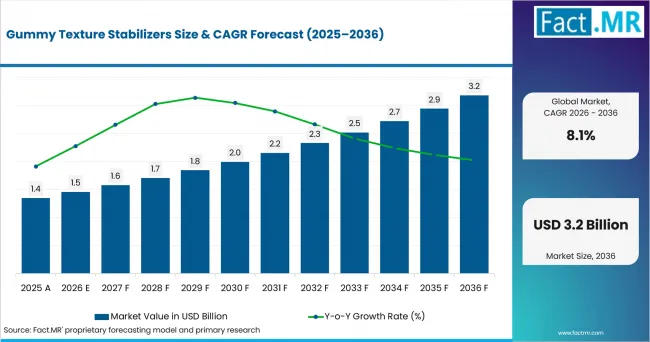
Gummy Texture Stabilizers Value Analysis | Source: Fact.MR
What are the defining numbers behind Gummy Texture Stabilizers Market growth?
An absolute opportunity of USD 1.7 billion is expected between 2026 and 2036.
- Demand Drivers in the Market
- Nutraceutical brands are extending dietary supplements into gummy delivery, which makes dose uniformity, active compatibility and storage texture part of ingredient qualification. FDA dietary supplement rules place responsibility on manufacturers for identity, purity, quality, strength and composition, raising the value of stabilizers that perform consistently across batches.
- Plant-based formulation is increasing the use of pectin and multi-gum systems where brands want a non-gelatin label. Cargill and IFF both document pectin systems for vegan or plant-based gummies, while IFF's 2026 DuoGel launch combines pectin and carrageenan to create a more elastic chew than a single hydrocolloid can provide.
- Sugar reduction changes soluble solids, water binding and gel development. Peer-reviewed gummy research shows that gelling-agent choice and concentration alter hardness, springiness, cohesiveness and consumer texture response, so lower-sugar development often requires a reformulated stabilizer package rather than a direct sweetener swap.
- Starchless and fast-set production is changing process economics for fortified gummies. Gelita documents a starch-free route that reduces demolding time from roughly one day to under two hours and lowers cross-contamination exposure when active ingredients change between batches.
- Warm distribution conditions increase demand for heat-resistant texture. CP Kelco positions pectin for fortified gummies through high melting point and heat stability, making the gelling system relevant to products that must retain shape and bite through warehousing and retail handling.
- Key Segments Analyzed
- By Gelling System: Pectin accounts for 42.0% share in 2026 because it supports plant-based positioning, clean flavor release and a higher melting point than conventional gelatin systems.
- By Gummy Segment: Nutraceutical gummies represent 45.0% share in 2026 as vitamin, mineral and specialty supplement brands use gummies to create an ingestible format that needs controlled dosage and stable texture.
- By Texture Objective: Chew and elasticity hold 31.0% share in 2026 because repeat purchase depends on a resilient bite that remains consistent through storage rather than on gel formation alone.
- By Process Format: Deposited gummies capture 56.0% share in 2026 since controlled depositing supports repeatable piece weight, shape and high-throughput molding across confectionery and supplement lines.
- Analyst Opinion at Fact.MR
- Shambhu Nath Jha, Principal Consultant, Fact.MR, states, "Gummy texture is now a manufacturing specification rather than a final sensory adjustment. Active ingredients, reduced sugar and non-gelatin claims all change how a gummy sets, releases from the mold and behaves in the bottle. Suppliers that can connect polymer choice with depositing temperature, demolding time and shelf-life testing are better positioned to move from sample approval to repeat production."
- Strategic Implications
- Stabilizer suppliers should provide application guidance by solids level, pH, acid addition point, active load and depositing temperature because the same pectin or gum blend will not behave identically across gummy recipes.
- Nutraceutical manufacturers should qualify texture and dose uniformity together. A faster set is valuable only when active distribution, piece weight and storage stability remain within specification.
- Formulators should compare gummy-specific systems with adjacent thickening agents on process performance, not on viscosity alone. Set speed, gel fracture, elasticity and demolding determine whether an ingredient works on a production line.
- Manufacturers serving several regions need separate regulatory and labeling reviews for confectionery, food supplements, pharmaceutical-style gummies and pet products, even when the physical gummy format looks similar.
How does the Gummy Texture Stabilizers Market break down by segment?
The market is segmented by Gelling System, Gummy Segment, Texture Objective and Process Format.
Why does Pectin lead Gelling System?
Pectin is projected to account for a 42.0% share of Gelling System in 2026.
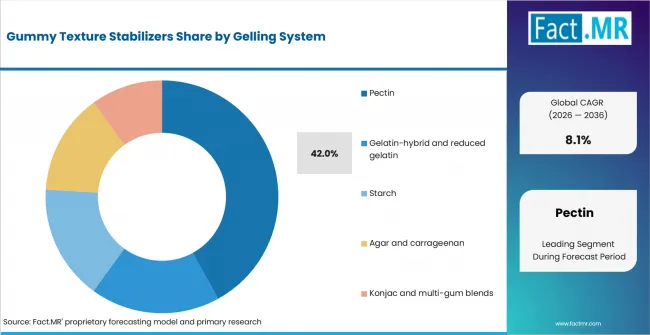
Gummy Texture Stabilizers Analysis By Gelling System | Source: Fact.MR
Pectin leads because gummy makers can tune set, bite and temperature resistance while maintaining a plant-derived formulation. CP Kelco describes citrus pectin as a gelling and stabilizing ingredient for gummies and fortified gummies, with grades selected around sugar level, calcium tolerance and process requirements.
The advantage comes with process discipline. High-methoxyl and low-methoxyl grades respond differently to soluble solids, acidity and calcium, and premature acid addition can shorten the depositing window. Suppliers win approval when they can specify the grade and sequence required for the customer's cooker and depositor.
Pectin's established food-additive status supports commercial use, but formulators must still comply with the applicable conditions of use and purity criteria. EFSA's re-evaluation of pectin and the European Union's food-additives regulation provide part of the technical and regulatory basis used for European product review.
Gelatin-hybrid and reduced-gelatin systems remain important where the target is a familiar elastic bite. The adjacent gelatin market provides a benchmark for bloom strength and thermal behavior, while pectin and multi-gum combinations address plant-based and warm-chain requirements.
Why do Nutraceutical gummies lead Gummy Segment?
Nutraceutical gummies are projected to account for a 45.0% share of Gummy Segment in 2026.
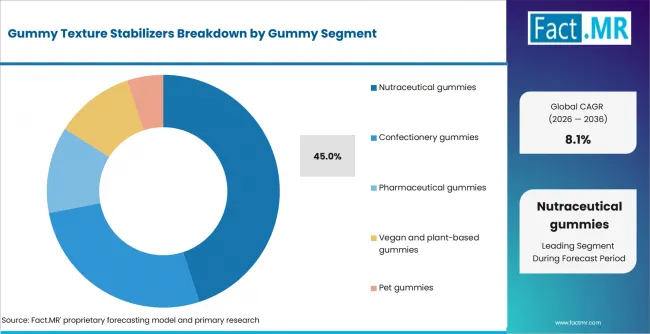
Gummy Texture Stabilizers Analysis By Gummy Segment | Source: Fact.MR
Nutraceutical gummies lead because the format has to carry vitamins, minerals, botanicals or other actives while remaining easy to chew and stable in the package. Active powders, oils, acids and minerals can weaken or accelerate gel formation, so each formulation creates paid demand for a stabilizer system and technical adjustment.
FDA current good manufacturing practice rules require dietary supplement manufacturers to establish specifications and controls for identity, purity, strength and composition. That compliance setting makes piece-weight control, active dispersion and moisture management commercial issues rather than cosmetic preferences.
Confectionery gummies use similar equipment, but the approval brief is usually centered on sensory appeal and line speed. Pharmaceutical and pet gummies introduce different ingredient, dosing and claim requirements, keeping nutraceutical systems at the center of formulation work.
Why do Chew and elasticity lead Texture Objective?
Chew and elasticity are projected to account for a 31.0% share of Texture Objective in 2026.
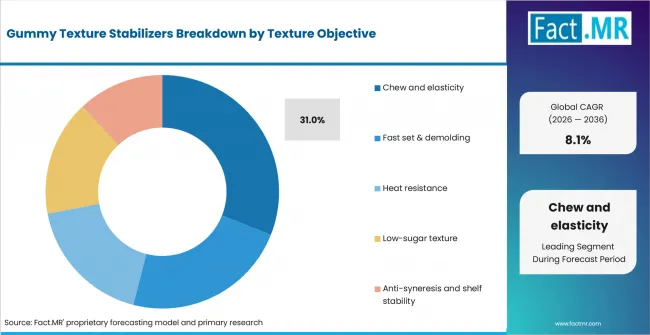
Gummy Texture Stabilizers Analysis By Texture Objective | Source: Fact.MR
Chew and elasticity lead because consumers experience gummy quality through compression, recovery and fracture. A product that becomes brittle, sticky or excessively firm during storage can fail even when its active or flavor specification remains unchanged.
Peer-reviewed sensory research by Tireki and colleagues linked instrumental gummy properties with texture liking and showed that gelling systems respond differently to temperature. This reinforces the need to qualify a stabilizer against the product's expected storage and consumption conditions.
Fast set, heat resistance, low-sugar texture and anti-syneresis remain distinct purchasing objectives. Chew and elasticity cover the broadest formulation requirement because they apply across supplement, confectionery, vegan and pharmaceutical-style formats.
Why do Deposited gummies lead Process Format?
Deposited gummies are projected to account for a 56.0% share of Process Format in 2026.
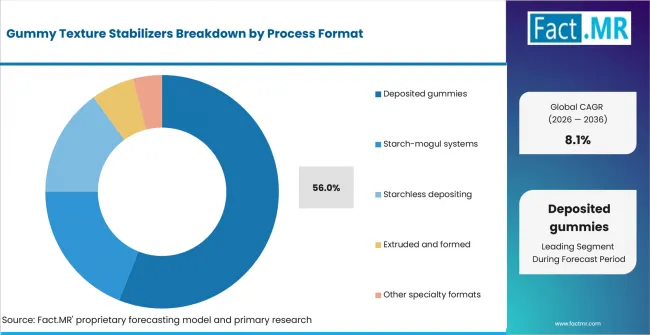
Gummy Texture Stabilizers Analysis By Process Format | Source: Fact.MR
Deposited gummies lead because a metered deposit gives manufacturers control over piece weight, cavity fill and shape at commercial speed. The stabilizer must stay fluid long enough to pass through the depositor, then set quickly enough for clean release and downstream coating or packaging.
Starch-mogul systems offer established shaping flexibility, while starchless depositing reduces starch handling and can shorten the path to demolding. Gelita's starch-free process illustrates how a gelling system, cooking profile and depositing line must be designed together when manufacturers want faster changeovers and lower cross-contamination exposure.
Extruded, formed and specialty formats serve narrower product architectures. Depositing remains the central format because it connects formulation rheology directly with high-volume piece control.
What is accelerating Gummy Texture Stabilizers Market adoption, and what is holding it back?
Nutraceutical format expansion, plant-based pectin systems, low-sugar reformulation and faster depositing are increasing demand. Adoption is restrained by active-ingredient interactions, gel-system qualification, raw-material variability and the risk that texture changes during storage or warm distribution.
Drivers Impact Analysis
| Factor | (~) % Impact on CAGR | Geographic Relevance | Impact Timeline |
|---|---|---|---|
| Nutraceutical gummy format expansion | +1.5% | Global | Short term (<= 2 years) |
| Plant-based pectin and multi-gum reformulation | +1.2% | North America and Western Europe | Medium term (2-4 years) |
| Texture reproducibility with active ingredients | +0.9% | USA, Germany and UK | Short term (<= 2 years) |
| Heat-resistant texture for storage and distribution | +0.6% | Brazil and warm-climate markets | Medium term (2-4 years) |
Opportunity Impact Analysis
| Factor | (~) % Impact on CAGR | Geographic Relevance | Impact Timeline |
|---|---|---|---|
| Starchless depositing and faster demolding | +0.8% | USA, Germany and UK | Medium term (2-4 years) |
| Low-sugar pectin and hydrocolloid blends | +0.7% | Europe and North America | Long term (>= 4 years) |
| Fast-set systems for flexible batch sizes | +0.5% | Global | Short term (<= 2 years) |
| Pet gummy texture platforms | +0.4% | USA and Brazil | Long term (>= 4 years) |
Restraints Impact Analysis
| Factor | (~) % Impact on CAGR | Geographic Relevance | Impact Timeline |
|---|---|---|---|
| Active and gelling-agent interactions | -0.8% | Global | Short term (<= 2 years) |
| Sugar and polyol reduction disrupting gel structure | -0.6% | USA, UK and European Union | Medium term (2-4 years) |
| Regulatory and labeling qualification by use case | -0.5% | USA, Germany and Brazil | Short term (<= 2 years) |
| Pectin, gelatin and specialty-gum cost variability | -0.4% | Global | Medium term (2-4 years) |
Which countries are scaling the Gummy Texture Stabilizers Market through 2036?
- USA: Dietary supplement manufacturing rules make identity, strength, composition and batch control central to gummy qualification, supporting stabilizer systems that hold piece weight and texture consistently.
- Germany: The BVL notification process for food supplements increases the value of complete formulation and labeling documentation before a gummy product enters the market.
- Brazil: ANVISA's notification framework for supplements and local pectin production create a market where regulatory readiness and regional ingredient access shape formulation decisions.
- UK: Government guidance explicitly recognizes gummies as a food supplement form, giving manufacturers a clear compliance path while increasing attention to composition, claims and label accuracy.
- France: Nutrivigilance and an established confectionery manufacturing base favor stabilizers that can support sensory quality while accommodating food-supplement safety review.
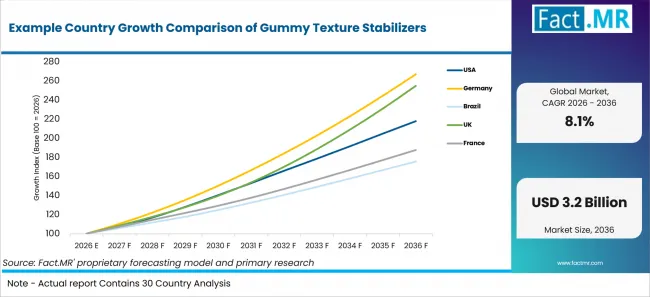
Example Country Growth Comparison Of Gummy Texture Stabilizers | Source: Fact.MR
Country CAGR (2026-2036)
| Country | CAGR, 2026-2036 |
|---|---|
| USA | 8.1% |
| Germany | 10.3% |
| Brazil | 5.8% |
| UK | 9.8% |
| France | 6.5% |
What is driving USA's growth through 2036?
The USA is forecast to expand at an 8.1% CAGR from 2026 to 2036.
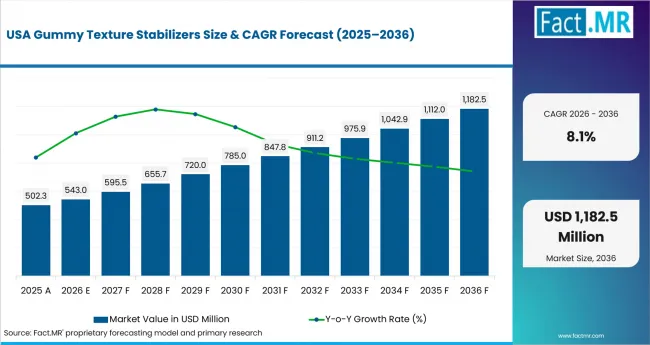
Gummy Texture Stabilizers Country Value Analysis | Source: Fact.MR
The U.S. market connects gummy product development with dietary supplement manufacturing controls. FDA guidance states that manufacturers, packers and holders of dietary supplements must follow current good manufacturing practices designed to ensure identity, purity, quality, strength and composition.
For gummy stabilizer suppliers, that framework turns piece-weight variation, active dispersion, moisture migration and texture drift into qualification issues. Demand therefore favors application support that links the gelling system with the active load and the intended shelf life.
What is driving Germany's growth through 2036?
Germany is forecast to expand at a 10.3% CAGR from 2026 to 2036.
Germany requires food supplements to pass a notification procedure with the Federal Office of Consumer Protection and Food Safety before first placement on the market. Manufacturers remain responsible for legal compliance, which encourages early review of ingredients, labeling and product form.
Gummy texture systems gain value in this environment when suppliers can provide pectin or multi-gum specifications, allergen information and process guidance in a form that supports product review and repeat manufacturing. Germany's rate reflects qualification-led growth rather than a simple transfer of confectionery recipes into supplements.
What is driving Brazil's growth through 2036?
Brazil is forecast to expand at a 5.8% CAGR from 2026 to 2036.
ANVISA states that food supplements moved into a mandatory notification framework from September 2024 and must comply with composition and labeling requirements. This makes authorized ingredients, use conditions and stability documentation part of the commercial path for gummy supplements.
Brazil also has local pectin capacity. Cargill's Bebedouro plant produces high-methoxyl pectin for confectionery, dairy drinks, juice beverages and related uses. Regional supply can shorten technical support and replenishment cycles, while the market's pace remains moderated by price sensitivity and regulatory transition work.
What is driving UK's growth through 2036?
The UK is forecast to expand at a 9.8% CAGR from 2026 to 2036.
UK government food-supplement guidance lists gummies alongside tablets, capsules, powders and liquids. The same guidance places responsibility on manufacturers, importers and retailers to comply with food law and restricts medicinal claims for products sold as supplements.
This explicit treatment of the gummy form supports product development while raising the importance of formulation discipline. Stabilizer suppliers can reduce launch friction by showing how the selected pectin, gelatin-hybrid or multi-gum system performs with the proposed active, sweetener system and package.
What is driving France's growth through 2036?
France is forecast to expand at a 6.5% CAGR from 2026 to 2036.
ANSES reports that food supplements are increasingly consumed in France and operates nutrivigilance for adverse-effect reporting. This oversight encourages supplement producers to assess formulation, labeling and consumer use carefully when they introduce chewable gummy formats.
France also retains a defined confectionery manufacturing base in INSEE's industrial classification. Suppliers that can bridge confectionery texture expertise with supplement-grade controls are positioned to support nutraceutical gummies without treating them as ordinary candy.
Who Leads the Gummy Texture Stabilizers Market?
Key players in the Gummy Texture Stabilizers Market include CP Kelco, Cargill, IFF, Ingredion, Tate & Lyle and Gelita.
CP Kelco, Cargill and IFF compete through direct pectin and hydrocolloid systems for gummies. CP Kelco positions GENU Pectin for gummies and fortified gummies; Cargill combines pectin with confectionery application support; and IFF offers GRINDSTED Pectin grades and a pectin-carrageenan system designed for elastic, chewy texture.
Gelita competes through gelatin and starch-free process systems where familiar chew, fast setting and reduced cross-contamination are central. Ingredion participates through gums, hydrocolloids and citrus-fiber texture systems that can support clean-label formulation work. Tate & Lyle completed its acquisition of CP Kelco in November 2024, so the two names represent a current parent-and-business relationship within the competitive set rather than fully independent ownership.
Competition is shaped by application laboratories, control of pectin or gelatin quality, the ability to tune set around sugar and acid conditions, and support for depositing trials. A broad ingredient portfolio matters only when the supplier can reproduce bite, demolding and shelf stability in the customer's process.
Which companies are the key providers?
CP Kelco, Cargill, IFF, Ingredion, Tate & Lyle and Gelita.
- CP Kelco
- Cargill
- IFF
- Ingredion
- Tate & Lyle
- Gelita
Bibliography
- Agence nationale de sécurité sanitaire de l'alimentation, de l'environnement et du travail. (2025). Food Supplements: Uses and Risks. ANSES.
- Agência Nacional de Vigilância Sanitária. (2024). Questions and Answers on Food Supplements. Government of Brazil.
- Cargill. (2026). Gummies - Confectionery. Cargill Food and Beverage.
- Cargill. (2026). Our New Brazilian Pectin Plant. Cargill Food and Beverage.
- Cargill. (2026). Texturizers for Sugar Confectionery. Cargill Food and Beverage.
- CP Kelco. (2026). GENU Pectin. CP Kelco.
- European Food Safety Authority Panel on Food Additives and Nutrient Sources Added to Food. (2017). Re-evaluation of Pectin (E 440i) and Amidated Pectin (E 440ii) as Food Additives. EFSA Journal.
- European Parliament and Council of the European Union. (2008). Regulation (EC) No 1333/2008 on Food Additives. Official Journal of the European Union.
- Federal Office of Consumer Protection and Food Safety. (2026). Food Supplements. Government of Germany.
- Food Standards Agency. (2026). Food Supplements Guidance. Government of the United Kingdom.
- GELITA. (2025). Starch-Free Gummy Production: Faster, Safer, Same Taste. GELITA.
- GELITA. (2026). Confectionery Gelatin Applications. GELITA.
- IFF. (2026). Plant-Based Gummy Formulations. IFF Pharma Solutions.
- IFF. (2026, June 23). IFF Launches First-of-Its-Kind Stabilizer System in Europe, the Middle East and Africa. IFF.
- Ingredion. (2026). Hydrocolloid Ingredients for Clean-Label Formulation and Texture. Ingredion.
- Institut national de la statistique et des études économiques. (2025). Manufacture of Cocoa, Chocolate and Confectionery Products. INSEE.
- Tarahi, M., Tahmouzi, S., Kianiani, M. R., Ezzati, S., Hedayati, S. and Niakousari, M. (2023). Current Innovations in the Development of Functional Gummy Candies. Foods.
- Tate & Lyle. (2024, November 15). Completion of Combination of Tate & Lyle and CP Kelco. Tate & Lyle PLC.
- Tireki, S., Sumnu, G. and Sahin, S. (2021). Correlation Between Physical and Sensorial Properties of Gummy Confections with Different Formulations During Storage. Journal of Food Science and Technology.
- U.S. Food and Drug Administration. (2025). Compliance Program 7321.008: Dietary Supplements. U.S. Department of Health and Human Services.
- U.S. Food and Drug Administration. (2026). Questions and Answers on Dietary Supplements. U.S. Department of Health and Human Services.
This Report Answers
- How large is the Gummy Texture Stabilizers Market in 2026 and 2036?
- Why does pectin hold the leading position among gelling systems?
- How do active ingredients, lower sugar and plant-based requirements change texture-system selection?
- Which process factors determine set speed, demolding and piece-weight consistency?
- How do growth mechanisms differ across USA, Germany, Brazil, UK and France?
- Which supplier capabilities matter when gummy manufacturers move from laboratory formulation to commercial depositing?
What does the Gummy Texture Stabilizers Market cover?
The Gummy Texture Stabilizers Market covers food-grade ingredient systems whose purchased function is to create, modify or preserve gummy structure. It includes single hydrocolloids and blended gum hydrocolloids when they are sold for gummy gelling, chew, elasticity, fast setting, heat resistance, low-sugar texture or anti-syneresis.
Revenue is counted at the stabilizer or texturizer-system level across nutraceutical, confectionery, pharmaceutical, vegan and plant-based, and pet gummies. Finished gummy product sales are outside the market value.
What is included in the scope?
The scope includes pectin, gelatin-hybrid and reduced-gelatin systems, starch, agar and carrageenan, konjac and multi-gum blends formulated for gummy production. It includes grades sold for chew and elasticity, rapid setting and demolding, heat resistance, lower-sugar texture, and shelf-stability control.
Commercial formats include deposited gummies, starch-mogul systems, starchless depositing, extruded and formed products, and other specialty gummy processes. Technical service linked directly to ingredient-system supply is included where it supports qualification and repeat purchase.
What is excluded from the scope?
The scope excludes finished gummy supplements, candies, medicines and pet treats; standalone flavors, colors, sweeteners and active ingredients; and processing machinery sold without a gummy texture system. General pectin, gelatin, starch or gum volumes are excluded when they are supplied for non-gummy food applications.
Packaging, coating oils, polishing agents and anti-sticking powders are outside the boundary unless they are sold as an inseparable part of the texture-stabilizer system. Prototype ingredients without commercial sales are also excluded.
How Was the Analysis Built?
The analysis draws on more than 120 sources, over 35 company portfolios and more than 20 industry interviews across at least 25 countries.
- Primary Research: Interviews with hydrocolloid and gelatin suppliers, gummy manufacturers, nutraceutical brands, confectionery processors, contract manufacturers, process-equipment specialists, quality teams and ingredient distributors examine formulation choice, line trials, purchasing criteria and failure modes.
- Desk Research: The review covers food-additive rules, supplement guidance, nutrivigilance, company technical literature, confectionery production indicators and peer-reviewed work on gummy texture and storage behavior. Publications used in the article are recorded in the bibliography.
- Market Sizing and Forecasting: Estimates combine stabilizer use per unit of gummy output, gelling-system mix, nutraceutical and confectionery production, average selling prices, plant-based conversion, process-format adoption and country-level formulation activity.
- Data Validation and Update Cycle: Findings are checked against company product activity, regulatory changes, process developments and industry interviews. Updates capture shifts in pectin and gelatin supply, new hydrocolloid blends, starchless production and qualification requirements for active-loaded gummies.
What is the report's scope and coverage?
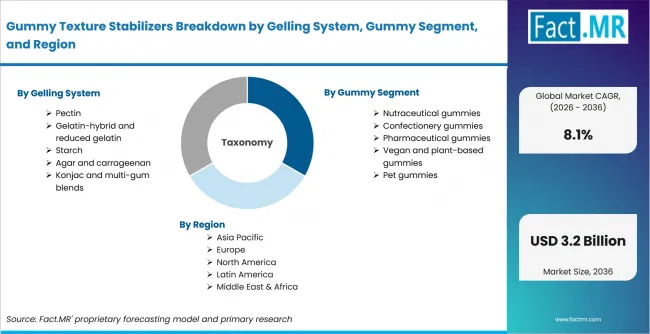
Gummy Texture Stabilizers Breakdown By Gelling System, Gummy Segment, And Region | Source: Fact.MR
| Attribute | Details |
|---|---|
| Quantitative Units | USD billion; shares and CAGR in percent |
| Market Definition | Food-grade gelling, texturizing and stabilizing systems sold for gummy manufacture |
| Segments Covered | Gelling System; Gummy Segment; Texture Objective; Process Format |
| Regions Covered | North America; Latin America; Western Europe; Eastern Europe; East Asia; South Asia and Pacific; Middle East and Africa |
| Countries Covered | USA; Germany; Brazil; UK; France |
| Key Companies Profiled | CP Kelco; Cargill; IFF; Ingredion; Tate & Lyle; Gelita |
| Forecast Period | 2026 to 2036 |
| Base Year | 2025 |
| Market Value, 2026 | USD 1.5 billion |
| Market Value, 2036 | USD 3.2 billion |
| CAGR, 2026-2036 | 8.1% |
| Absolute Opportunity | USD 1.7 billion |
| Approach | Hybrid top-down and bottom-up assessment using gummy output, stabilizer use intensity, gelling-system mix, process format, average selling price and country-level qualification activity |
How is the market segmented?
-
By Gelling System
- Pectin
- Gelatin-hybrid and reduced gelatin
- Starch
- Agar and carrageenan
- Konjac and multi-gum blends
-
By Gummy Segment
- Nutraceutical gummies
- Confectionery gummies
- Pharmaceutical gummies
- Vegan and plant-based gummies
- Pet gummies
-
By Texture Objective
- Chew and elasticity
- Fast set & demolding
- Heat resistance
- Low-sugar texture
- Anti-syneresis and shelf stability
-
By Process Format
- Deposited gummies
- Starch-mogul systems
- Starchless depositing
- Extruded and formed
- Other specialty formats
-
By Region
- North America
- Latin America
- Western Europe
- Eastern Europe
- East Asia
- South Asia and Pacific
- Middle East and Africa