- Market Value (2025): USD 1.2 Bn
- Estimated Value (2026): USD 1.3 Bn
- Forecast Value (2036): USD 2.9 Bn
- CAGR (2026-2036): 8.3%
What is the Plant-Based Gummy Stabilizers Market forecast to be worth by 2036?
USD 1.3 billion in 2026 to USD 2.9 billion by 2036 at an 8.3% CAGR.
- The Plant-Based Gummy Stabilizers Market reached USD 1.2 billion in 2025.
- Demand is projected to increase from USD 1.3 billion in 2026 to USD 2.9 billion by 2036.
- The market is forecast to record 8.3% CAGR from 2026 to 2036 as gummy brands use plant-derived stabilizers to manage bite and shelf stability.
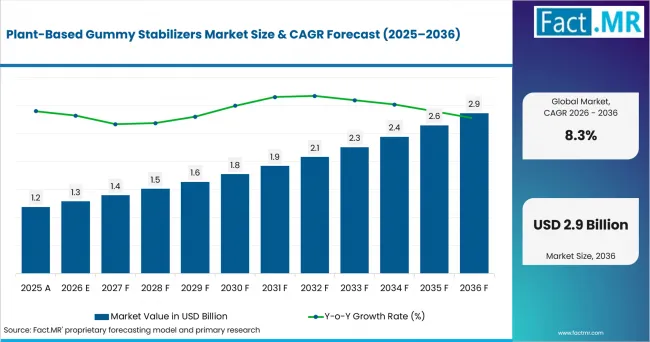
Plant Based Gummy Stabilizers Market Value Analysis | Source: Fact.MR
What are the defining numbers behind Plant-Based Gummy Stabilizers Market growth?
An absolute opportunity of USD 1.57 billion is expected between 2026 and 2036.
- Demand Drivers in the Market
- Supplement brands need pectin and gellan systems that create chewable delivery formats for vitamins, minerals and botanical actives.
- Confectionery manufacturers are anticipated to use starch and carrageenan blends where elastic bite must survive depositing and drying.
- Vegan functional gummy developers require gelatin replacement systems that hold shape while carrying acids and active ingredients.
- Low-sugar product teams need calcium-reactive or acid-set stabilizers since reduced sugar changes gel strength and water activity.
- Key Segments Analyzed
- By Gelling System: Pectin is expected to hold 46.00% share in 2026 because fruit-based gelling behavior fits acidic gummy recipes and familiar declarations.
- By Gummy Type: Nutraceutical gummies are projected to account for 44.00% share in 2026 as supplement makers use gummies to widen repeat consumption.
- By Texture Target: Elastic and chewy formats are anticipated to represent 34.00% share in 2026 owing to shopper expectations formed by gelatin gummies.
- By Processing Requirement: Acid-set systems are estimated to capture 36.00% share in 2026 due to their fit with fruit flavors and high-solids gummy bases.
- Analyst Opinion at Fact.MR
- Shambhu Nath Jha, Principal Consultant at Fact.MR, states, “Plant-based gummy stabilizers are drawing attention because they solve texture before label claims. The next phase is expected to reward suppliers that document acid tolerance and repeatable bite. Brands need partners with pilot support and dependable plant-based supply.”
- Strategic Implications
- Ingredient suppliers should publish application guidance for acid-set pectin systems across vitamin and mineral gummy bases.
- Supplement brands should test active stability with the selected gelling system before scaling nutraceutical gummies into larger batches.
- Confectionery manufacturers should compare pectin replacer blends with premium pectin grades where price pressure affects value gummies.
- Contract manufacturers should maintain separate process windows for starch, agar and carrageenan systems since each system sets differently.
The United States is expected to record 9.4% CAGR through supplement gummies. Germany is projected at 8.3% CAGR as vegan diet interest shapes confectionery choices. France is anticipated to reach 7.9% CAGR through sugar policy and candy formats. Japan is forecast to post 7.5% CAGR owing to health-food channels. The UK is estimated at 5.9% CAGR through HFSS review.
How does the Plant-Based Gummy Stabilizers Market break down by segment?
Pectin leads Gelling System at 46.0%; Nutraceutical gummies lead Gummy Type at 44.0%.
Which gelling system dominates?
Pectin is expected to hold 46.0% share in 2026.
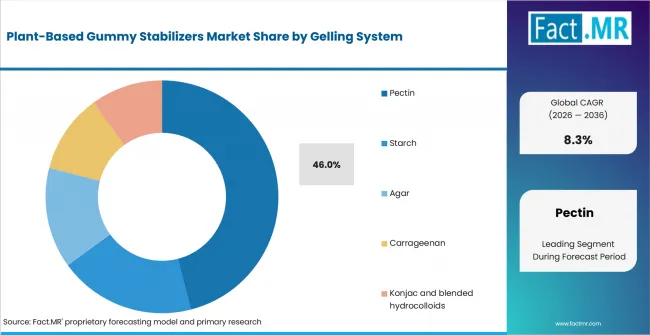
Plant Based Gummy Stabilizers Market Analysis By Gelling System | Source: Fact.MR
Pectin is expected to lead because acidic fruit profiles are common in gummy supplements and confectionery. Its plant origin supports vegan positioning, and its setting behavior suits deposited gummies that need clarity and clean bite. Starch remains relevant for cost control and opacity in value confectionery. Agar and carrageenan serve formulas that need firmer gels or elastic texture.
What leads the Gummy Type segment?
Nutraceutical gummies are projected to account for 44.0% share in 2026.
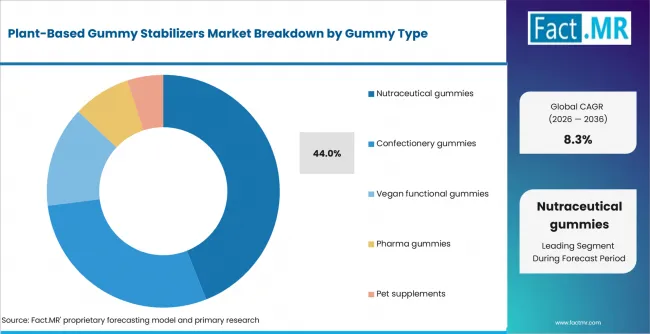
Plant Based Gummy Stabilizers Market Analysis By Gummy Type | Source: Fact.MR
Nutraceutical gummies lead because vitamins, minerals and botanicals create demand for pleasant chewable formats. IFF said in April 2025 that GRINDSTED Pectin Premium is a citrus-derived ingredient for plant-based gummies. Confectionery gummies remain a large outlet for plant-based stabilizers. Vegan functional gummies use pectin and gellan systems to replace animal gelatin.
How does Texture Target shape demand?
Elastic and chewy textures are anticipated to represent 34.0% share in 2026.
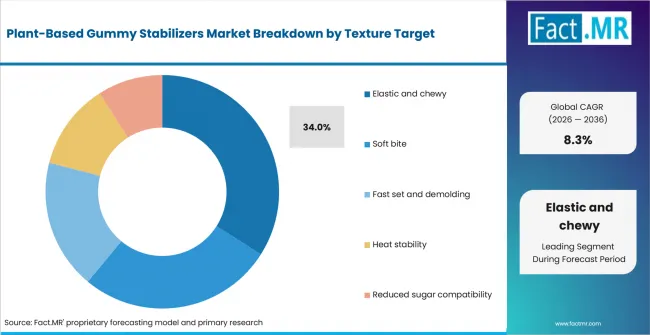
Plant Based Gummy Stabilizers Market Analysis By Texture Target | Source: Fact.MR
Elastic and chewy textures are anticipated to lead because gummy consumers expect bounce and clean bite. Softer bite formats use starch or blended hydrocolloids where brands want candy-like texture with easier chewing. Fast set and demolding systems matter in deposited lines that need reliable throughput. Heat stability becomes relevant for e-commerce and warm-climate distribution.
What supports demand by Processing Requirement?
Acid-set systems are estimated to capture 36.0% share in 2026.
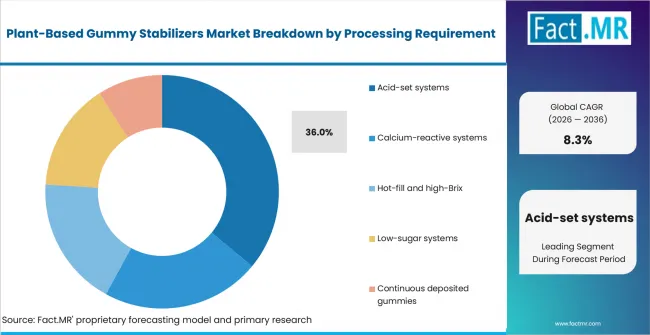
Plant Based Gummy Stabilizers Market Analysis By Processing Requirement | Source: Fact.MR
Acid-set systems are estimated to lead because fruit flavors and high-solids gummy bases require stable gelation at low pH. Calcium-reactive systems gain relevance in reduced-sugar recipes where low-methoxyl pectin helps create structure with lower sugar dependence. Hot-fill and high-Brix recipes need stabilizers that survive heat and solids stress. Low-sugar systems are evaluated more closely as candy makers manage sugar expectations.
What is accelerating Plant-Based Gummy Stabilizers Market adoption, and what is holding it back?
Nutraceutical gummies drive it; price and process variability restrain it.
Drivers Impact Analysis
| DRIVER | (~) % IMPACT ON CAGR | GEOGRAPHIC RELEVANCE | IMPACT TIMELINE |
|---|---|---|---|
| Nutraceutical gummy format expansion | +2.0% | North America, Europe, Japan | Short term (<= 2 years) |
| Pectin-led gelatin replacement | +1.5% | Global | Medium term (2-4 years) |
| Reduced-sugar and acid-set reformulation | +1.2% | United States, France, UK | Medium term (2-4 years) |
| Multi-texture deposited gummy concepts | +0.9% | North America, Europe | Long term (>= 4 years) |
Source: Fact.MR analysis. Updated Sep 3, 2026
- Nutraceutical gummy format expansion: Chewable supplements are creating recurring formulation work for pectin, gellan, and related stabilizer systems. Stabilizer selection increasingly needs to support texture, flavor masking, active-ingredient compatibility, and plant-based positioning within nutraceutical gummy formats.
- Pectin-led gelatin replacement: Formulators are prioritizing pectin where plant origin and acidic flavor profiles are important. Pectin-based systems can help manufacturers replace gelatin while maintaining familiar gummy texture, processing behavior, and consumer acceptance across confectionery and supplement applications.
- Reduced-sugar and acid-set reformulation: Sugar reduction is increasing formulation work around low-methoxyl pectin and calcium-reactive systems. These stabilizers can help manufacturers maintain gel structure, bite, and texture in products where conventional sugar-dependent setting conditions are reduced.
- Multi-texture deposited gummy concepts: Texture-led product design is increasing demand for hydrocolloid blends that create layered structures, differentiated bite, and controlled gel behavior. Combining pectin with carrageenan or other stabilizers gives formulators more flexibility in developing multi-texture gummy concepts.
Opportunity Impact Analysis
| OPPORTUNITY | (~) % IMPACT ON CAGR | GEOGRAPHIC RELEVANCE | IMPACT TIMELINE |
|---|---|---|---|
| Calcium-reactive low-sugar systems | +1.1% | United States, Europe | Medium term (2-4 years) |
| Heat-stable functional gummies | +0.8% | Japan, United States | Medium term (2-4 years) |
| Pectin replacers and starch blends | +0.7% | Global | Short term (<= 2 years) |
Source: Fact.MR analysis. Updated Sep 3, 2026
- Calcium-reactive low-sugar systems: Low-sugar gummies require stabilizers that can form reliable gels with reduced sugar solids. Low-methoxyl pectin and controlled calcium interaction create opportunities for suppliers that can simplify formulation, processing, and scale-up.
- Heat-stable functional gummies: E-commerce and warm-climate distribution increase interest in gummy systems that resist stickiness, deformation, and texture loss during storage and transport. Suppliers that provide stable hydrocolloid systems can support functional and nutraceutical gummies intended for wider geographic distribution.
- Pectin replacers and starch blends: Price-sensitive confectionery producers can compare blended stabilizer systems with premium pectin to balance texture and formulation cost. Pectin replacers and starch-based combinations create opportunities where manufacturers need acceptable chew, reduced-sugar performance, and scalable processing.
Restraints Impact Analysis
| RESTRAINT | (~) % IMPACT ON CAGR | GEOGRAPHIC RELEVANCE | IMPACT TIMELINE |
|---|---|---|---|
| Pectin and confectionery cost swings | -0.6% | United States, Germany, UK | Short term (<= 2 years) |
| Texture failure in reduced-sugar recipes | -0.5% | Global | Medium term (2-4 years) |
| Color and additive reformulation schedules | -0.4% | United States, Europe | Medium term (2-4 years) |
Source: Fact.MR analysis. Updated Sep 3, 2026
- Pectin and confectionery cost swings: Ingredient selection can come under pressure when confectionery prices and production costs rise. Manufacturers may review stabilizer systems more closely, balancing texture performance, formulation complexity, and ingredient cost before approving changes to gummy recipes.
- Texture failure in reduced-sugar recipes: Plant-based gels require careful control of pH, solids, and calcium balance. Small formulation changes can create sticky, brittle, or inconsistent gummies, making application support and scale-up testing important before commercial production.
- Color and additive reformulation schedules: Gummy and supplement brands may need to coordinate stabilizer trials with broader color and additive reformulation programs. Managing several formulation changes at once can lengthen development timelines and increase the need for structured testing before launch.
Which countries are scaling the Plant-Based Gummy Stabilizers Market through 2036?
- The country comparison spans 3.49 percentage points and forms three practical growth bands across the forecast period.
- The United States remains 1.08 percentage points above Germany through supplement gummies and retail channel scale.
- Germany remains 0.41 percentage point above France as vegan and flexitarian diets support animal-free confectionery formats.
- France remains 0.42 percentage point above Japan as sugar policy and premium confectionery guide formulation choices.
- Japan remains 1.58 percentage points above the UK through convenience retail and health-food formats.
- The UK closes the displayed range as HFSS policy and manufacturing scale keep recipe review active.
Comparable CAGRs create different entry conditions due to supplement regulation, confectionery pricing, sugar policy and local processing needs. Full report coverage includes North America, Latin America, Western Europe, Eastern Europe, East Asia, South Asia & Pacific, Middle East & Africa.
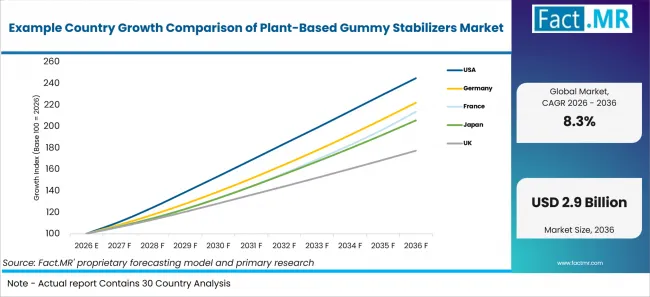
Example Country Growth Comparison Of Plant Based Gummy Stabilizers Market | Source: Fact.MR
| Country | CAGR (2026-2036) |
|---|---|
| United States | 9.4% |
| Germany | 8.3% |
| France | 7.9% |
| Japan | 7.5% |
| UK | 5.9% |
Source: Fact.MR analysis. Updated Sep 3, 2026
What supports USA adoption?
9.4% CAGR, supported by supplement gummies.
The U.S. Census Bureau estimated July 2026 retail and food services sales at USD 763.6 billion, providing a broad measure of retail and foodservice activity. FDA’s Red No. 3 order requires manufacturers using the color additive in foods, including dietary supplements, to reformulate by January 15, 2027.
How is Germany scaling demand?
8.3% CAGR, driven by vegan diet interest and confectionery formulation review.
Adjacent plant-based indicators provide context for Germany rather than direct gummy-stabilizer demand data. Max Rubner-Institut reported in August 2025 that just over one quarter of survey respondents described themselves as flexitarian, while Destatis reported that Germany produced 124,900 tonnes of meat-substitute products in 2025, down 1.2% from 2024.
What supports the France outlook?
7.9% CAGR, backed by sugar policy and premium confectionery formats.
INSEE initially reported in May 2025 that household food consumption increased 2.1% in April 2025, although the figure was subsequently revised to 2.7%. Separately, Article 1613 ter, as amended effective 1 March 2025, established sugar-tiered contribution rates for covered beverages containing added sugar.
How does Japan perform?
7.5% CAGR, led by health-food formats and convenience retail use.
The Statistics Bureau of Japan reported in February 2026 that average monthly consumption expenditure for two-or-more-person households was 314,001 yen in 2025. MAFF reported on August 7, 2026 that the fiscal-2025 food self-sufficiency ratio was 66% on a production-value basis.
What supports UK growth?
5.9% CAGR, supported by HFSS rules and food-manufacturing scale.
UK confectionery brands may review product formulation and marketing strategies where products fall within the less-healthy-food advertising rules, which the government states can incentivise reformulation. GOV.UK confirms that the restrictions took effect UK-wide on January 5, 2026, while its official product-scope guidance identifies food supplements as exempt. ONS reported that the manufacture of food represented 22.9% of total UK manufacturers’ sales in 2025.
Who leads the Plant-Based Gummy Stabilizers Market?
CP Kelco operates within Tate & Lyle following the November 2024 business combination and remains active through pectin, specialty gums and other nature-based ingredients. Tate & Lyle reported in April 2025 that its Lille Skensved site manufactures pectin and carrageenan, which support applications including gummies and other food and beverage formulations. The combined business therefore has a direct position in gummy texturizing and stabilizing systems.
Cargill competes through pectin, starches, hydrocolloids and texturizer systems for confectionery. Its March 2025 AAHAR showcase included a cost-effective pectin replacer for gummies and jellies, supporting formulations focused on ingredient-cost control while maintaining product quality and texture.
IFF is active through GRINDSTED® Pectin Premium and related dietary-supplement ingredients. The company’s April 2025 Vitafoods Europe portfolio identified GRINDSTED® Pectin Premium as a citrus-sourced ingredient for plant-based gummies. Ingredion and JRS Silvateam Ingredients also provide relevant texture solutions for gummy and confectionery applications, including starch, hydrocolloid and pectin-based systems.
Which companies are the key providers?
Key companies include Tate & Lyle (including the CP Kelco portfolio); Cargill; IFF; Ingredion; and JRS Silvateam Ingredients.
- Cargill
- IFF
- Ingredion
- Tate & Lyle (including the CP Kelco portfolio)
- JRS Silvateam Ingredients
Bibliography
- Zeballos, E., & Sinclair, W. (2026, June 11). Total U.S. food spending reached $2.51 trillion in 2025. U.S. Department of Agriculture, Economic Research Service.
- U.S. Census Bureau. (2026, August 14). Advance monthly sales for retail and food services, July 2026.
- U.S. Food and Drug Administration. (2025, January 15). FDA to revoke authorization for the use of Red No. 3 in food and ingested drugs.
- U.S. Bureau of Labor Statistics. (2026, August 12). Consumer Price Index—July 2026.
- Max Rubner-Institut. (2025, August 15). Nationales Ernährungsmonitoring - nemo.
- Institut national de la statistique et des études économiques. (2025, May 28). Household consumption of goods rebounded slightly in April 2025 (+0.3%).
- Office for National Statistics. (2026, July 24). UK manufacturers’ sales by product: 2025.
- Statistics Bureau of Japan. (2026, February 6). 2025 yearly average [Family Income and Expenditure Survey].
- Cargill. (2025, March 4). Cargill showcases full range of innovative food solutions at AAHAR 2025.
- IFF. (2025, April 22). IFF Pharma Solutions to showcase plant-based dietary supplement ingredients and technical expertise at Vitafoods™ Europe 2025.
- Tate & Lyle. (2025, July 7). Tate & Lyle debuts expanded portfolio and mouthfeel leadership at IFT FIRST 2025.
- Tate & Lyle. (2025, April 1). Tate & Lyle welcomes government officials to Lille Skensved, formerly of CP Kelco, to celebrate completion of carbon reduction and energy efficiency project.
- Ingredion Incorporated. (2025, July 22). Ingredion at IFT FIRST 2025 — Connecting texture, health and innovation.
- Statistisches Bundesamt (Destatis). (2026, May 18). Nach jahrelangem Anstieg: Fleischersatz-Produktion sinkt 2025 um 1,2 % gegenüber dem Vorjahr.
- Department of Health and Social Care. (2025, June 4). Restricting advertising of less healthy food or drink on TV and online: Products in scope.
- Tate & Lyle. (2024, November 15). Completion of combination of Tate & Lyle and CP Kelco to create a leading global speciality food and beverage solutions business.
This Report Answers
- The report explains where plant-based gummy stabilizers are used across gelling systems and gummy types. It covers texture targets and processing requirements, together with regional adoption.
- Segment analysis identifies the leading subsegments and the formulation reasons behind pectin, nutraceutical gummies, elastic texture and acid-set systems.
- Country analysis examines the listed markets and the policy, retail and consumer mechanisms supporting gelatin-free gummy formulation.
- Competitive analysis reviews providers across pectin, starch, carrageenan and blended hydrocolloid systems. It also examines application support and recent company developments.
- Application analysis assesses how bite, clarity, set time and heat tolerance affect supplier selection.
What does the Plant-Based Gummy Stabilizers Market cover?
The Plant-Based Gummy Stabilizers Market covers ingredients and systems that give gummies their shape, bite and stability without relying on animal gelatin. The scope includes pectin, starch, agar, carrageenan, konjac and blends that perform gelling, thickening and water-control functions in gummy recipes.
The assessment covers nutraceutical, confectionery, vegan functional, pharma and pet supplement gummies. Demand is assessed across texture targets such as elastic chew, soft bite, fast set, heat stability and reduced-sugar compatibility.
What is included in the scope?
The scope includes commercial plant-derived stabilizers and blended systems used in gummies, jellies and chewable supplement formats. It includes ingredients sold as pectin systems, starch-based texturizers, seaweed-derived gels and formulation blends designed for gummy manufacturing.
It includes stabilizers used by supplement brands, confectionery producers, contract manufacturers and ingredient system providers. The scope covers acid-set, calcium-reactive, hot-fill, high-Brix and low-sugar processing systems where stabilizers determine texture and shelf quality.
What is excluded from the scope?
The scope excludes animal gelatin sold as the primary gelling ingredient. Finished gummies are covered only where stabilizer revenue is separated from brand-level retail sales.
General sweeteners, colors, flavors and active supplement ingredients are excluded when they are sold without a stabilizing function. Packaging and manufacturing equipment are also excluded unless tied directly to stabilizer system qualification.
How Was the Analysis Built?
The analysis draws on 120+ sources, 35+ company portfolios, 25+ countries, and more than 20 industry interviews.
- Primary Research: Primary research includes discussions with manufacturers, service providers, technology developers, distributors, end users, and subject-matter experts. These conversations examine purchasing priorities, product adoption, operational challenges, approval requirements, competitive positioning, and the factors that influence wider market acceptance.
- Desk Research: Desk research covers government statistics, regulatory publications, company filings, trade data, technical studies, industry associations, standards, public policy, and other authoritative sources. Every source used in the analysis is documented in the bibliography.
- Market Sizing and Forecasting: Market estimates combine historical performance, demand indicators, pricing and volume trends, segment shares, company participation, country-level growth, adoption patterns, investment activity, and barriers to market expansion.
- Data Validation and Update Cycle: Findings are validated by comparing primary interviews with public data, company activity, regulatory changes, trade patterns, and industry developments. Regular updates review new product launches, capacity changes, partnerships, approvals, and shifts in commercial adoption.
Segmentation
What is the report’s scope and coverage?
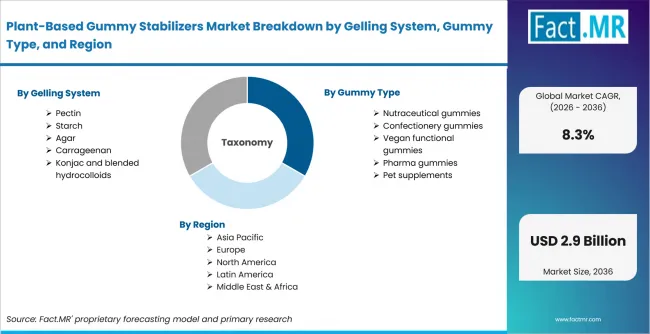
Plant Based Gummy Stabilizers Market Breakdown By Gelling System, Gummy Type, And Region | Source: Fact.MR
| Attribute | Details |
|---|---|
| Quantitative Units | USD billion |
| Market Definition | Plant-derived and plant-compatible stabilizing systems used to build gummy structure, including pectin, starch, agar, carrageenan, konjac and blended hydrocolloids. |
| Gelling System | Pectin; Starch; Agar; Carrageenan; Konjac and blended hydrocolloids |
| Gummy Type | Nutraceutical gummies; Confectionery gummies; Vegan functional gummies; Pharma gummies; Pet supplements |
| Texture Target | Elastic and chewy; Soft bite; Fast set and demolding; Heat stability; Reduced sugar compatibility; Continuous deposited gummies |
| Processing Requirement | Acid-set systems; Calcium-reactive systems; Hot-fill and high-Brix; Low-sugar systems |
| Regions Covered | North America; Latin America; Western Europe; Eastern Europe; East Asia; South Asia & Pacific; Middle East & Africa |
| Countries Covered | United States; Germany; France; Japan; UK |
| Key Companies Profiled | Tate & Lyle (including the CP Kelco portfolio); Cargill; IFF; Ingredion; JRS Silvateam Ingredients |
| Forecast Period | 2026 to 2036 |
| Approach | Hybrid top-down and bottom-up approach using gummy application demand, hydrocolloid use cases, supplier portfolio review, country adoption signals and formulation constraints. |
Source: Fact.MR analysis. Updated Sep 3, 2026
How is the market segmented?
-
By Gelling System
- Pectin
- Starch
- Agar
- Carrageenan
- Konjac and blended hydrocolloids
-
By Gummy Type
- Nutraceutical gummies
- Confectionery gummies
- Vegan functional gummies
- Pharma gummies
- Pet supplements
-
By Texture Target
- Elastic and chewy
- Soft bite
- Fast set and demolding
- Heat stability
- Reduced sugar compatibility
- Continuous deposited gummies
-
By Processing Requirement
- Acid-set systems
- Calcium-reactive systems
- Hot-fill and high-Brix
- Low-sugar systems
-
By Region
- North America
- Latin America
- Western Europe
- Eastern Europe
- East Asia
- South Asia & Pacific
- Middle East & Africa
Frequently Asked Questions
How big is the plant-based gummy stabilizers market in 2026?
What is the CAGR of the plant-based gummy stabilizers market from 2026 to 2036?
Which gelling system leads the plant-based gummy stabilizers market?
Which gummy type leads the plant-based gummy stabilizers market?
Who are the leading companies in the plant-based gummy stabilizers market?
Who worked on this report


Preview the report firsthand - request a free sample
Free SampleGet the brochure for pricing and purchase details
Download PDF