- Market Value (2025): USD 1.8 Bn
- Estimated Value (2026): USD 1.9 Bn
- Forecast Value (2036): USD 3.0 Bn
- CAGR (2026-2036): 4.6%
What is the Half And Half Cream Market forecast to be worth by 2036?
USD 1.9 billion in 2026 to USD 3.0 billion by 2036 at 4.6% CAGR.
- Half and half cream market was valued at USD 1.8 billion in 2025.
- Demand is projected to increase from USD 1.9 billion in 2026 to USD 3.0 billion by 2036.
- The market is forecast to record 4.6% CAGR from 2026 to 2036.
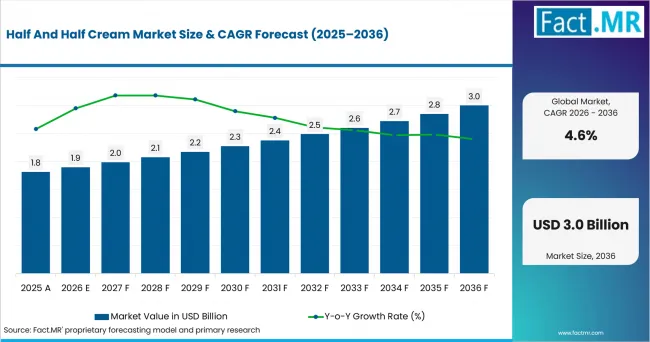
Half And Half Cream Market Value Analysis | Source: Fact.MR
What are the defining numbers behind Half And Half Cream Market growth?
USD 1.1 billion absolute opportunity by 2036.
- Demand Drivers in the Market
- Coffee and beverage use is expected to keep repeat purchasing active through daily drink routines.
- Household and retail demand is likely to benefit from routine grocery replacement.
- Supermarkets and hypermarkets are expected to remain the main access point during regular shopping trips.
- Carton packaging is anticipated to support shelf handling and clear product identification across chilled dairy aisles.
- Key Segments Analyzed
- By Product Type: Regular Half and Half leads with 46.0% share in 2026 as mainstream use favors familiar dairy composition.
- By Application: Coffee and Beverages accounts for 44.0% share in 2026 as daily drink use creates frequent buying occasions.
- By End Use: Household and Retail holds 51.0% share in 2026 because home consumption creates the broadest buyer base.
- By Distribution Channel: Supermarkets and Hypermarkets capture 48.0% share in 2026 as chilled dairy buying remains store-led.
- By Packaging Type: Cartons represent 52.0% share in 2026 as the format fits retail display and refrigerator storage.
- Analyst Opinion at Fact.MR
- Shambhu Nath Jha, Principal Consultant at Fact.MR, states, “Half and half cream market as a routine-use dairy category. Buyers compare product type and application before choosing a pack. Distribution reach then affects repeat buying. Suppliers that explain freshness clearly are likely to gain stronger orders.”
- Strategic Implications
- Retail teams can prioritize carton-led shelf plans because cartons carry the highest Packaging Type share.
- Brand owners need clear product naming so buyers can separate regular and low-fat options. Organic and lactose-free labels should remain easy to understand.
- Foodservice sellers can build account messages around beverage use and recipe consistency.
The USA leads at 5.0% CAGR. Canada follows at 4.8%. The UK records 4.7%. Germany reaches 4.6%. France posts 4.4%. Australia expands at 4.2% through 2036.
How does the Half And Half Cream Market break down by segment?
Regular Half and Half leads Product Type with 46.0% share in 2026. Coffee and Beverages leads Application with 44.0% share.
Which Product Type dominates?
Regular Half and Half is projected to account for 46.0% share in 2026.
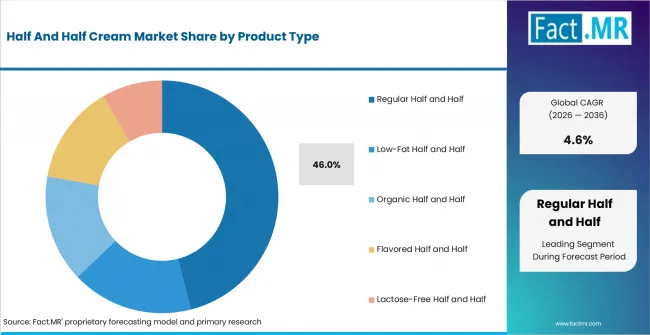
Half And Half Cream Market Analysis By Product Type | Source: Fact.MR
Regular Half and Half leads Product Type because it matches the most familiar buyer expectation. Full-Fat and Homogenized options serve texture-led buyers. Low-Fat formats serve one buyer need. Organic, Flavored and Lactose-Free formats serve targeted needs.
What leads the Application segment?
Coffee and Beverages is expected to hold 44.0% share in 2026.
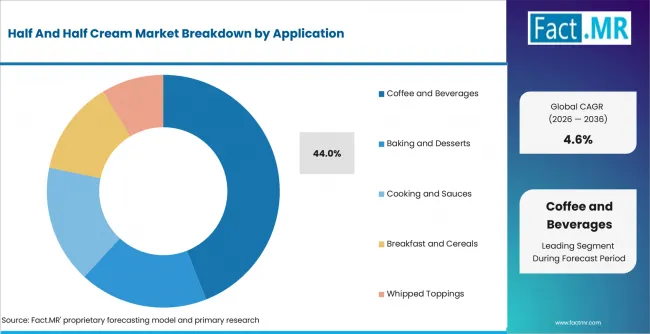
Half And Half Cream Market Analysis By Application | Source: Fact.MR
Daily drink preparation gives Coffee and Beverages the clearest application base. Coffee Shops and Cafes need consistent texture. Home Brewing adds an at-home route. Baking and Desserts, Cooking and Sauces and Whipped Toppings create smaller recipe uses.
What supports Household and Retail within End Use?
Household and Retail is anticipated to lead End Use with 51.0% share in 2026.
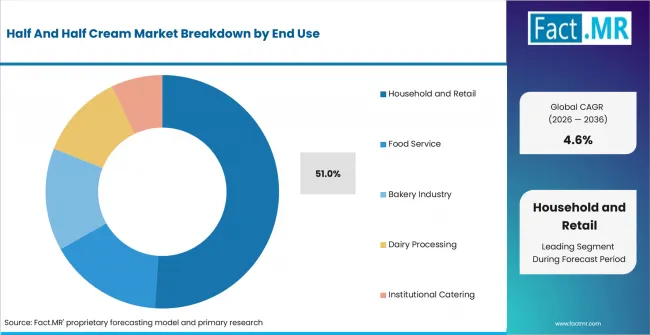
Half And Half Cream Market Analysis By End Use | Source: Fact.MR
Household and Retail leads because most decisions occur during grocery replenishment. Daily Household Consumption and Premium Home Barista Users create routine demand. Food Service and Coffee Chains add commercial use. Bakery Industry and Institutional Catering support repeat preparation.
How do Supermarkets and Hypermarkets lead Distribution Channel?
Supermarkets and Hypermarkets is estimated to capture 48.0% share in 2026.
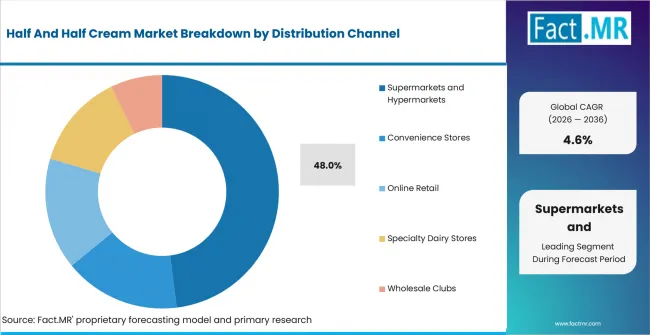
Half And Half Cream Market Analysis By Distribution Channel | Source: Fact.MR
Supermarkets and Hypermarkets lead because chilled dairy buyers often prefer visible selection and immediate purchase. Convenience Stores support urgent buying. Online Retail and Grocery Delivery Platforms may help planned replenishment when cold-chain service is reliable.
Why do Cartons lead Packaging Type?
Cartons are forecast to represent 52.0% share in 2026.
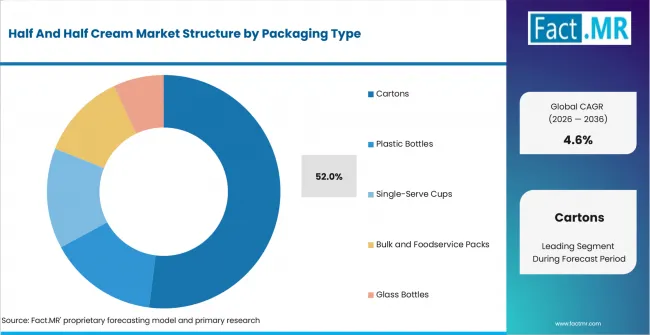
Half And Half Cream Market Analysis By Packaging Type | Source: Fact.MR
Cartons lead Packaging Type because the format suits chilled dairy display and refrigerator storage. Gable-Top and Aseptic Cartons support handling needs. Bottles and cups serve more specific use situations. Bulk packs and glass formats complete the packaging set.
What is accelerating Half And Half Cream Market adoption, and what is holding it back?
Demand is expected to rise through daily beverage use and stronger retail access. Growth may be limited by refrigerated handling and input-cost pressure. Packaging choice can affect repeat buying after opening.
Drivers Impact Analysis
| DRIVER | (~) % IMPACT ON CAGR | GEOGRAPHIC RELEVANCE | IMPACT TIMELINE |
|---|---|---|---|
| Coffee and beverage usage | +1.3% | USA, Canada, UK | Short term (<= 2 years) |
| Household and retail base | +1.1% | USA, Canada, Germany | Short term (<= 2 years) |
| Store-led chilled dairy access | +0.9% | USA, UK, France | Medium term (2-4 years) |
| Carton handling fit | +0.6% | Retail-led markets | Medium term (2-4 years) |
Source: Fact.MR analysis. Updated Aug 5, 2026
- Coffee and beverage usage: Half and half cream is expected to gain repeat demand where beverage preparation remains a daily habit.
- Household and retail base: Routine grocery replacement is anticipated to keep the buyer pool broad across mature dairy markets.
- Store-led chilled dairy access: Supermarket availability is likely to improve product comparison and replacement buying at shelf level.
Opportunity Impact Analysis
| OPPORTUNITY | (~) % IMPACT ON CAGR | GEOGRAPHIC RELEVANCE | IMPACT TIMELINE |
|---|---|---|---|
| Lactose-free and organic options | +0.7% | USA, Canada, UK | Medium term (2-4 years) |
| Digital grocery replenishment | +0.5% | USA, UK, Australia | Medium term (2-4 years) |
| Foodservice beverage menus | +0.4% | USA, Germany, France | Long term (>= 4 years) |
| Pack-format differentiation | +0.3% | Retail channels | Long term (>= 4 years) |
Source: Fact.MR analysis. Updated Aug 5, 2026
- Lactose-free and organic options: Targeted product types can reach buyers who need dietary fit without leaving the half and half category.
- Digital grocery replenishment: Online buying may improve planned replacement when chilled delivery is dependable.
- Foodservice beverage menus: Coffee chains and cafes are likely to use consistent cream formats where drink texture must repeat across locations.
Restraints Impact Analysis
| RESTRAINT | (~) % IMPACT ON CAGR | GEOGRAPHIC RELEVANCE | IMPACT TIMELINE |
|---|---|---|---|
| Refrigerated handling burden | -0.7% | Global | Short term (<= 2 years) |
| Dairy input cost movement | -0.6% | USA, Canada, Europe | Short term (<= 2 years) |
| Shelf-life limits | -0.4% | Retail and foodservice | Medium term (2-4 years) |
| Format switching hesitation | -0.2% | Mature dairy markets | Long term (>= 4 years) |
Source: Fact.MR analysis. Updated Aug 5, 2026
- Refrigerated handling burden: Temperature control is expected to raise channel discipline from plant dispatch to store shelf.
- Dairy input cost movement: Pricing pressure can reduce promotion flexibility for retailers and commercial buyers.
- Shelf-life limits: Shorter use windows may limit bulk buying when household consumption is irregular.
Which countries are scaling Half And Half Cream Market fastest?
- The country comparison spans 0.8 percentage point across the displayed forecast range.
- The USA remains 0.2 percentage point above Canada through wider retail and foodservice coverage.
- Canada remains 0.1 percentage point above the UK through steady household replenishment.
- The UK remains 0.1 percentage point above Germany as home beverage use keeps retail demand active.
- Germany remains 0.2 percentage point above France through mature chilled dairy purchasing.
- France remains 0.2 percentage point above Australia through stable retail channel depth.
- Australia closes the displayed range with selective household and cafe-led buying.
Comparable CAGRs can create different entry conditions because consumption routines vary by country. Retail shelf access and cold-chain reach affect adoption in different ways. Full coverage spans North America, Europe, Latin America, East Asia, South Asia & Oceania and Middle East & Africa.
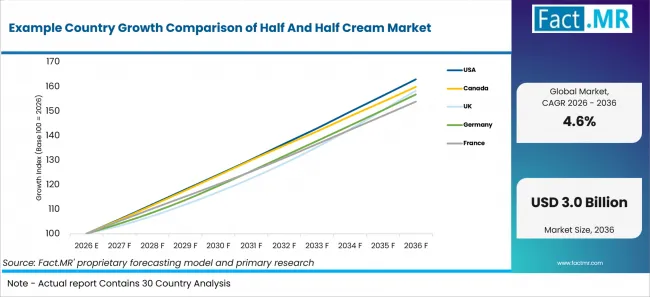
Example Country Growth Comparison Of Half And Half Cream Market | Source: Fact.MR
| Country | CAGR (2026-2036) |
|---|---|
| USA | 5.0% |
| Canada | 4.8% |
| UK | 4.7% |
| Germany | 4.6% |
| France | 4.4% |
| Australia | 4.2% |
Source: Fact.MR analysis. Updated Aug 5, 2026
What supports USA adoption?
5.0% CAGR, supported by wide retail access and beverage-led household use.
USA buyers are expected to favor half and half cream where daily beverage use supports routine replacement. Supermarkets give brands a visible chilled dairy route. Foodservice accounts are likely to compare consistency before expanding purchasing.
How is Canada scaling demand?
4.8% CAGR, driven by steady household replenishment and chilled dairy availability.
Canadian demand is projected to build through household routines and retailer-led access. Cartons remain practical after opening. Commercial use may stay steady where beverages need repeatable taste.
What is driving the UK from 2026 to 2036?
4.7% CAGR, backed by home beverage use and grocery-channel visibility.
The UK is expected to develop through at-home drink preparation and supermarket buying. Product type choice matters when shoppers compare regular and low-fat options.
How is Germany developing demand?
4.6% CAGR, led by mature retail dairy purchasing and controlled category expansion.
Germany is anticipated to grow near the global rate as buyers remain selective. Household and retail use provides a stable base. Foodservice demand may progress through coffee and dessert use.
How does France perform?
4.4% CAGR, shaped by chilled retail presence and use in desserts and sauces.
France is likely to expand through selective application use. Baking and desserts give the market a food-preparation route. Store-led access remains important during routine shopping.
What supports Australia’s growth?
4.2% CAGR, supported by household beverage routines and cafe-led purchasing.
Australia closes the listed country range but adds demand through beverage and household use. Coffee Shops and Cafes may support commercial purchasing. Online replenishment can help when chilled delivery is dependable.
Who leads the Half And Half Cream Market?
Land O'Lakes and Dairy Farmers of America show the strongest market presence, while HP Hood, Organic Valley and Horizon Organic broaden dairy coverage.
Darigold and Prairie Farms reinforce regional supply. Shamrock Foods adds foodservice reach. Upstate Niagara and Byrne Dairy extend chilled distribution. Competition centers on freshness, carton availability, beverage use and dependable retail replenishment across household and commercial channels.
Which companies are the key providers?
Key companies include Land O'Lakes, Inc.; Dairy Farmers of America, Inc.; HP Hood LLC; CROPP Cooperative – Organic Valley; Horizon Organic; Darigold, Inc.; Shamrock Foods Company – Shamrock Farms; Prairie Farms Dairy, Inc.; Upstate Niagara Cooperative, Inc.; Byrne Dairy, Inc.
- Land O'Lakes, Inc.
- Dairy Farmers of America, Inc.
- HP Hood LLC
- CROPP Cooperative – Organic Valley
- Horizon Organic
- Darigold, Inc.
- Shamrock Foods Company – Shamrock Farms
- Prairie Farms Dairy, Inc.
- Upstate Niagara Cooperative, Inc.
- Byrne Dairy, Inc.
Bibliography
- National Agricultural Statistics Service. (2025, April 25). Dairy products: 2024 annual summary. U.S. Department of Agriculture.
- U.S. Food and Drug Administration. (2025, January 6). FDA releases allergen, food safety, and plant-based alternative labeling guidances.
- Organic Valley. (2025, March 13). Organic Valley unveils the first nationally available organic American cheese blocks in original and fiesta flavors.
This Report Answers
- The report provides strategic intelligence on Product Type and Application choices.
- Segment analysis covers Regular Half and Half and Coffee and Beverages as 2026 share leaders.
- End-use and channel analysis evaluates Household and Retail alongside store-led distribution.
- Packaging assessment covers Cartons as the leading Packaging Type. Bottle and cup formats complete part of the comparison. Bulk and glass formats complete it.
- Country outlook evaluates the USA and Canada. The UK and Germany complete part of the comparison. France and Australia complete it.
What does the Half And Half Cream Market cover?
Half and half cream products are assessed across type and application. End-use, distribution and packaging categories complete the view.
The Half And Half Cream Market covers regular, full-fat, homogenized and low-fat formats. Reduced-fat, organic, flavored and lactose-free options complete the product view. Coverage includes beverages, home preparation, desserts and sauces. Household and retail demand forms the base. Foodservice, bakery, dairy processing and institutional catering complete end-use coverage. Distribution includes store-led and online channels. Packaging includes cartons, bottles, cups, bulk packs and glass bottles.
What is included in the scope?
The scope includes the listed product types and commercial routes defined in the segmentation table.
Coverage includes half and half cream sold through supermarkets and hypermarkets. Convenience stores and online retail are included. Specialty dairy stores and wholesale clubs complete the channel view. It covers household, cafe, restaurant, bakery, dairy processing and institutional catering use.
What is excluded from the scope?
Products outside the defined half and half cream boundary remain outside the assessment.
The scope excludes unrelated dairy products. Non-dairy substitutes are excluded unless positioned as half and half alternatives. Standalone cream ingredients and unrelated foodservice inputs are also excluded.
How Was the Analysis Built?
The analysis draws on 120+ sources, 35+ company portfolios, 25+ countries, and more than 20 industry interviews.
- Primary Research: Primary research includes discussions with manufacturers, service providers, technology developers, distributors, end users, procurement teams, and subject-matter experts. These conversations examine purchasing priorities, product adoption, operational challenges, approval requirements, competitive positioning, and the factors that influence wider market acceptance.
- Desk Research: Desk research covers government statistics, regulatory publications, company filings, trade data, technical studies, industry associations, standards, public policy, and other authoritative sources. Every source used in the analysis is documented in the bibliography.
- Market Sizing and Forecasting: Market estimates combine historical performance, demand indicators, pricing and volume trends, segment shares, company participation, country-level growth, adoption patterns, investment activity, and barriers to market expansion.
- Data Validation and Update Cycle: Findings are validated by comparing primary interviews with public data, company activity, regulatory changes, trade patterns, and industry developments. Regular updates review new product launches, capacity changes, partnerships, approvals, procurement trends, and shifts in commercial adoption.
Segmentation
What is the report's scope and coverage?
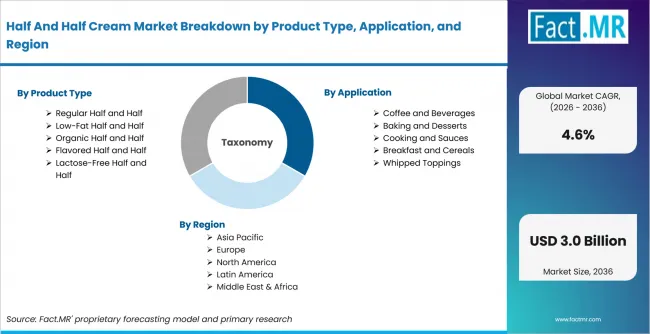
Half And Half Cream Market Breakdown By Product Type, Application, And Region | Source: Fact.MR
| Attribute | Details |
|---|---|
| Quantitative Units | USD billion |
| Market Definition | Half and half cream products sold across dairy retail and commercial channels where milkfat composition, product type, application, end use, distribution and packaging define market coverage |
| Product Type | Regular Half and Half; Full-Fat Half and Half; Homogenized Half and Half; Low-Fat Half and Half; Reduced-Fat Half and Half; Fat-Free Half and Half; Organic Half and Half; Grass-Fed Organic; Flavored Half and Half; Lactose-Free Half and Half |
| Application | Coffee and Beverages; Coffee Shops and Cafes; Home Brewing; Baking and Desserts; Cakes and Pastries; Custards and Puddings; Cooking and Sauces; Cream Sauces and Soups; Breakfast and Cereals; Whipped Toppings |
| End Use | Household and Retail; Daily Household Consumption; Premium Home Barista Users; Food Service; Coffee Chains; Restaurants and Diners; Bakery Industry; Commercial Bakeries; Dairy Processing; Institutional Catering |
| Distribution Channel | Supermarkets and Hypermarkets; Hypermarkets; Supermarket Chains; Convenience Stores; Corner Stores and Gas Stations; 24x7 Convenience Chains; Online Retail; Grocery Delivery Platforms; Specialty Dairy Stores; Wholesale Clubs |
| Packaging Type | Cartons; Gable-Top Cartons; Aseptic Cartons; Plastic Bottles; HDPE Bottles; PET Bottles; Single-Serve Cups; Bulk and Foodservice Packs; Bag-in-Box Bulk Packs; Glass Bottles |
| Regions Covered | North America; Latin America; Europe; East Asia; South Asia & Oceania; Middle East & Africa |
| Countries Covered | USA; Canada; UK; Germany; France; Australia |
| Key Companies Profiled | Land O'Lakes, Inc.; Dairy Farmers of America, Inc.; HP Hood LLC; CROPP Cooperative – Organic Valley; Horizon Organic; Darigold, Inc.; Shamrock Foods Company – Shamrock Farms; Prairie Farms Dairy, Inc.; Upstate Niagara Cooperative, Inc.; Byrne Dairy, Inc. |
| Forecast Period | 2026 to 2036 |
| Approach | Hybrid top-down and bottom-up approach using product type demand; application fit; end-use behavior; distribution access; packaging preference; country growth comparison; and company portfolio review |
Source: Fact.MR analysis. Updated Aug 5, 2026
How is the market segmented?
-
By Product Type:
- Regular Half and Half
- Full-Fat Half and Half
- Homogenized Half and Half
- Low-Fat Half and Half
- Reduced-Fat Half and Half
- Fat-Free Half and Half
- Organic Half and Half
- Grass-Fed Organic
- Flavored Half and Half
- Lactose-Free Half and Half
- Regular Half and Half
-
By Application:
- Coffee and Beverages
- Coffee Shops and Cafes
- Home Brewing
- Baking and Desserts
- Cakes and Pastries
- Custards and Puddings
- Cooking and Sauces
- Cream Sauces and Soups
- Breakfast and Cereals
- Whipped Toppings
- Coffee and Beverages
-
By End Use:
- Household and Retail
- Daily Household Consumption
- Premium Home Barista Users
- Food Service
- Coffee Chains
- Restaurants and Diners
- Bakery Industry
- Commercial Bakeries
- Dairy Processing
- Institutional Catering
- Household and Retail
-
By Distribution Channel:
- Supermarkets and Hypermarkets
- Hypermarkets
- Supermarket Chains
- Convenience Stores
- Corner Stores and Gas Stations
- 24x7 Convenience Chains
- Online Retail
- Grocery Delivery Platforms
- Specialty Dairy Stores
- Wholesale Clubs
- Supermarkets and Hypermarkets
-
By Packaging Type:
- Cartons
- Gable-Top Cartons
- Aseptic Cartons
- Plastic Bottles
- HDPE Bottles
- PET Bottles
- Single-Serve Cups
- Bulk and Foodservice Packs
- Bag-in-Box Bulk Packs
- Glass Bottles
- Cartons
-
By Region:
- North America
- USA
- Canada
- Europe
- Germany
- UK
- France
- South Asia & Oceania
- Australia
- Latin America
- East Asia
- Middle East & Africa
- North America
Frequently Asked Questions
How big is the half and half cream market in 2026?
What is the CAGR of the half and half cream market from 2026 to 2036?
Which product type leads the half and half cream market?
Who are the leading companies in the half and half cream market?
Who worked on this report


Preview the report firsthand - request a free sample
Free SampleGet the brochure for pricing and purchase details
Download PDF