- Base Value(2026): 13.8 Bn
- Estimated Value(2026): 13.8 Bn
- Forecast Value (2036): 18.7 Bn
- CAGR (2026 - 2036): 3.1%
Half-Shaft Assemblies Market Forecast Outlook 2026 to 2036
The half-shaft assemblies market is expected to reach USD 13.8 billion in 2026 and USD 18.7 billion by 2036, with a compound annual growth rate (CAGR) of 3.1%.
Key Takeaways from Half-Shaft Assemblies Market
- Half-Shaft Assemblies Market Value (2026): USD 13.8 billion
- Half-Shaft Assemblies Market Forecast Value (2036): USD 18.7 billion
- Half-Shaft Assemblies Market Forecast CAGR 2026 to 2036: 3.1%
- Leading Segment in Half-Shaft Assemblies Market: First Fit (OEM) Sales Channel (76%)
- Key Growth Region in Half-Shaft Assemblies Market: India (6.2%)
- Key Players in Half-Shaft Assemblies Market: GKN Automotive, ZF Friedrichshafen AG, Dana Incorporated, NTN Corporation, Schaeffler AG, Hyundai WIA Corporation, Wanxiang Group Corporation, JTEKT Corporation, Nexteer Automotive, SKF AB
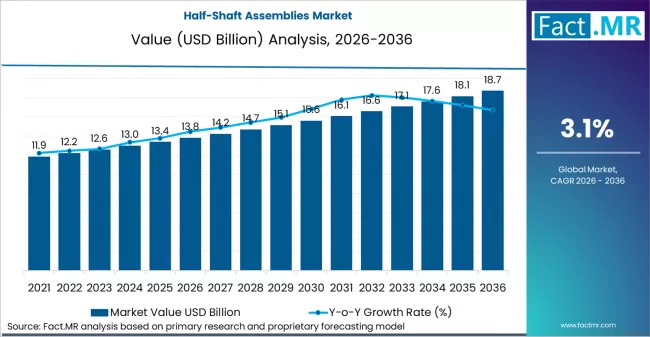
Half Shaft Assemblies Market Market Value Analysis | Source: Fact.MR
Procurement decisions in this market will be shaped by the need for cost efficiency, reliability, and long-term supplier relationships. Buyers tend to prioritize suppliers offering consistent quality and favorable terms, with a marked risk aversion toward vendors with unstable performance histories.
Vendor lock-in can become a significant factor, as established partnerships and contractual agreements often increase switching costs. As such, decisions are influenced by the strategic importance of long-term cost control, along with the challenge of managing supplier transitions. While the potential for cost reduction through vendor diversification exists, the ability to minimize operational disruptions will drive the overall procurement approach. The market will see continued demand for suppliers capable of offering stability, quality, and cost-efficient solutions.
Half-Shaft Assemblies Market
| Metric | Value |
|---|---|
| Estimated Value in (2026E) | USD 13.8 billion |
| Forecast Value in (2036F) | USD 18.7 billion |
| Forecast CAGR (2026 to 2036) | 3.1% |
Source: Fact.MR analysis. Updated Feb 2, 2026
Category
| Category | Segments |
|---|---|
| Sales Channel | First Fit (OEM); Aftermarket |
| Drive | FWD; RWD; AWD/4WD |
| Vehicle Type | Passenger Cars; LCV; HCV |
| Material | Steel; High-strength or Lightweight |
| Powertrain | ICE or HEV; BEV |
| Region | North America; Europe; Asia Pacific; Latin America; Middle East & Africa |
Source: Fact.MR analysis. Updated Feb 2, 2026
Segmental Analysis
What is the Analysis of the Leading Sales Channel in the Automotive Half-Shaft Assemblies Market?
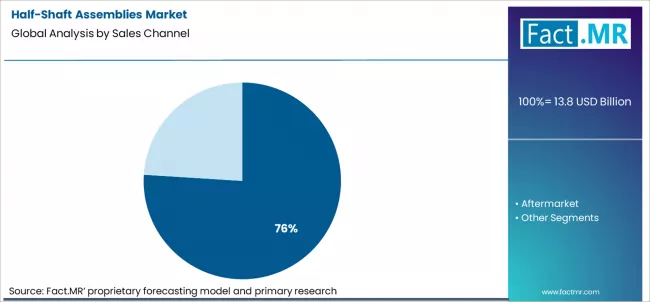
Half Shaft Assemblies Market Analysis By Sales Channel | Source: Fact.MR
The First Fit (OEM) segment holds a dominant 76% market share in 2026. This leadership is driven by the necessity for half-shafts to be engineered as integral components of the primary axle and propulsion systems, especially in front-wheel drive (FWD) and all-wheel drive (AWD) vehicle configurations. OEM demand is increasingly focused on "propulsion-agnostic" designs, which can be shared across internal combustion engine (ICE), hybrid electric vehicle (HEV), and battery electric vehicle (BEV) platforms, thereby reducing development costs. NTN Corporation's 2026 revitalization phase emphasizes the integration of OEM and aftermarket operations, optimizing production for EV-specific drive shafts that deliver world-class efficiency and low vibration. GKN Automotive maintains its market leadership with a 21.3% global share, supplying over 90% of major automotive OEMs with specialized sideshafts, further reinforcing its position in the sector.
What is the Analysis of the Leading Material Segment in the Automotive Half-Shaft Assemblies Market?
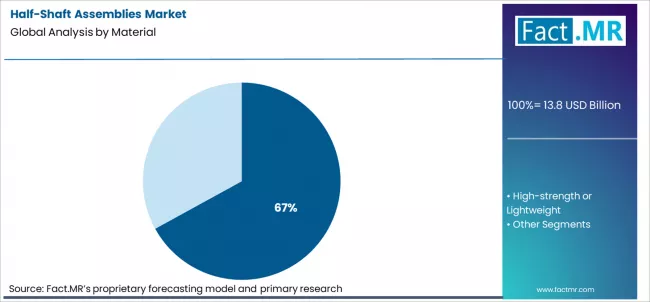
Half Shaft Assemblies Market Analysis By Material | Source: Fact.MR
Steel remains the dominant material for half-shaft assemblies, accounting for 67% of the market share in 2026. Steel's leadership stems from its superior fatigue resistance and cost-effectiveness, particularly in mass-market vehicle production. High-strength steel is the preferred material for heavier vehicles, such as SUVs and trucks, due to its ability to endure high stress and torque loads. Forging continues to be the largest manufacturing process for steel half-shafts, although there is a growing trend toward hollow side shafts, which help achieve weight reduction while maintaining steel's mechanical properties. In early 2026, Nexteer Automotive launched an 8-Ball Joint that delivers over 10% mass reduction through structural optimization of the outer race, enabling steel components to compete with lightweight materials in electric vehicle (EV) applications.
Country
| Country | Drivers | Restraints | Trends |
|---|---|---|---|
| USA | Strong SUV/AWD sales | EV shift reduces long-term demand | Reinforced half-shafts for performance |
| China | High vehicle production | EV adoption limits traditional part growth | Local production increases |
| India | Growing passenger vehicle sales | Cost sensitivity limits premium part uptake | Aftermarket expansion |
| Germany | Premium/Performance AWD demand | Electrification reduces future demand | Lightweight, durable shafts |
| Japan | Reliable OEM demand | Slow ICE growth limits expansion | Durable, compact assemblies |
| South Korea | Strong automotive production | EV trend limits long-term growth | Use of advanced materials |
| Mexico | Growing auto assembly | Cost constraints | Rising aftermarket demand |
Source: Fact.MR analysis. Updated Feb 2, 2026
Analysis of the Half-Shaft Assemblies Market by Key Country
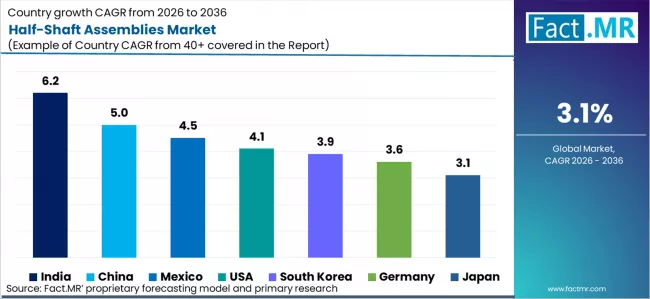
Half Shaft Assemblies Market Cagr Analysis By Country | Source: Fact.MR
| Country | CAGR (Forecast Period) |
|---|---|
| USA | 4.1% |
| China | 5.0% |
| India | 6.2% |
| Germany | 3.6% |
| Japan | 3.1% |
| South Korea | 3.9% |
| Mexico | 4.5% |
Source: Fact.MR analysis. Updated Feb 2, 2026
The report covers an in-depth analysis of 40+ countries; top-performing countries are highlighted below.
What Drives Growth in the USA Half-Shaft Assemblies Market?
USA market demand for half-shaft assemblies is driven by the NHTSA’s 2026 CAFE standards, which require vehicles to achieve an average of 49 mpg. To meet these standards, automakers are adopting lightweight hollow half-shaft designs that reduce unsprung weight and rotational inertia. Additionally, the market benefits from the rise of heavy-duty electric trucks, such as the Chevrolet Silverado EV and Tesla Cybertruck, which require oversized high-torque half-shafts. The aftermarket demand is also growing, driven by the aging vehicle fleet in the USA, where many vehicles are reaching an average age of nearly 13 years, increasing the frequency of CV boot and joint replacements.
Why is the China Half-Shaft Assemblies Market Projected to Expand at a 5.0% Rate?
China market growth for half-shaft assemblies is driven by the MIIT’s 2025-2026 Automotive Industry Growth Stabilization Work Plan, which sets a target of 15.5 million NEV sales by 2026. The rise of electric vehicles (EVs) and New Energy Vehicles (NEVs) is significantly increasing the demand for "e-axle ready" half-shafts that integrate with high-speed electric motors. Additionally, the 15th Five-Year Plan emphasizes technological self-sufficiency, which has spurred the development of high-precision forging and induction-hardening processes, further advancing half-shaft technology and reducing reliance on imported drivetrain components.
How Does the India Half-Shaft Assemblies Market Achieve Growth?
India market expansion in half-shaft assemblies is fueled by the Production Linked Incentive (PLI) Scheme for automobile components, which provides financial incentives for Advanced Automotive Technologies (AAT). As premium SUVs and turbocharged engines become more prevalent, the demand for durable driveline components, such as half-shafts, increases. The PLI scheme is driving the localization of half-shaft manufacturing, with companies like GKN Automotive and NTN Corporation expanding their Indian manufacturing facilities to support the growing Indian SUV market. Additionally, the enforcement of BS6 Phase 2 (RDE) norms is further pushing the adoption of high-performance driveline components.
What Supports the Growth for the Germany Half-Shaft Assemblies Market?
Germany market sales of half-shaft assemblies are driven by the industry’s alignment with Euro 7 regulations, which focus on reducing non-exhaust emissions, such as brake and tire wear. Advanced half-shafts are being integrated into Torque Vectoring systems, which allow for steering adjustments via torque modulation, reducing reliance on traditional friction braking and thus minimizing particulate matter. German manufacturers are also at the forefront of developing "Carbon Fiber-Steel Hybrid" shafts, which provide the strength required for high-torque applications in performance EVs while being lighter than traditional steel assemblies, helping to meet the Euro 7 emissions standards.
How Does Japan Achieve Growth in the Half-Shaft Assemblies Market?
Japan market demand for half-shaft assemblies is influenced by the METI Green Transformation (GX) 2040 Vision, which emphasizes energy efficiency in the automotive sector. As hybrid technology continues to grow in Japan, there is a growing demand for lightweight and highly efficient half-shafts. Japanese automakers are leveraging AI-driven design tools to optimize CV joint geometry, reducing frictional heat and energy loss, which directly improves the fuel economy of hybrid vehicles. Additionally, Japan’s strict emissions standards and the GX-ETS system incentivize the development of ultra-low-loss half-shafts, further enhancing vehicle efficiency and reducing carbon emissions.
Why Does South Korea Exhibit Growth in the Half-Shaft Assemblies Market?
South Korea market growth is supported by the K-Mobility Global Leadership Strategy, which includes a ₩35.3 trillion R&D budget for 2026. The focus on "Future Mobility" is driving the development of "Uni-Wheel" technology, where drivetrain components are integrated directly into the wheel hub. This technology is pushing the demand for short-length half-shafts, which are specialized for modular architectures. The Ministry of Trade, Industry and Energy (MOTIE) is providing funding to help South Korean suppliers transition from traditional drivetrain components to electronic and modular driveline systems, ensuring that Korean half-shaft manufacturers remain competitive in the global automotive market.
What Drives Growth in the Mexico Half-Shaft Assemblies Market?
Mexico demand for half-shaft assemblies is largely driven by the USMCA’s 75% Regional Value Content (RVC) requirement, which mandates that a large portion of vehicle components be sourced from North America to qualify for tariff-free trade. This has led to a significant increase in nearshoring investments in Mexico, particularly in regions like Guanajuato and Querétaro. Starting in 2026, the introduction of new tariffs on auto parts from non-FTA countries further incentivizes local production of half-shafts. Mexico’s highly automated factories serve as the primary source for driveline components for the U.S. pickup truck and SUV assembly lines, driving the market growth in Mexico.
How Are Participants Competing in the Half-Shaft Assemblies Market?
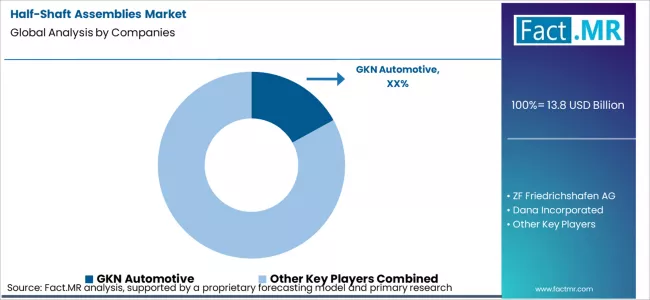
Half Shaft Assemblies Market Analysis By Company | Source: Fact.MR
The half-shaft assemblies market is transitioning from traditional mechanical components to performance-agnostic integrated drivelines, with a focus on decarbonization and hybrid vehicle specialization. Companies like GKN Automotive are increasingly investing in electric and full-hybrid platforms, with 43% of new business wins coming from these segments. Nexteer Automotive is gaining traction in China, with 39% of bookings tied to domestic OEMs, driven by innovations like Face Spline Axle and 8-Ball Joint technologies. Moving forward, circular economy integration is becoming a core competitive strategy, with GKN launching sideshaft remanufacturing to reduce steel usage by 80%. Hybrid driveline specialization is also emerging, particularly for the North American hybrid SUV market, as seen in Hyundai WIA's mass production of hybrid driveline components. The market is shifting toward motion-as-a-service, where half-shafts are bundled with software-defined chassis control to capture high-margin system integration contracts. Firms failing to adopt remanufacturing and circular economies will face price erosion from carbon-neutral mandates.
Recent Industry Developments
- Patent (2025): A half-shaft assembly patent (US-12208644-B2) covering a design with improved constant velocity (CV) joints and axial movement joint was published. This represents recent intellectual property activity in half-shaft design and drivetrain component innovation.???? Patent - Axial plunging half-shaft assembly (US-12208644-B2): https://pubchem.ncbi.nlm.nih.gov/patent/US-12208644-B2 (PubChem)
- Acquisition / Business Sale (Oct 2024): American Axle & Manufacturing (AAM) announced the sale of its commercial vehicle axle business and related assets in India (including axle assembly operations) to Bharat Forge Limited (BFL) for $65 million. This deal reshapes a major production base for axle and related components (which include half-shaft assemblies).???? Press release - AAM Announces Sale of Commercial Vehicle Axle Business in India: https://www.aam.com/media/story/aam-announces-sale-of-commercial-vehicle-axle-business-in-india (American Axle & Manufacturing)
- Joint Venture / Strategic Partnership (Apr 2024): ZF Friedrichshafen AG and Foxconn (Hon Hai Technology Group) completed a 50/50 joint venture for passenger car chassis systems, expanding capabilities in drivetrain and axle systems (including half-shaft production and integration) and reinforcing future component development.???? Press release - ZF and Foxconn Close on JV for Passenger Car Chassis Modules: https://www.foxconn.com/en-us/press-center/press-releases/latest-news/1329 (foxconn.com)
Key Players of the Half-Shaft Assemblies Market
- Companies
- GKN Automotive
- ZF Friedrichshafen AG
- Dana Incorporated
- NTN Corporation
- Schaeffler AG
- Hyundai WIA Corporation
- Wanxiang Group Corporation
- JTEKT Corporation
- Nexteer Automotive
- SKF AB
Bibliographies
- International Organization for Standardization. (2023). ISO 1940-1: Mechanical vibration - Balance quality requirements for rotors in a constant (rigid) state. ISO.
- United Nations Economic Commission for Europe (UNECE). (2024). Regulation No. 13 - Braking, drivetrain load, and axle performance considerations for passenger vehicles. UNECE Transport Division.
- National Highway Traffic Safety Administration (NHTSA). (2023). Drivetrain component integrity and vehicle safety performance in passenger vehicles. U.S. Department of Transportation.
- Institute of Electrical and Electronics Engineers (IEEE). (2024). Axle torque transmission and half-shaft stress behavior in electric and hybrid vehicles. IEEE Xplore Digital Library.
- European Commission Joint Research Centre. (2024). Materials engineering and torsional durability in automotive drivetrain components. JRC Technical Report.
Segmentation
Scope of the Report
| Items | Values |
|---|---|
| Quantitative Units (2026) | USD Billion |
| Sales Channel | First Fit (OEM), Aftermarket |
| Drive | FWD, RWD, AWD/4WD |
| Vehicle Type | Passenger Cars, LCV, HCV |
| Material | Steel, High-strength or Lightweight |
| Powertrain | ICE or HEV, BEV |
| Regions Covered | North America, Europe, Asia Pacific, Latin America, Middle East & Africa |
| Countries Covered | United States, Canada, Mexico, Germany, United Kingdom, France, Japan, South Korea, China, India, Brazil, and other countries |
| Key Companies Profiled | GKN Automotive, ZF Friedrichshafen AG, Dana Incorporated, NTN Corporation, Schaeffler AG, Hyundai WIA Corporation, Wanxiang Group Corporation, JTEKT Corporation, Nexteer Automotive, SKF AB |
| Additional Attributes | Dollar revenue by sales channel, drive, vehicle type, material, powertrain, and region; regional demand trends, competitive landscape, technological advancements in half-shaft assemblies, operational performance optimization initiatives, and product development strategies |
Source: Fact.MR analysis. Updated Feb 2, 2026
Half-Shaft Assemblies Market Key Segments
-
Sales Channel :
- First Fit (OEM)
- Aftermarket
-
Drive :
- FWD
- RWD
- AWD/4WD
-
Vehicle Type :
- Passenger Cars
- LCV (Light Commercial Vehicle)
- HCV (Heavy Commercial Vehicle)
-
Material :
- Steel
- High-strength or Lightweight
-
Powertrain :
- ICE or HEV
- BEV
-
Region :
- North America
- USA
- Canada
- Mexico
- Europe
- Germany
- UK
- France
- Italy
- Spain
- Nordic Countries
- BENELUX
- Rest of Europe
- Asia Pacific
- China
- Japan
- South Korea
- India
- Australia
- Rest of Asia Pacific
- Latin America
- Brazil
- Argentina
- Rest of Latin America
- Middle East and Africa
- Kingdom of Saudi Arabia
- United Arab Emirates
- South Africa
- Rest of Middle East and Africa
- Other Regions
- Oceania
- Central Asia
- Other Markets
- North America
Frequently Asked Questions
How big is the half-shaft assemblies market in 2026?
What will be the size of half-shaft assemblies market in 2036?
How much will be the half-shaft assemblies market growth between 2026 and 2036?
What are the key product types in the half-shaft assemblies market?
Which drive segment to contribute significant share in the half-shaft assemblies market in 2026?
Who worked on this report


Preview the report firsthand - request a free sample
Free SampleGet the brochure for pricing and purchase details
Download PDF