- Market Value (2025): USD 284.9 Mn
- Estimated Value (2026): USD 310.0 Mn
- Forecast Value (2036): USD 720.0 Mn
- CAGR (2026-2036): 8.8%
What is the Handheld Backscatter X-Ray Devices Market forecast to be worth by 2036?
USD 310.0 million in 2026 to USD 720.0 million by 2036 at 8.8% CAGR.
- The handheld backscatter X-Ray devices market reached USD 284.9 million in 2025 as law-enforcement and customs teams continued to use portable inspection tools for field checks.
- Demand is projected to increase from USD 310.0 million in 2026 to USD 720.0 million by 2036.
- The market is forecast to record 8.8% CAGR from 2026 to 2036.
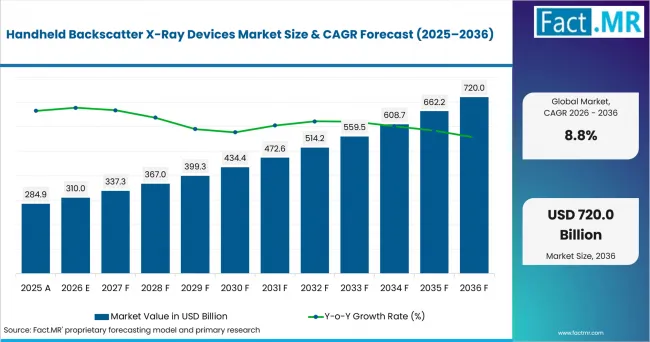
Handheld Backscatter X Ray Devices Market Value Analysis | Source: Fact.MR
What are the defining numbers behind Handheld Backscatter X-Ray Devices Market growth?
USD 410.0 million absolute opportunity by 2036.
- Demand Drivers in the Market
- Inspection teams need portable tools that can check luggage and vehicle panels without shifting every object to a fixed scanner. GAO reported that CBP increased passenger-vehicle scanning from 2% in fiscal 2020 to 8% in fiscal 2024 and commercial-vehicle scanning from 16% to 27%, expanding the flow of anomalies that can require targeted follow-up inspection.
- Backscatter imaging is expected to remain useful when operators need single-sided contrast for narcotics and hidden compartments.
- Law-enforcement agencies are anticipated to prioritize devices that support quick field decisions and preserve digital evidence for case records.
- Customs and border users require rugged devices for secondary inspection areas and temporary security checkpoints. DHS Science and Technology reported in June 2025 that CBP confiscated more than 573,000 pounds of illicit drugs in fiscal 2024, including more than 21,000 pounds of fentanyl, along with close to 5,000 weapons, supporting continued demand for field inspection tools.
- Key Segments Analyzed
- By Device Category: Handheld Backscatter X-ray Scanners are expected to hold 52.0% share in 2026 because they match the core use case for mobile inspection.
- By Application: Security Screening is projected to account for 46.0% share in 2026 as agencies use handheld devices during secondary checks.
- By End User: Law Enforcement Agencies are anticipated to capture 38.0% share in 2026 since field teams need portable imaging for contraband investigations.
- By Distribution Channel: Direct Sales is estimated to represent 57.0% share in 2026 due to training and government procurement workflows.
- By Imaging Technology: Backscatter X-ray Imaging is forecast to hold 61.0% share in 2026 as it provides the core contrast mechanism.
- Analyst Opinion at Fact.MR
- Shambhu Nath Jha, Sr. Consultant at Fact.MR, opines: “Handheld backscatter X-ray devices are expected to gain value where inspection teams need fast field evidence without a fixed scanning lane. Product acceptance is likely to depend on image clarity and dose control. Training support and service response are expected to matter more than portability alone.”
- Strategic Implications
- Manufacturers should show clear operating procedures for vehicle and parcel inspection before buyers compare device pricing.
- Providers can improve procurement outcomes by pairing the device with operator training and simple evidence-management workflows.
- Investors should separate direct handheld backscatter exposure from broader security scanning activity because buyer budgets differ.
- The USA leads at 9.7% CAGR through customs and public-safety inspection needs. China follows at 9.3% through security infrastructure and domestic equipment supply. Germany reaches 8.9% through transport inspection demand. The UK records 8.5%. Japan posts 8.1%. Canada reaches 7.7%. South Korea records 7.3% through port-security use cases.
How does the Handheld Backscatter X-Ray Devices Market break down by segment?
Handheld Backscatter X-ray Scanners are expected to lead Device Category at 52.0% share in 2026. Security Screening is projected to lead Application at 46.0% share in 2026.
Which Device Category dominates?
Handheld Backscatter X-ray Scanners are projected to account for 52.0% share in 2026.
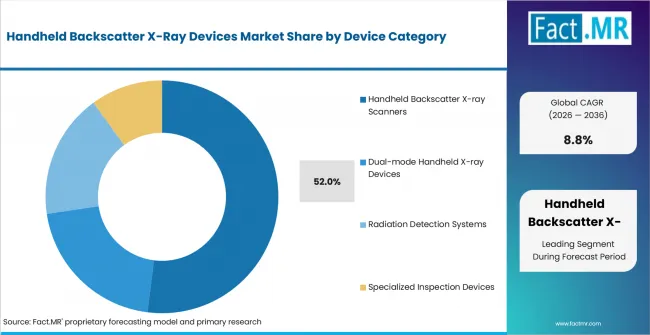
Handheld Backscatter X Ray Devices Market Analysis By Device Category | Source: Fact.MR
The category leads because it represents the primary form factor used when an operator must scan a target in place. A device can be carried to a vehicle lane or storage area. Buyers are expected to value rugged housing and safe operating steps. Hybrid and transmission-assisted devices remain useful when agencies require deeper confirmation. GAO also reported that 52 of 153 planned large-scale CBP non-intrusive inspection systems were fully operational as of February 2025.
Why does Security Screening lead Application?
Security Screening is expected to hold 46.0% share in 2026.
The segment benefits from checkpoint support and targeted screening around facilities and vehicles. It connects with airport security where portable tools handle exceptions outside fixed lanes. Handheld systems do not replace fixed scanners. Their value is concentrated in closer inspection of a suspicious area without unpacking or disassembling the item. This gives security teams a practical reason to keep portable devices available during daily operations. TSA reported in January 2025 that officers intercepted 6,678 firearms at U.S. airport security checkpoints during 2024, illustrating the scale of daily screening activity that supports layered inspection workflows.
Why do Law Enforcement Agencies lead End User?
Law Enforcement Agencies are anticipated to account for 38.0% share in 2026.
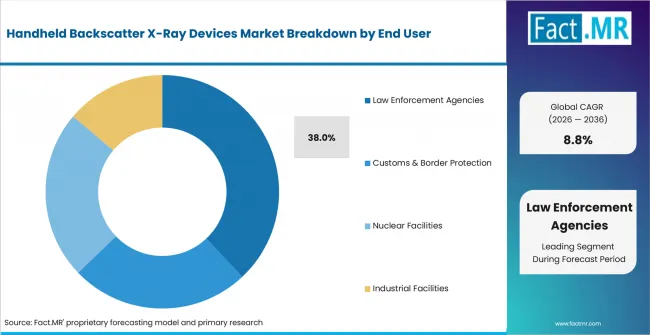
Handheld Backscatter X Ray Devices Market Analysis By End User | Source: Fact.MR
Law-enforcement use is shaped by narcotics interdiction and evidence documentation. Field teams need simple image storage and chain-of-custody workflows. Broader explosive detection technology spending reflects the same focus on actionable information at the point of inspection. DHS Science and Technology reported that CBP screened more than 2.9 million individuals and more than 38 million pieces of cargo in fiscal 2024, showing the operational scale faced by federal enforcement teams.
Why does Direct Sales lead Distribution Channel?
Direct Sales is estimated to represent 57.0% share in 2026.
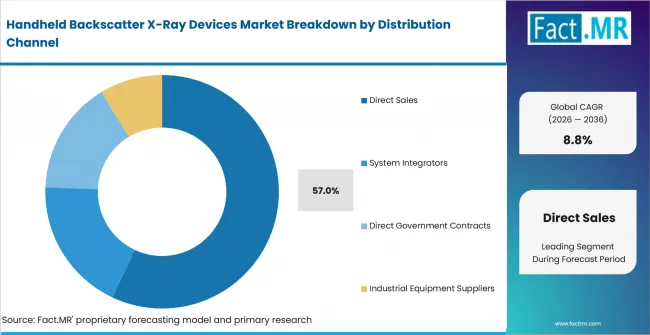
Handheld Backscatter X Ray Devices Market Analysis By Distribution Channel | Source: Fact.MR
Direct sales lead because handheld backscatter devices require demonstrations and radiation-safety documentation before purchase. Agency buyers need training support and service terms from the supplier. Automated border control procurement follows a similar pattern of vendor-led approval work.
Why does Backscatter X-ray Imaging lead Imaging Technology?
Backscatter X-ray Imaging is forecast to hold 61.0% share in 2026.
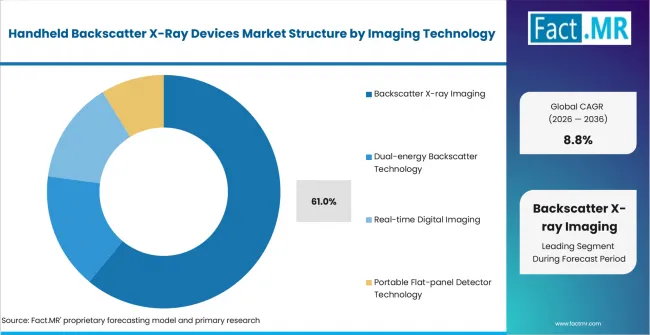
Handheld Backscatter X Ray Devices Market Analysis By Imaging Technology | Source: Fact.MR
Backscatter imaging leads because it supports single-sided inspection and surface-sensitive detection. Officers can inspect an object when it cannot be placed between a source and detector. The category remains important where operators need single-sided imaging during field inspection.
What is accelerating Handheld Backscatter X-Ray Devices Market adoption, and what is holding it back?
Demand depends on field inspection needs, faster secondary screening, and documented radiation-safety procedures. Buyers evaluate portability together with image quality, operating controls, training, and service support.
Drivers
| Driver | Relative Impact | Geographic Relevance | Impact Timeline |
|---|---|---|---|
| Field portability and quick-sweep use | High | USA, China, Germany | Near term |
| Organic-material visibility during targeted checks | High | Border and security agencies | Near term |
| Agency readiness and operator-training support | Medium | North America and Europe | Mid term |
| Digital image capture and reporting | Medium | Global | Mid term |
| Safety and dose-control features | Medium | Regulated markets | Long term |
Source: Fact.MR analysis. Updated Aug 10, 2026
Opportunities
| Opportunity | Relative Impact | Geographic Relevance | Impact Timeline |
|---|---|---|---|
| Border and vehicle-inspection programs | Medium | USA, Canada, China | Mid term |
| Corrections and facility screening | Medium | USA, UK, Germany | Mid term |
| Service-led procurement models | Medium | Direct-sales markets | Long term |
| AI-assisted image review | Low | Advanced security users | Long term |
Source: Fact.MR analysis. Updated Aug 10, 2026
Restraints
| Restraint | Relative Impact | Geographic Relevance | Impact Timeline |
|---|---|---|---|
| Radiation-safety procedure burden | High | Regulated markets | Near term |
| Operator-training requirements | Medium | Global | Near term |
| Budget cycles and procurement delays | Medium | Public-sector buyers | Mid term |
| Limited penetration compared with larger systems | Low | Cargo-heavy applications | Long term |
Source: Fact.MR analysis. Updated Aug 10, 2026
Which countries are scaling Handheld Backscatter X-Ray Devices Market fastest?
The USA, China, Germany, the UK, and Japan are the countries shown in the comparative outlook. Adoption depends on border and security workflows, radiation-use controls, procurement structures, and inspection requirements.
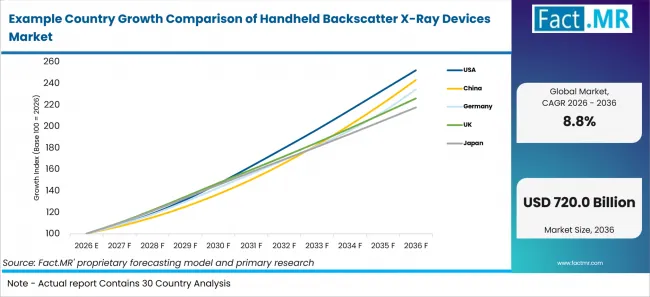
Example Country Growth Comparison Of Handheld Backscatter X Ray Devices Market | Source: Fact.MR
Country CAGR (2026-2036)
| Country | CAGR |
|---|---|
| USA | 9.7% |
| China | 9.3% |
| Germany | 8.9% |
| UK | 8.5% |
| Japan | 8.1% |
| Canada | 7.7% |
| South Korea | 7.3% |
Source: Fact.MR analysis. Updated Aug 10, 2026
What supports USA adoption?
USA is projected to register a 9.7% CAGR through 2036.
Agencies evaluate portability, evidence handling, safety procedures, and fit with customs and law-enforcement inspection workflows before approving handheld X-ray systems.
How is China scaling demand?
China is projected to register a 9.3% CAGR through 2036.
Buyers assess handheld security equipment for image quality, ruggedness, and fit with customs, law-enforcement, and transport-security operations.
What is driving Germany's growth from 2026 to 2036?
Germany is projected to register an 8.9% CAGR through 2036.
Detailed technical evaluation, radiation-safety documentation, dependable equipment performance, and responsive service support remain central to procurement.
How is UK demand developing?
The UK is projected to register an 8.5% CAGR through 2036.
Users evaluate handheld systems for secondary checks and event-security work where a fixed lane cannot address a narrow field-inspection question.
How does Japan perform?
Japan is projected to register an 8.1% CAGR through 2036.
Precise procurement standards and space-limited inspection environments make image stability, compact design, dependable operation, and maintenance support important selection criteria.
What supports Canada’s growth?
Canada is projected to register a 7.7% CAGR through 2036.
Targeted border-security and enforcement programs create demand for equipment that performs reliably across varied inspection settings.
How is South Korea advancing?
South Korea is projected to register a 7.3% CAGR through 2036.
Port security and customs users assess compact systems that complement fixed scanning assets during targeted inspection work.
Who leads the Handheld Backscatter X-Ray Devices Market?
Viken Detection Corporation, OSI Systems, Inc. through Rapiscan Systems and AS&E, Videray Technologies, Inc., and Nuctech Company Limited have direct handheld backscatter product evidence. Buyers compare field portability, image quality, radiation controls, digital evidence handling, operator training, and service coverage.
Which companies are the key providers?
Key companies profiled in the Handheld Backscatter X-Ray Devices market include Viken Detection Corporation, OSI Systems, Inc. through Rapiscan Systems and AS&E, Videray Technologies, Inc., and Nuctech Company Limited.
Viken Detection Corporation
OSI Systems, Inc. through Rapiscan Systems and AS&E
Videray Technologies, Inc.
Nuctech Company Limited
Bibliography
- Department of Homeland Security. (2026, July 15). NII Large-Scale Fixed Systems (MEP & LEP).
- U.S. Department of Homeland Security, Science and Technology Directorate. (2025, September 9). Feature article: Inside the X-ray technology showcase supporting DHS components.
- U.S. Customs and Border Protection. (2025, May 20). CBP partners with Canadian Pacific Kansas City Railway Company at the Laredo Rail Port of Entry.
- U.S. Department of Homeland Security, Science and Technology Directorate. (2025, June 23). S&T is developing new fentanyl-detection technologies.
- U.S. Government Accountability Office. (2026). Border security: Improvements needed to increase vehicle scanning at land ports of entry (GAO-26-108767).
- State Council of the People's Republic of China. (2025). China’s customs handle 5,719 smuggling criminal cases in 2024.
Viken Detection. Nighthawk Handheld X-Ray Backscatter Imaging System.
Rapiscan Systems. AS&E MINI Z Handheld Z Backscatter.
Videray Technologies. Handheld Backscatter X-Ray Imager.
Nuctech Company Limited. BXM2000 Handheld Backscatter Inspection Instrument.
This Report Answers
- The report examines Handheld Backscatter X-Ray Devices Market performance by Device Category, Application, End User, Distribution Channel, Imaging Technology, and Region.
- Handheld Backscatter X-ray Scanners lead Device Category with a 52.0% share in 2026, while Security Screening leads Application with a 46.0% share.
- The country outlook compares the USA, China, Germany, the UK, and Japan, with additional coverage of Canada and South Korea.
- Competitive analysis profiles Viken Detection Corporation, OSI Systems, Inc. through Rapiscan Systems and AS&E, Videray Technologies, Inc., and Nuctech Company Limited.
- The assessment evaluates market value and share across the defined segment groups.
What does the Handheld Backscatter X-Ray Devices Market cover?
Handheld Backscatter X-Ray Devices Market covers portable X-ray inspection equipment used for one-sided field screening of concealed threats. The scope follows Device Category, Application, End User, Distribution Channel, Imaging Technology, and Region.
What is included in the scope?
Coverage includes handheld backscatter scanners, transmission imagers, hybrid devices, compact inspection units, and accessory imaging kits used for security screening, contraband detection, vehicle and cargo inspection, critical-infrastructure inspection, and facility or event security. The report covers the end users, distribution channels, imaging technologies, and regions defined in the segmentation.
What is excluded from the scope?
Medical diagnostic X-ray systems, dental X-ray systems, CT scanners, and fixed high-energy inspection portals are outside the scope unless they are part of a defined handheld or field-portable backscatter workflow.
How was the analysis built?
The analysis draws on public company disclosures, product documentation, government and regulatory material, technical studies, industry publications, and interviews with relevant market participants. These inputs are assessed alongside the report's defined market scope, segment structure, regional coverage, and forecast period.
Segmentation
What is the report’s scope and coverage?
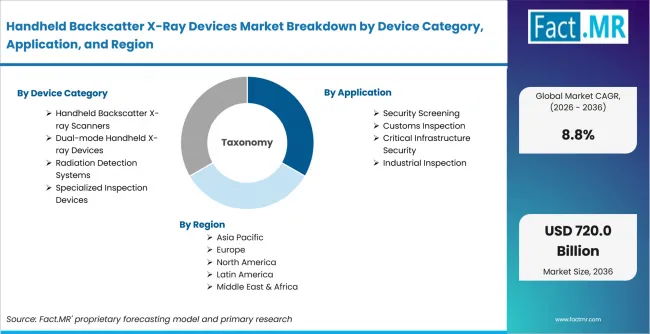
Handheld Backscatter X Ray Devices Market Breakdown By Device Category, Application, And Region | Source: Fact.MR
| Attribute | Details |
|---|---|
| Quantitative Units | USD 310.0 million in 2026 to USD 720.0 million by 2036 at 8.8% CAGR |
| Market Definition | Portable X-ray inspection devices that use backscatter imaging to reveal concealed threats during field screening |
| Device Category | Handheld Backscatter X-ray Scanners; Handheld Transmission X-ray Imagers; Hybrid Backscatter/Transmission Devices; Compact X-ray Inspection Units; Accessory Imaging Kits |
| Application | Security Screening; Contraband Detection; Vehicle and Cargo Inspection; Critical Infrastructure Inspection; Facility and Event Security |
| End User | Law Enforcement Agencies; Customs and Border Agencies; Correctional Facilities; Military and Defense Units; Critical Infrastructure Operators |
| Distribution Channel | Direct Sales; Distributor/Dealer Networks; Government Procurement Platforms; Rental/Leasing Programs; Service Contracts |
| Imaging Technology | Backscatter X-ray Imaging; Transmission X-ray Imaging; Dual-Mode Imaging; Digital Image Enhancement; Automated Threat Assistance |
| Regions Covered | North America; Latin America; Europe; East Asia; South Asia and Pacific; Middle East and Africa |
| Countries Covered | USA; China; Germany; UK; Japan; Canada; South Korea |
| Key Companies Profiled | Viken Detection Corporation; OSI Systems, Inc. – Rapiscan Systems/AS&E; Videray Technologies, Inc.; Nuctech Company Limited; Scanna MSC Ltd.; Comet Holding AG |
| Forecast Period | 2026 to 2036 |
| Approach | Hybrid top-down and bottom-up approach using security inspection demand; handheld backscatter use cases; agency procurement patterns; radiation-safety needs; service requirements; training burden; regional adoption conditions; country growth patterns and company portfolio review |
Source: Fact.MR analysis. Updated Aug 10, 2026
How is the market segmented?
-
By Device Category
- Handheld Backscatter X-ray Scanners
- Compact Handheld Scanners
- Rugged Handheld Scanners
- Dual-mode Handheld X-ray Devices
- Backscatter & Transmission Devices
- Multi-purpose Inspection Devices
- Radiation Detection Systems
- Integrated Radiation Scanners
- Combined X-ray Detection Units
- Specialized Inspection Devices
- Handheld Industrial Scanners
- Portable Maintenance Scanners
- Handheld Backscatter X-ray Scanners
-
By Application
- Security Screening
- Contraband Detection
- Explosive Detection
- Customs Inspection
- Baggage Inspection
- Vehicle Inspection
- Critical Infrastructure Security
- Power Plant Security
- Port Security
- Industrial Inspection
- Non-destructive Testing
- Infrastructure Inspection
- Security Screening
-
By End User
- Law Enforcement Agencies
- Police Departments
- Border Security Agencies
- Customs & Border Protection
- Airport Security Authorities
- Defense & Military
- Nuclear Facilities
- Energy Utilities
- Seaport Authorities
- Industrial Facilities
- Oil & Gas Companies
- Critical Infrastructure Operators
- Law Enforcement Agencies
-
By Distribution Channel
- Direct Sales
- Government Procurement
- Authorized Distributors
- System Integrators
- Defense Contractors
- Specialized Security Suppliers
- Direct Government Contracts
- Defense Procurement Programs
- National Security Contracts
- Industrial Equipment Suppliers
- Industrial Distributors
- OEM Partnerships
- Direct Sales
-
By Imaging Technology
- Backscatter X-ray Imaging
- Low-dose Backscatter Imaging
- High-resolution Digital Imaging
- Dual-energy Backscatter Technology
- Dual-energy Imaging
- Portable Digital Detector Technology
- Real-time Digital Imaging
- AI-assisted Image Processing
- Image Enhancement Algorithms
- Portable Flat-panel Detector Technology
- High-sensitivity Digital Sensors
- Compact Solid-state Detectors
- Backscatter X-ray Imaging
-
By Region
- North America
- Latin America
- Europe
- East Asia
- South Asia and Oceania
- Middle East and Africa
Frequently Asked Questions
How big is the handheld backscatter X-ray devices market in 2026?
What is the CAGR of the handheld backscatter X-ray devices market from 2026 to 2036?
Which device category leads the handheld backscatter X-ray devices market?
Which application leads the handheld backscatter X-ray devices market?
Who are the leading companies in the handheld backscatter X-ray devices market?
Who worked on this report


Preview the report firsthand - request a free sample
Free SampleGet the brochure for pricing and purchase details
Download PDF