- Base Value(2025): 1.3 Bn
- Estimated Value(2026): 1.4 Bn
- Forecast Value (2036): 3.6 Bn
- CAGR (2026 - 2036): 10.7%
Haptic Feedback Switch and Button Platforms Market Forecast and Outlook by Fact.MR
In 2025, the haptic feedback switch and button platforms market was valued at USD 1.3 billion. Based on Fact.MR analysis, demand for haptic feedback switch and button platforms is estimated to grow to USD 1.4 billion in 2026 and USD 3.6 billion by 2036. FACT.MR projects a CAGR of 10.7% during the forecast period.
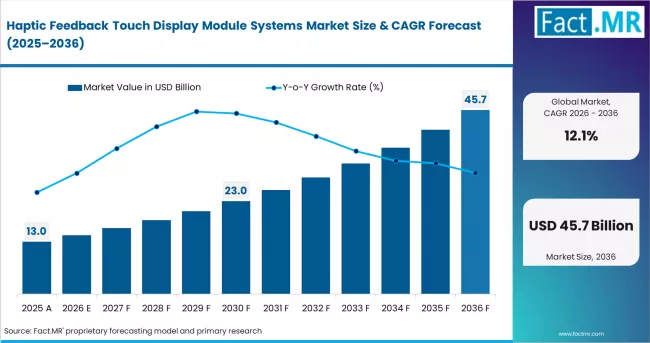
Haptic Feedback Touch Display Module Systems Market Value Analysis | Source: Fact.MR
Summary of Haptic Feedback Switch and Button Platforms Market
- Market Definition
- Market covers programmable haptic actuator platforms, controllers, and software used in automotive cockpit and consumer device touch interfaces globally.
- Demand Drivers
- Automotive OEMs are eliminating mechanical buttons and specifying haptic-enabled touch surfaces across EV cockpit refresh programmes.
- China's smart cockpit regulations are mandating advanced HMI systems that require programmable haptic feedback across new energy vehicle platforms.
- Consumer electronics brands are integrating force-calibrated haptic layers in wearables and smartphones to differentiate on tactile experience.
- Key Segments Analyzed
- By Component: Actuators lead at 50% share in 2026, anchored by ERM, LRA, and piezo units in automotive cockpit applications.
- By Technology: Electromechanical (ERM/LRA) holds 60% share in 2026, dominant across mid-range automotive and wearable platforms.
- By Application: Infotainment & center console controls lead at 45% share in 2026, driven by EV cockpit digitalization mandates.
- Analyst Opinion at FACT.MR
- Shambhu Nath Jha, Principal Consultant at Fact.MR, ‘CXOs will find that actuator technology differentiation is a key gatekeeper to design wins. Automotive-grade IC certification is the second critical barrier. Suppliers with validated piezoelectric platforms hold a strong advantage.’
- Strategic Implications
- Invest in piezoelectric and ultrasonic actuator platforms targeting premium EV cockpit and wearable design win pipelines.
- Build co-development partnerships with automotive tier-1 HMI integrators ahead of EV platform refresh cycles in China and Germany.
- Target mid-segment automotive programmes in India with cost-optimised ERM/LRA haptic solutions matching OEM price-point mandates.
- Methodology
- Uses actuator shipment volumes and ASP benchmarks validated with 2024 to 2025 OEM procurement data.
- Includes company disclosures from Bosch, TDK, Immersion Corporation, and Continental AG filings.
- Forecasts consider EV cockpit adoption curves, haptic IC certification timelines, and consumer electronics refresh cycles.
| Metric | Value |
|---|---|
| Estimated Value in 2026 | USD 1.4 billion |
| Forecast Value in 2036 | USD 3.6 billion |
| Forecast CAGR (2026 to 2036) | 10.7% |
Source: Fact.MR analysis. Updated Apr 29, 2026
The market is projected to generate USD 2.2 billion in absolute opportunity over the forecast period. Growth is structurally driven by automotive cockpit digitalization and wearable device expansion. Adoption is steady across premium segments but constrained by higher per-unit cost of piezoelectric and ultrasonic actuators relative to mechanical alternatives in cost-sensitive mid-range platforms.
Haptic integration is shifting from simple buzz-notification to force-calibrated, multi-zone tactile response. Automotive tier-1 suppliers are securing design wins by embedding haptic controllers directly into cockpit domain architectures. Semiconductor players with validated automotive-grade haptic IC portfolios are consolidating OEM relationships ahead of EV cockpit refresh cycles.
China leads with 11.5% CAGR, driven by electric vehicles production scale and smart cockpit mandates across domestic brands. India follows at 11.0% on rising mid-segment vehicle volumes and consumer electronics expansion. South Korea records 10.7% through display and haptic integration leadership at Samsung and LG subsidiaries. Germany registers 10.0% via premium OEM adoption at BMW and Volkswagen platforms. The United States grows at 9.4% supported by advanced HMI integration across North American automotive and wearable device programmes. Mature European markets generate steady replacement demand, constrained by longer platform refresh cycles and higher validation costs.
Segmental Analysis
Haptic Feedback Switch and Button Platforms Market Analysis by Component
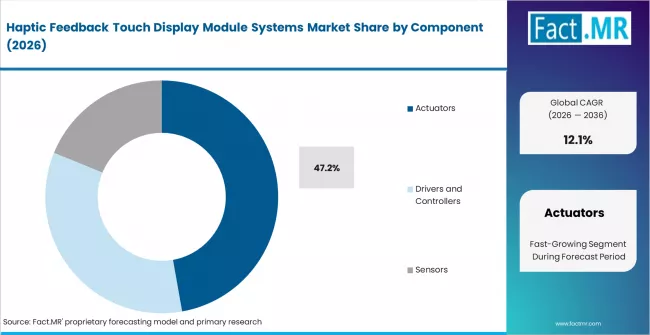
Haptic Feedback Touch Display Module Systems Market Analysis By Component | Source: Fact.MR
Based on Fact.MR, actuators hold ~50% share in 2026. They lead due to their direct role in tactile output. ERM, LRA, and piezo actuators are core revenue drivers. Automotive cockpit demand supports high volumes and stable pricing.
- TDK Actuator Expansion: TDK Corporation expanded its PowerHap piezo series in 2024. New variants target automotive HMI. Focus is on compact, high-force applications. [1]
- Alps Alpine LRA Development: Alps Alpine Co., Ltd. launched an updated LRA module in 2025. It offers higher force and lower power use. It targets mid-range vehicle platforms. [2]
- Actuator Consolidation Trend: Tier-1 suppliers are reducing vendor bases. Preference is for ISO 26262-compliant suppliers. This increases value for qualified actuator specialists. [3]
Haptic Feedback Switch and Button Platforms Market Analysis by Technology
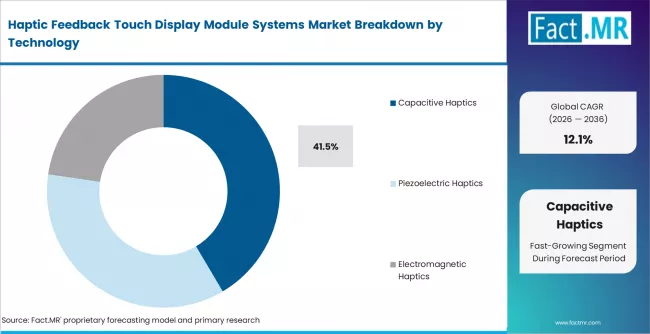
Haptic Feedback Touch Display Module Systems Market Analysis By Technology | Source: Fact.MR
Based on Fact.MR, electromechanical (ERM/LRA) holds ~60% share in 2026. It benefits from mature supply chains and lower cost. It is widely used across automotive and consumer devices. Piezoelectric technology is growing faster in premium segments.
- Immersion Licensing: Immersion Corporation expanded licensing in 2024. It covers both electromechanical and piezo platforms. New deals target EV cockpit programmes. [4]
- Bosch Piezo Platform: Robert Bosch GmbH advanced piezo switch modules in 2025. Focus is on steering and HVAC controls. Target is premium OEM programmes. [5]
- ERM Persistence: ERM remains dominant in mid-range devices. It benefits from low cost and established ecosystems. 2024 shipment data shows continued high-volume demand in Asia. [6]
Drivers, Restraints, and Opportunities
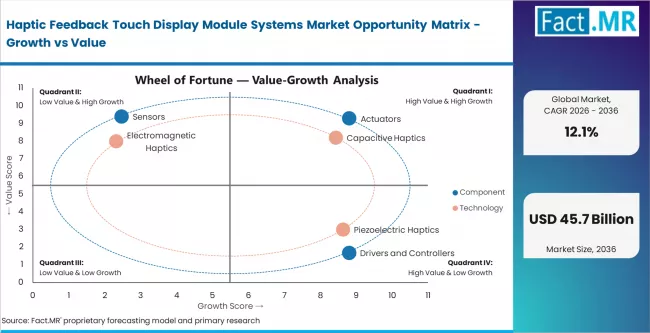
Haptic Feedback Touch Display Module Systems Market Opportunity Matrix Growth Vs Value | Source: Fact.MR
Fact.MR analysts observe that the market is a fast-growing segment within automotive and consumer electronics HMI. Demand is driven by replacement of mechanical switches with programmable haptic surfaces. This shift is visible across EV cockpits, premium smartphones, and wearable devices. Tactile confirmation has become a standard expectation in digital interfaces. Haptic actuator platforms address this functional gap.
The market is consolidating toward higher-fidelity actuator technologies. Basic ERM motors are losing relevance in premium segments. LRA and piezoelectric solutions offer precise, multi-zone tactile feedback. These platforms have higher costs but support premium positioning. Revenue growth is driven more by ASP expansion than volume.
- EV Cockpit Digitalization: EV platforms are removing mechanical buttons from dashboards and consoles. Haptic-enabled touch surfaces are becoming standard. OEM demand is rising for automotive-grade, safety-certified actuators. The trend is strongest in China with fully haptic-integrated EV cockpits.
- Smart Cockpit Standards in China: China’s GB/T 39263-2020 HMI standard is driving adoption. OEMs like BYD and NIO are deploying programmable haptic controls. This regulation is accelerating procurement across tier-1 suppliers.
- Consumer Wearable Expansion: Wearable shipments are rising in Asia Pacific and North America. TDK Corporation and Alps Alpine Co., Ltd. reported higher actuator demand in 2024. Growth is driven by tactile notifications in compact devices.
Regional Analysis
The haptic feedback switch and button platforms market is assessed across Asia Pacific, North America, Europe, Latin America, and Middle East and Africa, covering 40+ countries with demand shaped by automotive EV adoption, OEM cockpit design mandates, consumer electronics refresh cycles, and haptic platform regulatory requirements. The full report provides market attractiveness analysis by region and country.
.webp "Top Country Growth Comparison Haptic Feedback Touch Display Module Systems Market Cagr (2026 2036)")
Top Country Growth Comparison Haptic Feedback Touch Display Module Systems Market Cagr (2026 2036) | Source: Fact.MR
| Country | CAGR (2026 to 2036) |
|---|---|
| China | 11.5% |
| India | 11.0% |
| South Korea | 10.7% |
| Germany | 10.0% |
| United States | 9.4% |
Source: Fact.MR analysis. Updated Apr 29, 2026
Source: Fact.MR (FACT.MR) analysis, based on proprietary forecasting model and primary research
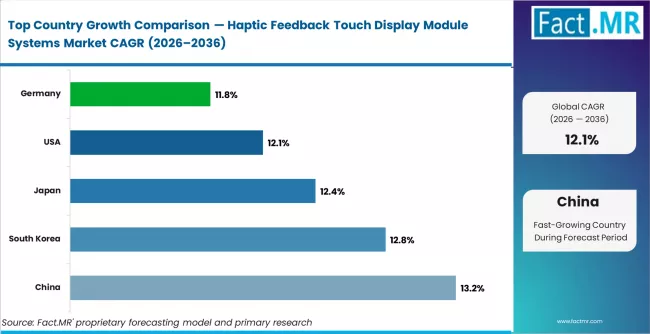
Haptic Feedback Touch Display Module Systems Market Cagr Analysis By Country | Source: Fact.MR
Asia Pacific Haptic Feedback Switch and Button Platforms Market Analysis
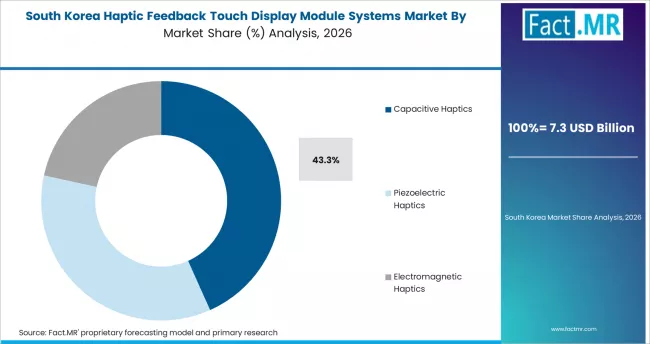
Haptic Feedback Touch Display Module Systems Market South Korea Market Share Analysis By Technology | Source: Fact.MR
Asia Pacific leads in both volume and growth for haptic platforms. China drives scale through EV production. India contributes through rising passenger vehicle demand. South Korea leads in display and actuator integration. TDK Corporation, Alps Alpine Co., Ltd., and BOE Technology Group are strengthening supply capabilities. The region is shifting toward vertically integrated haptic module manufacturing.
- China: China is scaling haptic adoption rapidly with EV dominance. Regulatory push from MIIT HMI standards is accelerating deployment. BYD and NIO are embedding haptics across new EV models. Domestic OEMs are standardising tactile interfaces. State-backed EV policies are compressing adoption timelines. Local sourcing of actuators is increasing.
- India: India is expanding haptic adoption into mid-range vehicles. Policy support through the PLI scheme is boosting local electronics integration. Maruti Suzuki and Tata Motors are introducing touch-based cockpits. Demand is shifting toward cost-efficient ERM and LRA solutions. Consumer preference for tactile feedback is rising in affordable segments. Supplier presence is strengthening through localization.
- South Korea: South Korea is advancing high-performance haptic integration. Samsung Electro-Mechanics and LG Innotek are scaling actuator supply. Hyundai Motor Group is deploying multi-zone haptic controls in EV models. Government support is accelerating domestic component innovation. The ecosystem is reducing reliance on imports.
Fact.MR analysis covers China, India, Japan, South Korea, ASEAN, and ANZ. It includes EV cockpit trends, actuator penetration, and production outlook.
Europe Haptic Feedback Switch and Button Platforms Market Analysis
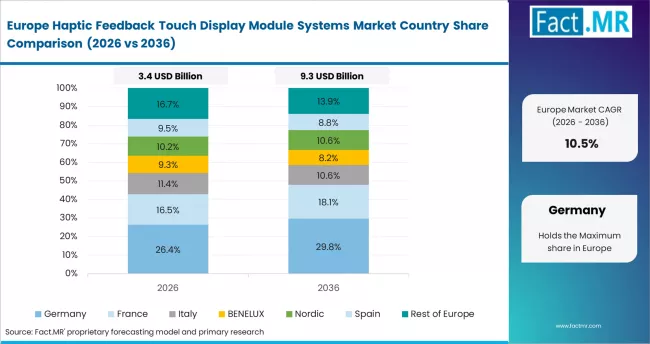
Haptic Feedback Touch Display Module Systems Market Europe Country Market Share Analysis, 2026 & 2036 | Source: Fact.MR
Europe leads in premium innovation and regulation. Demand is shaped by safety standards and OEM design mandates. Robert Bosch GmbH, Continental AG, and Valeo SA dominate supply through OEM partnerships. ISO 26262 compliance is a key differentiator.
- Germany: Germany anchors premium haptic deployment in Europe. BMW AG and Volkswagen Group are embedding tactile controls in new platforms. EU safety regulations are pushing adoption of intuitive interfaces. OEMs are focusing on multi-zone haptic feedback systems. Supplier investments in local manufacturing are increasing.
Fact.MR covers Germany, France, the UK, Italy, Spain, and the rest of Europe. The analysis includes regulatory impact and premium cockpit adoption.
North America Haptic Feedback Switch and Button Platforms Market Analysis
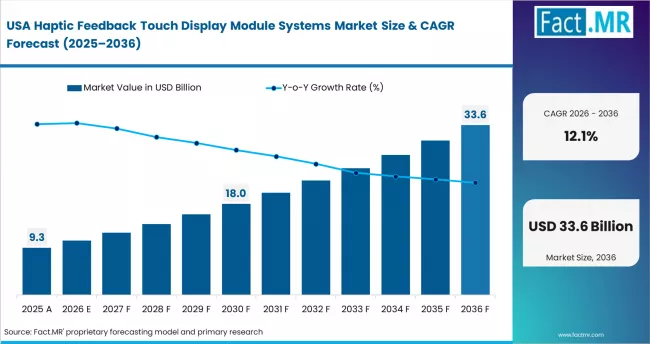
Haptic Feedback Touch Display Module Systems Market Country Value Analysis | Source: Fact.MR
North America is a mature but upgrading market. Demand is driven by EV cockpit integration and usability standards. Texas Instruments and Aptiv PLC support system integration. Consumer electronics demand continues to sustain actuator volumes.
- United States: The United States is focusing on advanced HMI functionality. Ford Motor Company and General Motors are deploying haptic controls in EV platforms. Regulatory guidance is encouraging reduced driver distraction. OEMs are integrating tactile feedback into steering and console systems. Wearable ecosystems are also driving actuator demand.
Fact.MR covers the United States, Canada, and Mexico. It includes EV adoption trends, HMI compliance, and wearable device demand.
Competitive Aligners for Market Players
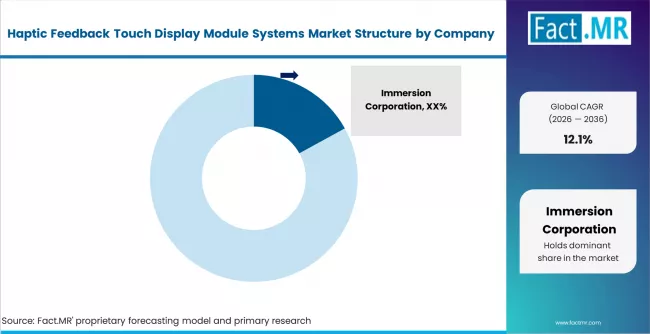
Haptic Feedback Touch Display Module Systems Market Analysis By Company | Source: Fact.MR
The competitive landscape is defined by control over actuator performance, system integration capability, and OEM access. Players are aligning strategies around high-fidelity tactile output, automotive-grade reliability, and scalable manufacturing.
Actuator specialists such as TDK Corporation and Alps Alpine Co., Ltd. are focusing on differentiated hardware. Investment is directed toward piezoelectric and advanced LRA platforms that deliver precise, multi-zone feedback. These companies are strengthening automotive-qualified portfolios to secure long-term supply agreements with OEMs.
Platform and IP-driven companies like Immersion Corporation are expanding licensing ecosystems. Their strategy centers on embedding proprietary haptic algorithms across both electromechanical and piezo platforms. This enables recurring revenue streams and deep integration into OEM design architectures.
Automotive tier-1 suppliers including Robert Bosch GmbH, Continental AG, and Valeo SA are prioritizing system-level integration. They are bundling haptic modules with broader HMI platforms, combining controllers, software, and safety-certified electronics. Co-development agreements with OEMs are central to securing design wins. Semiconductor companies such as Texas Instruments and NXP Semiconductors are targeting controller IC leadership. Their focus is on low-latency drivers and automotive-grade certification. Across the market, competitive advantage is shifting toward vertically integrated solutions that combine actuators, control electronics, and software into unified haptic platforms.
Key Players
- Robert Bosch GmbH
- Continental AG
- Denso Corporation
- Valeo SA
- Aptiv PLC
- Immersion Corporation
- TDK Corporation
- Texas Instruments Incorporated
- Alps Alpine Co., Ltd.
Bibliography
- [1] TDK Corporation. (2024). PowerHap piezo actuator series expansion for automotive HMI applications.
- [2] Alps Alpine Co., Ltd.. (2025). Next-generation LRA actuator module for automotive dashboard integration.
- [3] ISO. (2018). ISO 26262: Road vehicles – Functional safety standard and supplier compliance trends.
- [4] Immersion Corporation. (2024). Expansion of haptic technology licensing across automotive and consumer platforms.
- [5] Robert Bosch GmbH. (2025). Development of piezoelectric haptic modules for automotive control systems.
- [6] International Data Corporation. (2024). Global shipment trends for haptic actuators in consumer electronics and automotive applications.
This Report Addresses
- Strategic insights on demand across China, India, South Korea, Germany, and the United States. Covers EV cockpit adoption, haptic technology penetration, and OEM design win trends.
- Market forecast from USD 1.4 billion in 2026 to USD 3.6 billion by 2036, at a CAGR of 10.7%.
- Growth opportunity mapping across China EV cockpit mandates, India mid-segment vehicle expansion, and Germany premium OEM adoption.
- Segment analysis by component, technology, and application with leading sub-segment share and demand driver identification.
- Competition strategy assessment covering tier-1 automotive integrators, haptic IC specialists, and actuator platform suppliers.
- Regulatory impact analysis covering China GB/T 39263-2020, EU GSR 2019/2144, and NHTSA HMI usability standards.
- Technology tracking on piezoelectric actuator expansion, ERM/LRA platform evolution, and ultrasonic haptic development.
- Report delivery in PDF, Excel, and presentation formats with validated data and automotive procurement inputs.
Haptic Feedback Switch and Button Platforms Market Definition
The haptic feedback switch and button platforms market covers actuator systems, controllers, sensors, and software used to generate programmable tactile responses in touch-based interfaces.
Haptic Feedback Switch and Button Platforms Market Inclusions
Covers global and regional forecasts from 2026 to 2036 by component, technology, and application. Includes ERM, LRA, piezoelectric, and ultrasonic actuator platforms. Covers automotive infotainment, HVAC, steering, and surface control applications with haptic controller IC and software layers.
Haptic Feedback Switch and Button Platforms Market Exclusions
Excludes touchscreen display panels without dedicated haptic actuator integration. Omits standalone vibration motors in non-HMI applications. Excludes gaming controllers and medical simulation devices. Focus remains on programmable haptic switch and button platforms in automotive and consumer interface applications.
Haptic Feedback Switch and Button Platforms Market Research Methodology
- Primary Research
- Interviews with automotive tier-1 HMI engineers, haptic IC product managers, and consumer electronics platform designers across key markets.
- Desk Research
- Uses data from Bosch, Continental AG, TDK Corporation, and Immersion Corporation public filings and 2024–2025 automotive electronics procurement disclosures.
- Market-Sizing and Forecasting
- Hybrid model using actuator shipment volumes, ASP by technology tier, and automotive cockpit penetration rates by vehicle segment.
- Data Validation and Update Cycle
- Validated using OEM design win disclosures and haptic platform IC revenue benchmarks. Cross-checked with automotive electronics procurement data.
Segmentation
Scope of Report
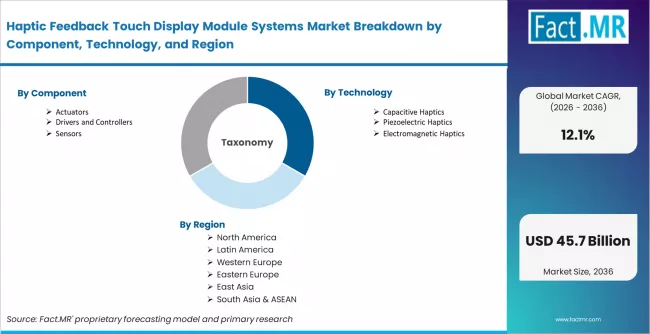
Haptic Feedback Touch Display Module Systems Market Breakdown By Component Technology And Region | Source: Fact.MR
| Attribute | Details |
|---|---|
| Quantitative Units | USD 1.4 billion (2026) to USD 3.6 billion (2036), at a CAGR of 10.7% |
| Market Definition | Programmable haptic actuator platforms, controllers, sensors, and software enabling tactile feedback in automotive cockpit and consumer device touch interfaces globally. |
| Component Segmentation | Actuators (ERM, LRA, Piezo), Controllers & Drivers, Sensors, Software |
| Technology Segmentation | Electromechanical (ERM/LRA), Piezoelectric, Ultrasonic & Electrostatic |
| Application Segmentation | Infotainment & Center Console Controls, HVAC Touch Controls, Steering Wheel Controls, Door/Seat/Surface Controls |
| Application Coverage | Automotive EV cockpit haptic surfaces, HVAC touch panels, steering wheel tactile alerts, wearable device feedback, and consumer electronics touch interfaces. |
| Regions Covered | North America, Europe, Asia Pacific, Latin America, Middle East and Africa |
| Countries Covered | USA, Canada, Mexico, Germany, UK, France, Italy, Spain, Nordic, BENELUX, China, Japan, South Korea, India, ASEAN, Australia and New Zealand, Brazil, Argentina, Chile, Saudi Arabia, GCC, Turkey, South Africa, Rest of MEA |
| Key Companies Profiled | Robert Bosch GmbH, Continental AG, Denso Corporation, Valeo SA, Aptiv PLC, Immersion Corporation, TDK Corporation, Texas Instruments Incorporated, Alps Alpine Co., Ltd. |
| Forecast Period | 2026 to 2036 |
| Approach | Hybrid top-down and bottom-up model using actuator shipment volumes, ASP by technology tier, automotive cockpit penetration rates, and primary interviews with OEM HMI engineers and haptic IC product managers. |
Source: Fact.MR analysis. Updated Apr 29, 2026
Haptic Feedback Switch and Button Platforms Market by Segment
-
By Component:
- Actuators (ERM, LRA, Piezo)
- Controllers & Drivers
- Sensors
- Software
-
By Technology:
- Electromechanical (ERM/LRA)
- Piezoelectric
- Ultrasonic & Electrostatic
-
By Application:
- Infotainment & Center Console Controls
- HVAC Touch Controls
- Steering Wheel Controls
- Door/Seat/Surface Controls
-
By Region:
- North America
- United States
- Canada
- Mexico
- Latin America
- Brazil
- Argentina
- Chile
- Rest of Latin America
- Western Europe
- Germany
- United Kingdom
- France
- Italy
- Spain
- Nordic Countries
- BENELUX
- Rest of Western Europe
- Eastern Europe
- Russia
- Poland
- Hungary
- Balkan and Baltic
- Rest of Eastern Europe
- East Asia
- China
- Japan
- South Korea
- South Asia and Pacific
- India
- ASEAN
- Australia and New Zealand
- Rest of South Asia and Pacific
- Middle East and Africa
- Kingdom of Saudi Arabia
- Other GCC Countries
- Turkey
- South Africa
- Rest of Middle East and Africa
- North America
Frequently Asked Questions
How large is the haptic feedback switch and button platforms market in 2025?
What will the market size be in 2026?
What is the projected market size by 2036?
What is the expected CAGR of the haptic feedback switch and button platforms market?
What is the absolute dollar opportunity in this market?
Which component segment leads the market?
Which technology segment is poised to lead?
Which application segment holds the largest share?
Which country shows the fastest growth?
What is driving market growth?
Who worked on this report


Preview the report firsthand - request a free sample
Free SampleGet the brochure for pricing and purchase details
Download PDF