- Market Value (2025): USD 314.0 Mn
- Estimated Value (2026): USD 335.0 Mn
- Forecast Value (2036): USD 640.0 Mn
- CAGR (2026-2036): 6.7%
What is the Heated Chemical Loading Arms Market forecast to be worth by 2036?
USD 335.0 million in 2026 to USD 640.0 million by 2036 at 6.7% CAGR.
- The heated chemical loading arms market crossed a valuation of USD 314.0 million in 2025.
- Demand is projected to increase from USD 335.0 million in 2026 to USD 640.0 million by 2036.
- The market is forecast to record 6.7% CAGR from 2026 to 2036 owing to heated transfer needs in bitumen/asphalt, sulfur and viscous chemical service.
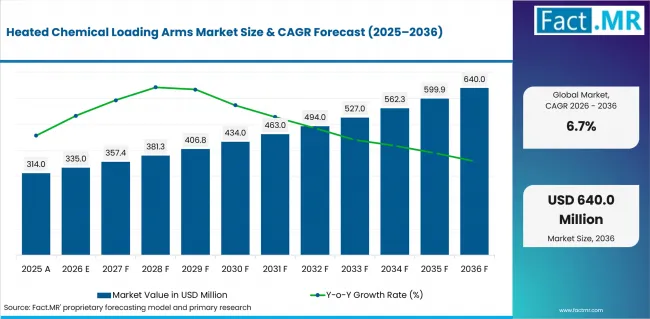
Heated Chemical Loading Arms Market Value Analysis | Source: Fact.MR
What are the defining numbers behind Heated Chemical Loading Arms Market growth?
USD 305.0 million absolute opportunity by 2036, led by Bitumen/asphalt and Steam-traced arms alongside Chemical producers.
- Demand Drivers in the Market
- Phenol, cresols and viscous acids can become difficult to transfer when their temperature falls during loading. Producers therefore use heated loading arms to keep the product moving between the rack and the receiving vessel.
- Asphalt and sulfur service creates demand for jacketed or heat-traced arms because a cooling product can solidify and block the line. The equipment protects loading schedules from that operating risk.
- Truck and rail terminals need a transfer connection that maintains product temperature without relying on manual hose handling. This makes purpose-built loading arms important where routine loading work exposes operators to heated chemicals.
- Loading-rack downtime rises when insulation, swivels or cleaning points are difficult to service. Buyers favor designs that make these maintenance tasks quicker and keep the rack available for the next transfer.
- Key Segments Analyzed
- By Product Handled: Bitumen/asphalt is expected to hold 26.0% share in 2026 due to steady rack demand for hot paving and refinery residue streams.
- By Heating Method: Steam-traced arms are projected to account for 46.0% share in 2026 since many chemical and refinery sites already operate steam utilities.
- By Loading Mode: Top loading is anticipated to capture 34.0% share in 2026 where sulfur, asphalt and chemical tankers still use top-hatch access.
- By End User: Chemical producers are estimated to represent 35.0% share in 2026 owing to wider use across phenols, acids and polymer-related liquids.
- Analyst Opinion at Fact.MR
- Shambhu Nath Jha, Sr. Consultant at Fact.MR, states: “Heated loading arms are chosen only after the product temperature window is understood at the rack. Purchases are expected to depend on heat continuity, safe reach and clean draining during repeated truck or rail operations. Providers with proven swivel design, insulation options and site documentation are better placed than catalog-only equipment sellers.”
- Strategic Implications
- Engineers should check product temperature, arm reach, insulation and swivel material before selecting a system.
- Buyers should compare the heating method, drainage and maintenance access before approving the equipment.
- Terminal operators should record heating, shutdown and lockout steps clearly to reduce safety risks.
Saudi Arabia is expected to record 8.3% CAGR through 2036, supported by refinery and chemical-terminal heat-handling requirements. The USA is projected to post 7.8% CAGR owing to asphalt terminals, refinery loading racks and chemical distribution sites. Japan is anticipated to advance at 7.1% CAGR where safety-focused chemical operators upgrade hot-product transfer points. Germany is estimated to hold 6.7% CAGR due to its chemical manufacturing base and strict site-engineering reviews. The UK is forecast to reach 6.3% CAGR as terminals and specialty chemical plants replace older hose-heavy loading arrangements.
How does the Heated Chemical Loading Arms Market break down by segment?
Bitumen/asphalt leads Product Handled at 26.0% share in 2026. Steam-traced arms lead Heating Method at 46.0% share in 2026.
Which product handled dominates?
Bitumen/asphalt is projected to account for 26.0% share in 2026.
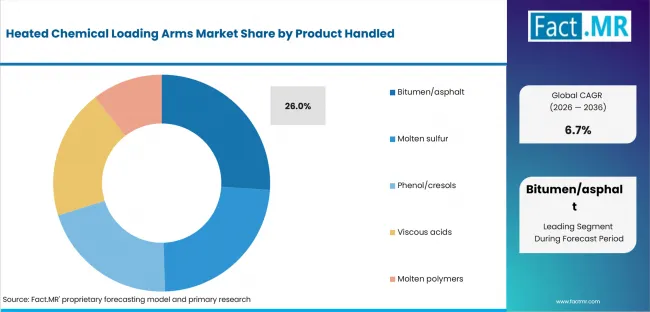
Heated Chemical Loading Arms Market Analysis By Product Handled | Source: Fact.MR
Bitumen/asphalt is projected to account for 26.0% share in 2026 since hot transfer stability decides whether loading remains smooth. Molten sulfur stays close to the market boundary since narrow temperature control is needed to avoid freezing inside the arm. Phenol/cresols and viscous acids support specialist demand where compatibility proof is central. Molten polymers add selected demand at resin and polymer handling sites.
What leads the Heating Method segment?
Steam-traced arms are expected to hold 46.0% share in 2026.
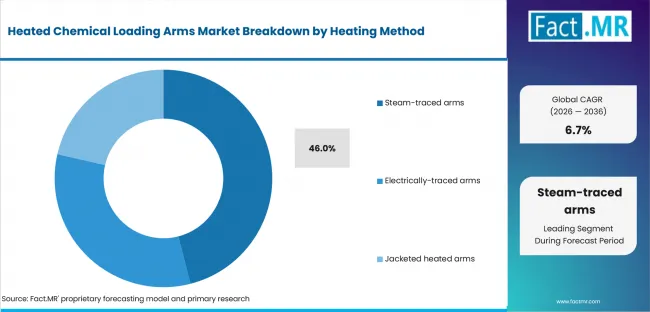
Heated Chemical Loading Arms Market Analysis By Heating Method | Source: Fact.MR
Steam-traced arms are expected to hold 46.0% share in 2026 due to their fit with refinery and chemical sites that already run steam networks. Electrically-traced arms serve terminals where steam supply is limited or where tighter zone control is preferred. Jacketed heated arms remain relevant when product heat loss is severe and the rack needs wider thermal coverage.
How does Loading Mode shape demand?
Top loading is anticipated to lead with 34.0% share in 2026.
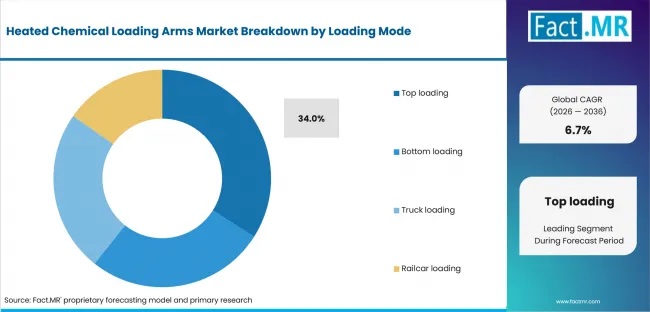
Heated Chemical Loading Arms Market Analysis By Loading Mode | Source: Fact.MR
Top loading is anticipated to lead with 34.0% share in 2026 since many hot-product tankers and railcars still use top-hatch access. Bottom loading gains attention where operators want ground-level connection and reduced splash risk. Truck loading carries steady demand in asphalt and chemical distribution. Railcar loading remains relevant for longer-distance movement of sulfur and viscous products.
What supports Chemical producers within End User?
Chemical producers are estimated to represent 35.0% share in 2026.
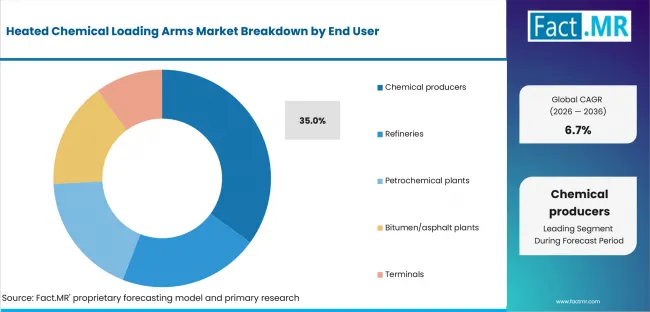
Heated Chemical Loading Arms Market Analysis By End User | Source: Fact.MR
Chemical producers are estimated to represent 35.0% share in 2026 owing to the range of heated liquids handled at process sites. Refineries rely on heated arms for asphalt, sulfur and residue-related movements. Petrochemical plants require compatibility checks for aromatics, polymers and corrosive service. Bitumen/asphalt plants and terminals create steady demand when high-viscosity material moves by truck or rail.
What is accelerating Heated Chemical Loading Arms Market adoption, and what is holding it back?
Demand is expected to be driven by temperature-sensitive product transfer and safer truck and rail loading. Adoption is expected to be held back by high installation costs, thermal safety risks and long customization cycles.
Drivers Impact Analysis
| DRIVER | (~) % IMPACT ON CAGR | GEOGRAPHIC RELEVANCE | IMPACT TIMELINE |
|---|---|---|---|
| Temperature-sensitive product transfer | +1.7% | Saudi Arabia, USA, Germany | Short term (<= 2 years) |
| Bitumen/asphalt rack demand | +1.4% | USA, UK, Japan | Short term (<= 2 years) |
| Safer truck and rail loading | +1.1% | USA, Germany, Japan | Medium term (2-4 years) |
| Heat retention and insulation | +0.9% | Cold-climate chemical sites | Medium term (2-4 years) |
| Operator protection requirements | +0.7% | Regulated terminals | Long term (>= 4 years) |
Source: Fact.MR analysis. Updated Jul 24, 2026
- Temperature-sensitive product transfer: Heated arms keep liquids moving when short heat loss creates blockage at the rack. Bitumen/asphalt and sulfur service carry the clearest need. Selection is expected to focus on temperature continuity and safe drainage.
- Bitumen/asphalt rack demand: Hot asphalt transfer rewards equipment that preserves viscosity from line to tanker. Fixed loading arms reduce repeated hose movement in frequent rack cycles. Demand is projected to favor sites handling bulk road and refinery residue products.
- Safer truck and rail loading: Operators prefer arms when loading positions repeat and hose handling increases exposure. Top and bottom configurations answer different vehicle layouts. Safety audits are anticipated to keep arm design linked to access control and emergency shutoff placement.
- Heat retention and insulation: Traced lines lose value if the final arm section cools too quickly. Removable insulation and jacketed sections help maintenance crews inspect wear points. Procurement is estimated to compare heat loss, service access and cleanability together.
- Operator protection requirements: Heated surfaces require guards, reach control and clear shutdown steps. Terminal teams review overfill and grounding interfaces during rack design. Equipment choices are forecast to depend on safer operation under repeated shifts.
Opportunity Impact Analysis
| OPPORTUNITY | (~) % IMPACT ON CAGR | GEOGRAPHIC RELEVANCE | IMPACT TIMELINE |
|---|---|---|---|
| Retrofit heated arms | +0.8% | USA and Germany | Medium term (2-4 years) |
| Electric heat tracing | +0.7% | Japan and UK | Medium term (2-4 years) |
| Modular rack packages | +0.6% | Saudi Arabia and terminals | Long term (>= 4 years) |
| Service contracts and spares | +0.5% | All profiled countries | Long term (>= 4 years) |
Source: Fact.MR analysis. Updated Jul 24, 2026
- Retrofit heated arms: Existing racks create opportunity when hoses no longer meet safety or heat-control expectations. Retrofit projects often begin with one problem product. Wider installation is expected once operators prove cycle time and maintenance gains.
- Electric heat tracing: Electric tracing helps sites that lack steam service near the loading bay. It suits distributed terminals where localized control is useful. Adoption is projected to rise where power supply and hazardous-area certification are already planned.
- Modular rack packages: Integrated platforms, arms and access equipment simplify work at new chemical loading points. The approach reduces interface risk between mechanical and safety packages. Demand is anticipated to improve where project teams want fewer handoff gaps.
- Service contracts and spares: Heated arms carry seals, swivels and insulation components that require regular attention. Service programs help terminal operators reduce downtime. Providers are estimated to gain follow-on revenue when spare kits match installed arm designs.
Restraints Impact Analysis
| RESTRAINT | (~) % IMPACT ON CAGR | GEOGRAPHIC RELEVANCE | IMPACT TIMELINE |
|---|---|---|---|
| High installed cost | -0.9% | Global | Short term (<= 2 years) |
| Thermal safety risk | -0.7% | Chemical and refinery sites | Short term (<= 2 years) |
| Long customization cycle | -0.5% | Project-led racks | Medium term (2-4 years) |
| Product compatibility testing | -0.4% | Specialty chemical plants | Long term (>= 4 years) |
Source: Fact.MR analysis. Updated Jul 24, 2026
- High installed cost: Heated loading arms require engineering, insulation and safety hardware beyond a basic arm. Smaller sites delay replacement when product movement is occasional. Project teams are expected to approve purchases only after maintenance savings are clear.
- Thermal safety risk: Hot surfaces add burn risk around crowded loading racks. Operators require shielding, platform design and lockout steps before use. Adoption is projected to slow where site procedures are not ready for heated-arm operation.
- Long customization cycle: Product viscosity, vehicle height and rack layout change the final design. Engineering reviews stretch when multiple products share one loading lane. Orders are anticipated to move slowly where drawings and approvals pass through several teams.
- Product compatibility testing: Seals, metallurgy and insulation design must fit the handled chemical. Acidic or polymer service raises the review load. Equipment providers are estimated to face longer quoting cycles when chemical data sheets are incomplete.
Which countries are scaling Heated Chemical Loading Arms Market fastest?
The country comparison gap 2.0 percentage points and shows a clear upper position for Saudi Arabia. The USA follows at a measured distance, while Japan sits between the upper group and mature European markets. Germany and the UK form the lower cluster in the profiled set. The pattern reflects refinery and chemical loading intensity more than general industrial size alone.
- Saudi Arabia holds the upper position where refinery, petrochemical and sulfur-handling sites require heated transfer at export-linked facilities.
- The USA remains close to the upper group as asphalt terminals, refineries and chemical distributors keep upgrading truck and rail loading points.
- Japan sits in the middle through safety-focused chemical sites that place value on controlled loading and compact rack design.
- Germany reflects a mature chemical base where engineering review depth supports steady replacement demand.
- The UK remains slightly below Germany as terminals and specialty chemical plants upgrade selected lanes instead of broad rack fleets.
Comparable CAGRs are expected to produce different project routes across these countries. Deployment timing depends on product temperature range, utility access and local maintenance capability. The full report provides country-level CAGR analysis across North America, Latin America, Europe, East Asia, South Asia, Oceania and the Middle East and Africa.
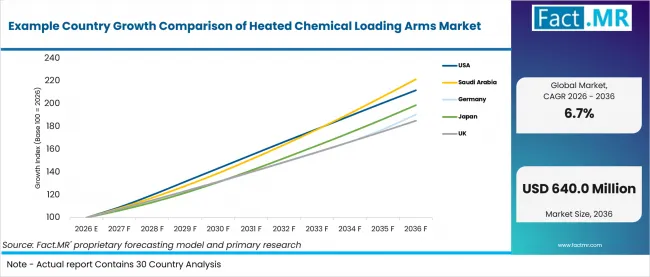
Example Country Growth Comparison Of Heated Chemical Loading Arms Market | Source: Fact.MR
| Country | CAGR |
|---|---|
| Saudi Arabia | 8.3% |
| USA | 7.8% |
| Japan | 7.1% |
| Germany | 6.7% |
| UK | 6.3% |
Source: Fact.MR analysis. Updated Jul 24, 2026
What supports Saudi Arabia adoption?
8.3% CAGR, supported by refinery, petrochemical and sulfur-handling activity.
Saudi Arabia leads the profiled countries because heated transfer is closely tied to refinery and export-terminal operations. Molten sulfur and asphalt can lose flow when temperatures fall, making steam-traced or jacketed arms important at truck and rail loading points. New rack projects also create an opening for integrated platforms, access equipment and heating systems rather than stand-alone arm replacements.
How is the USA scaling demand?
7.8% CAGR, driven by asphalt terminals, refinery racks and chemical distribution sites.
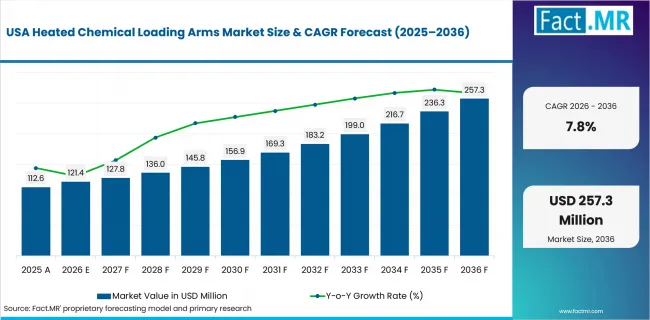
Heated Chemical Loading Arms Market Country Value Analysis | Source: Fact.MR
The USA market is shaped by a large installed base of loading racks rather than only new construction. Retrofit demand grows where older hoses create heat loss, repeated manual handling or slower turnaround during asphalt and chemical loading. Adoption depends on whether heated arms can demonstrate lower maintenance effort and more consistent product movement across frequent truck and rail cycles.
What is driving Japan’s growth from 2026 to 2036?
7.1% CAGR, backed by compact chemical sites and safety-focused equipment upgrades.
Japan’s opportunity is concentrated in plants where loading areas are space-constrained and operator access must be carefully controlled. Electrically traced arms can gain preference when localized temperature control is more practical than extending steam service to the loading bay. Buyers are also likely to place greater value on clear operating documentation, shielding and precise arm movement for phenols, acids and heated oils.
How is Germany developing demand?
6.7% CAGR, supported by chemical production depth and detailed engineering review.
Germany’s market is influenced by the technical approval process required for specialist chemicals. Heated-arm projects must match seal materials, metallurgy and insulation design with the handled product before installation. This creates steady replacement demand at chemical plants and tank terminals, but also lengthens quotation and approval cycles when compatibility data or rack drawings are incomplete.
How does the UK perform?
6.3% CAGR, led by selective terminal upgrades and specialty chemical handling.
The UK is expected to expand through targeted replacement of problem loading lanes rather than broad fleet-wide installation. Asphalt terminals and specialty chemical plants are more likely to adopt heated arms where existing hose arrangements cause temperature loss, restricted reach or maintenance delays. Electric heat tracing also offers a practical route at sites where steam infrastructure is limited near the loading area.
Who leads the Heated Chemical Loading Arms Market?
Emco Wheaton (Gardner Denver) and OPW (Dover) lead direct heated-arm coverage, while Kanon Loading Equipment and Woodfield Systems strengthen custom loading-arm capability.
Emco Wheaton (Gardner Denver) holds the largest share and has direct molten sulfur loading-arm coverage with steam-jacketed and electrical heat-tracing options. OPW (Dover) offers heated loading solutions for asphalt, molten sulfur, waxes and other viscous products. OPW introduced Loading Arm Central™ in January 2025 to give installers access to loading-arm installation and maintenance resources. Kanon Loading Equipment supports top-loading arms for bitumen, high-temperature oils and corrosive chemicals.
SVT GmbH and Woodfield Systems complete the profiled company set. Woodfield Systems adds heated top and bottom loading arms for bitumen, asphalt and molten sulfur service. From 2026 to 2036, competition is expected to depend on heating continuity and swivel reliability. Service access and documentation quality are expected to shape final selection.
Which companies are the key providers?
Emco Wheaton (Gardner Denver) and OPW (Dover) are key providers. Kanon Loading Equipment and SVT GmbH are profiled. Woodfield Systems completes the company set.
- Emco Wheaton (Gardner Denver)
- OPW (Dover)
- Kanon Loading Equipment
- SVT GmbH
- Woodfield Systems
Bibliography
- U.S. Energy Information Administration. (2026, June 29). U.S. refining capacity decreased during 2025. U.S. Energy Information Administration.
- OPW Engineered Systems. (2025, January 16). OPW Engineered Systems introduces Loading Arm Central™ microsite. OPW Engineered Systems.
- Federal Statistical Office of Germany. (2026, June). Production in April 2026: Up 0.4% on the previous month.
- U.S. Energy Information Administration. (2026, June 29). U.S. refining capacity decreased during 2025.
- OPW Engineered Systems. (2025, January 16). OPW Engineered Systems introduces Loading Arm Central™ microsite.
This Report Answers
- The report provides strategic intelligence on the Heated Chemical Loading Arms Market across Product Handled and Heating Method choices that shape hot-product loading programs.
- Segment analysis covers Bitumen/asphalt and Steam-traced arms as the share leaders within the 2026 market.
- Country outlook evaluates Saudi Arabia and the USA alongside Japan and Germany. The UK completes the growth comparison across the profiled markets.
- Competitive analysis profiles Emco Wheaton (Gardner Denver) and OPW (Dover) alongside Kanon Loading Equipment and SVT GmbH. Woodfield Systems completes the provider set.
- Loading-mode assessment covers Top loading and Bottom loading. Truck loading and Railcar loading complete the operating view across rack configurations.
What does the Heated Chemical Loading Arms Market cover?
Steam-traced, electrically-traced and jacketed loading arms used for heated chemical transfer.
The Heated Chemical Loading Arms Market covers articulated arms used to load or unload temperature-sensitive liquids at chemical, refinery and terminal racks. Coverage extends to bitumen/asphalt and molten sulfur when heat is part of the arm assembly. Phenol/cresols, viscous acids and molten polymers follow the same heated-transfer rule.
The market differs from general loading-arm equipment since commercial value comes from maintaining product temperature through the arm and connection point. Standard cold-product arms remain outside the boundary. Standard hoses and portable pumps are excluded unless they are sold as part of a heated loading-arm package.
What is included in the scope?
Heated chemical loading arm systems used at truck, rail and terminal racks.
The scope includes Product Handled, Heating Method, Loading Mode and End User. Coverage spans steam-traced arms, electrically-traced arms and jacketed heated arms used in heated chemical transfer. It aligns with adjacent marine loading arms when ship-to-shore transfer faces similar hot-product handling issues. The scope connects to bitumen handling and chemical metering pumps where heated transfer supports downstream dosing or terminal movements.
What is excluded from the scope?
Cold-product loading arms and general hose assemblies are outside the scope.
The scope excludes loading arms used only for ambient-temperature liquids. Standard hoses and portable pumps are outside the equipment boundary. Meter-only packages are excluded unless sold as part of a heated loading-arm package. Equipment treatment products such as asphalt release agents remain outside the equipment scope unless linked directly to a heated loading-rack project.
How Was the Analysis Built?
The analysis draws on 120+ sources, 35+ company portfolios, 25+ countries, and more than 20 industry interviews.
- Primary Research: Primary research includes discussions with manufacturers, service providers, technology developers, distributors, end users, procurement teams, and subject-matter experts. These conversations examine purchasing priorities, product adoption, operational challenges, approval requirements, competitive positioning, and the factors that influence wider market acceptance.
- Desk Research: Desk research covers government statistics, regulatory publications, company filings, trade data, technical studies, industry associations, standards, public policy, and other authoritative sources. Every source used in the analysis is documented in the bibliography.
- Market Sizing and Forecasting: Market estimates combine historical performance, demand indicators, pricing and volume trends, segment shares, company participation, country-level growth, adoption patterns, investment activity, and barriers to market expansion.
- Data Validation and Update Cycle: Findings are validated by comparing primary interviews with public data, company activity, regulatory changes, trade patterns, and industry developments. Regular updates review new product launches, capacity changes, partnerships, approvals, procurement trends, and shifts in commercial adoption.
Segmentation
What is the report’s scope and coverage?
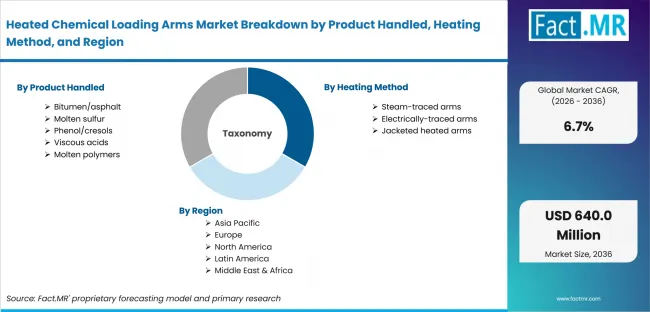
Heated Chemical Loading Arms Market Breakdown By Product Handled, Heating Method, And Region | Source: Fact.MR
| Attribute | Details |
|---|---|
| Quantitative Units | USD Million in 2026 to USD Million by 2036 at a CAGR |
| Market Definition | Heated loading arms used to transfer temperature-sensitive chemicals and petroleum-derived products where heat continuity, safe reach and swivel integrity shape loading-rack acceptance |
| Product Handled | Bitumen/asphalt; Molten sulfur; Phenol/cresols; Viscous acids; Molten polymers |
| Heating Method | Steam-traced arms; Electrically-traced arms; Jacketed heated arms |
| Loading Mode | Top loading; Bottom loading; Truck loading; Railcar loading |
| End User | Chemical producers; Refineries; Petrochemical plants; Bitumen/asphalt plants; Terminals |
| Regions Covered | North America; Latin America; Europe; East Asia; South Asia and Pacific; Middle East and Africa |
| Countries Covered | Saudi Arabia; USA; Japan; Germany; UK |
| Key Companies Profiled | Emco Wheaton (Gardner Denver); OPW (Dover); Kanon Loading Equipment; SVT GmbH; Woodfield Systems |
| Forecast Period | 2026 to 2036 |
| Approach | Hybrid top-down and bottom-up approach using heated chemical loading-rack demand; product temperature profiles; truck and rail loading patterns; heating-method mix; refinery and chemical terminal replacement cycles; company portfolio review; country adoption patterns and interview validation |
Source: Fact.MR analysis. Updated Jul 24, 2026
How is the market segmented?
-
By Product Handled:
- Bitumen/asphalt
- Molten sulfur
- Phenol/cresols
- Viscous acids
- Molten polymers
-
By Heating Method:
- Steam-traced arms
- Electrically-traced arms
- Jacketed heated arms
-
By Loading Mode:
- Top loading
- Bottom loading
- Truck loading
- Railcar loading
-
By End User:
- Chemical producers
- Refineries
- Petrochemical plants
- Bitumen/asphalt plants
- Terminals
-
By Region:
- North America
- Europe
- East Asia
- Middle East and Africa
Frequently Asked Questions
Which Product Handled leads the market?
Which Heating Method leads the market?
Which Loading Mode leads the market?
Which End User leads the market?
Which country records the highest listed CAGR?
How does the USA perform in the market?
How does Japan perform in the market?
How does Germany perform in the market?
How does the UK perform in the market?
What is the primary driver in this market?
What is the main restraint?
Why are steam-traced arms selected?
Why do chemical producers lead demand?
Who worked on this report


Preview the report firsthand - request a free sample
Free SampleGet the brochure for pricing and purchase details
Download PDF