- Base Value(2025): 3.2 Bn
- Estimated Value(2026): 3.4 Bn
- Forecast Value (2036): 6.1 Bn
- CAGR (2026 - 2036): 6.0%
Heavy-Duty Floor Degreasers for Industrial and Retail Sites Market Forecast and Outlook By Fact.MR
- In 2025, the heavy-duty floor degreasers for industrial and retail sites market was valued at USD 3.2 billion.
- Based on Fact.MR estimates, demand is estimated to grow to USD 3.4 billion in 2026 and USD 6.1 billion by 2036. Fact.MR projects a CAGR of 6.0% during the forecast period.
- These market values are model-based estimates built from current workplace-slip prevention guidance, industrial cleaning demand patterns, and specialty floor-chemical usage rather than from a published market-size source table.
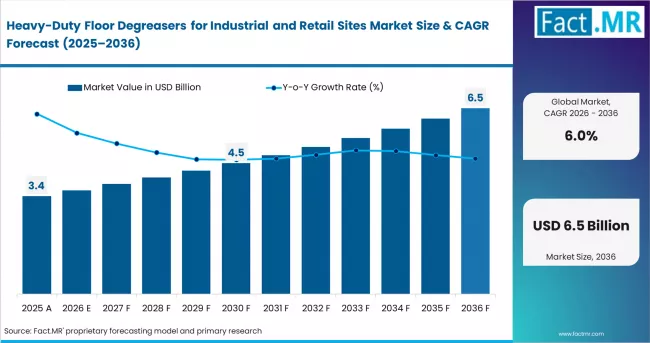
Heavy Duty Floor Degreasers For Industrial And Retail Sites Market Market Value Analysis | Source: Fact.MR
| Metric | Value |
|---|---|
| Estimated Value in 2026 | USD 3.4 billion |
| Forecast Value in 2036 | USD 6.1 billion |
| Forecast CAGR (2026 to 2036) | 6.0% |
Source: Fact.MR analysis. Updated May 13, 2026
Summary of Heavy-Duty Floor Degreasers for Industrial and Retail Sites Market
- Market Definition
- The market includes grease-cutting floor-cleaning chemistries used in industrial and retail environments to reduce oily film, improve floor safety, and support operational cleanliness.
- Demand Drivers
- Oil, grease, and water on working surfaces are established slip hazards, which supports recurring use of heavy-duty floor degreasers in both industrial and retail facilities.
- OSHA and NIOSH guidance both reinforce the importance of prompt contaminant removal from floors, which supports stronger compliance-led demand for specialized degreasers.
- Supplier positioning is moving toward low-foam, machine-compatible, and industrial-strength formulations that fit scrubber-based and large-area cleaning workflows. [5]
- Key Segments Analyzed
- By Product Type: Alkaline heavy-duty floor degreasers are estimated to lead with approximately 36% share in 2026, supported by strong grease-cutting performance in heavy-soil industrial and warehouse zones.
- By Application: Auto-scrubber programs are expected to hold approximately 34% share in 2026, driven by larger floor areas and repetitive cleaning in industrial and retail sites.
- By End Use Setting: Warehouses and distribution centers are projected to account for approximately 29% share in 2026, supported by large hard-floor footprints, vehicle traffic, and spill-cleaning needs.
- By Geography: India leads growth at 7.2% CAGR through 2036, supported by industrial and logistics expansion.
- These segment shares are model-based estimates rather than figures directly published in the cited sources.
- Analyst Opinion at FACT.MR
- Shambhu Nath Jha, Senior Analyst at Fact.MR, states, “CXOs should read this market as a floor-safety and workflow-efficiency category rather than a commodity cleaner segment. Buyers are not only paying for appearance. They are paying for contaminant removal that lowers injury risk and keeps industrial and retail operations moving.”
- This is a modeled analyst view, not a quoted external source.
- Strategic Implications
- Invest in floor-specific degreasers that remove oil and grease without disrupting machine-based cleaning routines.
- Build technical sales capability around slip-risk reduction, low-foam compatibility, and contaminant removal rather than fragrance or general cleaning claims.
- Position scrubber-compatible and safety-oriented formats where large floors and repeated cleaning cycles matter most.
- These implications are inferred from the cited safety and supplier materials.
The market is projected to generate USD 2.7 billion in absolute opportunity between 2026 and 2036. Growth is being supported by stronger housekeeping compliance in industrial environments, recurring slip-and-fall prevention needs, and wider use of specialized floor chemistries in areas exposed to oil, grease, packaging residue, food spills, and vehicle traffic. OSHA’s housekeeping guidance directly links oil, grease, and water spills to slip hazards on working surfaces, and CDC/NIOSH guidance for wholesale and retail trade also stresses the need to keep floors free from spilled liquids. That keeps heavy-duty floor degreasers commercially relevant in both industrial and large-format retail operations. [1]
India is projected to lead with a CAGR of 7.2% through 2036, driven by industrial expansion, warehouse growth, and rising outsourced facility cleaning. China follows at 6.8%, supported by manufacturing density and organized retail expansion. The United States is expected to grow at 6.1%, underpinned by mature jan-san procurement and strong compliance-led cleaning demand. Brazil records 5.7%, backed by industrial formalization and retail modernization. Mexico grows at 5.4%, supported by warehouse and supermarket growth. Canada records 5.1%, shaped by mature facility-maintenance channels and safety discipline. These country rates are model-based estimates rather than published country-by-country values from the cited sources. [2]
Segmental Analysis
Heavy-Duty Floor Degreasers for Industrial and Retail Sites Market Analysis by Product Type
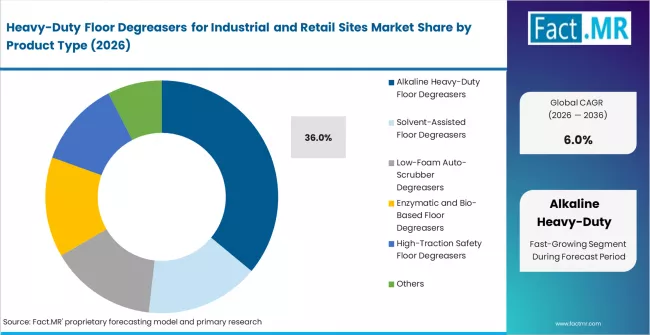
Heavy Duty Floor Degreasers For Industrial And Retail Sites Market Analysis By Product Type | Source: Fact.MR
Based on Fact.MR’s analysis, alkaline heavy-duty floor degreasers are estimated to hold 36% share in 2026. They lead because oil, grease, and embedded industrial soil still require strong cut-through performance on factory, warehouse, and loading-area floors. Low-foam auto-scrubber degreasers remain commercially important because large-area facilities increasingly rely on machine cleaning rather than hand-applied cleaning alone. Enzymatic and bio-based products also retain relevance where buyers want ongoing grease breakdown with milder environmental positioning. These share estimates are model-based.
- Alkaline leadership comes from stronger grease-cutting performance in heavy industrial soil conditions.
- Low-foam machine-compatible formats remain attractive where operators use scrubbers on large hard-floor surfaces.
- Bio-based formats gain traction where buyers want safer-use or lower-residue positioning without giving up degreasing performance.
Heavy-Duty Floor Degreasers for Industrial and Retail Sites Market Analysis by Application
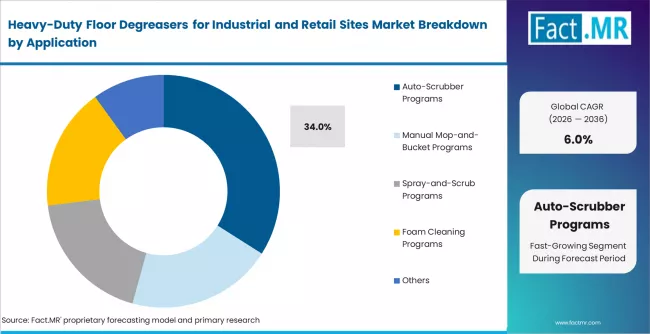
Heavy Duty Floor Degreasers For Industrial And Retail Sites Market Analysis By Application | Source: Fact.MR
Auto-scrubber programs are expected to hold approximately 34% share in 2026. This segment leads because warehouses, factories, and large-format retail stores increasingly manage broad floor areas through mechanized cleaning rather than fully manual routines. Manual mop-and-bucket programs remain important in smaller facilities and spot-cleaning zones, though the broadest base in high-footprint locations now favors machine-compatible chemistry. These application shares are model-based estimates inferred from facility scale and supplier positioning.
- Auto-scrubber programs lead because large industrial and retail floors require repeatable, fast, and wide-area cleaning coverage.
- Manual methods remain relevant for spot contamination and smaller backroom or utility zones.
- Low-foam chemistry grows where buyers want to avoid extra rinsing and machine downtime.
Heavy-Duty Floor Degreasers for Industrial and Retail Sites Market Analysis by End Use Setting
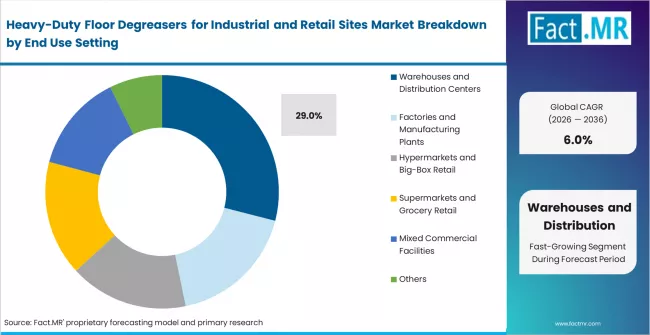
Heavy Duty Floor Degreasers For Industrial And Retail Sites Market Analysis By End Use Setting | Source: Fact.MR
Warehouses and distribution centers are projected to account for approximately 29% share in 2026, as large hard-floor footprints, vehicle movement, pallet handling, spills, dust, and oily contamination create recurring demand for stronger floor-care chemistry. Factories and manufacturing plants remain highly relevant because shop and machine floors also carry oil and grease contamination. Big-box retail and supermarkets create a separate but meaningful demand base where safety, presentation, and continuous customer traffic make floor cleanliness more visible. These end-use shares are model-based estimates built from contamination logic and facility size.
- Warehouses lead because their scale and contamination profile make routine degreasing commercially necessary.
- Manufacturing remains important where machine oil, grease, and industrial residue create heavier soil loads.
- Retail settings matter where spills and customer-facing floor safety make traction and cleanliness more visible.
Drivers, Restraints, and Opportunities
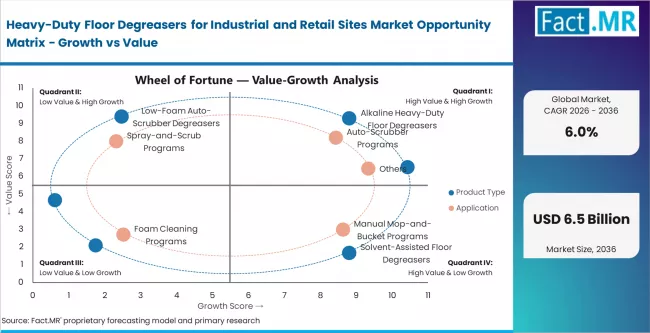
Heavy Duty Floor Degreasers For Industrial And Retail Sites Market Opportunity Matrix Growth Vs Value | Source: Fact.MR
The market is being shaped by the need to reduce contaminant-related slip risk without slowing industrial or retail workflow. Structural demand is anchored in the fact that oil, grease, water, and debris remain established workplace slip hazards, and safety guidance continues to stress prompt removal from walking and working surfaces. That gives heavy-duty floor degreasers a persistent operating role even when broader maintenance budgets face pressure.
The main restraint is execution inconsistency. Cleaning outcomes still depend on dilution, water use, cleaning method, contaminant type, and whether the floor is fully dried or residues are removed. Poor use practice can weaken the value of premium chemistry even when the product itself is sound. This is partly an inference from the heavy dependence of the category on housekeeping discipline and slip prevention.
- Low-foam machine-compatible formats remain the clearest opportunity where labor time and wide-area cleaning matter most.
- Safety-positioned degreasers create stronger value than general-purpose cleaners where contaminant-driven slip risk is high.
- Higher-value opportunity sits in products sold with training, dilution control, and facility-care support rather than as stand-alone chemicals.
Regional Analysis
The market is assessed across North America, Europe, Asia Pacific, Latin America, and Middle East and Africa, covering 40+ countries with demand profiles shaped by industrial-floor contamination intensity, organized retail growth, facility-maintenance discipline, and specialty-cleaner adoption. The country growth rates below are model-based estimates.
.webp "Top Country Growth Comparison Heavy Duty Floor Degreasers For Industrial And Retail Sites Market Cagr (2026 2036)")
Top Country Growth Comparison Heavy Duty Floor Degreasers For Industrial And Retail Sites Market Cagr (2026 2036) | Source: Fact.MR
| Country | CAGR (2026 to 2036) |
|---|---|
| India | 7.2% |
| China | 6.8% |
| United States | 6.1% |
| Brazil | 5.7% |
| Mexico | 5.4% |
Source: Fact.MR analysis. Updated May 13, 2026
North America Heavy-Duty Floor Degreasers for Industrial and Retail Sites Market Analysis
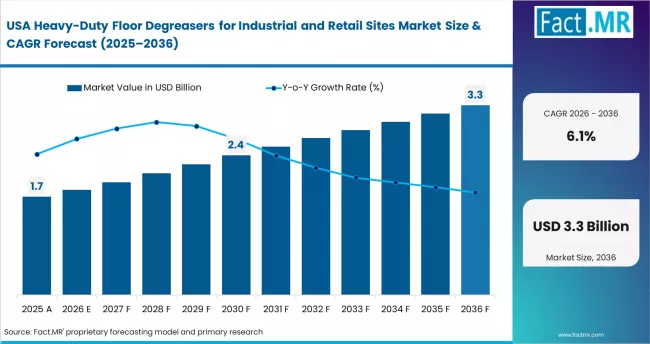
Heavy Duty Floor Degreasers For Industrial And Retail Sites Market Country Value Analysis | Source: Fact.MR
North America remains an important commercial region because it combines mature industrial maintenance practices, warehouse cleaning demand, and strong emphasis on slip prevention in workplaces. Demand is strongest where operators already treat floor care as part of injury prevention and operational continuity rather than simple housekeeping. [4]
- United States: Established safety compliance, high warehouse density, and a mature jan-san distribution network continue to support demand across the United States. The market is projected to expand at a CAGR of 6.1% through 2036, driven by consistent need for operational safety, maintenance standards, and efficient facility management across logistics, retail, and industrial environments.
- Mexico: Growth in industrial corridors and expansion of organized retail create a practical commercial fit in Mexico. Sales are likely to rise at a CAGR of 5.4% during the forecast period, supported by increasing warehouse activity and modernization of facility management practices. Adoption is strengthening as businesses align with structured safety and maintenance protocols.
Asia Pacific and Latin America Heavy-Duty Floor Degreasers for Industrial and Retail Sites Market Analysis
Asia Pacific and Latin America offer the strongest long-term expansion potential because industrialization, warehouse buildout, and organized retail growth are rising across multiple urban markets. Demand is likely to strengthen where operators move from general-purpose cleaning toward floor-specific contaminant control in sites with oil, grease, dust, spills, and heavy traffic. These regional growth views are model-based estimates built from facility growth and safety-driven cleaner adoption logic.
- India: Industrial expansion and the growing shift toward outsourced facility cleaning continue to support demand across India. The market is projected to grow at a CAGR of 7.2% through 2036, driven by rising compliance awareness, expansion of organized industrial zones, and increasing reliance on professional facility management services. Adoption is strengthening in manufacturing clusters and large commercial spaces where standardized cleaning and safety practices are becoming more critical.
- Brazil: Industrial formalization and ongoing retail modernization support growth in Brazil. Demand is expected to rise at a CAGR of 5.7% through 2036, as businesses adopt more structured facility maintenance and hygiene protocols. Growth is particularly visible in urban industrial corridors and organized retail environments where operational consistency and compliance are gaining importance.
- China: High manufacturing density and expanding organized retail networks continue to support demand across China. The market is projected to grow at a CAGR of 6.8% through 2036, driven by large-scale industrial activity and increasing emphasis on standardized cleaning and safety programs. Adoption is rising in logistics hubs, factories, and commercial spaces where efficiency and compliance are closely managed.
Competitive Aligners for Market Players
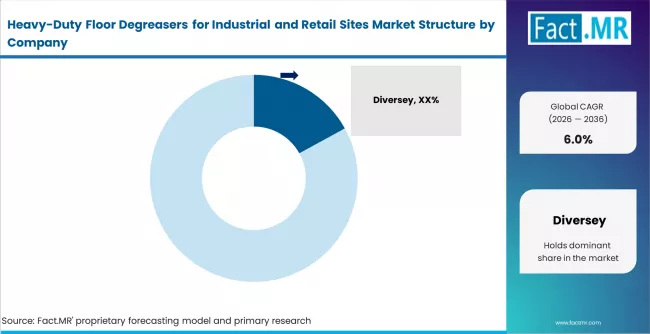
Heavy Duty Floor Degreasers For Industrial And Retail Sites Market Analysis By Company | Source: Fact.MR
The market is moderately concentrated at the branded chemistry and service-program level, while local distribution and day-to-day purchasing remain fragmented. Competitive strength comes from the ability to connect floor chemistry with measurable contaminant removal, slip-risk reduction, and machine compatibility. Suppliers need more than a general degreasing claim. They need a clear explanation of how the product performs on oily shop floors, warehouse aisles, loading areas, and retail backrooms under real operating conditions.
Competitive advantage is defined by grease-cutting performance, low-foam compatibility, floor-safety positioning, and fit with wider facility-maintenance programs. Buyers in this category usually choose on cleaning reliability and workflow fit as much as on price. This competitive framing is an analytical view derived from current supplier positioning and workplace-safety materials rather than a published market-share table.
Key Players
- Diversey
- Ecolab
- Zep
- Spartan Chemical
- Betco
- 3M
- SC Johnson Professional
- P&G Professional
- Reckitt
- TASKI / Solenis
Bibliography
- [1] OSHA. Housekeeping safety guidance on oil, grease, water, and slip hazards on working surfaces.
- [2] CDC/NIOSH. Preventing slips, trips, and falls in wholesale and retail trade establishments.
- [3] National Safety Council. Guidance on slips, trips, and falls caused by foreign substances on floors.
- [4] CDC/NIOSH. Young worker slips, trips, and falls guidance noting greasy floors and spills as common causes.
- [5] Industrial floor cleaner supplier materials positioning heavy-duty low-foam degreasers for factories, warehouses, and commercial facilities.
This Report Addresses
- Strategic intelligence on heavy-duty floor degreaser demand across factories, warehouses, distribution centers, and organized retail facilities.
- Market forecast from USD 3.4 billion in 2026 to USD 6.1 billion by 2036 at a CAGR of 6.0%.
- Growth opportunity mapping across alkaline degreasers, solvent-assisted formats, low-foam auto-scrubber products, and safety-positioned floor degreasers.
- Segment analysis by product type, application method, end use setting, and distribution channel.
- Regional outlook covering North America, Europe, Asia Pacific, Latin America, and Middle East and Africa.
- Competitive analysis of major suppliers serving industrial floor care, warehouse cleaning, and large-site maintenance programs.
- Floor-safety and contaminant-removal analysis covering grease, oil, spill residue, traction improvement, and workflow-compatible cleaning formats.
- Market interpretation built around slip-risk control, machine-compatible cleaning chemistry, and recurring facility-maintenance demand.
Heavy-Duty Floor Degreasers for Industrial and Retail Sites Market Definition
The market covers chemical cleaning products specifically formulated to remove grease, oils, oily soil films, and industrial or retail floor residues from hard floor surfaces in factories, warehouses, distribution sites, supermarkets, and other high-traffic commercial environments. It includes heavy-duty floor degreasers used on production-area floors, loading-zone floors, stockroom aisles, retail backrooms, and mixed-use commercial hard surfaces where traction and cleanliness are operational priorities. [3]
Heavy-Duty Floor Degreasers for Industrial and Retail Sites Market Inclusions
Covers global and regional forecasts from 2026 to 2036. Includes alkaline industrial floor degreasers, solvent-assisted degreasers, low-foam machine-compatible floor degreasers, enzymatic and bio-based floor cleaners, and safety-positioned traction-support cleaners sold for industrial and retail floor maintenance. Covers products positioned around grease-film removal, contaminant lifting, traction improvement, and compatibility with both manual and mechanized cleaning workflows.
Heavy-Duty Floor Degreasers for Industrial and Retail Sites Market Exclusions
Excludes consumer household floor cleaners, restroom-specific cleaners, food-contact sanitizers without floor use, and highly specialized process chemicals not positioned for industrial or retail floor maintenance. It also excludes mats, coatings, and floor equipment unless chemical degreasing remains the core product role. This exclusion logic is an analytical market boundary rather than a quoted source definition.
Heavy-Duty Floor Degreasers for Industrial and Retail Sites Market Research Methodology
- Primary Research:Interviews with industrial facility managers, warehouse operations teams, jan-san distributors, retail maintenance contractors, and commercial floor-care procurement specialists.
- Desk Research:Uses OSHA housekeeping guidance, CDC/NIOSH wholesale and retail trade slip-prevention guidance, National Safety Council floor-safety materials, and current supplier positioning for industrial floor cleaning and degreasing products.
- Market-Sizing and Forecasting:Hybrid model using industrial-floor contamination intensity, warehouse and retail floor-cleaning frequency, safety compliance pressure, specialty-chemical adoption, and floor-maintenance workflow logic.
- Data Validation and Update Cycle:Validated using workplace safety guidance, slip-prevention materials, and supplier evidence on floor degreasing for industrial and commercial settings.
Segmentation
Scope of Report
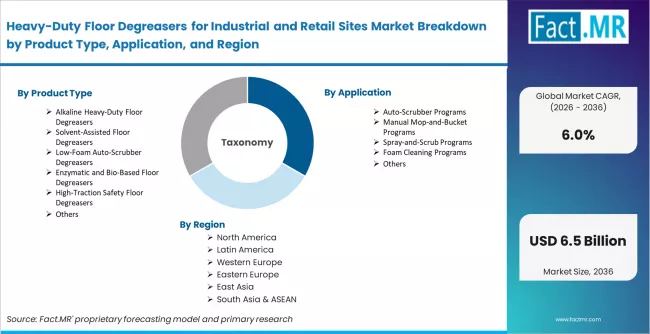
Heavy Duty Floor Degreasers For Industrial And Retail Sites Market Breakdown By Product Type, Application, And Region | Source: Fact.MR
| Attribute | Details |
|---|---|
| Quantitative Units | USD 3.4 billion (2026) to USD 6.1 billion (2036), at a CAGR of 6.0% |
| Market Definition | Heavy-duty floor degreasers formulated for industrial and retail hard floors, used to remove oily film, improve traction, and support facility safety and cleanliness |
| Product Type Segmentation | Alkaline Heavy-Duty Floor Degreasers, Solvent-Assisted Floor Degreasers, Low-Foam Auto-Scrubber Degreasers, Enzymatic and Bio-Based Floor Degreasers, High-Traction Safety Floor Degreasers, Others |
| Application Segmentation | Manual Mop-and-Bucket Programs, Auto-Scrubber Programs, Spray-and-Scrub Programs, Foam Cleaning Programs, Others |
| End Use Segmentation | Factories and Manufacturing Plants, Warehouses and Distribution Centers, Hypermarkets and Big-Box Retail, Supermarkets and Grocery Retail, Mixed Commercial Facilities, Others |
| Distribution Channel Segmentation | Direct Sales, Jan-San Distributors, Industrial Supply Dealers, Facility Service Contracts, Others |
| Regions Covered | North America, Europe, Asia Pacific, Latin America, Middle East and Africa |
| Countries Covered | United States, Canada, Mexico, China, India, Brazil, Germany, France, and 40+ countries |
| Forecast Period | 2026 to 2036 |
| Approach | Hybrid top-down and bottom-up model using industrial-floor contamination intensity, retail maintenance frequency, safety pressure, and primary interviews with operators, distributors, and facility-care advisors |
Source: Fact.MR analysis. Updated May 13, 2026
Heavy-Duty Floor Degreasers for Industrial and Retail Sites Market by Segments
-
By Product Type:
- Alkaline Heavy-Duty Floor Degreasers
- Solvent-Assisted Floor Degreasers
- Low-Foam Auto-Scrubber Degreasers
- Enzymatic and Bio-Based Floor Degreasers
- High-Traction Safety Floor Degreasers
- Others
-
By Application:
- Manual Mop-and-Bucket Programs
- Auto-Scrubber Programs
- Spray-and-Scrub Programs
- Foam Cleaning Programs
- Others
-
By End Use Setting:
- Factories and Manufacturing Plants
- Warehouses and Distribution Centers
- Hypermarkets and Big-Box Retail
- Supermarkets and Grocery Retail
- Mixed Commercial Facilities
- Others
-
By Region:
- North America
- United States
- Canada
- Mexico
- Latin America
- Brazil
- Argentina
- Chile
- Rest of Latin America
- Western Europe
- Germany
- France
- United Kingdom
- Italy
- Spain
- Nordic Countries
- BENELUX
- Rest of Western Europe
- Eastern Europe
- Russia
- Poland
- Hungary
- Balkan and Baltic
- Rest of Eastern Europe
- East Asia
- China
- Japan
- South Korea
- South Asia and Pacific
- India
- ASEAN
- Australia and New Zealand
- Rest of South Asia and Pacific
- Middle East and Africa
- Kingdom of Saudi Arabia
- Other GCC Countries
- Turkey
- South Africa
- Rest of Middle East and Africa
- North America
Frequently Asked Questions
How large is the global heavy-duty floor degreasers for industrial and retail sites market in 2025?
What will the market size be in 2026?
What is the projected market size by 2036?
What is the expected CAGR from 2026 to 2036?
Which product type is poised to lead the market?
Which application segment holds the largest share?
Which end-use setting is expected to remain strongest?
Which country shows the fastest growth?
What is driving demand for heavy-duty floor degreasers?
What is the key challenge in this market?
Who worked on this report


Preview the report firsthand - request a free sample
Free SampleGet the brochure for pricing and purchase details
Download PDF