- Base Value(2025): 1.9 Bn
- Estimated Value(2026): 2.0 Bn
- Forecast Value (2036): 3.6 Bn
- CAGR (2026 - 2036): 6.0%
Back-of-House Floor Degreasers for Foodservice Operations Market Forecast and Outlook By Fact.MR
- In 2025, the back-of-house floor degreasers for foodservice operations market was valued at USD 1.9 billion.
- Based on Fact.MR estimates, demand for back-of-house floor degreasers for foodservice operations is estimated to grow to USD 2.0 billion in 2026 and USD 3.6 billion by 2036.
- Fact.MR projects a CAGR of 6.0% during the forecast period.
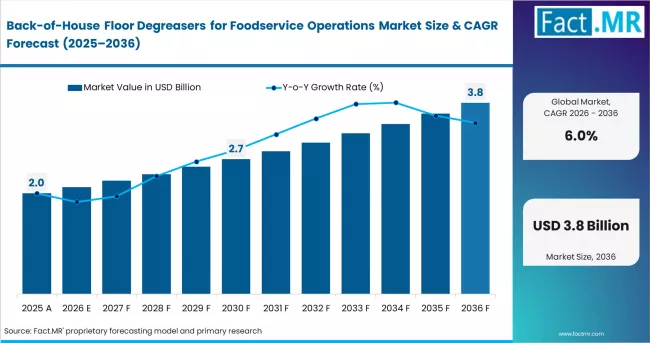
Back Of House Floor Degreasers For Foodservice Operations Market Market Value Analysis | Source: Fact.MR
| Metric | Value |
|---|---|
| Estimated Value in 2026 | USD 2.0 billion |
| Forecast Value in 2036 | USD 3.6 billion |
| Forecast CAGR (2026 to 2036) | 6.0% |
Source: Fact.MR analysis. Updated Jun 16, 2026
Summary of Back-of-House Floor Degreasers for Foodservice Operations Market
- Market Definition
- The market includes grease-cutting floor-cleaning chemistries used in foodservice back-of-house areas to reduce greasy film, improve floor safety, and support kitchen hygiene.
- Demand Drivers
- Grease and liquid contamination are major contributors to restaurant slips, which supports recurring use of specialized floor degreasers in kitchen operations.
- OSHA guidance explicitly links kitchen floor safety with grease-cutting cleaning solutions and keeping floors clean and dry.
- Supplier development is moving toward no-rinse, enzyme-based, and floor-and-drain combined solutions that reduce labor steps and support safer back-of-house cleaning routines.
- Key Segments Analyzed
- By Product Type: Alkaline floor degreasers are estimated to lead with approximately 35% share in 2026, supported by strong grease-cutting performance in heavy-soil kitchen zones.
- By Application: Manual mop-and-bucket programs are expected to hold approximately 39% share in 2026, driven by continued use across independent restaurants and smaller kitchens.
- By End Use Setting: Quick service restaurants are projected to account for approximately 30% share in 2026, supported by high fryer exposure, frequent floor cleaning, and dense store counts.
- By Geography: India leads growth at 7.3% CAGR through 2036, supported by expanding organized foodservice and rising kitchen-safety standards.
- Analyst Opinion at FACT.MR
- Shambhu Nath Jha, Senior Analyst at Fact.MR, opines, “CXOs should read this market as a slip-prevention and workflow-efficiency category rather than a commodity cleaner segment. Buyers are not only paying for floor appearance. They are paying for grease removal that lowers safety risk and keeps the kitchen moving.”
- Strategic Implications
- Invest in floor-specific degreasers that remove grease film without creating overly complex rinse cycles.
- Build technical sales capability around slip-risk reduction, dilution accuracy, and grease-film removal rather than fragrance or general cleaning claims.
- Position no-rinse and floor-and-drain combo formats where labor efficiency and daily compliance matter most.
The market is projected to generate USD 1.6 billion in absolute opportunity between 2026 and 2036. Growth is being supported by stronger foodservice hygiene expectations, recurring slip-and-fall prevention needs, and wider use of specialized kitchen-floor chemistries in high-grease zones such as fry stations, cook lines, and dish areas. OSHA continues to identify wet and slippery kitchen floors as a core foodservice hazard, while supplier materials continue to market kitchen floor degreasers specifically around grease removal and slip reduction. These market values reflect Fact.MR’s analysis of safety guidance, foodservice operating patterns, and specialty-cleaner usage.
India is projected to lead with a CAGR of 7.3% through 2036, driven by organized foodservice expansion and rising outsourced hygiene procurement. China follows at 6.8%, supported by chain restaurant growth and commercial kitchen standardization. The United States is expected to grow at 6.2%, underpinned by established compliance habits and higher recurring spend on specialty back-of-house chemicals. Brazil records 5.8%, backed by organized foodservice growth. Mexico grows at 5.5%, supported by QSR expansion and institutional kitchen demand.
Segmental Analysis
Back-of-House Floor Degreasers for Foodservice Operations Market Analysis by Product Type
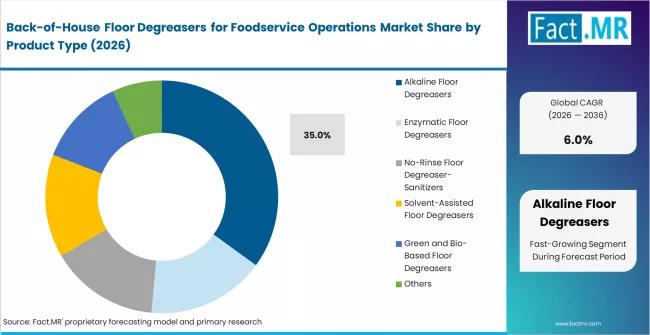
Back Of House Floor Degreasers For Foodservice Operations Market Analysis By Product Type | Source: Fact.MR
Alkaline floor degreasers are estimated to hold 35% share in 2026, as high-grease kitchen soils still require fast break-up of fats, oils, and food residues in fryer- and cookline-adjacent areas. Enzyme-based and no-rinse products remain commercially important because supplier materials increasingly position them for ongoing grease-film control and reduced slip risk. This segment is now shaped by the balance between raw degreasing power and easier maintenance chemistry. These share estimates are model-based.
- Alkaline leadership comes from strong grease-cutting performance in heavy kitchen soil conditions.
- Enzymatic formats remain attractive where operators want ongoing grease breakdown and lower-rinse workflows.
- No-rinse and traction-oriented formats gain traction where buyers prioritize slip-risk reduction as much as cleaning strength.
Back-of-House Floor Degreasers for Foodservice Operations Market Analysis by Application
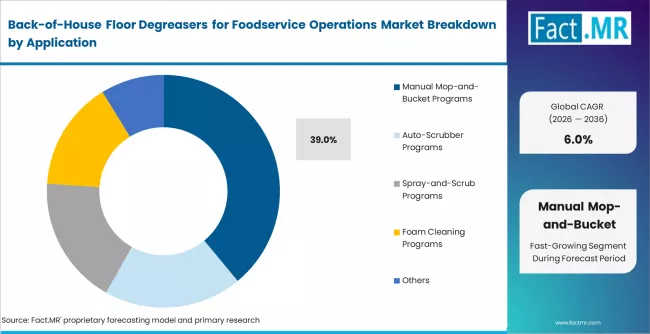
Back Of House Floor Degreasers For Foodservice Operations Market Analysis By Application | Source: Fact.MR
Based on Fact.MR’s analysis, manual mop-and-bucket programs are expected to hold approximately 39% share in 2026. This segment leads because most restaurant kitchens still rely on routine manual cleaning at end-of-day or between-daypart intervals, especially in smaller outlets and independent restaurants. Auto-scrubber programs remain important in larger commissaries and institutional kitchens, though the broadest base still lies with manual methods because they are cheaper, more flexible, and easier to deploy in tight back-of-house layouts. These application shares reflect Fact.MR’s assessment of foodservice cleaning workflows and supplier positioning.
- Manual programs lead because they fit the most common day-to-day back-of-house cleaning workflow.
- Auto-scrubber use rises where kitchen footprints are larger and hygiene routines are standardized.
- Tight and cluttered back-of-house layouts still favor flexible hand-applied cleaning.
Back-of-House Floor Degreasers for Foodservice Operations Market Analysis by End Use Setting
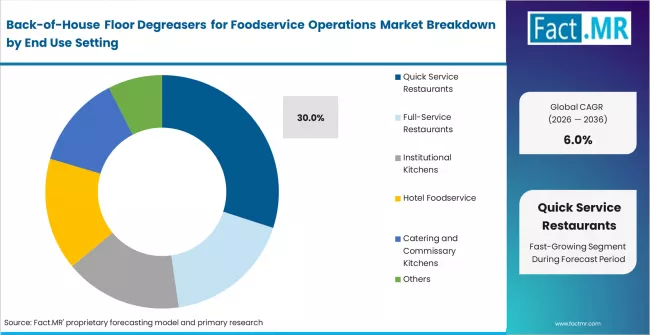
Back Of House Floor Degreasers For Foodservice Operations Market Analysis By End Use Setting | Source: Fact.MR
Quick service restaurants are projected to account for approximately 30% share in 2026. They lead because fryer-heavy production, high transaction volume, and repeated back-of-house floor exposure create strong recurring need for grease-cutting floor care. Full-service restaurants remain relevant, though quick service operations create the most frequent cleaning cycles and the greatest reliance on standardized programs. These end-use shares reflect Fact.MR’s assessment of grease exposure and cleaning frequency across foodservice settings.
- QSRs lead because fryer and cookline grease create recurring floor-soil pressure.
- Chain-style routines support more frequent and structured degreaser use.
- Institutional and commissary kitchens remain attractive where floor area and traffic justify stronger recurring programs.
Drivers, Restraints, and Opportunities
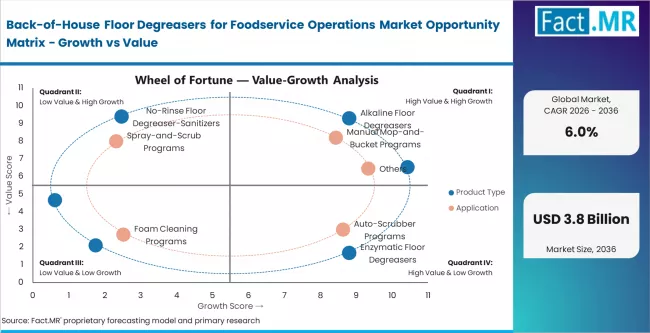
Back Of House Floor Degreasers For Foodservice Operations Market Opportunity Matrix Growth Vs Value | Source: Fact.MR
The market is being shaped by the need to reduce grease-related slip risk without slowing kitchen workflow. Structural demand is anchored in the fact that wet and greasy kitchen floors remain a documented safety issue in restaurants, and OSHA continues to stress grease-cutting floor cleaning as part of safer kitchen practice. That gives back-of-house floor degreasers a persistent operating role even when broader cleaning budgets are under pressure.
The main restraint is execution inconsistency. Cleaning outcomes depend on dilution, water temperature, method, and residue removal, and poor use practice can weaken the value of premium chemistry even when the product itself is sound. This is partly an inference from the heavy dependence of the category on operational compliance and supplier-led usage protocols.
- No-rinse formats remain the clearest opportunity where labor time and repeat daily cleaning matter most.
- Floor-specific safety positioning creates stronger value than general-purpose cleaning claims.
- Higher-value opportunity sits in products sold with training, dilution control, and sanitation support rather than as stand-alone chemicals.
Regional Analysis
The market is assessed across North America, Europe, Asia Pacific, Latin America, and Middle East and Africa, covering 40+ countries with demand profiles shaped by organized foodservice growth, back-of-house compliance habits, grease-intensive kitchen formats, and specialty-cleaner adoption.
.webp "Top Country Growth Comparison Back Of House Floor Degreasers For Foodservice Operations Market Cagr (2026 2036)")
Top Country Growth Comparison Back Of House Floor Degreasers For Foodservice Operations Market Cagr (2026 2036) | Source: Fact.MR
| Country | CAGR (2026 to 2036) |
|---|---|
| India | 7.3% |
| China | 6.8% |
| United States | 6.2% |
| Brazil | 5.8% |
| Mexico | 5.5% |
Source: Fact.MR analysis. Updated Jun 16, 2026
.webp "Back Of House Floor Degreasers For Foodservice Operations Market Cagr Analysis By Country 1 (1)")
Back Of House Floor Degreasers For Foodservice Operations Market Cagr Analysis By Country 1 (1) | Source: Fact.MR
North America Back-of-House Floor Degreasers for Foodservice Operations Market Analysis
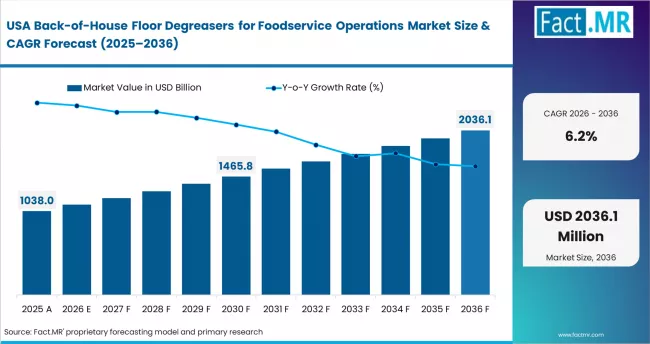
Back Of House Floor Degreasers For Foodservice Operations Market Country Value Analysis | Source: Fact.MR
North America remains an important commercial region because it combines strong foodservice hygiene expectations, recurring OSHA-driven safety logic, and widespread use of specialty floor-and-drain chemistries in commercial kitchens. Demand is strongest where operators already treat back-of-house floor care as part of injury prevention and brand protection rather than simple housekeeping.
- United States: Established kitchen-safety compliance, high fryer density across QSR formats, and a mature jan-san distribution network continue to support demand in the United States. The market is projected to expand at a CAGR of 6.2% through 2036, driven by consistent regulatory adherence and the need for reliable back-of-house safety and maintenance solutions. Adoption remains strong across large restaurant chains and foodservice operators where operational consistency and safety standards are tightly managed.
- Mexico: Expansion of QSR chains and growth in hospitality kitchens create a practical commercial fit in Mexico. Sales are likely to rise at a CAGR of 5.5% during the forecast period, supported by increasing foodservice activity and evolving kitchen safety practices. Demand is strengthening as operators adopt more structured cleaning and safety routines in both urban and tourism-driven markets.
Asia Pacific and Latin America Back-of-House Floor Degreasers for Foodservice Operations Market Analysis
Asia Pacific and Latin America offer the strongest long-term expansion potential because organized foodservice density, chain restaurant growth, and outsourced hygiene procurement are rising across multiple urban markets. Demand is likely to strengthen where operators move from general-purpose cleaning toward floor-specific grease control in kitchens with heavier fryer and fast-turn service patterns. These regional growth views are model-based estimates built from formalization and specialty-cleaner adoption logic.
- India: Organized foodservice expansion and improving back-of-house hygiene discipline continue to support demand across India. The market is projected to grow at a CAGR of 7.3% through 2036, driven by rapid growth of QSR chains, cloud kitchens, and urban dining formats. Operators are placing greater emphasis on standardized cleaning practices and safety protocols, especially in high-volume kitchens where consistency and compliance are becoming more important.
- Brazil: Chain restaurant expansion and rising awareness around kitchen safety are supporting growth in Brazil. Demand is expected to rise at a CAGR of 5.8% through 2036, as foodservice operators adopt more structured hygiene and maintenance routines. Growth is particularly visible in urban centers where organized dining and franchise models continue to expand.
- China: Commercial kitchen standardization and increasing adoption of jan-san programs continue to support demand across China. The market is projected to grow at a CAGR of 6.8% through 2036, driven by scaling foodservice operations and stronger focus on operational consistency. Adoption is rising across chain restaurants and institutional kitchens where hygiene, safety, and efficiency are closely managed.
Competitive Aligners for Market Players
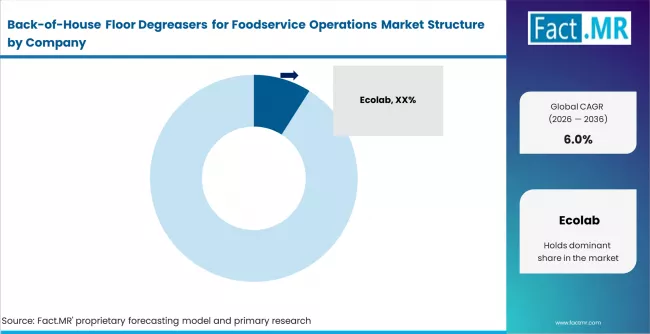
Back Of House Floor Degreasers For Foodservice Operations Market Analysis By Company | Source: Fact.MR
The market is moderately concentrated at the branded chemistry and service-program level, while local distribution and day-to-day purchasing remain fragmented. Competitive strength comes from the ability to connect floor chemistry with measurable grease removal, slip-risk reduction, and labor efficiency. Suppliers need more than a general degreasing claim. They need a clear explanation of how the product performs on greasy quarry tile, grout, drains, and back-of-house work zones under real kitchen conditions.
Competitive advantage is defined by grease-cutting performance, floor-specific safety positioning, ease of use, and fit with broader sanitation programs. Ecolab has a visible foodservice floor-and-drain program presence, and category messaging across suppliers is shifting from simple soil removal toward workflow and safety outcomes.
Key Players
- Ecolab
- Solenis
- Zep
- Spartan Chemical
- Betco
- 3M
- SC Johnson Professional
- P&G Professional
- Unilever Professional
Bibliography
- National Institute for Occupational Safety and Health, & Occupational Safety and Health Administration. (2024, January). Small business safety and health handbook (DHHS [NIOSH] Publication No. 2021-120; OSHA Publication No. 2209-01R 2024).
- Occupational Safety and Health Administration. (n.d.). Young worker safety in restaurants eTool: General hazards.
- Bureau of Labor Statistics. (2026, January 22). Employer-reported workplace injuries and illnesses: 2023–2024 (USDL-26-0101). U.S. Department of Labor.
- Ecolab New Zealand. (2024, June 6). Safety data sheet: Sanitising floor and drain cleaner.
- Restaurant Technologies, Inc. (2025, March 15). How to clean restaurant floor properly.
- CleanLink. (2025, November 5). Cleaning foodservice spaces must be consistent.
- WebstaurantStore. (2026, May 28). Restaurant floor cleaning guide.
This Report Addresses
- Strategic intelligence on demand for back-of-house floor degreasers across quick service restaurants, full-service restaurants, institutional kitchens, hotel foodservice, and commissary kitchen cleaning programs worldwide.
- Market forecast from USD 2.0 billion in 2026 to USD 3.6 billion by 2036 at a CAGR of 6.0%.
- Growth opportunity mapping across India organized foodservice expansion, China commercial kitchen standardization, U.S. compliance-driven specialty chemical demand, Brazil chain restaurant growth, and Mexico QSR and institutional kitchen expansion.
- Segment analysis by product type, application method, end use setting, and region, with detailed coverage of alkaline, enzymatic, no-rinse, solvent-assisted, and green or bio-based floor degreaser formats.
- Regional outlook covering North America kitchen safety compliance demand, Asia Pacific foodservice formalization, Latin America chain-led kitchen hygiene adoption, and Europe commercial sanitation program requirements.
- Competitive analysis of Ecolab, Solenis, Zep, Spartan Chemical, Betco, 3M, SC Johnson Professional, P&G Professional, and Unilever Professional. Focus on grease-cutting performance, floor-safety positioning, labor-efficiency fit, and sanitation program integration.
- Operational analysis covering slip-risk reduction, grease-film removal, no-rinse chemistry adoption, dilution control, execution consistency, and demand for floor-specific cleaning in high-grease kitchen zones.
- Report delivered with forecast modeling, segment assessment, country-level growth analysis, competitive mapping, and research support built from primary interviews, OSHA safety guidance, foodservice slip studies, and supplier product-positioning materials.
Back-of-House Floor Degreasers for Foodservice Operations Market Definition
The market covers chemical cleaning products specifically formulated to remove grease, fats, oils, and greasy soil films from non-food-contact back-of-house floors in foodservice operations. It includes floor degreasers used in restaurant kitchens, prep corridors, dish areas, drain-adjacent zones, and other grease-prone work areas where floor safety and hygiene are operational priorities.
Back-of-House Floor Degreasers for Foodservice Operations Market Inclusions
Covers global and regional forecasts from 2026 to 2036. Includes alkaline degreasers, enzyme-based floor degreasers, no-rinse floor cleaner-sanitizers, floor-and-drain combination chemistries, and green or bio-based back-of-house floor cleaners sold for foodservice kitchen use. Covers products positioned around grease-film removal, traction improvement, odor control, and drain-linked floor maintenance in commercial kitchens.
Back-of-House Floor Degreasers for Foodservice Operations Market Exclusions
Excludes front-of-house neutral floor cleaners, restroom floor cleaners, food-contact surface sanitizers without floor use, and general industrial degreasers not positioned for foodservice back-of-house floor maintenance. It also excludes floor coatings, anti-slip mats, and cleaning tools unless chemical degreasing remains the core product role.
Back-of-House Floor Degreasers for Foodservice Operations Market Research Methodology
- Primary Research
- Interviews with restaurant operations managers, foodservice sanitation distributors, kitchen safety consultants, jan-san channel partners, and institutional foodservice facility managers.
- Desk Research
- Uses OSHA safety guidance for restaurant kitchens, slip research in foodservice settings, and current product positioning from commercial cleaning suppliers serving foodservice back-of-house operations.
- Market-Sizing and Forecasting
- Hybrid model using organized foodservice growth, grease-exposure intensity, compliance frequency, specialty-chemical adoption, and replacement-cycle logic in back-of-house cleaning programs.
- Data Validation and Update Cycle
- Validated using workplace safety guidance, kitchen floor-cleaning research, and current supplier positioning around grease removal and slip reduction.
Segmentation
Scope of Report
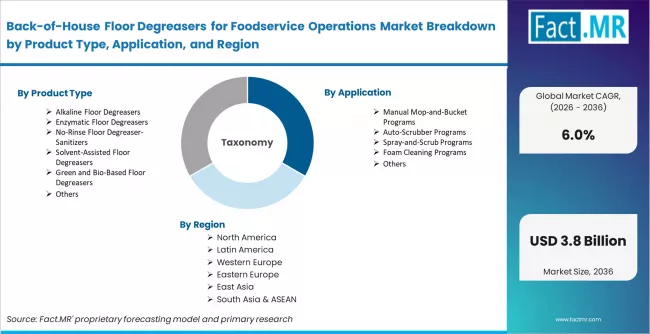
Back Of House Floor Degreasers For Foodservice Operations Market Breakdown By Product Type, Application, And Region | Source: Fact.MR
| Attribute | Details |
|---|---|
| Quantitative Units | USD 2.0 billion (2026) to USD 3.6 billion (2036), at a CAGR of 6.0% |
| Market Definition | Floor degreasers specifically formulated for grease-prone back-of-house foodservice floors, used to remove oily film, improve traction, and support kitchen hygiene |
| Product Type Segmentation | Alkaline Floor Degreasers, Enzymatic Floor Degreasers, No-Rinse Floor Degreaser-Sanitizers, Solvent-Assisted Floor Degreasers, Green and Bio-Based Floor Degreasers, Others |
| Application Segmentation | Manual Mop-and-Bucket Programs, Auto-Scrubber Programs, Spray-and-Scrub Programs, Foam Cleaning Programs, Others |
| End Use Segmentation | Quick Service Restaurants, Full-Service Restaurants, Institutional Kitchens, Hotel Foodservice, Catering and Commissary Kitchens, Others |
| Regions Covered | North America, Europe, Asia Pacific, Latin America, Middle East and Africa |
| Countries Covered | United States, Canada, Mexico, Spain, Netherlands, Germany, France, India, China, Brazil, and 40+ countries |
| Forecast Period | 2026 to 2036 |
| Approach | Hybrid top-down and bottom-up model using foodservice density, grease exposure, cleaning frequency, safety pressure, and primary interviews with operators, distributors, and sanitation advisors |
Source: Fact.MR analysis. Updated Jun 16, 2026
Back-of-House Floor Degreasers for Foodservice Operations Market by Segments
-
By Product Type:
- Alkaline Floor Degreasers
- Enzymatic Floor Degreasers
- No-Rinse Floor Degreaser-Sanitizers
- Solvent-Assisted Floor Degreasers
- Green and Bio-Based Floor Degreasers
- Others
-
By Application:
- Manual Mop-and-Bucket Programs
- Auto-Scrubber Programs
- Spray-and-Scrub Programs
- Foam Cleaning Programs
- Others
-
By End Use Setting:
- Quick Service Restaurants
- Full-Service Restaurants
- Institutional Kitchens
- Hotel Foodservice
- Catering and Commissary Kitchens
- Others
-
By Region:
- North America
- United States
- Canada
- Mexico
- Latin America
- Brazil
- Argentina
- Chile
- Rest of Latin America
- Western Europe
- Germany
- France
- United Kingdom
- Italy
- Spain
- Nordic Countries
- BENELUX
- Rest of Western Europe
- Eastern Europe
- Russia
- Poland
- Hungary
- Balkan and Baltic
- Rest of Eastern Europe
- East Asia
- China
- Japan
- South Korea
- South Asia and Pacific
- India
- ASEAN
- Australia and New Zealand
- Rest of South Asia and Pacific
- Middle East and Africa
- Kingdom of Saudi Arabia
- Other GCC Countries
- Turkey
- South Africa
- Rest of Middle East and Africa
- North America
Frequently Asked Questions
How large is the global back-of-house floor degreasers for foodservice operations market in 2025?
What will the market size be in 2026?
What is the projected market size by 2036?
What is the expected CAGR from 2026 to 2036?
Which product type is poised to lead the market?
Which application segment holds the largest share?
Which end-use setting is expected to remain strongest?
Which country shows the fastest growth?
What is driving demand for back-of-house floor degreasers?
What is the key challenge in this market?
Who worked on this report


Preview the report firsthand - request a free sample
Free SampleGet the brochure for pricing and purchase details
Download PDF