- Base Value(2026): 266.2 Mn
- Estimated Value(2026): 266.2 Mn
- Forecast Value (2036): 659.6 Mn
- CAGR (2026 - 2036): 9.5%
High-Brix Fruit Quality Enhancement Fertilizer Market Forecast and Outlook 2026 to 2036
The global market for high-Brix fruit quality enhancement fertilizers is projected to grow from USD 266.17 million in 2026 to USD 659.64 million by 2036, advancing at a CAGR of 9.5%. This market represents a premium segment within specialty plant nutrition, dedicated to formulating fertilizers that directly increase the soluble solids content (measured as °Brix) and improve the overall flavor, sweetness, and nutritional density of fruit crops. Growth is driven by the powerful economic incentives for growers to meet the stringent quality standards of premium fresh markets, processors, and discerning consumers who prioritize taste and eating experience. High Brix Fruit Quality Enhancement Fertilizer Market Market Value Analysis | Source: Fact.MR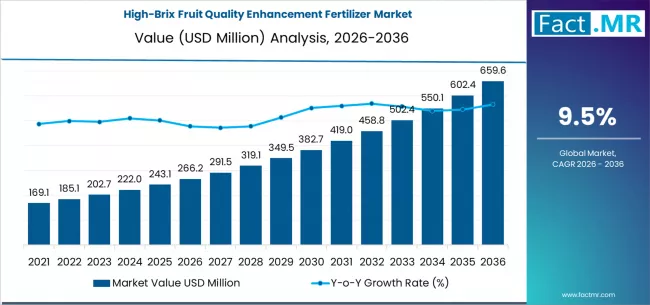
- Market Snapshot
- Globalhigh-Brix fruit quality enhancement fertilizer market revenue stood at USD 266.17 million in 2026 and is forecast to reach USD 659.64 million by 2036.
- At a 9.5%CAGRfrom 2026 to 2036, this premium specialty plant nutrition segment is driven by economic incentives for growers to meet quality standards of premium fresh markets.
- Growth is driven by thevalorizationof quality over sheer yield in fruit production, with higher Brix levels directly translating to superior market grades and better pricing.
- These fertilizers go beyond standardNPKnutrition tooptimizecomplex biochemical pathways responsible for sugar accumulation, acid balance, and aromatic compound development.
- Demand and Growth Drivers
- Economic premium paid forhigh-Brix fruit in fresh and processing markets, with winemakers, fruit packers, and retail chains often offering bonus payments for above-minimum Brix.
- Growing consumer awareness and demand forflavorful, nutrient-dense food pushes the supply chain to prioritize quality parameters over volume.
- Advances in plant nutrition science enabling formulation of targeted potassium-to-nitrogen ratios, micronutrients (boron, calcium, magnesium), and sugar translocation optimization.
- Integration of sensor technology including handheld refractometers tomonitorBrix levels in real-time, guiding in-season nutrient adjustments.
- Emergence of organic-compliant Brix enhancement programs using approved potassium sources andbiostimulantsfor premium organic fruit markets.
- Product and Segment View
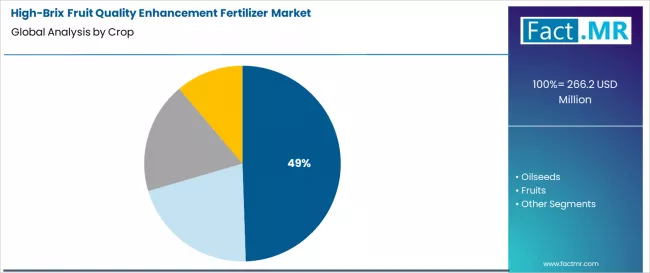
- Cereals lead the Crop Type segment with a 49.5% market share in 2026, encompassing sweet corn and specialty grains, though the most sophisticated applications are concentrated in high-value fruit crops.
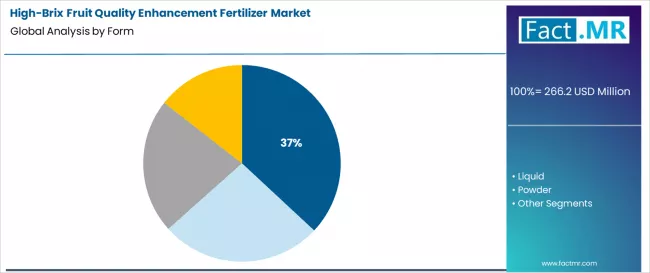
- Granular form leads the Form segment with a 37.0% share in 2026,favoredin orchard and vineyard settings for controlled-release nutrient delivery through critical fruit maturation phases.
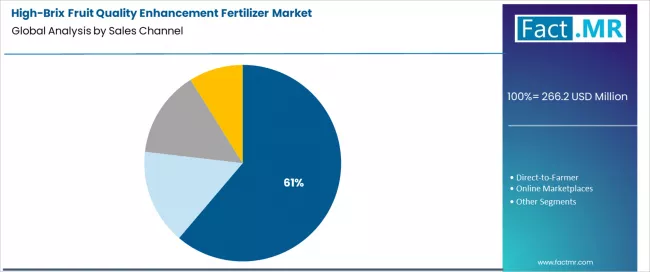
- Ag-Retailers lead the Sales Channel segment with a 61% share in 2026,providingessential site-specific agronomic guidance for successful implementation of Brix enhancement programs.
- Additional segments include Oilseeds, Fruits, Vegetables crop types; Liquid, Powder, Suspension forms; and Direct-to-Farmer, Online Marketplaces, and Cooperatives sales channels.
- Geography and Competitive Outlook
- India (13.4%CAGR), China (12.9%), USA (12.6%), and France (11.8%) are the key growth countries highlighted on the webpage.
- South Asia & Pacific, East Asia, North America, and Western Europe are primary regional markets driven by horticultural export ambitions, premium domestic markets, and winemaking heritage.
- Market expansion is closely tied to premium fresh produce trade standards, quality-based pricing grids, wine industry quality benchmarks, and horticultural export certification requirements.
- Key companies active in this market includeICLGroup Ltd., Haifa Group,Nutrien,YaraInternationalASA,UPLLimited, and BASF SE.
High-Brix Fruit Quality Enhancement Fertilizer Market — At a Glance
| Attribute | Details |
|---|---|
| Market Value 2026 | USD 266.17 Million |
| Market Value 2036 | USD 659.64 Million |
| Absolute Dollar Opportunity 2026–2036 | USD393.47Million |
| Total Growth 2026–2036 | 148% |
| CAGR2026–2036 | 9.5% |
| Growth Multiple | 2.5x |
| Key Demand Theme | Premium specialty nutritionprogrammesscientifically designed to increase fruit soluble solids (°Brix), enhance sweetness, and command higher market prices |
| Leading Segment by Crop Type (2026) | Cereals |
| Crop Type Segment Share (2026) | 49.5% |
| Leading Segment by Form (2026) | Granular |
| Form Segment Share (2026) | 37.0% |
| Leading Segment by Sales Channel (2026) | Ag-Retailers |
| Sales Channel Segment Share (2026) | 61% |
| Key Growth Regions | South Asia & Pacific, East Asia, North America, Western Europe |
| CountryCAGRs | India 13.4%, China 12.9%, USA 12.6%, France 11.8% |
| Top Companies | ICLGroup Ltd., Haifa Group,Nutrien,YaraInternationalASA,UPLLimited, BASF SE |
| Segmentation by Crop Type | Cereals, Oilseeds, Fruits, Vegetables |
| Segmentation by Form | Granular, Liquid, Powder, Suspension |
| Segmentation by Sales Channel | Ag-Retailers, Direct-to-Farmer, Online Marketplaces, Cooperatives |
| Segmentation by Region | North America, Latin America, Western Europe, Eastern Europe, East Asia, South Asia & Pacific, MEA |
Source: Fact.MR analysis. Updated Apr 15, 2026
These advanced fertilizers go beyond standard NPK nutrition to optimize the complex biochemical pathways responsible for sugar accumulation, acid balance, and aromatic compound development. They typically feature precise ratios of potassium to nitrogen to favor fruit filling over vegetative growth, along with targeted micronutrients like boron, calcium, and magnesium that influence sugar transport and cell wall integrity. The application of these programs is especially critical for high-value horticultural crops such as grapes, citrus, stone fruits, berries, and mangoes, where a higher Brix level directly translates to superior market grade, better pricing, and enhanced consumer satisfaction. The market’s evolution is closely tied to the valorization of quality over sheer yield in fruit production. Success depends on providing growers with scientifically validated nutrition programs that deliver measurable improvements in fruit biochemistry, supported by data from refractometers and sensory panels, thereby bridging agronomic practice with tangible market reward.
Category
| Category | Segments |
|---|---|
| Crop Type | Cereals, Oilseeds, Fruits, Vegetables |
| Form | Granular, Liquid, Powder, Suspension |
| Sales Channel | Ag-Retailers, Direct-to-Farmer, Online Marketplaces, Cooperatives |
| Region | North America, Latin America, Western Europe, Eastern Europe, East Asia, South Asia & Pacific, MEA |
Source: Fact.MR analysis. Updated Apr 15, 2026
Segmental Analysis
By Crop Type, Which Segment Shows Broad Application Potential?
High Brix Fruit Quality Enhancement Fertilizer Market Analysis By Crop | Source: Fact.MR
The cereals segment holds a leading 49% share. This significant portion is attributed to the application of Brix-enhancement principles in crops like sweet corn and certain specialty grains where sugar content is a key quality determinant, as well as the vast scale of cereal production exploring value-addition.
However, the most intense focus and technological sophistication of these fertilizers are applied within the Fruits segment, including vineyards, orchards, and berry fields, where a direct price premium exists for measurable improvements in sweetness and flavor profile.
By Form, Which Allows for Controlled Nutrient Release During Fruit Development?
High Brix Fruit Quality Enhancement Fertilizer Market Analysis By Form | Source: Fact.MR
Granular form, particularly controlled-release or slow-release varieties, leads with a 37% share. This format is favored in orchard and vineyard settings because it provides a steady, predictable supply of nutrients throughout the critical fruit development and maturation phases.
Consistent potassium availability, crucial for sugar translocation, is better maintained with granular matrices that minimize leaching and align nutrient release with the tree or vine’s physiological demands, preventing late-season vigor that can dilute Brix.
By Sales Channel, Where is Quality-Focused Agronomy Critical?
High Brix Fruit Quality Enhancement Fertilizer Market Analysis By Sales Channel | Source: Fact.MR
Ag-retailers are the dominant channel, commanding a 61% share. Achieving higher Brix is a nuanced agronomic challenge that depends on correct product selection, timing, and integration with irrigation management.
Local retailer agronomists provide the essential, site-specific guidance needed to implement these programs effectively, helping growers interpret soil and leaf tissue tests to tailor applications that maximize sugar accumulation without compromising other quality aspects like fruit size or finish.
What are the Drivers, Restraints, and Key Trends of the High-Brix Fruit Quality Enhancement Fertilizer Market?
The foremost driver is the economic premium paid for high-Brix fruit in both fresh and processing markets. Winemakers, fruit packers, and retail chains often offer bonus payments for produce exceeding minimum Brix standards. Growing consumer awareness and demand for flavorful, nutrient-dense food further push the supply chain to prioritize quality parameters. Additionally, the scientific understanding of plant nutrition's role in carbohydrate metabolism has advanced, enabling the formulation of more effective products.
A key restraint is the higher cost of these specialized fertilizer programs compared to standard grades. Results can also be influenced by uncontrollable environmental factors like sunlight hours and temperature, which may limit the visible impact of nutrition in some seasons. Demonstrating a clear and consistent return on investment through higher prices or yield of premium-grade fruit is necessary to justify the added expense for growers, particularly in competitive commodity markets.
Key trends include the integration of sensor technology, where handheld or canopy-mounted refractometers are used to monitor Brix levels in real-time, guiding in-season nutrient adjustments. Organic-compliant Brix enhancement programs are emerging, using approved potassium sources and biostimulants. There is also a trend toward full-season nutritional programming that manages plant balance from flowering through post-veraison to ensure optimal conditions for sugar accumulation and fruit maturity.
Analysis of the High-Brix Fruit Quality Enhancement Fertilizer Market by Key Countries
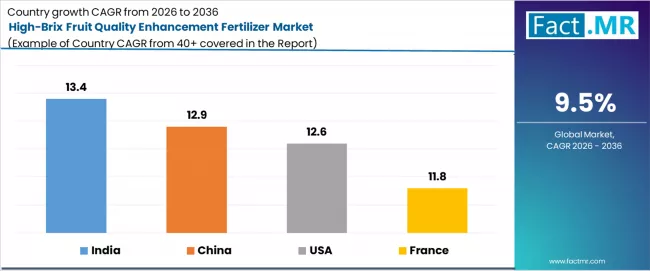
High Brix Fruit Quality Enhancement Fertilizer Market Cagr Analysis By Country | Source: Fact.MR
| Country | CAGR (2026-2036) |
|---|---|
| India | 13.4% |
| China | 12.9% |
| USA | 12.6% |
| France | 11.8% |
Source: Fact.MR analysis. Updated Apr 15, 2026
How is India's Horticultural Export Ambition Driving Market Growth?
India’s leading CAGR of 13.4% is fueled by its ambitions to expand and upgrade its fruit export industry for crops like mangoes, grapes, and pomegranates. Meeting the high Brix and quality standards of international markets is essential.
Government and industry-led initiatives are promoting precision nutrition and post-harvest management, creating significant demand for fertilizers scientifically proven to enhance internal fruit quality and sweetness for long-haul shipping and shelf-life.
What is the Impact of China's Domestic Premium Market and Viticulture?
A booming domestic market for premium fruits and a rapidly growing wine industry drive China’s 12.9% growth. Chinese consumers are increasingly quality-conscious, and vineyards are focused on improving grape quality for both domestic and international acclaim. This dual focus on high-value table fruit and wine grapes creates a substantial market for fertilization strategies aimed explicitly at elevating soluble solids and flavor complexity.
Why is the USA's Sophisticated Quality-Based Pricing a Key Factor?
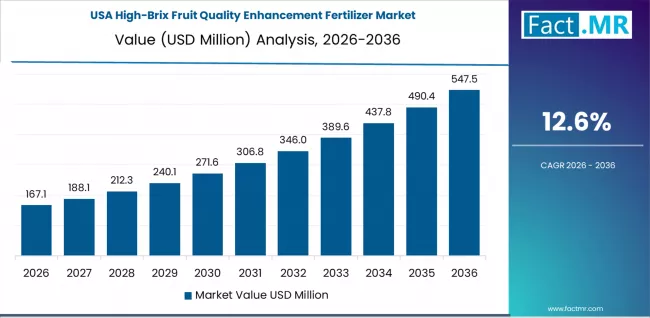
High Brix Fruit Quality Enhancement Fertilizer Market Country Value Analysis | Source: Fact.MR
Highly developed quality-based pricing grids in its fruit and wine sectors underpin the USA’s 12.6% growth. Contracts for processing tomatoes, wine grapes, and fresh-market citrus often include Brix bonuses.
This direct financial incentive makes investment in quality-enhancing fertilizers a standard cost of doing business for professional growers, driving consistent demand and innovation in nutritional technologies tailored to major US cropping systems.
How is France's Winemaking Tradition and Terroir Focus Influencing Demand?
France’s 11.8% CAGR is deeply rooted in its globally influential wine and orchard industries. The concept of terroir emphasizes intrinsic fruit quality. French growers and viticulturists are adept at using nutritional tools to express the potential of their land, employing precision fertilization to achieve optimal grape maturity and enhance the flavor profile of stone fruits, making this a mature yet innovation-focused market for premium quality enhancement products.
Competitive Landscape of the High-Brix Fruit Quality Enhancement Fertilizer Market
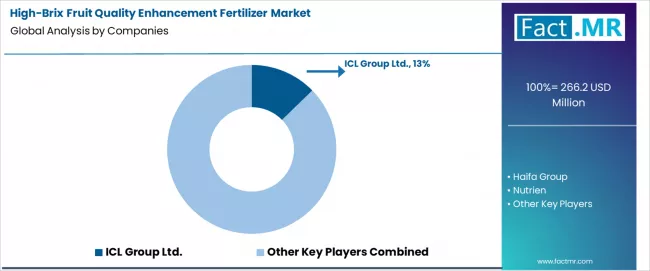
High Brix Fruit Quality Enhancement Fertilizer Market Analysis By Company | Source: Fact.MR
The competitive landscape is characterized by competition between specialty fertilizer companies with strong horticultural portfolios and global agriscience firms. Rivalry centers on proprietary nutrient formulations and chelation technologies, the strength of agronomic research linking specific products to measurable Brix increases, and the provision of comprehensive technical support.
Success requires building trust through demonstrable results in field trials across different fruit crops and forging strong relationships with influential growers, cooperatives, and wineries that set quality trends.
Key Players in the High-Brix Fruit Quality Enhancement Fertilizer Market
- ICL Group Ltd.
- Haifa Group
- Nutrien
- Yara International ASA
- UPL Limited
- BASF SE
Segmentation
Scope of Report
| Items | Values |
|---|---|
| Quantitative Units | USD Million |
| Crop Type | Cereals, Oilseeds, Fruits, Vegetables |
| Form | Granular, Liquid, Powder, Suspension |
| Sales Channel | Ag-Retailers, Direct-to-Farmer, Online Marketplaces, Cooperatives |
| Key Countries | India, USA, China, France |
| Key Companies | ICL Group Ltd., Haifa Group, Nutrien, Yara International ASA, UPL Limited, BASF SE |
| Additional Analysis | Physiological studies on nutrient influence on sugar metabolism and translocation; correlation between leaf/tissue nutrient levels and final fruit Brix; economic analysis of premium pricing for high-Brix fruit; impact of enhanced nutrition on post-harvest shelf-life and integrity; review of quality certification programs and their nutritional prerequisites. |
Source: Fact.MR analysis. Updated Apr 15, 2026
Market by Segments
-
Crop Type :
- Cereals
- Oilseeds
- Fruits
- Vegetables
-
Form :
- Granular
- Liquid
- Powder
- Suspension
-
Sales Channel :
- Ag-Retailers
- Direct-to-Farmer
- Online Marketplaces
- Cooperatives
-
Region :
-
North America
- USA
- Canada
-
Latin America
- Brazil
- Mexico
- Argentina
- Rest of Latin America
-
Western Europe
- Germany
- UK
- France
- Spain
- Italy
- BENELUX
- Rest of Western Europe
-
Eastern Europe
- Russia
- Poland
- Czech Republic
- Rest of Eastern Europe
-
East Asia
- China
- Japan
- South Korea
- Rest of East Asia
-
South Asia & Pacific
- India
- ASEAN
- Australia
- Rest of South Asia & Pacific
-
MEA
- Saudi Arabia
- UAE
- Turkiye
- Rest of MEA
-
Frequently Asked Questions
How big is the high-brix fruit quality enhancement fertilizer market in 2026?
What will be the size of high-brix fruit quality enhancement fertilizer market in 2036?
How much will be the high-brix fruit quality enhancement fertilizer market growth between 2026 and 2036?
What are the key product types in the high-brix fruit quality enhancement fertilizer market?
Which form segment to contribute significant share in the high-brix fruit quality enhancement fertilizer market in 2026?
Who worked on this report


Preview the report firsthand - request a free sample
Free SampleGet the brochure for pricing and purchase details
Download PDF