Fruit-Cracking Prevention Spray Program Market

Fruit-Cracking Prevention Spray Program Market Size and Share Forecast Outlook 2026 to 2036

Fruit-cracking prevention spray program market is projected to grow from USD 0.3 billion in 2026 to USD 1.3 billion by 2036, at a CAGR of 14.9%. Calcium–Boron Reinforcement Sprays will dominate with a 34.0% market share, while tomatoes will lead the fruit type segment with a 29.0% share.

Fruit-Cracking Prevention Spray Program Market Forecast and Outlook 2026 to 2036

The global fruit-cracking prevention spray program market is projected to reach USD 1.28 billion by 2036. The market is valued at USD 0.32 billion in 2026 and is set to rise at a CAGR of 14.9% during the assessment period. By program chemistry type, calcium-boron reinforcement sprays hold a leading 34% share. The tomatoes fruit type segment represents a dominant 29% share, while the cell wall strengthening physiological control mechanism accounts for 38% market share.

Key Takeaways from the Fruit-Cracking Prevention Spray Program Market

  • Market Value for 2026: USD 0.32 Billion
  • Market Value for 2036: USD 1.28 Billion
  • Forecast CAGR (2026-2036): 14.9%
  • Leading Program Chemistry Type Share (2026): Calcium-Boron Reinforcement Sprays (34%)
  • Leading Fruit Type Share (2026): Tomatoes (29%)
  • Leading Physiological Control Mechanism Share (2026): Cell Wall Strengthening (38%)
  • Key Players in the Market: SePRO Corporation, Oro Agri International, AgroLiquid, Koch Agronomic Services, Agro-K Corporation
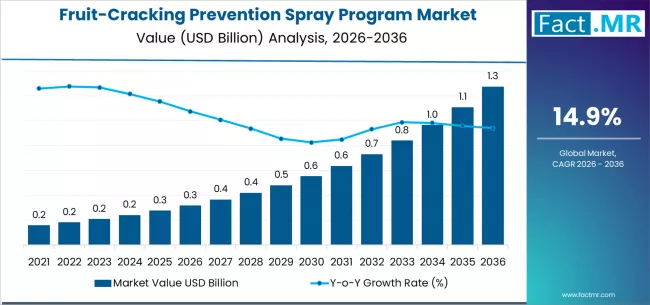
Fruit Cracking Prevention Spray Program Market Market Value Analysis

A defining trend is the integration of nutrient supplementation with physical barrier technologies to address both the nutritional and structural causes of fruit cracking. Research focuses on optimizing spray timing and formulation adhesion to protect fruit during critical rapid growth phases and water stress events. Programs are increasingly customized based on real-time soil moisture data and weather forecasts to preemptively manage the conditions that lead to cracking.

Regulatory drivers are generally supportive, focusing on food quality and loss reduction rather than restrictive chemical policies. Initiatives aimed at minimizing post-harvest waste and improving marketable yield create a favorable environment for adoption. Regulations concerning maximum residue limits for edible coatings are well-established, guiding the development of safe, compliant film-forming products.

Fruit-Cracking Prevention Spray Program Market

Metric Value
Market Value (2026) USD 0.32 Billion
Market Forecast Value (2036) USD 1.28 Billion
Forecast CAGR (2026-2036) 14.9%

Category

Category Segments
Program Chemistry Type Calcium-Boron Reinforcement Sprays, Elastic Film-Forming Anti-Crack Coatings, Osmoregulation & Cuticle-Strengthening Blends, Silicon & Mineral Barrier Programs, Others
Fruit Type Tomatoes, Cherries, Citrus Fruits, Grapes & Berries, Others
Physiological Control Mechanism Cell Wall Strengthening, Cuticle Elasticity Enhancement, Water Uptake Regulation, Rapid Growth Stress Moderation, Others
Region North America, Latin America, Western Europe, Eastern Europe, East Asia, South Asia & Pacific, MEA

Segmental Analysis

By Program Chemistry, Which Nutrients Address a Fundamental Structural Weakness?
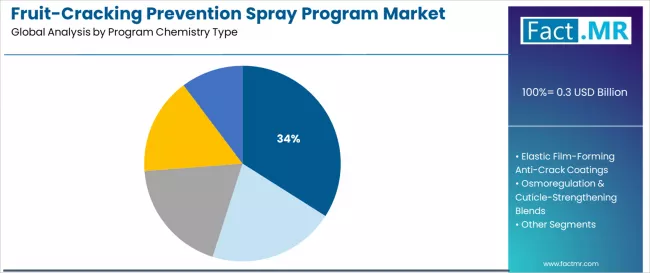
Fruit Cracking Prevention Spray Program Market Analysis By Program Chemistry Type

Calcium-boron reinforcement sprays lead the segment with a 34% share. This dominance is rooted in the fundamental role of calcium in forming stable pectin bonds in the cell wall and boron in facilitating calcium uptake and utilization. A deficiency in either nutrient directly results in weak cell walls prone to rupture under internal pressure. Foliar applications during fruit development are a direct and effective method to correct this deficiency and enhance structural integrity.

By Fruit Type, Which High-Value Crop Suffers the Most Significant Economic Loss?
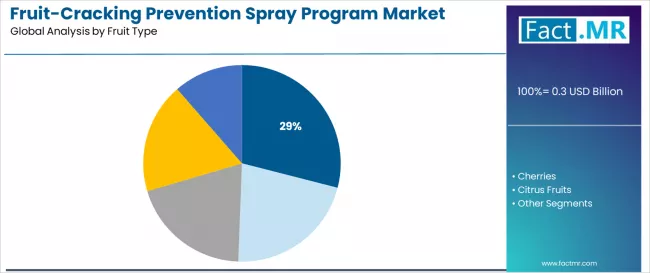
Fruit Cracking Prevention Spray Program Market Analysis By Fruit Type

Tomatoes command the largest share at 29%. Cracking in tomatoes, particularly radial and concentric cracking, causes direct and often total market loss, as cracked fruit are unmarketable for fresh consumption and highly susceptible to disease. The intensity of production in both open-field and greenhouse systems, combined with high sensitivity to irregular irrigation, makes crack prevention a universal priority for tomato growers globally.

By Physiological Control Mechanism, What is the Primary Biochemical Defense?
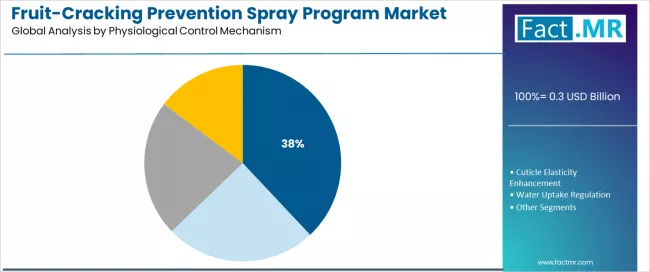
Fruit Cracking Prevention Spray Program Market Analysis By Physiological Control Mechanism

Cell wall strengthening is the leading mechanism at 38%. This approach targets the root cause of cracking: insufficient mechanical strength in the fruit skin and flesh to withstand turgor pressure. Programs that enhance the deposition and cross-linking of structural components like calcium-pectin complexes directly increase the fruit's resistance to splitting, providing a foundational solution that is applicable across a wide range of fruit species.

What are the Drivers, Restraints, and Key Trends of the Fruit-Cracking Prevention Spray Program Market?

Market growth is driven by the high economic loss from cracked fruit, which can render entire harvests unsaleable for fresh markets. The increasing consumer and retailer demand for cosmetically perfect, blemish-free produce raises quality standards. Climate variability leading to irregular rainfall and irrigation events exacerbates cracking pressure, making preventive programs more essential. The expansion of protected cultivation of high-value fruits also supports adoption.

A key restraint is the difficulty in achieving perfect spray coverage and absorption during the narrow window of fruit development. Rain or overhead irrigation can wash off protective coatings. The cost of multiple applications through the season can be significant, and demonstrating a clear return on investment requires accurate records of cracking reduction and grade improvement.

Significant trends include the development of combination sprays that deliver nutrients, growth regulators, and physical barriers in a single application. Synergistic blends of calcium with amino acids or seaweed extracts improve uptake and efficacy. Data-driven irrigation management is being paired with spray programs to maintain optimal soil moisture and minimize the water uptake surges that cause cracking.

Analysis of the Fruit-Cracking Prevention Spray Program Market by Key Countries
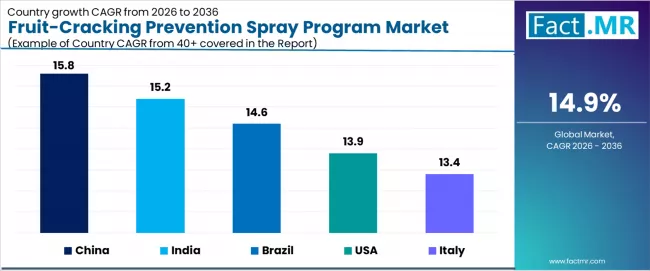
Fruit Cracking Prevention Spray Program Market Cagr Analysis By Country

Country CAGR (2026-2036)
China 15.80%
India 15.20%
Brazil 14.60%
USA 13.90%
Italy 13.40%

How does China's Massive Protected Horticulture Sector Drive Demand?

China leads with a 15.80% CAGR, fueled by its world-leading area of greenhouse vegetable production, where tomatoes are a primary crop. Controlling the environment only partially mitigates cracking risk. Chinese growers implement intensive spray programs to guarantee the high-grade, unblemished fruit required by domestic and export markets, viewing these inputs as essential for protecting their substantial investment in infrastructure and achieving maximum return.

Why is India's Monsoon-Affected Fruit Production a Key Growth Area?

India's 15.20% growth is driven by the vulnerability of its tomato and grape crops to cracking caused by erratic monsoon rains following dry periods. The pre-monsoon heat and subsequent heavy rainfall create ideal conditions for fruit splitting. Smallholder and commercial growers are increasingly adopting calcium and film-forming spray programs as a critical defense mechanism to salvage yield and quality during the volatile harvest season.

What Role does Brazil's Export-Oriented Fruit Agriculture Play?

Brazil's 14.60% growth is linked to its large export volumes of citrus and table grapes, where skin integrity is paramount for shelf life and consumer acceptance. Cracking caused by tropical rain events immediately prior to harvest is a major quality defect. Brazilian export protocols mandate strict quality control, making anti-crack spray programs a standard practice in orchards and vineyards supplying international markets.

How is the USA's High-Value Specialty Crop Industry a Focused Market?
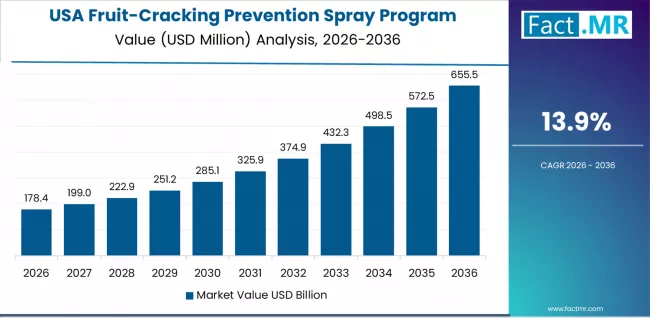
Fruit Cracking Prevention Spray Program Market Country Value Analysis

The USA's 13.90% growth is concentrated in regions producing cracking-prone fruits like sweet cherries in the Pacific Northwest, tomatoes in California and Florida, and grapes nationwide. The extreme value of these crops per acre justifies sophisticated management. American growers utilize tailored spray programs-often involving calcium, surfactants, and film formers-integrated with precision irrigation to manage fruit quality as a core component of their production strategy.

What Factors Underpin Italy's Quality-Focused Viticulture and Horticulture?

Italy's 13.40% growth reflects its premium wine grape and tomato processing (e.g., San Marzano) industries, where cracking compromises both quality and yield. Italian growers, operating under stringent protected designation of origin rules, employ targeted programs using silicon and mineral barriers to enhance grape skin strength and calcium sprays for tomatoes. This focus on preserving the integrity of high-value produce sustains steady market demand.

Competitive Landscape of the Fruit-Cracking Prevention Spray Program Market
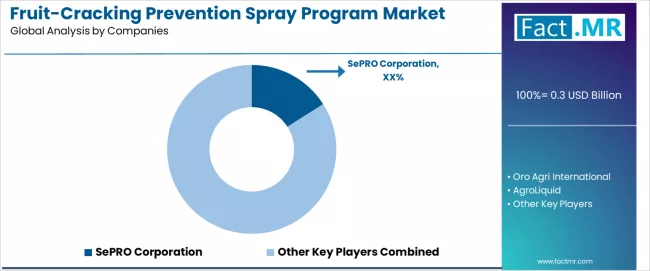
Fruit Cracking Prevention Spray Program Market Analysis By Company

Specialty nutrition companies, biostimulant firms, and adjuvant manufacturers serve the market. Nutrition-focused players like AgroLiquid, Koch Agronomic Services, and Agro-K Corporation compete with advanced, highly available calcium and micronutrient formulations designed for foliar uptake and translocation into fruit. Their expertise lies in chelation chemistry and nutrient synergy.

Companies like SePRO Corporation and Oro Agri International compete with broader portfolios that include film-forming coating technologies and combination products. Their advantage is offering a complete physical and nutritional solution. Competition centers on proving efficacy through university and independent field trials on specific high-value crops, providing clear application protocols, and building trust with growers through demonstrable reductions in cullage rates.

Key Players in the Fruit-Cracking Prevention Spray Program Market

  • SePRO Corporation
  • Oro Agri International
  • AgroLiquid
  • Koch Agronomic Services
  • Agro-K Corporation

Scope of Report

Items Values
Quantitative Units USD Billion
Program Chemistry Type Calcium-Boron Reinforcement Sprays, Elastic Film-Forming Anti-Crack Coatings, Osmoregulation & Cuticle-Strengthening Blends, Silicon & Mineral Barrier Programs, Others
Fruit Type Tomatoes, Cherries, Citrus Fruits, Grapes & Berries, Others
Physiological Control Mechanism Cell Wall Strengthening, Cuticle Elasticity Enhancement, Water Uptake Regulation, Rapid Growth Stress Moderation, Others
Key Countries China, India, Brazil, USA, Italy
Key Companies SePRO Corporation, Oro Agri International, AgroLiquid, Koch Agronomic Services, Agro-K Corporation
Additional Analysis Analysis of fruit tissue nutrient sufficiency levels, interaction with irrigation scheduling, economic impact models of cracking loss, and post-harvest shelf-life extension benefits.

Fruit-Cracking Prevention Spray Program Market by Segments

  • Program Chemistry Type :

    • Calcium-Boron Reinforcement Sprays
    • Elastic Film-Forming Anti-Crack Coatings
    • Osmoregulation & Cuticle-Strengthening Blends
    • Silicon & Mineral Barrier Programs
    • Others
  • Fruit Type :

    • Tomatoes
    • Cherries
    • Citrus Fruits
    • Grapes & Berries
    • Others
  • Physiological Control Mechanism :

    • Cell Wall Strengthening
    • Cuticle Elasticity Enhancement
    • Water Uptake Regulation
    • Rapid Growth Stress Moderation
    • Others
  • Region :

    • North America

      • USA
      • Canada
    • Latin America

      • Brazil
      • Mexico
      • Argentina
      • Rest of Latin America
    • Western Europe

      • Germany
      • UK
      • France
      • Spain
      • Italy
      • BENELUX
      • Rest of Western Europe
    • Eastern Europe

      • Czech Republic
      • Poland
      • Russia
      • Rest of Eastern Europe
    • East Asia

      • China
      • Japan
      • South Korea
      • Rest of East Asia
    • South Asia & Pacific

      • India
      • Indonesia
      • Australia
      • Rest of South Asia & Pacific
    • MEA

      • GCC Countries
      • Turkiye
      • Saudi Arabia
      • Rest of MEA

Table of Content

  1. Executive Summary
    • Global Market Outlook
    • Demand to side Trends
    • Supply to side Trends
    • Technology Roadmap Analysis
    • Analysis and Recommendations
  2. Market Overview
    • Market Coverage / Taxonomy
    • Market Definition / Scope / Limitations
  3. Market Background
    • Market Dynamics
      • Drivers
      • Restraints
      • Opportunity
      • Trends
    • Scenario Forecast
      • Demand in Optimistic Scenario
      • Demand in Likely Scenario
      • Demand in Conservative Scenario
    • Opportunity Map Analysis
    • Product Life Cycle Analysis
    • Supply Chain Analysis
    • Investment Feasibility Matrix
    • Value Chain Analysis
    • PESTLE and Porter’s Analysis
    • Regulatory Landscape
    • Regional Parent Market Outlook
    • Production and Consumption Statistics
    • Import and Export Statistics
  4. Global Market Analysis 2021 to 2025 and Forecast, 2026 to 2036
    • Historical Market Size Value (USD Million) Analysis, 2021 to 2025
    • Current and Future Market Size Value (USD Million) Projections, 2026 to 2036
      • Y to o to Y Growth Trend Analysis
      • Absolute $ Opportunity Analysis
  5. Global Market Pricing Analysis 2021 to 2025 and Forecast 2026 to 2036
  6. Global Market Analysis 2021 to 2025 and Forecast 2026 to 2036, By Program Chemistry Type
    • Introduction / Key Findings
    • Historical Market Size Value (USD Million) Analysis By Program Chemistry Type, 2021 to 2025
    • Current and Future Market Size Value (USD Million) Analysis and Forecast By Program Chemistry Type, 2026 to 2036
      • Calcium-Boron Reinforcement Sprays
      • Elastic Film-Forming Anti-Crack Coatings
      • Osmoregulation & Cuticle-Strengthening Blends
      • Silicon & Mineral Barrier Programs
      • Others
    • Y to o to Y Growth Trend Analysis By Program Chemistry Type, 2021 to 2025
    • Absolute $ Opportunity Analysis By Program Chemistry Type, 2026 to 2036
  7. Global Market Analysis 2021 to 2025 and Forecast 2026 to 2036, By Fruit Type
    • Introduction / Key Findings
    • Historical Market Size Value (USD Million) Analysis By Fruit Type, 2021 to 2025
    • Current and Future Market Size Value (USD Million) Analysis and Forecast By Fruit Type, 2026 to 2036
      • Tomatoes
      • Cherries
      • Citrus Fruits
      • Grapes & Berries
      • Others
    • Y to o to Y Growth Trend Analysis By Fruit Type, 2021 to 2025
    • Absolute $ Opportunity Analysis By Fruit Type, 2026 to 2036
  8. Global Market Analysis 2021 to 2025 and Forecast 2026 to 2036, By Physiological Control Mechanism
    • Introduction / Key Findings
    • Historical Market Size Value (USD Million) Analysis By Physiological Control Mechanism, 2021 to 2025
    • Current and Future Market Size Value (USD Million) Analysis and Forecast By Physiological Control Mechanism, 2026 to 2036
      • Cell Wall Strengthening
      • Cuticle Elasticity Enhancement
      • Water Uptake Regulation
      • Rapid Growth Stress Moderation
    • Y to o to Y Growth Trend Analysis By Physiological Control Mechanism, 2021 to 2025
    • Absolute $ Opportunity Analysis By Physiological Control Mechanism, 2026 to 2036
  9. Global Market Analysis 2021 to 2025 and Forecast 2026 to 2036, By Region
    • Introduction
    • Historical Market Size Value (USD Million) Analysis By Region, 2021 to 2025
    • Current Market Size Value (USD Million) Analysis and Forecast By Region, 2026 to 2036
      • North America
      • Latin America
      • Western Europe
      • Eastern Europe
      • East Asia
      • South Asia and Pacific
      • Middle East & Africa
    • Market Attractiveness Analysis By Region
  10. North America Market Analysis 2021 to 2025 and Forecast 2026 to 2036, By Country
    • Historical Market Size Value (USD Million) Trend Analysis By Market Taxonomy, 2021 to 2025
    • Market Size Value (USD Million) Forecast By Market Taxonomy, 2026 to 2036
      • By Country
        • USA
        • Canada
        • Mexico
      • By Program Chemistry Type
      • By Fruit Type
      • By Physiological Control Mechanism
    • Market Attractiveness Analysis
      • By Country
      • By Program Chemistry Type
      • By Fruit Type
      • By Physiological Control Mechanism
    • Key Takeaways
  11. Latin America Market Analysis 2021 to 2025 and Forecast 2026 to 2036, By Country
    • Historical Market Size Value (USD Million) Trend Analysis By Market Taxonomy, 2021 to 2025
    • Market Size Value (USD Million) Forecast By Market Taxonomy, 2026 to 2036
      • By Country
        • Brazil
        • Chile
        • Rest of Latin America
      • By Program Chemistry Type
      • By Fruit Type
      • By Physiological Control Mechanism
    • Market Attractiveness Analysis
      • By Country
      • By Program Chemistry Type
      • By Fruit Type
      • By Physiological Control Mechanism
    • Key Takeaways
  12. Western Europe Market Analysis 2021 to 2025 and Forecast 2026 to 2036, By Country
    • Historical Market Size Value (USD Million) Trend Analysis By Market Taxonomy, 2021 to 2025
    • Market Size Value (USD Million) Forecast By Market Taxonomy, 2026 to 2036
      • By Country
        • Germany
        • UK
        • Italy
        • Spain
        • France
        • Nordic
        • BENELUX
        • Rest of Western Europe
      • By Program Chemistry Type
      • By Fruit Type
      • By Physiological Control Mechanism
    • Market Attractiveness Analysis
      • By Country
      • By Program Chemistry Type
      • By Fruit Type
      • By Physiological Control Mechanism
    • Key Takeaways
  13. Eastern Europe Market Analysis 2021 to 2025 and Forecast 2026 to 2036, By Country
    • Historical Market Size Value (USD Million) Trend Analysis By Market Taxonomy, 2021 to 2025
    • Market Size Value (USD Million) Forecast By Market Taxonomy, 2026 to 2036
      • By Country
        • Russia
        • Poland
        • Hungary
        • Balkan & Baltic
        • Rest of Eastern Europe
      • By Program Chemistry Type
      • By Fruit Type
      • By Physiological Control Mechanism
    • Market Attractiveness Analysis
      • By Country
      • By Program Chemistry Type
      • By Fruit Type
      • By Physiological Control Mechanism
    • Key Takeaways
  14. East Asia Market Analysis 2021 to 2025 and Forecast 2026 to 2036, By Country
    • Historical Market Size Value (USD Million) Trend Analysis By Market Taxonomy, 2021 to 2025
    • Market Size Value (USD Million) Forecast By Market Taxonomy, 2026 to 2036
      • By Country
        • China
        • Japan
        • South Korea
      • By Program Chemistry Type
      • By Fruit Type
      • By Physiological Control Mechanism
    • Market Attractiveness Analysis
      • By Country
      • By Program Chemistry Type
      • By Fruit Type
      • By Physiological Control Mechanism
    • Key Takeaways
  15. South Asia and Pacific Market Analysis 2021 to 2025 and Forecast 2026 to 2036, By Country
    • Historical Market Size Value (USD Million) Trend Analysis By Market Taxonomy, 2021 to 2025
    • Market Size Value (USD Million) Forecast By Market Taxonomy, 2026 to 2036
      • By Country
        • India
        • ASEAN
        • Australia & New Zealand
        • Rest of South Asia and Pacific
      • By Program Chemistry Type
      • By Fruit Type
      • By Physiological Control Mechanism
    • Market Attractiveness Analysis
      • By Country
      • By Program Chemistry Type
      • By Fruit Type
      • By Physiological Control Mechanism
    • Key Takeaways
  16. Middle East & Africa Market Analysis 2021 to 2025 and Forecast 2026 to 2036, By Country
    • Historical Market Size Value (USD Million) Trend Analysis By Market Taxonomy, 2021 to 2025
    • Market Size Value (USD Million) Forecast By Market Taxonomy, 2026 to 2036
      • By Country
        • Kingdom of Saudi Arabia
        • Other GCC Countries
        • Turkiye
        • South Africa
        • Other African Union
        • Rest of Middle East & Africa
      • By Program Chemistry Type
      • By Fruit Type
      • By Physiological Control Mechanism
    • Market Attractiveness Analysis
      • By Country
      • By Program Chemistry Type
      • By Fruit Type
      • By Physiological Control Mechanism
    • Key Takeaways
  17. Key Countries Market Analysis
    • USA
      • Pricing Analysis
      • Market Share Analysis, 2025
        • By Program Chemistry Type
        • By Fruit Type
        • By Physiological Control Mechanism
    • Canada
      • Pricing Analysis
      • Market Share Analysis, 2025
        • By Program Chemistry Type
        • By Fruit Type
        • By Physiological Control Mechanism
    • Mexico
      • Pricing Analysis
      • Market Share Analysis, 2025
        • By Program Chemistry Type
        • By Fruit Type
        • By Physiological Control Mechanism
    • Brazil
      • Pricing Analysis
      • Market Share Analysis, 2025
        • By Program Chemistry Type
        • By Fruit Type
        • By Physiological Control Mechanism
    • Chile
      • Pricing Analysis
      • Market Share Analysis, 2025
        • By Program Chemistry Type
        • By Fruit Type
        • By Physiological Control Mechanism
    • Germany
      • Pricing Analysis
      • Market Share Analysis, 2025
        • By Program Chemistry Type
        • By Fruit Type
        • By Physiological Control Mechanism
    • UK
      • Pricing Analysis
      • Market Share Analysis, 2025
        • By Program Chemistry Type
        • By Fruit Type
        • By Physiological Control Mechanism
    • Italy
      • Pricing Analysis
      • Market Share Analysis, 2025
        • By Program Chemistry Type
        • By Fruit Type
        • By Physiological Control Mechanism
    • Spain
      • Pricing Analysis
      • Market Share Analysis, 2025
        • By Program Chemistry Type
        • By Fruit Type
        • By Physiological Control Mechanism
    • France
      • Pricing Analysis
      • Market Share Analysis, 2025
        • By Program Chemistry Type
        • By Fruit Type
        • By Physiological Control Mechanism
    • India
      • Pricing Analysis
      • Market Share Analysis, 2025
        • By Program Chemistry Type
        • By Fruit Type
        • By Physiological Control Mechanism
    • ASEAN
      • Pricing Analysis
      • Market Share Analysis, 2025
        • By Program Chemistry Type
        • By Fruit Type
        • By Physiological Control Mechanism
    • Australia & New Zealand
      • Pricing Analysis
      • Market Share Analysis, 2025
        • By Program Chemistry Type
        • By Fruit Type
        • By Physiological Control Mechanism
    • China
      • Pricing Analysis
      • Market Share Analysis, 2025
        • By Program Chemistry Type
        • By Fruit Type
        • By Physiological Control Mechanism
    • Japan
      • Pricing Analysis
      • Market Share Analysis, 2025
        • By Program Chemistry Type
        • By Fruit Type
        • By Physiological Control Mechanism
    • South Korea
      • Pricing Analysis
      • Market Share Analysis, 2025
        • By Program Chemistry Type
        • By Fruit Type
        • By Physiological Control Mechanism
    • Russia
      • Pricing Analysis
      • Market Share Analysis, 2025
        • By Program Chemistry Type
        • By Fruit Type
        • By Physiological Control Mechanism
    • Poland
      • Pricing Analysis
      • Market Share Analysis, 2025
        • By Program Chemistry Type
        • By Fruit Type
        • By Physiological Control Mechanism
    • Hungary
      • Pricing Analysis
      • Market Share Analysis, 2025
        • By Program Chemistry Type
        • By Fruit Type
        • By Physiological Control Mechanism
    • Kingdom of Saudi Arabia
      • Pricing Analysis
      • Market Share Analysis, 2025
        • By Program Chemistry Type
        • By Fruit Type
        • By Physiological Control Mechanism
    • Turkiye
      • Pricing Analysis
      • Market Share Analysis, 2025
        • By Program Chemistry Type
        • By Fruit Type
        • By Physiological Control Mechanism
    • South Africa
      • Pricing Analysis
      • Market Share Analysis, 2025
        • By Program Chemistry Type
        • By Fruit Type
        • By Physiological Control Mechanism
  18. Market Structure Analysis
    • Competition Dashboard
    • Competition Benchmarking
    • Market Share Analysis of Top Players
      • By Regional
      • By Program Chemistry Type
      • By Fruit Type
      • By Physiological Control Mechanism
  19. Competition Analysis
    • Competition Deep Dive
      • SePRO Corporation
        • Overview
        • Product Portfolio
        • Profitability by Market Segments (Product/Age /Sales Channel/Region)
        • Sales Footprint
        • Strategy Overview
          • Marketing Strategy
          • Product Strategy
          • Channel Strategy
      • Oro Agri International
      • AgroLiquid
      • Koch Agronomic Services
      • Agro-K Corporation
      • Others
  20. Assumptions & Acronyms Used
  21. Research Methodology

List Of Table

  • Table 1: Global Market Value (USD Million) Forecast by Region, 2021 to 2036
  • Table 2: Global Market Value (USD Million) Forecast by Program Chemistry Type, 2021 to 2036
  • Table 3: Global Market Value (USD Million) Forecast by Fruit Type, 2021 to 2036
  • Table 4: Global Market Value (USD Million) Forecast by Physiological Control Mechanism, 2021 to 2036
  • Table 5: North America Market Value (USD Million) Forecast by Country, 2021 to 2036
  • Table 6: North America Market Value (USD Million) Forecast by Program Chemistry Type, 2021 to 2036
  • Table 7: North America Market Value (USD Million) Forecast by Fruit Type, 2021 to 2036
  • Table 8: North America Market Value (USD Million) Forecast by Physiological Control Mechanism, 2021 to 2036
  • Table 9: Latin America Market Value (USD Million) Forecast by Country, 2021 to 2036
  • Table 10: Latin America Market Value (USD Million) Forecast by Program Chemistry Type, 2021 to 2036
  • Table 11: Latin America Market Value (USD Million) Forecast by Fruit Type, 2021 to 2036
  • Table 12: Latin America Market Value (USD Million) Forecast by Physiological Control Mechanism, 2021 to 2036
  • Table 13: Western Europe Market Value (USD Million) Forecast by Country, 2021 to 2036
  • Table 14: Western Europe Market Value (USD Million) Forecast by Program Chemistry Type, 2021 to 2036
  • Table 15: Western Europe Market Value (USD Million) Forecast by Fruit Type, 2021 to 2036
  • Table 16: Western Europe Market Value (USD Million) Forecast by Physiological Control Mechanism, 2021 to 2036
  • Table 17: Eastern Europe Market Value (USD Million) Forecast by Country, 2021 to 2036
  • Table 18: Eastern Europe Market Value (USD Million) Forecast by Program Chemistry Type, 2021 to 2036
  • Table 19: Eastern Europe Market Value (USD Million) Forecast by Fruit Type, 2021 to 2036
  • Table 20: Eastern Europe Market Value (USD Million) Forecast by Physiological Control Mechanism, 2021 to 2036
  • Table 21: East Asia Market Value (USD Million) Forecast by Country, 2021 to 2036
  • Table 22: East Asia Market Value (USD Million) Forecast by Program Chemistry Type, 2021 to 2036
  • Table 23: East Asia Market Value (USD Million) Forecast by Fruit Type, 2021 to 2036
  • Table 24: East Asia Market Value (USD Million) Forecast by Physiological Control Mechanism, 2021 to 2036
  • Table 25: South Asia and Pacific Market Value (USD Million) Forecast by Country, 2021 to 2036
  • Table 26: South Asia and Pacific Market Value (USD Million) Forecast by Program Chemistry Type, 2021 to 2036
  • Table 27: South Asia and Pacific Market Value (USD Million) Forecast by Fruit Type, 2021 to 2036
  • Table 28: South Asia and Pacific Market Value (USD Million) Forecast by Physiological Control Mechanism, 2021 to 2036
  • Table 29: Middle East & Africa Market Value (USD Million) Forecast by Country, 2021 to 2036
  • Table 30: Middle East & Africa Market Value (USD Million) Forecast by Program Chemistry Type, 2021 to 2036
  • Table 31: Middle East & Africa Market Value (USD Million) Forecast by Fruit Type, 2021 to 2036
  • Table 32: Middle East & Africa Market Value (USD Million) Forecast by Physiological Control Mechanism, 2021 to 2036

List Of Figures

  • Figure 1: Global Market Pricing Analysis
  • Figure 2: Global Market Value (USD Million) Forecast 2021 to 2036
  • Figure 3: Global Market Value Share and BPS Analysis by Program Chemistry Type, 2026 and 2036
  • Figure 4: Global Market Y to o to Y Growth Comparison by Program Chemistry Type, 2026 to 2036
  • Figure 5: Global Market Attractiveness Analysis by Program Chemistry Type
  • Figure 6: Global Market Value Share and BPS Analysis by Fruit Type, 2026 and 2036
  • Figure 7: Global Market Y to o to Y Growth Comparison by Fruit Type, 2026 to 2036
  • Figure 8: Global Market Attractiveness Analysis by Fruit Type
  • Figure 9: Global Market Value Share and BPS Analysis by Physiological Control Mechanism, 2026 and 2036
  • Figure 10: Global Market Y to o to Y Growth Comparison by Physiological Control Mechanism, 2026 to 2036
  • Figure 11: Global Market Attractiveness Analysis by Physiological Control Mechanism
  • Figure 12: Global Market Value (USD Million) Share and BPS Analysis by Region, 2026 and 2036
  • Figure 13: Global Market Y to o to Y Growth Comparison by Region, 2026 to 2036
  • Figure 14: Global Market Attractiveness Analysis by Region
  • Figure 15: North America Market Incremental Dollar Opportunity, 2026 to 2036
  • Figure 16: Latin America Market Incremental Dollar Opportunity, 2026 to 2036
  • Figure 17: Western Europe Market Incremental Dollar Opportunity, 2026 to 2036
  • Figure 18: Eastern Europe Market Incremental Dollar Opportunity, 2026 to 2036
  • Figure 19: East Asia Market Incremental Dollar Opportunity, 2026 to 2036
  • Figure 20: South Asia and Pacific Market Incremental Dollar Opportunity, 2026 to 2036
  • Figure 21: Middle East & Africa Market Incremental Dollar Opportunity, 2026 to 2036
  • Figure 22: North America Market Value Share and BPS Analysis by Country, 2026 and 2036
  • Figure 23: North America Market Value Share and BPS Analysis by Program Chemistry Type, 2026 and 2036
  • Figure 24: North America Market Y to o to Y Growth Comparison by Program Chemistry Type, 2026 to 2036
  • Figure 25: North America Market Attractiveness Analysis by Program Chemistry Type
  • Figure 26: North America Market Value Share and BPS Analysis by Fruit Type, 2026 and 2036
  • Figure 27: North America Market Y to o to Y Growth Comparison by Fruit Type, 2026 to 2036
  • Figure 28: North America Market Attractiveness Analysis by Fruit Type
  • Figure 29: North America Market Value Share and BPS Analysis by Physiological Control Mechanism, 2026 and 2036
  • Figure 30: North America Market Y to o to Y Growth Comparison by Physiological Control Mechanism, 2026 to 2036
  • Figure 31: North America Market Attractiveness Analysis by Physiological Control Mechanism
  • Figure 32: Latin America Market Value Share and BPS Analysis by Country, 2026 and 2036
  • Figure 33: Latin America Market Value Share and BPS Analysis by Program Chemistry Type, 2026 and 2036
  • Figure 34: Latin America Market Y to o to Y Growth Comparison by Program Chemistry Type, 2026 to 2036
  • Figure 35: Latin America Market Attractiveness Analysis by Program Chemistry Type
  • Figure 36: Latin America Market Value Share and BPS Analysis by Fruit Type, 2026 and 2036
  • Figure 37: Latin America Market Y to o to Y Growth Comparison by Fruit Type, 2026 to 2036
  • Figure 38: Latin America Market Attractiveness Analysis by Fruit Type
  • Figure 39: Latin America Market Value Share and BPS Analysis by Physiological Control Mechanism, 2026 and 2036
  • Figure 40: Latin America Market Y to o to Y Growth Comparison by Physiological Control Mechanism, 2026 to 2036
  • Figure 41: Latin America Market Attractiveness Analysis by Physiological Control Mechanism
  • Figure 42: Western Europe Market Value Share and BPS Analysis by Country, 2026 and 2036
  • Figure 43: Western Europe Market Value Share and BPS Analysis by Program Chemistry Type, 2026 and 2036
  • Figure 44: Western Europe Market Y to o to Y Growth Comparison by Program Chemistry Type, 2026 to 2036
  • Figure 45: Western Europe Market Attractiveness Analysis by Program Chemistry Type
  • Figure 46: Western Europe Market Value Share and BPS Analysis by Fruit Type, 2026 and 2036
  • Figure 47: Western Europe Market Y to o to Y Growth Comparison by Fruit Type, 2026 to 2036
  • Figure 48: Western Europe Market Attractiveness Analysis by Fruit Type
  • Figure 49: Western Europe Market Value Share and BPS Analysis by Physiological Control Mechanism, 2026 and 2036
  • Figure 50: Western Europe Market Y to o to Y Growth Comparison by Physiological Control Mechanism, 2026 to 2036
  • Figure 51: Western Europe Market Attractiveness Analysis by Physiological Control Mechanism
  • Figure 52: Eastern Europe Market Value Share and BPS Analysis by Country, 2026 and 2036
  • Figure 53: Eastern Europe Market Value Share and BPS Analysis by Program Chemistry Type, 2026 and 2036
  • Figure 54: Eastern Europe Market Y to o to Y Growth Comparison by Program Chemistry Type, 2026 to 2036
  • Figure 55: Eastern Europe Market Attractiveness Analysis by Program Chemistry Type
  • Figure 56: Eastern Europe Market Value Share and BPS Analysis by Fruit Type, 2026 and 2036
  • Figure 57: Eastern Europe Market Y to o to Y Growth Comparison by Fruit Type, 2026 to 2036
  • Figure 58: Eastern Europe Market Attractiveness Analysis by Fruit Type
  • Figure 59: Eastern Europe Market Value Share and BPS Analysis by Physiological Control Mechanism, 2026 and 2036
  • Figure 60: Eastern Europe Market Y to o to Y Growth Comparison by Physiological Control Mechanism, 2026 to 2036
  • Figure 61: Eastern Europe Market Attractiveness Analysis by Physiological Control Mechanism
  • Figure 62: East Asia Market Value Share and BPS Analysis by Country, 2026 and 2036
  • Figure 63: East Asia Market Value Share and BPS Analysis by Program Chemistry Type, 2026 and 2036
  • Figure 64: East Asia Market Y to o to Y Growth Comparison by Program Chemistry Type, 2026 to 2036
  • Figure 65: East Asia Market Attractiveness Analysis by Program Chemistry Type
  • Figure 66: East Asia Market Value Share and BPS Analysis by Fruit Type, 2026 and 2036
  • Figure 67: East Asia Market Y to o to Y Growth Comparison by Fruit Type, 2026 to 2036
  • Figure 68: East Asia Market Attractiveness Analysis by Fruit Type
  • Figure 69: East Asia Market Value Share and BPS Analysis by Physiological Control Mechanism, 2026 and 2036
  • Figure 70: East Asia Market Y to o to Y Growth Comparison by Physiological Control Mechanism, 2026 to 2036
  • Figure 71: East Asia Market Attractiveness Analysis by Physiological Control Mechanism
  • Figure 72: South Asia and Pacific Market Value Share and BPS Analysis by Country, 2026 and 2036
  • Figure 73: South Asia and Pacific Market Value Share and BPS Analysis by Program Chemistry Type, 2026 and 2036
  • Figure 74: South Asia and Pacific Market Y to o to Y Growth Comparison by Program Chemistry Type, 2026 to 2036
  • Figure 75: South Asia and Pacific Market Attractiveness Analysis by Program Chemistry Type
  • Figure 76: South Asia and Pacific Market Value Share and BPS Analysis by Fruit Type, 2026 and 2036
  • Figure 77: South Asia and Pacific Market Y to o to Y Growth Comparison by Fruit Type, 2026 to 2036
  • Figure 78: South Asia and Pacific Market Attractiveness Analysis by Fruit Type
  • Figure 79: South Asia and Pacific Market Value Share and BPS Analysis by Physiological Control Mechanism, 2026 and 2036
  • Figure 80: South Asia and Pacific Market Y to o to Y Growth Comparison by Physiological Control Mechanism, 2026 to 2036
  • Figure 81: South Asia and Pacific Market Attractiveness Analysis by Physiological Control Mechanism
  • Figure 82: Middle East & Africa Market Value Share and BPS Analysis by Country, 2026 and 2036
  • Figure 83: Middle East & Africa Market Value Share and BPS Analysis by Program Chemistry Type, 2026 and 2036
  • Figure 84: Middle East & Africa Market Y to o to Y Growth Comparison by Program Chemistry Type, 2026 to 2036
  • Figure 85: Middle East & Africa Market Attractiveness Analysis by Program Chemistry Type
  • Figure 86: Middle East & Africa Market Value Share and BPS Analysis by Fruit Type, 2026 and 2036
  • Figure 87: Middle East & Africa Market Y to o to Y Growth Comparison by Fruit Type, 2026 to 2036
  • Figure 88: Middle East & Africa Market Attractiveness Analysis by Fruit Type
  • Figure 89: Middle East & Africa Market Value Share and BPS Analysis by Physiological Control Mechanism, 2026 and 2036
  • Figure 90: Middle East & Africa Market Y to o to Y Growth Comparison by Physiological Control Mechanism, 2026 to 2036
  • Figure 91: Middle East & Africa Market Attractiveness Analysis by Physiological Control Mechanism
  • Figure 92: Global Market - Tier Structure Analysis
  • Figure 93: Global Market - Company Share Analysis

- FAQs -

How big is the fruit-cracking prevention spray program market in 2026?

The global fruit-cracking prevention spray program market is estimated to be valued at USD 0.3 billion in 2026.

What will be the size of fruit-cracking prevention spray program market in 2036?

The market size for the fruit-cracking prevention spray program market is projected to reach USD 1.3 billion by 2036.

How much will be the fruit-cracking prevention spray program market growth between 2026 and 2036?

The fruit-cracking prevention spray program market is expected to grow at a 14.9% CAGR between 2026 and 2036.

What are the key product types in the fruit-cracking prevention spray program market?

The key product types in fruit-cracking prevention spray program market are calcium–boron reinforcement sprays, elastic film-forming anti-crack coatings, osmoregulation & cuticle-strengthening blends, silicon & mineral barrier programs and others.

Which fruit type segment to contribute significant share in the fruit-cracking prevention spray program market in 2026?

In terms of fruit type, tomatoes segment to command 29.0% share in the fruit-cracking prevention spray program market in 2026.

Fruit-Cracking Prevention Spray Program Market