- Market Value (2025): USD 198.7 Mn
- Estimated Value (2026): USD 227.5 Mn
- Forecast Value (2036): USD 879.6 Mn
- CAGR (2026-2036): 14.5%
What is the Embedded Vision Sensor Platforms Market forecast to be worth by 2036?
USD 227.5 million in 2026 to USD 879.6 million by 2036, registering a CAGR of 14.5%.
- As per Fact.MR analysis, the embedded vision sensor platforms market surpassed a value of USD 198.7 million in 2025.
- Demand is projected to increase from USD 227.5 million in 2026 to USD 879.6 million by 2036.
- The market is forecast to expand at a 14.5% CAGR from 2026 to 2036, supported by wider integration of machine vision, real-time image processing, and automated inspection across industrial operations.
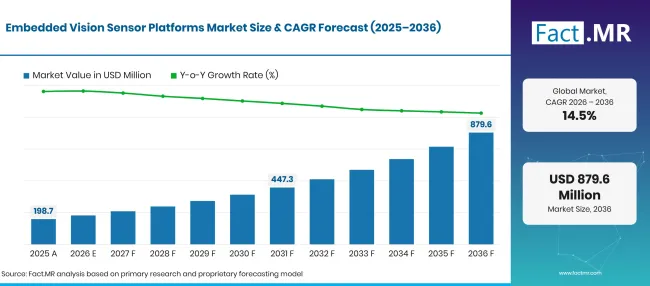
Embedded Vision Sensor Platforms Forecast Global | Source: Fact.MR
| Year | Basis | Market Value (USD million) |
|---|---|---|
| 2025 | Actual | 198.7 |
| 2026 | Estimate | 227.5 |
| 2036 | Forecast | 879.6 |
| CAGR 2026 to 2036 | Forecast period | 14.5% |
Source: Fact.MR analysis. Updated Nov 10, 2026
What are the defining numbers behind Embedded Vision Sensor Platforms Market growth?
USD 652.1 million absolute opportunity between 2026 and 2036.
- Demand Drivers in the Market
- Industrial automation and automated inspection: Manufacturers are increasingly integrating machine vision into production lines to identify defects, inspect components, and improve quality consistency. Sony's industrial global shutter sensors support high-speed imaging for precision inspection, while Cognex is expanding embedded AI vision systems for factory-floor applications [1].
- Demand for high-resolution image capture: Semiconductor, electronics, and advanced manufacturing facilities require sensors capable of capturing small defects at high production speeds. Sony announced the IMX927 industrial global shutter CMOS sensor in September 2025, with approximately 105.51 effective megapixels and full-pixel readout at 112 fps in 8-bit mode or 102 fps in 10-bit mode [3].[3]
- Expansion of edge AI and robotics: Embedded processing enables vision systems to analyze images closer to the point of capture, reducing reliance on external computing infrastructure. Cognex introduced its In-Sight 3900 embedded AI vision system in May 2026, targeting high-speed inspection without an external PC [2].
- Specialized imaging requirements: Applications involving material identification, low-light inspection, and moving objects are encouraging manufacturers to develop advanced global shutter, multispectral, and short-wave infrared imaging technologies [4].
- Key Segments Analyzed
- By Embedded Vision Sensor Architecture: Multispectral Vision is projected to account for 25.1% of the market in 2026, supported by demand for imaging systems that identify differences in materials and visual characteristics.
- By Installation Method: Immersion / Probe is estimated to hold 28.0% share in 2026
- By Process Measurement Target: Material Composition leads with a 31.8% share, reflecting demand for visual identification and analysis of materials during industrial processing.
- By End-Use Process: Factory Automation is expected to account for 26.1% of the market in 2026, shaped by automated inspection and production monitoring requirements.
- Analyst Opinion at Fact.MR
- Shambhu Nath Jha, Principal Consultant at Fact.MR, states, “Embedded vision platforms are becoming important to industrial operations where visual inspection and immediate processing can improve production consistency. Manufacturers need to balance imaging resolution, processing capabilities, and integration requirements to develop solutions that deliver measurable value across different industrial applications.”
- Strategic Implications
- Image sensor manufacturers need to prioritize higher resolution and improved sensitivity alongside faster frame rates. These enhancements can help embedded vision platforms meet demanding inspection requirements and support accurate image capture across industrial applications.
- Embedded vision developers must improve compatibility with edge AI processors and industrial computing platforms. Better interoperability can simplify system integration and support efficient deployment of vision capabilities across different industrial environments.
- Industrial equipment manufacturers should evaluate multispectral imaging and global shutter technologies for material identification and high-speed inspection. Selecting suitable imaging capabilities can improve detection accuracy and support reliable performance in specialized industrial applications.
- System integrators can develop tailored solutions that connect image acquisition with real-time processing and factory automation systems. Effective integration can improve operational coordination and help manufacturers address application-specific inspection requirements.
- End users should assess imaging accuracy and processing latency alongside integration costs and long-term equipment reliability. A comprehensive evaluation can help manufacturers select embedded vision platforms that meet operational requirements and deliver consistent performance.
South Korea is projected to record the highest CAGR at 16.6% through 2036, followed by China at 15.9%. The USA is forecast to advance at 14.9%, while Japan is expected to register 13.8% and Germany 13.6%.
How does the Embedded Vision Sensor Platforms Market break down by segment?
Fact.MR finds that Multispectral Vision Leads Embedded Vision Sensor Architecture with 25.1%; Immersion / Probe leads Installation Method with 28.0%; Material Composition leads Process Measurement Target with 31.8%; and Factory Automation leads End-Use Process with 26.1%.
Which Embedded Vision Sensor Architecture dominates?
Multispectral Vision is projected to account for 25.1% share in 2026.
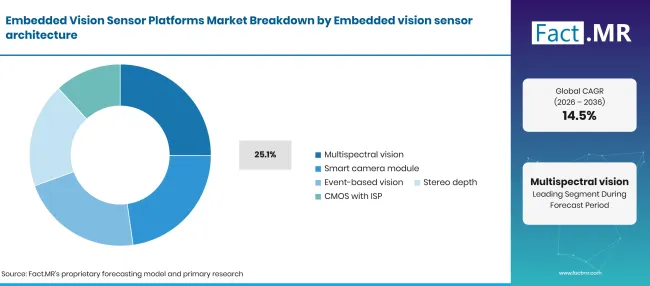
Embedded Vision Sensor Platforms Breakdown Embedded Vision Sensor Architecture | Source: Fact.MR
| Embedded Vision Sensor Architecture | Share (2026) |
|---|---|
| Multispectral Vision (Leading segment) | 25.1% |
| Other segments combined | 74.9%* |
| Total | 100.0% |
Source: Fact.MR analysis. Updated Nov 10, 2026
Multispectral vision platforms capture information across multiple wavelengths, helping industrial users distinguish materials that may appear similar under conventional imaging. These capabilities are useful in material sorting, agricultural inspection, pharmaceutical processing, and quality control. Demand for more precise material identification can encourage adoption of multispectral imaging, particularly where conventional RGB cameras cannot provide sufficient information.
What leads the Installation Method segment?
Immersion / Probe is expected to represent 28.0% share in 2026.
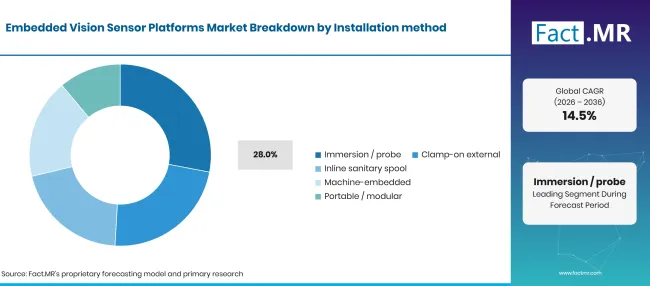
Embedded Vision Sensor Platforms Breakdown Installation Method | Source: Fact.MR
| Installation Method | Share (2026) |
|---|---|
| Immersion / Probe (Leading segment) | 28.0% |
| Other segments combined | 72.0%* |
| Total | 100.0% |
Source: Fact.MR analysis. Updated Nov 10, 2026
Probe-based imaging configurations can support applications requiring visual measurements close to the material being examined. Their inclusion in this segment applies to systems with an embedded imaging or machine-vision function. Clamp-on external configurations can support installations where equipment modifications need to remain limited. Inline sanitary spool systems can serve controlled processing environments, including pharmaceutical and food production. Machine-embedded and portable configurations provide additional flexibility across industrial inspection requirements.
Which Process Measurement Target leads demand?
Material Composition is projected to account for 31.8% share in 2026.
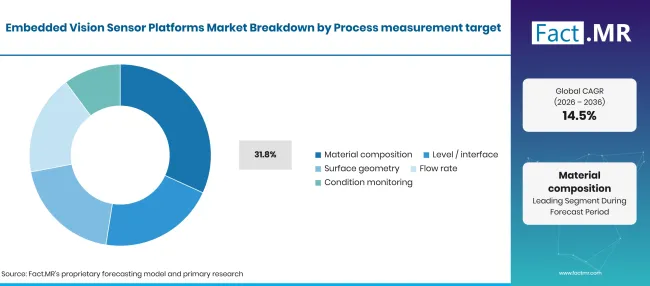
Embedded Vision Sensor Platforms Breakdown Process Measurement Target | Source: Fact.MR
| Process Measurement Target | Share (2026) |
|---|---|
| Material Composition (Leading segment) | 31.8% |
| Other segments combined | 68.2%* |
| Total | 100.0% |
Source: Fact.MR analysis. Updated Nov 10, 2026
Material composition measurement represents an important application area where imaging technologies can help identify differences in raw materials, detect contamination, and support product quality checks. Multispectral and specialized imaging technologies can improve the identification of materials that conventional visual inspection may not distinguish reliably. Manufacturers can integrate these systems into production environments to support more consistent inspection.
Which End-Use Process dominates?
Factory Automation is estimated to hold 26.1% share in 2026.
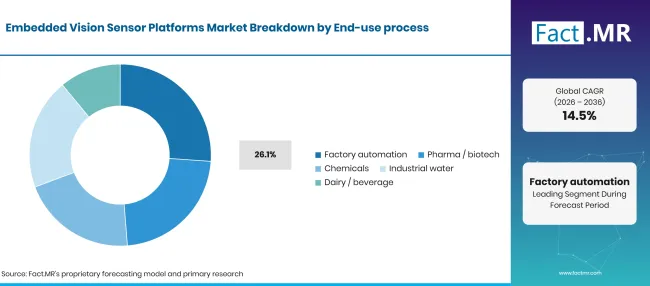
Embedded Vision Sensor Platforms Breakdown End Use Process | Source: Fact.MR
| End-Use Process | Share (2026) |
|---|---|
| Factory Automation (Leading segment) | 26.1% |
| Other segments combined | 73.9%* |
| Total | 100.0% |
Source: Fact.MR analysis. Updated Nov 10, 2026
Factory automation represents a major application area for embedded vision platforms because manufacturers need consistent inspection and monitoring across production lines. Embedded cameras and image sensors can identify defects, verify component positioning, and support automated quality checks. Integration with robotics and industrial computing systems also enables faster responses to production irregularities. Electronics, automotive, and semiconductor manufacturers can benefit from these capabilities as inspection requirements become more demanding.
What is accelerating Embedded Vision Sensor Platforms Market adoption, and what is holding it back?
Industrial automation, edge AI integration, and demand for advanced inspection are supporting adoption, while integration costs, processing requirements, and technical complexity can restrict deployment.
Drivers Impact Analysis
| DRIVER | (~) % IMPACT ON CAGR | GEOGRAPHIC RELEVANCE | IMPACT TIMELINE |
|---|---|---|---|
| Rising demand for automated industrial inspection | +1.0% | Europe, Asia | Medium term (2–4 years) |
| Integration of AI-enabled vision systems | +0.9% | Global | Short term (≤ 2 years) |
| Increasing deployment of machine vision in robotics | +0.7% | Asia, Americas | Medium term (2–4 years) |
| Demand for high-speed image processing | +0.5% | Global | Short term (≤ 2 years) |
| Expansion of smart manufacturing infrastructure | +0.4% | Europe, Asia | Long term (≥ 4 years) |
Source: Fact.MR analysis. Updated Nov 10, 2026
Opportunity Impact Analysis
| OPPORTUNITY | (~) % IMPACT ON CAGR | GEOGRAPHIC RELEVANCE | IMPACT TIMELINE |
|---|---|---|---|
| Edge AI integration in embedded vision platforms | +0.8% | Global | Medium term (2–4 years) |
| Development of multispectral imaging capabilities | +0.6% | Europe, Americas | Medium term (2–4 years) |
| Adoption of compact and low-power vision sensors | +0.5% | Asia, Global | Long term (≥ 4 years) |
| Expansion of application-specific vision solutions | +0.4% | Global | Short term (≤ 2 years) |
Source: Fact.MR analysis. Updated Nov 10, 2026
Restraints Impact Analysis
| RESTRAINT | (~) % IMPACT ON CAGR | GEOGRAPHIC RELEVANCE | IMPACT TIMELINE |
|---|---|---|---|
| High initial system integration costs | -0.8% | Global | Short term (≤ 2 years) |
| Compatibility constraints with existing industrial systems | -0.6% | Global | Medium term (2–4 years) |
| Processing and power consumption limitations | -0.5% | Asia, Americas | Short term (≤ 2 years) |
| Shortage of skilled vision system integration expertise | -0.4% | Global | Medium term (2–4 years) |
Source: Fact.MR analysis. Updated Nov 10, 2026
Which countries are scaling the Embedded Vision Sensor Platforms Market through 2036?
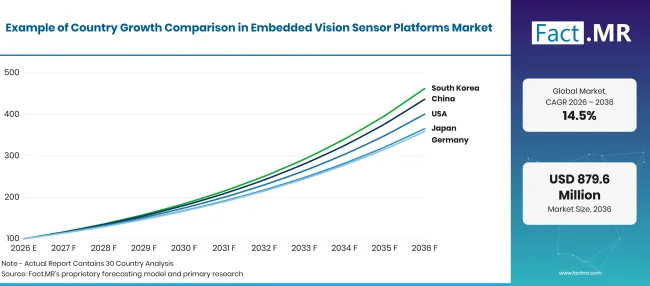
Embedded Vision Sensor Platforms Growth Index | Source: Fact.MR
| Country | CAGR (2026–2036) |
|---|---|
| South Korea | 16.6% |
| China | 15.9% |
| USA | 14.9% |
| Japan | 13.8% |
| Germany | 13.6% |
Source: Fact.MR analysis. Updated Nov 10, 2026
What supports South Korea adoption?
16.6% CAGR, supported by continuous technology advancement in semiconductor and electronics manufacturing industries
South Korea is projected to register the fastest growth, supported by its semiconductor, electronics, and advanced manufacturing industries. Manufacturers require high-resolution imaging and accurate inspection systems for semiconductor components, electronic assemblies, and precision equipment. Embedded vision platforms can support automated defect identification and production monitoring. Suppliers offering compact sensors, high-speed imaging, and edge processing capabilities can address these requirements.
What is driving growth in China?
15.9% CAGR, shaped by increasing investment in smart manufacturing
China's market is expected to expand through increasing industrial automation, electronics production, robotics deployment, and investment in smart manufacturing. Production facilities need machine vision systems for component identification, dimensional inspection, and automated quality control. Domestic and international sensor suppliers can benefit from demand for scalable imaging technologies and embedded camera solutions across manufacturing operations.
What supports United States adoption?
14.9% CAGR, driven by expansion of ADAS and autonomous vehicle technologies
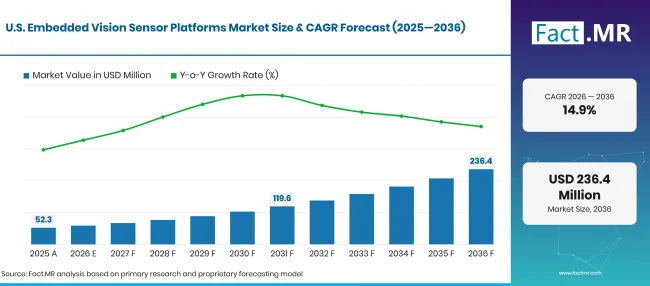
Embedded Vision Sensor Platforms Forecast Usa | Source: Fact.MR
The US is projected to record strong demand as manufacturers integrate artificial intelligence and advanced imaging into industrial equipment. Semiconductor production, pharmaceutical processing, logistics, and automated manufacturing provide opportunities for embedded vision platforms. Companies developing edge AI vision controllers and specialized image sensors can address demand for faster inspection and reduced dependence on external computing systems. The U.S. embedded vision sensor platforms market is driven by the growing adoption of artificial intelligence (AI)-enabled imaging technologies across automotive, industrial automation, healthcare and security applications.
What is driving demand in Japan?
13.8% CAGR, growing adoption of machine vision technologies across electronics manufacturing
Japan's market is supported by its established electronics, automotive, robotics, and precision manufacturing industries. Industrial operators require reliable imaging systems for component inspection, surface defect detection, and automated production monitoring. Manufacturers can benefit from high-resolution global shutter sensors and compact camera modules that support demanding industrial applications. Additionally, rising investments in autonomous driving and advanced driver-assistance systems (ADAS) are creating opportunities for camera-based sensing technologies used in vehicle safety and driver monitoring.
What factors are supporting market growth in Germany?
13.6% CAGR, expansion of industry 4.0 and smart manufacturing
Germany's market is expected to develop through investments in factory automation, industrial robotics, automotive production, and precision engineering. Manufacturers require reliable machine vision technologies to improve production quality and identify defects during manufacturing. Embedded vision platforms can support automated inspection and real-time process monitoring across industrial facilities. The country's established robotics industry and high adoption of industrial robots are further supporting the integration of vision sensors for robotic guidance, precision assembly and automated material handling.
Who leads the Embedded Vision Sensor Platforms Market?
Fact.MR identifies Sony Semiconductor Solutions Corporation, onsemi, OmniVision Technologies, Inc., Teledyne Technologies Incorporated, Basler AG, and Cognex Corporation as important participants in the embedded vision and industrial machine vision ecosystem.
Sony Semiconductor Solutions Corporation develops industrial CMOS image sensors, including global shutter, multispectral, SWIR, and other specialized imaging technologies. Its IMX927 series demonstrates its focus on high-resolution industrial imaging. onsemi supplies CMOS image sensors and machine vision components through its XGS, PYTHON, and Hyperlux product families. Its portfolio addresses high-speed imaging, industrial automation, robotics, and advanced sensing applications. OmniVision Technologies, Inc. develops CMOS image sensors for industrial machine vision and robotics. Its OG05D and OG12S10 global shutter sensors, announced in October 2026, demonstrate continued product development for industrial applications [5] [6]
Teledyne Technologies Incorporated participates through its imaging businesses, including Teledyne DALSA [7]. Its portfolio includes industrial cameras, CMOS image sensors, line-scan cameras, smart cameras, and machine vision systems. Basler AG develops industrial cameras, embedded camera modules, and vision components [8]. Its dart camera family and GMSL-based embedded vision solutions support integration into industrial and AI-based applications.
Cognex Corporation develops machine vision systems and embedded AI inspection platforms. Its In-Sight 3900 and In-Sight 6900 product launches in 2026 demonstrate its continued investment in embedded AI vision technology. [9]
Competition depends on sensor performance, image processing capabilities, integration flexibility, product reliability, and industrial application support. Semiconductor suppliers primarily compete through image sensor technology, while camera and vision system developers compete through integrated hardware, software, and inspection capabilities.
Which companies are the key providers?
Key companies include Sony Semiconductor Solutions Corporation, onsemi, OmniVision Technologies, Inc., Teledyne Technologies Incorporated, Basler AG, and Cognex Corporation.
- Sony Semiconductor Solutions Corporation
- onsemi
- OmniVision Technologies, Inc.
- Teledyne Technologies Incorporated
- Basler AG
- Cognex Corporation
Bibliography
- [1] Sony Semiconductor Solutions Corporation. (n.d.). Image sensor for industrial use.
- [2] Cognex Corporation. (2026, May 5). Cognex launches highest performance embedded AI vision system powered by Qualcomm.
- [3] Sony Semiconductor Solutions Corporation. (2025, September 29). Sony Semiconductor Solutions to release the industry-leading global shutter CMOS image sensor for industrial use that achieves both approximately 105-effective-megapixels and high-speed 100 FPS output.
- [4] onsemi. (n.d.). Machine vision.
- [5] OMNIVISION. (2026, October 5). OMNIVISION launches industry’s first 2.2-micron global shutter HDR sensor for flagship industrial and robotics machine vision cameras.
- [6] OMNIVISION. (2026, October 5). OMNIVISION launches new 12MP global shutter sensor for factory automation and intelligent transportation systems.
- [7] Teledyne Imaging. (n.d.). Industrial / Machine Vision.
- [8] Basler AG. (n.d.). Embedded Vision.
- [9] Cognex Corporation. (2026, April 28). Cognex launches In-Sight Vision Controller powered by NVIDIA.
This Report Answers
- The report examines the growth of embedded vision sensor platforms across industrial imaging and automated inspection applications.
- Architecture analysis compares multispectral vision, smart camera modules, event-based vision, stereo depth, and CMOS with ISP technologies.
- Installation analysis evaluates the specified installation configurations and their respective market shares.
- Process measurement analysis examines material composition, level, surface geometry, flow rate, and condition monitoring applications.
- Country analysis compares China, Japan, Germany, the USA, and South Korea through their projected growth rates.
- The competitive overview profiles six companies involved in industrial image sensors, embedded cameras, and machine vision systems.
- The report evaluates the role of edge AI, robotics, and advanced image processing in industrial adoption.
What does the Embedded Vision Sensor Platforms Market cover?
The market covers image sensors, embedded camera modules, and integrated vision platforms used to capture and process visual information in industrial and automated environments. These technologies support automated inspection, material identification, defect detection, surface analysis, and production monitoring. Market coverage includes specialized imaging architectures and embedded processing capabilities used across the specified industrial applications.
What is included in the scope?
Included products comprise industrial CMOS image sensors, global shutter sensors, multispectral imaging sensors, smart camera modules, stereo vision components, and integrated embedded vision systems.
The market also covers associated image processing capabilities used in industrial imaging applications. Products are considered within scope when their primary function involves embedded image acquisition and visual information processing.
What is excluded from the scope?
The analysis excludes conventional consumer photography sensors, standalone security cameras without an embedded industrial vision function, general-purpose imaging devices, and unrelated semiconductor components.
Standalone industrial measurement equipment that does not use image acquisition or embedded vision technology is also excluded. General-purpose computing hardware and unrelated factory automation equipment are outside the defined market boundary.
How Was the Analysis Built?
The analysis draws on 120+ sources, 35+ company portfolios, 25+ countries, and more than 20 industry interviews.
- Primary Research: Primary research includes discussions with image sensor manufacturers, embedded vision developers, industrial camera suppliers, system integrators, distributors, end users, and subject-matter experts. These discussions examine purchasing priorities, technology adoption, integration requirements, image processing capabilities, competitive positioning, and barriers to wider market acceptance.
- Desk Research: Desk research covers company product announcements, technical documentation, semiconductor industry publications, manufacturing statistics, regulatory publications, industry associations, technical studies, and other authoritative sources. Every source used in the analysis is documented in the bibliography.
- Market Sizing and Forecasting: Market estimates combine historical performance, demand indicators, pricing and volume trends, segment shares, company participation, country-level growth, industrial automation investments, product development, and adoption patterns.
- Data Validation and Update Cycle: Findings are validated by comparing primary interviews with company disclosures, product launches, technical specifications, manufacturing developments, and industrial adoption trends. Regular updates review new sensor releases, camera module developments, partnerships, processing capabilities, and changes in commercial adoption.
Segmentation
What is the report's scope and coverage?
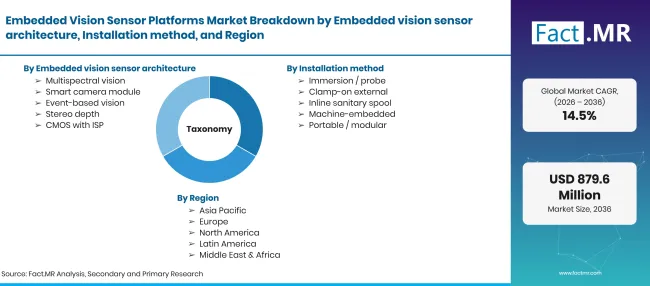
Embedded Vision Sensor Platforms Taxonomy | Source: Fact.MR
| Attribute | Details |
|---|---|
| Quantitative Units | USD Million in 2026 to USD Million by 2036, at CAGR |
| Market Definition | The embedded vision sensor platforms market comprises image sensors and integrated camera-based systems designed to capture and process visual data within industrial and automated environments. It includes CMOS and other image sensor technologies alongside camera modules and embedded vision systems that combine image acquisition with onboard processing capabilities. |
| Embedded Vision Sensor Architecture | Multispectral Vision; Smart Camera Module; Event-Based Vision; Stereo Depth; CMOS with ISP |
| Installation Method | Immersion / Probe; Clamp-On External; Inline Sanitary Spool; Machine-Embedded; Portable / Modular |
| Process Measurement Target | Material Composition; Level / Interface; Surface Geometry; Flow Rate; Condition Monitoring |
| End-Use Process | Factory Automation; Pharma / Biotech; Chemicals; Industrial Water; Dairy / Beverage |
| Regions Covered | North America; Latin America; Western Europe; Eastern Europe; East Asia; South Asia & Pacific; Middle East & Africa |
| Countries Covered | China; Japan; Germany; USA; South Korea |
| Companies Profiled | Sony Semiconductor Solutions Corporation; onsemi; OmniVision Technologies, Inc.; Teledyne Technologies Incorporated; Basler AG; Cognex Corporation |
| Forecast Period | 2026 to 2036 |
| Approach | Market segmentation and scenario-based analysis supported by company product portfolios, industrial imaging developments, and manufacturing automation trends |
Source: Fact.MR analysis. Updated Nov 10, 2026
How is the market segmented?
-
By Embedded Vision Sensor Architecture
- Multispectral Vision
- Smart Camera Module
- Event-Based Vision
- Stereo Depth
- CMOS with ISP
-
By Installation Method
- Immersion / Probe
- Clamp-On External
- Inline Sanitary Spool
- Machine-Embedded
- Portable / Modular
-
By Process Measurement Target
- Material Composition
- Level / Interface
- Surface Geometry
- Flow Rate
- Condition Monitoring
-
By End-Use Process
- Factory Automation
- Pharma / Biotech
- Chemicals
- Industrial Water
- Dairy / Beverage
-
By Region
- North America
- Latin America
- Western Europe
- Eastern Europe
- East Asia
- South Asia & Pacific
- Middle East & Africa
Frequently Asked Questions
How big is the Embedded Vision Sensor Platforms Market in 2026?
What is the CAGR from 2026 to 2036?
Which Embedded Vision Sensor Architecture has the largest share?
Which Installation Method leads the market?
Which Process Measurement Target dominates?
Which End-Use Process leads the market?
Which country is projected to grow fastest?
Which companies are covered?
Who worked on this report


Preview the report firsthand - request a free sample
Free SampleGet the brochure for pricing and purchase details
Download PDF