- Market Value (2025): USD 169.6 Mn
- Estimated Value (2026): USD 182.6 Mn
- Forecast Value (2036): USD 381.3 Mn
- CAGR (2026-2036): 7.6%
What is the Ruggedized Edge Computing Devices Market forecast to be worth by 2036?
USD 182.6 million in 2026 to USD 381.3 million by 2036 at a 7.6% CAGR.
- Fact.MR estimates the ruggedized edge computing devices market at USD 169.6 million for 2025, with defense electronics and factory automation as the main buyers.
- Revenue will grow from USD 182.6 million in 2026 to USD 381.3 million by 2036 as GPU inference, autonomous platforms and smart factory upgrades push compute out of server rooms and onto equipment.
- A 7.6% CAGR reflects a niche where unit prices stay high and qualification cycles are long, so each design win turns into years of repeat orders.
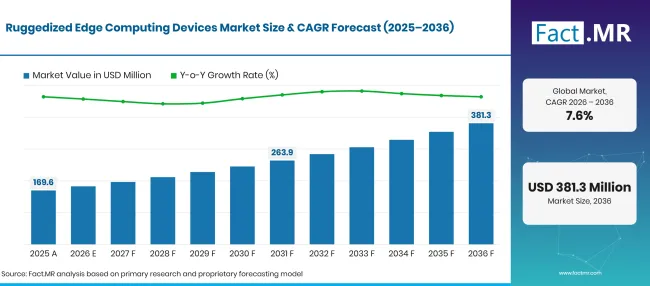
Ruggedized Edge Computing Devices Forecast Global | Source: Fact.MR
| Year | Basis | Market Value (USD million) |
|---|---|---|
| 2025 | Actual | 169.6 |
| 2026 | Estimate | 182.6 |
| 2036 | Forecast | 381.3 |
| CAGR 2026 to 2036 | Forecast period | 7.6% |
Source: Fact.MR analysis. Updated Nov 9, 2026
What are the defining numbers behind Ruggedized Edge Computing Devices Market growth?
New value of USD 198.7 million will be added between 2026 and 2036, with Modular Rugged Servers, Embedded Subsystems, Aerospace / Defense and OEM Direct holding the lead positions in their segments.
- Demand Drivers in the Market
- Factory automation is placing more compute at the machine level. China produced 773,000 sets of industrial robots in 2025, up 28.0% on the year, and each robot cell needs controllers and vision computers that tolerate vibration and electrical noise [1].
- Defense budgets are funding platforms that carry their own processing. The U.S. Department of Defense FY2026 budget request lists USD 13.4 billion for autonomous and remotely operated systems across air, land and sea [2].
- Edge AI is turning GPU acceleration into a field requirement. Machine vision, sensor fusion and inspection models run locally to cut latency and network load, which favors compact systems with embedded GPU modules and passive cooling.
- Connected vehicles and rail systems are adding onboard computers for navigation, passenger monitoring and predictive maintenance, all of which must meet wide-voltage and vehicle certification rules.
- Key Segments Analyzed
- By Rugged Edge Compute Platform: Modular Rugged Servers will hold 25.3% share in 2026, since configurable chassis let integrators match processor, GPU and storage options to each mission.
- By Integration / Product Form: Embedded Subsystems will account for 23.5% of 2026 value as equipment makers build compute directly into machines, vehicles and weapon systems.
- By System Application: Aerospace / Defense will capture 27.2% in 2026, given that surveillance, navigation and command systems require hardware tested against military environmental standards.
- By Procurement Route: OEM Direct will take 28.3% in 2026 because platform builders specify custom I/O, thermal design and lifecycle terms with the computer maker.
- Analyst Opinion at Fact.MR
- Shambhu Nath Jha, Principal Consultant at Fact.MR, states, “Rugged edge computing will move from specialist defense hardware into everyday industrial practice as factories, transport networks and tactical systems process more data where it is created. Modular servers and embedded subsystems will gain share of new designs because they can be refreshed with new processors without requalifying the whole platform.”
- Strategic Implications
- Hardware manufacturers should publish full environmental test data and commit to long supply windows, since defense and rail buyers reject platforms that may change before the end of a program.
- System integrators should build validated reference stacks that combine rugged computers with vision software, networking and security.
- Component distributors should stock standard fanless and DIN-rail models in volume, as smaller automation buyers want fast delivery more than custom configuration.
- Investors should favor suppliers with local production close to defense customers and a balanced mix of industrial and military revenue.
Growth across the profiled countries spans 9.7% to 7.4%. Taiwan (9.7%) leads because the island designs and builds much of the world’s industrial computing hardware and keeps adding AI server and chip capacity. China (9.5%) follows closely on the sheer scale of its factory automation drive. South Korea (8.9%) gains from semiconductor fabs and smart factories that need compute beside every tool. Japan (7.5%) grows from a mature robotics and machine tool base, and the United States (7.4%) relies on defense modernization and a large installed base that renews at a steadier pace.
How does the Ruggedized Edge Computing Devices Market break down by segment?
Modular Rugged Servers will lead Rugged Edge Compute Platform at 25.3%; Embedded Subsystems will head Integration / Product Form at 23.5%; Aerospace / Defense will top System Application at 27.2%; OEM Direct will hold Procurement Route at 28.3% in 2026.
Which Rugged Edge Compute Platform leads?
Modular Rugged Servers represent 25.3% of 2026 sales.
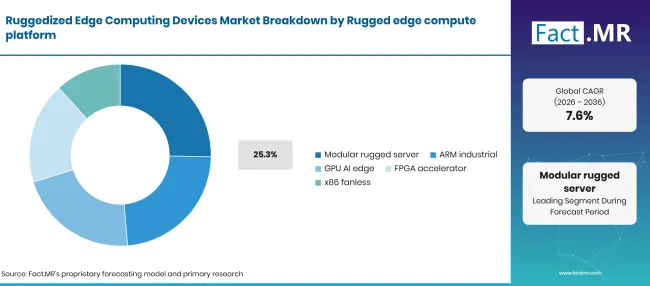
Ruggedized Edge Computing Devices Breakdown Rugged Edge Compute Platform | Source: Fact.MR
| Rugged Edge Compute Platform | Share (2026) |
|---|---|
| Modular Rugged Servers (Leading segment) | 25.3% |
| Other segments combined | 74.7%* |
| Total | 100.0% |
Source: Fact.MR analysis. Updated Nov 9, 2026
Program engineers want a box they can upgrade card by card, so a new processor or GPU does not force a fresh round of shock and thermal testing. VPX and similar open standards make that possible. Kontron began U.S. production of its VX307H rugged 3U VPX board in Huntsville in October 2026 and moved it to build-to-stock to shorten delivery for defense customers [3]. ARM industrial platforms, GPU AI edge systems, FPGA accelerators and x86 fanless computers complete the platform mix. GPU edge systems are gaining in robotics and inspection, while FPGA accelerators serve signal processing in radar and electronic warfare. Buyers of edge computing hardware in less demanding settings often start with x86 fanless boxes before moving to modular designs.
What supports Embedded Subsystems within Integration / Product Form?
Embedded Subsystems take 23.5% of 2026 revenue.
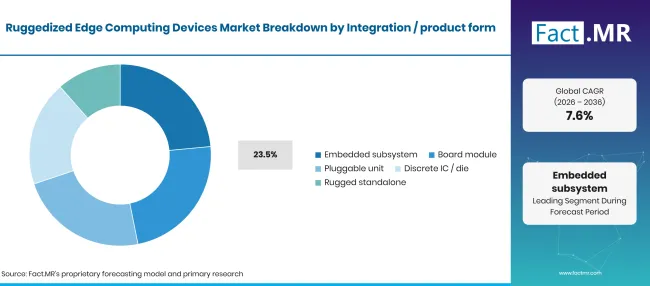
Ruggedized Edge Computing Devices Breakdown Integration Product Form | Source: Fact.MR
| Integration / Product Form | Share (2026) |
|---|---|
| Embedded Subsystems (Leading segment) | 23.5% |
| Other segments combined | 76.5%* |
| Total | 100.0% |
Source: Fact.MR analysis. Updated Nov 9, 2026
Machine builders prefer compute that mounts inside the cabinet or chassis they already ship, which removes a separate enclosure and a set of cables. Cincoze launched its MAGNET DIN-rail line in October 2025 for vision-guided robotics, inspection and measurement, with an operating range of minus 40 to 65 degrees Celsius [4]. Board modules, pluggable units, discrete ICs or dies and rugged standalone systems complete the integration range. Board modules suit designers who want to build their own carrier, while standalone systems serve retrofit jobs on existing industrial robotics lines where space inside the cabinet is limited.
What leads the System Application segment?
Aerospace / Defense holds 27.2% of 2026 demand.
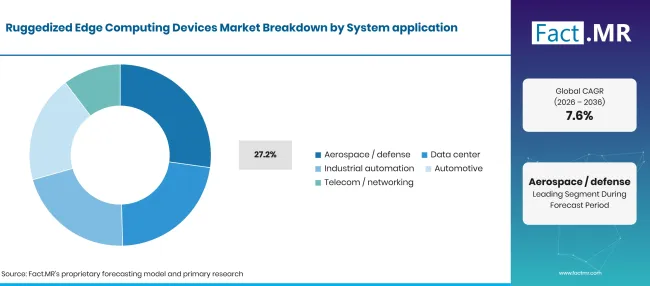
Ruggedized Edge Computing Devices Breakdown System Application | Source: Fact.MR
| System Application | Share (2026) |
|---|---|
| Aerospace / Defense (Leading segment) | 27.2% |
| Other segments combined | 72.8%* |
| Total | 100.0% |
Source: Fact.MR analysis. Updated Nov 9, 2026
Military platforms expose electronics to gunfire shock, salt fog, wide temperature swings and unstable vehicle power, and every computer must pass formal testing before it is fielded. Cincoze lists its GM-1100 MXM GPU computer for military reconnaissance, real-time image analysis and terrain recognition, with MIL-STD-810H shock and vibration testing and a 9 to 48 volt input for vehicles and vessels [5]. Mission computers in military vetronics programs follow similar rules. Data center, industrial automation, automotive and telecom or networking applications form the remaining demand base. Industrial automation is the closest follower in unit terms, while telecom operators need hardened servers at cell sites that support 5G network equipment in outdoor cabinets.
What shapes the Procurement Route segment?
OEM Direct accounts for 28.3% of 2026 value.
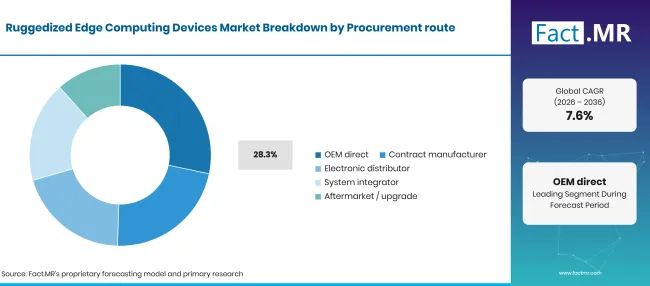
Ruggedized Edge Computing Devices Breakdown Procurement Route | Source: Fact.MR
| Procurement Route | Share (2026) |
|---|---|
| OEM Direct (Leading segment) | 28.3% |
| Other segments combined | 71.7%* |
| Total | 100.0% |
Source: Fact.MR analysis. Updated Nov 9, 2026
Builders of armored vehicles, rail cars and production machines usually negotiate directly with the computer maker, since they need custom I/O, conformal coating, branding and a fixed bill of materials for the life of their own product. Direct contracts also carry the revision control and long-term supply clauses that defense programs demand. Contract manufacturers handle volume builds for equipment developers that outsource assembly. Electronic distributors serve buyers of standard catalog models, and system integrators combine computers with software and networking.
What is accelerating Ruggedized Edge Computing Devices Market adoption, and what is holding it back?
Factory automation, defense autonomy programs and local AI inference are widening the pool of buyers for hardened compute. High unit prices, long validation cycles and tight supply of extended-temperature processors still slow adoption among smaller firms.
Drivers Impact Analysis
| DRIVER | (~) % IMPACT ON CAGR | GEOGRAPHIC RELEVANCE | IMPACT TIMELINE |
|---|---|---|---|
| Rugged computing in aerospace and defense systems | +2.6% | North America, East Asia, Europe | Long term (>=4 years) |
| Industrial automation and machine vision | +2.1% | Global | Medium term (2-4 years) |
| GPU-based edge AI and local inference | +1.7% | North America, East Asia | Medium term (2-4 years) |
| Connected vehicles and intelligent transport | +0.8% | East Asia, Europe, North America | Long term (>=4 years) |
| Industrial IoT and real-time monitoring | +0.4% | Global | Short term (<=2 years) |
Source: Fact.MR analysis. Updated Nov 9, 2026
Opportunity Impact Analysis
| OPPORTUNITY | (~) % IMPACT ON CAGR | GEOGRAPHIC RELEVANCE | IMPACT TIMELINE |
|---|---|---|---|
| GPU-accelerated rugged platforms for edge AI workloads | +0.9% | North America, East Asia | Medium term (2-4 years) |
| Modular rugged servers for mission-critical programs | +0.6% | Global | Long term (>=4 years) |
| Custom embedded computers for automation and transport | +0.4% | East Asia, Europe | Medium term (2-4 years) |
| Rugged compute for connected vehicles and smart infrastructure | +0.3% | East Asia, North America | Long term (>=4 years) |
Source: Fact.MR analysis. Updated Nov 9, 2026
Restraints Impact Analysis
| RESTRAINT | (~) % IMPACT ON CAGR | GEOGRAPHIC RELEVANCE | IMPACT TIMELINE |
|---|---|---|---|
| High upfront cost of specialized rugged platforms | -0.8% | Global | Short term (<=2 years) |
| Complex customization, integration and validation | -0.6% | Global | Medium term (2-4 years) |
| Supply limits on extended-temperature processors and components | -0.5% | Global | Medium term (2-4 years) |
| Cybersecurity and long-term maintenance of connected edge systems | -0.3% | Global | Long term (>=4 years) |
Source: Fact.MR analysis. Updated Nov 9, 2026
Which countries are scaling the Ruggedized Edge Computing Devices Market through 2036?
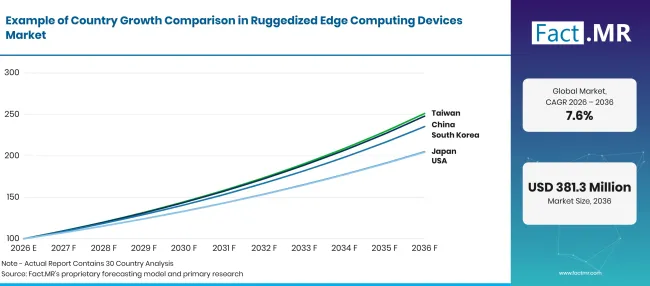
Ruggedized Edge Computing Devices Growth Index | Source: Fact.MR
| Country | CAGR (2026 to 2036) |
|---|---|
| Taiwan | 9.7% |
| China | 9.5% |
| South Korea | 8.9% |
| Japan | 7.5% |
| United States | 7.4% |
Source: Fact.MR analysis. Updated Nov 9, 2026
What supports adoption in Taiwan?
9.7% CAGR, driven by a deep embedded computing supply base and fast AI hardware buildout.
Taiwan hosts many of the companies that design fanless computers, edge AI boxes and industrial boards, so new products reach local factories first. The island’s chip sector anchors that ecosystem: integrated circuit exports reached about USD 92.5 billion in the first half of 2025, according to the U.S. International Trade Administration [6]. Fabs, packaging plants and server assembly lines all use rugged compute for tool monitoring and automated inspection.
How is China developing demand?
9.5% CAGR, backed by national programs that link AI with the industrial internet.
A plan released in January 2026 calls for network upgrades at no fewer than 50,000 enterprises and high-quality datasets in 20 key industries by 2028 [7]. Those upgrades place edge servers and gateways on production floors. Connectivity is already in place, with 4.84 million 5G base stations at the end of 2025 [1]. Local robot builders and electric vehicle plants are steady buyers of embedded controllers and vision computers.
What is shaping South Korea’s adoption?
8.9% CAGR, helped by chip fabs and a national smart factory push.
South Korea’s semiconductor exports set a record of USD 173.4 billion in 2025, and a government project plans about USD 664 million from 2026 to 2030 for on-device AI chips [8]. Fabs run thousands of tools that each need local compute for process data. About 30,000 smart factories were in operation as of 2024, and the government aims for more than 100 AI-based manufacturing zones by 2030 [9].
What supports adoption in Japan?
7.5% CAGR, reflecting a mature robotics base that keeps upgrading its controls.
The 2026 White Paper on Manufacturing Industries, approved by the Cabinet in May 2026, names AI and digital technology as priorities for industrial competitiveness [10]. Japan’s local production of industrial machine tools is estimated at about USD 6.0 billion for 2025 [11]. Builders of robots and machine tools embed fanless computers for motion control, inspection and predictive maintenance.
How is the United States developing demand?
7.4% CAGR, as defense modernization and factory AI renew a large installed base.
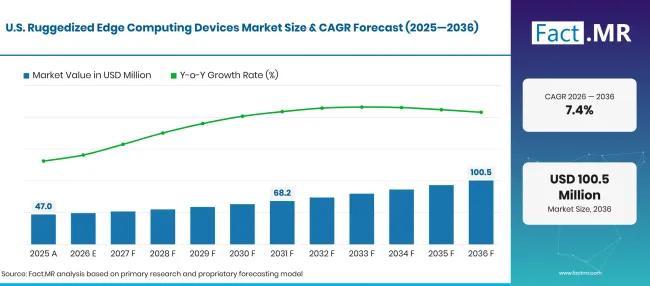
Ruggedized Edge Computing Devices Forecast Usa | Source: Fact.MR
The FY2026 defense budget request includes USD 2.9 billion for microelectronics, which supports domestic supply of the chips inside rugged mission computers [2]. On the industrial side, the National Institute of Standards and Technology published a report in December 2025 on an improved robotic workcell that generates operational data for research in OT cybersecurity, digital twins and industrial AI [12]. Vehicle programs from unmanned combat aerial vehicles to ground robots keep mission computer demand steady.
Who leads the Ruggedized Edge Computing Devices Market?
Competition splits into three groups that win on different strengths. Broad industrial computing suppliers, led by Advantech, ADLINK and AAEON, cover fanless PCs, edge AI boxes built on NVIDIA Jetson modules, single board computers and computer-on-modules, and they compete on catalog breadth, global distribution and fast refresh cycles.
Defense-focused embedded specialists, with Kontron as the main example, compete on VPX boards, mission computers and certified local production; Kontron began U.S. manufacturing of its VX307H board in October 2026 [3]. Rugged system specialists such as Cincoze and OnLogic compete on compact, wide-temperature designs for factories, vehicles and remote sites. Cincoze introduced its MAGNET DIN-rail line for machine vision in October 2025 [4] and positions its MXM GPU computers for defense reconnaissance [5], while OnLogic sells its Karbon series for extreme edge deployments. Across all three groups, buyers will reward suppliers that combine GPU performance with long availability and documented environmental testing.
Which companies are the key providers?
Key companies in the Ruggedized Edge Computing Devices Market include Advantech, Kontron, ADLINK Technology, AAEON, Cincoze and OnLogic.
- Advantech
- Kontron
- ADLINK Technology
- AAEON
- Cincoze
- OnLogic
Bibliography
- [1] National Bureau of Statistics of China. (2026, February 28). Statistical Communiqué of the People’s Republic of China on the 2025 National Economic and Social Development.
- [2] Office of the Under Secretary of Defense (Comptroller). (2025, June). Defense Budget Overview: United States Department of Defense Fiscal Year 2026 Budget Request.
- [3] Kontron. (2026, October 12). Kontron Expands U.S. Defense Manufacturing with VX307H Production in Huntsville.
- [4] Cincoze. (2025, October 16). Cincoze Launches New MAGNET Product Line: High-Performance DIN-Rail Embedded Computers for Machine Vision.
- [5] Cincoze. (2025, July 24). Cincoze MXM GPU Computers: The AI Solutions for Manufacturing, Transportation, and Defense.
- [6] International Trade Administration. (2025, December 1). Taiwan: Semiconductors including chip design for AI.
- [7] The State Council of the People’s Republic of China. (2026, January 7). China unveils plan to deepen integration of industrial internet, AI.
- [8] International Trade Administration. (2026, June 8). South Korea AI Semiconductor.
- [9] International Trade Administration. (2026, June 29). South Korea: Manufacturing Technology: Smart Factory.
- [10] Ministry of Economy, Trade and Industry. (2026, May 29). FY2025 Measures to Promote Manufacturing Technology (White Paper on Manufacturing Industries 2026) Released.
- [11] International Trade Administration. (2025, November 18). Japan: Industrial Machine Tools.
- [12] National Institute of Standards and Technology. (2025, December). An Improved Robotic Workcell for Operational Technology (OT) Research (NIST IR 8604).
This Report Answers
- How is revenue split between modular rugged servers, ARM industrial platforms, GPU AI edge systems, FPGA accelerators and x86 fanless computers?
- Why do embedded subsystems lead the integration mix, and which design traits keep machine builders loyal to them?
- What makes aerospace and defense programs the main application for hardened edge compute?
- How do OEM contracts, contract manufacturing, distribution and integration shape supplier selection?
- Which of the five profiled countries will grow quickest, and which industrial programs explain the gaps between them?
- Where will GPU acceleration and modular design open new revenue for rugged computer makers?
What does the Ruggedized Edge Computing Devices Market cover?
This study tracks hardened computers that run software at the point where data is created, from a robot cell to a vehicle hull or a roadside cabinet. Modular rugged servers, embedded computers, GPU edge systems, FPGA platforms and fanless industrial PCs form the core product range.
Revenue is valued at the manufacturer selling price of the hardware, across aerospace and defense, data center, industrial automation, automotive and telecom uses. Sales through OEM contracts, contract manufacturers, distributors, integrators and aftermarket upgrades all count toward the total.
What is included in the scope?
Rugged embedded computers, modular rugged servers, ARM industrial computers, GPU edge systems, FPGA accelerators and x86 fanless platforms built for harsh environments are included.
Embedded subsystems, board modules, pluggable units, discrete ICs or dies and standalone rugged systems count when sold for qualifying edge computing roles.
Hardware installed in defense platforms, factory equipment, vehicles, data center edge sites and telecom networks is covered, including onboard compute for autonomous mobile robots.
What is excluded from the scope?
Consumer laptops, desktops, smartphones and office computers without rugged or edge-specific design are excluded.
Cloud subscriptions, software-only edge platforms, AI models and analytics services fall outside this hardware study.
General-purpose data center servers and standard networking switches without hardened design are not counted.
How Was the Analysis Built?
The analysis draws on 120+ sources, 35+ company portfolios, 25+ countries, and more than 20 industry interviews.
- Primary Research: Primary research includes discussions with manufacturers, service providers, technology developers, distributors, end users, and subject-matter experts. These conversations examine purchasing priorities, product adoption, operational challenges, approval requirements, competitive positioning, and the factors that influence wider market acceptance.
- Desk Research: Desk research covers government statistics, regulatory publications, company filings, trade data, technical studies, industry associations, standards, public policy, and other authoritative sources. Every source used in the analysis is documented in the bibliography.
- Market Sizing and Forecasting: Market estimates combine historical performance, demand indicators, pricing and volume trends, segment shares, company participation, country-level growth, adoption patterns, investment activity, and barriers to market expansion.
- Data Validation and Update Cycle: Findings are validated by comparing primary interviews with public data, company activity, regulatory changes, trade patterns, and industry developments. Regular updates review new product launches, capacity changes, partnerships, approvals, and shifts in commercial adoption.
Segmentation
What is the report’s scope and coverage?
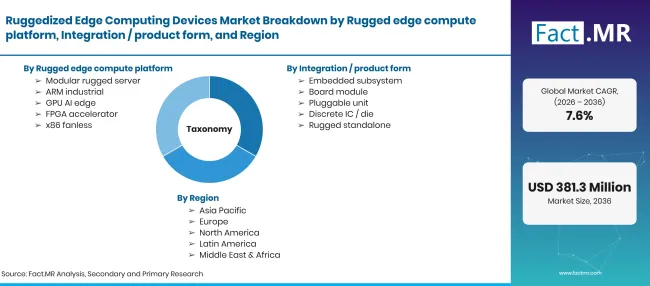
Ruggedized Edge Computing Devices Taxonomy | Source: Fact.MR
| Attribute | Details |
|---|---|
| Quantitative Units | USD million in 2026 to USD million by 2036 at CAGR |
| Market Definition | Ruggedized computing hardware that processes and analyzes data close to its source in harsh operating environments, across industrial, defense, aerospace, automotive, telecom and infrastructure uses. |
| Rugged Edge Compute Platform | Modular Rugged Servers; ARM Industrial; GPU AI Edge; FPGA Accelerator; x86 Fanless |
| Integration / Product Form | Embedded Subsystems; Board Module; Pluggable Unit; Discrete IC / Die; Rugged Standalone |
| System Application | Aerospace / Defense; Data Center; Industrial Automation; Automotive; Telecom / Networking |
| Procurement Route | OEM Direct; Contract Manufacturer; Electronic Distributor; System Integrator; Aftermarket / Upgrade |
| Regions Covered | North America; Latin America; Western Europe; Eastern Europe; East Asia; South Asia & Pacific; Middle East & Africa |
| Countries Covered | Taiwan; China; South Korea; Japan; United States |
| Companies Profiled | Advantech; Kontron; ADLINK Technology; AAEON; Cincoze; OnLogic |
| Forecast Period | 2026 to 2036 |
| Approach | Installed base and replacement cycles of rugged compute in defense, factory, vehicle and telecom platforms, checked against supplier portfolios and country automation programs. |
Source: Fact.MR analysis. Updated Nov 9, 2026
How is the market segmented?
-
By Rugged Edge Compute Platform
- Modular Rugged Servers
- ARM Industrial
- GPU AI Edge
- FPGA Accelerator
- x86 Fanless
-
By Integration / Product Form
- Embedded Subsystems
- Board Module
- Pluggable Unit
- Discrete IC / Die
- Rugged Standalone
-
By System Application
- Aerospace / Defense
- Data Center
- Industrial Automation
- Automotive
- Telecom / Networking
-
By Procurement Route
- OEM Direct
- Contract Manufacturer
- Electronic Distributor
- System Integrator
- Aftermarket / Upgrade
-
By Region
- North America
- Latin America
- Western Europe
- Eastern Europe
- East Asia
- South Asia & Pacific
- Middle East & Africa
Frequently Asked Questions
How large is the ruggedized edge computing devices market in 2026?
What growth rate will the ruggedized edge computing devices market record?
Which rugged edge compute platform leads?
Which integration or product form leads?
Which system application leads?
Which procurement route leads?
Which country will grow quickest?
Who are the main companies?
What holds the market back?
Who worked on this report


Preview the report firsthand - request a free sample
Free SampleGet the brochure for pricing and purchase details
Download PDF