- Market Value (2025): USD 5.86 Bn
- Estimated Value (2026): USD 6.17 Bn
- Forecast Value (2036): USD 10.4 Bn
- CAGR (2026-2036): 5.3%
What is the Air Independent Propulsion Systems for Submarine Market forecast to be worth by 2036?
USD 6.2 billion in 2026 to USD 10.4 billion by 2036 at a 5.3% CAGR.
- Air independent propulsion system demand came to USD 5.86 billion in 2025, with new-build conventional submarines in Europe and Asia taking most of the spending.
- By 2036 the market will reach USD 10.4 billion, up from USD 6.17 billion in 2026, as orders placed in 2025 and 2026 move from design into hull construction and AIP installation.
- A 5.3% CAGR reflects long naval build cycles, where a single submarine contract releases propulsion spending over five to eight years.
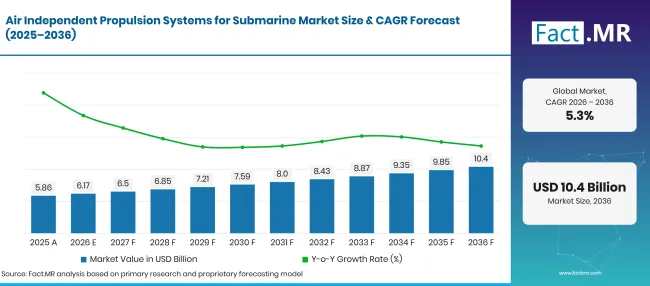
Air Independent Propulsion Systems For Submarine Market Forecast Global | Source: Fact.MR
| Year | Basis | Market Value (USD billion) |
|---|---|---|
| 2025 | Actual | 5.86 |
| 2026 | Estimate | 6.17 |
| 2036 | Forecast | 10.4 |
| CAGR 2026 to 2036 | Forecast period | 5.3% |
Source: Fact.MR analysis. Updated Nov 9, 2026
What are the defining numbers behind Air Independent Propulsion Systems for Submarine Market growth?
The 2026 to 2036 period adds USD 4.2 billion in new value, most of it tied to conventional attack submarines now on order in Europe, Asia and Canada.
- Demand Drivers in the Market
- Ageing conventional fleets are being kept in service while replacements are built. Australia committed up to AUD 11 billion over the next decade in May 2026 to sustain its six Collins class submarines, including a life of type extension starting with HMAS Farncomb [1]. Extension work of this kind opens room for power and energy upgrades on boats that will stay in service into the 2040s.
- European navies are replacing Cold War designs with new conventional boats. The Dutch Ministry of Defence confirmed in June 2025 an agreement covering the construction of four Orka-class submarines to replace the Walrus class [2]. Each new class brings a fresh propulsion and energy specification, which feeds AIP and battery demand.
- Indigenous AIP programmes are moving toward sea service. India inaugurated Setting to Work Phase 2 of its DRDO-developed AIP energy module at Hazira in October 2026, with integration on a Kalvari-class submarine planned for early 2027 [3]. Home-grown modules add a new layer of demand for retrofit work on existing boats.
- Submerged endurance is the main tactical gain navies pay for. Fewer snorkel periods mean fewer radar and visual detection chances, so coastal states facing dense surveillance give AIP a high weight in tenders.
- Fuel cell, Stirling and battery technology keep improving. Higher energy density and quieter auxiliaries let designers extend patrols without growing the hull, which keeps AIP attractive for mid-size export designs.
- Key Segments Analyzed
- By Propulsion Technology Type: Stirling Engine will hold 38.5% share in 2026 because the technology has decades of service on Swedish and Japanese boats and a simple fuel and oxygen supply chain.
- By Submarine Type: SSK will account for 54.9% of 2026 value, since diesel-electric attack boats are the only platform class where AIP replaces the need for frequent snorkelling.
- By Component: Generators will capture 40.0% of 2026 revenue as every AIP architecture depends on a power unit that converts stored fuel into electricity while submerged.
- Analyst Opinion at Fact.MR
- Shambhu Nath Jha, Principal Consultant at Fact.MR, states, “Navies are no longer asking whether a conventional submarine needs AIP, only which type and how soon it can be fitted. The suppliers that win will be those who can show sea-proven hours on their AIP plant and deliver it with the battery and power management system already integrated. Programmes in Poland, Canada and the Netherlands will set the reference designs that smaller navies copy through 2036.”
- Strategic Implications
- Submarine builders should present AIP, lithium-ion batteries and power management as a single tested package, since buyers now score integration risk as heavily as endurance.
- Component suppliers should qualify generators, reformers and fuel cell stacks with more than one shipyard, because export programmes increasingly require local production partners.
- Navies should budget AIP retrofits alongside mid-life refits, when the hull is already open and the incremental cost of a new propulsion section is lowest.
- Investors should track contract signature dates closely, as revenue for AIP equipment arrives years after a government selects a submarine design.
Germany leads the country set at 6.8%, a pace that reflects fuel cell AIP exports and a 212CD order book now extending to Canada. Brazil follows at 6.2%, building conventional boats at home under its national submarine programme. The United States, at 5.6%, grows from technology supply and component work for allied programmes, not from AIP boats of its own. The United Kingdom records 5.0% on a similar logic, with engineering firms serving export customers. Japan closes the range at 4.4%, where a steady one-boat-a-year build rate keeps demand predictable but limits upside.
How does the Air Independent Propulsion Systems for Submarine Market break down by segment?
Stirling Engine will lead Propulsion Technology Type at 38.5%; SSK will head Submarine Type at 54.9%; Generators will hold Component at 40.0% in 2026.
Which Propulsion Technology Type leads?
Stirling Engine takes 38.5% of 2026 sales.
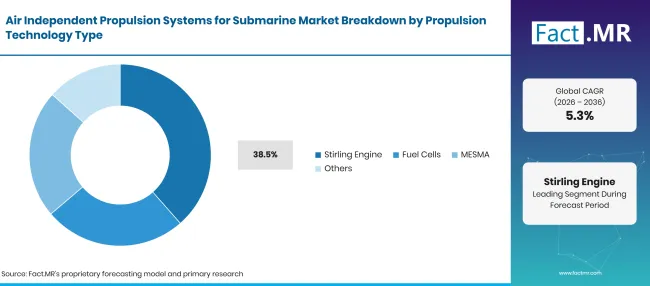
Air Independent Propulsion Systems For Submarine Market Breakdown Propulsion Technology Type | Source: Fact.MR
| Propulsion Technology Type | Share (2026) |
|---|---|
| Stirling Engine (Leading segment) | 38.5% |
| Other segments combined | 61.5%* |
| Total | 100.0% |
Source: Fact.MR analysis. Updated Nov 9, 2026
Closed-cycle Stirling units burn diesel fuel with liquid oxygen, so a navy can run them with logistics it already understands. The design has logged long service on Swedish boats and gave Japan its first AIP experience, and that record lowers technical risk for first-time buyers. Poland signed its contract for three A26 submarines on 29 June 2026, with Saab heading the Swedish industrial effort [4]. Fuel cells compete strongly where hydrogen storage and very low noise take priority, while MESMA and reformer-based systems serve navies tied to specific French or Spanish designs. Fuel cell plants rely on onboard hydrogen generation or metal hydride storage, which shapes refuelling and safety procedures. In Sweden, Saab received an order in October 2025 for the final production phase of the two Blekinge-class (A26) boats, with most deliveries due from 2026 to 2032 [5].
What supports SSK within Submarine Type?
SSK represents 54.9% of 2026 revenue.
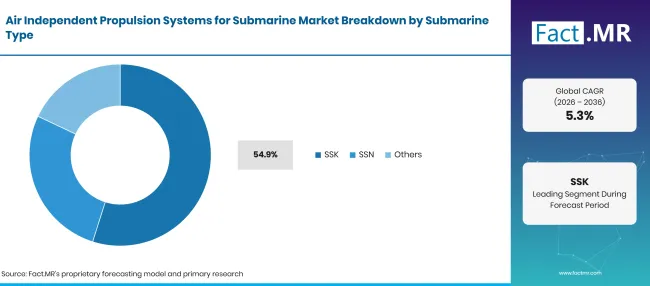
Air Independent Propulsion Systems For Submarine Market Breakdown Submarine Type | Source: Fact.MR
| Submarine Type | Share (2026) |
|---|---|
| SSK (Leading segment) | 54.9% |
| Other segments combined | 45.1%* |
| Total | 100.0% |
Source: Fact.MR analysis. Updated Nov 9, 2026
Diesel-electric attack boats patrol shallow and coastal seas where nuclear boats are either too costly or not permitted, and AIP narrows their endurance gap with nuclear designs. Canada’s Patrol Submarine Project shortlisted TKMS and Hanwha Ocean in August 2025 for up to 12 conventional submarines, with the first boat needed by 2035 [6]. SSN platforms are part of the segmentation but use reactors, so their share of AIP spending is limited to auxiliary energy systems. The Others group covers midget submarines and large uncrewed underwater vehicles, where compact fuel cells and lithium-ion batteries extend mission time without a snorkel mast.
What leads the Component segment?
Generators account for 40.0% of 2026 value.
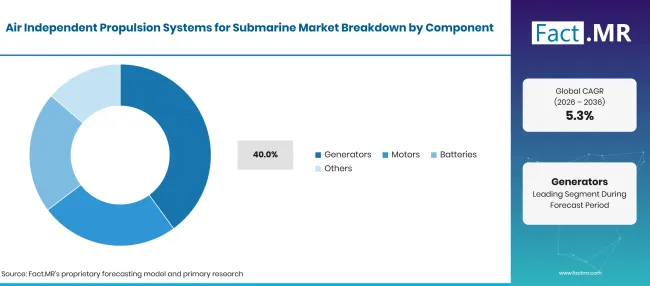
Air Independent Propulsion Systems For Submarine Market Breakdown Component | Source: Fact.MR
| Component | Share (2026) |
|---|---|
| Generators (Leading segment) | 40.0% |
| Other segments combined | 60.0%* |
| Total | 100.0% |
Source: Fact.MR analysis. Updated Nov 9, 2026
An AIP plant is in effect a submerged power station, and the generator is the unit that turns fuel and oxygen into the electricity the boat runs on. Navantia’s BEST system, for example, reforms bioethanol into hydrogen and feeds a fuel cell, which its maker says extends submerged endurance to as much as three weeks. Suppliers of large generators bring marine-grade winding and cooling expertise into this niche. Motors convert stored electricity into thrust, and permanent magnet designs are replacing older DC units for lower noise. Batteries hold the charge between AIP and diesel periods, so cell chemistry and the battery management system now decide how long a boat can sprint. Others include oxygen tanks, fuel storage and switchgear.
What is accelerating Air Independent Propulsion Systems for Submarine Market adoption, and what is holding it back?
New conventional submarine contracts in Poland, the Netherlands and Canada, plus life extensions in Australia and India, are lifting demand for proven AIP plants. Growth is limited by high unit costs, strict safety rules for stored oxygen and hydrogen, and procurement cycles that can take a decade from requirement to sea trials.
Drivers Impact Analysis
| DRIVER | (~) % IMPACT ON CAGR | GEOGRAPHIC RELEVANCE | IMPACT TIMELINE |
|---|---|---|---|
| New conventional submarine programmes in Europe and Canada | +1.2% | Western Europe, North America | Medium term (2-4 years) |
| Requirement for longer submerged patrols in coastal waters | +1.0% | Global | Medium term (2-4 years) |
| Priority on low acoustic signatures and reduced detection | +0.9% | Europe, East Asia | Long term (>=4 years) |
| Advances in fuel cell, Stirling and battery technology | +0.8% | Western Europe, East Asia | Long term (>=4 years) |
| Life extension and mid-life refits of existing fleets | +0.6% | South Asia & Pacific | Medium term (2-4 years) |
Source: Fact.MR analysis. Updated Nov 9, 2026
Opportunity Impact Analysis
| OPPORTUNITY | (~) % IMPACT ON CAGR | GEOGRAPHIC RELEVANCE | IMPACT TIMELINE |
|---|---|---|---|
| Higher efficiency fuel cell AIP modules | +0.4% | Europe, East Asia | Medium term (2-4 years) |
| AIP retrofit plugs for in-service submarines | +0.3% | South Asia & Pacific, Latin America | Long term (>=4 years) |
| Compact AIP units for smaller and uncrewed platforms | +0.3% | Global | Long term (>=4 years) |
| Integrated lithium-ion and energy management packages | +0.3% | East Asia, Western Europe | Medium term (2-4 years) |
Source: Fact.MR analysis. Updated Nov 9, 2026
Restraints Impact Analysis
| RESTRAINT | (~) % IMPACT ON CAGR | GEOGRAPHIC RELEVANCE | IMPACT TIMELINE |
|---|---|---|---|
| High development and purchase cost of AIP plants | -0.2% | Global | Short term (<=2 years) |
| Complex integration with hull and electrical systems | -0.1% | Global | Medium term (2-4 years) |
| Safety rules for stored oxygen and hydrogen | -0.1% | Global | Medium term (2-4 years) |
| Long testing and naval procurement cycles | -0.1% | Global | Long term (>=4 years) |
Source: Fact.MR analysis. Updated Nov 9, 2026
Which countries are scaling the Air Independent Propulsion Systems for Submarine Market through 2036?
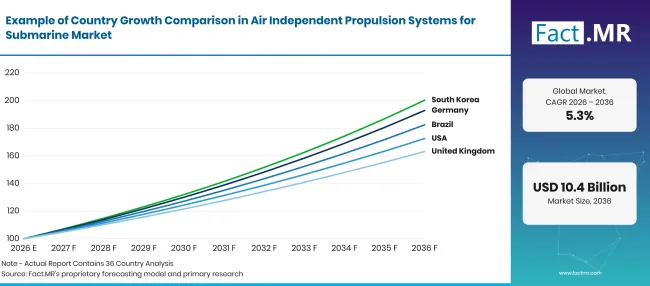
Air Independent Propulsion Systems For Submarine Market Growth Index | Source: Fact.MR
| Country | CAGR (2026 to 2036) |
|---|---|
| Germany | 6.8% |
| Brazil | 6.2% |
| United States | 5.6% |
| United Kingdom | 5.0% |
| Japan | 4.4% |
Source: Fact.MR analysis. Updated Nov 9, 2026
What supports adoption in Germany?
6.8% CAGR, driven by fuel cell AIP exports and an expanding 212CD partnership.
German submarine engineering is built around hydrogen fuel cell AIP, used on the Type 212A and its 212CD successor developed with Norway. That partnership widened in July 2026, when the German, Norwegian and Canadian leaders welcomed Canada’s decision to join the Type 212CD cooperation [7]. For German suppliers, a third partner nation means longer production runs for fuel cell modules, oxygen storage and power electronics.
How is Brazil developing demand?
6.2% CAGR, as local shipbuilding under PROSUB matures.
Brazil builds its conventional Riachuelo-class boats at the Itaguaí naval complex under PROSUB, a technology transfer programme with France. The conventional boats do not carry AIP today, but the yard, workforce and supply base give Brazil the option to add an AIP section to later hulls or refits. Demand growth comes from local content in power, battery and propulsion equipment as the programme moves through its later stages.
What is supporting United States adoption?
5.6% CAGR, helped by component exports and allied programme work.
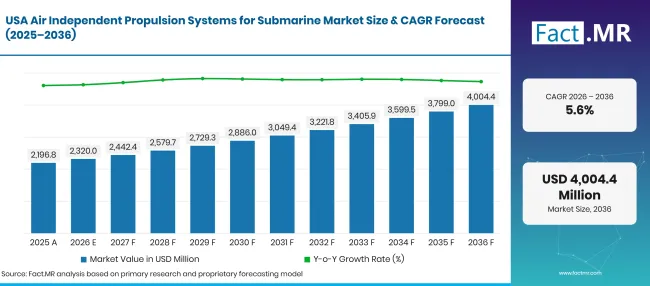
Air Independent Propulsion Systems For Submarine Market Forecast Usa | Source: Fact.MR
The US Navy operates an all-nuclear submarine fleet and keeps investing in it; in April 2025, two more Virginia-class attack submarines were put under contract [8]. AIP demand in the country therefore rests on suppliers of fuel cells, batteries, power conversion and test equipment serving allied conventional programmes and uncrewed undersea vehicles. US firms also gain from Canadian and Australian submarine spending, which draws on North American supply chains.
How is the United Kingdom developing demand?
5.0% CAGR, reflecting naval engineering exports.
The Royal Navy Submarine Service counted nine boats at 1 April 2026, four ballistic missile and five attack submarines, all nuclear powered [9]. With no conventional fleet at home, UK demand comes from engineering firms that supply motors, switchboards and sonar-related power systems to foreign builders. Producers of marine switchboards and power conversion equipment find work on European conventional programmes.
What supports Japan’s adoption?
4.4% CAGR, given a steady domestic build rate.
Japan’s FY2026 defence budget funds construction of one new submarine at JPY 120.8 billion [10]. The country gained Stirling AIP experience on the Soryu class before moving to lithium-ion batteries on later boats. Kawasaki Heavy Industries held a naming and launching ceremony for a submarine planned in FY2022 at its Kobe Shipyard on 14 October 2025 [11], showing a yard cadence that keeps propulsion and battery suppliers in continuous work.
Who leads the Air Independent Propulsion Systems for Submarine Market?
Competition divides into two groups. Full-system designers that own their AIP technology, namely TKMS with fuel cells, Saab with Stirling engines, Naval Group with MESMA heritage and Navantia with its bioethanol BEST system, compete on sea-proven endurance and on how well AIP is integrated with the battery and combat system.
Saab strengthened its position when Sweden placed an order in October 2025 for the final production phase of its two A26 boats [5]. Naval Group’s Orka programme for the Netherlands gained a Dutch industrial partner in June 2025, when Royal IHC signed to supply modules and steel structures for all four boats [12]. A second group of large Asian builders, led by Hanwha Ocean and Kawasaki Heavy Industries, competes on build speed, price and lithium-ion battery expertise, and Hanwha Ocean reached the two-supplier shortlist in Canada alongside TKMS [6]. Through 2036, contracts will go to the bidder that pairs a credible AIP or battery solution with local industrial participation in the buyer’s country.
Which companies are the key providers?
Key companies in the Air Independent Propulsion Systems for Submarine Market include TKMS, Saab, Naval Group, Navantia, Hanwha Ocean and Kawasaki Heavy Industries.
- TKMS
- Saab
- Naval Group
- Navantia
- Hanwha Ocean
- Kawasaki Heavy Industries
Bibliography
- [1] Australian Government, Department of Defence. (2026, May 19). Albanese Government to commence Collins class life of type extension.
- [2] Ministerie van Defensie, Netherlands. (2025, June 17). Overeenkomst houdt Nederland maximaal betrokken bij bouw Orka’s.
- [3] Press Information Bureau, Ministry of Defence, Government of India. (2026, October 24). Indigenous AIP system for Indian Navy’s diesel-electric submarines achieves key milestone with inauguration of Setting to Work Phase-2 activity.
- [4] Ministry of National Defence, Republic of Poland. (2026, June 29). Umowa na zakup okrętów podwodnych A26 dla Marynarki Wojennej RP podpisana!.
- [5] Saab. (2025, October 13). Saab receives additional order relating to the Swedish A26 submarines.
- [6] Public Services and Procurement Canada. (2025, August 26). Government of Canada advances to next step in Canadian Patrol Submarine Project procurement.
- [7] Press and Information Office of the Federal Government, Germany. (2026, July 7). Statement by Prime Minister Mark Carney, Chancellor Friedrich Merz and Prime Minister Jonas Gahr Støre.
- [8] General Dynamics. (2025, April 30). General Dynamics Electric Boat Awarded $12 Billion Contract Modification for Virginia-Class Submarines.
- [9] Ministry of Defence, United Kingdom. (2026, August 20). UK armed forces equipment and formations 2026.
- [10] Ministry of Defense, Japan. (2025, December 26). Progress and Budget in Fundamental Reinforcement of Defense Capabilities: Overview of FY2026 Budget.
- [11] Japan Maritime Self-Defense Force. (2025, October 7). Naming and Launching Ceremony of a Submarine Planned in Fiscal Year 2022.
- [12] Royal IHC. (2025, June 16). Royal IHC en Naval Group ondertekenen strategisch contract voor bouw Orka-klasse onderzeeboten voor Nederlandse Defensie.
This Report Answers
- How is AIP revenue split between Stirling engines, fuel cells, MESMA and other systems through 2036?
- Why do navies still favour Stirling engines for first-time AIP adoption?
- Which submarine programmes in Europe, Asia and Canada will release AIP spending first?
- What role do generators, motors and batteries play in the value of an AIP installation?
- Where do countries without conventional fleets, such as the United States and the United Kingdom, earn AIP revenue?
- How do full-system designers and large Asian shipyards differ in the way they compete?
What does the Air Independent Propulsion Systems for Submarine Market cover?
This market tracks propulsion systems that let a submarine produce or deliver electrical power underwater for long periods without drawing air through a snorkel mast. Value is counted at the level of the AIP plant and its directly linked generators, motors, batteries and auxiliaries.
Revenue is booked as equipment is delivered to the shipyard for new hulls or installed during refit, so a single contract spreads value over several years of the forecast.
What is included in the scope?
Stirling engine, fuel cell, MESMA and reformer-based AIP plants for new conventional submarines are included.
Generators, propulsion motors and battery systems are counted when they form part of an AIP power architecture, including solid-state batteries under qualification for naval use.
AIP retrofit sections, plug-in hull segments and the integration work needed to install them on in-service boats are covered.
Oxygen and fuel storage, power conversion and energy management equipment tied to the AIP plant are included.
What is excluded from the scope?
Nuclear reactors and their steam plants on SSN and SSBN boats are left out.
Diesel-electric submarines without any AIP capability, and their stand-alone diesel generators, are not counted.
Hull construction, weapons, sonar and combat management systems are not counted unless they form part of AIP equipment.
Crew training, port services and general fleet maintenance not linked to AIP equipment are excluded.
How Was the Analysis Built?
The analysis draws on 120+ sources, 35+ company portfolios, 25+ countries, and more than 20 industry interviews.
- Primary Research: Primary research includes discussions with manufacturers, service providers, technology developers, distributors, end users, and subject-matter experts. These conversations examine purchasing priorities, product adoption, operational challenges, approval requirements, competitive positioning, and the factors that influence wider market acceptance.
- Desk Research: Desk research covers government statistics, regulatory publications, company filings, trade data, technical studies, industry associations, standards, public policy, and other authoritative sources. Every source used in the analysis is documented in the bibliography.
- Market Sizing and Forecasting: Market estimates combine historical performance, demand indicators, pricing and volume trends, segment shares, company participation, country-level growth, adoption patterns, investment activity, and barriers to market expansion.
- Data Validation and Update Cycle: Findings are validated by comparing primary interviews with public data, company activity, regulatory changes, trade patterns, and industry developments. Regular updates review new product launches, capacity changes, partnerships, approvals, and shifts in commercial adoption.
Segmentation
What is the report’s scope and coverage?
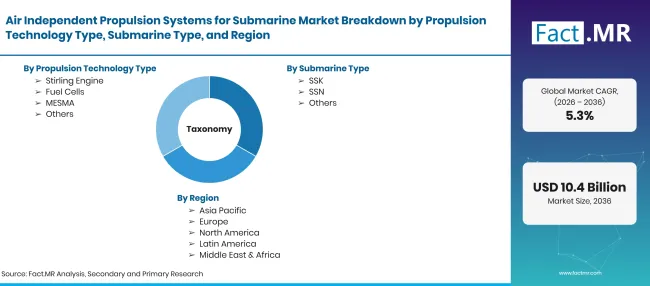
Air Independent Propulsion Systems For Submarine Market Taxonomy | Source: Fact.MR
| Attribute | Details |
|---|---|
| Quantitative Units | USD billion |
| Market Definition | Air independent propulsion systems and their power, energy storage and propulsion components that let conventional submarines generate or deliver electricity underwater without atmospheric oxygen. |
| Propulsion Technology Type | Stirling Engine; Fuel Cells; MESMA; Others |
| Submarine Type | SSK; SSN; Others |
| Component | Generators; Motors; Batteries; Others |
| Regions Covered | North America; Latin America; Western Europe; Eastern Europe; East Asia; South Asia & Pacific; Middle East & Africa |
| Countries Covered | Germany; Brazil; United States; United Kingdom; Japan |
| Companies Profiled | TKMS; Saab; Naval Group; Navantia; Hanwha Ocean; Kawasaki Heavy Industries |
| Forecast Period | 2026 to 2036 |
| Approach | Programme-level build of AIP content per submarine on order or in refit, checked against shipyard delivery schedules and national defence budgets. |
Source: Fact.MR analysis. Updated Nov 9, 2026
How is the market segmented?
-
By Propulsion Technology Type
- Stirling Engine
- Fuel Cells
- MESMA
- Others
-
By Submarine Type
- SSK
- SSN
- Others
-
By Component
- Generators
- Motors
- Batteries
- Others
-
By Region
- North America
- Latin America
- Western Europe
- Eastern Europe
- East Asia
- South Asia & Pacific
- Middle East & Africa
Frequently Asked Questions
How large is the air independent propulsion systems for submarine market in 2026?
What growth rate will the air independent propulsion systems for submarine market record?
Which propulsion technology type leads?
Which submarine type leads?
Which component leads?
Which country will grow quickest?
Who are the main companies?
What holds the market back?
Who worked on this report


Preview the report firsthand - request a free sample
Free SampleGet the brochure for pricing and purchase details
Download PDF