- Market Value (2025): USD 508 Mn
- Estimated Value (2026): USD 540 Mn
- Forecast Value (2036): USD 995 Mn
- CAGR (2026-2036): 6.3%
What is the High-Pressure Coolant Filtration Systems Market forecast to be worth by 2036?
USD 540 million in 2026 to USD 995 million by 2036 at 6.3% CAGR.
- The high-pressure coolant filtration systems market crossed a valuation of USD 508 million in 2025.
- Demand is projected to increase from USD 540 million in 2026 to USD 995 million by 2036.
- The market is forecast to record 6.3% CAGR from 2026 to 2036 as machining users qualify cleaner coolant at higher pump pressures.
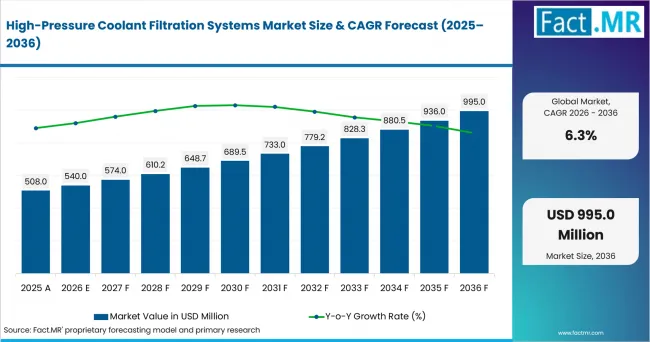
High Pressure Coolant Filtration Systems Market Value Analysis | Source: Fact.MR
What are the defining numbers behind High-Pressure Coolant Filtration Systems Market growth?
USD 455 million absolute opportunity by 2036, led by media/bag filtration, up to 70 bar systems and automotive machining users.
- Demand Drivers in the Market
- Automotive machining teams need stable coolant cleanliness because fine chips shorten tool life and raise surface-finish rejection risk.
- Aerospace suppliers require pressure-ready filtration where alloy cutting creates heavy chip load and higher coolant-delivery stress.
- Medical and precision shops use cleaner coolant to protect small tools where recutting chips quickly damages edges.
- Key Segments Analyzed
- By Filtration Type: Media/bag filtration is expected to hold 34.0% share in 2026 because it is familiar and easy to retrofit.
- By Pressure Class: Up to 70 bar is projected to account for 41.0% share in 2026 since many machining cells remain below upper-pressure ranges.
- By End-Use Industry: Automotive is anticipated to capture 32.0% share in 2026 owing to coolant-intensive cutting across vehicle component lines.
- Analyst Opinion at Fact.MR
- Shambhu Nath Jha, Principal Consultant at Fact.MR, states, “Coolant filtration is not selected only by micron rating. Plant teams want proof that the system protects pumps and machining quality. Suppliers are expected to combine pressure-rated hardware with fluid testing and service reasoning.”
- Strategic Implications
- Machine-tool builders should define coolant cleanliness targets before selecting pump and filtration packages for new installations.
- Automotive plant managers should compare retrofit payback against unplanned tool changes and pump-related downtime.
- Investors should separate coolant filtration exposure from wider hydraulic filter portfolios because application proof decides the addressable base.
South Korea is projected to record 8.3% CAGR through 2036. The United States follows at 7.8%. Germany reaches 6.8%, France posts 6.7%, Italy records 6.3% and Japan reaches 5.8%.
How does the High-Pressure Coolant Filtration Systems Market break down by segment?
Media/bag filtration leads at 34.0%; up to 70 bar leads at 41.0%.
Which filtration type dominates?
Media/bag filtration holds 34.0% share in 2026.
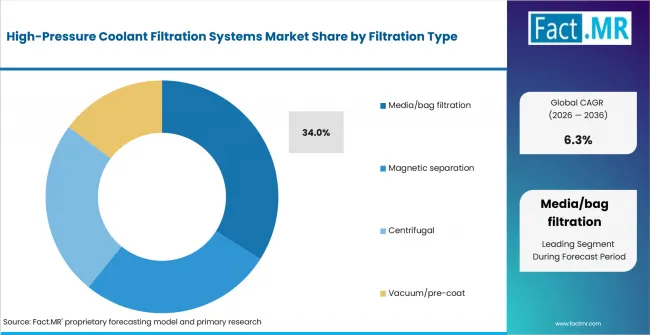
High Pressure Coolant Filtration Systems Market Analysis By Filtration Type | Source: Fact.MR
Media/bag filtration leads because it is easy to specify, operate and service across common machining cells. The category suits plants seeking straightforward coolant-cleaning systems without excessive equipment complexity. Its broad applicability across repeatable cutting operations supports adoption where manufacturers prioritize dependable filtration, manageable maintenance and consistent coolant quality.
What leads the Pressure Class segment?
Up to 70 bar is expected to hold 41.0% share in 2026.
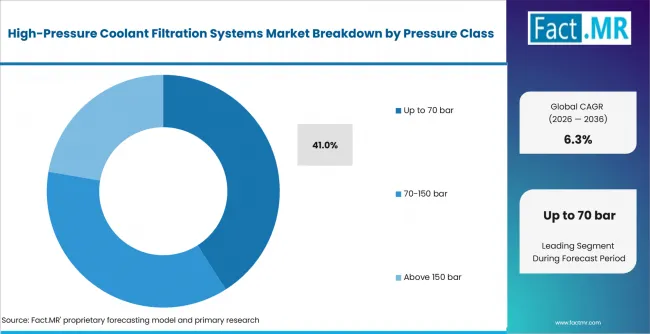
High Pressure Coolant Filtration Systems Market Analysis By Pressure Class | Source: Fact.MR
Up to 70 bar leads because many machining operations require reliable chip evacuation without the added cost of very high-pressure pump systems. This pressure range supports routine cutting applications while balancing filtration performance and equipment investment. Eaton expanded its hydraulic filtration portfolio in March 2025 with new DUA duplex, LWF in-line, and DNR duplex pressure-filter series.
How does End-Use Industry shape demand?
Automotive is anticipated to lead with 32.0% share in 2026.
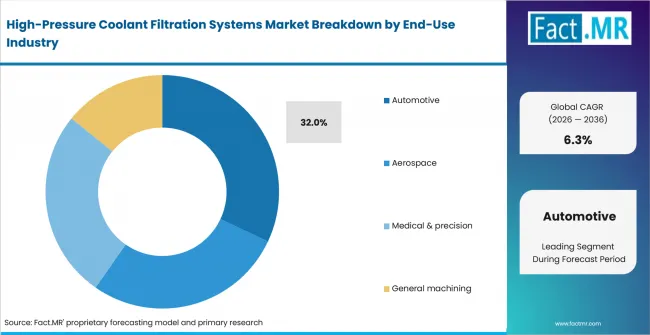
High Pressure Coolant Filtration Systems Market Analysis By End Use Industry | Source: Fact.MR
Automotive leads the End-Use Industry segment because vehicle-component production involves large volumes of repeatable cutting and machining operations. Coolant filtration helps maintain tool performance, control chips and support consistent machining conditions across production lines, making dependable filtration systems particularly important where manufacturers prioritize uptime, quality and repeatable output.
What is accelerating High-Pressure Coolant Filtration Systems Market adoption, and what is holding it back?
High-pressure machining drives it; retrofit cost restrains it.
Drivers Impact Analysis
| DRIVER | (~) % IMPACT ON CAGR | GEOGRAPHIC RELEVANCE | IMPACT TIMELINE |
|---|---|---|---|
| High-pressure machining intensity | +1.7% | Germany, United States, Japan | Short term (<= 2 years) |
| Particle and chip control | +1.4% | Automotive and precision clusters | Short term (<= 2 years) |
| Tool-life protection | +1.2% | Global machining centers | Medium term (2-4 years) |
| Centralized coolant filtration | +0.9% | Large plants and transfer lines | Medium term (2-4 years) |
| Fluid cleanliness documentation | +0.7% | Medical and aerospace suppliers | Long term (>= 4 years) |
- High-pressure machining intensity: Higher coolant pressure moves chips away from the cut and raises filtration load. Plants that qualify high-pressure pumps also need filters sized for flow, pressure and service access.
- Particle and chip control: Fine particles damage pumps and tool edges before visible coolant problems appear. Filtration value rises when machines cut smaller features or harder alloys.
- Tool-life protection: High-pressure coolant systems are expected to support longer tool life when filtration keeps abrasive fines out of the cutting zone.
- Centralized coolant filtration: Large plants use shared coolant handling where filter choice affects several machines and maintenance teams.
- Fluid cleanliness documentation: Aerospace and medical suppliers increasingly want process evidence that supports audits and customer approvals.
Opportunity Impact Analysis
| OPPORTUNITY | (~) % IMPACT ON CAGR | GEOGRAPHIC RELEVANCE | IMPACT TIMELINE |
|---|---|---|---|
| Retrofit filtration packages | +1.0% | Installed machining base | Short term (<= 2 years) |
| Sensor-linked monitoring | +0.8% | United States, Germany, Japan | Medium term (2-4 years) |
| Medical and precision machining | +0.6% | Japan, France, South Korea | Medium term (2-4 years) |
| Local service bundles | +0.5% | Europe, North America, East Asia | Long term (>= 4 years) |
- Retrofit filtration packages: Installed CNC machines create opportunity when operators add high-pressure coolant after the original machine purchase.
- Medical and precision machining: Small tools make coolant cleanliness more visible in precision work. The segment needs simple proof of particle control before procurement approval.
- Local service bundles: High-pressure filtration systems need element supply, fluid checks and maintenance training near the operating site.
Restraints Impact Analysis
| RESTRAINT | (~) % IMPACT ON CAGR | GEOGRAPHIC RELEVANCE | IMPACT TIMELINE |
|---|---|---|---|
| Filter element and consumable cost | -0.8% | Global | Short term (<= 2 years) |
| Coolant variability | -0.6% | Mixed-material shops | Short term (<= 2 years) |
| Retrofit floor-space limits | -0.5% | Older plants | Medium term (2-4 years) |
| Machine-tool cycle weakness | -0.4% | Germany, France, Japan | Medium term (2-4 years) |
- Filter element and consumable cost: Media/bag systems are familiar, but replacement cost affects operating budgets on dirty castings and ferrous materials.
- Coolant variability: Coolant chemistry and chip form change filtration performance from one plant to another. Trial runs remain part of the purchase process.
- Retrofit floor-space limits: Older machining halls often have little space around pumps, tanks and conveyors. Compact layouts become necessary.
- Machine-tool cycle weakness: Slower machinery ordering reduces new-machine filtration packages. This shifts some demand toward retrofits and service-led upgrades.
Which countries are scaling High-Pressure Coolant Filtration Systems Market fastest?
- The country comparison spans 2.50 percentage points and forms three practical growth bands across the forecast period.
- South Korea remains 0.56 percentage point above the United States through export-linked automotive machining and machinery-order support.
- The United States remains 0.97 percentage point above Germany as machine-tool orders support filtration retrofits.
- Germany remains 0.11 percentage point above France through automotive production and precision engineering depth.
- France remains 0.43 percentage point above Italy because transport equipment and machinery goods sustain selective upgrades.
- Italy remains 0.43 percentage point above Japan due to machine-tool production and automation investment.
- Japan closes the displayed range because mature machining lines often require careful replacement justification before filtration upgrades.
Comparable CAGRs create different entry conditions because machining scale and service depth vary by country. Full report coverage includes North America, Latin America, Europe, East Asia, South Asia and Pacific, Middle East and Africa.
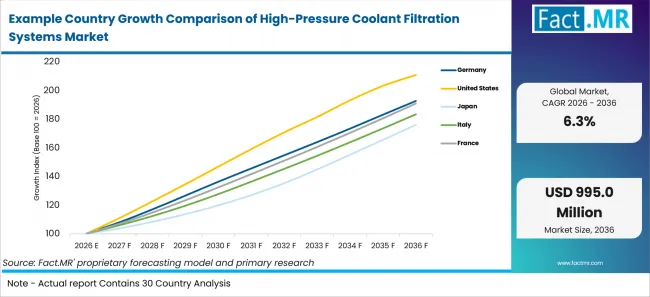
Example Country Growth Comparison Of High Pressure Coolant Filtration Systems Market | Source: Fact.MR
| Country | CAGR (2026-2036) |
|---|---|
| South Korea | 8.3% |
| United States | 7.8% |
| Germany | 6.8% |
| France | 6.7% |
| Italy | 6.3% |
| Japan | 5.8% |
What supports South Korea adoption?
8.3% CAGR, led by automotive exports, machinery activity and precision manufacturing.
South Korea’s growth is shaped by export-oriented automotive production and precision component manufacturing. MOTIR reported that South Korea’s automobile exports reached USD 72.0 billion in 2025. Separately, the Ministry of Data and Statistics reported that the value of domestic machinery orders received increased 6.9% year over year in December 2025, while the Equipment Investment Index declined 3.6% from the previous month.
How is the United States scaling demand?
7.8% CAGR, backed by machine-tool orders and durable-goods activity.
The United States benefits from extensive CNC, aerospace and automotive machining activity. U.S. manufacturing technology orders reached USD 814.3 million in December 2025, while the U.S. Census Bureau reported that durable-goods orders increased 0.3% to USD 334.8 billion in June 2026.
What supports Germany growth?
6.8% CAGR, supported by automotive production and precision engineering.
Germany’s demand reflects automotive machining, machine-tool expertise and disciplined maintenance practices. VDA reported that Germany produced 4,148,836 passenger cars in 2025, while Destatis reported that production in the manufacture of machinery and equipment increased 9.5% month over month in July 2025. German machine-tool orders fell 3.0% in 2025, with domestic orders down 16.0%. VDW also reported that high costs and insufficient planning security constrained industrial investment during the year.
How does France perform?
6.7% CAGR, linked to transport equipment, aerospace and precision manufacturing.
France’s outlook is supported by automotive, aerospace and precision-machining activity. Demand is strengthened by advanced manufacturing requirements, higher-pressure coolant use and the need for consistent chip removal. Filtration systems help protect tools and surface quality, although service availability and cautious investment planning can slow wider adoption.
What supports Italy adoption?
6.3% CAGR, supported by machine-tool production and automation demand.
Italy’s market benefits from machine-tool builders, automation suppliers and precision component manufacturers. Italian production of machine tools, robots and automation reached EUR 6,391 million in 2025, up 1.0% from 2024. Istat reported that Italy’s seasonally adjusted industrial production index fell 0.4% month over month in December 2025, while calendar-adjusted production was 3.2% higher year over year.
How does Japan perform?
5.8% CAGR, supported by machine-tool orders and precision machining depth.
Japan’s growth is underpinned by advanced machine-tool and precision-manufacturing capabilities. Japan’s machine-tool orders reached JPY 1,604.32 billion in 2025, up 8.0% year over year, while METI reported a seasonally adjusted Industrial Production Index of 103.0 in May 2026. The Cabinet Office forecast private-sector machinery orders, excluding volatile orders for ships and electric power companies, to decline 4.5% quarter over quarter in January–March 2026.
Who leads the High-Pressure Coolant Filtration Systems Market?
Official product materials show direct machine-tool coolant-filtration relevance for HYDAC and KNOLL, and high-pressure/contamination-monitoring filtration capability for LNS Group / ChipBLASTER. HOFFMANN FILTER CORPORATION, Eaton and Barnes International, Inc. provide broader industrial or hydraulic filtration offerings; those public sources are adjacent evidence and do not by themselves establish direct participation in high-pressure metalworking coolant filtration.
Supplier selection is expected to depend on pressure rating, flow stability and service support.
Which companies are the key providers?
Key companies include Hydac, LNS Group / ChipBLASTER, Knoll Maschinenbau, Hoffmann Filter Corporation, Eaton, and Barnes International, Inc.
- Hydac
- LNS Group / ChipBLASTER
- Knoll Maschinenbau
- Hoffmann Filter Corporation
- Eaton
- Barnes International, Inc.
Bibliography
- Chidzik, C. (2026, February 9). Manufacturing technology orders set record in December 2025. AMT – The Association for Manufacturing Technology.
- ANFIA. (2026, February 11). L’indice della produzione dell’industria automotive italiana riporta una crescita a dicembre (+13,5%), ma il 2025 si chiude in flessione a doppia cifra (-10,3%).
Economic and Social Research Institute, Cabinet Office, Government of Japan. (2026, February 19). Machinery orders in December, 2025 and forecast for Jan.–Mar. 2026. - Eaton. (2025, March 5). Eaton expands its hydraulic filtration portfolio: New duplex and in-line pressure filters for diverse applications.
- Board of Governors of the Federal Reserve System. (2025, June 17). Industrial production and capacity utilization – G.17.
- Federal Statistical Office (Destatis). (2025, September 8). Production in July 2025: +1.3% on the previous month.
- Institut national de la statistique et des études économiques. (2025, November 5). In September 2025, manufacturing output bounced back (+0.9%).
- Japan Machine Tool Builders’ Association. (2026, February 3). The current condition of the Japanese machine tool industry: Monthly machine tool orders (December 2025).
- Ministry of Economy, Trade and Industry. (2026, June 30). Indices of industrial production: Preliminary report for May 2026.
- Ministry of Trade, Industry and Resources. (2026, January 15). Automobile exports hit record high of $72 billion in 2025.
This Report Answers
- The report provides strategic intelligence on the High-Pressure Coolant Filtration Systems Market across filtration type and pressure-class choices that shape machining-fluid decisions.
- Segment analysis covers media/bag filtration and up to 70 bar systems as the 2026 share leaders within the market.
- Country outlook evaluates South Korea and the United States alongside Germany, France, Italy and Japan.
- Competitive analysis profiles Hydac and LNS Group / ChipBLASTER alongside Knoll Maschinenbau and Hoffmann Filter Corporation. Eaton and Barnes International, Inc. complete the provider set.
- Application assessment covers automotive and aerospace machining. Medical and precision use completes the end-use view alongside general machining.
What does the High-Pressure Coolant Filtration Systems Market cover?
High-pressure coolant filtration systems clean metalworking fluids where pressure, chip load and particle control affect tool life.
The market covers filtration units, media and integrated systems used with high-pressure coolant pumps. The market includes systems serving automotive, aerospace, medical and precision machining, and general metalworking operations.
What is included in the scope?
The scope connects with broader industrial filtration coverage when plants compare fluid-cleanliness programs across production assets.
It also aligns with coolant filtration coverage where machining-fluid cleaning is the core function. Coolant delivery context is considered when coolant circulation systems are paired with particle separation and serviceable filter housings.
Filter-element choices link to filter media where dirt-holding capacity and particle retention shape replacement intervals. Automotive demand links with automotive filters when plants compare contamination control across vehicle production and service systems.
What is excluded from the scope?
The scope excludes coolant additives, cutting tools and low-pressure tank accessories sold without filtration function. Pumps alone are excluded unless filtration hardware is included.
Input-fluid chemistry is covered only where metalworking fluids influence filtration load and element selection. Small-tool use overlaps with micromachining equipment when fine particles affect edge life and surface quality.
How Was the Analysis Built?
The analysis draws on 120+ sources, 35+ company portfolios, 25+ countries, and more than 20 industry interviews.
- Primary Research: Primary research includes discussions with manufacturers, service providers, technology developers, distributors, end users, procurement teams, and subject-matter experts. These conversations examine purchasing priorities, product adoption, operational challenges, approval requirements, competitive positioning, and the factors that influence wider market acceptance.
- Desk Research: Desk research covers government statistics, regulatory publications, company filings, trade data, technical studies, industry associations, standards, public policy, and other authoritative sources. Every source used in the analysis is documented in the bibliography.
- Market Sizing and Forecasting: Market estimates combine historical performance, demand indicators, pricing and volume trends, segment shares, company participation, country-level growth, adoption patterns, investment activity, and barriers to market expansion.
- Data Validation and Update Cycle: Findings are validated by comparing primary interviews with public data, company activity, regulatory changes, trade patterns, and industry developments. Regular updates review new product launches, capacity changes, partnerships, approvals, procurement trends, and shifts in commercial adoption.
What is the report’s scope and coverage?
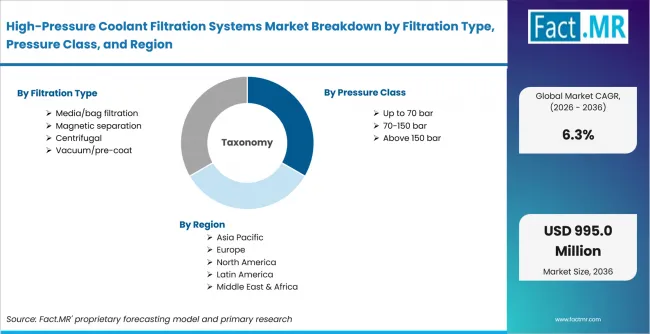
High Pressure Coolant Filtration Systems Market Breakdown By Filtration Type, Pressure Class, And Region | Source: Fact.MR
| Attribute | Details |
|---|---|
| Quantitative Units | USD Million |
| Market Definition | Filtration systems used to clean metalworking coolant in high-pressure machining circuits where particle control, chip removal, pump protection and surface-finish stability influence production approval |
| Filtration Type | Media/bag filtration; Magnetic separation; Centrifugal; Vacuum/pre-coat |
| Pressure Class | Up to 70 bar; 70-150 bar; Above 150 bar |
| End-Use Industry | Automotive; Aerospace; Medical and precision; General machining |
| Regions Covered | North America; Latin America; Europe; East Asia; South Asia and Pacific; Middle East and Africa |
| Countries Covered | Germany; United States; Japan; Italy; France; South Korea |
| Key Companies Profiled | Hydac; LNS Group / ChipBLASTER; Knoll Maschinenbau; Hoffmann Filter Corporation; Eaton; Barnes International, Inc. |
| Forecast Period | 2026 to 2036 |
| Approach | Hybrid top-down and bottom-up approach using machining demand; coolant pressure needs; filtration-type share; pressure-class split; end-use mix; country adoption patterns; company portfolio review; retrofit barriers; service requirements; source-verified industrial indicators |
How is the market segmented?
-
By Filtration Type
- Media/bag filtration
- Magnetic separation
- Centrifugal
- Vacuum/pre-coat
-
By Pressure Class
- Up to 70 bar
- 70-150 bar
- Above 150 bar
-
By End-Use Industry
- Automotive
- Aerospace
- Medical and precision
- General machining
-
By Region
- North America
- Latin America
- Europe
- East Asia
- South Asia and Oceania
- Middle East and Africa