Coolant Distribution Units Market (2026 - 2036)

Coolant distribution units market, By type (Floor-Mounted CDUs, Rack-Mounted CDUs, In-Row CDUs, Modular / Scalable CDUs, Standalone / Centralized CDUs), By cooling capacity, By distribution method, By Component, By Application and Region - Market Insights 2026 to 2036

Core Findings

    Coolant Distribution Units Market Outlook 2026 to 2036

    Fact.MR is of the opinion that long-term leadership in the Coolant Distribution Units market will be determined by suppliers’ ability to integrate high-efficiency liquid cooling systems directly into hyperscale and AI-driven data center architectures while delivering modular scalability and energy-compliance alignment at competitive total cost of ownership.

    The global coolant distribution units market is expected to reach USD 6,976.8 million by 2036, up from USD 1,032.5 million in 2026. During the forecast period (2026 – 2036), the industry is projected to expand at a CAGR of 21.10%.

    The​‍​‌‍​‍‌​‍​‌‍​‍‌ coolant distribution units market is expanding with the growth of data centers that require efficient thermal management to sustain the increasing computing densities. The rise in the use of liquid cooling in HPC, AI, and cloud facilities, coupled with the necessity to lower energy consumption and keep operational reliability, is causing a rapid increase in CDU installation. The imposition of regulations for eco-friendly data-center operations, improvements in heat-exchange technologies, and the transition to modular, scalable cooling infrastructures are additional factors propelling the market ​‍​‌‍​‍‌​‍​‌‍​‍‌upward.

    The absolute dollar growth between 2026 and 2036 is USD 5,944.3 million. This represents transformational expansion rather than incremental growth, driven primarily by hyperscale data center buildouts, AI workload density, and the structural shift from air cooling to liquid cooling architectures. Growth is sustained by rising rack power densities and energy-efficiency mandates, though high capital expenditure requirements, component supply chain constraints, and standardization challenges may moderate the pace in certain regions.
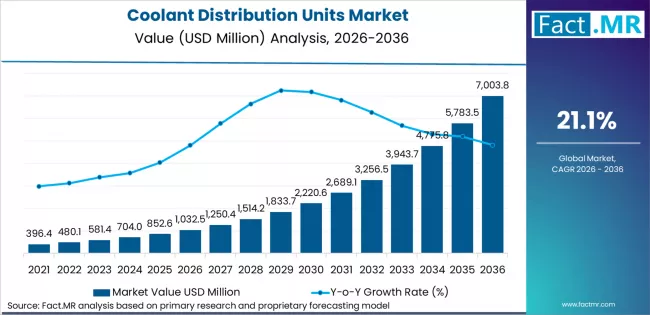
    Coolant Distribution Units Market Market Value Analysis

    Quick Stats for Coolant Distribution Units Market

    • Industry Value (2026): USD 1,032.5 million
    • Projected Value (2036): USD 6,976.8 million
    • Forecast CAGR (2026 to 2036): 21.10%
    • Leading Segment (2026): Soil Sensors (24.4% Market Share)
    • Fastest Growing Country (2026-2036): China (10.9% CAGR)
    • Top Key Players: Schneider Electric Vertiv Group Corp., Delta Electronics, Inc., nVent, DCX Liquid Cooling Systems, Asetek, Boyd, Chilldyne, CoolIT Systems, DCX POLSKA SP. Z O.O., Delta Power Solutions, Liquid Stack, Motivair (Schneider Electric), Munters Group, Nidec, Rittal GmbH & Co. KG, Stulz GmbH, Submer, Supermicro, Trane

    Market Definition

    The Coolant Distribution Units market refers to systems that control and circulate liquid coolant to remove heat from high performance computing equipment. A CDU is a dedicated cooling system that pumps, filters, monitors, and regulates temperature-controlled liquid through servers, racks, or direct to chip cooling loops. Its primary function is to manage the high thermal loads generated by dense computing hardware where air cooling is no longer sufficient. The main end use is in data centers, including hyperscale, colocation, and AI focused facilities, where stable temperature control is essential for performance, reliability, and energy efficiency.

    Market Inclusion: The report presents detailed global and regional market size estimates for the Coolant Distribution Units market, covering the historical base year, 2026 to 2036 forecast period, and long-term growth outlook. It provides segment level analysis by product type, application, and end user, along with country level breakdowns. The study also evaluates pricing trends, supply chain dynamics, trade flow patterns, competitive landscape, and technology adoption across data center infrastructure.

    Market Exclusion: The scope excludes standalone chillers, cooling towers, computer room air conditioning units, and complete HVAC systems unless directly integrated within CDU architecture. It also omits server hardware, GPUs, immersion cooling fluids, and full data center construction services. The report does not cover residential or commercial building cooling equipment, focusing strictly on coolant distribution units and their role within liquid cooling infrastructure for high density data center environments.

    Research Methodology

    • Primary Research: Interviews were conducted with data center operators, hyperscale infrastructure managers, liquid cooling system integrators, CDU manufacturers, component suppliers, and industry consultants across major regions.
    • Desk Research: The study incorporates annual reports, earnings call transcripts, data center capacity databases, regulatory filings, government energy efficiency guidelines, and verified company press releases issued from 2023 onward.
    • Market-Sizing and Forecasting: A hybrid approach was applied, combining bottom-up aggregation of company revenues and shipment data with top-down validation against global data center capital expenditure and installed rack capacity trends.
    • Data Validation and Update Cycle: Outputs were validated through triangulation between primary interviews, financial disclosures, and infrastructure investment data, with periodic updates aligned to hyperscale expansion announcements and technology deployment milestones.

    What are the drivers of the Coolant Distribution Units Market?

    Fact.MR analysts observe that the Coolant Distribution Units market is in a rapid structural expansion phase driven by the shift from conventional air cooling to liquid cooling in high density data centers. The market exists at its current size because rack power densities have exceeded the practical limits of air based systems, particularly with the rise of AI accelerators and high performance computing clusters. Its valuation is directly tied to hyperscale data center capital expenditure cycles and energy efficiency mandates that push operators toward more thermally efficient cooling architectures.

    Coolant​‍​‌‍​‍‌​‍​‌‍​‍‌ Distribution Units market is rapidly growing due to data centers, hyperscale operators, and AI-driven computing infrastructures which are very-density workloads that require advanced liquid-cooling solutions. The rise of heat loads from GPUs and HPC clusters, however, the inefficiency of traditional air cooling is what has been motivating the replacement of CDUs to achieve accurate thermal control and energy-saving. The proliferation of cloud services, edge computing, and large AI training facilities is increasing the need for real-time cooling even further.

    • AI Rack Density Surge: The rapid deployment of AI accelerators and high performance GPUs is pushing rack power densities beyond 30 to 80 kW per rack, where traditional air cooling becomes inefficient. This structural shift is directly increasing demand for liquid cooling systems and integrated coolant distribution units that can handle higher thermal loads with stable temperature control. Recent product launches reflect this shift. In March 2024, Vertiv introduced the Vertiv™ CoolChip CDU 70 designed for high-density AI and HPC applications, supporting scalable direct-to-chip liquid cooling integration. [1]
    • Energy Efficiency Mandates: Regulations such as the European Union Energy Efficiency Directive and regional data center sustainability guidelines are compelling operators to lower power usage effectiveness and reduce water and electricity consumption. CDUs support compliance by enabling closed loop liquid cooling architectures that improve thermal efficiency and reduce overall facility energy intensity. In April 2024, Schneider Electric expanded its liquid cooling portfolio for AI-ready data centers, integrating rack-based CDU systems with EcoStruxure monitoring to improve efficiency and compliance visibility. [2]
    • Asia Hyperscale Expansion: Rapid data center construction in markets such as India and Southeast Asia is creating incremental demand for advanced cooling infrastructure. Government backed digital infrastructure programs and cloud region expansions in Asia Pacific are accelerating adoption of modular, scalable liquid cooling systems, positioning the region as a high growth market for CDUs.

    What are the regional trends of the Coolant Distribution Units Market?

    The​‍​‌‍​‍‌​‍​‌‍​‍‌ regional progression of the coolant distribution units market is influenced by the differences in the expansion of data centers, the adoption of liquid cooling, and the investments in digital infrastructure. Basically,​‍​‌‍​‍‌​‍​‌‍​‍‌ North America is still the leader with a massive expansion of hyperscale, very fast AI deployment, and a first wave of migration to liquid cooling.

    The main factors that have helped Western Europe to progress further are energy-efficiency regulations, sustainability mandates, and the modernization of the old data centers. Especially China, South Korea, and Japan are going very fast, with AI clusters supported by the government and huge cloud-facility ​‍​‌‍​‍‌​‍​‌‍​‍‌build-outs. The gradual adoption of colocation markets is evident in South Asia and the Pacific. On the other hand, the Middle East and Latin America are becoming two of the most attractive places for green, high-density data-center ​‍​‌‍​‍‌​‍​‌‍​‍‌projects.

    What are the challenges and restraining factors of the Coolant Distribution Units Market?

    Several​‍​‌‍​‍‌​‍​‌‍​‍‌ hurdles stand in the way of the Liquid-Cooling Distribution Units market becoming widely adopted. The hefty upfront investment in a liquid-cooling infrastructure and the difficulty of integrating it into the existing air-cooled data centers are the main reasons for the slow deployment. The personnel who are in charge of the data centers usually do not have the requisite knowledge to manage coolant loops, pump controls, and leak-detection systems. Even the performance reliability could be influenced by the compatibility of the fluid, the risk of corrosion, and the strict maintenance requirements.

    Country-Wise Insights

    The report covers North America, Latin America, Western Europe, Eastern Europe, South Asia and Pacific, and the Middle East and Africa. The market is segmented geographically at regional and country levels, with detailed analysis of demand trends, infrastructure investment, and technology adoption patterns. The full report also provides a comprehensive market attractiveness analysis across key regions.
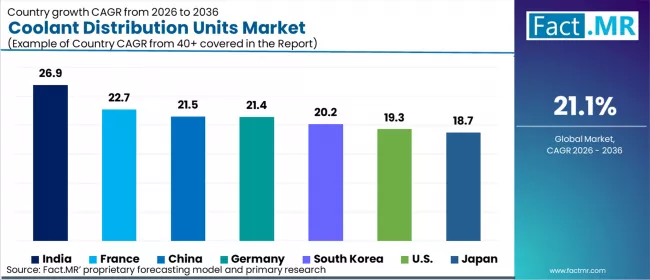
    Coolant Distribution Units Market Cagr Analysis By Country

    Country CAGR %
    U.S. 19.3%
    China 21.5%
    India 26.9%
    Germany 21.4%
    Japan 18.7%
    South Korea 20.2%
    France 22.7%
    U.K. 19.4%
    Saudi Arabia 23.2%
    Indonesia 22.4%

    Source: Fact.MR (Fact.MR) analysis, based on proprietary forecasting model and primary research

    United States leads CDU adoption through hyperscale growth and advanced cooling

    The​‍​‌‍​‍‌​‍​‌‍​‍‌ U.S. is the main contributor to the Coolant Distribution Units market with a hyperscale data-center expansion that is happening very fast, AI and cloud infrastructure growing strongly, and liquid cooling being adopted very early for high-density server environments. The data-center operators of the future such as Google, Microsoft, Meta, and AWS are liquid-cooling going to be dramatically changing their systems to accommodate power-intensive workloads. Incentives given by the government and at the state-level for energy-efficient data-center technologies are also helping in the rapid deployment of CDU.

    Places like Northern Virginia, Dallas, Phoenix, and Silicon Valley where the demand is very high are also being supported by OEMs who are specializing in advanced immersion and direct-to-chip cooling. The collaboration that exists among cooling manufacturers, data-center integrators, and research labs is one of the factors that strengthen U.S. ​‍​‌‍​‍‌​‍​‌‍​‍‌leadership.

    China rapidly expands CDU use driven by AI and mega data centers

    China​‍​‌‍​‍‌​‍​‌‍​‍‌ remains a significant factor in the expansion of the Coolant Distribution Units market through several substantial investments related to cloud computing, hyperscale facilities, and AI supercomputing clusters. Among other things, government programs like the “Eastern Data, Western Computing” project are facilitating the adoption of energy-saving data-center cooling solutions, thus, quickening the transition to CDUs. High server densities and escalating electricity costs are making liquid cooling technologies more attractive to data center operators.

    These (regions) areas, i.e., Beijing, Shanghai, Guangdong, and Inner Mongolia, are heavily concentrated with deployment activities. China is well-positioned to rapidly increase the uptake of CDUs due to its strong local manufacturing base combined with state-supported R&D in thermal management. In turn, the local cloud giants such as Alibaba, Tencent, and Huawei are the increasers of the ​‍​‌‍​‍‌​‍​‌‍​‍‌demand.

    Germany accelerates CDU adoption with strict efficiency rules and sustainable infrastructure

    Germany​‍​‌‍​‍‌​‍​‌‍​‍‌ is the main driver of CDU adoption in Europe with the country being influenced by strict energy-efficiency regulations, sustainability directives, and the fast data-center infrastructure modernization. Operators are being encouraged by the country’s Digital Strategy and Climate Protection Act to adopt advanced cooling technologies in order to reduce PUE and carbon footprint. Liquid-cooling systems are in demand as Frankfurt, Berlin, and Munich act as main centers for hyperscale and colocation facilities.

    The adoption is well supported by strong engineering expertise and the presence of advanced cooling technology suppliers. The collaboration between universities, data-center operators, and industrial automation firms is helping the CDU development to advance further. Moreover, Germany’s focus on renewable energy integration is also compatible with efficient cooling ​‍​‌‍​‍‌​‍​‌‍​‍‌transitions.

    Fact.MR's analysis of the Coolant Distribution Units market in Asia Pacific consists of country-wise assessment that includes China, India, Japan, South Korea, and Indonesia. Readers can find detailed insights on hyperscale data center expansion, liquid cooling adoption trends, regulatory environment, infrastructure investments, pricing dynamics, and long term growth projections through 2036.

    Category-Wise Analysis

    Modular CDUs enable flexible, efficient cooling for expanding data centers
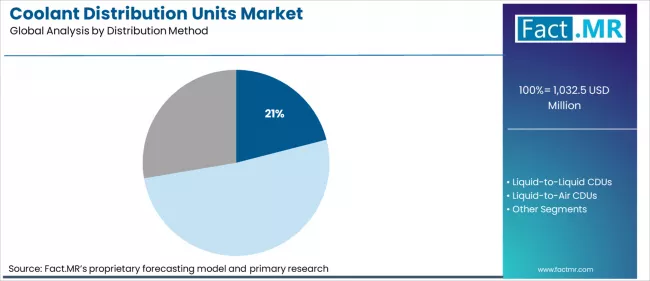
    Coolant Distribution Units Market Analysis By Distribution Method

    As​ data centers are moving away from the conventional cooling methods to adaptable liquid-cooling architectures that can extend with increasing thermal loads, modular and scalable CDUs are taking over the market. These devices provide plug-and-play implementation, are less floor space-consuming, and can be easily integrated with the facilities that are either newly built or have been retrofitted.

    Their scalability helps fast growth in colocation facilities, enterprise data centers, and edge locations, where the volumes of work change, and the need for cooling develops. The segment is supported by the rising use of AI clusters, cloud workloads, and modular data center builds. Operators use modular CDUs as they are more affordable at the beginning, offer redundancy options, and can be used to gradually increase cooling ​‍​‌‍​‍‌​‍​‌‍​‍‌efficiency.

    Mid-capacity CDUs deliver reliable cooling for dense AI workloads
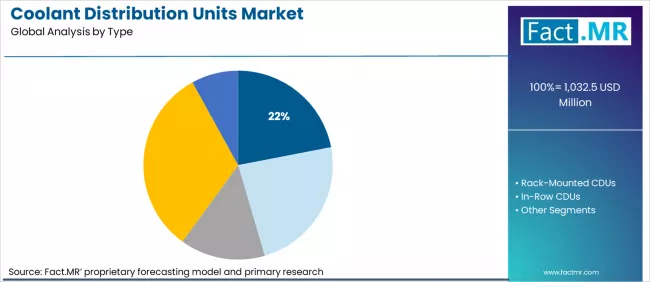
    Coolant Distribution Units Market Analysis By Type

    As​ data centers are moving away from the conventional cooling methods to adaptable liquid-cooling architectures that can extend with increasing thermal loads, modular and scalable CDUs are taking over the market. These devices provide plug-and-play implementation, are less floor space-consuming, and can be easily integrated with the facilities that are either newly built or have been retrofitted. Their scalability helps fast growth in colocation facilities, enterprise data centers, and edge locations, where the volumes of work change, and the need for cooling develops. The segment is supported by the rising use of AI clusters, cloud workloads, and modular data center builds. Operators use modular CDUs as they are more affordable at the beginning, offer redundancy options, and can be used to gradually increase cooling ​‍​‌‍​‍‌​‍​‌‍​‍‌efficiency.
    HPC CDUs provide advanced thermal management for extreme compute environments

    High-Performance​ Computing is one of the major reasons why there is a demand for CDUs.
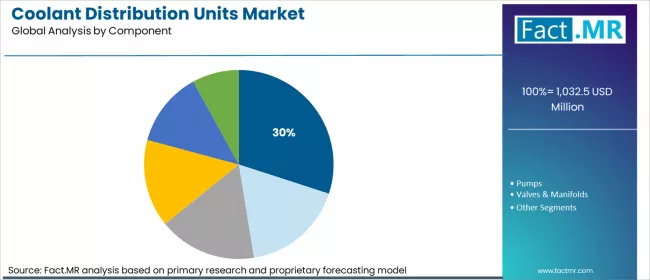
    Coolant Distribution Units Market Analysis By Component

    This is because HPC workloads produce very high heat densities which air-cooling systems are not able to handle efficiently. HPC facilities such as scientific research centers, defense computing clusters, weather modeling, and genomics need precision cooling, reliability, and a high capacity for heat removal. CDUs coupled with direct-to-chip liquid cooling or immersion cooling technologies help in maintaining the thermal stability that, in turn, allows for maximum compute output and energy efficiency. In May 2024, CoolIT Systems partnered with Dell Technologies to deploy direct-to-chip liquid cooling integrated with Dell PowerEdge servers for AI and HPC workloads. [3]

    The rise of AI-accelerated HPC, exascale computing projects, and national supercomputing initiatives is the major reason behind the surge in demand. While governments and research institutions are pouring money into HPC infrastructure, CDUs that are designed for ultra-dense compute racks are still being widely adopted ​‍​‌‍​‍‌​‍​‌‍​‍‌worldwide.

    Competitive Analysis

    Key players in the coolant distribution units market include Schneider Electric Vertiv Group Corp., Delta Electronics, Inc., nVent, DCX Liquid Cooling Systems, Asetek, Boyd, Chilldyne, CoolIT Systems, DCX POLSKA SP. Z O.O., Delta Power Solutions, Liquid Stack, Motivair (Schneider Electric), Munters Group, Nidec, Rittal GmbH & Co. KG, Stulz GmbH, Submer, Supermicro, Trane.
    The​ Coolant Distribution Units (CDU) market is intensely competitive with the competition primarily coming from the leading thermal management companies, data center cooling specialists, and a bunch of new innovators who are coming up with advanced liquid-cooling infrastructures. The competition firms focus primarily on efficiency, reliability, modularity, and seamless integration with high-density compute systems. The companies use smart monitoring features, leak-prevention mechanisms, scalable CDU architectures, and compatibility with direct-to-chip and immersion cooling as means to differentiate their products to the market.

    They benefit from faster adoption by forming strategic partnerships with hyperscale data centers, HPC operators, and OEMs. Also, the players in the market are increasingly allocating funds to R&D to raise the level of heat-removal performance, automation, IoT-enabled diagnostics, and the energy-efficient coolant control systems to be in line with the ever-increasing thermal demands of AI, cloud, and edge computing environments.

    Recent Development

    • In September 2025, Johnson Controls (through its Silent-Aire brand) introduced a scalable CDU platform with a capacity range from 500 kW to more than 10 MW, possible deployments include in-row and whitespace-perimeter, and the platform is suitable for the edge as well as large AI factories. [4]
    • In November 2025, ZutaCore unveiled its “Waterless End-of-Row” CDU series for AI/hyperscale data centres only – 1.2 MW and 2 MW systems that employ two-phase, direct-to-chip cooling with dielectric fluid, do not use white-space water and lower the duplication of the infrastructure and TCO are being offered. [5]
    • In February 2024, Submer expanded its U.S. operations to support rising demand for immersion cooling and CDU infrastructure in high-density AI facilities. [6]

    Segmentation of Coolant Distribution Units Market

    • By Type :

      • Floor-Mounted CDUs
      • Rack-Mounted CDUs
      • In-Row CDUs
      • Modular / Scalable CDUs
      • Standalone / Centralized CDUs
      • Nutrient Sensors
    • By Cooling Capacity :

      • Up to 50 kW
      • 50–200 kW
      • 200–500 kW
      • 500–1,000 kW
      • Above 1,000 kW
    • By Component :

      • Heat Exchangers
      • Pumps
      • Valves & Manifolds
      • Control Systems
      • Sensors & Monitoring Units
      • Piping & Connectors
    • By Distribution Method :

      • Direct Liquid Cooling (DLC)
      • Liquid-to-Liquid CDUs
      • Liquid-to-Air CDUs
    • By Application :

      • High-Performance Computing (HPC)
      • Artificial Intelligence & Machine Learning Clusters
      • Cloud Data Centers
      • Enterprise Data Centers
      • Edge Data Centers
      • Colocation Facilities
      • Telecom & Networking Rooms
    • By Region :

      • North America
      • Latin America
      • Western Europe
      • Eastern Europe
      • East Asia
      • South Asia & Pacific
      • Middle East & Africa

    Bibliography

    Table of Content

    1. Executive Summary
      • Global Market Outlook
      • Demand-side Trends
      • Supply-side Trends
      • Technology Roadmap Analysis
      • Analysis and Recommendations
    2. Market Overview
      • Market Coverage / Taxonomy
      • Market Definition / Scope / Limitations
    3. Market Background
      • Market Dynamics
        • Drivers
        • Restraints
        • Opportunity
        • Trends
      • Scenario Forecast
        • Demand in Optimistic Scenario
        • Demand in Likely Scenario
        • Demand in Conservative Scenario
      • Opportunity Map Analysis
      • Product Life Cycle Analysis
      • Supply Chain Analysis
      • Investment Feasibility Matrix
      • Value Chain Analysis
      • PESTLE and Porter’s Analysis
      • Regulatory Landscape
      • Regional Parent Market Outlook
      • Production and Consumption Statistics
      • Import and Export Statistics
    4. Global Coolant Distribution Units Market Analysis 2021-2025 and Forecast, 2026-2036
      • Historical Market Size Value (USD Mn) & Volume (Units) Analysis, 2021-2025
      • Current and Future Market Size Value (USD Mn) & Volume (Units) Projections, 2026-2036
        • Y-o-Y Growth Trend Analysis
        • Absolute $ Opportunity Analysis
    5. Global Coolant Distribution Units Market Pricing Analysis 2021-2025 and Forecast 2026-2036
    6. Global Coolant Distribution Units Market Analysis 2021-2025 and Forecast 2026-2036, By Type
      • Introduction / Key Findings
      • Historical Market Size Value (USD Mn) & Volume (Units) Analysis By Type, 2021-2025
      • Current and Future Market Size Value (USD Mn) & Volume (Units) Analysis and Forecast By Type, 2026-2036
        • Floor-Mounted CDUs
        • Rack-Mounted CDUs
        • In-Row CDUs
        • Modular / Scalable CDUs
        • Standalone / Centralized CDUs
      • Y-o-Y Growth Trend Analysis By Type, 2021-2025
      • Absolute $ Opportunity Analysis By Type, 2026-2036
    7. Global Coolant Distribution Units Market Analysis 2021-2025 and Forecast 2026-2036, By Cooling Capacity
      • Introduction / Key Findings
      • Historical Market Size Value (USD Mn) & Volume (Units) Analysis By Cooling Capacity, 2021-2025
      • Current and Future Market Size Value (USD Mn) & Volume (Units) Analysis and Forecast By Cooling Capacity, 2026-2036
        • Up to 50 kW
        • 50–200 kW
        • 200–500 kW
        • 500–1,000 kW
        • Above 1,000 kW
      • Y-o-Y Growth Trend Analysis By Cooling Capacity, 2021-2025
      • Absolute $ Opportunity Analysis By Cooling Capacity, 2026-2036
    8. Global Coolant Distribution Units Market Analysis 2021-2025 and Forecast 2026-2036, By Component
      • Introduction / Key Findings
      • Historical Market Size Value (USD Mn) & Volume (Units) Analysis By Component, 2021-2025
      • Current and Future Market Size Value (USD Mn) & Volume (Units) Analysis and Forecast By Component, 2026-2036
        • Heat Exchangers
        • Pumps
        • Valves & Manifolds
        • Control Systems
        • Sensors & Monitoring Value (USD Mn) & Volume (Units)s
        • Piping & Connectors
      • Y-o-Y Growth Trend Analysis By Component, 2021-2025
      • Absolute $ Opportunity Analysis By Component, 2026-2036
    9. Global Coolant Distribution Units Market Analysis 2021-2025 and Forecast 2026-2036, By Distribution Method
      • Introduction / Key Findings
      • Historical Market Size Value (USD Mn) & Volume (Units) Analysis By Distribution Method, 2021-2025
      • Current and Future Market Size Value (USD Mn) & Volume (Units) Analysis and Forecast By Distribution Method, 2026-2036
        • Direct Liquid Cooling (DLC)
        • Liquid-to-Liquid CDUs
        • Liquid-to-Air CDUs
      • Y-o-Y Growth Trend Analysis By Distribution Method, 2021-2025
      • Absolute $ Opportunity Analysis By Distribution Method, 2026-2036
    10. Global Coolant Distribution Units Market Analysis 2021-2025 and Forecast 2026-2036, By Application
      • Introduction / Key Findings
      • Historical Market Size Value (USD Mn) & Volume (Units) Analysis By Application, 2021-2025
      • Current and Future Market Size Value (USD Mn) & Volume (Units) Analysis and Forecast By Application, 2026-2036
        • High-Performance Computing (HPC)
        • Artificial Intelligence & Machine Learning Clusters
        • Cloud Data Centers
        • Enterprise Data Centers
        • Edge Data Centers
        • Colocation Facilities
        • Telecom & Networking Rooms
      • Y-o-Y Growth Trend Analysis By Application, 2021-2025
      • Absolute $ Opportunity Analysis By Application, 2026-2036
    11. Global Coolant Distribution Units Market Analysis 2021-2025 and Forecast 2026-2036, By Region
      • Introduction
      • Historical Market Size Value (USD Mn) & Volume (Units) Analysis By Region, 2021-2025
      • Current Market Size Value (USD Mn) & Volume (Units) Analysis and Forecast By Region, 2026-2036
        • North America
        • Latin America
        • Western Europe
        • Eastern Europe
        • East Asia
        • South Asia and Pacific
        • Middle East & Africa
      • Market Attractiveness Analysis By Region
    12. North America Coolant Distribution Units Market Analysis 2021-2025 and Forecast 2026-2036, By Country
      • Historical Market Size Value (USD Mn) & Volume (Units) Trend Analysis By Market Taxonomy, 2021-2025
      • Market Size Value (USD Mn) & Volume (Units) Forecast By Market Taxonomy, 2026-2036
        • By Country
          • U.S.
          • Canada
          • Mexico
        • By Type
        • By Cooling Capacity
        • By Component
        • By Distribution Method
        • By Application
      • Market Attractiveness Analysis
        • By Country
        • By Type
        • By Cooling Capacity
        • By Component
        • By Distribution Method
        • By Application
      • Key Takeaways
    13. Latin America Coolant Distribution Units Market Analysis 2021-2025 and Forecast 2026-2036, By Country
      • Historical Market Size Value (USD Mn) & Volume (Units) Trend Analysis By Market Taxonomy, 2021-2025
      • Market Size Value (USD Mn) & Volume (Units) Forecast By Market Taxonomy, 2026-2036
        • By Country
          • Brazil
          • Chile
          • Rest of Latin America
        • By Type
        • By Cooling Capacity
        • By Component
        • By Distribution Method
        • By Application
      • Market Attractiveness Analysis
        • By Country
        • By Type
        • By Cooling Capacity
        • By Component
        • By Distribution Method
        • By Application
      • Key Takeaways
    14. Western Europe Coolant Distribution Units Market Analysis 2021-2025 and Forecast 2026-2036, By Country
      • Historical Market Size Value (USD Mn) & Volume (Units) Trend Analysis By Market Taxonomy, 2021-2025
      • Market Size Value (USD Mn) & Volume (Units) Forecast By Market Taxonomy, 2026-2036
        • By Country
          • Germany
          • U.K.
          • Italy
          • Spain
          • France
          • Nordic
          • BENELUX
          • Rest of Western Europe
        • By Type
        • By Cooling Capacity
        • By Component
        • By Distribution Method
        • By Application
      • Market Attractiveness Analysis
        • By Country
        • By Type
        • By Cooling Capacity
        • By Component
        • By Distribution Method
        • By Application
      • Key Takeaways
    15. Eastern Europe Coolant Distribution Units Market Analysis 2021-2025 and Forecast 2026-2036, By Country
      • Historical Market Size Value (USD Mn) & Volume (Units) Trend Analysis By Market Taxonomy, 2021-2025
      • Market Size Value (USD Mn) & Volume (Units) Forecast By Market Taxonomy, 2026-2036
        • By Country
          • Russia
          • Poland
          • Hungary
          • Balkan & Baltic
          • Rest of Eastern Europe
        • By Type
        • By Cooling Capacity
        • By Component
        • By Distribution Method
        • By Application
      • Market Attractiveness Analysis
        • By Country
        • By Type
        • By Cooling Capacity
        • By Component
        • By Distribution Method
        • By Application
      • Key Takeaways
    16. East Asia Coolant Distribution Units Market Analysis 2021-2025 and Forecast 2026-2036, By Country
      • Historical Market Size Value (USD Mn) & Volume (Units) Trend Analysis By Market Taxonomy, 2021-2025
      • Market Size Value (USD Mn) & Volume (Units) Forecast By Market Taxonomy, 2026-2036
        • By Country
          • China
          • Japan
          • South Korea
        • By Type
        • By Cooling Capacity
        • By Component
        • By Distribution Method
        • By Application
      • Market Attractiveness Analysis
        • By Country
        • By Type
        • By Cooling Capacity
        • By Component
        • By Distribution Method
        • By Application
      • Key Takeaways
    17. South Asia and Pacific Coolant Distribution Units Market Analysis 2021-2025 and Forecast 2026-2036, By Country
      • Historical Market Size Value (USD Mn) & Volume (Units) Trend Analysis By Market Taxonomy, 2021-2025
      • Market Size Value (USD Mn) & Volume (Units) Forecast By Market Taxonomy, 2026-2036
        • By Country
          • India
          • ASEAN
          • Australia & New Zealand
          • Rest of South Asia and Pacific
        • By Type
        • By Cooling Capacity
        • By Component
        • By Distribution Method
        • By Application
      • Market Attractiveness Analysis
        • By Country
        • By Type
        • By Cooling Capacity
        • By Component
        • By Distribution Method
        • By Application
      • Key Takeaways
    18. Middle East & Africa Coolant Distribution Units Market Analysis 2021-2025 and Forecast 2026-2036, By Country
      • Historical Market Size Value (USD Mn) & Volume (Units) Trend Analysis By Market Taxonomy, 2021-2025
      • Market Size Value (USD Mn) & Volume (Units) Forecast By Market Taxonomy, 2026-2036
        • By Country
          • Kingdom of Saudi Arabia
          • Other GCC Countries
          • Turkiye
          • South Africa
          • Other African Union
          • Rest of Middle East & Africa
        • By Type
        • By Cooling Capacity
        • By Component
        • By Distribution Method
        • By Application
      • Market Attractiveness Analysis
        • By Country
        • By Type
        • By Cooling Capacity
        • By Component
        • By Distribution Method
        • By Application
      • Key Takeaways
    19. Key Countries Coolant Distribution Units Market Analysis
      • U.S.
        • Pricing Analysis
        • Market Share Analysis, 2025
          • By Type
          • By Cooling Capacity
          • By Component
          • By Distribution Method
          • By Application
      • Canada
        • Pricing Analysis
        • Market Share Analysis, 2025
          • By Type
          • By Cooling Capacity
          • By Component
          • By Distribution Method
          • By Application
      • Mexico
        • Pricing Analysis
        • Market Share Analysis, 2025
          • By Type
          • By Cooling Capacity
          • By Component
          • By Distribution Method
          • By Application
      • Brazil
        • Pricing Analysis
        • Market Share Analysis, 2025
          • By Type
          • By Cooling Capacity
          • By Component
          • By Distribution Method
          • By Application
      • Chile
        • Pricing Analysis
        • Market Share Analysis, 2025
          • By Type
          • By Cooling Capacity
          • By Component
          • By Distribution Method
          • By Application
      • Germany
        • Pricing Analysis
        • Market Share Analysis, 2025
          • By Type
          • By Cooling Capacity
          • By Component
          • By Distribution Method
          • By Application
      • U.K.
        • Pricing Analysis
        • Market Share Analysis, 2025
          • By Type
          • By Cooling Capacity
          • By Component
          • By Distribution Method
          • By Application
      • Italy
        • Pricing Analysis
        • Market Share Analysis, 2025
          • By Type
          • By Cooling Capacity
          • By Component
          • By Distribution Method
          • By Application
      • Spain
        • Pricing Analysis
        • Market Share Analysis, 2025
          • By Type
          • By Cooling Capacity
          • By Component
          • By Distribution Method
          • By Application
      • France
        • Pricing Analysis
        • Market Share Analysis, 2025
          • By Type
          • By Cooling Capacity
          • By Component
          • By Distribution Method
          • By Application
      • India
        • Pricing Analysis
        • Market Share Analysis, 2025
          • By Type
          • By Cooling Capacity
          • By Component
          • By Distribution Method
          • By Application
      • ASEAN
        • Pricing Analysis
        • Market Share Analysis, 2025
          • By Type
          • By Cooling Capacity
          • By Component
          • By Distribution Method
          • By Application
      • Australia & New Zealand
        • Pricing Analysis
        • Market Share Analysis, 2025
          • By Type
          • By Cooling Capacity
          • By Component
          • By Distribution Method
          • By Application
      • China
        • Pricing Analysis
        • Market Share Analysis, 2025
          • By Type
          • By Cooling Capacity
          • By Component
          • By Distribution Method
          • By Application
      • Japan
        • Pricing Analysis
        • Market Share Analysis, 2025
          • By Type
          • By Cooling Capacity
          • By Component
          • By Distribution Method
          • By Application
      • South Korea
        • Pricing Analysis
        • Market Share Analysis, 2025
          • By Type
          • By Cooling Capacity
          • By Component
          • By Distribution Method
          • By Application
      • Russia
        • Pricing Analysis
        • Market Share Analysis, 2025
          • By Type
          • By Cooling Capacity
          • By Component
          • By Distribution Method
          • By Application
      • Poland
        • Pricing Analysis
        • Market Share Analysis, 2025
          • By Type
          • By Cooling Capacity
          • By Component
          • By Distribution Method
          • By Application
      • Hungary
        • Pricing Analysis
        • Market Share Analysis, 2025
          • By Type
          • By Cooling Capacity
          • By Component
          • By Distribution Method
          • By Application
      • Kingdom of Saudi Arabia
        • Pricing Analysis
        • Market Share Analysis, 2025
          • By Type
          • By Cooling Capacity
          • By Component
          • By Distribution Method
          • By Application
      • Turkiye
        • Pricing Analysis
        • Market Share Analysis, 2025
          • By Type
          • By Cooling Capacity
          • By Component
          • By Distribution Method
          • By Application
      • South Africa
        • Pricing Analysis
        • Market Share Analysis, 2025
          • By Type
          • By Cooling Capacity
          • By Component
          • By Distribution Method
          • By Application
    20. Market Structure Analysis
      • Competition Dashboard
      • Competition Benchmarking
      • Market Share Analysis of Top Players
        • By Regional
        • By Type
        • By Cooling Capacity
        • By Component
        • By Distribution Method
        • By Application
    21. Competition Analysis
      • Competition Deep Dive
        • Schneider Electric
          • Overview
          • Product Portfolio
          • Profitability by Market Segments (Product/Age /Sales Channel/Region)
          • Sales Footprint
          • Strategy Overview
          • Vertiv Group Corp.
          • Delta Electronics, Inc.
          • nVent
          • DCX Liquid Cooling Systems
          • Asetek
          • Boyd
          • Chilldyne
          • CoolIT Systems
          • DCX POLSKA SP. Z O.O.
          • Delta Power Solutions
          • Liquid Stack
          • Motivair (Schneider Electric)
          • Munters Group
          • Nidec
          • Rittal GmbH & Co. KG
          • Stulz GmbH
          • Submer
          • Supermicro
          • Trane
      • Assumptions & Acronyms Used
      • Research Methodology

    List Of Table

    • Table 1: Global Market Value (USD Million) Forecast by Region, 2021 to 2036
    • Table 2: Global Market Volume (Units) Forecast by Region, 2021 to 2036
    • Table 3: Global Market Value (USD Million) Forecast by Type, 2021 to 2036
    • Table 4: Global Market Volume (Units) Forecast by Type, 2021 to 2036
    • Table 5: Global Market Value (USD Million) Forecast by Cooling Capacity, 2021 to 2036
    • Table 6: Global Market Volume (Units) Forecast by Cooling Capacity, 2021 to 2036
    • Table 7: Global Market Value (USD Million) Forecast by Component, 2021 to 2036
    • Table 8: Global Market Volume (Units) Forecast by Component, 2021 to 2036
    • Table 9: Global Market Value (USD Million) Forecast by Distribution Method, 2021 to 2036
    • Table 10: Global Market Volume (Units) Forecast by Distribution Method, 2021 to 2036
    • Table 11: Global Market Value (USD Million) Forecast by Application, 2021 to 2036
    • Table 12: Global Market Volume (Units) Forecast by Application, 2021 to 2036
    • Table 13: North America Market Value (USD Million) Forecast by Country, 2021 to 2036
    • Table 14: North America Market Volume (Units) Forecast by Country, 2021 to 2036
    • Table 15: North America Market Value (USD Million) Forecast by Type, 2021 to 2036
    • Table 16: North America Market Volume (Units) Forecast by Type, 2021 to 2036
    • Table 17: North America Market Value (USD Million) Forecast by Cooling Capacity, 2021 to 2036
    • Table 18: North America Market Volume (Units) Forecast by Cooling Capacity, 2021 to 2036
    • Table 19: North America Market Value (USD Million) Forecast by Component, 2021 to 2036
    • Table 20: North America Market Volume (Units) Forecast by Component, 2021 to 2036
    • Table 21: North America Market Value (USD Million) Forecast by Distribution Method, 2021 to 2036
    • Table 22: North America Market Volume (Units) Forecast by Distribution Method, 2021 to 2036
    • Table 23: North America Market Value (USD Million) Forecast by Application, 2021 to 2036
    • Table 24: North America Market Volume (Units) Forecast by Application, 2021 to 2036
    • Table 25: Latin America Market Value (USD Million) Forecast by Country, 2021 to 2036
    • Table 26: Latin America Market Volume (Units) Forecast by Country, 2021 to 2036
    • Table 27: Latin America Market Value (USD Million) Forecast by Type, 2021 to 2036
    • Table 28: Latin America Market Volume (Units) Forecast by Type, 2021 to 2036
    • Table 29: Latin America Market Value (USD Million) Forecast by Cooling Capacity, 2021 to 2036
    • Table 30: Latin America Market Volume (Units) Forecast by Cooling Capacity, 2021 to 2036
    • Table 31: Latin America Market Value (USD Million) Forecast by Component, 2021 to 2036
    • Table 32: Latin America Market Volume (Units) Forecast by Component, 2021 to 2036
    • Table 33: Latin America Market Value (USD Million) Forecast by Distribution Method, 2021 to 2036
    • Table 34: Latin America Market Volume (Units) Forecast by Distribution Method, 2021 to 2036
    • Table 35: Latin America Market Value (USD Million) Forecast by Application, 2021 to 2036
    • Table 36: Latin America Market Volume (Units) Forecast by Application, 2021 to 2036
    • Table 37: Western Europe Market Value (USD Million) Forecast by Country, 2021 to 2036
    • Table 38: Western Europe Market Volume (Units) Forecast by Country, 2021 to 2036
    • Table 39: Western Europe Market Value (USD Million) Forecast by Type, 2021 to 2036
    • Table 40: Western Europe Market Volume (Units) Forecast by Type, 2021 to 2036
    • Table 41: Western Europe Market Value (USD Million) Forecast by Cooling Capacity, 2021 to 2036
    • Table 42: Western Europe Market Volume (Units) Forecast by Cooling Capacity, 2021 to 2036
    • Table 43: Western Europe Market Value (USD Million) Forecast by Component, 2021 to 2036
    • Table 44: Western Europe Market Volume (Units) Forecast by Component, 2021 to 2036
    • Table 45: Western Europe Market Value (USD Million) Forecast by Distribution Method, 2021 to 2036
    • Table 46: Western Europe Market Volume (Units) Forecast by Distribution Method, 2021 to 2036
    • Table 47: Western Europe Market Value (USD Million) Forecast by Application, 2021 to 2036
    • Table 48: Western Europe Market Volume (Units) Forecast by Application, 2021 to 2036
    • Table 49: Eastern Europe Market Value (USD Million) Forecast by Country, 2021 to 2036
    • Table 50: Eastern Europe Market Volume (Units) Forecast by Country, 2021 to 2036
    • Table 51: Eastern Europe Market Value (USD Million) Forecast by Type, 2021 to 2036
    • Table 52: Eastern Europe Market Volume (Units) Forecast by Type, 2021 to 2036
    • Table 53: Eastern Europe Market Value (USD Million) Forecast by Cooling Capacity, 2021 to 2036
    • Table 54: Eastern Europe Market Volume (Units) Forecast by Cooling Capacity, 2021 to 2036
    • Table 55: Eastern Europe Market Value (USD Million) Forecast by Component, 2021 to 2036
    • Table 56: Eastern Europe Market Volume (Units) Forecast by Component, 2021 to 2036
    • Table 57: Eastern Europe Market Value (USD Million) Forecast by Distribution Method, 2021 to 2036
    • Table 58: Eastern Europe Market Volume (Units) Forecast by Distribution Method, 2021 to 2036
    • Table 59: Eastern Europe Market Value (USD Million) Forecast by Application, 2021 to 2036
    • Table 60: Eastern Europe Market Volume (Units) Forecast by Application, 2021 to 2036
    • Table 61: East Asia Market Value (USD Million) Forecast by Country, 2021 to 2036
    • Table 62: East Asia Market Volume (Units) Forecast by Country, 2021 to 2036
    • Table 63: East Asia Market Value (USD Million) Forecast by Type, 2021 to 2036
    • Table 64: East Asia Market Volume (Units) Forecast by Type, 2021 to 2036
    • Table 65: East Asia Market Value (USD Million) Forecast by Cooling Capacity, 2021 to 2036
    • Table 66: East Asia Market Volume (Units) Forecast by Cooling Capacity, 2021 to 2036
    • Table 67: East Asia Market Value (USD Million) Forecast by Component, 2021 to 2036
    • Table 68: East Asia Market Volume (Units) Forecast by Component, 2021 to 2036
    • Table 69: East Asia Market Value (USD Million) Forecast by Distribution Method, 2021 to 2036
    • Table 70: East Asia Market Volume (Units) Forecast by Distribution Method, 2021 to 2036
    • Table 71: East Asia Market Value (USD Million) Forecast by Application, 2021 to 2036
    • Table 72: East Asia Market Volume (Units) Forecast by Application, 2021 to 2036
    • Table 73: South Asia and Pacific Market Value (USD Million) Forecast by Country, 2021 to 2036
    • Table 74: South Asia and Pacific Market Volume (Units) Forecast by Country, 2021 to 2036
    • Table 75: South Asia and Pacific Market Value (USD Million) Forecast by Type, 2021 to 2036
    • Table 76: South Asia and Pacific Market Volume (Units) Forecast by Type, 2021 to 2036
    • Table 77: South Asia and Pacific Market Value (USD Million) Forecast by Cooling Capacity, 2021 to 2036
    • Table 78: South Asia and Pacific Market Volume (Units) Forecast by Cooling Capacity, 2021 to 2036
    • Table 79: South Asia and Pacific Market Value (USD Million) Forecast by Component, 2021 to 2036
    • Table 80: South Asia and Pacific Market Volume (Units) Forecast by Component, 2021 to 2036
    • Table 81: South Asia and Pacific Market Value (USD Million) Forecast by Distribution Method, 2021 to 2036
    • Table 82: South Asia and Pacific Market Volume (Units) Forecast by Distribution Method, 2021 to 2036
    • Table 83: South Asia and Pacific Market Value (USD Million) Forecast by Application, 2021 to 2036
    • Table 84: South Asia and Pacific Market Volume (Units) Forecast by Application, 2021 to 2036
    • Table 85: Middle East & Africa Market Value (USD Million) Forecast by Country, 2021 to 2036
    • Table 86: Middle East & Africa Market Volume (Units) Forecast by Country, 2021 to 2036
    • Table 87: Middle East & Africa Market Value (USD Million) Forecast by Type, 2021 to 2036
    • Table 88: Middle East & Africa Market Volume (Units) Forecast by Type, 2021 to 2036
    • Table 89: Middle East & Africa Market Value (USD Million) Forecast by Cooling Capacity, 2021 to 2036
    • Table 90: Middle East & Africa Market Volume (Units) Forecast by Cooling Capacity, 2021 to 2036
    • Table 91: Middle East & Africa Market Value (USD Million) Forecast by Component, 2021 to 2036
    • Table 92: Middle East & Africa Market Volume (Units) Forecast by Component, 2021 to 2036
    • Table 93: Middle East & Africa Market Value (USD Million) Forecast by Distribution Method, 2021 to 2036
    • Table 94: Middle East & Africa Market Volume (Units) Forecast by Distribution Method, 2021 to 2036
    • Table 95: Middle East & Africa Market Value (USD Million) Forecast by Application, 2021 to 2036
    • Table 96: Middle East & Africa Market Volume (Units) Forecast by Application, 2021 to 2036

    List Of Figures

    • Figure 1: Global Market Volume (Units) Forecast 2021 to 2036
    • Figure 2: Global Market Pricing Analysis
    • Figure 3: Global Market Value (USD Million) Forecast 2021 to 2036
    • Figure 4: Global Market Value Share and BPS Analysis by Type, 2026 and 2036
    • Figure 5: Global Market Y-o-Y Growth Comparison by Type, 2026 to 2036
    • Figure 6: Global Market Attractiveness Analysis by Type
    • Figure 7: Global Market Value Share and BPS Analysis by Cooling Capacity, 2026 and 2036
    • Figure 8: Global Market Y-o-Y Growth Comparison by Cooling Capacity, 2026 to 2036
    • Figure 9: Global Market Attractiveness Analysis by Cooling Capacity
    • Figure 10: Global Market Value Share and BPS Analysis by Component, 2026 and 2036
    • Figure 11: Global Market Y-o-Y Growth Comparison by Component, 2026 to 2036
    • Figure 12: Global Market Attractiveness Analysis by Component
    • Figure 13: Global Market Value Share and BPS Analysis by Distribution Method, 2026 and 2036
    • Figure 14: Global Market Y-o-Y Growth Comparison by Distribution Method, 2026 to 2036
    • Figure 15: Global Market Attractiveness Analysis by Distribution Method
    • Figure 16: Global Market Value Share and BPS Analysis by Application, 2026 and 2036
    • Figure 17: Global Market Y-o-Y Growth Comparison by Application, 2026 to 2036
    • Figure 18: Global Market Attractiveness Analysis by Application
    • Figure 19: Global Market Value (USD Million) Share and BPS Analysis by Region, 2026 and 2036
    • Figure 20: Global Market Y-o-Y Growth Comparison by Region, 2026 to 2036
    • Figure 21: Global Market Attractiveness Analysis by Region
    • Figure 22: North America Market Incremental $ Opportunity, 2026 to 2036
    • Figure 23: Latin America Market Incremental $ Opportunity, 2026 to 2036
    • Figure 24: Western Europe Market Incremental $ Opportunity, 2026 to 2036
    • Figure 25: Eastern Europe Market Incremental $ Opportunity, 2026 to 2036
    • Figure 26: East Asia Market Incremental $ Opportunity, 2026 to 2036
    • Figure 27: South Asia and Pacific Market Incremental $ Opportunity, 2026 to 2036
    • Figure 28: Middle East & Africa Market Incremental $ Opportunity, 2026 to 2036
    • Figure 29: North America Market Value Share and BPS Analysis by Country, 2026 and 2036
    • Figure 30: North America Market Value Share and BPS Analysis by Type, 2026 and 2036
    • Figure 31: North America Market Y-o-Y Growth Comparison by Type, 2026 to 2036
    • Figure 32: North America Market Attractiveness Analysis by Type
    • Figure 33: North America Market Value Share and BPS Analysis by Cooling Capacity, 2026 and 2036
    • Figure 34: North America Market Y-o-Y Growth Comparison by Cooling Capacity, 2026 to 2036
    • Figure 35: North America Market Attractiveness Analysis by Cooling Capacity
    • Figure 36: North America Market Value Share and BPS Analysis by Component, 2026 and 2036
    • Figure 37: North America Market Y-o-Y Growth Comparison by Component, 2026 to 2036
    • Figure 38: North America Market Attractiveness Analysis by Component
    • Figure 39: North America Market Value Share and BPS Analysis by Distribution Method, 2026 and 2036
    • Figure 40: North America Market Y-o-Y Growth Comparison by Distribution Method, 2026 to 2036
    • Figure 41: North America Market Attractiveness Analysis by Distribution Method
    • Figure 42: North America Market Value Share and BPS Analysis by Application, 2026 and 2036
    • Figure 43: North America Market Y-o-Y Growth Comparison by Application, 2026 to 2036
    • Figure 44: North America Market Attractiveness Analysis by Application
    • Figure 45: Latin America Market Value Share and BPS Analysis by Country, 2026 and 2036
    • Figure 46: Latin America Market Value Share and BPS Analysis by Type, 2026 and 2036
    • Figure 47: Latin America Market Y-o-Y Growth Comparison by Type, 2026 to 2036
    • Figure 48: Latin America Market Attractiveness Analysis by Type
    • Figure 49: Latin America Market Value Share and BPS Analysis by Cooling Capacity, 2026 and 2036
    • Figure 50: Latin America Market Y-o-Y Growth Comparison by Cooling Capacity, 2026 to 2036
    • Figure 51: Latin America Market Attractiveness Analysis by Cooling Capacity
    • Figure 52: Latin America Market Value Share and BPS Analysis by Component, 2026 and 2036
    • Figure 53: Latin America Market Y-o-Y Growth Comparison by Component, 2026 to 2036
    • Figure 54: Latin America Market Attractiveness Analysis by Component
    • Figure 55: Latin America Market Value Share and BPS Analysis by Distribution Method, 2026 and 2036
    • Figure 56: Latin America Market Y-o-Y Growth Comparison by Distribution Method, 2026 to 2036
    • Figure 57: Latin America Market Attractiveness Analysis by Distribution Method
    • Figure 58: Latin America Market Value Share and BPS Analysis by Application, 2026 and 2036
    • Figure 59: Latin America Market Y-o-Y Growth Comparison by Application, 2026 to 2036
    • Figure 60: Latin America Market Attractiveness Analysis by Application
    • Figure 61: Western Europe Market Value Share and BPS Analysis by Country, 2026 and 2036
    • Figure 62: Western Europe Market Value Share and BPS Analysis by Type, 2026 and 2036
    • Figure 63: Western Europe Market Y-o-Y Growth Comparison by Type, 2026 to 2036
    • Figure 64: Western Europe Market Attractiveness Analysis by Type
    • Figure 65: Western Europe Market Value Share and BPS Analysis by Cooling Capacity, 2026 and 2036
    • Figure 66: Western Europe Market Y-o-Y Growth Comparison by Cooling Capacity, 2026 to 2036
    • Figure 67: Western Europe Market Attractiveness Analysis by Cooling Capacity
    • Figure 68: Western Europe Market Value Share and BPS Analysis by Component, 2026 and 2036
    • Figure 69: Western Europe Market Y-o-Y Growth Comparison by Component, 2026 to 2036
    • Figure 70: Western Europe Market Attractiveness Analysis by Component
    • Figure 71: Western Europe Market Value Share and BPS Analysis by Distribution Method, 2026 and 2036
    • Figure 72: Western Europe Market Y-o-Y Growth Comparison by Distribution Method, 2026 to 2036
    • Figure 73: Western Europe Market Attractiveness Analysis by Distribution Method
    • Figure 74: Western Europe Market Value Share and BPS Analysis by Application, 2026 and 2036
    • Figure 75: Western Europe Market Y-o-Y Growth Comparison by Application, 2026 to 2036
    • Figure 76: Western Europe Market Attractiveness Analysis by Application
    • Figure 77: Eastern Europe Market Value Share and BPS Analysis by Country, 2026 and 2036
    • Figure 78: Eastern Europe Market Value Share and BPS Analysis by Type, 2026 and 2036
    • Figure 79: Eastern Europe Market Y-o-Y Growth Comparison by Type, 2026 to 2036
    • Figure 80: Eastern Europe Market Attractiveness Analysis by Type
    • Figure 81: Eastern Europe Market Value Share and BPS Analysis by Cooling Capacity, 2026 and 2036
    • Figure 82: Eastern Europe Market Y-o-Y Growth Comparison by Cooling Capacity, 2026 to 2036
    • Figure 83: Eastern Europe Market Attractiveness Analysis by Cooling Capacity
    • Figure 84: Eastern Europe Market Value Share and BPS Analysis by Component, 2026 and 2036
    • Figure 85: Eastern Europe Market Y-o-Y Growth Comparison by Component, 2026 to 2036
    • Figure 86: Eastern Europe Market Attractiveness Analysis by Component
    • Figure 87: Eastern Europe Market Value Share and BPS Analysis by Distribution Method, 2026 and 2036
    • Figure 88: Eastern Europe Market Y-o-Y Growth Comparison by Distribution Method, 2026 to 2036
    • Figure 89: Eastern Europe Market Attractiveness Analysis by Distribution Method
    • Figure 90: Eastern Europe Market Value Share and BPS Analysis by Application, 2026 and 2036
    • Figure 91: Eastern Europe Market Y-o-Y Growth Comparison by Application, 2026 to 2036
    • Figure 92: Eastern Europe Market Attractiveness Analysis by Application
    • Figure 93: East Asia Market Value Share and BPS Analysis by Country, 2026 and 2036
    • Figure 94: East Asia Market Value Share and BPS Analysis by Type, 2026 and 2036
    • Figure 95: East Asia Market Y-o-Y Growth Comparison by Type, 2026 to 2036
    • Figure 96: East Asia Market Attractiveness Analysis by Type
    • Figure 97: East Asia Market Value Share and BPS Analysis by Cooling Capacity, 2026 and 2036
    • Figure 98: East Asia Market Y-o-Y Growth Comparison by Cooling Capacity, 2026 to 2036
    • Figure 99: East Asia Market Attractiveness Analysis by Cooling Capacity
    • Figure 100: East Asia Market Value Share and BPS Analysis by Component, 2026 and 2036
    • Figure 101: East Asia Market Y-o-Y Growth Comparison by Component, 2026 to 2036
    • Figure 102: East Asia Market Attractiveness Analysis by Component
    • Figure 103: East Asia Market Value Share and BPS Analysis by Distribution Method, 2026 and 2036
    • Figure 104: East Asia Market Y-o-Y Growth Comparison by Distribution Method, 2026 to 2036
    • Figure 105: East Asia Market Attractiveness Analysis by Distribution Method
    • Figure 106: East Asia Market Value Share and BPS Analysis by Application, 2026 and 2036
    • Figure 107: East Asia Market Y-o-Y Growth Comparison by Application, 2026 to 2036
    • Figure 108: East Asia Market Attractiveness Analysis by Application
    • Figure 109: South Asia and Pacific Market Value Share and BPS Analysis by Country, 2026 and 2036
    • Figure 110: South Asia and Pacific Market Value Share and BPS Analysis by Type, 2026 and 2036
    • Figure 111: South Asia and Pacific Market Y-o-Y Growth Comparison by Type, 2026 to 2036
    • Figure 112: South Asia and Pacific Market Attractiveness Analysis by Type
    • Figure 113: South Asia and Pacific Market Value Share and BPS Analysis by Cooling Capacity, 2026 and 2036
    • Figure 114: South Asia and Pacific Market Y-o-Y Growth Comparison by Cooling Capacity, 2026 to 2036
    • Figure 115: South Asia and Pacific Market Attractiveness Analysis by Cooling Capacity
    • Figure 116: South Asia and Pacific Market Value Share and BPS Analysis by Component, 2026 and 2036
    • Figure 117: South Asia and Pacific Market Y-o-Y Growth Comparison by Component, 2026 to 2036
    • Figure 118: South Asia and Pacific Market Attractiveness Analysis by Component
    • Figure 119: South Asia and Pacific Market Value Share and BPS Analysis by Distribution Method, 2026 and 2036
    • Figure 120: South Asia and Pacific Market Y-o-Y Growth Comparison by Distribution Method, 2026 to 2036
    • Figure 121: South Asia and Pacific Market Attractiveness Analysis by Distribution Method
    • Figure 122: South Asia and Pacific Market Value Share and BPS Analysis by Application, 2026 and 2036
    • Figure 123: South Asia and Pacific Market Y-o-Y Growth Comparison by Application, 2026 to 2036
    • Figure 124: South Asia and Pacific Market Attractiveness Analysis by Application
    • Figure 125: Middle East & Africa Market Value Share and BPS Analysis by Country, 2026 and 2036
    • Figure 126: Middle East & Africa Market Value Share and BPS Analysis by Type, 2026 and 2036
    • Figure 127: Middle East & Africa Market Y-o-Y Growth Comparison by Type, 2026 to 2036
    • Figure 128: Middle East & Africa Market Attractiveness Analysis by Type
    • Figure 129: Middle East & Africa Market Value Share and BPS Analysis by Cooling Capacity, 2026 and 2036
    • Figure 130: Middle East & Africa Market Y-o-Y Growth Comparison by Cooling Capacity, 2026 to 2036
    • Figure 131: Middle East & Africa Market Attractiveness Analysis by Cooling Capacity
    • Figure 132: Middle East & Africa Market Value Share and BPS Analysis by Component, 2026 and 2036
    • Figure 133: Middle East & Africa Market Y-o-Y Growth Comparison by Component, 2026 to 2036
    • Figure 134: Middle East & Africa Market Attractiveness Analysis by Component
    • Figure 135: Middle East & Africa Market Value Share and BPS Analysis by Distribution Method, 2026 and 2036
    • Figure 136: Middle East & Africa Market Y-o-Y Growth Comparison by Distribution Method, 2026 to 2036
    • Figure 137: Middle East & Africa Market Attractiveness Analysis by Distribution Method
    • Figure 138: Middle East & Africa Market Value Share and BPS Analysis by Application, 2026 and 2036
    • Figure 139: Middle East & Africa Market Y-o-Y Growth Comparison by Application, 2026 to 2036
    • Figure 140: Middle East & Africa Market Attractiveness Analysis by Application
    • Figure 141: Global Market – Tier Structure Analysis
    • Figure 142: Global Market – Company Share Analysis

    - FAQs -

    How large is the Coolant Distribution Units market in 2026?

    The global market is estimated to be valued at USD 1,032.5 million in 2026.

    What will be the market size by 2036?

    The market is projected to reach USD 6,976.8 million by 2036, reflecting rapid infrastructure expansion in data centers and high-performance computing facilities.

    What is the expected growth rate between 2026 and 2036?

    The market is forecast to grow at a CAGR of 21.10%, driven by increasing demand for liquid cooling systems in hyperscale data centers, AI workloads, and edge computing deployments.

    Which segment leads the market in 2026?

    Soil Sensors are identified as the leading segment, accounting for 24.4% of market share in 2026.

    Which country shows the highest growth rate?

    India is projected to register the highest CAGR at 26.9%, supported by rapid data center construction, cloud infrastructure expansion, and digital transformation initiatives.

    How does China perform in this market?

    China is expected to grow at a CAGR of 21.5%, driven by strong investment in AI infrastructure and hyperscale data centers.

    What is the outlook for Saudi Arabia?

    Saudi Arabia is projected to grow at a CAGR of 23.2%, reflecting increased digital infrastructure investments and smart city initiatives.

    How are Southeast Asian markets positioned?

    Indonesia is expected to grow at a CAGR of 22.4%, supported by rising colocation facilities and expanding cloud adoption.

    How does the United States perform?

    The United States is projected to grow at a CAGR of 19.3%, driven by AI data centers, hyperscale expansions, and liquid cooling adoption.

    What are Coolant Distribution Units used for?

    Coolant Distribution Units regulate and circulate liquid coolant within data center liquid cooling systems. They maintain temperature control for high-density racks, GPUs, and advanced processors, ensuring energy efficiency and system reliability.

    What does the market scope include?

    The market scope includes CDUs deployed in hyperscale data centers, enterprise data centers, edge facilities, high-performance computing environments, and AI-driven infrastructure.

    Coolant Distribution Units Market