Coolant Circulation System Market (2026 - 2036)
Coolant circulation system market is segmented by Vehicle Type (Battery Electric Vehicles, Hybrid Electric Vehicles, Plug-in Hybrid Electric Vehicles, Fuel Cell Vehicles, Others), Component Type (Coolant Pumps, Valves, Hoses & Connectors, Reservoirs, Heat Exchangers, Others), Application (Battery Thermal Management, Power Electronics Cooling, Cabin-Integrated Thermal Loop, E-Axle & Motor Cooling, Others), and Region. Forecast for 2026 to 2036.
Core Findings
Coolant Circulation System Market Forecast and Outlook By Fact.MR
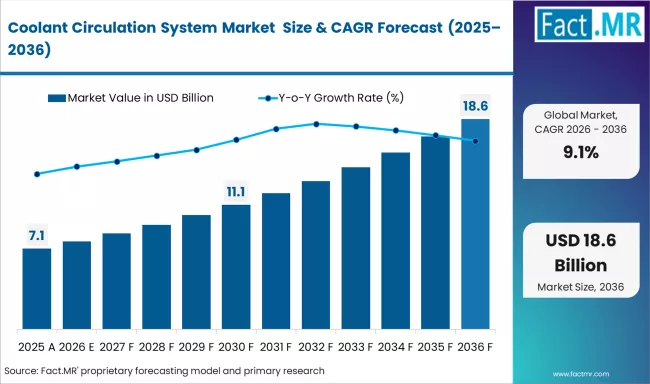
The coolant circulation system market was valued at USD 6.9 billion in 2025. The market is projected to reach USD 7.8 billion in 2026 and USD 18.7 billion by 2036, expanding at a CAGR of 9.1% during the forecast period. Battery electric vehicles are expected to lead vehicle type with a 48.4% share in 2026. Coolant pumps are projected to remain the leading component type with a 29.6% share in 2026. Battery thermal management is expected to lead application demand with a 43.8% share in 2026.
Key Drivers
- EV scaling: Rising electric-vehicle deployment is expanding the installed base of thermal loops and circulating components.
- Battery protection: Vehicles need stable coolant flow to hold battery temperature within safe operating windows.
- System integration: Higher electronic content per vehicle is increasing the need for coordinated cooling architecture.
Key Segments Analyzed in the Report
- Vehicle type: battery electric vehicles, hybrid electric vehicles, plug-in hybrid electric vehicles, fuel cell vehicles, and others
- Component type: coolant pumps, valves, hoses and connectors, reservoirs, heat exchangers, and others
- Application: battery thermal management, power electronics cooling, cabin-integrated thermal loop, e-axle and motor cooling, and others
- Region: North America, Latin America, Europe, Asia Pacific, and Middle East and Africa
Analyst Opinion
Shambhu Nath Jha, Principal Consultant, Fact.MR says, The winning suppliers in this market are the ones that fit more thermal function into each vehicle platform. Content per vehicle, integration skill, and control of flow efficiency are where value concentrates.
Coolant Circulation System Market Definition
The coolant circulation system market includes the pumps, valves, connectors, reservoirs, heat exchangers, control hardware, and fluid-routing assemblies used to circulate coolant across electrified vehicle thermal loops. It covers systems designed for battery packs, e-motors, inverters, cabin-linked thermal architectures, and fuel cell subsystems. These solutions serve passenger and commercial vehicle manufacturers, thermal-system integrators, and electrified mobility platforms seeking temperature stability, energy efficiency, and range protection.
Coolant Circulation System Market Inclusions
- Components and assemblies used to circulate coolant in electrified vehicle systems
- Revenue generated from pumps, valves, routing hardware, reservoirs, and related thermal-loop parts
- Demand across North America, Latin America, Europe, Asia Pacific, and Middle East and Africa
Coolant Circulation System Market Exclusions
- Standalone coolant fluids not sold as part of the circulation-system value pool
- Conventional combustion-engine cooling hardware except as a reference point
Coolant Circulation System Market Research Methodology
This study evaluates the coolant circulation system market across vehicle type, component type, application, and region, with 2025 as the base year and forecasts extending from 2026 to 2036. Market value is expressed in USD billion. The assessment incorporates electric-vehicle deployment data, automotive supplier disclosures, thermal-management product literature, and company statements on electrification strategy. Triangulation aligns EV volumes, thermal content per vehicle, supplier penetration, and platform-level cooling complexity to produce the market estimates. The IEA’s Global EV Outlook 2025 supports the broader demand case for electric mobility growth, while MAHLE, FORVIA, and Hanon Systems provide supplier-side evidence on thermal-management positioning and integrated cooling technologies.
Key Drivers, Restraints, and Trends in Coolant Circulation System Market
Drivers
Electric-vehicle adoption is expanding rapidly, and every additional battery-electric or hybrid platform adds thermal-management content. The IEA’s Global EV Outlook 2025 shows that electric car sales are expected to exceed 20 million in 2025, representing more than one-quarter of total car sales worldwide. That matters directly for coolant circulation systems because electrified platforms depend on tightly managed thermal loops to protect batteries, power electronics, motors, and increasingly integrated cabin systems. MAHLE continues to identify thermal management as a strategic field for future mobility, while FORVIA highlights expertise in battery and cooling-circuit thermal management. As architectures become more integrated, coolant circulation shifts from a supporting subsystem to a core performance enabler because poor flow design can reduce range, charging efficiency, and component durability.
Restraints
Vehicle-platform cycles can delay design wins and push out revenue timing. Cost pressure from automakers remains intense, especially in mass-market EV programs where every subsystem is scrutinized for efficiency and pricing discipline. Integration complexity also rises when multiple loops serve batteries, motors, inverters, and cabins together. Reliability standards are strict because pump or valve failure can affect core vehicle function. Regional EV slowdowns or uneven policy support can also create temporary order volatility even when long-term thermal-management demand remains intact.
Trends
The market is moving toward more integrated thermal architectures with fewer stand-alone subsystems. Suppliers are pushing for higher content per vehicle through combined modules, smarter flow control, and more compact packaging. MAHLE has continued to position thermal management as a core strategic area, and FORVIA’s mobility disclosures emphasize battery cooling and thermal-loop expertise. Hanon Systems’ 2025 AAPEX showcase also reinforces the shift toward complete-system thinking in thermal technologies. The competitive direction is clear: suppliers that can package circulation, sensing, and control into one coherent thermal-engineering offer are better positioned to gain share.
Segmental Analysis
Coolant Circulation System Market Analysis by Vehicle Type
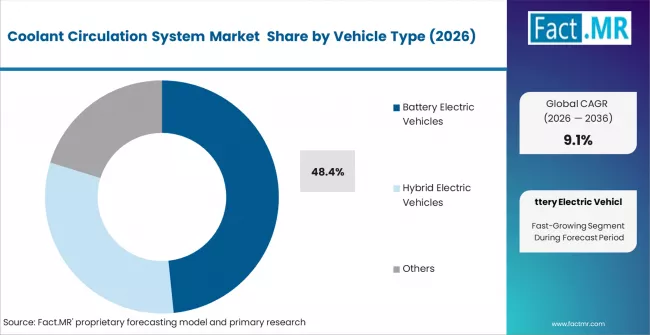
Battery electric vehicles are likely to hold 48.4% share in 2026 because they depend most heavily on active thermal control across battery packs, power electronics, and drive units. Unlike simpler hybrid layouts, BEVs carry more thermal hardware per platform and place tighter demands on coolant routing efficiency. This raises component intensity per vehicle and increases the strategic relevance of well-designed circulation systems. The IEA’s EV outlook supports the broader expansion of electric mobility, while supplier positioning from MAHLE reinforces the importance of thermal management in next-generation vehicle architectures. That is why BEVs lead the market not just in unit growth, but in system value intensity.
Coolant Circulation System Market Analysis by Component Type
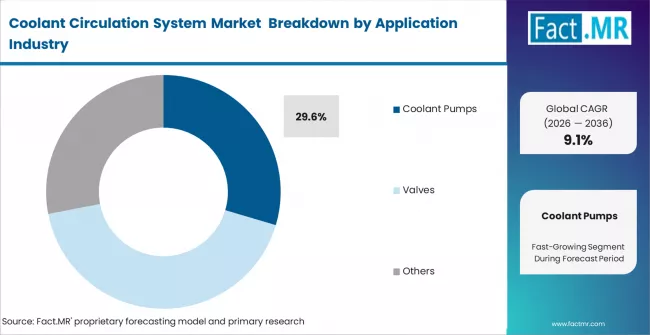
Coolant pumps are likely to account for 29.6% share in 2026 as they remain the active heart of circulation architecture. They perform the basic but critical task of moving coolant through battery plates, motor loops, and integrated thermal branches with controlled flow rates and energy efficiency. Pump count and sophistication can rise as loop architectures become more complex, especially in vehicles with tightly integrated battery, inverter, and cabin systems. Supplier messaging from MAHLE and Hanon Systems reinforces the direction of the market toward more advanced and coordinated thermal systems, which supports pump leadership within the component stack.
Coolant Circulation System Market Analysis by Application
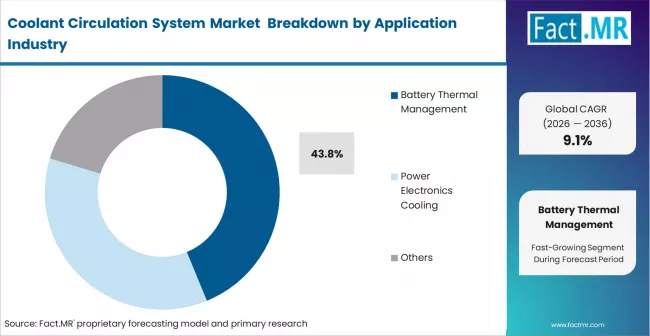
Battery thermal management is expected to lead application demand with a 43.8% share in 2026 because battery performance, charging stability, safety, and lifetime are all highly temperature sensitive. This makes battery cooling one of the most important thermal-control tasks in an electric vehicle. As pack energy density rises and charging expectations become more demanding, stable coolant circulation becomes even more important. Suppliers that can support efficient and compact battery-cooling architectures are therefore positioned to capture a disproportionate share of value as EV adoption expands.
Competitive Aligners for Market Players
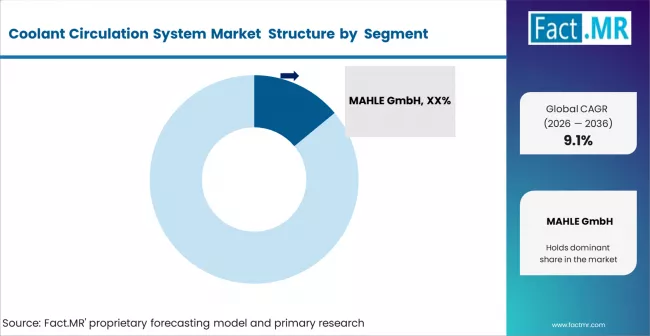
Buyers are looking for platform integration, low energy draw, durability, and the ability to fit multiple thermal functions into a compact system. MAHLE continues to present thermal management as a core strategic field, while FORVIA highlights cooling-circuit expertise for batteries, electric motors, and interiors. Hanon Systems has also signaled the commercial importance of integrated thermal technologies through its 2025 AAPEX showcase. Leadership is being built around module integration, control precision, and the ability to secure design slots early in EV platform development. The winning companies will be those that improve thermal efficiency without creating packaging penalties or unnecessary system complexity.
Key Players in Coolant Circulation System Market
- MAHLE GmbH
- Hanon Systems
- Valeo SE
- BorgWarner Inc.
- FORVIA SE
- Denso Corporation
- Robert Bosch GmbH
- Vitesco Technologies Group AG
- Modine Manufacturing Company
- Dana Incorporated
Strategic Outlook by Fact.MR on Coolant Circulation System Market
The market is shifting from discrete cooling parts toward tightly integrated thermal-loop systems for electrified mobility. Through 2036, value creation will depend on EV penetration, thermal integration complexity, and supplier ability to reduce energy losses inside the loop. Companies that can raise content per platform while maintaining reliability, packaging efficiency, and control performance will lead the market. The strategic center of gravity is moving away from individual parts and toward integrated thermal function.
Scope of the Report
| Metric | Value |
|---|---|
| Market Value | USD 6.9 billion in 2025 to USD 18.7 billion by 2036 |
| Estimated Market Size in 2026 | USD 7.8 billion |
| CAGR | 9.1% from 2026 to 2036 |
| Base Year | 2025 |
| Forecast Period | 2026 to 2036 |
| Vehicle Type Segmentation | Battery Electric Vehicles, Hybrid Electric Vehicles, Plug-in Hybrid Electric Vehicles, Fuel Cell Vehicles, Others |
| Component Type Segmentation | Coolant Pumps, Valves, Hoses and Connectors, Reservoirs, Heat Exchangers, Others |
| Application Segmentation | Battery Thermal Management, Power Electronics Cooling, Cabin-Integrated Thermal Loop, E-Axle and Motor Cooling, Others |
| Regions Covered | North America, Latin America, Europe, Asia Pacific, and Middle East and Africa |
Bibliography
- International Energy Agency. 2025. Global EV Outlook 2025.
- International Energy Agency. 2024. Outlook for battery and energy demand. In Global EV Outlook 2024.
- MAHLE GmbH. 2025. Sustainability Report 2024.
- FORVIA SE. 2024. Sustainability Report 2023.
- Hanon Systems. 2025. Hanon Systems Joins Hankook & Company Group to Showcase Thermal Management Technologies at AAPEX 2025.
Table of Content
- Executive Summary
- Global Market Outlook
- Demand to side Trends
- Supply to side Trends
- Technology Roadmap Analysis
- Analysis and Recommendations
- Market Overview
- Market Coverage / Taxonomy
- Market Definition / Scope / Limitations
- Research Methodology
- Chapter Orientation
- Analytical Lens and Working Hypotheses
- Market Structure, Signals, and Trend Drivers
- Benchmarking and Cross-market Comparability
- Market Sizing, Forecasting, and Opportunity Mapping
- Research Design and Evidence Framework
- Desk Research Programme (Secondary Evidence)
- Company Annual and Sustainability Reports
- Peer-reviewed Journals and Academic Literature
- Corporate Websites, Product Literature, and Technical Notes
- Earnings Decks and Investor Briefings
- Statutory Filings and Regulatory Disclosures
- Technical White Papers and Standards Notes
- Trade Journals, Industry Magazines, and Analyst Briefs
- Conference Proceedings, Webinars, and Seminar Materials
- Government Statistics Portals and Public Data Releases
- Press Releases and Reputable Media Coverage
- Specialist Newsletters and Curated Briefings
- Sector Databases and Reference Repositories
- Fact.MR Internal Proprietary Databases and Historical Market Datasets
- Subscription Datasets and Paid Sources
- Social Channels, Communities, and Digital Listening Inputs
- Additional Desk Sources
- Expert Input and Fieldwork (Primary Evidence)
- Primary Modes
- Qualitative Interviews and Expert Elicitation
- Quantitative Surveys and Structured Data Capture
- Blended Approach
- Why Primary Evidence is Used
- Field Techniques
- Interviews
- Surveys
- Focus Groups
- Observational and In-context Research
- Social and Community Interactions
- Stakeholder Universe Engaged
- C-suite Leaders
- Board Members
- Presidents and Vice Presidents
- R&D and Innovation Heads
- Technical Specialists
- Domain Subject-matter Experts
- Scientists
- Physicians and Other Healthcare Professionals
- Governance, Ethics, and Data Stewardship
- Research Ethics
- Data Integrity and Handling
- Primary Modes
- Tooling, Models, and Reference Databases
- Desk Research Programme (Secondary Evidence)
- Data Engineering and Model Build
- Data Acquisition and Ingestion
- Cleaning, Normalisation, and Verification
- Synthesis, Triangulation, and Analysis
- Quality Assurance and Audit Trail
- Market Background
- Market Dynamics
- Drivers
- Restraints
- Opportunity
- Trends
- Scenario Forecast
- Demand in Optimistic Scenario
- Demand in Likely Scenario
- Demand in Conservative Scenario
- Opportunity Map Analysis
- Product Life Cycle Analysis
- Supply Chain Analysis
- Investment Feasibility Matrix
- Value Chain Analysis
- PESTLE and Porter’s Analysis
- Regulatory Landscape
- Regional Parent Market Outlook
- Production and Consumption Statistics
- Import and Export Statistics
- Market Dynamics
- Global Market Analysis 2021 to 2025 and Forecast, 2026 to 2036
- Historical Market Size Value (USD Million) Analysis, 2021 to 2025
- Current and Future Market Size Value (USD Million) Projections, 2026 to 2036
- Y to o to Y Growth Trend Analysis
- Absolute $ Opportunity Analysis
- Global Market Pricing Analysis 2021 to 2025 and Forecast 2026 to 2036
- Global Market Analysis 2021 to 2025 and Forecast 2026 to 2036, By Vehicle Type
- Introduction / Key Findings
- Historical Market Size Value (USD Million) Analysis By Vehicle Type, 2021 to 2025
- Current and Future Market Size Value (USD Million) Analysis and Forecast By Vehicle Type, 2026 to 2036
- Battery Electric Vehicles
- Hybrid Electric Vehicles
- Others
- Battery Electric Vehicles
- Y to o to Y Growth Trend Analysis By Vehicle Type, 2021 to 2025
- Absolute $ Opportunity Analysis By Vehicle Type, 2026 to 2036
- Global Market Analysis 2021 to 2025 and Forecast 2026 to 2036, By Component Type
- Introduction / Key Findings
- Historical Market Size Value (USD Million) Analysis By Component Type, 2021 to 2025
- Current and Future Market Size Value (USD Million) Analysis and Forecast By Component Type, 2026 to 2036
- Coolant Pumps
- Valves
- Others
- Coolant Pumps
- Y to o to Y Growth Trend Analysis By Component Type, 2021 to 2025
- Absolute $ Opportunity Analysis By Component Type, 2026 to 2036
- Global Market Analysis 2021 to 2025 and Forecast 2026 to 2036, By Application
- Introduction / Key Findings
- Historical Market Size Value (USD Million) Analysis By Application, 2021 to 2025
- Current and Future Market Size Value (USD Million) Analysis and Forecast By Application, 2026 to 2036
- Battery Thermal Management
- Power Electronics Cooling
- Others
- Battery Thermal Management
- Y to o to Y Growth Trend Analysis By Application, 2021 to 2025
- Absolute $ Opportunity Analysis By Application, 2026 to 2036
- Global Market Analysis 2021 to 2025 and Forecast 2026 to 2036, By Region
- Introduction
- Historical Market Size Value (USD Million) Analysis By Region, 2021 to 2025
- Current Market Size Value (USD Million) Analysis and Forecast By Region, 2026 to 2036
- North America
- Latin America
- Western Europe
- Eastern Europe
- East Asia
- South Asia and Pacific
- Middle East & Africa
- Market Attractiveness Analysis By Region
- North America Market Analysis 2021 to 2025 and Forecast 2026 to 2036, By Country
- Historical Market Size Value (USD Million) Trend Analysis By Market Taxonomy, 2021 to 2025
- Market Size Value (USD Million) Forecast By Market Taxonomy, 2026 to 2036
- By Country
- USA
- Canada
- Mexico
- By Vehicle Type
- By Component Type
- By Application
- By Country
- Market Attractiveness Analysis
- By Country
- By Vehicle Type
- By Component Type
- By Application
- Key Takeaways
- Latin America Market Analysis 2021 to 2025 and Forecast 2026 to 2036, By Country
- Historical Market Size Value (USD Million) Trend Analysis By Market Taxonomy, 2021 to 2025
- Market Size Value (USD Million) Forecast By Market Taxonomy, 2026 to 2036
- By Country
- Brazil
- Chile
- Rest of Latin America
- By Vehicle Type
- By Component Type
- By Application
- By Country
- Market Attractiveness Analysis
- By Country
- By Vehicle Type
- By Component Type
- By Application
- Key Takeaways
- Western Europe Market Analysis 2021 to 2025 and Forecast 2026 to 2036, By Country
- Historical Market Size Value (USD Million) Trend Analysis By Market Taxonomy, 2021 to 2025
- Market Size Value (USD Million) Forecast By Market Taxonomy, 2026 to 2036
- By Country
- Germany
- UK
- Italy
- Spain
- France
- Nordic
- BENELUX
- Rest of Western Europe
- By Vehicle Type
- By Component Type
- By Application
- By Country
- Market Attractiveness Analysis
- By Country
- By Vehicle Type
- By Component Type
- By Application
- Key Takeaways
- Eastern Europe Market Analysis 2021 to 2025 and Forecast 2026 to 2036, By Country
- Historical Market Size Value (USD Million) Trend Analysis By Market Taxonomy, 2021 to 2025
- Market Size Value (USD Million) Forecast By Market Taxonomy, 2026 to 2036
- By Country
- Russia
- Poland
- Hungary
- Balkan & Baltic
- Rest of Eastern Europe
- By Vehicle Type
- By Component Type
- By Application
- By Country
- Market Attractiveness Analysis
- By Country
- By Vehicle Type
- By Component Type
- By Application
- Key Takeaways
- East Asia Market Analysis 2021 to 2025 and Forecast 2026 to 2036, By Country
- Historical Market Size Value (USD Million) Trend Analysis By Market Taxonomy, 2021 to 2025
- Market Size Value (USD Million) Forecast By Market Taxonomy, 2026 to 2036
- By Country
- China
- Japan
- South Korea
- By Vehicle Type
- By Component Type
- By Application
- By Country
- Market Attractiveness Analysis
- By Country
- By Vehicle Type
- By Component Type
- By Application
- Key Takeaways
- South Asia and Pacific Market Analysis 2021 to 2025 and Forecast 2026 to 2036, By Country
- Historical Market Size Value (USD Million) Trend Analysis By Market Taxonomy, 2021 to 2025
- Market Size Value (USD Million) Forecast By Market Taxonomy, 2026 to 2036
- By Country
- India
- ASEAN
- Australia & New Zealand
- Rest of South Asia and Pacific
- By Vehicle Type
- By Component Type
- By Application
- By Country
- Market Attractiveness Analysis
- By Country
- By Vehicle Type
- By Component Type
- By Application
- Key Takeaways
- Middle East & Africa Market Analysis 2021 to 2025 and Forecast 2026 to 2036, By Country
- Historical Market Size Value (USD Million) Trend Analysis By Market Taxonomy, 2021 to 2025
- Market Size Value (USD Million) Forecast By Market Taxonomy, 2026 to 2036
- By Country
- Kingdom of Saudi Arabia
- Other GCC Countries
- Turkiye
- South Africa
- Other African Union
- Rest of Middle East & Africa
- By Vehicle Type
- By Component Type
- By Application
- By Country
- Market Attractiveness Analysis
- By Country
- By Vehicle Type
- By Component Type
- By Application
- Key Takeaways
- Key Countries Market Analysis
- USA
- Pricing Analysis
- Market Share Analysis, 2025
- By Vehicle Type
- By Component Type
- By Application
- Canada
- Pricing Analysis
- Market Share Analysis, 2025
- By Vehicle Type
- By Component Type
- By Application
- Mexico
- Pricing Analysis
- Market Share Analysis, 2025
- By Vehicle Type
- By Component Type
- By Application
- Brazil
- Pricing Analysis
- Market Share Analysis, 2025
- By Vehicle Type
- By Component Type
- By Application
- Chile
- Pricing Analysis
- Market Share Analysis, 2025
- By Vehicle Type
- By Component Type
- By Application
- Germany
- Pricing Analysis
- Market Share Analysis, 2025
- By Vehicle Type
- By Component Type
- By Application
- UK
- Pricing Analysis
- Market Share Analysis, 2025
- By Vehicle Type
- By Component Type
- By Application
- Italy
- Pricing Analysis
- Market Share Analysis, 2025
- By Vehicle Type
- By Component Type
- By Application
- Spain
- Pricing Analysis
- Market Share Analysis, 2025
- By Vehicle Type
- By Component Type
- By Application
- France
- Pricing Analysis
- Market Share Analysis, 2025
- By Vehicle Type
- By Component Type
- By Application
- India
- Pricing Analysis
- Market Share Analysis, 2025
- By Vehicle Type
- By Component Type
- By Application
- ASEAN
- Pricing Analysis
- Market Share Analysis, 2025
- By Vehicle Type
- By Component Type
- By Application
- Australia & New Zealand
- Pricing Analysis
- Market Share Analysis, 2025
- By Vehicle Type
- By Component Type
- By Application
- China
- Pricing Analysis
- Market Share Analysis, 2025
- By Vehicle Type
- By Component Type
- By Application
- Japan
- Pricing Analysis
- Market Share Analysis, 2025
- By Vehicle Type
- By Component Type
- By Application
- South Korea
- Pricing Analysis
- Market Share Analysis, 2025
- By Vehicle Type
- By Component Type
- By Application
- Russia
- Pricing Analysis
- Market Share Analysis, 2025
- By Vehicle Type
- By Component Type
- By Application
- Poland
- Pricing Analysis
- Market Share Analysis, 2025
- By Vehicle Type
- By Component Type
- By Application
- Hungary
- Pricing Analysis
- Market Share Analysis, 2025
- By Vehicle Type
- By Component Type
- By Application
- Kingdom of Saudi Arabia
- Pricing Analysis
- Market Share Analysis, 2025
- By Vehicle Type
- By Component Type
- By Application
- Turkiye
- Pricing Analysis
- Market Share Analysis, 2025
- By Vehicle Type
- By Component Type
- By Application
- South Africa
- Pricing Analysis
- Market Share Analysis, 2025
- By Vehicle Type
- By Component Type
- By Application
- USA
- Market Structure Analysis
- Competition Dashboard
- Competition Benchmarking
- Market Share Analysis of Top Players
- By Regional
- By Vehicle Type
- By Component Type
- By Application
- Competition Analysis
- Competition Deep Dive
- MAHLE GmbH
- Overview
- Product Portfolio
- Profitability by Market Segments (Product/Age /Sales Channel/Region)
- Sales Footprint
- Strategy Overview
- Marketing Strategy
- Product Strategy
- Channel Strategy
- Hanon Systems
- Valeo SE
- BorgWarner Inc.
- FORVIA SE
- Denso Corporation
- Robert Bosch GmbH
- MAHLE GmbH
- Competition Deep Dive
- Assumptions & Acronyms Used
List Of Table
- Table 1: Global Market Value (USD Million) Forecast by Region, 2021 to 2036
- Table 2: Global Market Value (USD Million) Forecast by Vehicle Type, 2021 to 2036
- Table 3: Global Market Value (USD Million) Forecast by Component Type, 2021 to 2036
- Table 4: Global Market Value (USD Million) Forecast by Application, 2021 to 2036
- Table 5: North America Market Value (USD Million) Forecast by Country, 2021 to 2036
- Table 6: North America Market Value (USD Million) Forecast by Vehicle Type, 2021 to 2036
- Table 7: North America Market Value (USD Million) Forecast by Component Type, 2021 to 2036
- Table 8: North America Market Value (USD Million) Forecast by Application, 2021 to 2036
- Table 9: Latin America Market Value (USD Million) Forecast by Country, 2021 to 2036
- Table 10: Latin America Market Value (USD Million) Forecast by Vehicle Type, 2021 to 2036
- Table 11: Latin America Market Value (USD Million) Forecast by Component Type, 2021 to 2036
- Table 12: Latin America Market Value (USD Million) Forecast by Application, 2021 to 2036
- Table 13: Western Europe Market Value (USD Million) Forecast by Country, 2021 to 2036
- Table 14: Western Europe Market Value (USD Million) Forecast by Vehicle Type, 2021 to 2036
- Table 15: Western Europe Market Value (USD Million) Forecast by Component Type, 2021 to 2036
- Table 16: Western Europe Market Value (USD Million) Forecast by Application, 2021 to 2036
- Table 17: Eastern Europe Market Value (USD Million) Forecast by Country, 2021 to 2036
- Table 18: Eastern Europe Market Value (USD Million) Forecast by Vehicle Type, 2021 to 2036
- Table 19: Eastern Europe Market Value (USD Million) Forecast by Component Type, 2021 to 2036
- Table 20: Eastern Europe Market Value (USD Million) Forecast by Application, 2021 to 2036
- Table 21: East Asia Market Value (USD Million) Forecast by Country, 2021 to 2036
- Table 22: East Asia Market Value (USD Million) Forecast by Vehicle Type, 2021 to 2036
- Table 23: East Asia Market Value (USD Million) Forecast by Component Type, 2021 to 2036
- Table 24: East Asia Market Value (USD Million) Forecast by Application, 2021 to 2036
- Table 25: South Asia and Pacific Market Value (USD Million) Forecast by Country, 2021 to 2036
- Table 26: South Asia and Pacific Market Value (USD Million) Forecast by Vehicle Type, 2021 to 2036
- Table 27: South Asia and Pacific Market Value (USD Million) Forecast by Component Type, 2021 to 2036
- Table 28: South Asia and Pacific Market Value (USD Million) Forecast by Application, 2021 to 2036
- Table 29: Middle East & Africa Market Value (USD Million) Forecast by Country, 2021 to 2036
- Table 30: Middle East & Africa Market Value (USD Million) Forecast by Vehicle Type, 2021 to 2036
- Table 31: Middle East & Africa Market Value (USD Million) Forecast by Component Type, 2021 to 2036
- Table 32: Middle East & Africa Market Value (USD Million) Forecast by Application, 2021 to 2036
List Of Figures
- Figure 1: Global Market Pricing Analysis
- Figure 2: Global Market Value (USD Million) Forecast 2021 to 2036
- Figure 3: Global Market Value Share and BPS Analysis by Vehicle Type, 2026 and 2036
- Figure 4: Global Market Y-o-Y Growth Comparison by Vehicle Type, 2026 to 2036
- Figure 5: Global Market Attractiveness Analysis by Vehicle Type
- Figure 6: Global Market Value Share and BPS Analysis by Component Type, 2026 and 2036
- Figure 7: Global Market Y-o-Y Growth Comparison by Component Type, 2026 to 2036
- Figure 8: Global Market Attractiveness Analysis by Component Type
- Figure 9: Global Market Value Share and BPS Analysis by Application, 2026 and 2036
- Figure 10: Global Market Y-o-Y Growth Comparison by Application, 2026 to 2036
- Figure 11: Global Market Attractiveness Analysis by Application
- Figure 12: Global Market Value (USD Million) Share and BPS Analysis by Region, 2026 and 2036
- Figure 13: Global Market Y-o-Y Growth Comparison by Region, 2026 to 2036
- Figure 14: Global Market Attractiveness Analysis by Region
- Figure 15: North America Market Incremental Dollar Opportunity, 2026 to 2036
- Figure 16: Latin America Market Incremental Dollar Opportunity, 2026 to 2036
- Figure 17: Western Europe Market Incremental Dollar Opportunity, 2026 to 2036
- Figure 18: Eastern Europe Market Incremental Dollar Opportunity, 2026 to 2036
- Figure 19: East Asia Market Incremental Dollar Opportunity, 2026 to 2036
- Figure 20: South Asia and Pacific Market Incremental Dollar Opportunity, 2026 to 2036
- Figure 21: Middle East & Africa Market Incremental Dollar Opportunity, 2026 to 2036
- Figure 22: North America Market Value Share and BPS Analysis by Country, 2026 and 2036
- Figure 23: North America Market Value Share and BPS Analysis by Vehicle Type, 2026 and 2036
- Figure 24: North America Market Y-o-Y Growth Comparison by Vehicle Type, 2026 to 2036
- Figure 25: North America Market Attractiveness Analysis by Vehicle Type
- Figure 26: North America Market Value Share and BPS Analysis by Component Type, 2026 and 2036
- Figure 27: North America Market Y-o-Y Growth Comparison by Component Type, 2026 to 2036
- Figure 28: North America Market Attractiveness Analysis by Component Type
- Figure 29: North America Market Value Share and BPS Analysis by Application, 2026 and 2036
- Figure 30: North America Market Y-o-Y Growth Comparison by Application, 2026 to 2036
- Figure 31: North America Market Attractiveness Analysis by Application
- Figure 32: Latin America Market Value Share and BPS Analysis by Country, 2026 and 2036
- Figure 33: Latin America Market Value Share and BPS Analysis by Vehicle Type, 2026 and 2036
- Figure 34: Latin America Market Y-o-Y Growth Comparison by Vehicle Type, 2026 to 2036
- Figure 35: Latin America Market Attractiveness Analysis by Vehicle Type
- Figure 36: Latin America Market Value Share and BPS Analysis by Component Type, 2026 and 2036
- Figure 37: Latin America Market Y-o-Y Growth Comparison by Component Type, 2026 to 2036
- Figure 38: Latin America Market Attractiveness Analysis by Component Type
- Figure 39: Latin America Market Value Share and BPS Analysis by Application, 2026 and 2036
- Figure 40: Latin America Market Y-o-Y Growth Comparison by Application, 2026 to 2036
- Figure 41: Latin America Market Attractiveness Analysis by Application
- Figure 42: Western Europe Market Value Share and BPS Analysis by Country, 2026 and 2036
- Figure 43: Western Europe Market Value Share and BPS Analysis by Vehicle Type, 2026 and 2036
- Figure 44: Western Europe Market Y-o-Y Growth Comparison by Vehicle Type, 2026 to 2036
- Figure 45: Western Europe Market Attractiveness Analysis by Vehicle Type
- Figure 46: Western Europe Market Value Share and BPS Analysis by Component Type, 2026 and 2036
- Figure 47: Western Europe Market Y-o-Y Growth Comparison by Component Type, 2026 to 2036
- Figure 48: Western Europe Market Attractiveness Analysis by Component Type
- Figure 49: Western Europe Market Value Share and BPS Analysis by Application, 2026 and 2036
- Figure 50: Western Europe Market Y-o-Y Growth Comparison by Application, 2026 to 2036
- Figure 51: Western Europe Market Attractiveness Analysis by Application
- Figure 52: Eastern Europe Market Value Share and BPS Analysis by Country, 2026 and 2036
- Figure 53: Eastern Europe Market Value Share and BPS Analysis by Vehicle Type, 2026 and 2036
- Figure 54: Eastern Europe Market Y-o-Y Growth Comparison by Vehicle Type, 2026 to 2036
- Figure 55: Eastern Europe Market Attractiveness Analysis by Vehicle Type
- Figure 56: Eastern Europe Market Value Share and BPS Analysis by Component Type, 2026 and 2036
- Figure 57: Eastern Europe Market Y-o-Y Growth Comparison by Component Type, 2026 to 2036
- Figure 58: Eastern Europe Market Attractiveness Analysis by Component Type
- Figure 59: Eastern Europe Market Value Share and BPS Analysis by Application, 2026 and 2036
- Figure 60: Eastern Europe Market Y-o-Y Growth Comparison by Application, 2026 to 2036
- Figure 61: Eastern Europe Market Attractiveness Analysis by Application
- Figure 62: East Asia Market Value Share and BPS Analysis by Country, 2026 and 2036
- Figure 63: East Asia Market Value Share and BPS Analysis by Vehicle Type, 2026 and 2036
- Figure 64: East Asia Market Y-o-Y Growth Comparison by Vehicle Type, 2026 to 2036
- Figure 65: East Asia Market Attractiveness Analysis by Vehicle Type
- Figure 66: East Asia Market Value Share and BPS Analysis by Component Type, 2026 and 2036
- Figure 67: East Asia Market Y-o-Y Growth Comparison by Component Type, 2026 to 2036
- Figure 68: East Asia Market Attractiveness Analysis by Component Type
- Figure 69: East Asia Market Value Share and BPS Analysis by Application, 2026 and 2036
- Figure 70: East Asia Market Y-o-Y Growth Comparison by Application, 2026 to 2036
- Figure 71: East Asia Market Attractiveness Analysis by Application
- Figure 72: South Asia and Pacific Market Value Share and BPS Analysis by Country, 2026 and 2036
- Figure 73: South Asia and Pacific Market Value Share and BPS Analysis by Vehicle Type, 2026 and 2036
- Figure 74: South Asia and Pacific Market Y-o-Y Growth Comparison by Vehicle Type, 2026 to 2036
- Figure 75: South Asia and Pacific Market Attractiveness Analysis by Vehicle Type
- Figure 76: South Asia and Pacific Market Value Share and BPS Analysis by Component Type, 2026 and 2036
- Figure 77: South Asia and Pacific Market Y-o-Y Growth Comparison by Component Type, 2026 to 2036
- Figure 78: South Asia and Pacific Market Attractiveness Analysis by Component Type
- Figure 79: South Asia and Pacific Market Value Share and BPS Analysis by Application, 2026 and 2036
- Figure 80: South Asia and Pacific Market Y-o-Y Growth Comparison by Application, 2026 to 2036
- Figure 81: South Asia and Pacific Market Attractiveness Analysis by Application
- Figure 82: Middle East & Africa Market Value Share and BPS Analysis by Country, 2026 and 2036
- Figure 83: Middle East & Africa Market Value Share and BPS Analysis by Vehicle Type, 2026 and 2036
- Figure 84: Middle East & Africa Market Y-o-Y Growth Comparison by Vehicle Type, 2026 to 2036
- Figure 85: Middle East & Africa Market Attractiveness Analysis by Vehicle Type
- Figure 86: Middle East & Africa Market Value Share and BPS Analysis by Component Type, 2026 and 2036
- Figure 87: Middle East & Africa Market Y-o-Y Growth Comparison by Component Type, 2026 to 2036
- Figure 88: Middle East & Africa Market Attractiveness Analysis by Component Type
- Figure 89: Middle East & Africa Market Value Share and BPS Analysis by Application, 2026 and 2036
- Figure 90: Middle East & Africa Market Y-o-Y Growth Comparison by Application, 2026 to 2036
- Figure 91: Middle East & Africa Market Attractiveness Analysis by Application
- Figure 92: Global Market - Tier Structure Analysis
- Figure 93: Global Market - Company Share Analysis
- FAQs -
What is the projected size of the Coolant Circulation System Market by 2036?
The Coolant Circulation System Market is projected to reach USD 18.7 billion by 2036.
What is the CAGR of the Coolant Circulation System Market from 2026 to 2036?
The Coolant Circulation System Market is expected to grow at a CAGR of 9.1% during the forecast period.
Which vehicle type leads the Coolant Circulation System Market in 2026?
Battery electric vehicles are expected to lead the Coolant Circulation System Market in 2026 with a 48.4% share.
Which component type dominates the Coolant Circulation System Market?
Coolant pumps are projected to remain the leading component type in the Coolant Circulation System Market with a 29.6% share in 2026.
Which application leads the Coolant Circulation System Market in 2026?
Battery thermal management is expected to lead the Coolant Circulation System Market in 2026 with a 43.8% share.
What is driving growth in the Coolant Circulation System Market?
Growth in the Coolant Circulation System Market is being driven by EV scaling, battery protection needs, and rising demand for integrated thermal management systems.