- Market Value (2025): USD 149.8 Mn
- Estimated Value (2026): USD 162.0 Mn
- Forecast Value (2036): USD 355.0 Mn
- CAGR (2026-2036): 8.2%
What is the High-Pressure Glass Autoclaves Market forecast to be worth by 2036?
USD 162 million in 2026 to USD 355 million by 2036, at 8.2% CAGR.
- The market stood at roughly USD 149.8 million in 2025 as academic, pharmaceutical and chemical laboratories continued to invest in visible high-pressure reaction equipment.
- Revenue is projected to grow from USD 162.0 million in 2026 to USD 355.0 million by 2036 as catalysis, hydrogenation and hydrothermal research programs expand with public and private R&D funding.
- An 8.2% CAGR from 2026 to 2036 is supported by rising global research budgets, the spread of high-throughput screening into pressurized chemistry, and replacement cycles for certified pressure equipment.
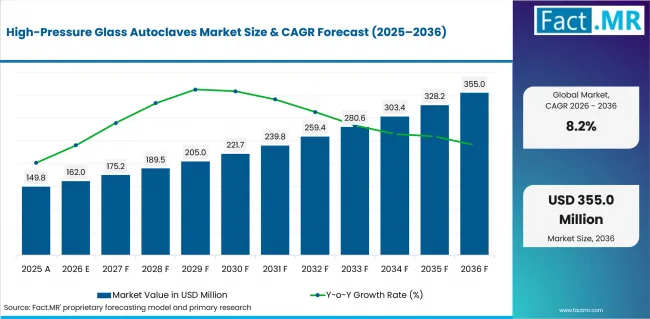
High Pressure Glass Autoclaves Market Value Analysis | Source: Fact.MR
What are the defining numbers behind High-Pressure Glass Autoclaves Market growth?
USD 193 million absolute opportunity by 2036, led by Borosilicate glass autoclaves and the 20-60 bar rating within their respective segments.
- Demand Drivers in the Market
- Pacific Northwest National Laboratory’s hydrothermal liquefaction research, funded by the U.S. Department of Energy’s Bioenergy Technologies Office, works at 347 degrees C and around 3,000 psi in subcritical water, exactly the regime where researchers use windowed and glass vessels to observe phase behavior before scaling.
- University teams publishing hydrothermal and catalytic studies in venues such as Nature Sustainability rely on small pressurized reactors to develop processes like wet-waste-to-fuel conversion, sustaining a steady academic replacement and expansion market.
- Green chemistry and process intensification agendas at national research agencies push laboratories to study reactions under pressure with direct observation, from supercritical processing to catalysis mechanism work.
- Key Segments Analyzed
- By Vessel Type: Borosilicate glass autoclaves lead at 37.2% of 2026 demand because they give full 360-degree visibility at moderate pressure and temperature with the lowest cost of ownership, which is why they are the default first purchase for catalysis and hydrogenation teaching and research groups.
- By Pressure Rating: The 20-60 bar band holds 29.0% of demand as the practical sweet spot for hydrogenation and catalytic screening, high enough to drive gas-liquid reactions meaningfully, low enough to keep glass and closure engineering manageable and certification straightforward.
- By Application: Catalysis research accounts for 39.0% of application demand because catalyst development programs run hundreds of pressurized screening experiments per candidate, and visual observation of gas dispersion, foaming and phase separation informs catalyst selection in ways that pressure traces alone cannot.
- By Volume Class: Below 100 mL autoclaves support screening where sample availability limits batch size. Larger classes support method development and pilot work when experiments need more representative charge volumes.
- By End User: Academic laboratories hold 41.0% of end user demand, reflecting the breadth of university chemistry and chemical engineering departments equipped with bench autoclaves, while pharmaceutical R&D at 37.0% buys higher-specification units with data logging and containment features.
- Analyst Opinion at Fact.MR
- Shambhu Nath Jha, Sr. Consultant at Fact.MR, states, “The glass autoclave is not competing with steel on pressure. It is competing with inference. When a research group can see gas dispersion or crystal nucleation directly, it shortens the path from hypothesis to mechanism. The buyers I speak with will compromise on volume before they compromise on sight, and that preference is remarkably stable across academic and industrial labs.”
- Strategic Implications
- Suppliers should publish witnessed pressure test documentation and burst margins for every vessel type, since laboratory safety officers increasingly gate purchases on certification files.
- Pharmaceutical buyers benefit from standardizing closure and stirring interfaces across vessel sizes, cutting validation effort when methods transfer between scales.
- Academic purchasers should evaluate sapphire-window options for the highest-pressure work rather than stretching borosilicate designs beyond their certified envelope.
- Vendors can build recurring revenue through certified inspection, re-testing and seal replacement programs, which pressure equipment rules effectively require.
Buchi’s limbo and kiloclave lines combine glass and glass-lined pressure vessels with certified sight glasses and standardized closures for laboratory reaction work. The pairing of visibility with documented pressure ratings across vessel sizes shows how the market expects observation and certification to arrive in the same package.
The United States is positioned for 8.8% annual growth from 2026 to 2036 on national laboratory and pharmaceutical research investment. Germany is projected to grow at 8.4% on chemical research strength. The United Kingdom follows at 8.1% on academic chemistry funding, Japan advances at 7.9% on applied catalysis programs.
How does the High-Pressure Glass Autoclaves Market break down by segment?
The leading shares are Borosilicate glass autoclaves at 37.2% by Vessel Type and Catalysis research at 39.0% by Application.
Why do borosilicate glass autoclaves lead the vessel mix?
At 37.2% share in 2026, borosilicate glass autoclaves lead because they deliver full visibility at useful pressure with the lowest cost and the simplest maintenance.
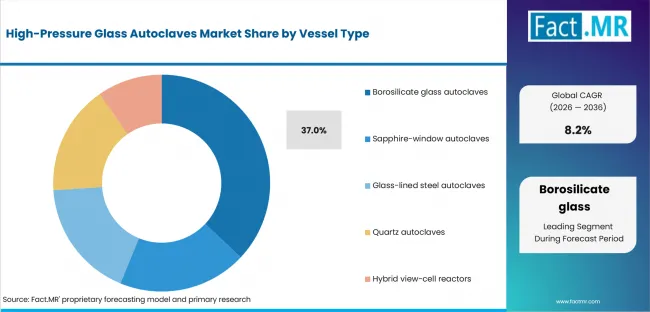
High Pressure Glass Autoclaves Market Analysis By Vessel Type | Source: Fact.MR
Borosilicate glass autoclaves account for 37.2% of demand because most laboratory pressure work sits within the ratings borosilicate can carry, and full circumferential visibility beats windowed designs for observing mixing and phase behavior. Sapphire-window autoclaves suit higher-pressure observation, glass-lined steel autoclaves address corrosion-resistant duties, quartz autoclaves support specialist thermal applications, and hybrid view-cell reactors combine pressure capability with focused visual access.
Why does the 20-60 bar band capture the largest share?
A 29.0% share puts the 20-60 bar rating first in 2026 because it covers the working range of most hydrogenation and catalytic screening without extreme engineering.
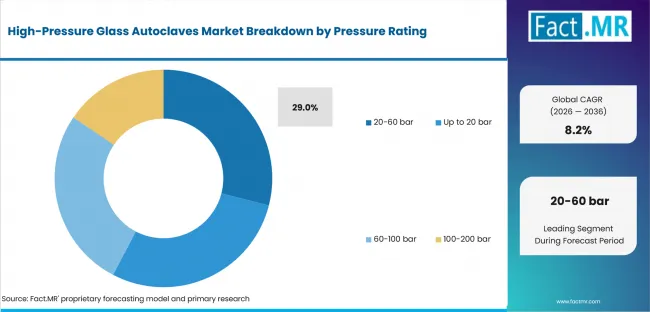
High Pressure Glass Autoclaves Market Analysis By Pressure Rating | Source: Fact.MR
The 20-60 bar band represents 29.0% of demand because typical laboratory hydrogenation runs in this window, and certification, sealing and sight-glass design are all manageable here. Lower-pressure systems suit routine screening, while the 60-100 bar and 100-200 bar ranges serve experiments that require greater reaction severity and more stringent vessel engineering.
Why does catalysis research lead the application group?
The 2026 leader is catalysis research at 39.0% share because catalyst development multiplies pressurized experiments per program more than any other laboratory discipline.
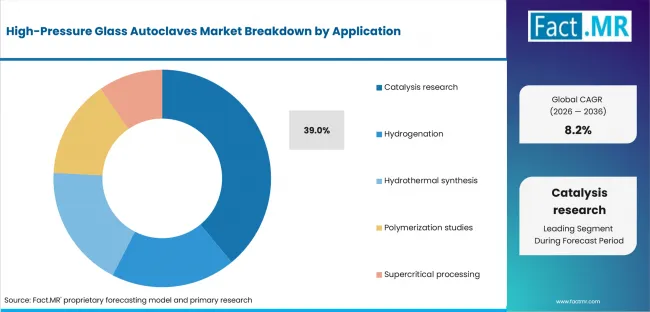
High Pressure Glass Autoclaves Market Analysis By Application | Source: Fact.MR
Catalysis research accounts for 39.0% of application demand because screening a catalyst family means running many pressurized reactions across temperature, pressure and gas composition, and visible reactors help researchers interpret gas-liquid behavior directly. Hydrogenation remains a defined reaction class across pharmaceutical and fine-chemical work. Hydrothermal synthesis, polymerization studies, and supercritical processing each require reactor configurations suited to their specific temperature, pressure, and observation needs.
How does volume class affect autoclave selection?
Vessel volume must match both sample availability and the heat and pressure control required for the experiment.
Below 100 mL units suit high-throughput screening and studies with limited material. The 100-500 mL class supports method development with larger reaction charges. Volumes from 0.5-2 L provide more representative conditions for scale-up work, while 2-5 L systems serve pilot studies that require greater throughput.
Why do academic laboratories lead the end user group?
The leading 2026 share is 41.0% for academic labs because nearly every university chemistry and chemical engineering department operates bench pressure reactors.
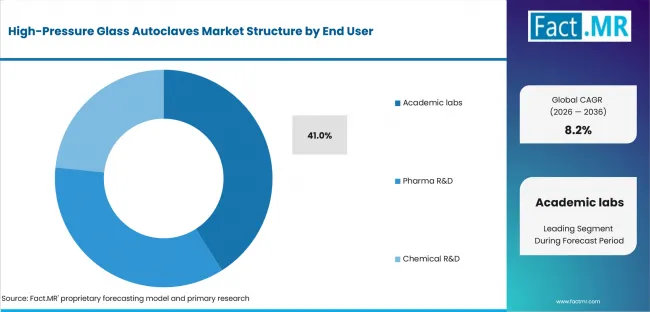
High Pressure Glass Autoclaves Market Analysis By End User | Source: Fact.MR
Academic laboratories represent 41.0% of demand because publicly funded research, which the OECD totals in the tens of billions of dollars annually, equips thousands of university groups with bench autoclaves and replaces them on steady cycles. Pharmaceutical R&D uses higher-specification units for controlled reaction work, while chemical R&D applies visual pressure reactors to process development and materials studies.
What is accelerating High-Pressure Glass Autoclaves Market adoption, and what is holding it back?
The principal accelerator is sustained growth in public and private research funding that equips catalysis, hydrogenation and hydrothermal programs. Adoption is slowed by pressure certification cost, safety-case conservatism toward glass under pressure, and competition from steel reactors fitted with sight glasses.
Drivers Impact Analysis
| DRIVER | (~) % IMPACT ON CAGR | GEOGRAPHIC RELEVANCE | IMPACT TIMELINE |
|---|---|---|---|
| Pharmaceutical R&D expansion | +1.3% | United States, Europe | Long term (>= 4 years) |
| Public research budgets | +1.1% | OECD countries | Medium term (2-4 years) |
| Hydrothermal and waste-to-fuel research | +0.9% | United States, Europe | Medium term (2-4 years) |
| High-throughput pressurized screening | +0.8% | Pharma and catalyst hubs | Short term (<= 2 years) |
| Green chemistry programs | +0.6% | Global | Long term (>= 4 years) |
Source: Fact.MR analysis. Updated Jul 24, 2026
- Pharmaceutical R&D expansion: OECD data show industry R&D spending up 76% in real terms since 2010 and Chinese pharmaceutical research spending up 365% in the same period. New chemistry groups being equipped on that spending need pressurized reactors, and visible vessels are standard purchases.
- Public research budgets: Government health-related R&D budgets of USD 73 billion across OECD countries flow substantially into university laboratories, whose procurement cycles replace and expand bench autoclave fleets.
- Hydrothermal and waste-to-fuel research: DOE-funded work at Pacific Northwest National Laboratory and university teams converts wet wastes to fuels in subcritical water near 347 degrees C and 3,000 psi. Process development in that regime depends on small windowed reactors to observe phase behavior before continuous pilot rigs are built.
Opportunity Impact Analysis
| OPPORTUNITY | (~) % IMPACT ON CAGR | GEOGRAPHIC RELEVANCE | IMPACT TIMELINE |
|---|---|---|---|
| Certified inspection services | +0.5% | Global installed base | Short term (<= 2 years) |
| Camera-integrated vessels | +0.4% | Pharma and academic labs | Medium term (2-4 years) |
| Supercritical CO2 research kits | +0.4% | Green chemistry groups | Long term (>= 4 years) |
| Teaching-lab bundles | +0.3% | Universities in Asia | Medium term (2-4 years) |
Source: Fact.MR analysis. Updated Jul 24, 2026
- Certified inspection services: Pressure equipment rules require periodic inspection and re-testing. Vendors offering certified inspection and seal replacement turn a regulatory obligation into recurring revenue.
- Camera-integrated vessels: Recording reactions through the glass with synchronized sensor data lets researchers correlate visual events with pressure and temperature traces, a feature pharmaceutical and academic groups increasingly request.
- Teaching-lab bundles: Asian universities expanding chemical engineering programs buy multiple identical bench units. Bundles with training, spares and certification files fit their procurement patterns.
Restraints Impact Analysis
| RESTRAINT | (~) % IMPACT ON CAGR | GEOGRAPHIC RELEVANCE | IMPACT TIMELINE |
|---|---|---|---|
| Pressure certification cost | -0.5% | Global | Short term (<= 2 years) |
| Safety conservatism toward glass | -0.4% | Industrial labs | Medium term (2-4 years) |
| Steel-with-sightglass competition | -0.3% | Higher-pressure work | Medium term (2-4 years) |
| Budget cycle volatility | -0.2% | Publicly funded labs | Short term (<= 2 years) |
Source: Fact.MR analysis. Updated Jul 24, 2026
- Pressure certification cost: Certified pressure testing, documentation and periodic re-inspection add cost at purchase and through life, pushing some buyers toward unrated or lower-rated alternatives.
- Safety conservatism: Some corporate safety policies restrict glass under pressure regardless of certification, steering those laboratories to steel vessels with windows and shrinking the addressable base.
- Steel-with-sightglass competition: Metal autoclaves with sapphire windows compete directly at higher ratings, and their durability advantage wins where visibility needs are modest.
How do the leading high-pressure glass autoclave markets compare?
United States 8.8% CAGR. Germany 8.4%. United Kingdom 8.1%. Japan 7.9%.
Regional analysis addresses North America, Europe, and Asia Pacific through country sections on the United States, Germany, the United Kingdom and Japan with more than 30 countries treated in the complete report.
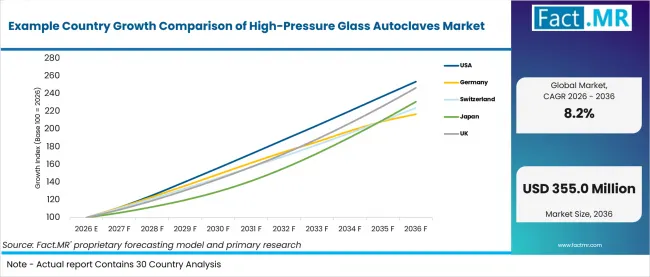
Example Country Growth Comparison Of High Pressure Glass Autoclaves Market | Source: Fact.MR
| COUNTRY | CAGR |
|---|---|
| United States | 8.8% |
| Germany | 8.4% |
| United Kingdom | 8.1% |
| Japan | 7.9% |
Source: Fact.MR analysis. Updated Jul 24, 2026
Why Do National Laboratories and Pharma Keep US Demand in Front?
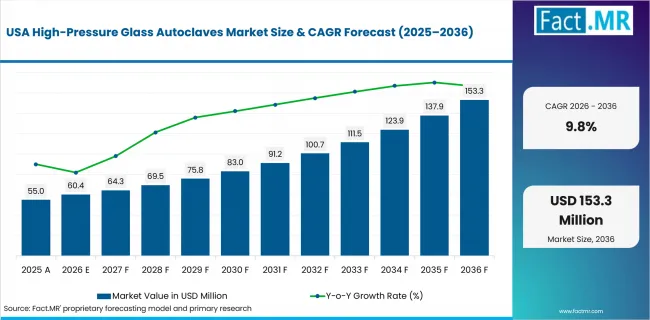
High Pressure Glass Autoclaves Market Country Value Analysis | Source: Fact.MR
The United States spends more on health-related R&D than the rest of the OECD combined, with the OECD tallying USD 49.5 billion of the USD 73 billion government total in 2022, on top of USD 103.9 billion in industry pharmaceutical R&D. That money equips university chemistry departments, national laboratories and corporate discovery groups, all routine buyers of pressurized glass reactors.
The DOE research complex adds a second stream. Pacific Northwest National Laboratory’s hydrothermal liquefaction program for the Bioenergy Technologies Office develops wet-waste-to-fuel processes at 347 degrees C and around 3,000 psi, work that progresses from small pressurized and windowed reactors to continuous rigs. United States demand for high-pressure glass autoclaves is forecast to rise at an 8.8% CAGR from 2026 to 2036.
Why Does Germany’s Chemical Research Base Sustain Premium Demand?
Germany’s chemical industry and its publicly funded research institutes run dense catalysis and process chemistry programs, and German laboratories have a long tradition of precision pressure glassware. Procurement emphasizes certification under European pressure equipment rules, which favors suppliers with complete documentation.
University and institute replacement cycles are steady, and applied catalysis programs linked to the energy transition add hydrogenation and hydrothermal work that fits glass and windowed reactors. Germany’s demand grows at an 8.4% CAGR from 2026 to 2036.
Why Is the UK a Chemistry-Led Academic Market?
The United Kingdom budgeted USD 3.7 billion for health-related R&D in the OECD’s 2022 tally, second only to the United States, and its university chemistry departments are disproportionately large buyers of bench pressure equipment relative to country size.
British pharmaceutical discovery groups at the major research campuses add industrial demand, and the country’s catalysis research community sustains a specialist niche for windowed and sapphire vessels. The UK market grows at an 8.1% CAGR from 2026 to 2036.
Why Does Japan Buy for Applied Catalysis and Durability?
Japan’s research base applies catalysis to energy and materials problems, from fuel processing to polymerization, and Japanese laboratories specify pressure glassware with an emphasis on closure quality and long service life. Government R&D budgeting, which the OECD records at USD 3.3 billion for health-related research alone, supports steady academic replacement.
Japanese buyers tend to standardize on proven designs and maintain them for long periods, which concentrates demand among certified premium suppliers. Japan’s demand advances at a 7.9% CAGR from 2026 to 2036.
Who leads the High-Pressure Glass Autoclaves Market?
Parr Instrument, Buchi AG, Berghof Products, Amar Equipment, Syrris, and Premex AG compete through certified pressure ratings, optical quality, and closure engineering.
Competition rests on certified pressure ratings, optical access, closure integrity, and service support. Buchi’s limbo and kiloclave lines illustrate the buyer requirement for documented pressure performance with visual observation; Parr Instrument, Berghof Products, Amar Equipment, Syrris, and Premex AG provide alternatives across laboratory and higher-specification reactor needs.
Competitive differentiation centers on camera-integrated vessels, inspection services, and teaching-laboratory bundles.
Which companies are the key providers?
The company set includes Parr Instrument, Buchi AG, Berghof Products, Amar Equipment, Syrris, and Premex AG.
- Parr Instrument
- Buchi AG
- Berghof Products
- Amar Equipment
- Syrris
- Premex AG
The six named manufacturers anchor the comparison, and the full report reviews more than 20 laboratory reactor suppliers.
Bibliography
- OECD. (2025). Health at a Glance 2025: Pharmaceutical knowledge and innovation.
- Pacific Northwest National Laboratory. (n.d.). Hydrothermal Liquefaction Processing of Wet Waste to Fuels, PNNL-27186 (U.S. DOE Bioenergy Technologies Office).
- U.S. Department of Energy, Bioenergy Technologies Office. (2023). Hydrothermal Liquefaction of Wet Wastes, multi-laboratory publication (OSTI 85784).
- University of Massachusetts Lowell. (2019). Researchers Produce Renewable Engine Fuel from Wet Biowaste (Nature Sustainability study).
- Parr Instrument Company. (n.d.). Glass and Sapphire-Window Pressure Reactors.
- Buchi AG. (n.d.). Pressure Reactors and Stirred Autoclaves.
This Report Addresses
- The report quantifies the 2025 baseline and forecasts revenue from 2026 through 2036.
- It compares the United States, Germany, the United Kingdom and Japan drawing on country coverage of 30+ markets.
- It evaluates Parr Instrument, Buchi AG, Berghof Products, Amar Equipment, Syrris, and Premex AG.
- It examines vessel type, pressure rating, application, volume class, and end user choices.
- It separates academic, pharmaceutical, and chemical research demand across pressure ratings and vessel types.
- It tests the forecast against R&D funding trends, research program activity, and certification requirements.
What does the High-Pressure Glass Autoclaves Market cover?
The study follows visible pressure reactors from laboratory specification through certified pressure testing, research service, and periodic re-inspection.
Revenue includes the vessel, closure, stirring system, sight glasses or windows, heating and control packages, and certification documentation sold with the reactor. Installation services are excluded.
Demand is segmented by vessel type, pressure rating, application, volume class, and end user. Country estimates reflect research funding, laboratory counts, certification regimes, and supplier access.
What is included in the scope?
Included systems are pressure-rated reactors designed to allow direct visual observation of the reaction contents.
Borosilicate glass, sapphire-window, glass-lined steel, quartz and hybrid view-cell reactors are counted when pressure-certified for laboratory or pilot use across the covered ratings and volumes. Certified inspection, re-testing and seal replacement services are included when billed by the manufacturer.
What is excluded from the scope?
All-metal autoclaves without viewing capability, stirred tank production reactors, and general laboratory glassware are not included.
The study excludes steel autoclaves lacking sight glasses, production-scale pressure vessels, unpressurized laboratory glassware, and analytical instruments coupled to reactors.
How was the analysis built?
Research funding data, laboratory procurement patterns, user interviews, and forecast cross-checks referencing more than 30 countries.
- Primary Research: Primary research targets laboratory managers, principal investigators, pharmaceutical process chemists, reactor manufacturers, and pressure equipment inspectors. Interviews test vessel selection, rating requirements, certification practice, replacement cycles, and service expectations.
- Desk Research: Desk research reviews OECD research expenditure data, national laboratory program publications, university research announcements, pressure equipment regulations, and manufacturer literature. Named statistics are used only when supported by the intergovernmental or government sources listed in the bibliography.
- Market-Sizing and Forecasting: Sizing is developed from laboratory counts, equipment budgets, unit prices by vessel type and rating, replacement cycles, and service attach rates. The result is reconciled to USD 162 million in 2026 and USD 355 million in 2036.
- Data Validation and Update Cycle: Validation compares segment shares, supplier positions, and country growth with funding data and procurement signals. Update signals include research program announcements, laboratory construction, certification rule changes, and product launches.
Segmentation
What is the report’s scope and coverage?
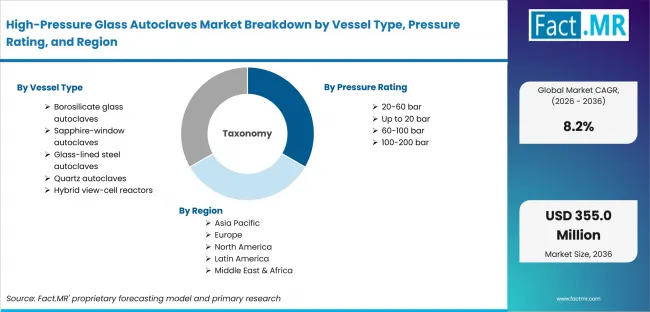
High Pressure Glass Autoclaves Market Breakdown By Vessel Type, Pressure Rating, And Region | Source: Fact.MR
| ATTRIBUTE | DETAILS |
|---|---|
| Quantitative Units | USD 162 million in 2026 to USD 355 million by 2036 at 8.2% CAGR |
| Market Definition | The market covers high-pressure glass, glass-lined and windowed autoclave reactors for visual observation of catalytic, hydrogenation, hydrothermal and related reactions at elevated pressure in research and pilot scale work. |
| Vessel Type | Borosilicate glass autoclaves; Sapphire-window autoclaves; Glass-lined steel autoclaves; Quartz autoclaves; Hybrid view-cell reactors |
| Pressure Rating | Up to 20 bar; 20-60 bar; 60-100 bar; 100-200 bar |
| Application | Catalysis research; Hydrogenation; Hydrothermal synthesis; Polymerization studies; Supercritical processing |
| Volume Class | Below 100 mL; 100-500 mL; 0.5-2 L; 2-5 L |
| End User | Academic labs; Pharma R&D; Chemical R&D |
| Regions Covered | North America; Europe; Asia Pacific |
| Countries Covered | United States; Germany; United Kingdom; Japan(full report analyzes 30+ countries) |
| Key Companies Profiled | Parr Instrument; Buchi AG; Berghof Products; Amar Equipment; Syrris; Premex AG |
| Forecast Period | 2026 to 2036 |
| Approach | Sizing combines laboratory counts and equipment budgets by end user, unit prices by vessel type and rating, replacement and inspection cycles, and separately billed certification and service. |
Source: Fact.MR analysis. Updated Jul 24, 2026
How is the market segmented?
-
By Vessel Type
- Borosilicate glass autoclaves
- Sapphire-window autoclaves
- Glass-lined steel autoclaves
- Quartz autoclaves
- Hybrid view-cell reactors
-
By Pressure Rating
- Up to 20 bar
- 20-60 bar
- 60-100 bar
- 100-200 bar
-
By Application
- Catalysis research
- Hydrogenation
- Hydrothermal synthesis
- Polymerization studies
- Supercritical processing
-
By Volume Class
- Below 100 mL
- 100-500 mL
- 0.5-2 L
- 2-5 L
-
By End User
- Academic labs
- Pharma R&D
- Chemical R&D
-
By Region
- North America
- Europe
- Asia Pacific
Frequently Asked Questions
What is the high-pressure glass autoclaves market worth in 2026?
What revenue level is projected for high-pressure glass autoclaves in 2036?
What CAGR is expected through 2036?
Which vessel type leads demand?
Which pressure rating is the largest segment?
Which application has the largest share?
Which end user is most common?
Who worked on this report


Preview the report firsthand - request a free sample
Free SampleGet the brochure for pricing and purchase details
Download PDF