- Market Value (2025): USD 5.2 Bn
- Estimated Value (2026): USD 5.8 Bn
- Forecast Value (2036): USD 18.9 Bn
- CAGR (2026-2036): 12.5%
What is the High Purity Chemicals for DRAM Wet Market Processing forecast to be worth by 2036?
The market is projected to grow from USD 5.8 billion in 2026 to USD 18.9 billion by 2036, registering a CAGR of 12.5%.
- The High Purity Chemicals for DRAM Wet Market Processing market reached USD 5.2 billion in 2025.
- Demand is forecast to increase from USD 5.8 billion in 2026 to USD 18.9 billion by 2036.
- The market is forecast to record 12.5% CAGR from 2026 to 2036.
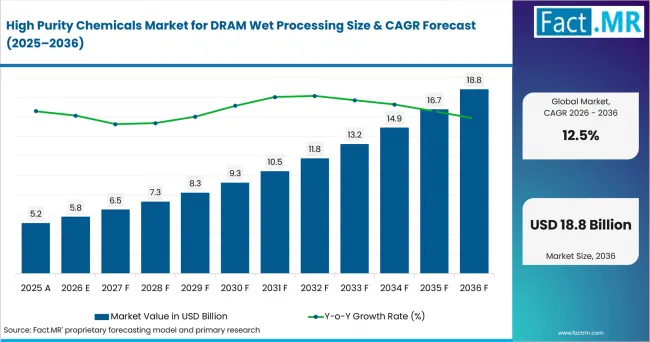
High Purity Chemicals Market For Dram Wet Processing Value Analysis | Source: Fact.MR
What are the defining numbers behind High Purity Chemicals for DRAM Wet Market Processing growth?
An absolute dollar opportunity of USD 13.1 billion is expected between 2026 and 2036.
- Demand Drivers in the Market
- Exponential growth in AI and machine learning workloads is driving demand for high-bandwidth memory and advanced GPU architectures in data center and edge computing environments.
- The transition to chiplet-based designs and advanced 2.5D/3D packaging is accelerating adoption of silicon interposers, TSV technology, and hybrid bonding solutions.
- Expanding hyperscale data center capacity and cloud computing infrastructure is fueling demand for GPU servers and high-speed memory subsystems.
- Geopolitical emphasis on semiconductor supply chain resilience and regional fab capacity expansion is driving investment in advanced manufacturing and test technologies.
- Increasing transistor density and thermal design power (TDP) requirements are creating demand for advanced thermal management solutions, including TIMs and liquid cooling.
- Automotive AI processors and autonomous driving compute platforms are emerging as high-growth applications for HBM and advanced GPU architectures.
- Key Segments Analyzed
- By Chemical Type: Wet Cleaning Chemicals account for 44.0% of the segment in 2026, supported by their extensive use in removing particles and residues during semiconductor fabrication.
- By Application: Wafer Cleaning holds a 47.0% share in 2026 because repeated cleaning is required between critical deposition and patterning stages.
- By End User: Memory Manufacturers represent 51.0% of the segment in 2026, reflecting the high chemical purity requirements of DRAM and NAND production.
- By Supply Channel: Direct Supply Agreements account for 58.0% in 2026 as semiconductor manufacturers require consistent specifications and dependable delivery from qualified suppliers.
- By Purity Grade: Electronic Grade Chemicals hold a 63.0% share in 2026 due to the strict contamination limits applied in advanced semiconductor processing.
- Analyst Opinion at Fact.MR
- Shambhu Nath Jha, Principal Consultant at Fact.MR, states, “DRAM manufacturers are tightening chemical-purity and contamination-control requirements as memory structures become denser and fabrication processes add more cleaning stages. Demand will increasingly favour suppliers that can maintain consistent impurity limits across high-volume deliveries and support rapid qualification when production processes change. Direct technical support and secure regional supply will carry greater weight than broad chemical portfolios alone.”
- Strategic Implications
- Chemical suppliers should prioritize purification, filtration and analytical-control capabilities that reduce metallic, ionic and particulate contamination in DRAM fabrication.
- Producers should establish joint qualification programmes with memory manufacturers because changes in chemical composition or production location require extensive process validation.
- Suppliers need resilient regional manufacturing and storage capacity near major semiconductor clusters to reduce delivery risk for materials consumed continuously by fabrication plants.
- Product-development programmes should address lower chemical consumption, improved recycling and alternatives to chemistries facing environmental scrutiny.
- Commercial strategies should focus on batch consistency and contamination traceability because process variation can affect wafer yield across large production volumes.
- Country-level Growth Outlook
- South Korea is projected to expand at a 13.8% CAGR, supported by its concentration of large memory manufacturers and continued investment in advanced DRAM production.
- Taiwan is forecast to grow at a 13.4% CAGR as its semiconductor fabrication ecosystem increases demand for qualified wet-process chemicals and local technical support.
- The USA is expected to register a 12.9% CAGR as new semiconductor manufacturing capacity increases requirements for domestic chemical supply and contamination-control infrastructure. The CHIPS for America programme provides USD 50 billion for semiconductor research, development and manufacturing initiatives.
- Japan is forecast to advance at a 12.5% CAGR, supported by its established semiconductor-materials industry and policies intended to strengthen domestic semiconductor supply. Japan approved eight semiconductor and advanced-component supply plans with subsidies of up to approximately JPY 100 billion.
- China is projected to grow at a 12.0% CAGR as domestic memory-fabrication investment expands the addressable requirement for locally available high-purity processing chemicals.
- Germany is forecast to register an 11.5% CAGR, supported by semiconductor manufacturing investment serving automotive and industrial electronics applications.
- Singapore is projected to grow at an 11.0% CAGR as its established wafer-fabrication base supports demand for electronic-grade chemicals and regional distribution services.
How does the High Purity Chemicals for DRAM Wet Market Processing break down by segment?
The market is segmented by Chemical Type, Application, End User, Supply Channel and Purity Grade.
Why do Wet Cleaning Chemicals lead Chemical Type?
Wet Cleaning Chemicals are projected to account for a 44.0% share in 2026.
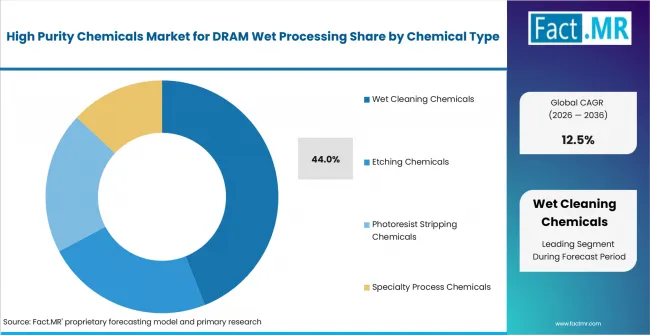
High Purity Chemicals Market For Dram Wet Processing Analysis By Chemical Type | Source: Fact.MR
Wet cleaning is used repeatedly during semiconductor fabrication to remove particles, organic residues, metallic contamination and material left by preceding process steps. Semiconductor wafers are highly sensitive to contamination, making controlled cleaning essential before deposition, patterning and other surface-processing stages.
The Semiconductor Industry Association identifies cleaning, stripping and wet etching among the semiconductor processes that use wet chemistries. These chemicals remain embedded across multiple fabrication stages rather than being limited to a single final-cleaning operation.
DRAM manufacturing strengthens this requirement because defects introduced at one stage can affect large numbers of memory cells. Buyers therefore favour qualified chemicals with stable composition and trace impurity levels over less expensive alternatives that could increase process variation.
Why does Wafer Cleaning lead Application?
Wafer Cleaning is projected to account for a 47.0% share in 2026.
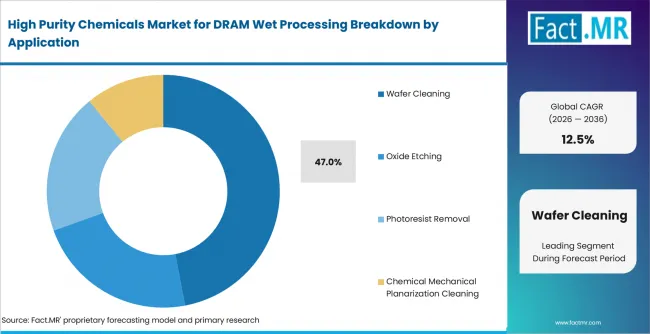
High Purity Chemicals Market For Dram Wet Processing Analysis By Application | Source: Fact.MR
Wafer cleaning leads because contamination must be removed between successive fabrication steps. Residual particles or metallic ions can interfere with pattern formation and electrical performance, while incomplete removal of process residues can reduce adhesion during subsequent deposition.
The requirement becomes more demanding as device dimensions shrink and structures become harder to clean without damaging exposed surfaces. Imec notes that established wafer-cleaning processes can require repeated oxidation and etching cycles and consume substantial quantities of chemicals and ultrapure water.
Memory manufacturers consequently purchase cleaning chemicals as recurring process inputs. Selection depends on removal efficiency and compatibility with the materials already present on the wafer.
Why do Memory Manufacturers lead End User?
Memory Manufacturers are projected to account for a 51.0% share in 2026.
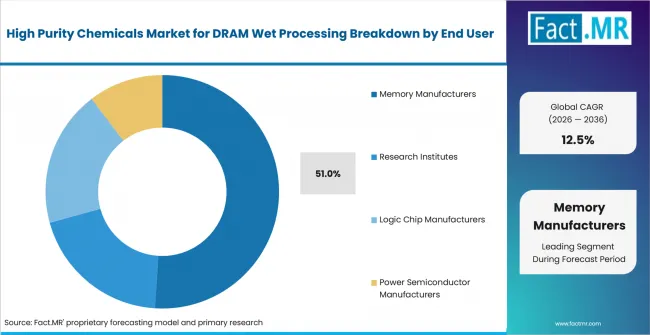
High Purity Chemicals Market For Dram Wet Processing Analysis By End User | Source: Fact.MR
Memory manufacturers lead because DRAM fabrication combines high production volumes with repeated cleaning and surface-treatment requirements. A small level of contamination can affect cell uniformity and reduce the number of functional dies obtained from a wafer.
DRAM producers also operate tightly controlled processes that require chemicals to remain consistent across production batches. Semiconductor fabrication controls airborne and process contamination at extremely low levels because nanoscale integrated circuits are sensitive to particles and chemical impurities.
This makes qualified supply continuity important. Once a chemical has been validated for a production line, manufacturers have limited incentive to change suppliers unless the alternative can demonstrate equivalent purity and process performance.
Why do Direct Supply Agreements lead Supply Channel?
Direct Supply Agreements are projected to account for a 58.0% share in 2026.
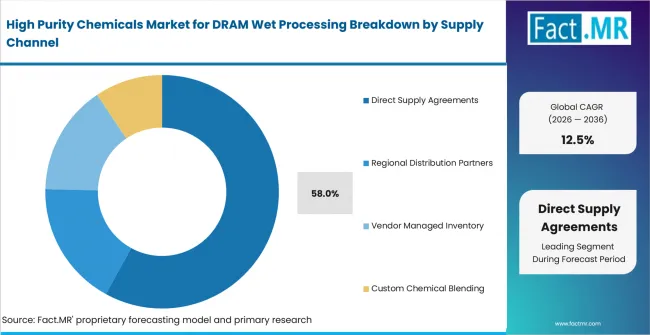
High Purity Chemicals Market For Dram Wet Processing Analysis By Supply Channel | Source: Fact.MR
Direct agreements lead because semiconductor chemicals require tighter technical coordination than standard industrial chemical purchases. Memory manufacturers need detailed information on purity specifications, analytical methods and batch consistency before approving a material for production use.
Direct relationships allow suppliers to coordinate deliveries with fab consumption and investigate process deviations more quickly. They also improve traceability by linking each chemical batch with production and quality-control records.
Large fabrication plants consume chemicals continuously, so an interruption can affect equipment utilization. Long-term agreements help manufacturers reserve supply while allowing chemical producers to plan purification and packaging capacity around customer requirements.
Why do Electronic Grade Chemicals lead Purity Grade?
Electronic Grade Chemicals are projected to account for a 63.0% share in 2026.
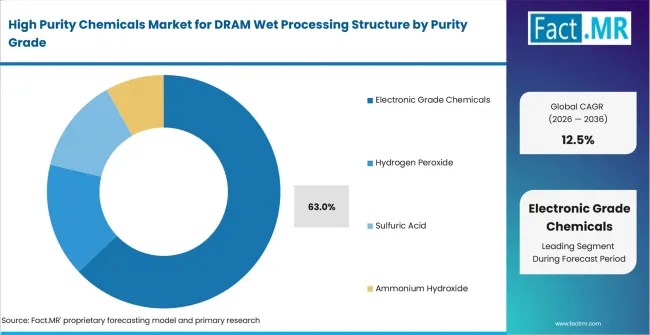
High Purity Chemicals Market For Dram Wet Processing Analysis By Purity Grade | Source: Fact.MR
Electronic-grade chemicals lead because standard industrial grades can contain metallic ions, particles or organic residues at levels that are unacceptable for semiconductor production. DRAM manufacturers require defined impurity limits and analytical verification before chemicals can enter a qualified wet-processing line.
The need for extreme purity is directly connected to yield. Semiconductor devices are susceptible to contamination from particles, metal ions and other chemical impurities, making control of incoming process materials a production requirement.
Suppliers must therefore combine purification with controlled packaging and transportation. Buyers assess the complete contamination pathway, including the chemical container and handling system, rather than evaluating chemical composition alone.
What is accelerating High Purity Chemicals for DRAM Wet Market Processing adoption, and what is holding it back?
Drivers Impact Analysis
| Driver | % Impact on CAGR | Geographic Relevance | Impact Timeline |
|---|---|---|---|
| Technology Innovation & R&D | High | Global | 2026-2036 |
| Regulatory & Policy Drivers | Medium-High | North America, Europe | 2026-2032 |
| End-User Industry Expansion | High | Asia Pacific, MEA | 2026-2036 |
| Operational & Cost Efficiency | Medium | Global | 2026-2036 |
Source: Fact.MR analysis. Updated Aug 11, 2026
Restraints Impact Analysis
| Restraint | % Impact on CAGR | Geographic Relevance | Impact Timeline |
|---|---|---|---|
| Capital Intensity & Investment | Medium | Developing Markets | 2026-2030 |
| Supply Chain & Raw Material | Medium | Global | 2026-2028 |
| Workforce & Capability Gaps | Low-Medium | Africa, Latin America | 2026-2036 |
Source: Fact.MR analysis. Updated Aug 11, 2026
Which countries are scaling the High Purity Chemicals for DRAM Wet Market Processing fastest?
- South Korea’s growth is supported by its concentration of DRAM production and the presence of large memory manufacturers operating advanced fabrication facilities. These plants require continuous supplies of qualified acids, solvents and cleaning formulations across high-volume production lines.
- Local chemical availability also reduces transport and inventory risk for materials that must remain within narrow contamination limits. Suppliers with nearby purification capacity and technical-service teams are positioned to support production changes more rapidly.
- Taiwan’s semiconductor manufacturing ecosystem creates substantial demand for electronic-grade chemicals used in wafer cleaning and surface preparation. Fabrication capacity and the supporting materials network allow chemical suppliers to serve multiple semiconductor customers from regional production and distribution facilities.
- Growth also reflects the importance of process qualification. Suppliers that already support other advanced wafer processes can extend analytical and contamination-control capabilities to DRAM wet-processing applications.
- The USA is adding semiconductor manufacturing capacity under government-supported programmes intended to strengthen domestic production. New fabrication facilities require supporting investments in bulk chemical delivery and waste handling before commercial output can begin.
- CHIPS for America provides USD 50 billion for programmes supporting semiconductor research, development and manufacturing. Additional fab construction can expand demand for high-purity chemicals sourced from suppliers able to meet domestic-content and supply-security requirements.
- Japan benefits from an established semiconductor-materials base with expertise in purification and chemical quality control. Memory and logic manufacturers depend on this supplier ecosystem for electronic-grade acids, solvents and specialty formulations.
- Government measures to strengthen semiconductor and advanced-component supply are also encouraging domestic capacity. METI approved eight supply-security plans with subsidies of up to approximately JPY 100 billion, equivalent to about USD 680 million.
- China’s growth is connected to continued investment in domestic semiconductor production and efforts to reduce reliance on imported materials. New memory capacity increases requirements for wet chemicals and local qualification support.
- Domestic suppliers must still demonstrate that their chemicals meet the impurity and batch-consistency requirements of advanced DRAM processes. This creates opportunities for producers that invest in analytical laboratories and electronic-grade purification lines.
- Germany’s semiconductor manufacturing expansion is being shaped by demand from automotive and industrial electronics. New fabrication investment requires local access to qualified process chemicals and supporting infrastructure.
- Chemical companies with established European manufacturing and regulatory capabilities can serve this requirement, particularly where customers seek shorter supply chains and documented chemical-management practices.
- Singapore’s established semiconductor-fabrication cluster supports demand for chemicals used across cleaning and surface-treatment processes. Its logistics infrastructure also allows suppliers to distribute qualified materials to other fabrication locations in Southeast Asia.
- Growth is likely to favour companies that combine regional warehousing with controlled packaging and on-site technical support.
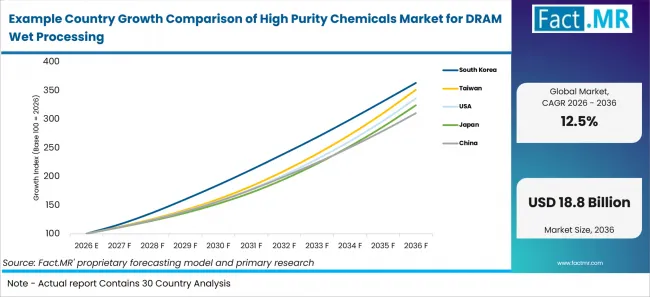
Example Country Growth Comparison Of High Purity Chemicals Market For Dram Wet Processing | Source: Fact.MR
Country-wise CAGR Forecast, 2026-2036
| Country | CAGR |
|---|---|
| South Korea | 13.8% |
| Taiwan | 13.4% |
| USA | 12.9% |
| Japan | 12.5% |
| Germany | 11.5% |
| Singapore | 11.0% |
Source: Fact.MR analysis. Updated Aug 11, 2026
What is driving the High Purity Chemicals for DRAM Wet Market Processing in South Korea?
South Korea is projected to register a 13.8% CAGR through 2036.
The country hosts large memory manufacturers that require high volumes of qualified wet-process chemicals for DRAM production. Increasing device density and process complexity raise the cost of contamination, encouraging manufacturers to maintain close technical relationships with chemical suppliers.
Growth will favour vendors that can provide local purification capacity and rapid failure analysis. Direct supply arrangements also help memory producers protect production continuity when chemical demand rises during fab expansions or technology transitions.
What is driving the High Purity Chemicals for DRAM Wet Market Processing in Taiwan?
Taiwan is projected to register a 13.4% CAGR through 2036.
Taiwan’s dense semiconductor manufacturing ecosystem supports local demand for electronic-grade chemicals and specialist distribution infrastructure. Chemical suppliers can serve fabrication plants through shorter delivery routes while maintaining controlled storage and handling.
Demand is strengthened by strict supplier-qualification procedures. Producers with analytical capabilities and an established record in advanced semiconductor processes are more likely to secure recurring supply agreements.
What is driving the High Purity Chemicals for DRAM Wet Market Processing in the USA?
The USA is projected to register a 12.9% CAGR through 2036.
New semiconductor facilities require large supporting systems for chemical storage, distribution and contamination control. This expands the addressable market before commercial wafer output begins because chemical infrastructure must be qualified during fab commissioning.
Federal support is strengthening domestic semiconductor manufacturing and research. CHIPS for America provides USD 50 billion across semiconductor programmes, creating opportunities for chemical suppliers with domestic production and secure supply chains.
What is driving the High Purity Chemicals for DRAM Wet Market Processing in Japan?
Japan is projected to register a 12.5% CAGR through 2036.
Japan’s chemical and semiconductor-materials industries have established capabilities in high-purity production and quality control. These capabilities support the manufacture of acids, solvents and other wet-process materials supplied to memory producers.
Government initiatives to reinforce semiconductor supply also support domestic investment. METI’s semiconductor revitalization policy includes measures intended to strengthen manufacturing and supporting materials capacity.
What is driving the High Purity Chemicals for DRAM Wet Market Processing in China?
China is projected to register a 12.0% CAGR through 2036.
Domestic memory-fabrication investment is increasing consumption of chemicals used in cleaning and surface preparation. Efforts to qualify local suppliers can reduce dependence on imported formulations and improve supply continuity for expanding fabs.
The transition remains technically demanding because replacing an approved chemical requires verification of contamination levels and process performance. Suppliers able to meet electronic-grade specifications consistently are positioned to capture a larger share of domestic procurement.
Who leads the High Purity Chemicals for DRAM Wet Market Processing?
BASF SE, Stella Chemifa Corporation and Kanto Chemical Co., Inc. hold prominent positions through their semiconductor-material portfolios and high-purity manufacturing capabilities. Avantor, Honeywell International and Fujifilm compete through electronic chemicals, solvents and supporting material technologies.
Solvay, Mitsubishi Chemical Group and TOKUYAMA strengthen competition through fluorine chemistry and other semiconductor-process materials. Entegris participates through contamination-control technologies and materials used across semiconductor manufacturing.
Competition depends on impurity control and batch consistency. Suppliers must also demonstrate reliable packaging and delivery because contamination can be introduced after chemical purification.
Customer qualification creates a substantial barrier to entry. Memory manufacturers test chemical performance before approving a material, and changing a qualified supplier may require additional engineering work. This favours companies with established technical relationships and production facilities close to major semiconductor clusters.
Environmental regulation is creating another competitive factor. Imec is evaluating alternatives to PFAS-containing semiconductor materials due to environmental and regulatory concerns, while industry sources identify wet cleaning and etching among processes that use regulated chemistries. Suppliers able to develop qualified alternatives without reducing process performance may gain an advantage.
Which companies are the key providers?
Key companies profiled include BASF SE; Stella Chemifa Corporation; Kanto Chemical Co., Inc.; Avantor, Inc.; Honeywell International Inc.; Fujifilm Corporation; Solvay SA; Mitsubishi Chemical Group Corporation; TOKUYAMA Corporation; and Entegris, Inc.
- BASF SE
- Stella Chemifa Corporation
- Kanto Chemical Co., Inc.
- Avantor, Inc.
- Honeywell International Inc.
- Fujifilm Corporation
- Solvay SA
- Mitsubishi Chemical Group Corporation
- TOKUYAMA Corporation
- Entegris, Inc.
Bibliography
- Imec. (2025). How Can We Reduce Environmental Impact in Chip Manufacturing? Imec.
- Imec. (2025). Removing PFAS from Semiconductor Manufacturing, from Resists to Rinses. Imec.
- Japan Ministry of Economy, Trade and Industry. (2024). Outline of Semiconductor Revitalization Strategy in Japan. Government of Japan.
- Japan Ministry of Economy, Trade and Industry. (2024). Approval of Plans for Securing the Supply of Semiconductors and Advanced Electronic Components. Government of Japan.
- National Institute of Standards and Technology. (2026). CHIPS for America. U.S. Department of Commerce.
- Semiconductor Industry Association. (2020). Overview of the Semiconductor Industry and Its Approach to Chemical Management and Environmental, Health and Safety. Semiconductor Industry Association.
- Semiconductor Industry Association. (2023). Background on Semiconductor Manufacturing and PFAS. Semiconductor Industry Association.
- Semiconductor Industry Association. (2023). PFAS-Containing Wet Chemistries Used in Semiconductor Manufacturing. Semiconductor Industry Association.
This Report Answers
- The report provides strategic intelligence on the High Purity Chemicals for DRAM Wet Processing Market across Chemical Type, Application, End User, Supply Channel and Purity Grade.
- Segment analysis covers Wet Cleaning Chemicals and Wafer Cleaning as the leading categories in 2026, with shares of 44.0% and 47.0%, respectively. Memory Manufacturers lead End User with a 51.0% share.
- Supply-channel and purity-grade analysis identifies Direct Supply Agreements and Electronic Grade Chemicals as the leading segments, accounting for 58.0% and 63.0% shares in 2026.
- Country outlook evaluates South Korea and Taiwan alongside the USA, Japan and China. Germany and Singapore complete the growth comparison across the profiled markets.
- Competitive analysis profiles BASF SE, Stella Chemifa Corporation and Kanto Chemical alongside Avantor, Honeywell and Fujifilm. Solvay, Mitsubishi Chemical Group, TOKUYAMA and Entegris complete the provider set.
What does the High Purity Chemicals for DRAM Wet Processing Market cover?
High-purity chemicals are used across DRAM wet-processing steps where contamination control, batch consistency and chemical purity affect wafer yield and process stability.
The High Purity Chemicals for DRAM Wet Processing Market covers wet cleaning chemicals, wet etching chemicals, stripping chemicals, solvents and other specialty process chemicals used in semiconductor fabrication. Coverage includes wafer cleaning, surface preparation, wet etching and residue removal. The market also includes electronic-grade and ultra-high-purity chemicals supplied to memory manufacturers and other semiconductor fabrication facilities.
What is included in the scope?
High-purity wet-process chemicals are used by memory manufacturers, foundries, integrated device manufacturers, semiconductor fabrication facilities and R&D institutes.
The scope includes Chemical Type and Application alongside End User, Supply Channel and Purity Grade. Coverage spans wet cleaning chemicals, wet etching chemicals, stripping chemicals and solvents. Wafer cleaning and surface preparation are included alongside wet etching and residue removal. Direct supply agreements, distributors and specialty chemical suppliers are covered. Electronic-grade chemicals, ultra-high-purity grades and other semiconductor-grade chemicals complete the purity scope.
What is excluded from the scope?
General industrial chemicals and materials without a clear connection to DRAM wet processing remain outside the scope of this market.
The scope excludes standard industrial-grade chemicals that do not meet semiconductor contamination requirements. Chemicals used only in unrelated deposition, packaging, assembly or non-semiconductor applications are excluded. General cleaning materials without wafer-processing use are also outside the market. Supplier revenue without a clear connection to qualified semiconductor wet-process chemicals, contamination control or DRAM fabrication is excluded.
How Was the Analysis Built?
The analysis uses a hybrid top-down and bottom-up approach covering DRAM fabrication demand, wafer-processing requirements, supplier qualification, contamination control, regional semiconductor investment and company portfolio activity.
- Primary Research: Primary research includes discussions with chemical manufacturers, semiconductor producers, distributors, technical-service providers, procurement teams and industry specialists. These discussions examine purity requirements, supplier qualification, batch consistency, delivery reliability, contamination-control priorities and purchasing decisions.
- Desk Research: Desk research covers government publications, semiconductor-industry associations, company filings, technical studies, environmental and chemical regulations, public policy, fab-investment announcements and other authoritative sources. Source material is reviewed to support market structure, country trends and supplier activity.
- Market Sizing and Forecasting: Market estimates combine DRAM fabrication demand, wet-process chemical consumption, semiconductor manufacturing capacity, segment shares, supplier participation, country-level growth, purification requirements, qualification activity and barriers affecting wider market adoption.
- Data Validation and Update Cycle: Findings are validated by comparing primary inputs with public data, company activity, semiconductor investment, regulatory developments and chemical-supply trends. Updates review changes in fab capacity, supplier qualification, purification capability, regional manufacturing, environmental requirements and commercial adoption.
Segmentation
What is the report’s scope and coverage?
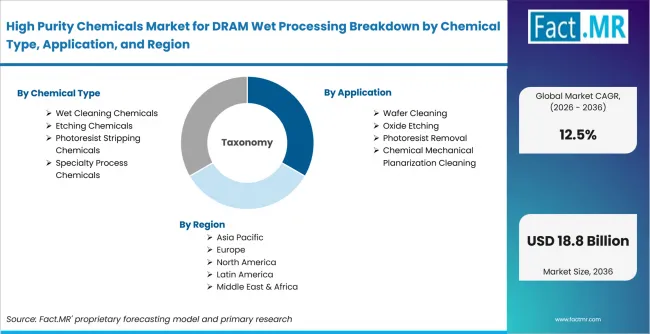
High Purity Chemicals Market For Dram Wet Processing Breakdown By Chemical Type, Application, And Region | Source: Fact.MR
| Attribute | Details |
|---|---|
| Quantitative Units | USD 5.8 billion |
| Market Definition | High-purity chemicals used in DRAM wet-processing steps such as wafer cleaning, surface preparation and wet etching, where impurity control, batch consistency and reliable chemical supply are required to protect wafer yield |
| Chemical Type | Wet Cleaning Chemicals; Wet Etching Chemicals; Stripping Chemicals; Solvents; Other Specialty Process Chemicals |
| Application | Wafer Cleaning; Surface Preparation; Wet Etching; Residue Removal; Other Wet Processing Applications |
| End User | Memory Manufacturers; Foundries; Integrated Device Manufacturers; Semiconductor Fabrication Facilities; R&D Institutes |
| Supply Channel | Direct Supply Agreements; Distributors; Specialty Chemical Suppliers; Other Supply Channels |
| Purity Grade | Electronic Grade Chemicals; Ultra-high-purity Grades; Other Semiconductor-grade Chemicals |
| Regions Covered | North America; Europe; Asia Pacific; Latin America; Middle East & Africa |
| Countries Covered | South Korea; Taiwan; USA; Japan; China; Germany; Singapore |
| Key Companies Profiled | BASF SE; Stella Chemifa Corporation; Kanto Chemical Co., Inc.; Avantor, Inc.; Honeywell International Inc.; Fujifilm Corporation; Solvay SA; Mitsubishi Chemical Group Corporation; TOKUYAMA Corporation; Entegris, Inc. |
| Forecast Period | 2026 to 2036 |
| Approach | Hybrid top-down and bottom-up approach using DRAM fabrication demand; wafer-cleaning and wet-processing requirements; chemical purity and contamination-control needs; memory manufacturing capacity; supplier qualification activity; batch consistency; purification and filtration capability; packaging and delivery control; regional semiconductor investment; country adoption patterns and company portfolio review |
Source: Fact.MR analysis. Updated Aug 11, 2026
How is the market segmented?
-
By Chemical Type:
- Wet Cleaning Chemicals
- SC-1 Cleaning Chemicals
- SC-2 Cleaning Chemicals
- Etching Chemicals
- Hydrofluoric Acid
- Phosphoric Acid
- Photoresist Stripping Chemicals
- Sulfuric Acid Mixtures
- Organic Solvent Cleaners
- Specialty Process Chemicals
- Corrosion Inhibitors
- Surface Conditioning Chemicals
- Wet Cleaning Chemicals
-
By Application:
- Wafer Cleaning
- Pre-diffusion Cleaning
- Post-etch Cleaning
- Oxide Etching
- Silicon Surface Treatment
- Metal Layer Etching
- Photoresist Removal
- Post-lithography Cleaning
- Residue Removal
- Chemical Mechanical Planarization Cleaning
- Post-Chemical Mechanical Planarization Cleaning
- Final Wafer Rinse
- Wafer Cleaning
-
By End User:
- Memory Manufacturers
- Integrated Device Manufacturers
- Semiconductor Foundries
- Research Institutes
- Advanced Packaging Companies
- Chemical Blending Companies
- Logic Chip Manufacturers
- High-performance Computing Chip Manufacturers
- Display Manufacturers
- Power Semiconductor Manufacturers
- Automotive Semiconductor Manufacturers
- Optoelectronic Device Manufacturers
- Memory Manufacturers
-
By Supply Channel
- Direct Supply Agreements
- Long-term Supply Contracts
- Authorized Chemical Distributors
- Regional Distribution Partners
- Global Chemical Supply Networks
- On-site Chemical Management
- Vendor Managed Inventory
- Chemical Integration Services
- Just-in-time Chemical Supply
- Custom Chemical Blending
- On-demand Chemical Supply
- Dedicated Manufacturing Supply
- Direct Supply Agreements
-
By Purity Grade
- Electronic Grade Chemicals
- Ultra-high Purity Grade
- Semiconductor Grade Chemicals
- Hydrogen Peroxide
- High-purity Hydrofluoric Acid
- High-purity Phosphoric Acid
- Sulfuric Acid
- High-purity Sulfuric Acid
- Isopropyl Alcohol
- Ammonium Hydroxide
- High-purity Ammonium Hydroxide
- Ultrapure Deionized Water
- Electronic Grade Chemicals
-
By Region:
- North America
- Latin America
- Western Europe
- Eastern Europe
- East Asia
- South Asia and Pacific
- Middle East & Africa
Frequently Asked Questions
How big is the high purity chemicals for DRAM wet processing market in 2026?
What is the CAGR of the high purity chemicals for DRAM wet processing market from 2026 to 2036?
Which chemical type leads the high purity chemicals for DRAM wet processing market?
Which application leads the high purity chemicals for DRAM wet processing market?
Who are the leading companies in the high purity chemicals for DRAM wet processing market?
Who worked on this report


Preview the report firsthand - request a free sample
Free SampleGet the brochure for pricing and purchase details
Download PDF