- Base Value(2025): 101.5 Mn
- Forecast Value (2035): 150.2 Mn
- CAGR (2035): 4%
High Purity Quartz Sand Industry Analysis in South Asia & Oceania Market Outlook (2025 to 2035)
The global high-purity quartz sand industry analysis in the South Asia & Oceania market is projected to increase from USD 101.5 million in 2025 to USD 150.2 million by 2035, with a CAGR of 4%, driven by rising solar and semiconductor investments in India and Australia, due to their expanding clean energy and chip ecosystems.
Regional HPQ sourcing is a trend used to reduce import dependency. Unexplored silica deposits in Indonesia and Malaysia provide opportunities for local HPQ production to meet high-tech industry demands.
Quick Facts about South Asia & Oceania High Purity Quartz Sand Industry
- Industry Value (2025): USD 101.5 Million
- Projected Value (2035): USD 150.2 Million
- Forecast CAGR (2025 to 2035): 4%
- Leading Segment (2025): 3N (39% Market Share)
- Country Growth Rate (2025 to 2035): Indonesia (5.4% CAGR)
- Top Key Players: Australian Silica Quartz Pty Ltd., Iluka Resources, and Ultra HPQ
What are the Drivers of High Purity Quartz Sand Industry Analysis in South Asia & Oceania Market?
The expansion of the semiconductor industry in South Asia and Oceania is a significant driver of high-purity quartz sand demand. Countries such as India are investing in domestic chip fabrication through government initiatives like the Semicon India Programme, which is increasing the demand for ultra-pure quartz crucibles and components.
Rising investments in electronics manufacturing across Southeast Asia also help to drive the HPQ Sand market growth. Countries such as Malaysia and Thailand are expanding their electronics and display panel industries, which rely on high-purity inputs for cleanroom manufacturing processes.
Abundant regional quartz resources in Indonesia and Sri Lanka present long-term supply opportunities, particularly as countries seek self-sufficient mineral sourcing strategies to strengthen supply chains.
| Metric | Value |
|---|---|
| Industry Size (2025E) | USD 101.5 million |
| Industry Size (2035F) | USD 150.2 million |
| CAGR (2025-2035) | 4% |
Source: Fact.MR analysis. Updated Aug 1, 2025
What are the Regional Trends of High Purity Quartz Sand Industry Analysis in South Asia & Oceania Market?
India is emerging as a major player, owing to its "Semicon India" program and large-scale solar projects. To support its expanding electronics and renewable industries, the country is investing in the development of local HPQ sources and processing capabilities.
Australia has an advantage due to its abundant mineral reserves and growing clean energy infrastructure. Government incentives and international collaborations are encouraging domestic HPQ refinement to support the growing solar cell and glass manufacturing sectors.
Southeast Asian countries such as Malaysia, Thailand, and Indonesia are increasingly integrated into the global semiconductor and electronics value chain. Malaysia's semiconductor hub in Penang and Thailand's advanced electronics export base are driving HPQ demand. Meanwhile, Indonesia's abundant quartz reserves in provinces such as Bangka Belitung and West Kalimantan are being assessed for HPQ-grade extraction potential.
What are the Challenges and Restraining Factors of High Purity Quartz Sand Industry Analysis in South Asia & Oceania Market?
A shortage of ultra-high-grade quartz deposits remains one of the most significant challenges in the South Asia and Oceania high purity quartz sand (HPQ) market. While countries such as Indonesia and Sri Lanka have large silica reserves, only a small portion meets the stringent purity requirements (4N and above) for semiconductor and photovoltaic applications. This results in a reliance on expensive imports or complex beneficiation processes, limiting local production growth.
The lack of advanced purification infrastructure further limits HPQ scalability. HPQ production requires sophisticated techniques such as flotation, acid leaching, and thermal treatment. Many countries in the region lack the industrial base and technical expertise needed to support such large-scale processes, limiting their ability to meet rising domestic demand.
Furthermore, high capital expenditures and lengthy return cycles deter new entrants. HPQ production is capital-intensive, requiring high-precision equipment and quality control systems. Small and medium-sized enterprises continue to face financial risks in the absence of strong government incentives or long-term purchase agreements.
Country-Wise Outlook
| Countries | CAGR (2025 to 2035) |
|---|---|
| Thailand | 2.6% |
| Indonesia | 5.4% |
| Malaysia | 3.1% |
Source: Fact.MR analysis. Updated Aug 1, 2025
Thailand: Emerging HPQ Market Driven by Electronics and Solar Manufacturing Expansion
Thailand is becoming an emerging contributor to the high purity quartz sand (HPQ) market in South Asia & Oceania due to the country’s growing demand in electronics and solar energy sectors. As Southeast Asia's second-largest economy, Thailand has a strong electronics manufacturing base, particularly for hard drives, semiconductors, and display panels.
The increasing push toward renewable energy is another major driver. Under Thailand’s Power Development Plan (PDP 2023), the country aims to generate 38.5% of its electricity from renewable sources by 2037. HPQ plays a key role in the photovoltaic supply chain, especially in the production of silicon crucibles and solar ingots used in solar cells. The government’s solar farm and rooftop programs are encouraging local and international manufacturers to explore HPQ sourcing options within the region.
Thailand currently imports most of its HPQ requirements, as domestic quartz deposits are often lower in purity and require advanced processing. However, initiatives are underway to assess and upgrade domestic silica resources in provinces like Rayong and Chonburi. Local research institutes are collaborating with the private sector to test cost-effective purification techniques to meet 4N+ (99.99%+) standards.
Thailand’s Eastern Economic Corridor (EEC) initiative, offering tax incentives and infrastructure support to high-tech and clean energy investors, is expected to attract HPQ-intensive industries. This also opens up opportunities for backward integration of HPQ sourcing and refinement to reduce reliance on imports from the U.S., China, or Australia.
Indonesia Rising Potential in HPQ Market Backed by Abundant Quartz Reserves and Exploration Initiatives
Indonesia's abundant natural silica reserves make it a promising market for high purity quartz sand (HPQ). The country has large quartz sand deposits in provinces like Bangka Belitung, Riau Islands, and West Kalimantan. Recent geological surveys have identified zones with high SiO₂ content, potentially suitable for HPQ extraction with further processing.
One of the primary drivers is Indonesia's expanding solar energy sector. The government's goal of achieving 23% renewable energy in its energy mix by 2025 is driving investment in domestic solar panel production. HPQ is critical in this industry, especially for producing crucibles and wafers for photovoltaic (PV) cells. As the demand for clean energy solutions grows, local manufacturers are investigating the possibility of producing HPQ-grade inputs rather than importing them.
Indonesia is also focusing on increasing its downstream mineral processing capabilities. Under Presidential Regulation No. 55/2019 and the Ministry of Energy and Mineral Resources' downstream value-add strategy, the government encourages domestic raw material refinement, including quartz sand. This opens up opportunities for HPQ processing investments that align with national industrial policy.
Moreover, Indonesia's electronics manufacturing sector is steadily growing. With the increased production of lighting systems, LCD panels, and mobile components, there is an increasing demand for ultra-pure silica materials. The government's Making Indonesia 4.0 strategy, which promotes high-tech industries, may increase demand for HPQ in sectors such as semiconductors, optical fiber, and precision glass.
Malaysia Strategic Semiconductor Hub Driving Local Demand for High Purity Quartz Sand (HPQ)
Malaysia's pivot role in the global semiconductor supply chain is a major growth driver. Penang, known as the "Silicon Valley of the East," has a high concentration of multinational semiconductor and electronics companies. These companies rely on HPQ for quartz crucibles and other precision components used in chip manufacturing. According to the Malaysian Investment Development Authority (MIDA), there is an increase in demand for materials that support advanced semiconductor processes, which is driving interest in local HPQ sources.
Another growing sector is photovoltaics (PV). With Malaysia as one of the world's leading exporters of solar cells and modules, high-purity quartz is critical in the production of crucibles and components for monocrystalline silicon ingots.
Regulatory support also aids development. The Malaysian government provides tax breaks and grants for high-tech manufacturing and raw material upgrading through programs like the Industry4WRD policy and the National Minerals Industry Transformation Plan 2021-2030. These frameworks promote vertical integration and local value creation, making HPQ development a strategic choice.
Domestic mining companies can collaborate with international technology partners to invest in purification technology. With rising global scrutiny of responsible mineral sourcing, Malaysia's political stability, trade openness, and improved environmental compliance make it an appealing location for future HPQ investments.
Category-wise Analysis
3N to Exhibit Leading by Grade
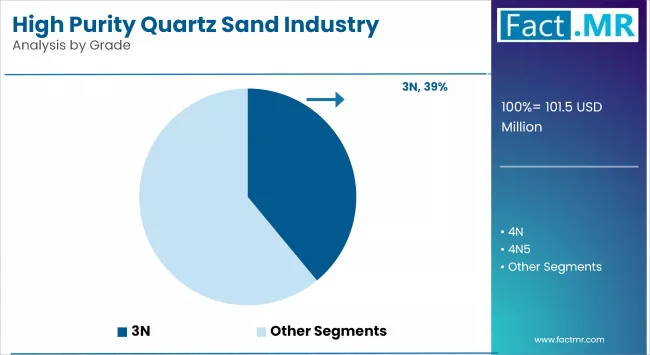
High Purity Quartz Sand Industry Analysis In South Asia & Oceania Market By Grade | Source: Fact.MR
3N grade quartz sand dominates the high purity quartz sand industry analysis in South Asia & Oceania market, as this is primarily used in standard glass production, lighting equipment, and some low-cost electronics. South Asia, particularly India and Sri Lanka, has an abundance of 3N quartz, which is extracted from naturally occurring quartz-rich deposits. While this grade is not suitable for high-end applications such as semiconductors or solar panels, its cost-effectiveness drives regional demand in construction materials, ceramics, and general industrial processes. India uses 3N quartz for traditional applications and exports the surplus to neighboring countries.
4N8 grade quartz is the fastest-growing segment in the high-purity quartz sand industry in South Asia & Oceania. This is an ultra-pure material used in advanced semiconductor and photovoltaic applications. Australia is the most likely regional supplier of such grades, due to its strict processing techniques and cleaner quartz reserves. This grade is popular for precision optical components, silicon wafer production, and high-performance solar cell manufacturing.
However, due to the capital-intensive nature of refining to 4N8, only a few producers in Oceania (most notably Australia) can currently meet this purity standard. As India's semiconductor ambitions grow, 4N8-grade imports may increase, particularly from Australian and East Asian producers.
Solar Cell to Exhibit Leading by Application
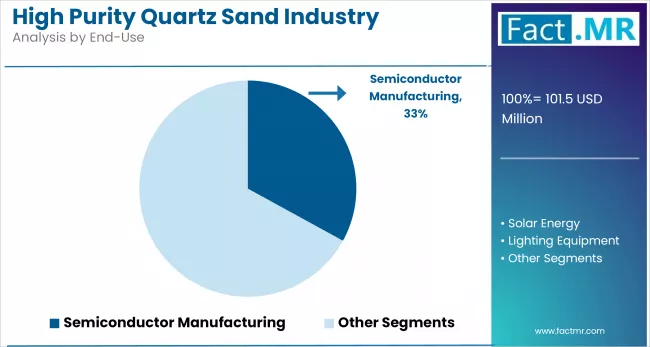
High Purity Quartz Sand Industry Analysis In South Asia & Oceania Market By End Use | Source: Fact.MR
Solar cell dominates the high-purity quartz sand industry analysis in the South Asia & Oceania market. Solar cell manufacturing is a major driver of HPQ demand, especially in countries like Australia, which is rapidly expanding its solar energy infrastructure. HPQ is used to manufacture crucibles and other components required for the growth of monocrystalline silicon ingots, which serve as the foundation for high-efficiency solar cells.
With Australia aiming for more than 82% renewable electricity by 2030 and India promoting solar as a part of its National Solar Mission, demand for HPQ in this sector is steadily increasing. The region is increasingly looking into domestic HPQ sourcing to reduce reliance on imports and secure clean energy supply chains.
Quartz crucibles made from ultrapure HPQ are the fastest-growing segment in the high-purity quartz sand industry in South Asia & Oceania. These are essential in the semiconductor and solar industries because they can withstand high temperatures during the silicon ingot formation process.
Australia's mineral processing capabilities, as well as India's growing interest in semiconductor self-reliance through its "Make in India" program, are driving up local demand for quartz crucibles. The market is gradually developing purification and forming capabilities to support domestic production of high-performance crucibles for solar and chip fabrication applications.
Semiconductor to Exhibit Leading by End-Use
HPQ dominates the high-purity quartz sand industry analysis in the South Asia & Oceania market. HPQ is critical in the semiconductor industry because it allows for the production of quartz crucibles, tubes, and wafers that are used in high-temperature, high-purity environments. India is investing heavily in developing a local chip ecosystem through its "Semicon India Programme," which is opening up new opportunities for HPQ use.
Similarly, Australia's technology R&D ecosystem is looking into semiconductor-grade quartz for precision component fabrication. As the region seeks to reduce its reliance on global semiconductor supply chains, HPQ is becoming an increasingly important raw material.
Glass manufacturing, particularly of specialty and LCD glass, is a significant end-use segment for HPQ in this region. HPQ ensures excellent optical clarity, durability, and thermal shock resistance. South Asia's expanding architectural and consumer electronics markets, combined with Oceania's demand for high-performance glass in solar panels and electronics, ensure a constant demand for high-purity quartz. India and Australia are both showing an increased interest in upgrading their glass-making infrastructure with high-purity raw materials.
Competitive Analysis
The High Purity Quartz Sand (HPQS) market in South Asia and Oceania is becoming increasingly competitive, owing to the expanding solar energy sector and rising demand for semiconductors. Photovoltaic cells, semiconductors, and specialty glass are among the most common HPQS applications in this region. The market is characterized by a mix of established and emerging suppliers, all competing for a share of the growing demand.
The competitive landscape in this region is moderately fragmented, with both international and local players. Major companies include both global and regional players. Product quality, purity levels, supply chain efficiency, and pricing strategies all have an impact on the competitive landscape. Companies are focusing on increasing production capacity, improving product purity, and forming strategic alliances to gain a competitive advantage.
Several factors influence HPQS demand in South Asia and Oceania. The expansion of the solar energy industry, aided by government initiatives and rising environmental awareness, is a major driver. The expansion of the semiconductor industry, particularly in countries with manufacturing hubs, is also helping to drive market growth. The market, however, faces challenges such as the availability of high-quality raw materials, transportation costs, and stringent regulatory requirements.
Key players in the market are Australian Silica Quartz Pty Ltd., Iluka Resources, Ultra HPQ, and other players.
Recent Development
- In July 2024, the National Institute of Standards and Technology (NIST) highlighted the significant water usage in semiconductor facilities, emphasizing the need for efficient ultra-pure water (UPW) systems. The CHIPS Act encourages projects to reduce, recycle, and treat process wastewater to the maximum extent possible.
- In April 2023, Australian Silica Quartz received a grant of US$131,656 for the exploration of the White Springs High Purity Quartz project in Australia under the Queensland government's Critical Minerals Collaborative Exploration Incentive Scheme (EIS).
Segmentation
Segmentation of High Purity Quartz Sand Industry Analysis in South Asia & Oceania Market
-
By Grade :
- 3N
- 4N
- 4N5
- 4N6
- 4N7
- 4N8
- 5N
-
By Application :
- Wafer Processing
- Crucibles
- Quartz Lighting
- Xenon for Automotive
- Halogen Lamps
- Ultra-high-Performance Lamps
- High-intensity Discharge Lamps
- Others
- Solar Cells
- Optical Lenses
- Quartz Fibers
- Specialty Glass
- LCD Glass
- Lenses
- Ceramics
- Epoxy Molding Compounds
- Others
-
By End-Use :
- Semiconductor Manufacturing
- Solar Energy
- Lighting Equipment
- Telecommunication Equipment Production
- Optical Product Manufacturing
- Polymer Modification
- Glass Manufacturing
- Others
-
By Region :
- India
- Thailand
- Indonesia
- Malaysia
- Australia & New Zealand
- Rest of South Asia & Oceania
Frequently Asked Questions
What is the Global High Purity Quartz Sand Industry Analysis in South Asia & Oceania Market size in 2025?
Who are the Major Players Operating in the High Purity Quartz Sand Industry Analysis in South Asia & Oceania Market?
What is the Estimated Valuation of the High Purity Quartz Sand Industry Analysis in South Asia & Oceania Market by 2035?
What value CAGR Did the High Purity Quartz Sand Industry Analysis in South Asia & Oceania Market Exhibit over the Last Five Years?
Who worked on this report


Preview the report firsthand - request a free sample
Free SampleGet the brochure for pricing and purchase details
Download PDF