- Market Value (2025): USD 16.6 Bn
- Estimated Value (2026): USD 18.9 Bn
- Forecast Value (2036): USD 67.6 Bn
- CAGR (2026-2036): 13.6%
What is the High Speed DDR5 DRAM Module Market forecast to be worth by 2036?
The market is projected to grow from USD 18.9 billion in 2026 to USD 67.6 billion by 2036, registering a CAGR of 13.6%.
- The High Speed DDR5 DRAM Module market reached USD 16.6 billion in 2025.
- Demand is forecast to increase from USD 18.9 billion in 2026 to USD 67.6 billion by 2036.
- The market is forecast to record 13.6% CAGR from 2026 to 2036.
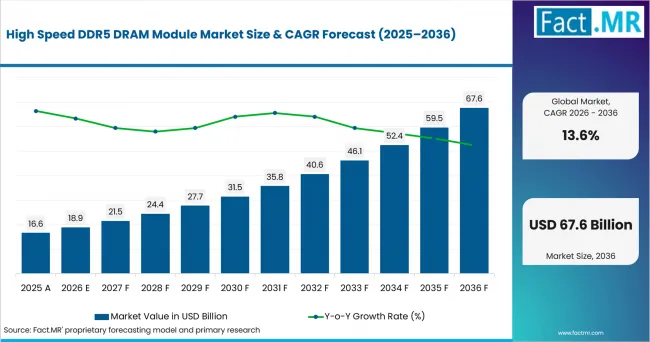
High Speed Ddr5 Dram Module Market Value Analysis | Source: Fact.MR
What are the defining numbers behind High Speed DDR5 DRAM Module Market growth?
An absolute dollar opportunity of USD 48.6 billion is expected between 2026 and 2036.
- Demand Drivers in the Market
- Expansion of AI and high-performance computing is increasing the memory capacity required in server nodes. The U.S. Department of Energy operates AI testbeds across seven national laboratories using CPU, GPU and heterogeneous computing architectures. These systems evaluate different memory architectures and create demand for server memory that can support large datasets alongside accelerator-based processing.
- New server platforms are standardizing around multi-channel DDR5 memory. Open Compute Project-listed servers support configurations such as 12 DDR5 RDIMM channels at up to 6,400 MT/s, allowing processors to access more memory bandwidth than earlier server generations. Each platform transition creates module demand during new server production and infrastructure refresh cycles.
- AI servers require substantial system memory in addition to the high-bandwidth memory attached directly to accelerators. An Open Compute Project-listed 16-GPU AI system uses twelve 96 GB DDR5 RDIMMs per CPU alongside HBM3e GPU memory. This configuration shows that DDR5 modules support operating systems and data preparation while accelerators handle parallel computation.
- Growth in cloud and data-centre workloads is increasing demand for servers with higher memory density. The U.S. Department of Energy identifies large AI data centres as a rapidly expanding class of computing infrastructure in which thousands of specialized chips operate in coordinated cycles. More processors and nodes increase the number of DDR5 sockets installed across server clusters.
- Faster server processors and PCIe interfaces are raising the value of balanced memory subsystems. Open Compute Project server designs combine DDR5 RDIMMs with PCIe 5.0 connectivity and processors supporting several memory channels. Server manufacturers therefore qualify modules against platform-specific speed and population requirements before volume production.
- Data-centre operators continue to prioritize computing efficiency. The U.S. Department of Energy states that server efficiency depends on the amount of useful workload processed per watt. Higher-capacity DDR5 modules allow operators to increase memory per server without adding the same number of physical nodes, although processor utilization and cooling design also affect total efficiency.
- Key Segments Analyzed
- Registered DDR5 Modules account for 48.0% of Product Type in 2026, supported by their use in server platforms requiring multiple memory channels and stable operation across populated DIMM slots.
- Artificial Intelligence Servers represent 36.0% of Application in 2026 as AI training and inference systems require substantial CPU memory alongside accelerator memory.
- Server Manufacturers account for 41.0% of End User in 2026 because memory modules must be qualified against processor platforms and motherboard configurations before system production.
- Direct OEM Sales hold 57.0% of Distribution Channel in 2026, reflecting platform-specific qualification and volume procurement by server manufacturers.
- 64 GB Modules represent 32.0% of Memory Capacity in 2026 because they provide a practical balance between installed capacity and socket utilization across enterprise and data-centre servers.
- Analyst Opinion at Fact.MR
- Shambhu Nath Jha, Principal Consultant at Fact.MR, states, “DDR5 module demand is tied to the amount of memory installed per server and the rate at which data-centre operators replace earlier platforms. AI systems require high-bandwidth accelerator memory, but they also depend on substantial CPU memory for data preparation and system operations. Suppliers that combine higher module speeds with platform qualification and consistent volume delivery are positioned to secure direct OEM programmes as the market expands from USD 18.9 billion in 2026 to USD 67.5 billion by 2036.”
- Strategic Implications
- Module suppliers should align product qualification with current server platforms supporting DDR5 RDIMMs at up to 6,400 MT/s. Open Compute Project-listed systems show that channel count and supported speed vary according to processor and DIMM population, making platform-specific validation important.
- Manufacturers should expand higher-capacity RDIMM portfolios for AI and high-performance computing systems. Current open server designs combine multiple DDR5 channels with GPU accelerators, creating demand for substantial CPU-side memory alongside HBM-equipped accelerator cards.
- Commercial teams should work directly with server manufacturers during qualification. Module speed and capacity must match motherboard routing, processor memory controllers and the number of DIMMs installed per channel.
- Suppliers should maintain traceability across DRAM components and assembled modules because server OEMs require consistent electrical performance across production batches.
- Product planning should distinguish DDR5 RDIMMs from HBM. DDR5 modules provide expandable system memory through processor memory channels, while HBM is packaged close to accelerators for very high bandwidth. Demand can rise for both technologies within the same AI server.
How does the High Speed DDR5 DRAM Module Market break down by segment?
The market is segmented by Product Type, Application, End User, Distribution Channel and Memory Capacity.
Why do Registered DDR5 Modules lead Product Type?
Registered DDR5 Modules are projected to account for a 48.0% share in 2026.
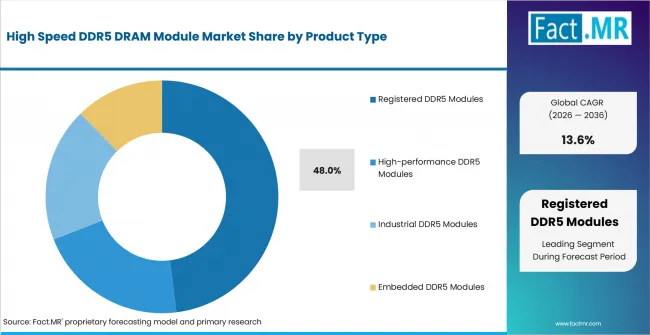
High Speed Ddr5 Dram Module Market Analysis By Product Type | Source: Fact.MR
Registered modules are used in servers where processors access memory through several channels and motherboards may contain multiple DIMM sockets. The register buffers command and address signals before they reach the DRAM components, supporting stable operation in configurations with higher electrical loading.
Current Open Compute Project-listed servers include twelve-channel DDR5 RDIMM configurations operating at up to 6,400 MT/s. This established role in data-centre platforms supports the share of registered modules within the product mix.
Why do Artificial Intelligence Servers lead Application?
Artificial Intelligence Servers are projected to account for a 36.0% share in 2026.
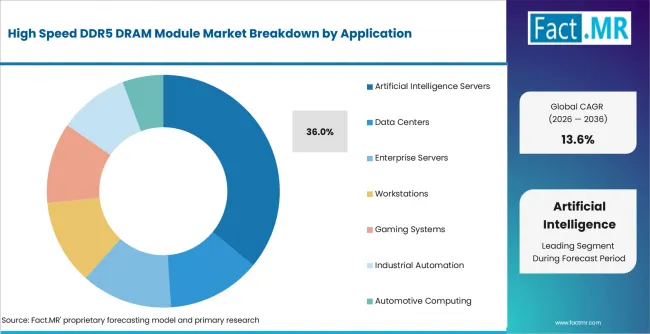
High Speed Ddr5 Dram Module Market Analysis By Application | Source: Fact.MR
AI servers require system memory for operating environments and data preparation. DDR5 modules also support CPU-side workloads that coordinate data movement between storage and accelerator resources.
An Open Compute Project-listed 16-GPU system uses twelve 96 GB DDR5 RDIMMs per CPU alongside HBM3e on each accelerator. The configuration illustrates how DDR5 and accelerator memory perform different roles within the same AI server.
Why do Server Manufacturers lead End User?
Server Manufacturers are projected to account for a 41.0% share in 2026.
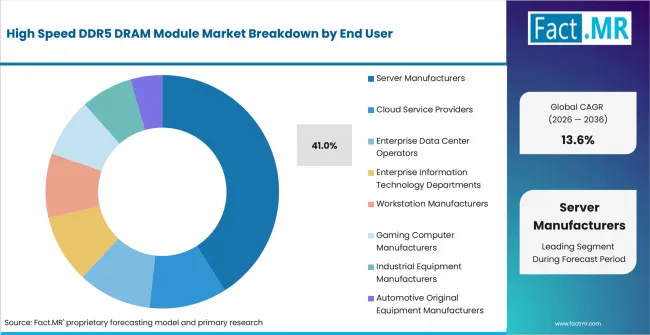
High Speed Ddr5 Dram Module Market Analysis By End User | Source: Fact.MR
Server manufacturers select memory during motherboard and platform development. Supported speed depends on the processor generation and the number of modules installed per channel. The same server may operate at a higher transfer rate with one DIMM per channel and a lower rate when a second module is added.
Open Compute Project-listed servers show configurations ranging from twelve DDR5 channels with one DIMM per channel to systems supporting two DIMMs across eight channels. Module suppliers therefore work with server manufacturers to complete compatibility and reliability testing before commercial deployment.
Why do Direct OEM Sales lead Distribution Channel?
Direct OEM Sales are projected to account for a 57.0% share in 2026.
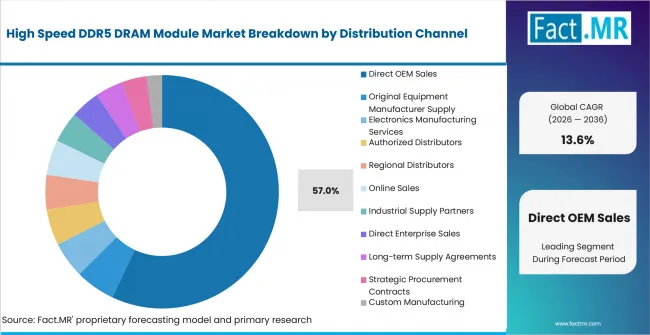
High Speed Ddr5 Dram Module Market Analysis By Distribution Channel | Source: Fact.MR
Direct procurement allows server manufacturers to qualify module speed and capacity against a defined processor and motherboard design. OEMs also require traceability and planned supply volumes so that memory configurations remain consistent across each system programme.
High-volume server production can involve several modules per node. A direct commercial relationship allows the module supplier to coordinate forecasts and engineering changes with the OEM rather than supplying interchangeable inventory through a general distribution channel.
Why do 64 GB Modules lead Memory Capacity?
64 GB Modules are projected to account for a 32.0% share in 2026.
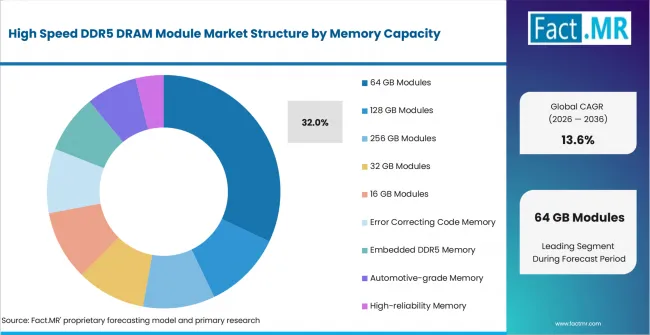
High Speed Ddr5 Dram Module Market Analysis By Memory Capacity | Source: Fact.MR
A 64 GB module allows server manufacturers to increase total system memory while retaining DIMM slots for later expansion. It can be deployed across enterprise servers and data-centre nodes without moving immediately to higher-capacity modules that may carry a greater acquisition cost.
The capacity also supports balanced server configurations across multiple memory channels. For example, a twelve-channel platform populated with 64 GB modules provides 768 GB of system memory, while allowing manufacturers to scale the same motherboard design through different DIMM capacities.
What is accelerating High Speed DDR5 DRAM Module Market adoption, and what is holding it back?
Drivers Impact Analysis
| Driver | % Impact on CAGR | Geographic Relevance | Impact Timeline |
|---|---|---|---|
| Technology Innovation & R&D | High | Global | 2026-2036 |
| Regulatory & Policy Drivers | Medium-High | North America, Europe | 2026-2032 |
| End-User Industry Expansion | High | Asia Pacific, MEA | 2026-2036 |
| Operational & Cost Efficiency | Medium | Global | 2026-2036 |
Source: Fact.MR analysis. Updated Aug 11, 2026
Restraints Impact Analysis
| Restraint | % Impact on CAGR | Geographic Relevance | Impact Timeline |
|---|---|---|---|
| Capital Intensity & Investment | Medium | Developing Markets | 2026-2030 |
| Supply Chain & Raw Material | Medium | Global | 2026-2028 |
| Workforce & Capability Gaps | Low-Medium | Africa, Latin America | 2026-2036 |
Source: Fact.MR analysis. Updated Aug 11, 2026
Which countries are scaling the High Speed DDR5 DRAM Module Market fastest?
- South Korea: South Korea is forecast to expand at a 14.8% CAGR. Memory semiconductor exports reached USD 9.05 billion in May 2025, increasing 32.0% from the previous year as demand grew for high-value products such as DDR5 and HBM. The country’s concentration of DRAM production supports early access to newer memory generations and closer coordination between chip manufacturing and module qualification.
- USA: The USA is forecast to register a 14.0% CAGR. Micron announced USD 200 billion in U.S. semiconductor manufacturing and research investment covering memory production for AI and other advanced applications. Expansion of domestic memory capacity and AI infrastructure strengthens demand for qualified DDR5 modules supplied to server manufacturers and data-centre operators.
- Taiwan: Taiwan is projected to expand at a 13.5% CAGR. The country combines semiconductor production with a broad AI-server supply chain. Taiwan’s Ministry of Economic Affairs identifies the country as a major provider of AI servers, creating local demand for DDR5 RDIMMs installed alongside accelerator memory in computing systems.
- Japan: Japan is forecast to grow at a 13.1% CAGR. Government industrial planning places semiconductors and computing resources among the foundations required for AI deployment. Investment in advanced computing infrastructure supports demand for server memory, while Japan’s established electronic-component supply chain provides technical support for module production and qualification.
- Germany: Germany is projected to expand at a 12.7% CAGR. Policy efforts to strengthen digital sovereignty and European semiconductor capacity support investment in data infrastructure and computing systems. Demand is concentrated in enterprise servers and industrial computing applications that require qualified memory configurations with long product lifecycles.
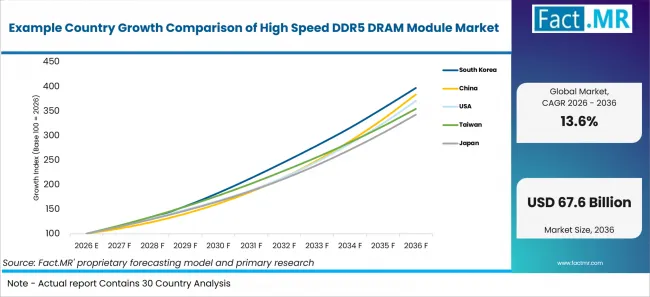
Example Country Growth Comparison Of High Speed Ddr5 Dram Module Market | Source: Fact.MR
Country-wise CAGR Forecast, 2026-2036
| Country | CAGR |
|---|---|
| South Korea | 14.8% |
| USA | 14.0% |
| Taiwan | 13.5% |
| Japan | 13.1% |
| Germany | 12.7% |
Source: Fact.MR analysis. Updated Aug 11, 2026
What is driving the High Speed DDR5 DRAM Module market in South Korea?
South Korea is projected to register a CAGR of 14.8% from 2026 to 2036.
South Korea’s DRAM manufacturing base allows module producers and server customers to qualify new memory generations close to the source of the underlying chips. Memory semiconductor exports increased 32.0% in May 2025 as demand rose for DDR5 and other high-value memory products.
The country’s suppliers serve global server and data-centre programmes. This supports demand for registered modules with higher transfer rates and capacities, particularly where customers require consistent DRAM sourcing across large production runs.
What is driving the High Speed DDR5 DRAM Module market in USA?
The USA is projected to register a CAGR of 14.0% from 2026 to 2036.
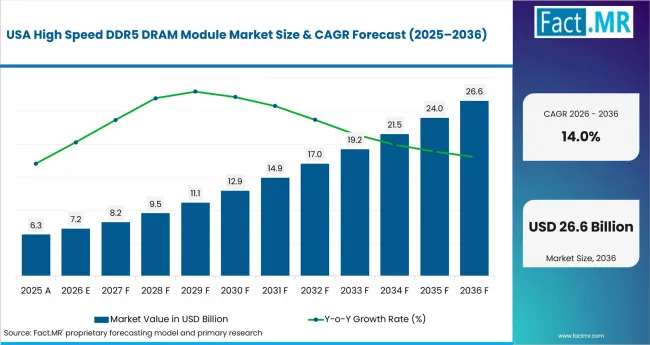
High Speed Ddr5 Dram Module Market Country Value Analysis | Source: Fact.MR
Growth is supported by investment in domestic memory production and AI infrastructure. Micron’s announced USD 200 billion programme includes semiconductor manufacturing and research intended to strengthen U.S. memory capacity for AI and other critical industries.
Data-centre operators also continue to deploy servers with larger memory footprints. DDR5 RDIMMs provide expandable system memory for processors, complementing the HBM installed next to AI accelerators.
What is driving the High Speed DDR5 DRAM Module market in Taiwan?
Taiwan is projected to register a CAGR of 13.5% from 2026 to 2036.
Taiwan holds a substantial position in AI-server manufacturing. Its domestic supply chain covers server assembly and several supporting components, creating direct demand for DDR5 modules during system integration.
Server manufacturers qualify modules according to motherboard layout and processor memory-channel requirements. Proximity to system production gives local module suppliers an opportunity to support engineering samples and volume procurement within the same manufacturing ecosystem.
What is driving the High Speed DDR5 DRAM Module market in Japan?
Japan is projected to register a CAGR of 13.1% from 2026 to 2036.
Japan’s industrial strategy treats semiconductors and computing resources as critical infrastructure for AI development. Government planning is intended to increase investment in advanced digital capacity, supporting demand for enterprise and high-performance computing systems.
Japan also has established capabilities in semiconductor materials and electronic components. These capabilities support module production through precision components and manufacturing equipment, while server replacement creates recurring demand for qualified DDR5 configurations.
Who leads the High Speed DDR5 DRAM Module Market?
Samsung Electronics Co., Ltd., SK hynix Inc. and Micron Technology, Inc. hold strong positions because they manufacture DRAM chips and participate directly in server-memory supply. Control over DRAM production supports access to newer densities and speeds while reducing dependence on external component sourcing.
Kingston Technology Company, Inc., ADATA Technology Co., Ltd., TEAMGROUP Inc. and Apacer Technology Inc. compete through module design and assembly. Their position depends on DRAM sourcing and qualification capability. Product availability across several capacities and regional distribution also affects customer selection.
Corsair Gaming, Inc. and G.SKILL International Enterprise Co., Ltd. are more visible in performance desktop and workstation memory. Crucial operates as Micron’s consumer-facing memory brand. These companies participate in the broader DDR5 module environment, although registered server modules and direct OEM programmes require a different qualification model from retail memory.
Competition in server modules centres on transfer speed and capacity. Error-correction support and compatibility with processor platforms also influence selection. Buyers require stable performance across populated memory channels rather than peak speed under a single-module configuration.
Supply consistency creates a further advantage. Server manufacturers procure modules against defined bills of materials and validate any change in DRAM components or module design. Suppliers that maintain component traceability and engineering support are more likely to retain direct OEM programmes.
Which companies are the key providers?
Key companies include Samsung Electronics Co., Ltd.; SK hynix Inc.; Micron Technology, Inc.; Kingston Technology Company, Inc.; ADATA Technology Co., Ltd.; Corsair Gaming, Inc.; Crucial, a Micron consumer brand; G.SKILL International Enterprise Co., Ltd.; TEAMGROUP Inc.; and Apacer Technology Inc.
- Samsung Electronics Co., Ltd.
- SK hynix Inc.
- Micron Technology, Inc.
- Kingston Technology Company, Inc.
- ADATA Technology Co., Ltd.
- Corsair Gaming, Inc.
- Crucial, a Micron consumer brand
- G.SKILL International Enterprise Co., Ltd.
- TEAMGROUP Inc.
- Apacer Technology Inc.
What is the report’s scope and coverage?
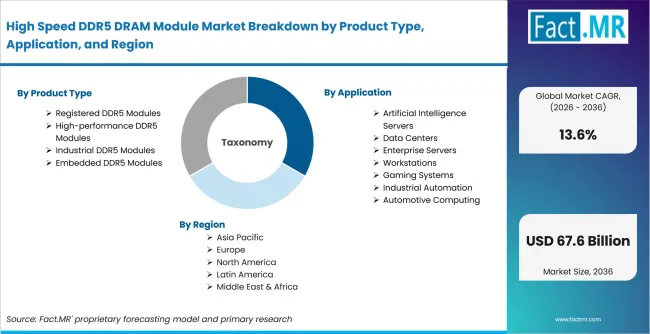
High Speed Ddr5 Dram Module Market Breakdown By Product Type, Application, And Region | Source: Fact.MR
| Attribute | Details |
|---|---|
| Quantitative Units | USD billion |
| Market Definition | DDR5 memory modules designed for high-speed computing and server applications, combining DDR5 DRAM components with a printed circuit board and supporting devices required to operate within processor memory-channel architectures |
| Product Type | Registered DDR5 Modules; High-performance DDR5 Modules; Industrial DDR5 Modules; Embedded DDR5 Modules |
| Application | Artificial Intelligence Servers; Data Centers; Enterprise Servers; Workstations; Gaming Systems; Industrial Automation; Automotive Computing |
| End User | Server Manufacturers; Cloud Service Providers; Enterprise Data Center Operators; Enterprise Information Technology Departments; Workstation Manufacturers; Gaming Computer Manufacturers; Industrial Equipment Manufacturers; Automotive Original Equipment Manufacturers |
| Distribution Channel | Direct OEM Sales; Original Equipment Manufacturer Supply; Electronics Manufacturing Services; Authorized Distributors; Regional Distributors; Online Sales; Industrial Supply Partners; Direct Enterprise Sales; Long-term Supply Agreements; Strategic Procurement Contracts; Custom Manufacturing Agreements |
| Memory Capacity | 64 GB Modules; 128 GB Modules; 256 GB Modules; 32 GB Modules; 16 GB Modules; Error Correcting Code Memory; Embedded DDR5 Memory; Automotive-grade Memory; High-reliability Memory |
| Regions Covered | North America; Latin America; Europe; East Asia; South Asia and Oceania; Middle East and Africa |
| Countries Covered | South Korea; USA; Taiwan; Japan; Germany |
| Key Companies Profiled | Samsung Electronics Co., Ltd.; SK hynix Inc.; Micron Technology, Inc.; Kingston Technology Company, Inc.; ADATA Technology Co., Ltd.; Corsair Gaming, Inc.; Crucial; G.SKILL International Enterprise Co., Ltd.; TEAMGROUP Inc.; Apacer Technology Inc. |
| Forecast Period | 2026 to 2036 |
| Approach | Hybrid top-down and bottom-up assessment using server shipments, memory content per system, module capacity, DDR5 pricing, channel mix and supplier portfolios |
Source: Fact.MR analysis. Updated Aug 11, 2026
How is the market segmented?
-
Product type
- Registered DDR5 Modules
- High-performance DDR5 Modules
- Industrial DDR5 Modules
- Embedded DDR5 Modules
-
Application
- Artificial Intelligence Servers
- Data Centers
- Enterprise Servers
- Workstations
- Gaming Systems
- Industrial Automation
- Automotive Computing
-
End User
- Server Manufacturers
- Cloud Service Providers
- Enterprise Data Center Operators
- Enterprise Information Technology Departments
- Workstation Manufacturers
- Gaming Computer Manufacturers
- Industrial Equipment Manufacturers
- Automotive Original Equipment Manufacturers
-
Distribution channel
- Direct OEM Sales
- Original Equipment Manufacturer Supply
- Electronics Manufacturing Services
- Authorized Distributors
- Regional Distributors
- Online Sales
- Industrial Supply Partners
- Direct Enterprise Sales
- Long-term Supply Agreements
- Strategic Procurement Contracts
- Custom Manufacturing Agreements
-
Memory Capacity
- 64 GB Modules
- 128 GB Modules
- 256 GB Modules
- 32 GB Modules
- 16 GB Modules
- Error Correcting Code Memory
- Embedded DDR5 Memory
- Automotive-grade Memory
- High-reliability Memory
-
By Region
- North America
- Latin America
- Europe
- East Asia
- South Asia and Oceania
- Middle East and Africa
Bibliography
- Ministry of Electronics and Information Technology, India. (2024). Annual Report 2023-2024. Government of India.
- Ministry of Electronics and Information Technology, India. (2025). Estimation and Measurement of India’s Digital Economy. Government of India.
- Ministry of Economy, Trade and Industry, Japan. (2025). Industrial Structure in 2040 Led by Growth Investment. Government of Japan.
- Ministry of Economy, Trade and Industry, Japan. (2025). Reference Materials for the Committee on the New Direction of Economic and Industrial Policies. Government of Japan.
- Ministry of Economic Affairs, Taiwan. (2024). Administrative Report on Taiwan’s AI Server and Semiconductor Supply Chain. Government of Taiwan.
- Ministry of Economic Affairs, Taiwan. (2025). Administrative Report on Semiconductor and AI Industry Development. Government of Taiwan.
- Ministry of Trade, Industry and Energy, Republic of Korea. (2025). January 2025 Information and Communications Technology Export and Import Trends. Government of the Republic of Korea.
- Ministry of Trade, Industry and Energy, Republic of Korea. (2025). May 2025 Export and Import Trends. Government of the Republic of Korea.
- National Data Administration, China. (2025). National Data Infrastructure Construction Guidelines. Government of China.
- National Development and Reform Commission, China. (2025). National Data Infrastructure Construction Guidelines. Government of China.
- U.S. Department of Commerce. (2025). Micron Technology Announces USD 200 Billion Investment in U.S. Memory Semiconductor Manufacturing and Research. Government of the United States.
This Report Answers
- The report provides strategic intelligence on the High Speed DDR5 DRAM Module Market across Product Type, Application, End User, Distribution Channel and Memory Capacity categories that shape server-memory demand.
- Segment analysis covers Registered DDR5 Modules, Artificial Intelligence Servers, Server Manufacturers, Direct OEM Sales and 64 GB Modules as the leading categories within the 2026 market.
- Country outlook evaluates South Korea, China and the USA alongside Taiwan and Japan. Germany and India complete the growth comparison across the profiled markets.
- Competitive analysis profiles Samsung Electronics, SK hynix and Micron Technology alongside Kingston Technology and ADATA Technology. Corsair, Crucial, G.SKILL, TEAMGROUP and Apacer complete the provider set.
- Memory-capacity assessment covers 64 GB, 128 GB and 256 GB Modules alongside 32 GB and 16 GB Modules. Error Correcting Code Memory, Embedded DDR5 Memory, Automotive-grade Memory and High-reliability Memory complete the capacity view.
What does the High Speed DDR5 DRAM Module Market cover?
The market covers DDR5 memory modules designed for high-speed computing and server applications. These modules combine DDR5 DRAM components with a printed circuit board and supporting devices required to operate within a processor’s memory-channel architecture.
The assessment includes registered DDR5 modules and the other product types identified in the segmentation. Modules supplied for AI servers and enterprise computing systems are included when they are sold as complete memory assemblies.
Memory capacities are assessed according to finished-module configuration. The market measures module revenue rather than the value of individual DRAM chips or complete servers.
What is included in the scope?
The scope includes DDR5 registered memory modules supplied for servers. Other high-speed DDR5 module formats are included when sold for the applications and end users identified in the segmentation.
- Applications include artificial intelligence servers and other enterprise or high-performance computing systems. End-user coverage includes server manufacturers and organizations purchasing qualified DDR5 modules for system deployment.
- Direct OEM sales are included together with the other identified distribution channels. OEM revenue covers modules supplied against platform-specific qualification and volume agreements.
- Memory-capacity coverage includes 64 GB modules and the other capacities identified in the segmentation. Module capacity refers to the usable memory installed on one finished DIMM.
What is excluded from the scope?
Individual DDR5 DRAM chips sold without assembly into a module are excluded.
- HBM products are outside the market because they are packaged close to processors or accelerators and do not use the DDR5 DIMM form factor.
- DDR4 and earlier memory generations are excluded. LPDDR products and embedded memory soldered directly onto a system board also fall outside the market.
- Complete servers and motherboards are not counted as module revenue. Memory controllers and processors are treated as adjacent components.
- Used or refurbished modules are excluded unless they are sold through a formal channel and included within the stated market definition.
How Was the Analysis Built?
The analysis draws on 120+ sources and 35+ company portfolios. It covers 25+ countries and more than 20 industry interviews.
- Primary Research: Interviews with DRAM manufacturers and memory-module assemblers examine component sourcing and qualification requirements. Server manufacturers provide insight into capacity selection and DIMM population. Distributors and data-centre procurement teams assess pricing and channel preferences.
- Desk Research: The review covers server-platform specifications and national semiconductor policy. Memory export data and computing-infrastructure investment are assessed. Company disclosures and product portfolios are used to verify market participation. Every external source used in the analysis is included in the bibliography.
- Market Sizing and Forecasting: Estimates combine server shipments and average DDR5 module content per system. The model considers memory capacity mix and module pricing. Direct OEM penetration and country-level data-centre expansion are incorporated into the forecast.
- Data Validation and Update Cycle: Findings are cross-checked against public server specifications and semiconductor investment announcements. Supplier portfolios are reviewed for DDR5 speed and capacity changes. Updates account for processor-platform transitions and DRAM pricing. Module qualification and regional production developments are also assessed.
Frequently Asked Questions
What is the High Speed DDR5 DRAM Module market size in 2026?
At what CAGR is the High Speed DDR5 DRAM Module market expected to grow?
What is the projected High Speed DDR5 DRAM Module market size by 2036?
Which country records the highest listed CAGR?
Which Product Type accounts for the largest share?
Which Application accounts for the largest share?
Which End User accounts for the largest share?
Which Distribution Channel accounts for the largest share?
Which Memory Capacity accounts for the largest share?
Which companies are included in the market assessment?
Who worked on this report


Preview the report firsthand - request a free sample
Free SampleGet the brochure for pricing and purchase details
Download PDF