High‑Voltage‑Resilient Additives Market (2026 - 2036)

High Voltage Resilient Additives Market is segmented by Additive Function (Oxidation Inhibitors, Corrosion Inhibitors / Metal Deactivators, Conductivity Modifiers / Dielectric Stabilizers, Anti-Foam & Other Aids), Application System (E-Transmission Fluids, Dielectric Coolants (Immersion), Thermal Management Coolants, Insulating Oils), Compatibility Target (Copper Protection, Aluminum Protection, Polymer Seal Compatibility, Multi-Material Packages), Customer Type (Additive Packages to Oil Blenders, OEM Co-Development, Tier-1 Drivetrain Suppliers, Specialty Fluid Formulators), and Region. Forecast for 2026 to 2036.

Core Findings

    High-Voltage-Resilient Additives Market Forecast 2026 to 2036

    In 2025, the high-voltage-resilient additives market was valued at USD 330 million. Based on Fact MR’s analysis, demand for high-voltage-resilient additives is estimated to grow to USD 379 million in 2026 and USD 1,120 million by 2036. FMR projects a CAGR of 13.0% during the forecast period.

    The absolute dollar growth from 2026 to 2036 is USD 741 million. This growth is driven by the increasing demand for additives used in high-voltage applications such as electric vehicles, renewable energy storage, and industrial machinery. These additives help improve the performance, safety, and durability of materials under high-voltage conditions. However, market challenges such as regulatory complexities and raw material availability could influence growth in some regions.

    China leads with a CAGR of 14.7%, driven by the rapidly expanding electric vehicle market and renewable energy initiatives. Brazil follows with a 13.6% CAGR, supported by the rising demand for high-voltage materials in industrial applications. South Korea grows at 13.1%, benefiting from advancements in electric vehicle and energy storage technologies. The USA shows growth at 12.6%, driven by increasing adoption of electric mobility and renewable energy systems. Germany and Europe grow at 12.5% and 12.4%, respectively, fueled by strong industrial and automotive demand for high-voltage materials. The UK shows growth at 12.3%, reflecting increasing adoption of electric vehicles and clean energy technologies. Japan experiences slower growth at 11.2%, as the market matures, but remains a key player in high-voltage applications.
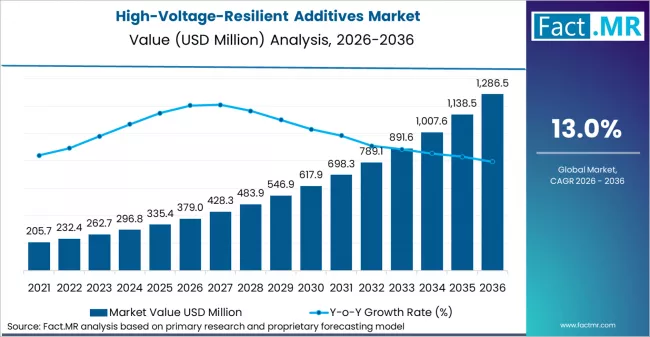
    High Voltage Resilient Additives Market Market Value Analysis

    High‑Voltage‑Resilient Additives Market Definition

    The High‑Voltage‑Resilient Additives Market refers to the production and sale of chemical additives formulated to enhance the electrical, thermal, and mechanical stability of materials used in high‑voltage applications. These additives help polymers, insulating fluids, and composites resist degradation, corona discharge, tracking, and thermal stress in environments such as power cables, transformers, switchgear, and EV power electronics. Their primary function is to improve dielectric performance and prolong service life under elevated electrical stress. Key end uses include electrical utilities, renewable energy systems, industrial power equipment, and electric vehicles requiring robust insulation materials.

    Market Inclusions

    This report covers global and regional market sizes for high‑voltage‑resilient additives with a defined forecast period. It includes segment breakdowns by additive type (antioxidants, anti‑tracking agents, corona suppression agents), application (cables, insulating fluids, molded composites), and end user (power generation, transmission and distribution, EVs). Pricing trends, raw material supply, and trade flow data are included to capture market dynamics.

    Market Exclusions

    The scope excludes unrelated additive classes used solely for aesthetic, fragrance, or non‑electrical performance purposes. Finished electrical equipment and complete polymer or composite systems not focused on additive performance are not covered. Niche chemistries for low‑voltage or consumer products without high‑voltage performance requirements are omitted.

    Research Methodology

    • Primary Research: Interviews were conducted with material scientists, electrical engineers, and additive suppliers.
    • Desk Research: Data was sourced from industry reports, standards bodies, and trade statistics.
    • Market‑Sizing and Forecasting: A hybrid model was used, combining top‑down demand forecasts with bottom‑up shipment and revenue data.
    • Data Validation and Update Cycle: Findings were validated through expert review and aligned with recent production and trade figures, with periodic updates.

    High-Voltage-Resilient Additives Market Summary

    • High-Voltage-Resilient Additives Market Definition
      • The High Voltage Resilient Additives Market refers to the production and sale of chemical additives specifically designed to enhance the electrical, thermal, and mechanical stability of materials in high-voltage applications. These additives are used in various systems such as power cables, transformers, and electric vehicle (EV) power electronics to improve dielectric performance, reduce corona discharge, and enhance resistance to tracking and thermal stress. Key end uses include electrical utilities, renewable energy systems, and electric vehicles, where reliable insulation and long-term performance under high-voltage conditions are critical.
    • Demand Drivers in the Market
      • Expansion of Electric Vehicle (EV) Market: The rapid growth of the EV market, coupled with rising demand for efficient high-voltage systems in electric drivetrains and power electronics, is fueling the demand for high-voltage-resilient additives.
      • Renewable Energy Growth: Increasing investments in renewable energy storage and transmission systems, where high-voltage-resilient materials are crucial for safe and efficient operations, are driving the demand for these additives.
      • Technological Advancements in Electronics: The rise of high-performance electronics, which require stable materials under high voltage, has intensified the need for additives that enhance performance and durability.
      • Regulatory Push for Safety and Efficiency: Stricter safety and performance regulations related to voltage resilience, dielectric strength, and thermal stability are propelling the adoption of high-performance additives in high-voltage systems.
    • Key Segments Analyzed in the FMR Report
      • Additive Function: Oxidation Inhibitors are projected to capture a significant share of the market by 2026 due to their critical role in preventing material degradation and extending the life of high-voltage components.
      • Application System: E-Transmission Fluids are expected to dominate the market with a 45% share by 2026, driven by the rapid adoption of electric vehicles and the need for efficient fluid systems in electric drivetrains.
      • Customer Type: Additive Packages to Oil Blenders will capture the largest share, accounting for 51% of the market by 2026, due to their role in formulating specialized high-voltage lubricants for automotive and industrial systems.
    • Analyst Opinion at FMR
      • Fact MR analysts predict, "The High Voltage Resilient Additives market is set for substantial growth, driven by the increasing electrification of the automotive and renewable energy sectors. As demand for high-voltage systems rises, so will the need for additives that ensure safety, efficiency, and longevity in these applications."
    • Strategic Implications/Executive Takeaways
      • Focus on High-Performance Solutions: Manufacturers should prioritize the development of high-performance additives that provide superior dielectric and thermal stability to meet the evolving needs of the EV and renewable energy sectors.
      • Explore Regional Growth Opportunities: Countries like China, Brazil, and the USA, which are witnessing a rise in EV adoption and renewable energy infrastructure, represent significant growth opportunities for high-voltage-resilient additives.
      • Emphasize Safety and Compliance: With increasing regulatory pressures, there is a growing opportunity to create additives that comply with stringent safety standards, especially for high-voltage systems in electric vehicles and industrial applications.
    • Methodology
      • Primary Research: Interviews were conducted with material scientists, electrical engineers, and additive suppliers to gain insights into emerging trends and market needs for high-voltage resilience.
      • Desk Research: Data from industry reports, regulatory bodies, and trade associations were analyzed to understand the dynamics driving high-voltage resilient additive demand.
      • Market Sizing and Forecasting: A hybrid model combining top-down projections for high-voltage application growth with bottom-up data on additive demand was used to forecast market trends and opportunities.

    Segmental Analysis

    High-Voltage-Resilient Additives Market Analysis by Customer Type
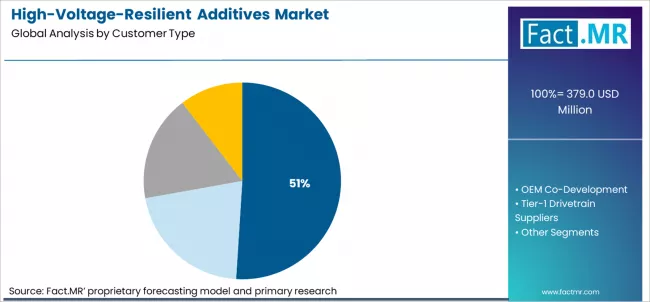
    High Voltage Resilient Additives Market Analysis By Customer Type

    • Market Overview: Additive packages to oil blenders are expected to capture 51% of the high-voltage-resilient additives market by 2026. Oil blenders play a key role in formulating and mixing additives with base oils, particularly for automotive applications. The demand for high-voltage-resilient additives in these packages is driven by the increasing adoption of electric vehicles (EVs) and the need for specialized fluids that can withstand high-voltage conditions.
    • Demand Drivers:
      • Focus on Electric Vehicle Components: As electric vehicles proliferate, there is a growing need for specialized additives that enhance the performance and safety of fluids in high-voltage systems, such as e-transmission fluids and dielectric coolants. Oil blenders are integral to providing these solutions, as they mix high-performance additives into the base oils.
      • Customization and Flexibility: Oil blenders offer the flexibility to customize additive packages according to specific requirements, which is crucial as the demand for tailored solutions increases in electric drivetrains and high-voltage systems.
      • Cost-Effectiveness and Scalability: Oil blenders are crucial for efficiently scaling additive production and ensuring cost-effective manufacturing processes, particularly for large-volume applications in the automotive sector.

    High-Voltage-Resilient Additives Market Analysis by Application System
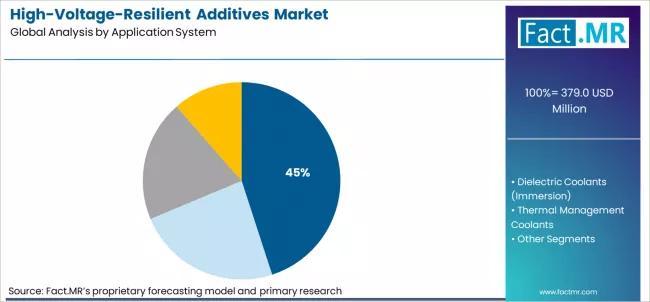
    High Voltage Resilient Additives Market Analysis By Application System

    • Market Overview: E-transmission fluids are expected to account for 45% of the market share by 2026. E-transmission fluids are critical for electric vehicles, where they help optimize the performance of electric drivetrains and ensure smooth operation of the transmission system under high-voltage conditions. The growing EV market is a key driver for the increasing use of high-voltage-resilient additives in these fluids.
    • Demand Drivers:
      • Increasing Adoption of Electric Vehicles: As the adoption of electric vehicles accelerates, the demand for specialized e-transmission fluids that can handle the heat, pressure, and high-voltage requirements of electric drivetrains grows. High-voltage-resilient additives ensure that these fluids perform optimally in such systems.
      • Performance and Longevity Requirements: E-transmission fluids must provide excellent lubrication, cooling, and protection under high-voltage conditions. Additives designed for high-voltage resilience ensure that these fluids maintain their performance and extend the lifespan of drivetrain components.
      • Regulatory and Industry Standards: With the development of more stringent standards for electric vehicle performance, manufacturers are increasingly relying on high-performance e-transmission fluids that incorporate high-voltage-resilient additives to meet these requirements.

    High Voltage Resilient Additives Market Drivers, Restraints, and Opportunities

    FMR analysts observe that the high‑voltage‑resilient additives market is a growing, technology‑driven segment tied to the rapid expansion of electrification across automotive, industrial, and power electronics applications. Historically, conventional additive chemistries served low‑voltage insulating fluids and polymers, but higher electrical stresses in EV powertrains, traction inverters, and renewable energy converters exposed performance limitations in legacy formulations. The 2026 valuation reflects this structural shift, where demand is driven by the need for additives that enhance dielectric strength, thermal stability, and long‑term reliability in high‑voltage environments.

    While demand for standard additive packages in low‑voltage applications remains stable, additive blends tailored for high‑voltage resilience (improved breakdown voltage, enhanced oxidation resistance) are gaining share. These advanced additives carry higher per‑unit pricing, contributing to net market value growth even as overall unit volumes scale with electrification rates. The market exists at its current size because high‑voltage systems require certified materials that can withstand elevated electric fields and thermal stresses, and regulatory/equipment standards increasingly codify performance thresholds.

    • Electrification Performance Demand: Growth in EVs, power electronics, and energy storage drives the need for additives that boost dielectric and thermal resilience beyond what standard packages can deliver.
    • Standards & Safety Regulations: Standards like IEC 61851 and UL 94 for high‑voltage insulation and flammability push manufacturers toward certified, resilient additive systems that meet defined safety and performance criteria.
    • Regional Electrification Trends: Markets such as Europe and China with high EV penetration and renewable energy build‑out show stronger uptake of high‑voltage‑resilient additives, while cost‑sensitive regions focus on legacy applications.

    Regional Analysis

    The market analysis covers key global regions, including North America, East Asia, South Korea, Western Europe, Latin America, and Germany. It is segmented geographically, with specific market dynamics for each region. The full report provides a detailed market attractiveness analysis.
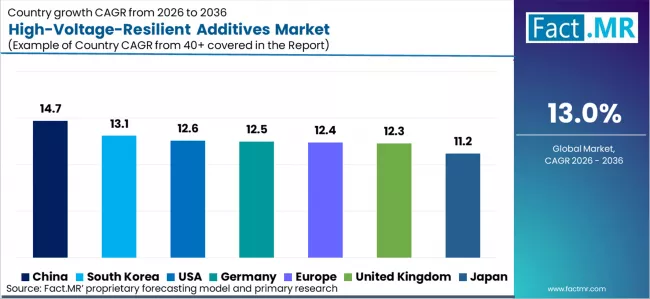
    High Voltage Resilient Additives Market Cagr Analysis By Country

    Country CAGR (2026-2036)
    USA 12.6%
    Japan 11.2%
    South Korea 13.1%
    Europe 12.4%
    Germany 12.5%
    China 14.7%
    United Kingdom 12.3%
    Brazil 13.6%

    Source: Fact MR (FMR) analysis, based on proprietary forecasting model and primary research.

    North America:

    North America is a "key region for high-voltage resilience" in additives, with growing demand driven by the expansion of the electronics, automotive, and renewable energy industries.

    • USA: Demand for high-voltage-resilient additives in the U.S. is projected to rise at 12.6% CAGR through 2036. The growth of electric vehicles (EVs) and increased demand for renewable energy systems contribute to the rising need for high-performance materials in the U.S.

    East Asia:

    East Asia, particularly China and South Korea, is a "global hub for industrial and technological advancement," where high-voltage-resilient additives are in demand due to rapid industrialization and the expansion of electric vehicle and energy infrastructure.

    • China: Demand for high-voltage-resilient additives in China is projected to rise at 14.7% CAGR through 2036. China's aggressive push for electric vehicle adoption and investment in renewable energy drive the demand for high-performance additives in this market.
    • Japan: Demand for high-voltage-resilient additives in Japan is projected to rise at 11.2% CAGR through 2036. Japan’s focus on advanced electronics and renewable energy solutions continues to drive market growth in high-voltage applications.

    South Korea:

    South Korea is a "key market for high-tech solutions" in automotive and energy sectors, where demand for high-voltage-resilient additives continues to rise with advancements in EVs and green technologies.

    • South Korea: Demand for high-voltage-resilient additives in South Korea is projected to rise at 13.1% CAGR through 2036. South Korea’s EV sector and growing renewable energy initiatives significantly contribute to the growing market for these additives.

    Western Europe:

    Europe remains a "leader in green energy and automotive innovation," with strong demand for high-voltage-resilient additives driven by the transition to renewable energy and the electric vehicle boom.

    • Germany: Demand for high-voltage-resilient additives in Germany is projected to rise at 12.5% CAGR through 2036. Germany’s renewable energy adoption and automotive sector investments in EV technologies continue to drive the demand for advanced materials.
    • United Kingdom: Demand for high-voltage-resilient additives in the UK is projected to rise at 12.3% CAGR through 2036. The UK's commitment to carbon neutrality and electric vehicle adoption drive the growth of this market.

    Latin America:

    In Latin America, Brazil is seeing an increase in demand for high-voltage-resilient additives, primarily due to growing energy infrastructure projects and the rise in electric vehicle use.

    • Brazil: Demand for high-voltage-resilient additives in Brazil is projected to rise at 13.6% CAGR through 2036. Brazil’s investments in renewable energy and increased focus on electric mobility contribute to the rapid growth of the market.

    Fact MR's analysis of the High-Voltage-Resilient Additives Market in North America, East Asia, South Korea, Western Europe, Latin America, and Germany consists of country-wise assessments that include the USA, Japan, South Korea, Germany, China, the United Kingdom, and Brazil. Readers can find detailed trends, regulatory updates, and company-specific investments shaping the market’s growth in these countries.

    How Are Key Players Competing in the High-Voltage-Resilient Additives Market?
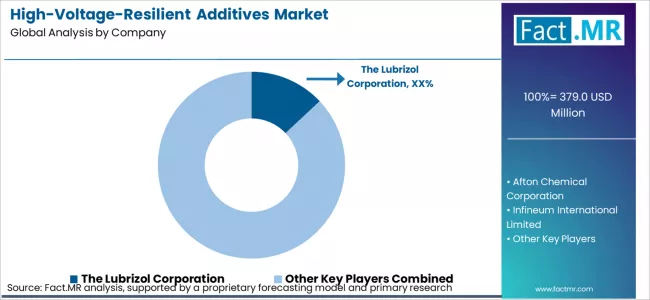
    High Voltage Resilient Additives Market Analysis By Company

    The high-voltage-resilient additives market is evolving rapidly, driven by the increasing demand for electric vehicles (EVs) and advanced energy storage systems. The Lubrizol Corporation, Afton Chemical Corporation, and Infineum International Limited are leading the way in developing additives that improve the performance of high-voltage systems, ensuring better insulation, durability, and safety in EV batteries and related components. BASF SE and Evonik Operations GmbH focus on providing additives that offer enhanced stability and thermal protection in high-voltage applications, essential for meeting industry standards. Clariant AG and LANXESS AG leverage their extensive chemical expertise to deliver solutions that enhance the resilience and efficiency of energy systems. Solvay SA and Dow Inc. are innovating in the area of materials science to provide additives that can withstand extreme conditions in high-voltage environments. Sinopec, a key player in China, is strengthening its position by developing cost-effective, high-performance additives for the rapidly growing Asian market.

    Recent Industry Developments

    • BASF officially launched Irgastab® Cable KV 10 in February 2026, a high-efficiency thermal stabilizer and antioxidant specifically engineered to ensure the dielectric stability and long-term insulation of cross-linked polyethylene (XLPE) in high-voltage power cables.
    • In September 2025, Afton Chemical introduced the HiTEC® 12582 series, which utilizes advanced surface-active chemistry to provide superior high-voltage electrical resistivity and copper protection in fluids designed for electrified heavy-duty powertrains.
    • Evonik expanded its VESTAMID® PA12 and functional additive portfolio in 2025 to include specialized high-voltage insulation and fire-resistant coatings (TEGO® Therm) designed to mitigate thermal runaway and electrical arcing in EV battery busbars and housings.

    Key Players of the High‑Voltage‑Resilient Additives Market

    • The Lubrizol Corporation
    • Afton Chemical Corporation
    • Infineum International Limited
    • BASF SE
    • Evonik Operations GmbH
    • Clariant AG
    • LANXESS AG
    • Solvay SA
    • Dow Inc.
    • China Petroleum & Chemical Corporation (Sinopec)

    Report Scope

    Metric Value
    Quantitative Units USD 379 million (2026) to USD 1,120 million (2036), at a CAGR of 13.0%
    Market Definition The High-Voltage-Resilient Additives Market includes additives designed to enhance the performance of fluids in high-voltage applications, ensuring protection and stability in systems like transmission fluids, coolants, and insulating oils.
    By Additive Function Oxidation Inhibitors, Corrosion Inhibitors / Metal Deactivators, Conductivity Modifiers / Dielectric Stabilizers, Anti-Foam & Other Aids
    By Application System E-Transmission Fluids, Dielectric Coolants (Immersion), Thermal Management Coolants, Insulating Oils
    By Compatibility Target Copper Protection, Aluminum Protection, Polymer Seal Compatibility, Multi-Material Packages
    By Customer Type Additive Packages to Oil Blenders, OEM Co-Development, Tier-1 Drivetrain Suppliers, Specialty Fluid Formulators
    Regions Covered North America, Latin America, Europe, East Asia, South Asia, Oceania, Middle East and Africa
    Countries Covered United States, Canada, Mexico, Brazil, Argentina, Germany, France, United Kingdom, Italy, Spain, China, India, Japan, South Korea, Indonesia, Australia, and 40+ countries
    Key Companies Profiled The Lubrizol Corporation, Afton Chemical Corporation, Infineum International Limited, BASF SE, Evonik Operations GmbH, Clariant AG, LANXESS AG, Solvay SA, Dow Inc., China Petroleum & Chemical Corporation (Sinopec)
    Forecast Period 2026 to 2036
    Approach Hybrid top-down and bottom-up market modeling validated through primary interviews with manufacturers and supported by trade data benchmarking and market research.

    High Voltage Resilient Additives Market Key Segments

    • By Additive Function

      • Oxidation Inhibitors
      • Corrosion Inhibitors / Metal Deactivators
      • Conductivity Modifiers / Dielectric Stabilizers
      • Anti-Foam & Other Aids
    • By Application System

      • E-Transmission Fluids
      • Dielectric Coolants (Immersion)
      • Thermal Management Coolants
      • Insulating Oils
    • By Compatibility Target

      • Copper Protection
      • Aluminum Protection
      • Polymer Seal Compatibility
      • Multi-Material Packages
    • By Customer Type

      • Additive Packages to Oil Blenders
      • OEM Co-Development
      • Tier-1 Drivetrain Suppliers
      • Specialty Fluid Formulators
    • Region

      • North America
        • USA
        • Canada
        • Mexico
      • Europe
        • Germany
        • UK
        • France
        • Italy
        • Spain
        • Nordic Countries
        • BENELUX
        • Rest of Europe
      • Asia Pacific
        • China
        • Japan
        • South Korea
        • India
        • Australia
        • Rest of Asia Pacific
      • Latin America
        • Brazil
        • Argentina
        • Rest of Latin America
      • Middle East and Africa
        • Kingdom of Saudi Arabia
        • United Arab Emirates
        • South Africa
        • Rest of Middle East and Africa
      • Other Regions
        • Oceania
        • Central Asia
        • Other Markets

    Bibliographies

    • BASF Launches Irgastab® Cable KV 10: BASF. (2026, February). BASF launches Irgastab® Cable KV 10 for high-voltage power cables. BASF.
    • Afton Chemical Introduces HiTEC® 12582 Series: Afton Chemical. (2025, September). Afton Chemical introduces HiTEC® 12582 for electrified heavy-duty powertrains. Afton Chemical.
    • Evonik Expands VESTAMID® PA12 and Functional Additive Portfolio: Evonik. (2025). Evonik expands VESTAMID® PA12 and TEGO® Therm portfolio for high-voltage EV solutions. Evonik.

    Table of Content

    1. Executive Summary
      • Global Market Outlook
      • Demand to side Trends
      • Supply to side Trends
      • Technology Roadmap Analysis
      • Analysis and Recommendations
    2. Market Overview
      • Market Coverage / Taxonomy
      • Market Definition / Scope / Limitations
    3. Research Methodology
      • Chapter Orientation
      • Analytical Lens and Working Hypotheses
        • Market Structure, Signals, and Trend Drivers
        • Benchmarking and Cross-market Comparability
        • Market Sizing, Forecasting, and Opportunity Mapping
      • Research Design and Evidence Framework
        • Desk Research Programme (Secondary Evidence)
          • Company Annual and Sustainability Reports
          • Peer-reviewed Journals and Academic Literature
          • Corporate Websites, Product Literature, and Technical Notes
          • Earnings Decks and Investor Briefings
          • Statutory Filings and Regulatory Disclosures
          • Technical White Papers and Standards Notes
          • Trade Journals, Industry Magazines, and Analyst Briefs
          • Conference Proceedings, Webinars, and Seminar Materials
          • Government Statistics Portals and Public Data Releases
          • Press Releases and Reputable Media Coverage
          • Specialist Newsletters and Curated Briefings
          • Sector Databases and Reference Repositories
          • FMR Internal Proprietary Databases and Historical Market Datasets
          • Subscription Datasets and Paid Sources
          • Social Channels, Communities, and Digital Listening Inputs
          • Additional Desk Sources
        • Expert Input and Fieldwork (Primary Evidence)
          • Primary Modes
            • Qualitative Interviews and Expert Elicitation
            • Quantitative Surveys and Structured Data Capture
            • Blended Approach
          • Why Primary Evidence is Used
          • Field Techniques
            • Interviews
            • Surveys
            • Focus Groups
            • Observational and In-context Research
            • Social and Community Interactions
          • Stakeholder Universe Engaged
            • C-suite Leaders
            • Board Members
            • Presidents and Vice Presidents
            • R&D and Innovation Heads
            • Technical Specialists
            • Domain Subject-matter Experts
            • Scientists
            • Physicians and Other Healthcare Professionals
          • Governance, Ethics, and Data Stewardship
            • Research Ethics
            • Data Integrity and Handling
        • Tooling, Models, and Reference Databases
      • Data Engineering and Model Build
        • Data Acquisition and Ingestion
        • Cleaning, Normalisation, and Verification
        • Synthesis, Triangulation, and Analysis
      • Quality Assurance and Audit Trail
    4. Market Background
      • Market Dynamics
        • Drivers
        • Restraints
        • Opportunity
        • Trends
      • Scenario Forecast
        • Demand in Optimistic Scenario
        • Demand in Likely Scenario
        • Demand in Conservative Scenario
      • Opportunity Map Analysis
      • Product Life Cycle Analysis
      • Supply Chain Analysis
      • Investment Feasibility Matrix
      • Value Chain Analysis
      • PESTLE and Porter’s Analysis
      • Regulatory Landscape
      • Regional Parent Market Outlook
      • Production and Consumption Statistics
      • Import and Export Statistics
    5. Global Market Analysis 2021 to 2025 and Forecast, 2026 to 2036
      • Historical Market Size Value (USD Million) Analysis, 2021 to 2025
      • Current and Future Market Size Value (USD Million) Projections, 2026 to 2036
        • Y to o to Y Growth Trend Analysis
        • Absolute $ Opportunity Analysis
    6. Global Market Pricing Analysis 2021 to 2025 and Forecast 2026 to 2036
    7. Global Market Analysis 2021 to 2025 and Forecast 2026 to 2036, By Customer Type
      • Introduction / Key Findings
      • Historical Market Size Value (USD Million) Analysis By Customer Type , 2021 to 2025
      • Current and Future Market Size Value (USD Million) Analysis and Forecast By Customer Type , 2026 to 2036
        • Additive Packages to Oil Blenders
        • OEM Co-Development
        • Tier-1 Drivetrain Suppliers
        • Specialty Fluid Formulators
      • Y to o to Y Growth Trend Analysis By Customer Type , 2021 to 2025
      • Absolute $ Opportunity Analysis By Customer Type , 2026 to 2036
    8. Global Market Analysis 2021 to 2025 and Forecast 2026 to 2036, By Application System
      • Introduction / Key Findings
      • Historical Market Size Value (USD Million) Analysis By Application System, 2021 to 2025
      • Current and Future Market Size Value (USD Million) Analysis and Forecast By Application System, 2026 to 2036
        • E-Transmission Fluids
        • Dielectric Coolants (Immersion)
        • Thermal Management Coolants
        • Insulating Oils
      • Y to o to Y Growth Trend Analysis By Application System, 2021 to 2025
      • Absolute $ Opportunity Analysis By Application System, 2026 to 2036
    9. Global Market Analysis 2021 to 2025 and Forecast 2026 to 2036, By Region
      • Introduction
      • Historical Market Size Value (USD Million) Analysis By Region, 2021 to 2025
      • Current Market Size Value (USD Million) Analysis and Forecast By Region, 2026 to 2036
        • North America
        • Latin America
        • Western Europe
        • Eastern Europe
        • East Asia
        • South Asia and Pacific
        • Middle East & Africa
      • Market Attractiveness Analysis By Region
    10. North America Market Analysis 2021 to 2025 and Forecast 2026 to 2036, By Country
      • Historical Market Size Value (USD Million) Trend Analysis By Market Taxonomy, 2021 to 2025
      • Market Size Value (USD Million) Forecast By Market Taxonomy, 2026 to 2036
        • By Country
          • USA
          • Canada
          • Mexico
        • By Customer Type
        • By Application System
      • Market Attractiveness Analysis
        • By Country
        • By Customer Type
        • By Application System
      • Key Takeaways
    11. Latin America Market Analysis 2021 to 2025 and Forecast 2026 to 2036, By Country
      • Historical Market Size Value (USD Million) Trend Analysis By Market Taxonomy, 2021 to 2025
      • Market Size Value (USD Million) Forecast By Market Taxonomy, 2026 to 2036
        • By Country
          • Brazil
          • Chile
          • Rest of Latin America
        • By Customer Type
        • By Application System
      • Market Attractiveness Analysis
        • By Country
        • By Customer Type
        • By Application System
      • Key Takeaways
    12. Western Europe Market Analysis 2021 to 2025 and Forecast 2026 to 2036, By Country
      • Historical Market Size Value (USD Million) Trend Analysis By Market Taxonomy, 2021 to 2025
      • Market Size Value (USD Million) Forecast By Market Taxonomy, 2026 to 2036
        • By Country
          • Germany
          • UK
          • Italy
          • Spain
          • France
          • Nordic
          • BENELUX
          • Rest of Western Europe
        • By Customer Type
        • By Application System
      • Market Attractiveness Analysis
        • By Country
        • By Customer Type
        • By Application System
      • Key Takeaways
    13. Eastern Europe Market Analysis 2021 to 2025 and Forecast 2026 to 2036, By Country
      • Historical Market Size Value (USD Million) Trend Analysis By Market Taxonomy, 2021 to 2025
      • Market Size Value (USD Million) Forecast By Market Taxonomy, 2026 to 2036
        • By Country
          • Russia
          • Poland
          • Hungary
          • Balkan & Baltic
          • Rest of Eastern Europe
        • By Customer Type
        • By Application System
      • Market Attractiveness Analysis
        • By Country
        • By Customer Type
        • By Application System
      • Key Takeaways
    14. East Asia Market Analysis 2021 to 2025 and Forecast 2026 to 2036, By Country
      • Historical Market Size Value (USD Million) Trend Analysis By Market Taxonomy, 2021 to 2025
      • Market Size Value (USD Million) Forecast By Market Taxonomy, 2026 to 2036
        • By Country
          • China
          • Japan
          • South Korea
        • By Customer Type
        • By Application System
      • Market Attractiveness Analysis
        • By Country
        • By Customer Type
        • By Application System
      • Key Takeaways
    15. South Asia and Pacific Market Analysis 2021 to 2025 and Forecast 2026 to 2036, By Country
      • Historical Market Size Value (USD Million) Trend Analysis By Market Taxonomy, 2021 to 2025
      • Market Size Value (USD Million) Forecast By Market Taxonomy, 2026 to 2036
        • By Country
          • India
          • ASEAN
          • Australia & New Zealand
          • Rest of South Asia and Pacific
        • By Customer Type
        • By Application System
      • Market Attractiveness Analysis
        • By Country
        • By Customer Type
        • By Application System
      • Key Takeaways
    16. Middle East & Africa Market Analysis 2021 to 2025 and Forecast 2026 to 2036, By Country
      • Historical Market Size Value (USD Million) Trend Analysis By Market Taxonomy, 2021 to 2025
      • Market Size Value (USD Million) Forecast By Market Taxonomy, 2026 to 2036
        • By Country
          • Kingdom of Saudi Arabia
          • Other GCC Countries
          • Turkiye
          • South Africa
          • Other African Union
          • Rest of Middle East & Africa
        • By Customer Type
        • By Application System
      • Market Attractiveness Analysis
        • By Country
        • By Customer Type
        • By Application System
      • Key Takeaways
    17. Key Countries Market Analysis
      • USA
        • Pricing Analysis
        • Market Share Analysis, 2025
          • By Customer Type
          • By Application System
      • Canada
        • Pricing Analysis
        • Market Share Analysis, 2025
          • By Customer Type
          • By Application System
      • Mexico
        • Pricing Analysis
        • Market Share Analysis, 2025
          • By Customer Type
          • By Application System
      • Brazil
        • Pricing Analysis
        • Market Share Analysis, 2025
          • By Customer Type
          • By Application System
      • Chile
        • Pricing Analysis
        • Market Share Analysis, 2025
          • By Customer Type
          • By Application System
      • Germany
        • Pricing Analysis
        • Market Share Analysis, 2025
          • By Customer Type
          • By Application System
      • UK
        • Pricing Analysis
        • Market Share Analysis, 2025
          • By Customer Type
          • By Application System
      • Italy
        • Pricing Analysis
        • Market Share Analysis, 2025
          • By Customer Type
          • By Application System
      • Spain
        • Pricing Analysis
        • Market Share Analysis, 2025
          • By Customer Type
          • By Application System
      • France
        • Pricing Analysis
        • Market Share Analysis, 2025
          • By Customer Type
          • By Application System
      • India
        • Pricing Analysis
        • Market Share Analysis, 2025
          • By Customer Type
          • By Application System
      • ASEAN
        • Pricing Analysis
        • Market Share Analysis, 2025
          • By Customer Type
          • By Application System
      • Australia & New Zealand
        • Pricing Analysis
        • Market Share Analysis, 2025
          • By Customer Type
          • By Application System
      • China
        • Pricing Analysis
        • Market Share Analysis, 2025
          • By Customer Type
          • By Application System
      • Japan
        • Pricing Analysis
        • Market Share Analysis, 2025
          • By Customer Type
          • By Application System
      • South Korea
        • Pricing Analysis
        • Market Share Analysis, 2025
          • By Customer Type
          • By Application System
      • Russia
        • Pricing Analysis
        • Market Share Analysis, 2025
          • By Customer Type
          • By Application System
      • Poland
        • Pricing Analysis
        • Market Share Analysis, 2025
          • By Customer Type
          • By Application System
      • Hungary
        • Pricing Analysis
        • Market Share Analysis, 2025
          • By Customer Type
          • By Application System
      • Kingdom of Saudi Arabia
        • Pricing Analysis
        • Market Share Analysis, 2025
          • By Customer Type
          • By Application System
      • Turkiye
        • Pricing Analysis
        • Market Share Analysis, 2025
          • By Customer Type
          • By Application System
      • South Africa
        • Pricing Analysis
        • Market Share Analysis, 2025
          • By Customer Type
          • By Application System
    18. Market Structure Analysis
      • Competition Dashboard
      • Competition Benchmarking
      • Market Share Analysis of Top Players
        • By Regional
        • By Customer Type
        • By Application System
    19. Competition Analysis
      • Competition Deep Dive
        • The Lubrizol Corporation
          • Overview
          • Product Portfolio
          • Profitability by Market Segments (Product/Age /Sales Channel/Region)
          • Sales Footprint
          • Strategy Overview
            • Marketing Strategy
            • Product Strategy
            • Channel Strategy
        • Afton Chemical Corporation
        • Infineum International Limited
        • BASF SE
        • Evonik Operations GmbH
        • Clariant AG
        • LANXESS AG
        • Solvay SA
        • Dow Inc.
        • China Petroleum & Chemical Corporation (Sinopec)
    20. Assumptions & Acronyms Used

    List Of Table

    • Table 1: Global Market Value (USD Million) Forecast by Region, 2021 to 2036
    • Table 2: Global Market Value (USD Million) Forecast by Customer Type , 2021 to 2036
    • Table 3: Global Market Value (USD Million) Forecast by Application System, 2021 to 2036
    • Table 4: North America Market Value (USD Million) Forecast by Country, 2021 to 2036
    • Table 5: North America Market Value (USD Million) Forecast by Customer Type , 2021 to 2036
    • Table 6: North America Market Value (USD Million) Forecast by Application System, 2021 to 2036
    • Table 7: Latin America Market Value (USD Million) Forecast by Country, 2021 to 2036
    • Table 8: Latin America Market Value (USD Million) Forecast by Customer Type , 2021 to 2036
    • Table 9: Latin America Market Value (USD Million) Forecast by Application System, 2021 to 2036
    • Table 10: Western Europe Market Value (USD Million) Forecast by Country, 2021 to 2036
    • Table 11: Western Europe Market Value (USD Million) Forecast by Customer Type , 2021 to 2036
    • Table 12: Western Europe Market Value (USD Million) Forecast by Application System, 2021 to 2036
    • Table 13: Eastern Europe Market Value (USD Million) Forecast by Country, 2021 to 2036
    • Table 14: Eastern Europe Market Value (USD Million) Forecast by Customer Type , 2021 to 2036
    • Table 15: Eastern Europe Market Value (USD Million) Forecast by Application System, 2021 to 2036
    • Table 16: East Asia Market Value (USD Million) Forecast by Country, 2021 to 2036
    • Table 17: East Asia Market Value (USD Million) Forecast by Customer Type , 2021 to 2036
    • Table 18: East Asia Market Value (USD Million) Forecast by Application System, 2021 to 2036
    • Table 19: South Asia and Pacific Market Value (USD Million) Forecast by Country, 2021 to 2036
    • Table 20: South Asia and Pacific Market Value (USD Million) Forecast by Customer Type , 2021 to 2036
    • Table 21: South Asia and Pacific Market Value (USD Million) Forecast by Application System, 2021 to 2036
    • Table 22: Middle East & Africa Market Value (USD Million) Forecast by Country, 2021 to 2036
    • Table 23: Middle East & Africa Market Value (USD Million) Forecast by Customer Type , 2021 to 2036
    • Table 24: Middle East & Africa Market Value (USD Million) Forecast by Application System, 2021 to 2036

    List Of Figures

    • Figure 1: Global Market Pricing Analysis
    • Figure 2: Global Market Value (USD Million) Forecast 2021-2036
    • Figure 3: Global Market Value Share and BPS Analysis by Customer Type , 2026 and 2036
    • Figure 4: Global Market Y to o to Y Growth Comparison by Customer Type , 2026 to 2036
    • Figure 5: Global Market Attractiveness Analysis by Customer Type
    • Figure 6: Global Market Value Share and BPS Analysis by Application System, 2026 and 2036
    • Figure 7: Global Market Y to o to Y Growth Comparison by Application System, 2026 to 2036
    • Figure 8: Global Market Attractiveness Analysis by Application System
    • Figure 9: Global Market Value (USD Million) Share and BPS Analysis by Region, 2026 and 2036
    • Figure 10: Global Market Y to o to Y Growth Comparison by Region, 2026 to 2036
    • Figure 11: Global Market Attractiveness Analysis by Region
    • Figure 12: North America Market Incremental Dollar Opportunity, 2026 to 2036
    • Figure 13: Latin America Market Incremental Dollar Opportunity, 2026 to 2036
    • Figure 14: Western Europe Market Incremental Dollar Opportunity, 2026 to 2036
    • Figure 15: Eastern Europe Market Incremental Dollar Opportunity, 2026 to 2036
    • Figure 16: East Asia Market Incremental Dollar Opportunity, 2026 to 2036
    • Figure 17: South Asia and Pacific Market Incremental Dollar Opportunity, 2026 to 2036
    • Figure 18: Middle East & Africa Market Incremental Dollar Opportunity, 2026 to 2036
    • Figure 19: North America Market Value Share and BPS Analysis by Country, 2026 and 2036
    • Figure 20: North America Market Value Share and BPS Analysis by Customer Type , 2026 and 2036
    • Figure 21: North America Market Y to o to Y Growth Comparison by Customer Type , 2026 to 2036
    • Figure 22: North America Market Attractiveness Analysis by Customer Type
    • Figure 23: North America Market Value Share and BPS Analysis by Application System, 2026 and 2036
    • Figure 24: North America Market Y to o to Y Growth Comparison by Application System, 2026 to 2036
    • Figure 25: North America Market Attractiveness Analysis by Application System
    • Figure 26: Latin America Market Value Share and BPS Analysis by Country, 2026 and 2036
    • Figure 27: Latin America Market Value Share and BPS Analysis by Customer Type , 2026 and 2036
    • Figure 28: Latin America Market Y to o to Y Growth Comparison by Customer Type , 2026 to 2036
    • Figure 29: Latin America Market Attractiveness Analysis by Customer Type
    • Figure 30: Latin America Market Value Share and BPS Analysis by Application System, 2026 and 2036
    • Figure 31: Latin America Market Y to o to Y Growth Comparison by Application System, 2026 to 2036
    • Figure 32: Latin America Market Attractiveness Analysis by Application System
    • Figure 33: Western Europe Market Value Share and BPS Analysis by Country, 2026 and 2036
    • Figure 34: Western Europe Market Value Share and BPS Analysis by Customer Type , 2026 and 2036
    • Figure 35: Western Europe Market Y to o to Y Growth Comparison by Customer Type , 2026 to 2036
    • Figure 36: Western Europe Market Attractiveness Analysis by Customer Type
    • Figure 37: Western Europe Market Value Share and BPS Analysis by Application System, 2026 and 2036
    • Figure 38: Western Europe Market Y to o to Y Growth Comparison by Application System, 2026 to 2036
    • Figure 39: Western Europe Market Attractiveness Analysis by Application System
    • Figure 40: Eastern Europe Market Value Share and BPS Analysis by Country, 2026 and 2036
    • Figure 41: Eastern Europe Market Value Share and BPS Analysis by Customer Type , 2026 and 2036
    • Figure 42: Eastern Europe Market Y to o to Y Growth Comparison by Customer Type , 2026 to 2036
    • Figure 43: Eastern Europe Market Attractiveness Analysis by Customer Type
    • Figure 44: Eastern Europe Market Value Share and BPS Analysis by Application System, 2026 and 2036
    • Figure 45: Eastern Europe Market Y to o to Y Growth Comparison by Application System, 2026 to 2036
    • Figure 46: Eastern Europe Market Attractiveness Analysis by Application System
    • Figure 47: East Asia Market Value Share and BPS Analysis by Country, 2026 and 2036
    • Figure 48: East Asia Market Value Share and BPS Analysis by Customer Type , 2026 and 2036
    • Figure 49: East Asia Market Y to o to Y Growth Comparison by Customer Type , 2026 to 2036
    • Figure 50: East Asia Market Attractiveness Analysis by Customer Type
    • Figure 51: East Asia Market Value Share and BPS Analysis by Application System, 2026 and 2036
    • Figure 52: East Asia Market Y to o to Y Growth Comparison by Application System, 2026 to 2036
    • Figure 53: East Asia Market Attractiveness Analysis by Application System
    • Figure 54: South Asia and Pacific Market Value Share and BPS Analysis by Country, 2026 and 2036
    • Figure 55: South Asia and Pacific Market Value Share and BPS Analysis by Customer Type , 2026 and 2036
    • Figure 56: South Asia and Pacific Market Y to o to Y Growth Comparison by Customer Type , 2026 to 2036
    • Figure 57: South Asia and Pacific Market Attractiveness Analysis by Customer Type
    • Figure 58: South Asia and Pacific Market Value Share and BPS Analysis by Application System, 2026 and 2036
    • Figure 59: South Asia and Pacific Market Y to o to Y Growth Comparison by Application System, 2026 to 2036
    • Figure 60: South Asia and Pacific Market Attractiveness Analysis by Application System
    • Figure 61: Middle East & Africa Market Value Share and BPS Analysis by Country, 2026 and 2036
    • Figure 62: Middle East & Africa Market Value Share and BPS Analysis by Customer Type , 2026 and 2036
    • Figure 63: Middle East & Africa Market Y to o to Y Growth Comparison by Customer Type , 2026 to 2036
    • Figure 64: Middle East & Africa Market Attractiveness Analysis by Customer Type
    • Figure 65: Middle East & Africa Market Value Share and BPS Analysis by Application System, 2026 and 2036
    • Figure 66: Middle East & Africa Market Y to o to Y Growth Comparison by Application System, 2026 to 2036
    • Figure 67: Middle East & Africa Market Attractiveness Analysis by Application System
    • Figure 68: Global Market - Tier Structure Analysis
    • Figure 69: Global Market - Company Share Analysis

    - FAQs -

    How large is the demand for High-Voltage-Resilient Additives in the global market in 2026?

    Demand for High-Voltage-Resilient Additives in the global market is estimated to be valued at USD 379 million in 2026.

    What will be the market size of High-Voltage-Resilient Additives in the global market by 2036?

    The market size for High-Voltage-Resilient Additives is projected to reach USD 1,120 million by 2036.

    What is the expected demand growth for High-Voltage-Resilient Additives in the global market between 2026 and 2036?

    Demand for High-Voltage-Resilient Additives in the global market is expected to grow at a CAGR of 13.0% - between 2026 and 2036.

    Which customer type is expected to dominate the market?

    Additive Packages to Oil Blenders are expected to dominate the market, accounting for 51% of the market share in 2026, due to the essential role of oil blenders in producing high-quality lubricants with enhanced high-voltage resilience.

    Which region is expected to show the highest growth rate for High-Voltage-Resilient Additives?

    China is projected to show the highest regional CAGR at 14.7% during the forecast period, driven by the increasing demand for high-performance additives in automotive and industrial sectors, particularly as EV adoption grows.

    How significant is the growth outlook for Brazil in this market?

    Brazil is expected to grow at a CAGR of 13.6%, reflecting strong demand for high-voltage-resilient additives in the growing automotive and industrial sectors in Latin America.

    What is the growth outlook for the United States in this report?

    The United States is anticipated to grow at a CAGR of 12.6% from 2026 to 2036, supported by increasing demand for advanced additives in the automotive, manufacturing, and energy sectors.

    What is the growth forecast for Japan in the High-Voltage-Resilient Additives market?

    Japan is expected to grow at a CAGR of 11.2%, driven by steady demand for high-quality lubricants and additives in automotive, industrial, and energy applications.

    What is the growth forecast for South Korea in this market?

    South Korea is projected to expand at a CAGR of 13.1%, supported by the increasing adoption of high-performance additives in the automotive and industrial sectors, particularly as the country leads in electric vehicle technology.

    Which European market is highlighted in this analysis?

    Germany is a key European market, with a projected CAGR of 12.5%, influenced by strong demand for high-voltage-resilient additives as the country continues to grow its automotive and industrial sectors.

    Which company is identified as a leading player in the High-Voltage-Resilient Additives market?

    The Lubrizol Corporation is recognized as a leading player in this market, providing advanced additives that improve the performance and resilience of high-voltage lubricants.

    What are High-Voltage-Resilient Additives used for?

    High-Voltage-Resilient Additives are used to enhance the performance and longevity of lubricants, particularly in high-voltage applications such as electric vehicles, industrial machinery, and power generation systems, where superior resistance to high temperatures and voltages is required.

    What does the High-Voltage-Resilient Additives market include in this report?

    The market scope includes high-performance additives designed to improve the stability, conductivity, and resilience of lubricants and oils in high-voltage environments, such as electric vehicles and industrial systems.

    How is the market forecast developed in this report?

    The forecast is developed using historical data on lubricant consumption, trends in high-voltage applications, and insights from key industry players involved in the production and distribution of high-voltage-resilient additives.

    What is meant by the High-Voltage-Resilient Additives market in this report?

    The market refers to the global production, trade, and consumption of additives used in lubricants and oils to ensure high performance and resilience in high-voltage applications, particularly in electric vehicles and industrial machinery.

    High‑Voltage‑Resilient Additives Market