- Market Value (2025): USD 291.11 Mn
- Estimated Value (2026): USD 327.5 Mn
- Forecast Value (2036): USD 1066.3 Mn
- CAGR (2026-2036): 12.5%
Hospital Longevity Programs Market Forecast and Outlook 2026 to 2036
As per the Fact.MR analysis, the Hospital Longevity Programs Market surpassed a value of USD 291.11 million and is projected to grow from USD 327.5 million in 2026 to USD 1,066.3 million by 2036. Demand for hospital longevity programs is likely to increase at a CAGR of 12.5% over the forecast period.
Demand is supported by growing interest in preventive health assessments, early risk identification, and structured health-management services for people seeking to maintain long-term health. Hospitals and specialized longevity providers are expanding offerings that combine comprehensive screening, cardiometabolic prevention, cognitive health assessments, precision nutrition, and longitudinal care. Subscription models and bundled packages can support recurring engagement, while virtual and employer-linked delivery options can extend access beyond conventional hospital settings. These service models are expected to support market expansion through 2036.
Key Takeaways from the Hospital Longevity Programs Market
- Hospital Longevity Programs Market Value (2025): USD 291.11 million
- Hospital Longevity Programs Market Value (2026): USD 327.5 million
- Hospital Longevity Programs Market Forecast Value (2036): USD 1,066.3 million
- Hospital Longevity Programs Market Forecast CAGR (2026–2036): 12.5%
- Leading Hospital Longevity Program Scope: Integrated longitudinal care (25.1%)
- Leading Contract / Payment Model: Annual subscription (30.7%)
- Leading Delivery Channel: Hospital / medical group (28.3%)
- Leading Service Beneficiary: Older adults (28.5%)
- Key Market Participants: Prenuvo, Fountain Life, Neko Health, Function Health (Ezra), Human Longevity, Inc.
- Key Growth Countries: South Korea, United States, China, Japan, Germany
Adoption of longevity services is increasingly focused on sustained health management rather than isolated diagnostic assessments. Comprehensive risk screening and integrated longitudinal care together account for a substantial share of program demand in 2026. Providers that connect diagnostic assessments with preventive recommendations, follow-up services, and ongoing health monitoring can support longer-term patient engagement. Similar integrated service models are projected to contribute to market growth through 2036.
Hospital Longevity Programs Market
| Metric | Value |
|---|---|
| Estimated Value in 2026 | USD 327.5 million |
| Forecast Value in 2036 | USD 1,066.3 million |
| Forecast CAGR (2026 to 2036) | 12.5% |
Source: Fact.MR analysis. Updated Nov 18, 2026
Source: Fact.MR analysis.
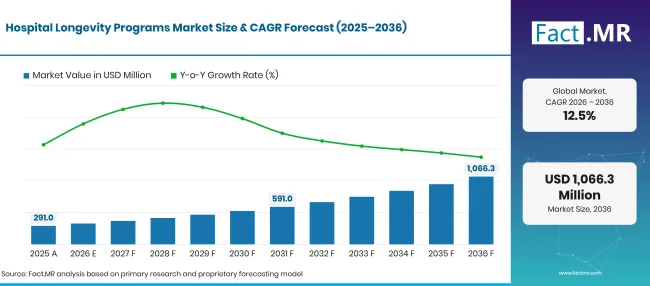
Hospital Longevity Programs Market Forecast Global | Source: Fact.MR
Category
| Category | Segments |
|---|---|
| Hospital Longevity Program Scope | Comprehensive risk screening, Cardiometabolic prevention, Cognitive health, Precision nutrition, Integrated longitudinal care |
| Contract / Payment Model | Annual subscription, Pay-per-visit, Employer / payer contract, Bundled care package, Project / consulting fee |
| Delivery Channel | Hospital / medical group, Dedicated facility, At-home / virtual, Employer site, Hospitality / residential partner |
| Service Beneficiary | Older adults, At-risk adults, Healthy adults, Family / caregivers, Corporate executives |
| Region | North America, Latin America, Europe, East Asia, South Asia and Pacific, Middle East & Africa |
| Key Countries | United States, China, Japan, Germany, South Korea |
Source: Fact.MR analysis. Updated Nov 18, 2026
Segmental Analysis
Why does integrated longitudinal care lead demand in the Hospital Longevity Programs Market?
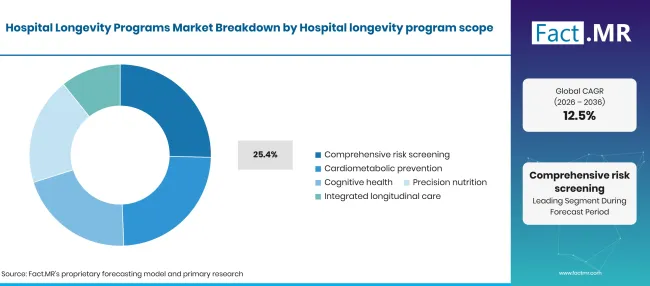
Hospital Longevity Programs Market Breakdown Hospital Longevity Program Scope | Source: Fact.MR
Demand for the integrated longitudinal care accounts for 25.4% of hospital longevity program scope demand in 2026, about USD 82.20 million. Demand is supported by the need to connect initial health assessments with diagnosis, treatment, and continued monitoring. The Ministry of Health and Family Welfare reported in March 2026 that more than 40.87 crore people had been screened for hypertension under India's National Programme for Prevention and Control of Non-Communicable Diseases, while approximately 5.57 crore diagnosed patients were receiving treatment as of February 2026. This scale of screening and treatment highlights the importance of follow-up and continuity after initial risk identification. Providers offering coordinated assessments, preventive recommendations, and periodic monitoring are positioned to address this requirement. Similar demand for integrated care is projected to drive sales of hospital longevity programs through 2036.
How does the annual subscription model support revenue in the Hospital Longevity Programs Market?
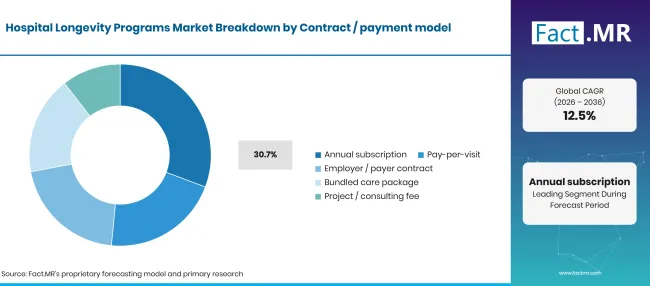
Hospital Longevity Programs Market Breakdown Contract Payment Model | Source: Fact.MR
Annual subscriptions lead with 30.7% of contract and payment model revenue in 2026, about USD 100.54 million. Sales through this model are supported by the recurring nature of preventive assessments, follow-up consultations, and personalized health-management services. India's Ministry of Health and Family Welfare reported in August 2026 that the Ayushman Bharat Pradhan Mantri Jan Arogya Yojana had issued more than 45.5 crore health cards, while over 38,466 public and private hospitals were empanelled under the scheme. These figures describe India’s wider public healthcare coverage and hospital network rather than payment for longevity subscriptions. Subscription-based preventive programs are a separate healthcare service model. Longevity providers can use annual packages to structure repeat assessments and continuing services into a defined payment arrangement. Similar demand for recurring care packages is projected to support sales through 2036.
Which facts make hospitals and medical groups lead delivery channel demand in the Hospital Longevity Programs Market?
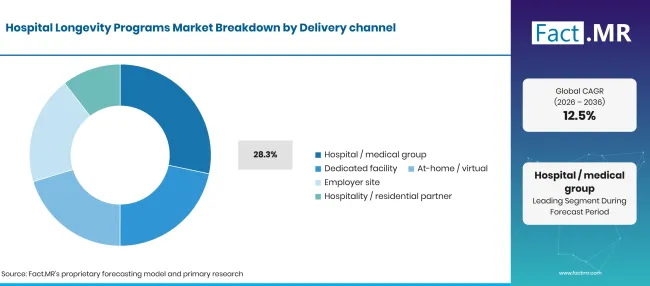
Hospital Longevity Programs Market Breakdown Delivery Channel | Source: Fact.MR
Hospitals and medical groups account for 28.3% of delivery channel revenue in 2026, about USD 92.68 million. Demand through clinical institutions is supported by their capacity to coordinate screening, diagnostic testing, specialist consultations, and follow-up care. The Government of India's August 2026 healthcare factsheet reported that the eSanjeevani national telemedicine platform had facilitated more than 49 crore consultations since its launch, with over 2.4 lakh healthcare providers registered on the platform. This demonstrates the scale of India's organized clinical and digital-care infrastructure. Hospitals and medical groups can build on such infrastructure to connect in-person assessments with remote consultations and continuing care. Similar demand for institution-led and clinically coordinated services is projected to drive sales through this channel through 2036.
Why do older adults represent the leading service beneficiary segment?
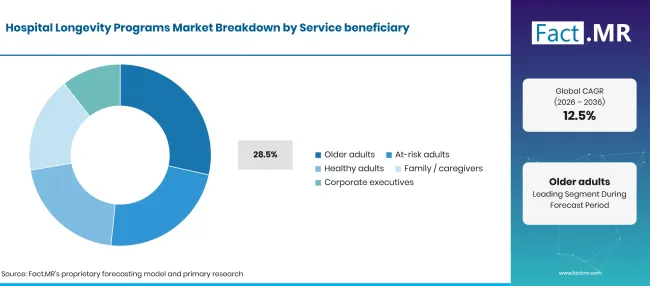
Hospital Longevity Programs Market Breakdown Service Beneficiary | Source: Fact.MR
Older adults account for 28.5% of service beneficiary demand in 2026, about USD 93.34 million. Demand from this group is supported by the need to monitor age-related health risks and maintain physical and cognitive well-being. According to a Government of India release published in March 2026, the population aged 60 years and above is projected to increase to 23 crore by 2036, representing 14.9% of India's total population, compared with 8.4% in 2011. This demographic shift creates a larger potential beneficiary base for preventive assessments, cardiometabolic monitoring, cognitive health services, and personalized nutrition programs. Providers that develop continuing health-management packages for older adults are positioned to address this expanding need. Similar demand is projected to drive sales of hospital longevity programs through 2036.
Hospital Longevity Programs Market – Drivers, Restraints and Trends
Driver
- Growing interest in preventive health assessment: Demand for hospital longevity programs is increasing as consumers seek earlier identification of potential health risks and more structured preventive care. Comprehensive risk screening accounts for 25.4% of program scope demand in 2026. Providers can combine diagnostic assessments with specialist consultations and personalized recommendations to address multiple health priorities. Similar interest in preventive screening is projected to drive demand for hospital longevity programs through 2036.
Driver
- Demand for integrated long-term care: Consumers are showing interest in services that connect initial assessments with ongoing health management. Integrated longitudinal care represents 25.1% of program scope demand in 2026. Providers can use periodic testing, follow-up consultations, and individualized care plans to maintain engagement beyond a single visit. Similar demand for continuing health-management services is projected to support market growth.
Restraint
- Cost and accessibility of comprehensive programs: Hospital longevity programs can involve multiple diagnostic assessments, specialist consultations, and recurring follow-up services. These requirements can increase the cost of participation and limit access for consumers without suitable insurance coverage or sufficient disposable income. Providers may need to offer tiered packages and flexible payment options to reach a wider patient base. Affordability considerations are likely to influence adoption across different beneficiary groups.
Opportunity
- Expansion of subscription-based services: Annual subscriptions account for 30.7% of contract and payment model revenue in 2026. Providers are positioned to use recurring packages to combine scheduled assessments with follow-up consultations and continuing health-management services. Subscription structures can also make service delivery more predictable for providers and patients. Similar recurring service models are projected to support revenue growth through 2036.
Trend
- Growth of virtual and alternative delivery models: At-home and virtual services account for 20.2% of delivery channel revenue in 2026. Digital consultations and remote follow-up can extend program access beyond dedicated clinical facilities, particularly for patients who require continuing engagement. Providers can use virtual services alongside in-person assessments rather than relying exclusively on facility-based delivery. Similar hybrid service models are projected to broaden the reach of hospital longevity programs.
Hospital Longevity Programs Market by Analysis by Key Country
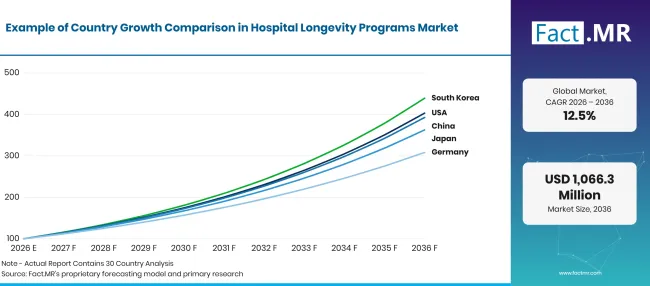
Hospital Longevity Programs Market Growth Index | Source: Fact.MR
| Country | CAGR (2026–2036) |
|---|---|
| United States | 15.0% |
| China | 14.7% |
| Japan | 13.8% |
| Germany | 11.9% |
| South Korea | 16.0% |
Source: Fact.MR analysis. Updated Nov 18, 2026
Source: Fact.MR analysis.
What is driving hospital longevity program growth in South Korea?
Demand for hospital longevity programs in South Korea is estimated to record a 16.0% CAGR, the fastest among the five key countries.
Growth reflects the market's projected expansion in demand for structured preventive assessments, integrated health services, and continuing care programs. Providers can address this demand through comprehensive screening, cognitive health assessments, precision nutrition, and longitudinal care packages. Similar expansion in organized longevity services is projected to support market growth in South Korea through 2036. According to Statistics Korea's October 2026 Older Adults Statistics, people aged 65 and above represent 21.6% of the country's population in 2026, equivalent to approximately 11.12 million people. Their share is projected to reach 30% by 2036. The same report found that the health-screening participation rate among older adults was 68.9% in 2024, while their average annual medical expenditure reached KRW 5.376 million. These figures highlight the growing importance of preventive assessments and ongoing health management among older adults.
Why is the United States a key growth market for hospital longevity programs?
The United States hospital longevity programs market is projected to grow at a 15.0% CAGR through 2036.
Demand is supported by the presence of specialized screening and preventive health providers, alongside interest in personalized health assessments and ongoing monitoring. Providers can combine diagnostic services with tailored recommendations and follow-up programs to serve consumers seeking more structured health management. The CDC reported in its May 2026 chronic disease factsheet that 90% of the country's USD 5.3 trillion in annual healthcare expenditure is associated with people living with chronic and mental health conditions. The CDC's National Diabetes Statistics Report, updated in March 2026, also estimated that 115.2 million U.S. adults had prediabetes, highlighting the need for early risk identification and ongoing metabolic health management. Providers combining comprehensive diagnostic assessments, personalized preventive recommendations, and follow-up monitoring are positioned to address this demand. Similar adoption of structured preventive health services is projected to drive sales of hospital longevity programs in the United States through 2036. The U.S. Department of Health and Human Services reported in August 2026 that HRSA-funded health centers served more than 32.7 million patients in 2025, across more than 16,000 service sites. These centers also recorded over 10.5 million colorectal, breast, and cervical cancer screenings.
How is demand for preventive health services supporting growth in China?
Adoption of preventive health-management services in China is gaining support from the country's expanding chronic disease management requirements and healthcare infrastructure.
According to China's National Health Commission, the country had approximately 450 million people living with chronic diseases, with chronic conditions accounting for 88.5% of all deaths, as reported in July 2026. The National Health Commission's 2026–2030 health plan emphasizes life-cycle health services, early disease screening, and integrated healthcare delivery. China's hospital longevity programs market is estimated represent 14.7% CAGR through 2036. Providers combining comprehensive risk screening, cardiometabolic prevention, and continuing consultations are positioned to address this growing need for preventive care. Similar adoption of integrated health-management services is projected to drive sales of hospital longevity programs in China through 2036.
What is supporting hospital longevity program demand in Japan?
Demand for hospital longevity programs in Japan is projected to grow at a 13.8% CAGR through 2036.
The market outlook is supported by the importance of services addressing age-related health risks, cognitive health, and long-term preventive management. Older adults account for the largest beneficiary share at 28.5% in 2026, creating a relevant demand base for services focused on continued health assessment. Similar interest in age-related preventive care is projected to support market growth in Japan.
What is sustaining growth in Germany's hospital longevity programs market?
The hospital longevity programs market in Germany is projected to record a 11.9% CAGR through 2036. Demand is expected to be supported by the adoption of structured screening and preventive health-management services.
Hospitals and medical groups account for 28.3% of delivery channel revenue in 2026, highlighting the importance of clinical settings in program delivery. Providers that coordinate screening, specialist input, and follow-up services are positioned to address demand for integrated longevity programs.
Competitive Landscape for Hospital Longevity Programs Market
Competition in hospital longevity programs includes hospital-based preventive care services alongside independent screening and health-assessment providers. These groups offer different clinical delivery models and should not automatically be treated as equivalent hospital programs. Prenuvo, Fountain Life, Neko Health, Function Health (Ezra), and Human Longevity, Inc. are identified as key market participants in the competitive set.
Providers compete through the breadth of screening services, diagnostic capabilities, personalized health assessments, care coordination, and patient access. Comprehensive risk screening and integrated longitudinal care together represent 50.5% of hospital longevity program scope demand in 2026. This creates an opportunity for providers to differentiate through the ability to connect assessment results with follow-up services and continuing care.
Recent Developments
- In March 2026, Prenuvo launched annual memberships combining whole-body MRI scans, biomarker tracking, and clinical guidance. The program supports regular health assessments and helps members monitor changes in their health through consistent preventive screening services.
- On June 22, 2026, Neko Health announced the addition of body-composition analysis and wearable-data integration to its preventive Health Scan. The improvements help users track body fat, visceral fat, sleep, steps, and heart-rate indicators alongside clinical assessments.
- In May 2026, Function Health acquired SuppCo, a supplement-management platform, to expand its personalized health services. The acquisition adds supplement tracking and product assessments to its existing laboratory testing and clinician-guided health platform.
- Human Longevity offers Genomics for All, a USD 599 at-home whole-genome sequencing service with genetic risk information and AI-assisted interpretation. The service provides screening information rather than a clinical diagnosis; the August 2026 launch date has not been independently confirmed.
Key Players in Hospital Longevity Programs Market
Key companies profiled include Prenuvo; Fountain Life; Neko Health; Function Health (Ezra); and Human Longevity, Inc.
- Prenuvo
- Fountain Life
- Neko Health
- Function Health (Ezra)
- Human Longevity, Inc.
Bibliography
- Centers for Disease Control and Prevention. (2026, May 26). Fast facts: Health and economic costs of chronic conditions.
- Centers for Disease Control and Prevention. (2026, March 11). National diabetes statistics report. United States Diabetes Surveillance System.
- Function Health. (2026, May 12). Function acquires SuppCo to bring trust and clarity to supplements.
- Human Longevity, Inc. (2026, May). Human Longevity launches Human Life Foundation Models, Inc. and collaborates with Insilico Medicine to build the first foundation model for longevity science.
- Ministry of Health and Family Welfare. (2026, March 23). Update on NP-NCD. Press Information Bureau, Government of India.
- Ministry of Social Justice and Empowerment. (2026, March 24). Growth of elderly population. Press Information Bureau, Government of India.
- National Data Agency. (2026, October 1). 2026[2026 statistics on older adults]. Government of the Republic of Korea.
- Neko Health. (2026, June 22). Neko Health announces advancements to its Health Scan experience, fueling the future of proactive healthcare.
- Prenuvo. (2026, March 23). Prenuvo launches membership designed for year-over-year health insights and interpretive peace of mind.
- Press Information Bureau. (2026, August 12). Affordable and accessible healthcare for all. Government of India.
- State Council of the People’s Republic of China. (2026, July 13)[Plan for national health during the 15th Five-Year Plan period].
- U.S. Department of Health and Human Services. (2026, August 3). HHS announces HRSA health centers deliver record-breaking care to more than 32.7 million patients.
Segmentation
Scope of Report
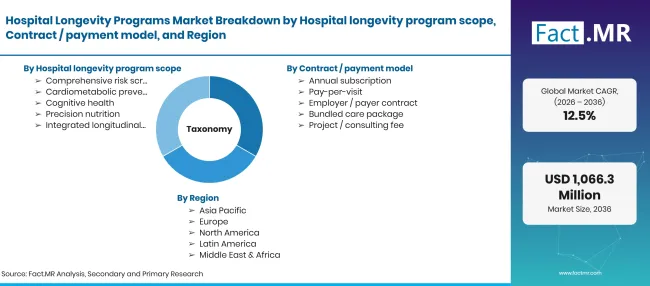
Hospital Longevity Programs Market Taxonomy | Source: Fact.MR
| Items | Values |
|---|---|
| Quantitative Units (2026) | USD 327.5 million |
| Hospital Longevity Program Scope | Comprehensive risk screening, Cardiometabolic prevention, Cognitive health, Precision nutrition, Integrated longitudinal care |
| Contract / Payment Model | Annual subscription, Pay-per-visit, Employer / payer contract, Bundled care package, Project / consulting fee |
| Delivery Channel | Hospital / medical group, Dedicated facility, At-home / virtual, Employer site, Hospitality / residential partner |
| Service Beneficiary | Older adults, At-risk adults, Healthy adults, Family / caregivers, Corporate executives |
| Regions Covered | North America, Latin America, Europe, East Asia, South Asia and Pacific, Middle East & Africa |
| Countries Covered | United States, China, Japan, Germany, South Korea, and other countries |
| Key Companies Profiled | Prenuvo, Fountain Life, Neko Health, Function Health (Ezra), Human Longevity, Inc. |
| Additional Attributes | Dollar revenue in the Hospital Longevity Programs Market is segmented by hospital longevity program scope (comprehensive risk screening, cardiometabolic prevention, cognitive health, precision nutrition, integrated longitudinal care), contract / payment model (annual subscription, pay-per-visit, employer / payer contract, bundled care package, project / consulting fee), delivery channel (hospital / medical group, dedicated facility, at-home / virtual, employer site, hospitality / residential partner), service beneficiary (older adults, at-risk adults, healthy adults, family / caregivers, corporate executives), and region. |
Source: Fact.MR analysis. Updated Nov 18, 2026
Hospital Longevity Programs Market by Segments
-
Hospital Longevity Program Scope
- Comprehensive risk screening
- Cardiometabolic prevention
- Cognitive health
- Precision nutrition
- Integrated longitudinal care
-
Contract / Payment Model
- Annual subscription
- Pay-per-visit
- Employer / payer contract
- Bundled care package
- Project / consulting fee
-
Delivery Channel
- Hospital / medical group
- Dedicated facility
- At-home / virtual
- Employer site
- Hospitality / residential partner
-
Service Beneficiary
- Older adults
- At-risk adults
- Healthy adults
- Family / caregivers
- Corporate executives
-
Region
- North America
- United States
- Canada
- Mexico
- Europe
- Germany
- United Kingdom
- France
- Italy
- Spain
- Rest of Europe
- Asia Pacific
- China
- India
- Japan
- South Korea
- Australia
- Rest of Asia Pacific
- Latin America
- Brazil
- Mexico
- Argentina
- Rest of Latin America
- Middle East & Africa
- GCC Countries
- South Africa
- Rest of Middle East & Africa
- North America
Frequently Asked Questions
How big is the global Hospital Longevity Programs Market in 2026?
What will be the size of the Hospital Longevity Programs Market by 2036?
How fast will the Hospital Longevity Programs Market grow during the forecast period?
Which hospital longevity program scope segment holds the largest share?
Which contract or payment model leads the Hospital Longevity Programs Market?
Which delivery channel holds the largest share of the market?
Who are the key companies in the Hospital Longevity Programs Market?
Who worked on this report


Preview the report firsthand - request a free sample
Free SampleGet the brochure for pricing and purchase details
Download PDF