Hydraulic Power Unit Market
Hydraulic Power Unit Market Size and Share Forecast Outlook 2026 to 2036
Hydraulic power unit market is projected to grow from USD 14.0 billion in 2026 to USD 24.2 billion by 2036, at a CAGR of 5.6%. 2000-3000 psi will dominate with a 42.4% market share, while electric will lead the power source segment with a 53.5% share.
Hydraulic Power Unit Market Forecast and Outlook 2026 to 2036
The global hydraulic power unit market is projected to grow from USD 14.0 billion in 2026 to approximately USD 24.2 billion by 2036. This translates into a total growth of 72.9%, with the market forecast to expand at a compound annual growth rate (CAGR) of 5.6% between 2026 and 2036.
Quick Stats on Hydraulic Power Unit Market
- Hydraulic Power Unit Market Value (2026): USD 14.0 billion
- Hydraulic Power Unit Market Forecast Value (2036): USD 24.2 billion
- Hydraulic Power Unit Market Forecast CAGR (2026 to 2036): 5.6%
- Leading Operating Pressure in Hydraulic Power Unit Market: 2000-3000 psi (42.4%)
- Leading Power Source in Hydraulic Power Unit Market: Electric (53.7%)
- Leading Application in Hydraulic Power Unit Market: Industrial (52.0%)
- Key Growth Regions in Hydraulic Power Unit Market: Asia Pacific, North America, and Europe
- Key Players in Hydraulic Power Unit Market: Bosch Rexroth AG, Nachi-Fujikoshi Corporation, Parker Hannifin Corporation, Weber Hydraulik GmbH, Hydac International GmbH, Related Fluid Power Ltd., HCS Control Systems Ltd., Bailey International LLC, Eaton Corporation Plc, Dana Motion Systems
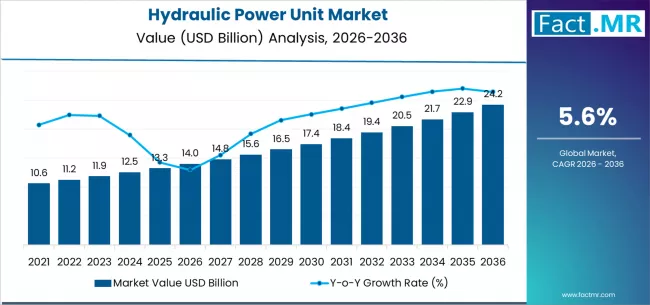
Demand is expected to grow by over 1.7X during this period, supported by exponential demand for industrial automation solutions, rising adoption of advanced hydraulic systems, and growing emphasis on energy efficiency innovation and operational reliability optimization across global manufacturing operations.
The hydraulic power unit market is positioned for substantial expansion, driven by increasing recognition of hydraulic system efficiency importance, growing industrial automation adoption rates with enhanced productivity standards, and rising deployment of advanced power transmission technologies across manufacturing and mobile equipment operations globally.
The market demonstrates robust fundamentals supported by expanding industrial machinery networks, equipment manufacturers' focus on energy-efficient hydraulic solutions, and rising recognition of hydraulic power units as critical components in achieving enhanced operational performance, precision control capabilities, and system reliability effectiveness within modern industrial architectures across diverse application segments.
Hydraulic Power Unit Market Key Takeaways
| Metric | Value |
|---|---|
| Estimated Value (2026E) | USD 14.0 billion |
| Forecast Value (2036F) | USD 24.2 billion |
| Forecast CAGR (2026 to 2036) | 5.6% |
Category
| Category | Segments |
|---|---|
| Operating Pressure | <750 psi; 750-2000 psi; 2000-3000 psi; 3000 psi |
| Power Source | Diesel; Gasoline; Electric |
| Application | Mobile; Industrial; Others |
| Region | Asia Pacific; North America; Europe; Latin America; Middle East & Africa |
Segmental Analysis
How does 2000-3000 psi Operating Pressure Drive Market Leadership?
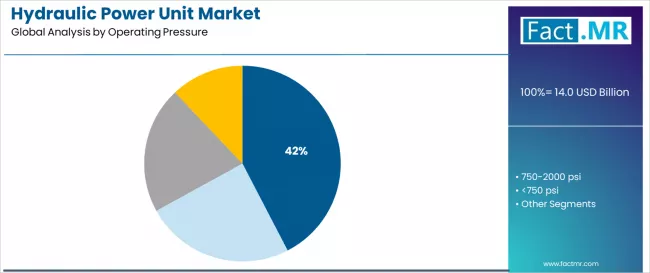
The 2000-3000 psi operating pressure segment is projected to account for 42.4% of the hydraulic power unit market in 2026, reaffirming its position as the category's dominant pressure specification.
Equipment manufacturers increasingly recognize the optimal balance of power delivery and system efficiency offered by medium-high pressure hydraulic units for industrial automation applications, particularly in manufacturing machinery operations and mobile equipment environments.
Why does Electric Power Source Command Majority Market Share?
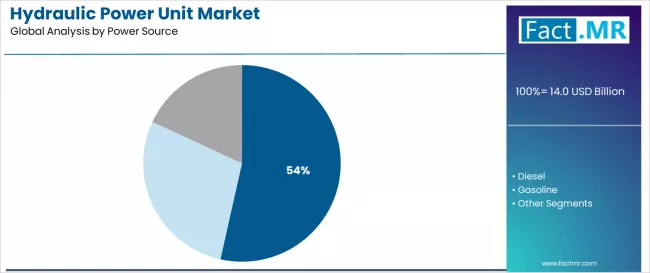
Electric power source is projected to represent 53.7% of hydraulic power unit demand in 2026, underscoring its role as the primary energy category driving market adoption and technology deployment. Equipment manufacturers recognize that electric-powered systems, including diverse motor configurations, varied efficiency ratings, and comprehensive control capabilities, provide the largest addressable market that diesel or gasoline applications cannot match in energy efficiency and environmental compliance.
What drives Industrial Applications of Hydraulic Power Units?
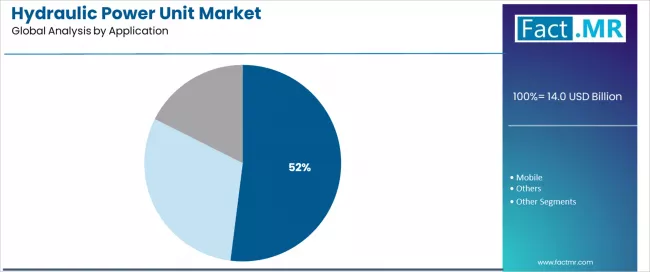
The industrial application is projected to account for 52.0% of the hydraulic power unit market in 2026, establishing its position as the leading application segment. Equipment manufacturers increasingly recognize that industrial applications, encompassing manufacturing machinery, processing equipment, and automated production systems, represent the most significant and volume-intensive category requiring specialized hydraulic power due to automation prevalence and operational complexity.
What are the Drivers, Restraints, and Key Trends of the Hydraulic Power Unit Market?
The hydraulic power unit market is driven by rising emphasis on energy efficiency and increasing adoption of automation across industrial manufacturing operations. Demand is supported by the need for reliable power delivery in continuous and precision-controlled applications. Ongoing modernization of industrial equipment is further encouraging replacement of legacy systems with more efficient hydraulic solutions.
Market restraints include high initial capital costs, particularly in price-sensitive emerging markets, which can delay investment decisions. Maintenance complexity in advanced systems and challenges related to hydraulic fluid contamination management also affect operating reliability and lifecycle costs, especially in harsh industrial environments.
Key trends include the growing adoption of electric drive technologies and variable speed systems, which improve energy efficiency and enable adaptive power management. Integration of IoT-based monitoring and predictive maintenance platforms is also gaining traction, allowing real-time condition tracking, early fault detection, and optimized maintenance planning. These trends are improving system uptime, reducing unplanned downtime, and enhancing overall operational efficiency.
Analysis of the Hydraulic Power Unit Market by Key Countries
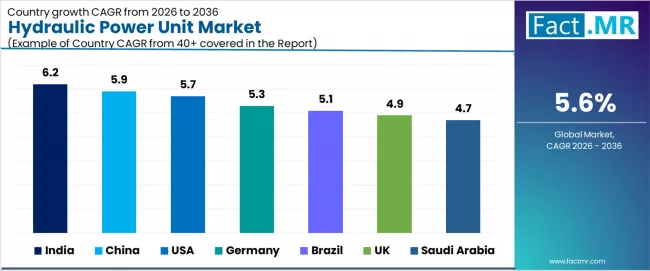
| Country | CAGR (2026-2036) |
|---|---|
| India | 6.2% |
| China | 5.9% |
| USA | 5.7% |
| Germany | 5.3% |
| Brazil | 5.1% |
| UK | 4.9% |
| Saudi Arabia | 4.7% |
How is Industrial Expansion Accelerating Hydraulic Power Unit Demand in India?
India’s hydraulic power unit market is projected to grow at a CAGR of 6.2% through 2036, supported by rapid industrialization and large-scale infrastructure development. Expanding manufacturing automation and construction activity across major industrial corridors are driving adoption of advanced hydraulic systems.
Government initiatives promoting manufacturing capability and domestic equipment development further support market expansion. Increasing focus on automation efficiency and indigenous hydraulic technology continues to strengthen long-term demand.
Why does China Command Scale-Driven Leadership in Hydraulic Systems?
China is expected to register a CAGR of 5.9%, driven by its vast manufacturing base and accelerating industrial automation. Demand is supported by large-scale machinery production, construction activity, and infrastructure modernization across key industrial provinces.
Domestic manufacturers are expanding hydraulic system capabilities to support automation upgrades and reduce reliance on imports. Ongoing industrial modernization policies continue to reinforce steady adoption of hydraulic power units.
What sustains the USA’s Position in Advanced Hydraulic Automation?
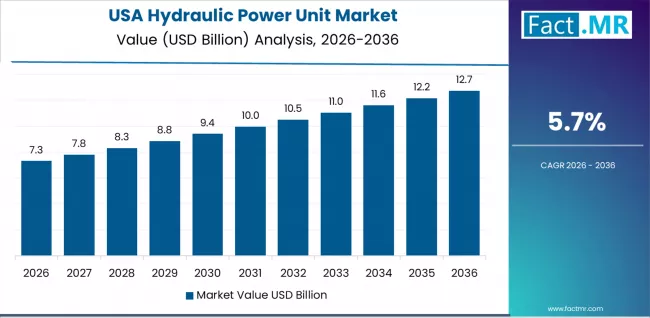
The USA market is forecast to grow at a CAGR of 5.7%, supported by high automation intensity and ongoing modernization of manufacturing facilities. Hydraulic power units are increasingly integrated into energy-efficient and digitally enabled production environments. Strong industrial infrastructure and Industry 4.0 adoption support demand for advanced hydraulic systems. Regulatory focus on energy efficiency further encourages upgrades across manufacturing and automation applications.
How is Industry 4.0 Reinforcing Germany’s Hydraulic Technology Leadership?
Germany is projected to expand at a CAGR of 5.3%, driven by precision manufacturing and advanced automation integration. Hydraulic power units are widely deployed in high-efficiency production lines and intelligent machinery systems. Strong engineering standards and emphasis on long-term efficiency support adoption of advanced hydraulic platforms. Environmental and energy management requirements further shape system specifications.
Why is Agricultural Mechanization Driving Hydraulic Demand in Brazil?
Brazil’s hydraulic power unit market is expected to grow at a CAGR of 5.1%, supported by agricultural mechanization and mining equipment demand. Extensive use of mobile and heavy machinery across farming and resource extraction regions drives requirement for durable hydraulic systems. Equipment operators prioritize reliability and performance in remote operating conditions. Expanding domestic equipment manufacturing supports continued system deployment.
How does Defense and Energy Modernization Support UK Market Growth?
The UK market is projected to grow at a CAGR of 4.9%, driven by defense equipment upgrades and offshore energy development. Hydraulic power units are increasingly used in mission-critical military platforms and energy infrastructure. Demand centers on high-reliability systems capable of operating under challenging conditions. Strong domestic engineering capabilities support specialized hydraulic applications.
What Role does Industrial Diversification Play in Saudi Arabia’s Market Development?
Saudi Arabia is expected to record a CAGR of 4.7%, supported by Vision 2030 industrial diversification and infrastructure investment. Hydraulic power units are being deployed across emerging manufacturing facilities and large construction projects. Demand favors proven technologies with strong reliability credentials. Continued public investment in industrial development supports steady equipment adoption.
Competitive Landscape of the Hydraulic Power Unit Market
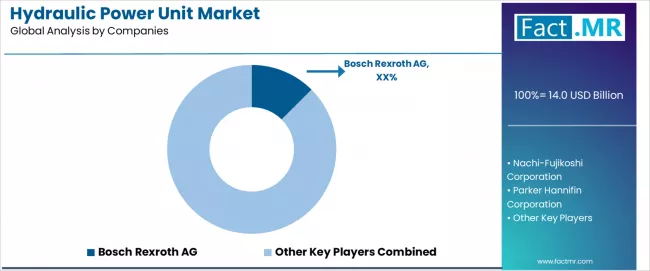
The hydraulic power unit market is highly competitive, with participation from global hydraulic system manufacturers, specialized power unit suppliers, and industrial automation companies. Competition is shaped by energy efficiency, system reliability, integration with automation platforms, and the ability to deliver application-specific solutions rather than price alone. Ongoing investment in electric drive integration, intelligent controls, and lifecycle technical support underpins market positioning.
Bosch Rexroth AG holds a leading position, supported by advanced electric drive technologies, digital control capabilities, and strong alignment with industrial automation requirements. Nachi-Fujikoshi Corporation competes through precision-engineered hydraulic platforms and deep machinery integration expertise, while Parker Hannifin Corporation leverages a broad motion control portfolio and global industrial reach. Weber Hydraulik GmbH focuses on custom-engineered hydraulic power systems for demanding applications.
Other participants include Hydac International GmbH, which emphasizes filtration-integrated systems and fluid management, and Eaton Corporation Plc and Dana Motion Systems, which offer integrated hydraulic and power management solutions. Regional specialists such as Related Fluid Power, HCS Control Systems, and Bailey International strengthen competition through application engineering, customization, and localized customer support.
Key Players in the Hydraulic Power Unit Market
- Bosch Rexroth AG
- Nachi-Fujikoshi Corporation
- Parker Hannifin Corporation
- Weber Hydraulik GmbH
- Hydac International GmbH
- Related Fluid Power Ltd.
- HCS Control Systems Ltd.
- Bailey International LLC
- Eaton Corporation Plc
- Dana Motion Systems
Scope of the Report
| Items | Values |
|---|---|
| Quantitative Units (2026) | USD 14.0 Billion |
| Operating Pressure | <750 psi, 750-2000 psi, 2000-3000 psi, >3000 psi |
| Power Source | Diesel, Gasoline, Electric |
| Application | Mobile, Industrial, Others |
| Regions Covered | Asia Pacific, North America, Europe, Latin America, MEA |
| Countries Covered | USA, Germany, UK, India, China, Brazil, Saudi Arabia and 40+ countries |
| Key Companies Profiled | Bosch Rexroth AG, Nachi-Fujikoshi Corporation, Parker Hannifin Corporation, Weber Hydraulik GmbH, Hydac International GmbH, Related Fluid Power Ltd., HCS Control Systems Ltd., Bailey International LLC, Eaton Corporation Plc, Dana Motion Systems |
| Additional Attributes | Dollar sales by operating pressure, power source, application, regional demand trends, competitive landscape, equipment manufacturer preferences for specific hydraulic power units, integration with comprehensive automation systems, innovations in electric drive development, energy efficiency advancement, and operational reliability optimization capabilities |
Hydraulic Power Unit Market by Segments
-
Operating Pressure :
- <750 psi
- 750-2000 psi
- 2000-3000 psi
- 3000 psi
-
Power Source :
- Diesel
- Gasoline
- Electric
-
Application :
- Mobile
- Industrial
- Others
-
Region :
-
Asia Pacific
- China
- India
- Japan
- South Korea
- ASEAN
- Australia & New Zealand
- Rest of Asia Pacific
-
North America
- USA
- Canada
- Mexico
-
Europe
- Germany
- France
- UK
- Italy
- Spain
- Nordic
- BENELUX
- Rest of Europe
-
Latin America
- Brazil
- Argentina
- Chile
- Rest of Latin America
-
MEA
- Kingdom of Saudi Arabia
- Other GCC Countries
- Turkey
- South Africa
- Other African Countries
- Rest of MEA
-
Table of Content
- Executive Summary
- Global Market Outlook
- Demand to side Trends
- Supply to side Trends
- Technology Roadmap Analysis
- Analysis and Recommendations
- Market Overview
- Market Coverage / Taxonomy
- Market Definition / Scope / Limitations
- Market Background
- Market Dynamics
- Drivers
- Restraints
- Opportunity
- Trends
- Scenario Forecast
- Demand in Optimistic Scenario
- Demand in Likely Scenario
- Demand in Conservative Scenario
- Opportunity Map Analysis
- Product Life Cycle Analysis
- Supply Chain Analysis
- Investment Feasibility Matrix
- Value Chain Analysis
- PESTLE and Porter’s Analysis
- Regulatory Landscape
- Regional Parent Market Outlook
- Production and Consumption Statistics
- Import and Export Statistics
- Market Dynamics
- Global Market Analysis 2021 to 2025 and Forecast, 2026 to 2036
- Historical Market Size Value (USD Million) Analysis, 2021 to 2025
- Current and Future Market Size Value (USD Million) Projections, 2026 to 2036
- Y to o to Y Growth Trend Analysis
- Absolute $ Opportunity Analysis
- Global Market Pricing Analysis 2021 to 2025 and Forecast 2026 to 2036
- Global Market Analysis 2021 to 2025 and Forecast 2026 to 2036, By Operating Pressure
- Introduction / Key Findings
- Historical Market Size Value (USD Million) Analysis By Operating Pressure, 2021 to 2025
- Current and Future Market Size Value (USD Million) Analysis and Forecast By Operating Pressure, 2026 to 2036
- 2000-3000 psi
- 750-2000 psi
- <750 psi
- 3000 psi
- 2000-3000 psi
- Y to o to Y Growth Trend Analysis By Operating Pressure, 2021 to 2025
- Absolute $ Opportunity Analysis By Operating Pressure, 2026 to 2036
- Global Market Analysis 2021 to 2025 and Forecast 2026 to 2036, By Power Source
- Introduction / Key Findings
- Historical Market Size Value (USD Million) Analysis By Power Source, 2021 to 2025
- Current and Future Market Size Value (USD Million) Analysis and Forecast By Power Source, 2026 to 2036
- Electric
- Diesel
- Gasoline
- Electric
- Y to o to Y Growth Trend Analysis By Power Source, 2021 to 2025
- Absolute $ Opportunity Analysis By Power Source, 2026 to 2036
- Global Market Analysis 2021 to 2025 and Forecast 2026 to 2036, By Application
- Introduction / Key Findings
- Historical Market Size Value (USD Million) Analysis By Application, 2021 to 2025
- Current and Future Market Size Value (USD Million) Analysis and Forecast By Application, 2026 to 2036
- Industrial
- Mobile
- Others
- Industrial
- Y to o to Y Growth Trend Analysis By Application, 2021 to 2025
- Absolute $ Opportunity Analysis By Application, 2026 to 2036
- Global Market Analysis 2021 to 2025 and Forecast 2026 to 2036, By Region
- Introduction
- Historical Market Size Value (USD Million) Analysis By Region, 2021 to 2025
- Current Market Size Value (USD Million) Analysis and Forecast By Region, 2026 to 2036
- North America
- Latin America
- Western Europe
- Eastern Europe
- East Asia
- South Asia and Pacific
- Middle East & Africa
- Market Attractiveness Analysis By Region
- North America Market Analysis 2021 to 2025 and Forecast 2026 to 2036, By Country
- Historical Market Size Value (USD Million) Trend Analysis By Market Taxonomy, 2021 to 2025
- Market Size Value (USD Million) Forecast By Market Taxonomy, 2026 to 2036
- By Country
- USA
- Canada
- Mexico
- By Operating Pressure
- By Power Source
- By Application
- By Country
- Market Attractiveness Analysis
- By Country
- By Operating Pressure
- By Power Source
- By Application
- Key Takeaways
- Latin America Market Analysis 2021 to 2025 and Forecast 2026 to 2036, By Country
- Historical Market Size Value (USD Million) Trend Analysis By Market Taxonomy, 2021 to 2025
- Market Size Value (USD Million) Forecast By Market Taxonomy, 2026 to 2036
- By Country
- Brazil
- Chile
- Rest of Latin America
- By Operating Pressure
- By Power Source
- By Application
- By Country
- Market Attractiveness Analysis
- By Country
- By Operating Pressure
- By Power Source
- By Application
- Key Takeaways
- Western Europe Market Analysis 2021 to 2025 and Forecast 2026 to 2036, By Country
- Historical Market Size Value (USD Million) Trend Analysis By Market Taxonomy, 2021 to 2025
- Market Size Value (USD Million) Forecast By Market Taxonomy, 2026 to 2036
- By Country
- Germany
- UK
- Italy
- Spain
- France
- Nordic
- BENELUX
- Rest of Western Europe
- By Operating Pressure
- By Power Source
- By Application
- By Country
- Market Attractiveness Analysis
- By Country
- By Operating Pressure
- By Power Source
- By Application
- Key Takeaways
- Eastern Europe Market Analysis 2021 to 2025 and Forecast 2026 to 2036, By Country
- Historical Market Size Value (USD Million) Trend Analysis By Market Taxonomy, 2021 to 2025
- Market Size Value (USD Million) Forecast By Market Taxonomy, 2026 to 2036
- By Country
- Russia
- Poland
- Hungary
- Balkan & Baltic
- Rest of Eastern Europe
- By Operating Pressure
- By Power Source
- By Application
- By Country
- Market Attractiveness Analysis
- By Country
- By Operating Pressure
- By Power Source
- By Application
- Key Takeaways
- East Asia Market Analysis 2021 to 2025 and Forecast 2026 to 2036, By Country
- Historical Market Size Value (USD Million) Trend Analysis By Market Taxonomy, 2021 to 2025
- Market Size Value (USD Million) Forecast By Market Taxonomy, 2026 to 2036
- By Country
- China
- Japan
- South Korea
- By Operating Pressure
- By Power Source
- By Application
- By Country
- Market Attractiveness Analysis
- By Country
- By Operating Pressure
- By Power Source
- By Application
- Key Takeaways
- South Asia and Pacific Market Analysis 2021 to 2025 and Forecast 2026 to 2036, By Country
- Historical Market Size Value (USD Million) Trend Analysis By Market Taxonomy, 2021 to 2025
- Market Size Value (USD Million) Forecast By Market Taxonomy, 2026 to 2036
- By Country
- India
- ASEAN
- Australia & New Zealand
- Rest of South Asia and Pacific
- By Operating Pressure
- By Power Source
- By Application
- By Country
- Market Attractiveness Analysis
- By Country
- By Operating Pressure
- By Power Source
- By Application
- Key Takeaways
- Middle East & Africa Market Analysis 2021 to 2025 and Forecast 2026 to 2036, By Country
- Historical Market Size Value (USD Million) Trend Analysis By Market Taxonomy, 2021 to 2025
- Market Size Value (USD Million) Forecast By Market Taxonomy, 2026 to 2036
- By Country
- Kingdom of Saudi Arabia
- Other GCC Countries
- Turkiye
- South Africa
- Other African Union
- Rest of Middle East & Africa
- By Operating Pressure
- By Power Source
- By Application
- By Country
- Market Attractiveness Analysis
- By Country
- By Operating Pressure
- By Power Source
- By Application
- Key Takeaways
- Key Countries Market Analysis
- USA
- Pricing Analysis
- Market Share Analysis, 2025
- By Operating Pressure
- By Power Source
- By Application
- Canada
- Pricing Analysis
- Market Share Analysis, 2025
- By Operating Pressure
- By Power Source
- By Application
- Mexico
- Pricing Analysis
- Market Share Analysis, 2025
- By Operating Pressure
- By Power Source
- By Application
- Brazil
- Pricing Analysis
- Market Share Analysis, 2025
- By Operating Pressure
- By Power Source
- By Application
- Chile
- Pricing Analysis
- Market Share Analysis, 2025
- By Operating Pressure
- By Power Source
- By Application
- Germany
- Pricing Analysis
- Market Share Analysis, 2025
- By Operating Pressure
- By Power Source
- By Application
- UK
- Pricing Analysis
- Market Share Analysis, 2025
- By Operating Pressure
- By Power Source
- By Application
- Italy
- Pricing Analysis
- Market Share Analysis, 2025
- By Operating Pressure
- By Power Source
- By Application
- Spain
- Pricing Analysis
- Market Share Analysis, 2025
- By Operating Pressure
- By Power Source
- By Application
- France
- Pricing Analysis
- Market Share Analysis, 2025
- By Operating Pressure
- By Power Source
- By Application
- India
- Pricing Analysis
- Market Share Analysis, 2025
- By Operating Pressure
- By Power Source
- By Application
- ASEAN
- Pricing Analysis
- Market Share Analysis, 2025
- By Operating Pressure
- By Power Source
- By Application
- Australia & New Zealand
- Pricing Analysis
- Market Share Analysis, 2025
- By Operating Pressure
- By Power Source
- By Application
- China
- Pricing Analysis
- Market Share Analysis, 2025
- By Operating Pressure
- By Power Source
- By Application
- Japan
- Pricing Analysis
- Market Share Analysis, 2025
- By Operating Pressure
- By Power Source
- By Application
- South Korea
- Pricing Analysis
- Market Share Analysis, 2025
- By Operating Pressure
- By Power Source
- By Application
- Russia
- Pricing Analysis
- Market Share Analysis, 2025
- By Operating Pressure
- By Power Source
- By Application
- Poland
- Pricing Analysis
- Market Share Analysis, 2025
- By Operating Pressure
- By Power Source
- By Application
- Hungary
- Pricing Analysis
- Market Share Analysis, 2025
- By Operating Pressure
- By Power Source
- By Application
- Kingdom of Saudi Arabia
- Pricing Analysis
- Market Share Analysis, 2025
- By Operating Pressure
- By Power Source
- By Application
- Turkiye
- Pricing Analysis
- Market Share Analysis, 2025
- By Operating Pressure
- By Power Source
- By Application
- South Africa
- Pricing Analysis
- Market Share Analysis, 2025
- By Operating Pressure
- By Power Source
- By Application
- USA
- Market Structure Analysis
- Competition Dashboard
- Competition Benchmarking
- Market Share Analysis of Top Players
- By Regional
- By Operating Pressure
- By Power Source
- By Application
- Competition Analysis
- Competition Deep Dive
- Bosch Rexroth AG
- Overview
- Product Portfolio
- Profitability by Market Segments (Product/Age /Sales Channel/Region)
- Sales Footprint
- Strategy Overview
- Marketing Strategy
- Product Strategy
- Channel Strategy
- Nachi-Fujikoshi Corporation
- Parker Hannifin Corporation
- Weber Hydraulik GmbH
- Hydac International GmbH
- Related Fluid Power Ltd.
- HCS Control Systems Ltd.
- Bailey International LLC
- Eaton Corporation Plc
- Dana Motion Systems
- Bosch Rexroth AG
- Competition Deep Dive
- Assumptions & Acronyms Used
- Research Methodology
List Of Table
- Table 1: Global Market Value (USD Million) Forecast by Region, 2021 to 2036
- Table 2: Global Market Value (USD Million) Forecast by Operating Pressure, 2021 to 2036
- Table 3: Global Market Value (USD Million) Forecast by Power Source, 2021 to 2036
- Table 4: Global Market Value (USD Million) Forecast by Application, 2021 to 2036
- Table 5: North America Market Value (USD Million) Forecast by Country, 2021 to 2036
- Table 6: North America Market Value (USD Million) Forecast by Operating Pressure, 2021 to 2036
- Table 7: North America Market Value (USD Million) Forecast by Power Source, 2021 to 2036
- Table 8: North America Market Value (USD Million) Forecast by Application, 2021 to 2036
- Table 9: Latin America Market Value (USD Million) Forecast by Country, 2021 to 2036
- Table 10: Latin America Market Value (USD Million) Forecast by Operating Pressure, 2021 to 2036
- Table 11: Latin America Market Value (USD Million) Forecast by Power Source, 2021 to 2036
- Table 12: Latin America Market Value (USD Million) Forecast by Application, 2021 to 2036
- Table 13: Western Europe Market Value (USD Million) Forecast by Country, 2021 to 2036
- Table 14: Western Europe Market Value (USD Million) Forecast by Operating Pressure, 2021 to 2036
- Table 15: Western Europe Market Value (USD Million) Forecast by Power Source, 2021 to 2036
- Table 16: Western Europe Market Value (USD Million) Forecast by Application, 2021 to 2036
- Table 17: Eastern Europe Market Value (USD Million) Forecast by Country, 2021 to 2036
- Table 18: Eastern Europe Market Value (USD Million) Forecast by Operating Pressure, 2021 to 2036
- Table 19: Eastern Europe Market Value (USD Million) Forecast by Power Source, 2021 to 2036
- Table 20: Eastern Europe Market Value (USD Million) Forecast by Application, 2021 to 2036
- Table 21: East Asia Market Value (USD Million) Forecast by Country, 2021 to 2036
- Table 22: East Asia Market Value (USD Million) Forecast by Operating Pressure, 2021 to 2036
- Table 23: East Asia Market Value (USD Million) Forecast by Power Source, 2021 to 2036
- Table 24: East Asia Market Value (USD Million) Forecast by Application, 2021 to 2036
- Table 25: South Asia and Pacific Market Value (USD Million) Forecast by Country, 2021 to 2036
- Table 26: South Asia and Pacific Market Value (USD Million) Forecast by Operating Pressure, 2021 to 2036
- Table 27: South Asia and Pacific Market Value (USD Million) Forecast by Power Source, 2021 to 2036
- Table 28: South Asia and Pacific Market Value (USD Million) Forecast by Application, 2021 to 2036
- Table 29: Middle East & Africa Market Value (USD Million) Forecast by Country, 2021 to 2036
- Table 30: Middle East & Africa Market Value (USD Million) Forecast by Operating Pressure, 2021 to 2036
- Table 31: Middle East & Africa Market Value (USD Million) Forecast by Power Source, 2021 to 2036
- Table 32: Middle East & Africa Market Value (USD Million) Forecast by Application, 2021 to 2036
List Of Figures
- Figure 1: Global Market Pricing Analysis
- Figure 2: Global Market Value (USD Million) Forecast 2021 to 2036
- Figure 3: Global Market Value Share and BPS Analysis by Operating Pressure, 2026 and 2036
- Figure 4: Global Market Y to o to Y Growth Comparison by Operating Pressure, 2026 to 2036
- Figure 5: Global Market Attractiveness Analysis by Operating Pressure
- Figure 6: Global Market Value Share and BPS Analysis by Power Source, 2026 and 2036
- Figure 7: Global Market Y to o to Y Growth Comparison by Power Source, 2026 to 2036
- Figure 8: Global Market Attractiveness Analysis by Power Source
- Figure 9: Global Market Value Share and BPS Analysis by Application, 2026 and 2036
- Figure 10: Global Market Y to o to Y Growth Comparison by Application, 2026 to 2036
- Figure 11: Global Market Attractiveness Analysis by Application
- Figure 12: Global Market Value (USD Million) Share and BPS Analysis by Region, 2026 and 2036
- Figure 13: Global Market Y to o to Y Growth Comparison by Region, 2026 to 2036
- Figure 14: Global Market Attractiveness Analysis by Region
- Figure 15: North America Market Incremental Dollar Opportunity, 2026 to 2036
- Figure 16: Latin America Market Incremental Dollar Opportunity, 2026 to 2036
- Figure 17: Western Europe Market Incremental Dollar Opportunity, 2026 to 2036
- Figure 18: Eastern Europe Market Incremental Dollar Opportunity, 2026 to 2036
- Figure 19: East Asia Market Incremental Dollar Opportunity, 2026 to 2036
- Figure 20: South Asia and Pacific Market Incremental Dollar Opportunity, 2026 to 2036
- Figure 21: Middle East & Africa Market Incremental Dollar Opportunity, 2026 to 2036
- Figure 22: North America Market Value Share and BPS Analysis by Country, 2026 and 2036
- Figure 23: North America Market Value Share and BPS Analysis by Operating Pressure, 2026 and 2036
- Figure 24: North America Market Y to o to Y Growth Comparison by Operating Pressure, 2026 to 2036
- Figure 25: North America Market Attractiveness Analysis by Operating Pressure
- Figure 26: North America Market Value Share and BPS Analysis by Power Source, 2026 and 2036
- Figure 27: North America Market Y to o to Y Growth Comparison by Power Source, 2026 to 2036
- Figure 28: North America Market Attractiveness Analysis by Power Source
- Figure 29: North America Market Value Share and BPS Analysis by Application, 2026 and 2036
- Figure 30: North America Market Y to o to Y Growth Comparison by Application, 2026 to 2036
- Figure 31: North America Market Attractiveness Analysis by Application
- Figure 32: Latin America Market Value Share and BPS Analysis by Country, 2026 and 2036
- Figure 33: Latin America Market Value Share and BPS Analysis by Operating Pressure, 2026 and 2036
- Figure 34: Latin America Market Y to o to Y Growth Comparison by Operating Pressure, 2026 to 2036
- Figure 35: Latin America Market Attractiveness Analysis by Operating Pressure
- Figure 36: Latin America Market Value Share and BPS Analysis by Power Source, 2026 and 2036
- Figure 37: Latin America Market Y to o to Y Growth Comparison by Power Source, 2026 to 2036
- Figure 38: Latin America Market Attractiveness Analysis by Power Source
- Figure 39: Latin America Market Value Share and BPS Analysis by Application, 2026 and 2036
- Figure 40: Latin America Market Y to o to Y Growth Comparison by Application, 2026 to 2036
- Figure 41: Latin America Market Attractiveness Analysis by Application
- Figure 42: Western Europe Market Value Share and BPS Analysis by Country, 2026 and 2036
- Figure 43: Western Europe Market Value Share and BPS Analysis by Operating Pressure, 2026 and 2036
- Figure 44: Western Europe Market Y to o to Y Growth Comparison by Operating Pressure, 2026 to 2036
- Figure 45: Western Europe Market Attractiveness Analysis by Operating Pressure
- Figure 46: Western Europe Market Value Share and BPS Analysis by Power Source, 2026 and 2036
- Figure 47: Western Europe Market Y to o to Y Growth Comparison by Power Source, 2026 to 2036
- Figure 48: Western Europe Market Attractiveness Analysis by Power Source
- Figure 49: Western Europe Market Value Share and BPS Analysis by Application, 2026 and 2036
- Figure 50: Western Europe Market Y to o to Y Growth Comparison by Application, 2026 to 2036
- Figure 51: Western Europe Market Attractiveness Analysis by Application
- Figure 52: Eastern Europe Market Value Share and BPS Analysis by Country, 2026 and 2036
- Figure 53: Eastern Europe Market Value Share and BPS Analysis by Operating Pressure, 2026 and 2036
- Figure 54: Eastern Europe Market Y to o to Y Growth Comparison by Operating Pressure, 2026 to 2036
- Figure 55: Eastern Europe Market Attractiveness Analysis by Operating Pressure
- Figure 56: Eastern Europe Market Value Share and BPS Analysis by Power Source, 2026 and 2036
- Figure 57: Eastern Europe Market Y to o to Y Growth Comparison by Power Source, 2026 to 2036
- Figure 58: Eastern Europe Market Attractiveness Analysis by Power Source
- Figure 59: Eastern Europe Market Value Share and BPS Analysis by Application, 2026 and 2036
- Figure 60: Eastern Europe Market Y to o to Y Growth Comparison by Application, 2026 to 2036
- Figure 61: Eastern Europe Market Attractiveness Analysis by Application
- Figure 62: East Asia Market Value Share and BPS Analysis by Country, 2026 and 2036
- Figure 63: East Asia Market Value Share and BPS Analysis by Operating Pressure, 2026 and 2036
- Figure 64: East Asia Market Y to o to Y Growth Comparison by Operating Pressure, 2026 to 2036
- Figure 65: East Asia Market Attractiveness Analysis by Operating Pressure
- Figure 66: East Asia Market Value Share and BPS Analysis by Power Source, 2026 and 2036
- Figure 67: East Asia Market Y to o to Y Growth Comparison by Power Source, 2026 to 2036
- Figure 68: East Asia Market Attractiveness Analysis by Power Source
- Figure 69: East Asia Market Value Share and BPS Analysis by Application, 2026 and 2036
- Figure 70: East Asia Market Y to o to Y Growth Comparison by Application, 2026 to 2036
- Figure 71: East Asia Market Attractiveness Analysis by Application
- Figure 72: South Asia and Pacific Market Value Share and BPS Analysis by Country, 2026 and 2036
- Figure 73: South Asia and Pacific Market Value Share and BPS Analysis by Operating Pressure, 2026 and 2036
- Figure 74: South Asia and Pacific Market Y to o to Y Growth Comparison by Operating Pressure, 2026 to 2036
- Figure 75: South Asia and Pacific Market Attractiveness Analysis by Operating Pressure
- Figure 76: South Asia and Pacific Market Value Share and BPS Analysis by Power Source, 2026 and 2036
- Figure 77: South Asia and Pacific Market Y to o to Y Growth Comparison by Power Source, 2026 to 2036
- Figure 78: South Asia and Pacific Market Attractiveness Analysis by Power Source
- Figure 79: South Asia and Pacific Market Value Share and BPS Analysis by Application, 2026 and 2036
- Figure 80: South Asia and Pacific Market Y to o to Y Growth Comparison by Application, 2026 to 2036
- Figure 81: South Asia and Pacific Market Attractiveness Analysis by Application
- Figure 82: Middle East & Africa Market Value Share and BPS Analysis by Country, 2026 and 2036
- Figure 83: Middle East & Africa Market Value Share and BPS Analysis by Operating Pressure, 2026 and 2036
- Figure 84: Middle East & Africa Market Y to o to Y Growth Comparison by Operating Pressure, 2026 to 2036
- Figure 85: Middle East & Africa Market Attractiveness Analysis by Operating Pressure
- Figure 86: Middle East & Africa Market Value Share and BPS Analysis by Power Source, 2026 and 2036
- Figure 87: Middle East & Africa Market Y to o to Y Growth Comparison by Power Source, 2026 to 2036
- Figure 88: Middle East & Africa Market Attractiveness Analysis by Power Source
- Figure 89: Middle East & Africa Market Value Share and BPS Analysis by Application, 2026 and 2036
- Figure 90: Middle East & Africa Market Y to o to Y Growth Comparison by Application, 2026 to 2036
- Figure 91: Middle East & Africa Market Attractiveness Analysis by Application
- Figure 92: Global Market - Tier Structure Analysis
- Figure 93: Global Market - Company Share Analysis
- FAQs -
How big is the hydraulic power unit market in 2026?
The global hydraulic power unit market is estimated to be valued at USD 14.0 billion in 2026.
What will be the size of hydraulic power unit market in 2036?
The market size for the hydraulic power unit market is projected to reach USD 24.2 billion by 2036.
How much will be the hydraulic power unit market growth between 2026 and 2036?
The hydraulic power unit market is expected to grow at a 5.6% CAGR between 2026 and 2036.
What are the key product types in the hydraulic power unit market?
The key product types in hydraulic power unit market are 2000-3000 psi, 750-2000 psi, <750 psi and 3000 psi.
Which power source segment to contribute significant share in the hydraulic power unit market in 2026?
In terms of power source, electric segment to command 53.5% share in the hydraulic power unit market in 2026.