Precision Infrastructure Hydraulic Excavators Market

Precision Infrastructure Hydraulic Excavators Market Size and Share Forecast Outlook 2026 to 2036

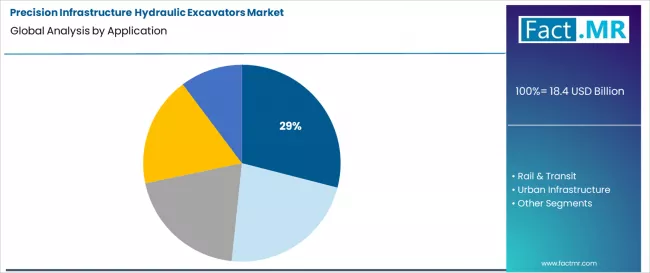
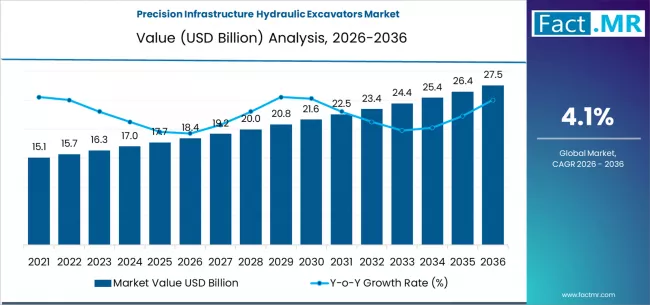
Precision infrastructure hydraulic excavators market is projected to grow from USD 18.4 billion in 2026 to USD 27.5 billion by 2036, at a CAGR of 4.1%. Standard Hydraulic Excavators will dominate with a 41.0% market share, while roads & highways will lead the application segment with a 29.0% share.

Precision Infrastructure Hydraulic Excavators Market Forecast and Outlook 2026 to 2036

The global market for hydraulic excavators in precision infrastructure represents the mature core of the construction equipment sector, projected to grow from USD 18.42 billion in 2026 to USD 27.53 billion by 2036, advancing at a steady 4.1% CAGR. This measured growth underscores a market in transition, where volume expansion is secondary to a fundamental shift in value creation.

Key Takeaways from the Precision Infrastructure Hydraulic Excavators Market

  • Market Value for 2026: USD 18.42 Billion
  • Market Value for 2036: USD 27.53 Billion
  • Forecast CAGR (2026-2036): 4.1%
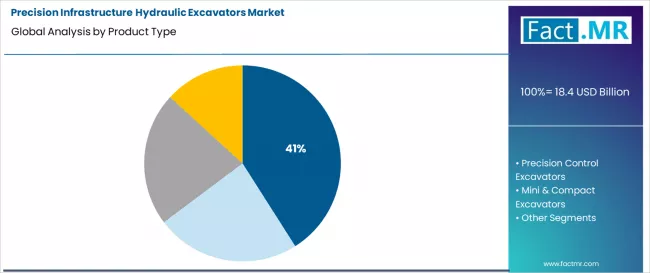
  • Leading Product Type Segment (2026): Standard Hydraulic Excavators (41%)
  • Leading Application Segment (2026): Roads & Highways (29%)
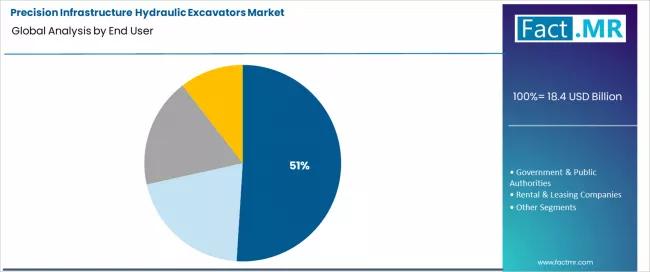
  • Leading End User Segment (2026): Construction & Infrastructure Firms (51%)
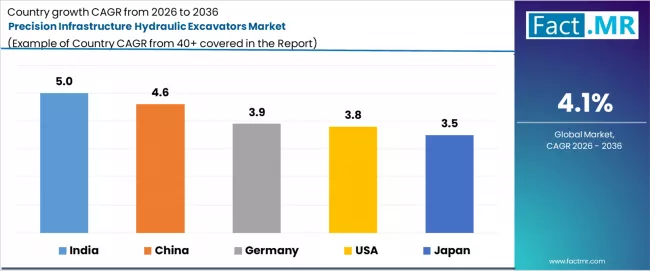
  • Key Growth Countries: India (5.00% CAGR), China (4.60% CAGR), USA (3.80% CAGR), Germany (3.90% CAGR), Japan (3.50% CAGR)
  • Key Players in the Market: Caterpillar Inc., Komatsu Ltd., Volvo Construction Equipment, Hitachi Construction Machinery, Liebherr Group

Precision Infrastructure Hydraulic Excavators Market Market Value Analysis

Demand is increasingly defined not by the need for more machines, but for smarter, more efficient, and more precise machines. The era of excavation as a bulk earthmoving task is giving way to its integration as a data-driven, first-step in the digital construction process.

The critical trend is the integration of advanced grade control, machine guidance, and telematics systems into standard hydraulic platforms. Excavators are evolving into connected worksite nodes, with GPS and GNSS technology enabling centimeter-level accuracy for grading, trenching, and foundation work.

This precision minimizes rework, reduces material overuse, and accelerates project timelines, directly translating to lower costs and improved margins for contractors. The rise of modular attachments and quick-coupler systems further enhances versatility, allowing a single machine to perform multiple precision tasks.

While standard hydraulic excavators maintain volume dominance, growth impetus is strongest in precision control variants and compact models suited for complex urban retrofits and utility work. This market’s trajectory is shaped by global infrastructure investment, but its evolution is driven by the imperative to do more with less fuel, less time, and less margin for error.

India leads growth with a 5.00% CAGR, fueled by unprecedented public and private investment in new transportation and urban networks. China follows at 4.60%, focusing on high-quality, technologically advanced infrastructure.

Markets in North America and Western Europe exhibit slower, stable growth centered on fleet renewal with higher-specification, connected machines that boost productivity amid skilled labor shortages.

Metric

Metric Value
Market Value (2026) USD 18.42 Billion
Market Forecast Value (2036) USD 27.53 Billion
Forecast CAGR (2026-2036) 4.1%

Category

Category Segments
Product Type Standard Hydraulic Excavators, Precision Control Excavators, Mini & Compact Excavators, Specialty Heavy Excavators
Application Roads & Highways, Rail & Transit, Urban Infrastructure, Energy & Utilities, Other Public Works
End User Construction & Infrastructure Firms, Government & Public Authorities, Rental & Leasing Companies, Specialty Contractors
Region North America, Latin America, Western Europe, Eastern Europe, East Asia, South Asia & Pacific, MEA

Segmental Analysis

By Product Type, Which Segment Forms the Volume Backbone?

Precision Infrastructure Hydraulic Excavators Market Analysis By Product Type

Standard hydraulic excavators maintain a dominant 41% share, representing the foundational, high-volume core of the market. These machines are the versatile workhorses for a wide range of infrastructure tasks, from bulk excavation to basic loading.

Their continued leadership is based on proven reliability, a vast service network, and their role as the primary platform upon which precision technology can be added via aftermarket or factory-fit kits, allowing buyers to step into advanced capabilities.

By Application, Which Sector Demands Sustained Investment?

Precision Infrastructure Hydraulic Excavators Market Analysis By Application

Roads & highways lead application segments with a 29% share. This reflects continuous global demand for new road construction, expansion, and rehabilitation. The nature of this work requires a high density of excavator use. The push for smarter roads with embedded sensors and precise grading for drainage further ties this application to the adoption of precision-enabled machines.

By End User, Who is the Primary Economic Engine?

Precision Infrastructure Hydraulic Excavators Market Analysis By End User

Construction & infrastructure firms command a 51% share as the primary owners and operators. These firms make capital investment decisions based on total cost of ownership, productivity gains, and the machine’s ability to win and execute contracts.

Their growing preference is for machines that offer integrated technology to improve bidding accuracy, reduce fuel and labor costs, and provide digital documentation of work completed, which is increasingly required by public authorities.

What are the Drivers, Restraints, Opportunities, and Key Trends?

Aspect Description
Driver Sustained global government spending on large-scale public infrastructure projects, including transportation networks, renewable energy installations, and urban utility upgrades. These multi-year projects create predictable, long-term demand for reliable and increasingly efficient excavation equipment.
Restraint The high initial capital cost of new, technology-rich excavators and significant economic sensitivity to interest rate fluctuations, which affect financing costs for both OEMs and buyers. This can delay fleet renewal cycles, especially among small and mid-sized contractors.
Opportunity The growing retrofit market for integrating aftermarket precision guidance, telematics, and fuel-efficiency kits into existing fleets. This allows contractors to upgrade machine capability at a fraction of the cost of a new purchase, extending asset life and improving the productivity of the vast installed base.
Key Trend The convergence of machine control with site management software. Data from precision excavators (e.g., cut/fill volumes, as-built models) is automatically fed into central platforms like BIM, creating a real-time digital twin of the earthworks and enabling proactive project management and progress validation.

Analysis of the Precision Infrastructure Hydraulic Excavators Market by Key Countries

Precision Infrastructure Hydraulic Excavators Market Cagr Analysis By Country

Country CAGR (2026-2036)
India 5.00%
China 4.60%
Germany 3.90%
USA 3.80%
Japan 3.50%

How is India's Infrastructure Surge Shaping Demand?

An aggressive national infrastructure pipeline encompassing highways, railways, and urban metro systems drives India’s leading 5.00% CAGR. The market is characterized by high-volume demand for robust, mid-size standard excavators that can operate in challenging conditions.

Price competitiveness and strong service support are critical, though a growing segment is showing interest in precision technology for large, complex projects to ensure adherence to tight schedules and specifications.

What Defines China's Shift in Market Demand?

China's 4.60% growth now focuses on quality and technology rather than sheer volume. Following decades of rapid build-out, new projects are more complex, involving mountainous terrain, dense urban environments, and greenfield smart cities.

This drives demand for high-specification precision control excavators and versatile compact models. Domestic OEMs are rapidly advancing their technological offerings to meet this sophisticated demand and compete globally.

Why Does Germany's Mature Market Prioritize Precision?

Germany's 3.90% CAGR reflects a market focused on optimization and replacement. With much core infrastructure already in place, work revolves around upgrades, maintenance, and dense urban projects where disruption must be minimized.

German engineering excellence drives demand for the most advanced precision control systems, fuel-efficient engines, and machines designed for low noise and emissions to comply with strict urban worksite regulations.

What Characterizes the USA's Steady Replacement Cycle?

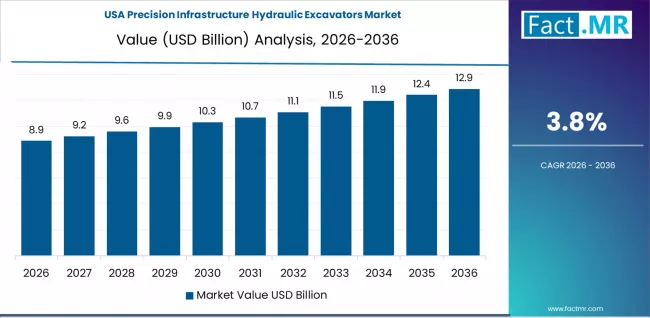
Precision Infrastructure Hydraulic Excavators Market Country Value Analysis

The USA's 3.80% growth is anchored in a steady private and public funding environment for infrastructure renewal. The market is driven by fleet replacement cycles, with contractors seeking machines that offer tangible improvements in fuel efficiency, uptime, and operator comfort to combat rising costs and labor shortages. Integrated technology that simplifies operation and reduces the skill threshold for high-precision tasks is a key purchasing factor.

How is Japan's Technical Expertise Applied?

Japan's 3.50% growth occurs in a context of sophisticated engineering needs and space constraints. The demand is for extremely precise, reliable, and compact machines for work in congested urban areas, complex rail interchanges, and disaster-resistant infrastructure projects. Japanese OEMs and contractors are leaders in utilizing advanced machine control for intricate excavation tasks, setting a benchmark for precision in challenging environments.

Competitive Landscape and Strategic Recommendations

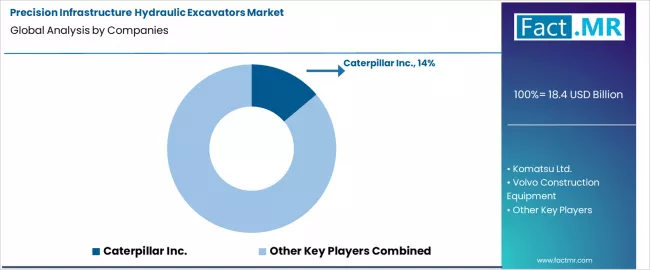
Precision Infrastructure Hydraulic Excavators Market Analysis By Company

Established global giants with deep product lines and extensive dealer networks dominate the competitive landscape. Competition centers on product reliability, total cost of ownership, and the depth of the technology ecosystem surrounding the machine.

Attribute Recommendation
Expand the Technology-Agnostic Ecosystem Develop precision guidance and telematics solutions that can be retrofitted across multiple OEM brands and older models. This captures value from the vast legacy fleet market and builds brand loyalty in the technology layer.
Focus on Lifecycle Value Services Shift emphasis from selling machines to selling guaranteed uptime, productivity contracts, and data-driven advisory services. Use machine data to help customers optimize their operations, creating sticky service revenue streams.
Develop Configurable & Modular Platforms Offer base machine platforms that can be more easily configured with different precision technology packages, arms, and attachments. This allows customers to tailor capabilities to specific project needs without moving to a completely different model.
Strengthen Partnerships with Civil Software Firms Deepen integrations with leading BIM, site management, and civil design software platforms. Ensuring seamless data flow from the excavator to the office suite increases the value of the machine and locks customers into a productive workflow.

Key Players in the Precision Infrastructure Hydraulic Excavators Market

  • Caterpillar Inc.
  • Komatsu Ltd.
  • Volvo Construction Equipment
  • Hitachi Construction Machinery
  • Liebherr Group

Scope of Report

Items Values
Quantitative Units USD Billion
Product Type Standard Hydraulic Excavators, Precision Control Excavators, Mini & Compact Excavators, Specialty Heavy Excavators
Application Roads & Highways, Rail & Transit, Urban Infrastructure, Energy & Utilities, Other Public Works
End User Construction & Infrastructure Firms, Government & Public Authorities, Rental & Leasing Companies, Specialty Contractors
Key Countries India, China, USA, Germany, Japan
Key Companies Caterpillar Inc., Komatsu Ltd., Volvo Construction Equipment, Hitachi Construction Machinery, Liebherr Group
Additional Analysis Comparative analysis of productivity gains from integrated vs. aftermarket precision systems; impact of autonomous functions (e.g., trenching, grading) on project economics and labor dynamics; analysis of secondary market strength and its effect on new machine pricing; regulatory impact of evolving Stage V/Tier 5 emission standards on engine design and cost.

Market by Segments

  • Product Type :

    • Standard Hydraulic Excavators
    • Precision Control Excavators
    • Mini & Compact Excavators
    • Specialty Heavy Excavators
  • Application :

    • Roads & Highways
    • Rail & Transit
    • Urban Infrastructure
    • Energy & Utilities
    • Other Public Works
  • End User :

    • Construction & Infrastructure Firms
    • Government & Public Authorities
    • Rental & Leasing Companies
    • Specialty Contractors
  • Region :

    • North America
      • USA
      • Canada
    • Latin America
      • Brazil
      • Mexico
      • Argentina
      • Rest of Latin America
    • Western Europe
      • Germany
      • UK
      • France
      • Spain
      • Italy
      • BENELUX
      • Rest of Western Europe
    • Eastern Europe
      • Russia
      • Poland
      • Czech Republic
      • Rest of Eastern Europe
    • East Asia
      • China
      • Japan
      • South Korea
      • Rest of East Asia
    • South Asia & Pacific
      • India
      • ASEAN
      • Australia
      • Rest of South Asia & Pacific
    • MEA
      • Saudi Arabia
      • UAE
      • Turkiye
      • Rest of MEA

References

  • International Monetary Fund (IMF). (2024). Public Investment and Infrastructure: A Post-Pandemic Assessment. IMF Departmental Paper Series.
  • OECD. (2023). Infrastructure Planning and Delivery: Benchmarking and Case Studies. OECD Publishing.
  • Schexnayder, C., & Mayo, R. E. (2023). Construction planning, equipment, and methods (10th ed.). McGraw-Hill Education.
  • Tatum, C. B., & Korman, T. M. (2024). Integration of construction technology: Impacts on equipment and processes. Journal of Construction Engineering and Management, 150(2), 04023123.
  • World Bank. (2024). Global Infrastructure Outlook: Needs and Investment Trends. World Bank Publications.

Table of Content

  1. Executive Summary
    • Global Market Outlook
    • Demand to side Trends
    • Supply to side Trends
    • Technology Roadmap Analysis
    • Analysis and Recommendations
  2. Market Overview
    • Market Coverage / Taxonomy
    • Market Definition / Scope / Limitations
  3. Market Background
    • Market Dynamics
      • Drivers
      • Restraints
      • Opportunity
      • Trends
    • Scenario Forecast
      • Demand in Optimistic Scenario
      • Demand in Likely Scenario
      • Demand in Conservative Scenario
    • Opportunity Map Analysis
    • Product Life Cycle Analysis
    • Supply Chain Analysis
    • Investment Feasibility Matrix
    • Value Chain Analysis
    • PESTLE and Porter’s Analysis
    • Regulatory Landscape
    • Regional Parent Market Outlook
    • Production and Consumption Statistics
    • Import and Export Statistics
  4. Global Market Analysis 2021 to 2025 and Forecast, 2026 to 2036
    • Historical Market Size Value (USD Million) Analysis, 2021 to 2025
    • Current and Future Market Size Value (USD Million) Projections, 2026 to 2036
      • Y to o to Y Growth Trend Analysis
      • Absolute $ Opportunity Analysis
  5. Global Market Pricing Analysis 2021 to 2025 and Forecast 2026 to 2036
  6. Global Market Analysis 2021 to 2025 and Forecast 2026 to 2036, By Product Type
    • Introduction / Key Findings
    • Historical Market Size Value (USD Million) Analysis By Product Type, 2021 to 2025
    • Current and Future Market Size Value (USD Million) Analysis and Forecast By Product Type, 2026 to 2036
      • Standard Hydraulic Excavators
      • Precision Control Excavators
      • Mini & Compact Excavators
      • Specialty Heavy Excavators
    • Y to o to Y Growth Trend Analysis By Product Type, 2021 to 2025
    • Absolute $ Opportunity Analysis By Product Type, 2026 to 2036
  7. Global Market Analysis 2021 to 2025 and Forecast 2026 to 2036, By Application
    • Introduction / Key Findings
    • Historical Market Size Value (USD Million) Analysis By Application, 2021 to 2025
    • Current and Future Market Size Value (USD Million) Analysis and Forecast By Application, 2026 to 2036
      • Roads & Highways
      • Rail & Transit
      • Urban Infrastructure
      • Energy & Utilities
      • Other Public Works
    • Y to o to Y Growth Trend Analysis By Application, 2021 to 2025
    • Absolute $ Opportunity Analysis By Application, 2026 to 2036
  8. Global Market Analysis 2021 to 2025 and Forecast 2026 to 2036, By End User
    • Introduction / Key Findings
    • Historical Market Size Value (USD Million) Analysis By End User, 2021 to 2025
    • Current and Future Market Size Value (USD Million) Analysis and Forecast By End User, 2026 to 2036
      • Construction & Infrastructure Firms
      • Government & Public Authorities
      • Rental & Leasing Companies
      • Specialty Contractors
    • Y to o to Y Growth Trend Analysis By End User, 2021 to 2025
    • Absolute $ Opportunity Analysis By End User, 2026 to 2036
  9. Global Market Analysis 2021 to 2025 and Forecast 2026 to 2036, By Region
    • Introduction
    • Historical Market Size Value (USD Million) Analysis By Region, 2021 to 2025
    • Current Market Size Value (USD Million) Analysis and Forecast By Region, 2026 to 2036
      • North America
      • Latin America
      • Western Europe
      • Eastern Europe
      • East Asia
      • South Asia and Pacific
      • Middle East & Africa
    • Market Attractiveness Analysis By Region
  10. North America Market Analysis 2021 to 2025 and Forecast 2026 to 2036, By Country
    • Historical Market Size Value (USD Million) Trend Analysis By Market Taxonomy, 2021 to 2025
    • Market Size Value (USD Million) Forecast By Market Taxonomy, 2026 to 2036
      • By Country
        • USA
        • Canada
        • Mexico
      • By Product Type
      • By Application
      • By End User
    • Market Attractiveness Analysis
      • By Country
      • By Product Type
      • By Application
      • By End User
    • Key Takeaways
  11. Latin America Market Analysis 2021 to 2025 and Forecast 2026 to 2036, By Country
    • Historical Market Size Value (USD Million) Trend Analysis By Market Taxonomy, 2021 to 2025
    • Market Size Value (USD Million) Forecast By Market Taxonomy, 2026 to 2036
      • By Country
        • Brazil
        • Chile
        • Rest of Latin America
      • By Product Type
      • By Application
      • By End User
    • Market Attractiveness Analysis
      • By Country
      • By Product Type
      • By Application
      • By End User
    • Key Takeaways
  12. Western Europe Market Analysis 2021 to 2025 and Forecast 2026 to 2036, By Country
    • Historical Market Size Value (USD Million) Trend Analysis By Market Taxonomy, 2021 to 2025
    • Market Size Value (USD Million) Forecast By Market Taxonomy, 2026 to 2036
      • By Country
        • Germany
        • UK
        • Italy
        • Spain
        • France
        • Nordic
        • BENELUX
        • Rest of Western Europe
      • By Product Type
      • By Application
      • By End User
    • Market Attractiveness Analysis
      • By Country
      • By Product Type
      • By Application
      • By End User
    • Key Takeaways
  13. Eastern Europe Market Analysis 2021 to 2025 and Forecast 2026 to 2036, By Country
    • Historical Market Size Value (USD Million) Trend Analysis By Market Taxonomy, 2021 to 2025
    • Market Size Value (USD Million) Forecast By Market Taxonomy, 2026 to 2036
      • By Country
        • Russia
        • Poland
        • Hungary
        • Balkan & Baltic
        • Rest of Eastern Europe
      • By Product Type
      • By Application
      • By End User
    • Market Attractiveness Analysis
      • By Country
      • By Product Type
      • By Application
      • By End User
    • Key Takeaways
  14. East Asia Market Analysis 2021 to 2025 and Forecast 2026 to 2036, By Country
    • Historical Market Size Value (USD Million) Trend Analysis By Market Taxonomy, 2021 to 2025
    • Market Size Value (USD Million) Forecast By Market Taxonomy, 2026 to 2036
      • By Country
        • China
        • Japan
        • South Korea
      • By Product Type
      • By Application
      • By End User
    • Market Attractiveness Analysis
      • By Country
      • By Product Type
      • By Application
      • By End User
    • Key Takeaways
  15. South Asia and Pacific Market Analysis 2021 to 2025 and Forecast 2026 to 2036, By Country
    • Historical Market Size Value (USD Million) Trend Analysis By Market Taxonomy, 2021 to 2025
    • Market Size Value (USD Million) Forecast By Market Taxonomy, 2026 to 2036
      • By Country
        • India
        • ASEAN
        • Australia & New Zealand
        • Rest of South Asia and Pacific
      • By Product Type
      • By Application
      • By End User
    • Market Attractiveness Analysis
      • By Country
      • By Product Type
      • By Application
      • By End User
    • Key Takeaways
  16. Middle East & Africa Market Analysis 2021 to 2025 and Forecast 2026 to 2036, By Country
    • Historical Market Size Value (USD Million) Trend Analysis By Market Taxonomy, 2021 to 2025
    • Market Size Value (USD Million) Forecast By Market Taxonomy, 2026 to 2036
      • By Country
        • Kingdom of Saudi Arabia
        • Other GCC Countries
        • Turkiye
        • South Africa
        • Other African Union
        • Rest of Middle East & Africa
      • By Product Type
      • By Application
      • By End User
    • Market Attractiveness Analysis
      • By Country
      • By Product Type
      • By Application
      • By End User
    • Key Takeaways
  17. Key Countries Market Analysis
    • USA
      • Pricing Analysis
      • Market Share Analysis, 2025
        • By Product Type
        • By Application
        • By End User
    • Canada
      • Pricing Analysis
      • Market Share Analysis, 2025
        • By Product Type
        • By Application
        • By End User
    • Mexico
      • Pricing Analysis
      • Market Share Analysis, 2025
        • By Product Type
        • By Application
        • By End User
    • Brazil
      • Pricing Analysis
      • Market Share Analysis, 2025
        • By Product Type
        • By Application
        • By End User
    • Chile
      • Pricing Analysis
      • Market Share Analysis, 2025
        • By Product Type
        • By Application
        • By End User
    • Germany
      • Pricing Analysis
      • Market Share Analysis, 2025
        • By Product Type
        • By Application
        • By End User
    • UK
      • Pricing Analysis
      • Market Share Analysis, 2025
        • By Product Type
        • By Application
        • By End User
    • Italy
      • Pricing Analysis
      • Market Share Analysis, 2025
        • By Product Type
        • By Application
        • By End User
    • Spain
      • Pricing Analysis
      • Market Share Analysis, 2025
        • By Product Type
        • By Application
        • By End User
    • France
      • Pricing Analysis
      • Market Share Analysis, 2025
        • By Product Type
        • By Application
        • By End User
    • India
      • Pricing Analysis
      • Market Share Analysis, 2025
        • By Product Type
        • By Application
        • By End User
    • ASEAN
      • Pricing Analysis
      • Market Share Analysis, 2025
        • By Product Type
        • By Application
        • By End User
    • Australia & New Zealand
      • Pricing Analysis
      • Market Share Analysis, 2025
        • By Product Type
        • By Application
        • By End User
    • China
      • Pricing Analysis
      • Market Share Analysis, 2025
        • By Product Type
        • By Application
        • By End User
    • Japan
      • Pricing Analysis
      • Market Share Analysis, 2025
        • By Product Type
        • By Application
        • By End User
    • South Korea
      • Pricing Analysis
      • Market Share Analysis, 2025
        • By Product Type
        • By Application
        • By End User
    • Russia
      • Pricing Analysis
      • Market Share Analysis, 2025
        • By Product Type
        • By Application
        • By End User
    • Poland
      • Pricing Analysis
      • Market Share Analysis, 2025
        • By Product Type
        • By Application
        • By End User
    • Hungary
      • Pricing Analysis
      • Market Share Analysis, 2025
        • By Product Type
        • By Application
        • By End User
    • Kingdom of Saudi Arabia
      • Pricing Analysis
      • Market Share Analysis, 2025
        • By Product Type
        • By Application
        • By End User
    • Turkiye
      • Pricing Analysis
      • Market Share Analysis, 2025
        • By Product Type
        • By Application
        • By End User
    • South Africa
      • Pricing Analysis
      • Market Share Analysis, 2025
        • By Product Type
        • By Application
        • By End User
  18. Market Structure Analysis
    • Competition Dashboard
    • Competition Benchmarking
    • Market Share Analysis of Top Players
      • By Regional
      • By Product Type
      • By Application
      • By End User
  19. Competition Analysis
    • Competition Deep Dive
      • Caterpillar Inc.
        • Overview
        • Product Portfolio
        • Profitability by Market Segments (Product/Age /Sales Channel/Region)
        • Sales Footprint
        • Strategy Overview
          • Marketing Strategy
          • Product Strategy
          • Channel Strategy
      • Komatsu Ltd.
      • Volvo Construction Equipment
      • Hitachi Construction Machinery
      • Liebherr Group
      • Others
  20. Assumptions & Acronyms Used
  21. Research Methodology

List Of Table

  • Table 1: Global Market Value (USD Million) Forecast by Region, 2021 to 2036
  • Table 2: Global Market Value (USD Million) Forecast by Product Type, 2021 to 2036
  • Table 3: Global Market Value (USD Million) Forecast by Application, 2021 to 2036
  • Table 4: Global Market Value (USD Million) Forecast by End User, 2021 to 2036
  • Table 5: North America Market Value (USD Million) Forecast by Country, 2021 to 2036
  • Table 6: North America Market Value (USD Million) Forecast by Product Type, 2021 to 2036
  • Table 7: North America Market Value (USD Million) Forecast by Application, 2021 to 2036
  • Table 8: North America Market Value (USD Million) Forecast by End User, 2021 to 2036
  • Table 9: Latin America Market Value (USD Million) Forecast by Country, 2021 to 2036
  • Table 10: Latin America Market Value (USD Million) Forecast by Product Type, 2021 to 2036
  • Table 11: Latin America Market Value (USD Million) Forecast by Application, 2021 to 2036
  • Table 12: Latin America Market Value (USD Million) Forecast by End User, 2021 to 2036
  • Table 13: Western Europe Market Value (USD Million) Forecast by Country, 2021 to 2036
  • Table 14: Western Europe Market Value (USD Million) Forecast by Product Type, 2021 to 2036
  • Table 15: Western Europe Market Value (USD Million) Forecast by Application, 2021 to 2036
  • Table 16: Western Europe Market Value (USD Million) Forecast by End User, 2021 to 2036
  • Table 17: Eastern Europe Market Value (USD Million) Forecast by Country, 2021 to 2036
  • Table 18: Eastern Europe Market Value (USD Million) Forecast by Product Type, 2021 to 2036
  • Table 19: Eastern Europe Market Value (USD Million) Forecast by Application, 2021 to 2036
  • Table 20: Eastern Europe Market Value (USD Million) Forecast by End User, 2021 to 2036
  • Table 21: East Asia Market Value (USD Million) Forecast by Country, 2021 to 2036
  • Table 22: East Asia Market Value (USD Million) Forecast by Product Type, 2021 to 2036
  • Table 23: East Asia Market Value (USD Million) Forecast by Application, 2021 to 2036
  • Table 24: East Asia Market Value (USD Million) Forecast by End User, 2021 to 2036
  • Table 25: South Asia and Pacific Market Value (USD Million) Forecast by Country, 2021 to 2036
  • Table 26: South Asia and Pacific Market Value (USD Million) Forecast by Product Type, 2021 to 2036
  • Table 27: South Asia and Pacific Market Value (USD Million) Forecast by Application, 2021 to 2036
  • Table 28: South Asia and Pacific Market Value (USD Million) Forecast by End User, 2021 to 2036
  • Table 29: Middle East & Africa Market Value (USD Million) Forecast by Country, 2021 to 2036
  • Table 30: Middle East & Africa Market Value (USD Million) Forecast by Product Type, 2021 to 2036
  • Table 31: Middle East & Africa Market Value (USD Million) Forecast by Application, 2021 to 2036
  • Table 32: Middle East & Africa Market Value (USD Million) Forecast by End User, 2021 to 2036

List Of Figures

  • Figure 1: Global Market Pricing Analysis
  • Figure 2: Global Market Value (USD Million) Forecast 2021 to 2036
  • Figure 3: Global Market Value Share and BPS Analysis by Product Type, 2026 and 2036
  • Figure 4: Global Market Y to o to Y Growth Comparison by Product Type, 2026 to 2036
  • Figure 5: Global Market Attractiveness Analysis by Product Type
  • Figure 6: Global Market Value Share and BPS Analysis by Application, 2026 and 2036
  • Figure 7: Global Market Y to o to Y Growth Comparison by Application, 2026 to 2036
  • Figure 8: Global Market Attractiveness Analysis by Application
  • Figure 9: Global Market Value Share and BPS Analysis by End User, 2026 and 2036
  • Figure 10: Global Market Y to o to Y Growth Comparison by End User, 2026 to 2036
  • Figure 11: Global Market Attractiveness Analysis by End User
  • Figure 12: Global Market Value (USD Million) Share and BPS Analysis by Region, 2026 and 2036
  • Figure 13: Global Market Y to o to Y Growth Comparison by Region, 2026 to 2036
  • Figure 14: Global Market Attractiveness Analysis by Region
  • Figure 15: North America Market Incremental Dollar Opportunity, 2026 to 2036
  • Figure 16: Latin America Market Incremental Dollar Opportunity, 2026 to 2036
  • Figure 17: Western Europe Market Incremental Dollar Opportunity, 2026 to 2036
  • Figure 18: Eastern Europe Market Incremental Dollar Opportunity, 2026 to 2036
  • Figure 19: East Asia Market Incremental Dollar Opportunity, 2026 to 2036
  • Figure 20: South Asia and Pacific Market Incremental Dollar Opportunity, 2026 to 2036
  • Figure 21: Middle East & Africa Market Incremental Dollar Opportunity, 2026 to 2036
  • Figure 22: North America Market Value Share and BPS Analysis by Country, 2026 and 2036
  • Figure 23: North America Market Value Share and BPS Analysis by Product Type, 2026 and 2036
  • Figure 24: North America Market Y to o to Y Growth Comparison by Product Type, 2026 to 2036
  • Figure 25: North America Market Attractiveness Analysis by Product Type
  • Figure 26: North America Market Value Share and BPS Analysis by Application, 2026 and 2036
  • Figure 27: North America Market Y to o to Y Growth Comparison by Application, 2026 to 2036
  • Figure 28: North America Market Attractiveness Analysis by Application
  • Figure 29: North America Market Value Share and BPS Analysis by End User, 2026 and 2036
  • Figure 30: North America Market Y to o to Y Growth Comparison by End User, 2026 to 2036
  • Figure 31: North America Market Attractiveness Analysis by End User
  • Figure 32: Latin America Market Value Share and BPS Analysis by Country, 2026 and 2036
  • Figure 33: Latin America Market Value Share and BPS Analysis by Product Type, 2026 and 2036
  • Figure 34: Latin America Market Y to o to Y Growth Comparison by Product Type, 2026 to 2036
  • Figure 35: Latin America Market Attractiveness Analysis by Product Type
  • Figure 36: Latin America Market Value Share and BPS Analysis by Application, 2026 and 2036
  • Figure 37: Latin America Market Y to o to Y Growth Comparison by Application, 2026 to 2036
  • Figure 38: Latin America Market Attractiveness Analysis by Application
  • Figure 39: Latin America Market Value Share and BPS Analysis by End User, 2026 and 2036
  • Figure 40: Latin America Market Y to o to Y Growth Comparison by End User, 2026 to 2036
  • Figure 41: Latin America Market Attractiveness Analysis by End User
  • Figure 42: Western Europe Market Value Share and BPS Analysis by Country, 2026 and 2036
  • Figure 43: Western Europe Market Value Share and BPS Analysis by Product Type, 2026 and 2036
  • Figure 44: Western Europe Market Y to o to Y Growth Comparison by Product Type, 2026 to 2036
  • Figure 45: Western Europe Market Attractiveness Analysis by Product Type
  • Figure 46: Western Europe Market Value Share and BPS Analysis by Application, 2026 and 2036
  • Figure 47: Western Europe Market Y to o to Y Growth Comparison by Application, 2026 to 2036
  • Figure 48: Western Europe Market Attractiveness Analysis by Application
  • Figure 49: Western Europe Market Value Share and BPS Analysis by End User, 2026 and 2036
  • Figure 50: Western Europe Market Y to o to Y Growth Comparison by End User, 2026 to 2036
  • Figure 51: Western Europe Market Attractiveness Analysis by End User
  • Figure 52: Eastern Europe Market Value Share and BPS Analysis by Country, 2026 and 2036
  • Figure 53: Eastern Europe Market Value Share and BPS Analysis by Product Type, 2026 and 2036
  • Figure 54: Eastern Europe Market Y to o to Y Growth Comparison by Product Type, 2026 to 2036
  • Figure 55: Eastern Europe Market Attractiveness Analysis by Product Type
  • Figure 56: Eastern Europe Market Value Share and BPS Analysis by Application, 2026 and 2036
  • Figure 57: Eastern Europe Market Y to o to Y Growth Comparison by Application, 2026 to 2036
  • Figure 58: Eastern Europe Market Attractiveness Analysis by Application
  • Figure 59: Eastern Europe Market Value Share and BPS Analysis by End User, 2026 and 2036
  • Figure 60: Eastern Europe Market Y to o to Y Growth Comparison by End User, 2026 to 2036
  • Figure 61: Eastern Europe Market Attractiveness Analysis by End User
  • Figure 62: East Asia Market Value Share and BPS Analysis by Country, 2026 and 2036
  • Figure 63: East Asia Market Value Share and BPS Analysis by Product Type, 2026 and 2036
  • Figure 64: East Asia Market Y to o to Y Growth Comparison by Product Type, 2026 to 2036
  • Figure 65: East Asia Market Attractiveness Analysis by Product Type
  • Figure 66: East Asia Market Value Share and BPS Analysis by Application, 2026 and 2036
  • Figure 67: East Asia Market Y to o to Y Growth Comparison by Application, 2026 to 2036
  • Figure 68: East Asia Market Attractiveness Analysis by Application
  • Figure 69: East Asia Market Value Share and BPS Analysis by End User, 2026 and 2036
  • Figure 70: East Asia Market Y to o to Y Growth Comparison by End User, 2026 to 2036
  • Figure 71: East Asia Market Attractiveness Analysis by End User
  • Figure 72: South Asia and Pacific Market Value Share and BPS Analysis by Country, 2026 and 2036
  • Figure 73: South Asia and Pacific Market Value Share and BPS Analysis by Product Type, 2026 and 2036
  • Figure 74: South Asia and Pacific Market Y to o to Y Growth Comparison by Product Type, 2026 to 2036
  • Figure 75: South Asia and Pacific Market Attractiveness Analysis by Product Type
  • Figure 76: South Asia and Pacific Market Value Share and BPS Analysis by Application, 2026 and 2036
  • Figure 77: South Asia and Pacific Market Y to o to Y Growth Comparison by Application, 2026 to 2036
  • Figure 78: South Asia and Pacific Market Attractiveness Analysis by Application
  • Figure 79: South Asia and Pacific Market Value Share and BPS Analysis by End User, 2026 and 2036
  • Figure 80: South Asia and Pacific Market Y to o to Y Growth Comparison by End User, 2026 to 2036
  • Figure 81: South Asia and Pacific Market Attractiveness Analysis by End User
  • Figure 82: Middle East & Africa Market Value Share and BPS Analysis by Country, 2026 and 2036
  • Figure 83: Middle East & Africa Market Value Share and BPS Analysis by Product Type, 2026 and 2036
  • Figure 84: Middle East & Africa Market Y to o to Y Growth Comparison by Product Type, 2026 to 2036
  • Figure 85: Middle East & Africa Market Attractiveness Analysis by Product Type
  • Figure 86: Middle East & Africa Market Value Share and BPS Analysis by Application, 2026 and 2036
  • Figure 87: Middle East & Africa Market Y to o to Y Growth Comparison by Application, 2026 to 2036
  • Figure 88: Middle East & Africa Market Attractiveness Analysis by Application
  • Figure 89: Middle East & Africa Market Value Share and BPS Analysis by End User, 2026 and 2036
  • Figure 90: Middle East & Africa Market Y to o to Y Growth Comparison by End User, 2026 to 2036
  • Figure 91: Middle East & Africa Market Attractiveness Analysis by End User
  • Figure 92: Global Market - Tier Structure Analysis
  • Figure 93: Global Market - Company Share Analysis

- FAQs -

How big is the precision infrastructure hydraulic excavators market in 2026?

The global precision infrastructure hydraulic excavators market is estimated to be valued at USD 18.4 billion in 2026.

What will be the size of precision infrastructure hydraulic excavators market in 2036?

The market size for the precision infrastructure hydraulic excavators market is projected to reach USD 27.5 billion by 2036.

How much will be the precision infrastructure hydraulic excavators market growth between 2026 and 2036?

The precision infrastructure hydraulic excavators market is expected to grow at a 4.1% CAGR between 2026 and 2036.

What are the key product types in the precision infrastructure hydraulic excavators market?

The key product types in precision infrastructure hydraulic excavators market are standard hydraulic excavators, precision control excavators, mini & compact excavators and specialty heavy excavators.

Which application segment to contribute significant share in the precision infrastructure hydraulic excavators market in 2026?

In terms of application, roads & highways segment to command 29.0% share in the precision infrastructure hydraulic excavators market in 2026.
Precision Infrastructure Hydraulic Excavators Market