Rain-Erosion Resistant Offshore Blade Edge Coatings Market
Rain-Erosion Resistant Offshore Blade Edge Coatings Market Size and Share Forecast Outlook 2026 to 2036
Rain-erosion resistant offshore blade edge coatings market is projected to grow from USD 177.2 million in 2026 to USD 475.8 million by 2036, at a CAGR of 10.4%. Up to 6 MW will dominate with a 20.0% market share, while polyurethane leading-edge coatings will lead the coating or protection type segment with a 45.0% share.
Rain-Erosion Resistant Offshore Blade Edge Coatings Market Forecast and Outlook 2026 to 2036
The global rain-erosion resistant offshore blade edge coatings market is projected to reach USD 475.85 million by 2036. The market is valued at USD 177.19 million in 2026 and is set to rise at a CAGR of 10.4% during the assessment period. By turbine rating, the up to 6 MW segment holds a leading 20% share. Polyurethane leading-edge coatings dominate the coating type segment at 45%, while the blade leading edge is the primary application area at 55.0%.
Key Takeaways from the Rain-Erosion Resistant Offshore Blade Edge Coatings Market
- Market Value for 2026: USD 177.19 Million
- Market Value for 2036: USD 475.85 Million
- Forecast CAGR (2026-2036): 10.4%
- Leading Turbine Rating Segment Share (2026): Up to 6 MW (20%)
- Leading Coating Type Share (2026): Polyurethane Leading-Edge Coatings (45%)
- Leading Application Area Share (2026): Blade Leading Edge (55.0%)
- Key Players in the Market: Phazebreak Coatings, BASF SE, Hempel, Belzona, Covestro AG, 3M
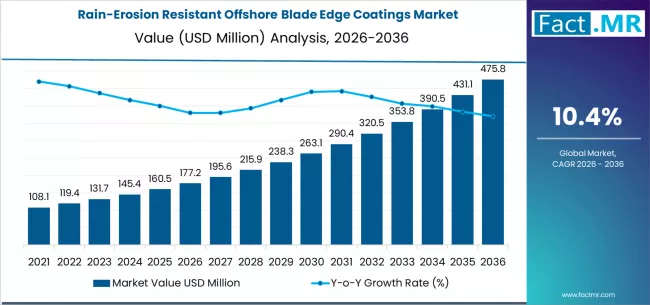
Defining trends involve the development of next-generation polymeric and nano-composite formulations designed for longer service life under extreme offshore conditions. Innovation is focused on enhancing coating toughness, flexibility, and adhesion to composite substrates to withstand high-velocity impact from rain and salt particles. Integration of these advanced coatings into both original equipment manufacturing and efficient field repair protocols is becoming a key competitive strategy.
The global expansion of offshore wind capacity into deeper waters and harsher climates is the primary market driver. The economic imperative to protect high-value wind turbine blades from performance degradation and avoid costly unscheduled repairs acts as a significant catalyst, creating sustained demand for high-durability protective coating solutions.
Rain-Erosion Resistant Offshore Blade Edge Coatings Market
| Metric | Value |
|---|---|
| Market Value (2026) | USD 177.19 Million |
| Market Forecast Value (2036) | USD 475.85 Million |
| Forecast CAGR (2026-2036) | 10.4% |
Category
| Category | Segments |
|---|---|
| Turbine Rating | Up to 6 MW, 6-9.9 MW, 10-14.9 MW, 15 MW & Above |
| Coating or Protection Type | Polyurethane Leading-Edge Coatings, Polyurea-Based Coatings, Epoxy & Epoxy-Hybrid Coatings, Acrylic & Other Polymeric Coatings, Others (Tapes, Shells, Nano-Composite LEP) |
| Application Area | Blade Leading Edge, Full Blade Surface (Beyond LE), Repair & Refurbishment Applications, Others (Niche or Prototype Applications) |
| Region | North America, Latin America, Western Europe, Eastern Europe, East Asia, South Asia & Pacific, MEA |
Segmental Analysis
By Turbine Rating, Which Segment Represents a Large and Active Installed Base?
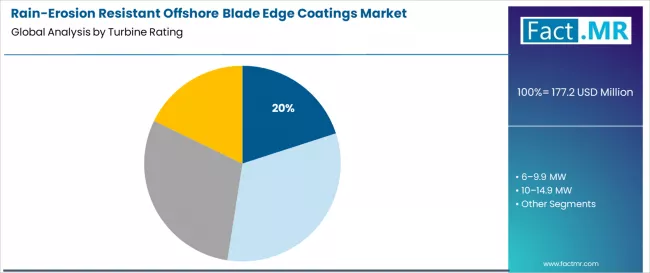
The up to 6 MW segment leads with a 20% share. This dominance is attributed to the extensive existing fleet of offshore wind turbines within this power class, which forms the foundation of the industry's earlier growth phases. These assets, many operating in demanding environments for several years, require continuous maintenance and recoating cycles to manage leading-edge erosion, driving consistent aftermarket demand for protective coatings.
By Coating Type, Which Chemistry Provides an Optimal Balance of Durability and Application Properties?
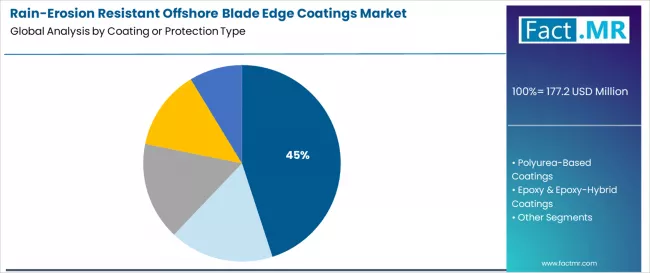
Polyurethane leading-edge coatings command the largest segment share at 45%. Their prominence is due to their excellent resistance to impact and abrasion, strong adhesion to blade composites, and good flexibility to accommodate blade flexing. These properties, combined with typically manageable application and curing characteristics, make them a preferred choice for protecting the most vulnerable areas of the blade from erosive wear.
By Application Area, Which Location is Most Critical for Maintaining Aerodynamic Efficiency?
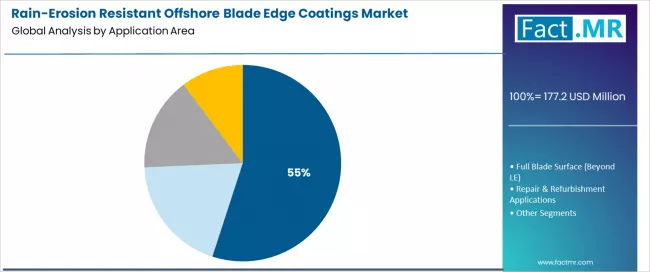
The blade leading edge represents the leading application area at 55.0%. This area is the first point of contact with rain, hail, and other particulates at very high tip speeds. Even minor damage here significantly disrupts airflow over the blade airfoil, leading to substantial losses in energy production efficiency and increased noise. Protecting this specific zone is therefore the highest priority for operators, constituting the core demand for specialized erosion-resistant coatings.
What are the Drivers, Restraints, and Key Trends of the Rain-Erosion Resistant Offshore Blade Edge Coatings Market?
The global push for renewable energy and significant capital investment in new offshore wind farm projects drive market growth. The deployment of larger turbines with longer blades, which experience higher tip speeds and greater erosive forces, increases the technical necessity for advanced protection. Furthermore, the high cost of blade repair, replacement, and energy revenue loss from downtime creates a strong economic incentive for operators to invest in durable coating solutions.
A significant restraint is the challenging and costly environment for applying and maintaining coatings on offshore assets, requiring specialized equipment and weather windows. The performance validation of new coating technologies under real-world, long-term offshore conditions can be a slow and expensive process. Competition from alternative protection methods, such as replaceable leading-edge tapes or shells, can also influence market dynamics in certain applications.
Key trends include the development of multi-functional coating systems that combine erosion resistance with properties like ice-phobicity or fouling release. There is a strong focus on improving the sustainability profile of coatings, including formulations with higher solids content, reduced VOC emissions, and longer service life to lower the total environmental footprint. The market is also moving towards digitalization, with coatings integrated into broader blade health monitoring and predictive maintenance platforms.
Analysis of the Rain-Erosion Resistant Offshore Blade Edge Coatings Market by Key Countries
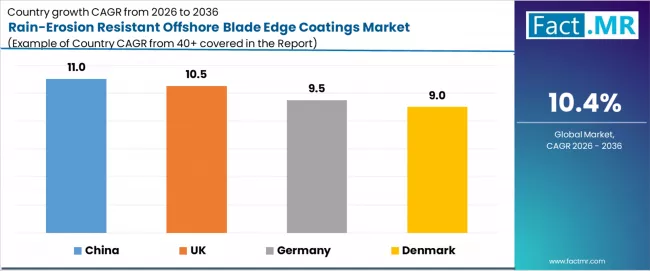
| Country | CAGR (2026-2036) |
|---|---|
| China | 11.00% |
| UK | 10.50% |
| Germany | 9.50% |
| Denmark | 9.00% |
How does China's Offshore Wind Ambition and Manufacturing Scale Drive Market Leadership?
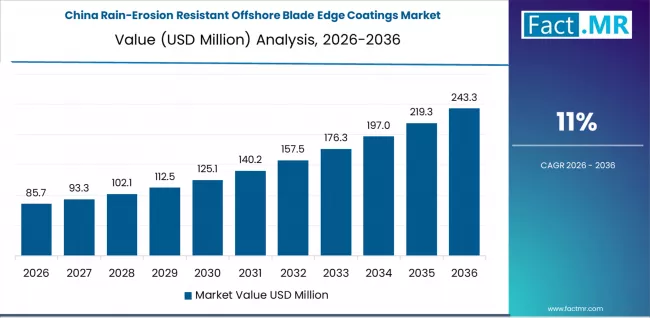
China's 11.00% CAGR is driven by its aggressive national targets for offshore wind capacity expansion and its position as a global manufacturing hub for wind turbines. The scale of new installations and the vast domestic supply chain create immense volume demand for coating solutions, making it the highest growth market.
Why is the UK's Established Offshore Fleet and Regulatory Push a Key Driver?
The UK's 10.50% growth is anchored in its mature and extensive offshore wind portfolio in the North Sea. The existing infrastructure requires ongoing maintenance and refurbishment, creating a strong aftermarket, while continued government support for new projects ensures demand for coatings on new turbine builds.
What Role does Germany's Engineering Leadership and North Sea Expansion Play?
Germany's 9.50% growth reflects its advanced offshore wind sector and commitment to energy transition. The expansion of wind farms in German waters, supported by engineering expertise, drives demand for high-performance protective technologies suitable for demanding marine environments.
How does Denmark's Pioneering Legacy and OEM Presence Influence the Market?
Denmark's 9.00% growth is underpinned by its historical role as a wind energy pioneer and the presence of major global turbine manufacturers. The country serves as a hub for innovation and testing of new coating technologies, fostering a market for advanced and efficient protection solutions.
Competitive Landscape of the Rain-Erosion Resistant Offshore Blade Edge Coatings Market

The competitive landscape features global chemical companies and specialized industrial coating manufacturers. Leading chemical firms like BASF SE and Covestro AG compete based on their advanced polymer technology and ability to supply high-performance resin systems to formulators. Dedicated coating specialists like Hempel, Belzona, and Phazebreak Coatings compete through deep application expertise, tailored product systems for blade protection, and strong service networks for wind farm operators.
Competition centers on technological innovation in polymer chemistry to extend coating longevity, proven performance data from field deployments, and the ability to provide complete system solutions that include surface preparation, application, and quality control for both OEM and repair scenarios.
Key Players in the Rain-Erosion Resistant Offshore Blade Edge Coatings Market
- Phazebreak Coatings
- BASF SE
- Hempel
- Belzona
- Covestro AG
- 3M
Scope of Report
| Items | Values |
|---|---|
| Quantitative Units | USD Million |
| Turbine Rating | Up to 6 MW, 6-9.9 MW, 10-14.9 MW, 15 MW & Above |
| Coating or Protection Type | Polyurethane Leading-Edge Coatings, Polyurea-Based Coatings, Epoxy & Epoxy-Hybrid Coatings, Acrylic & Other Polymeric Coatings, Others (Tapes, Shells, Nano-Composite LEP) |
| Application Area | Blade Leading Edge, Full Blade Surface (Beyond LE), Repair & Refurbishment Applications, Others (Niche or Prototype Applications) |
| Key Countries | China, UK, Germany, Denmark |
| Key Companies | Phazebreak Coatings, BASF SE, Hempel, Belzona, Covestro AG, 3M |
| Additional Analysis | Analysis of erosion test methodologies and performance benchmarking; total cost of ownership models comparing coating investment versus energy production loss; competitive assessment of liquid coatings versus solid protection systems; and review of sustainability and lifecycle analysis trends for coating systems. |
Rain-Erosion Resistant Offshore Blade Edge Coatings Market by Segments
-
Turbine Rating :
- Up to 6 MW
- 6-9.9 MW
- 10-14.9 MW
- 15 MW & Above
-
Coating or Protection Type :
- Polyurethane Leading-Edge Coatings
- Polyurea-Based Coatings
- Epoxy & Epoxy-Hybrid Coatings
- Acrylic & Other Polymeric Coatings
- Others (Tapes, Shells, Nano-Composite LEP)
-
Application Area :
- Blade Leading Edge
- Full Blade Surface (Beyond LE)
- Repair & Refurbishment Applications
- Others (Niche or Prototype Applications)
-
Region :
- North America
- USA
- Canada
- Latin America
- Brazil
- Mexico
- Argentina
- Rest of Latin America
- Western Europe
- Germany
- UK
- France
- Spain
- Italy
- BENELUX
- Rest of Western Europe
- Eastern Europe
- Russia
- Poland
- Czech Republic
- Rest of Eastern Europe
- East Asia
- China
- Japan
- South Korea
- Rest of East Asia
- South Asia & Pacific
- India
- ASEAN
- Australia
- Rest of South Asia & Pacific
- MEA
- Saudi Arabia
- UAE
- Turkiye
- Rest of MEA
- North America
Table of Content
- Executive Summary
- Global Market Outlook
- Demand to side Trends
- Supply to side Trends
- Technology Roadmap Analysis
- Analysis and Recommendations
- Market Overview
- Market Coverage / Taxonomy
- Market Definition / Scope / Limitations
- Market Background
- Market Dynamics
- Drivers
- Restraints
- Opportunity
- Trends
- Scenario Forecast
- Demand in Optimistic Scenario
- Demand in Likely Scenario
- Demand in Conservative Scenario
- Opportunity Map Analysis
- Product Life Cycle Analysis
- Supply Chain Analysis
- Investment Feasibility Matrix
- Value Chain Analysis
- PESTLE and Porter’s Analysis
- Regulatory Landscape
- Regional Parent Market Outlook
- Production and Consumption Statistics
- Import and Export Statistics
- Market Dynamics
- Global Market Analysis 2021 to 2025 and Forecast, 2026 to 2036
- Historical Market Size Value (USD Million) Analysis, 2021 to 2025
- Current and Future Market Size Value (USD Million) Projections, 2026 to 2036
- Y to o to Y Growth Trend Analysis
- Absolute $ Opportunity Analysis
- Global Market Pricing Analysis 2021 to 2025 and Forecast 2026 to 2036
- Global Market Analysis 2021 to 2025 and Forecast 2026 to 2036, By Turbine Rating
- Introduction / Key Findings
- Historical Market Size Value (USD Million) Analysis By Turbine Rating, 2021 to 2025
- Current and Future Market Size Value (USD Million) Analysis and Forecast By Turbine Rating, 2026 to 2036
- Up to 6 MW
- 6-9.9 MW
- 10-14.9 MW
- 15 MW & Above
- Up to 6 MW
- Y to o to Y Growth Trend Analysis By Turbine Rating, 2021 to 2025
- Absolute $ Opportunity Analysis By Turbine Rating, 2026 to 2036
- Global Market Analysis 2021 to 2025 and Forecast 2026 to 2036, By Coating or Protection Type
- Introduction / Key Findings
- Historical Market Size Value (USD Million) Analysis By Coating or Protection Type, 2021 to 2025
- Current and Future Market Size Value (USD Million) Analysis and Forecast By Coating or Protection Type, 2026 to 2036
- Polyurethane Leading-Edge Coatings
- Polyurea-Based Coatings
- Epoxy & Epoxy-Hybrid Coatings
- Acrylic & Other Polymeric Coatings
- Others (Tapes, Shells, Nano-Composite LEP)
- Polyurethane Leading-Edge Coatings
- Y to o to Y Growth Trend Analysis By Coating or Protection Type, 2021 to 2025
- Absolute $ Opportunity Analysis By Coating or Protection Type, 2026 to 2036
- Global Market Analysis 2021 to 2025 and Forecast 2026 to 2036, By Application Area
- Introduction / Key Findings
- Historical Market Size Value (USD Million) Analysis By Application Area, 2021 to 2025
- Current and Future Market Size Value (USD Million) Analysis and Forecast By Application Area, 2026 to 2036
- Blade Leading Edge
- Full Blade Surface (Beyond LE)
- Repair & Refurbishment Applications
- Others (Niche or Prototype Applications)
- Blade Leading Edge
- Y to o to Y Growth Trend Analysis By Application Area, 2021 to 2025
- Absolute $ Opportunity Analysis By Application Area, 2026 to 2036
- Global Market Analysis 2021 to 2025 and Forecast 2026 to 2036, By Region
- Introduction
- Historical Market Size Value (USD Million) Analysis By Region, 2021 to 2025
- Current Market Size Value (USD Million) Analysis and Forecast By Region, 2026 to 2036
- North America
- Latin America
- Western Europe
- Eastern Europe
- East Asia
- South Asia and Pacific
- Middle East & Africa
- Market Attractiveness Analysis By Region
- North America Market Analysis 2021 to 2025 and Forecast 2026 to 2036, By Country
- Historical Market Size Value (USD Million) Trend Analysis By Market Taxonomy, 2021 to 2025
- Market Size Value (USD Million) Forecast By Market Taxonomy, 2026 to 2036
- By Country
- USA
- Canada
- Mexico
- By Turbine Rating
- By Coating or Protection Type
- By Application Area
- By Country
- Market Attractiveness Analysis
- By Country
- By Turbine Rating
- By Coating or Protection Type
- By Application Area
- Key Takeaways
- Latin America Market Analysis 2021 to 2025 and Forecast 2026 to 2036, By Country
- Historical Market Size Value (USD Million) Trend Analysis By Market Taxonomy, 2021 to 2025
- Market Size Value (USD Million) Forecast By Market Taxonomy, 2026 to 2036
- By Country
- Brazil
- Chile
- Rest of Latin America
- By Turbine Rating
- By Coating or Protection Type
- By Application Area
- By Country
- Market Attractiveness Analysis
- By Country
- By Turbine Rating
- By Coating or Protection Type
- By Application Area
- Key Takeaways
- Western Europe Market Analysis 2021 to 2025 and Forecast 2026 to 2036, By Country
- Historical Market Size Value (USD Million) Trend Analysis By Market Taxonomy, 2021 to 2025
- Market Size Value (USD Million) Forecast By Market Taxonomy, 2026 to 2036
- By Country
- Germany
- UK
- Italy
- Spain
- France
- Nordic
- BENELUX
- Rest of Western Europe
- By Turbine Rating
- By Coating or Protection Type
- By Application Area
- By Country
- Market Attractiveness Analysis
- By Country
- By Turbine Rating
- By Coating or Protection Type
- By Application Area
- Key Takeaways
- Eastern Europe Market Analysis 2021 to 2025 and Forecast 2026 to 2036, By Country
- Historical Market Size Value (USD Million) Trend Analysis By Market Taxonomy, 2021 to 2025
- Market Size Value (USD Million) Forecast By Market Taxonomy, 2026 to 2036
- By Country
- Russia
- Poland
- Hungary
- Balkan & Baltic
- Rest of Eastern Europe
- By Turbine Rating
- By Coating or Protection Type
- By Application Area
- By Country
- Market Attractiveness Analysis
- By Country
- By Turbine Rating
- By Coating or Protection Type
- By Application Area
- Key Takeaways
- East Asia Market Analysis 2021 to 2025 and Forecast 2026 to 2036, By Country
- Historical Market Size Value (USD Million) Trend Analysis By Market Taxonomy, 2021 to 2025
- Market Size Value (USD Million) Forecast By Market Taxonomy, 2026 to 2036
- By Country
- China
- Japan
- South Korea
- By Turbine Rating
- By Coating or Protection Type
- By Application Area
- By Country
- Market Attractiveness Analysis
- By Country
- By Turbine Rating
- By Coating or Protection Type
- By Application Area
- Key Takeaways
- South Asia and Pacific Market Analysis 2021 to 2025 and Forecast 2026 to 2036, By Country
- Historical Market Size Value (USD Million) Trend Analysis By Market Taxonomy, 2021 to 2025
- Market Size Value (USD Million) Forecast By Market Taxonomy, 2026 to 2036
- By Country
- India
- ASEAN
- Australia & New Zealand
- Rest of South Asia and Pacific
- By Turbine Rating
- By Coating or Protection Type
- By Application Area
- By Country
- Market Attractiveness Analysis
- By Country
- By Turbine Rating
- By Coating or Protection Type
- By Application Area
- Key Takeaways
- Middle East & Africa Market Analysis 2021 to 2025 and Forecast 2026 to 2036, By Country
- Historical Market Size Value (USD Million) Trend Analysis By Market Taxonomy, 2021 to 2025
- Market Size Value (USD Million) Forecast By Market Taxonomy, 2026 to 2036
- By Country
- Kingdom of Saudi Arabia
- Other GCC Countries
- Turkiye
- South Africa
- Other African Union
- Rest of Middle East & Africa
- By Turbine Rating
- By Coating or Protection Type
- By Application Area
- By Country
- Market Attractiveness Analysis
- By Country
- By Turbine Rating
- By Coating or Protection Type
- By Application Area
- Key Takeaways
- Key Countries Market Analysis
- USA
- Pricing Analysis
- Market Share Analysis, 2025
- By Turbine Rating
- By Coating or Protection Type
- By Application Area
- Canada
- Pricing Analysis
- Market Share Analysis, 2025
- By Turbine Rating
- By Coating or Protection Type
- By Application Area
- Mexico
- Pricing Analysis
- Market Share Analysis, 2025
- By Turbine Rating
- By Coating or Protection Type
- By Application Area
- Brazil
- Pricing Analysis
- Market Share Analysis, 2025
- By Turbine Rating
- By Coating or Protection Type
- By Application Area
- Chile
- Pricing Analysis
- Market Share Analysis, 2025
- By Turbine Rating
- By Coating or Protection Type
- By Application Area
- Germany
- Pricing Analysis
- Market Share Analysis, 2025
- By Turbine Rating
- By Coating or Protection Type
- By Application Area
- UK
- Pricing Analysis
- Market Share Analysis, 2025
- By Turbine Rating
- By Coating or Protection Type
- By Application Area
- Italy
- Pricing Analysis
- Market Share Analysis, 2025
- By Turbine Rating
- By Coating or Protection Type
- By Application Area
- Spain
- Pricing Analysis
- Market Share Analysis, 2025
- By Turbine Rating
- By Coating or Protection Type
- By Application Area
- France
- Pricing Analysis
- Market Share Analysis, 2025
- By Turbine Rating
- By Coating or Protection Type
- By Application Area
- India
- Pricing Analysis
- Market Share Analysis, 2025
- By Turbine Rating
- By Coating or Protection Type
- By Application Area
- ASEAN
- Pricing Analysis
- Market Share Analysis, 2025
- By Turbine Rating
- By Coating or Protection Type
- By Application Area
- Australia & New Zealand
- Pricing Analysis
- Market Share Analysis, 2025
- By Turbine Rating
- By Coating or Protection Type
- By Application Area
- China
- Pricing Analysis
- Market Share Analysis, 2025
- By Turbine Rating
- By Coating or Protection Type
- By Application Area
- Japan
- Pricing Analysis
- Market Share Analysis, 2025
- By Turbine Rating
- By Coating or Protection Type
- By Application Area
- South Korea
- Pricing Analysis
- Market Share Analysis, 2025
- By Turbine Rating
- By Coating or Protection Type
- By Application Area
- Russia
- Pricing Analysis
- Market Share Analysis, 2025
- By Turbine Rating
- By Coating or Protection Type
- By Application Area
- Poland
- Pricing Analysis
- Market Share Analysis, 2025
- By Turbine Rating
- By Coating or Protection Type
- By Application Area
- Hungary
- Pricing Analysis
- Market Share Analysis, 2025
- By Turbine Rating
- By Coating or Protection Type
- By Application Area
- Kingdom of Saudi Arabia
- Pricing Analysis
- Market Share Analysis, 2025
- By Turbine Rating
- By Coating or Protection Type
- By Application Area
- Turkiye
- Pricing Analysis
- Market Share Analysis, 2025
- By Turbine Rating
- By Coating or Protection Type
- By Application Area
- South Africa
- Pricing Analysis
- Market Share Analysis, 2025
- By Turbine Rating
- By Coating or Protection Type
- By Application Area
- USA
- Market Structure Analysis
- Competition Dashboard
- Competition Benchmarking
- Market Share Analysis of Top Players
- By Regional
- By Turbine Rating
- By Coating or Protection Type
- By Application Area
- Competition Analysis
- Competition Deep Dive
- Phazebreak Coatings
- Overview
- Product Portfolio
- Profitability by Market Segments (Product/Age /Sales Channel/Region)
- Sales Footprint
- Strategy Overview
- Marketing Strategy
- Product Strategy
- Channel Strategy
- BASF SE
- Hempel
- Belzona
- Covestro AG
- 3M
- Phazebreak Coatings
- Competition Deep Dive
- Assumptions & Acronyms Used
- Research Methodology
List Of Table
- Table 1: Global Market Value (USD Million) Forecast by Region, 2021 to 2036
- Table 2: Global Market Value (USD Million) Forecast by Turbine Rating, 2021 to 2036
- Table 3: Global Market Value (USD Million) Forecast by Coating or Protection Type, 2021 to 2036
- Table 4: Global Market Value (USD Million) Forecast by Application Area, 2021 to 2036
- Table 5: North America Market Value (USD Million) Forecast by Country, 2021 to 2036
- Table 6: North America Market Value (USD Million) Forecast by Turbine Rating, 2021 to 2036
- Table 7: North America Market Value (USD Million) Forecast by Coating or Protection Type, 2021 to 2036
- Table 8: North America Market Value (USD Million) Forecast by Application Area, 2021 to 2036
- Table 9: Latin America Market Value (USD Million) Forecast by Country, 2021 to 2036
- Table 10: Latin America Market Value (USD Million) Forecast by Turbine Rating, 2021 to 2036
- Table 11: Latin America Market Value (USD Million) Forecast by Coating or Protection Type, 2021 to 2036
- Table 12: Latin America Market Value (USD Million) Forecast by Application Area, 2021 to 2036
- Table 13: Western Europe Market Value (USD Million) Forecast by Country, 2021 to 2036
- Table 14: Western Europe Market Value (USD Million) Forecast by Turbine Rating, 2021 to 2036
- Table 15: Western Europe Market Value (USD Million) Forecast by Coating or Protection Type, 2021 to 2036
- Table 16: Western Europe Market Value (USD Million) Forecast by Application Area, 2021 to 2036
- Table 17: Eastern Europe Market Value (USD Million) Forecast by Country, 2021 to 2036
- Table 18: Eastern Europe Market Value (USD Million) Forecast by Turbine Rating, 2021 to 2036
- Table 19: Eastern Europe Market Value (USD Million) Forecast by Coating or Protection Type, 2021 to 2036
- Table 20: Eastern Europe Market Value (USD Million) Forecast by Application Area, 2021 to 2036
- Table 21: East Asia Market Value (USD Million) Forecast by Country, 2021 to 2036
- Table 22: East Asia Market Value (USD Million) Forecast by Turbine Rating, 2021 to 2036
- Table 23: East Asia Market Value (USD Million) Forecast by Coating or Protection Type, 2021 to 2036
- Table 24: East Asia Market Value (USD Million) Forecast by Application Area, 2021 to 2036
- Table 25: South Asia and Pacific Market Value (USD Million) Forecast by Country, 2021 to 2036
- Table 26: South Asia and Pacific Market Value (USD Million) Forecast by Turbine Rating, 2021 to 2036
- Table 27: South Asia and Pacific Market Value (USD Million) Forecast by Coating or Protection Type, 2021 to 2036
- Table 28: South Asia and Pacific Market Value (USD Million) Forecast by Application Area, 2021 to 2036
- Table 29: Middle East & Africa Market Value (USD Million) Forecast by Country, 2021 to 2036
- Table 30: Middle East & Africa Market Value (USD Million) Forecast by Turbine Rating, 2021 to 2036
- Table 31: Middle East & Africa Market Value (USD Million) Forecast by Coating or Protection Type, 2021 to 2036
- Table 32: Middle East & Africa Market Value (USD Million) Forecast by Application Area, 2021 to 2036
List Of Figures
- Figure 1: Global Market Pricing Analysis
- Figure 2: Global Market Value (USD Million) Forecast 2021 to 2036
- Figure 3: Global Market Value Share and BPS Analysis by Turbine Rating, 2026 and 2036
- Figure 4: Global Market Y to o to Y Growth Comparison by Turbine Rating, 2026 to 2036
- Figure 5: Global Market Attractiveness Analysis by Turbine Rating
- Figure 6: Global Market Value Share and BPS Analysis by Coating or Protection Type, 2026 and 2036
- Figure 7: Global Market Y to o to Y Growth Comparison by Coating or Protection Type, 2026 to 2036
- Figure 8: Global Market Attractiveness Analysis by Coating or Protection Type
- Figure 9: Global Market Value Share and BPS Analysis by Application Area, 2026 and 2036
- Figure 10: Global Market Y to o to Y Growth Comparison by Application Area, 2026 to 2036
- Figure 11: Global Market Attractiveness Analysis by Application Area
- Figure 12: Global Market Value (USD Million) Share and BPS Analysis by Region, 2026 and 2036
- Figure 13: Global Market Y to o to Y Growth Comparison by Region, 2026 to 2036
- Figure 14: Global Market Attractiveness Analysis by Region
- Figure 15: North America Market Incremental Dollar Opportunity, 2026 to 2036
- Figure 16: Latin America Market Incremental Dollar Opportunity, 2026 to 2036
- Figure 17: Western Europe Market Incremental Dollar Opportunity, 2026 to 2036
- Figure 18: Eastern Europe Market Incremental Dollar Opportunity, 2026 to 2036
- Figure 19: East Asia Market Incremental Dollar Opportunity, 2026 to 2036
- Figure 20: South Asia and Pacific Market Incremental Dollar Opportunity, 2026 to 2036
- Figure 21: Middle East & Africa Market Incremental Dollar Opportunity, 2026 to 2036
- Figure 22: North America Market Value Share and BPS Analysis by Country, 2026 and 2036
- Figure 23: North America Market Value Share and BPS Analysis by Turbine Rating, 2026 and 2036
- Figure 24: North America Market Y to o to Y Growth Comparison by Turbine Rating, 2026 to 2036
- Figure 25: North America Market Attractiveness Analysis by Turbine Rating
- Figure 26: North America Market Value Share and BPS Analysis by Coating or Protection Type, 2026 and 2036
- Figure 27: North America Market Y to o to Y Growth Comparison by Coating or Protection Type, 2026 to 2036
- Figure 28: North America Market Attractiveness Analysis by Coating or Protection Type
- Figure 29: North America Market Value Share and BPS Analysis by Application Area, 2026 and 2036
- Figure 30: North America Market Y to o to Y Growth Comparison by Application Area, 2026 to 2036
- Figure 31: North America Market Attractiveness Analysis by Application Area
- Figure 32: Latin America Market Value Share and BPS Analysis by Country, 2026 and 2036
- Figure 33: Latin America Market Value Share and BPS Analysis by Turbine Rating, 2026 and 2036
- Figure 34: Latin America Market Y to o to Y Growth Comparison by Turbine Rating, 2026 to 2036
- Figure 35: Latin America Market Attractiveness Analysis by Turbine Rating
- Figure 36: Latin America Market Value Share and BPS Analysis by Coating or Protection Type, 2026 and 2036
- Figure 37: Latin America Market Y to o to Y Growth Comparison by Coating or Protection Type, 2026 to 2036
- Figure 38: Latin America Market Attractiveness Analysis by Coating or Protection Type
- Figure 39: Latin America Market Value Share and BPS Analysis by Application Area, 2026 and 2036
- Figure 40: Latin America Market Y to o to Y Growth Comparison by Application Area, 2026 to 2036
- Figure 41: Latin America Market Attractiveness Analysis by Application Area
- Figure 42: Western Europe Market Value Share and BPS Analysis by Country, 2026 and 2036
- Figure 43: Western Europe Market Value Share and BPS Analysis by Turbine Rating, 2026 and 2036
- Figure 44: Western Europe Market Y to o to Y Growth Comparison by Turbine Rating, 2026 to 2036
- Figure 45: Western Europe Market Attractiveness Analysis by Turbine Rating
- Figure 46: Western Europe Market Value Share and BPS Analysis by Coating or Protection Type, 2026 and 2036
- Figure 47: Western Europe Market Y to o to Y Growth Comparison by Coating or Protection Type, 2026 to 2036
- Figure 48: Western Europe Market Attractiveness Analysis by Coating or Protection Type
- Figure 49: Western Europe Market Value Share and BPS Analysis by Application Area, 2026 and 2036
- Figure 50: Western Europe Market Y to o to Y Growth Comparison by Application Area, 2026 to 2036
- Figure 51: Western Europe Market Attractiveness Analysis by Application Area
- Figure 52: Eastern Europe Market Value Share and BPS Analysis by Country, 2026 and 2036
- Figure 53: Eastern Europe Market Value Share and BPS Analysis by Turbine Rating, 2026 and 2036
- Figure 54: Eastern Europe Market Y to o to Y Growth Comparison by Turbine Rating, 2026 to 2036
- Figure 55: Eastern Europe Market Attractiveness Analysis by Turbine Rating
- Figure 56: Eastern Europe Market Value Share and BPS Analysis by Coating or Protection Type, 2026 and 2036
- Figure 57: Eastern Europe Market Y to o to Y Growth Comparison by Coating or Protection Type, 2026 to 2036
- Figure 58: Eastern Europe Market Attractiveness Analysis by Coating or Protection Type
- Figure 59: Eastern Europe Market Value Share and BPS Analysis by Application Area, 2026 and 2036
- Figure 60: Eastern Europe Market Y to o to Y Growth Comparison by Application Area, 2026 to 2036
- Figure 61: Eastern Europe Market Attractiveness Analysis by Application Area
- Figure 62: East Asia Market Value Share and BPS Analysis by Country, 2026 and 2036
- Figure 63: East Asia Market Value Share and BPS Analysis by Turbine Rating, 2026 and 2036
- Figure 64: East Asia Market Y to o to Y Growth Comparison by Turbine Rating, 2026 to 2036
- Figure 65: East Asia Market Attractiveness Analysis by Turbine Rating
- Figure 66: East Asia Market Value Share and BPS Analysis by Coating or Protection Type, 2026 and 2036
- Figure 67: East Asia Market Y to o to Y Growth Comparison by Coating or Protection Type, 2026 to 2036
- Figure 68: East Asia Market Attractiveness Analysis by Coating or Protection Type
- Figure 69: East Asia Market Value Share and BPS Analysis by Application Area, 2026 and 2036
- Figure 70: East Asia Market Y to o to Y Growth Comparison by Application Area, 2026 to 2036
- Figure 71: East Asia Market Attractiveness Analysis by Application Area
- Figure 72: South Asia and Pacific Market Value Share and BPS Analysis by Country, 2026 and 2036
- Figure 73: South Asia and Pacific Market Value Share and BPS Analysis by Turbine Rating, 2026 and 2036
- Figure 74: South Asia and Pacific Market Y to o to Y Growth Comparison by Turbine Rating, 2026 to 2036
- Figure 75: South Asia and Pacific Market Attractiveness Analysis by Turbine Rating
- Figure 76: South Asia and Pacific Market Value Share and BPS Analysis by Coating or Protection Type, 2026 and 2036
- Figure 77: South Asia and Pacific Market Y to o to Y Growth Comparison by Coating or Protection Type, 2026 to 2036
- Figure 78: South Asia and Pacific Market Attractiveness Analysis by Coating or Protection Type
- Figure 79: South Asia and Pacific Market Value Share and BPS Analysis by Application Area, 2026 and 2036
- Figure 80: South Asia and Pacific Market Y to o to Y Growth Comparison by Application Area, 2026 to 2036
- Figure 81: South Asia and Pacific Market Attractiveness Analysis by Application Area
- Figure 82: Middle East & Africa Market Value Share and BPS Analysis by Country, 2026 and 2036
- Figure 83: Middle East & Africa Market Value Share and BPS Analysis by Turbine Rating, 2026 and 2036
- Figure 84: Middle East & Africa Market Y to o to Y Growth Comparison by Turbine Rating, 2026 to 2036
- Figure 85: Middle East & Africa Market Attractiveness Analysis by Turbine Rating
- Figure 86: Middle East & Africa Market Value Share and BPS Analysis by Coating or Protection Type, 2026 and 2036
- Figure 87: Middle East & Africa Market Y to o to Y Growth Comparison by Coating or Protection Type, 2026 to 2036
- Figure 88: Middle East & Africa Market Attractiveness Analysis by Coating or Protection Type
- Figure 89: Middle East & Africa Market Value Share and BPS Analysis by Application Area, 2026 and 2036
- Figure 90: Middle East & Africa Market Y to o to Y Growth Comparison by Application Area, 2026 to 2036
- Figure 91: Middle East & Africa Market Attractiveness Analysis by Application Area
- Figure 92: Global Market - Tier Structure Analysis
- Figure 93: Global Market - Company Share Analysis
- FAQs -
How big is the rain-erosion resistant offshore blade edge coatings market in 2026?
The global anti-smudge coatings for automotive interior screens market is estimated to be valued at USD 85.0 million in 2026.
What will be the size of rain-erosion resistant offshore blade edge coatings market in 2036?
The market size for the anti-smudge coatings for automotive interior screens market is projected to reach USD 426.4 million by 2036.
How much will be the rain-erosion resistant offshore blade edge coatings market growth between 2026 and 2036?
The anti-smudge coatings for automotive interior screens market is expected to grow at a 17.5% CAGR between 2026 and 2036.
What are the key product types in the rain-erosion resistant offshore blade edge coatings market?
The key product types in anti-smudge coatings for automotive interior screens market are fluorinated oleophobic coatings, fluorine-free oleophobic coatings, anti-reflective & oleophobic hybrid, anti-smudge & anti-scratch hybrid, silane-based durable topcoats, sol-gel nano-coatings and polymer-based clear protective overlays.
Which coating or protection type segment to contribute significant share in the rain-erosion resistant offshore blade edge coatings market in 2026?
In terms of application, center stack infotainment displays segment to command 42.0% share in the anti-smudge coatings for automotive interior screens market in 2026.