Bio-Acrylic Industrial Floor Coatings Market
Bio-Acrylic Industrial Floor Coatings Market Size and Share Forecast Outlook 2026 to 2036
Bio-acrylic industrial floor coatings market is projected to grow from USD 0.4 million in 2026 to USD 1.1 million by 2036, at a CAGR of 11.1%. Food & Beverage Processing will dominate with a 25.0% market share, while self-leveling bio-acrylic systems will lead the system type segment with a 30.0% share.
Bio-Acrylic Industrial Floor Coatings Market Forecast and Outlook 2026 to 2036
The global bio-acrylic industrial floor coatings market is projected to reach USD 1.08 million by 2036. The market is valued at USD 0.38 million in 2026 and is set to rise at a CAGR of 11.1% during the assessment period.
By end-use industry, food & beverage processing holds a leading 25% share. Self-leveling bio-acrylic systems represent the dominant system type at 30%, while concrete substrates are the primary application base, accounting for 65.0% of the market.
Key Takeaways from the Bio-Acrylic Industrial Floor Coatings Market
- Market Value for 2026: USD 0.38 Million
- Market Value for 2036: USD 1.08 Million
- Forecast CAGR (2026-2036): 11.1%
- Leading End-Use Industry Share (2026): Food & Beverage Processing (25%)
- Leading System Type Share (2026): Self-Leveling Bio-Acrylic Systems (30%)
- Leading Substrate Type Share (2026): Concrete Substrates (65.0%)
- Key Players in the Market: SolEpoxy, Sika AG, BASF, PPG Industries Inc., RPM International, A&I Coatings
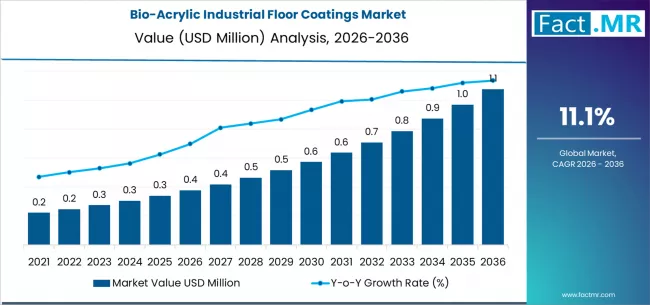
This robust growth is driven by a powerful industry-wide shift towards sustainable and environmentally responsible construction materials. Bio-acrylic resins, derived partially or wholly from renewable plant-based feedstocks like vegetable oils, sugar, or corn, offer a significant reduction in carbon footprint compared to their purely petroleum-derived counterparts. The transition is accelerated in industries with stringent hygiene and environmental standards, where the demand for high-performance, durable, and safe flooring solutions aligns perfectly with the value proposition of advanced bio-based chemistries.
Bio-Acrylic Industrial Floor Coatings Market
| Metric | Value |
|---|---|
| Market Value (2026) | USD 0.38 Million |
| Market Forecast Value (2036) | USD 1.08 Million |
| Forecast CAGR (2026-2036) | 11.1% |
Category
| Category | Segments |
|---|---|
| End-Use Industry | Food & Beverage Processing, Warehousing & Logistics, Pharmaceuticals & Healthcare, Manufacturing (Heavy & Light Industrial), Others (Retail, Commercial, Public Spaces) |
| System Type | Self-Leveling Bio-Acrylic Systems, High-Build or Roller-Applied Coatings, Mortar or Screed Floor Systems, Thin-Film Sealers & Curing Compounds, Others (ESD, Decorative, Flake, etc.) |
| Substrate Type | Concrete Substrates, Cementitious Screeds & Toppings, Metal Deck & Steel Substrates, Existing Resinous or Coated Floors (Recoats), Others (Tiles, Wood, Specialty) |
| Region | North America, Latin America, Western Europe, Eastern Europe, East Asia, South Asia & Pacific, MEA |
Segmental Analysis
By End-Use Industry, Which Sector Demands the Highest Level of Hygiene and Chemical Resistance?
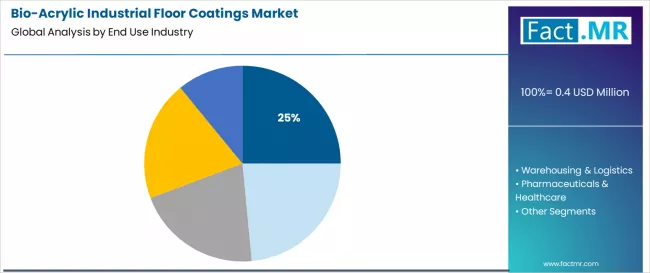
The food & beverage processing segment leads with a 25% share, a dominance rooted in its non-negotiable requirements for floor safety and cleanliness. Floors in these facilities must withstand constant exposure to water, steam, cleaning chemicals, oils, and organic acids while remaining completely seamless, non-porous, and easy to sanitize. Bio-acrylic coatings meet these demands while also offering a critical advantage: low odor and low VOC emissions during application.
This allows production areas to be recoated with minimal downtime and disruption, a vital factor for continuous operations. The sector's leadership is further reinforced by its proactive adoption of green building standards and corporate sustainability initiatives, making it the primary early adopter of bio-based coating technologies.
By System Type, Which Application Method is Synonymous with High-Performance, Seamless Floors?
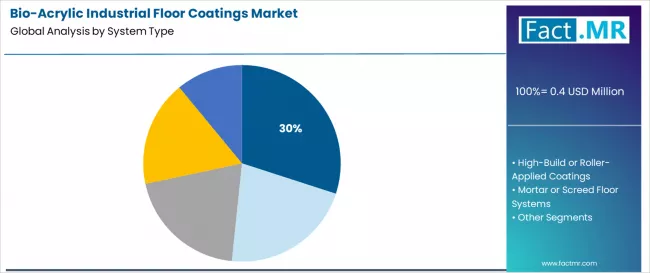
Self-leveling bio-acrylic systems command the largest system type share at 30%. These systems are prized for their ability to create a perfectly smooth, monolithic, and joint-free surface that is inherently easy to clean and maintain. The self-leveling property ensures excellent coverage and a consistent film thickness, which is crucial for achieving uniform chemical resistance and durability across large floor areas typical of industrial plants.
The transition to bio-acrylic chemistry in this demanding segment highlights significant material science advancements, as formulators have successfully engineered bio-resins to deliver the flow, leveling, and cure properties required for self-leveling performance without compromising on the final coating's mechanical strength or longevity.
By Substrate Type, Which Foundation is Ubiquitous in Industrial Construction?
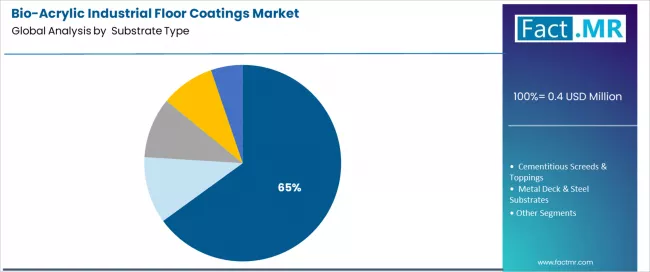
Concrete substrates represent the overwhelming majority of the substrate segment at 65.0%. Concrete is the fundamental building material for industrial facilities worldwide, but it is porous, prone to dusting, and vulnerable to chemical attack. A high-performance coating system is essential to protect the concrete, ensure durability, and meet operational requirements.
The prevalence of concrete drives consistent, high-volume demand for coatings specifically formulated to adhere strongly to it, tolerate its natural moisture variability, and bridge minor cracks. Bio-acrylic coatings designed for concrete must offer robust adhesion, breathability to prevent vapor pressure issues, and the flexibility to withstand substrate movement, making this the most critical and tested application for the technology.
What are the Drivers, Restraints, and Key Trends of the Bio-Acrylic Industrial Floor Coatings Market?
The market is propelled by a confluence of regulatory, corporate, and performance factors. Stringent environmental regulations worldwide are lowering permissible VOC limits, favoring water-based and low-emission technologies like many bio-acrylics. Simultaneously, corporate sustainability mandates are pushing facility owners and operators to seek building products with lower embodied carbon and greener life-cycle profiles. Furthermore, the superior performance characteristics of modern acrylics, such as excellent UV stability, color retention, and flexibility, are being successfully replicated in bio-based versions, making them a viable performance-grade choice rather than just an ecological alternative.
The market faces several headwinds. A primary restraint is the higher raw material cost associated with bio-based feedstocks and the advanced processing required to purify them for coating production, leading to a price premium over conventional options. There can also be performance perceptions and knowledge gaps among contractors and specifiers regarding the long-term durability and chemical resistance of bio-acrylic systems compared to established epoxy or polyurethane technologies. The variable quality and supply chain complexity for renewable raw materials can pose challenges for consistent, large-scale production, potentially affecting formulation consistency and availability.
Key trends shaping the future include the development of hybrid and multi-functional systems. Formulators are creating products that combine bio-acrylics with other sustainable technologies, such as bio-epoxy hybrids, to optimize cost and performance profiles. There is a growing focus on enhanced functionality, with bio-acrylics being engineered for specific needs like static-dissipative (ESD) properties for electronics manufacturing or antimicrobial additives for healthcare settings. The market is also moving towards digitalization and lifecycle tools, with manufacturers providing digital specifiers, environmental product declarations (EPDs), and total cost of ownership calculators to demonstrate long-term value and simplify the specification process for engineers and architects.
Analysis of the Bio-Acrylic Industrial Floor Coatings Market by Key Countries
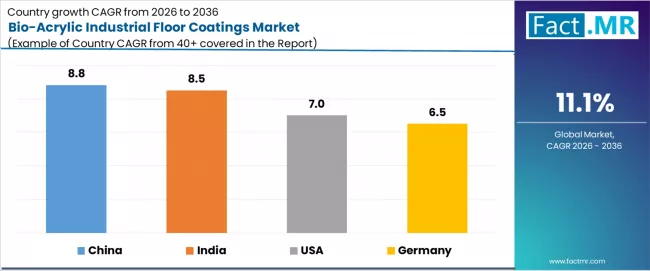
| Country | CAGR (2026-2036) |
|---|---|
| India | 8.50% |
| China | 8.80% |
| USA | 7.00% |
| Germany | 6.50% |
How does India's Rapid Industrial Expansion and Green Building Push Drive High Growth?
India's 8.50% CAGR is fueled by an unprecedented wave of new industrial and logistics facility construction, supported by government initiatives. The rapid growth of its food processing, pharmaceutical, and automotive manufacturing sectors creates direct demand for high-performance industrial floors.
Coupled with an increasing embrace of green building certification systems, this creates a fertile environment for adopting modern, sustainable coating solutions. The market is cost-sensitive but increasingly value-driven, favoring technologies that offer a balance of performance, longevity, and environmental benefits.
Why is China's Massive Manufacturing Base and Environmental Policy a Key Driver?
China’s leading 8.80% growth stems from the sheer scale of its industrial ecosystem and top-down environmental policy directives. As the world's factory, the continuous construction and refurbishment of manufacturing plants, warehouses, and food processing facilities represent immense volume potential.
National policies promoting "green manufacturing" and reducing industrial emissions are compelling state-owned and private enterprises to evaluate and adopt cleaner technologies, including sustainable construction materials like bio-based coatings for both new projects and retrofit applications.
What Role does the USA's Regulatory Environment and Focus on Operational Excellence Play?
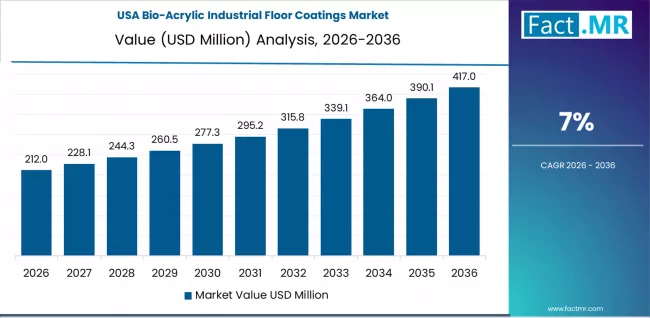
A mature regulatory framework for VOC emissions and a strong culture of corporate social responsibility underpins the USA’s 7.00% growth. Demand is driven by facility upgrades in existing food & beverage and pharmaceutical plants, where minimizing disruption is key, and the low-odor profile of bio-acrylics is a major advantage.
The focus on operational excellence in logistics and manufacturing sectors leads to investments in high-quality, durable flooring that reduces long-term maintenance costs, with bio-based options increasingly seen as a future-proof choice.
How does Germany's Engineering Rigor and Circular Economy Leadership Influence the Market?
Germany’s 6.50% growth reflects its engineering precision and its role as a European leader in the circular economy and sustainable chemistry. The market demands technically impeccable, certified products with fully transparent and documented environmental footprints.
Bio-acrylic coatings are adopted not merely for compliance but as part of holistic, high-performance building designs in the automotive, chemical, and high-tech manufacturing sectors, where product quality, worker safety, and environmental stewardship are integrally linked.
Competitive Landscape of the Bio-Acrylic Industrial Floor Coatings Market
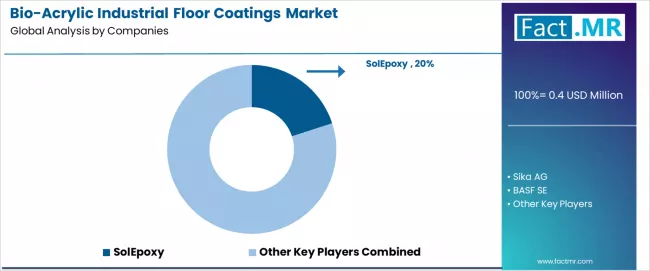
The competitive landscape features a mix of global chemical conglomerates and specialized flooring solution providers. Multinational giants like BASF, Sika AG, and PPG Industries Inc. compete by leveraging their vast R&D resources in polymer chemistry to develop proprietary bio-acrylic resin platforms. They integrate these into complete flooring system portfolios, offering everything from primers to topcoats, backed by global technical support and sustainability consulting for large, multinational clients.
Specialist manufacturers like RPM International (through its flooring subsidiaries) and A&I Coatings compete with deep, application-specific expertise and flexible formulation capabilities tailored to regional market needs or niche segments. Competition is intensifying around technological innovation in bio-resin performance, the completeness of sustainability certifications (e.g., USDA BioPreferred, Cradle to Cradle), and the ability to provide robust technical data and case studies that prove performance in real-world industrial environments, thereby reducing perceived risk for specifiers and end-users.
Key Players in the Bio-Acrylic Industrial Floor Coatings Market
- SolEpoxy
- Sika AG
- BASF SE
- PPG Industries Inc.
- RPM International
- A&I Coatings
Scope of Report
| Items | Values |
|---|---|
| Quantitative Units | USD Million |
| End-Use Industry | Food & Beverage Processing, Warehousing & Logistics, Pharmaceuticals & Healthcare, Manufacturing (Heavy & Light Industrial), Others (Retail, Commercial, Public Spaces) |
| System Type | Self-Leveling Bio-Acrylic Systems, High-Build or Roller-Applied Coatings, Mortar or Screed Floor Systems, Thin-Film Sealers & Curing Compounds, Others (ESD, Decorative, Flake, etc.) |
| Substrate Type | Concrete Substrates, Cementitious Screeds & Toppings, Metal Deck & Steel Substrates, Existing Resinous or Coated Floors (Recoats), Others (Tiles, Wood, Specialty) |
| Key Countries | India, China, USA, Germany |
| Key Companies | SolEpoxy, Sika AG, BASF, PPG Industries Inc., RPM International, A&I Coatings |
| Additional Analysis | In-depth analysis of bio-resin feedstock sources and supply chains; performance benchmarking against conventional epoxy and polyurethane on key parameters (abrasion, chemical resistance); total cost of ownership analysis including installation and maintenance; review of green building standards and certification credits relevant to flooring; and analysis of the contractor/specifier adoption funnel and key education barriers. |
Bio-Acrylic Industrial Floor Coatings Market by Segments
-
End-Use Industry :
- Food & Beverage Processing
- Warehousing & Logistics
- Pharmaceuticals & Healthcare
- Manufacturing (Heavy & Light Industrial)
- Others (Retail, Commercial, Public Spaces)
-
System Type :
- Self-Leveling Bio-Acrylic Systems
- High-Build or Roller-Applied Coatings
- Mortar or Screed Floor Systems
- Thin-Film Sealers & Curing Compounds
- Others (ESD, Decorative, Flake, etc.)
-
Substrate Type :
- Concrete Substrates
- Cementitious Screeds & Toppings
- Metal Deck & Steel Substrates
- Existing Resinous or Coated Floors (Recoats)
- Others (Tiles, Wood, Specialty)
-
Region :
-
North America
- USA
- Canada
-
Latin America
- Brazil
- Mexico
- Argentina
- Rest of Latin America
-
Western Europe
- Germany
- UK
- France
- Spain
- Italy
- BENELUX
- Rest of Western Europe
-
Eastern Europe
- Russia
- Poland
- Czech Republic
- Rest of Eastern Europe
-
East Asia
- China
- Japan
- South Korea
- Rest of East Asia
-
South Asia & Pacific
- India
- ASEAN
- Australia
- Rest of South Asia & Pacific
-
MEA
- Saudi Arabia
- UAE
- Turkiye
- Rest of MEA
-
Table of Content
- Executive Summary
- Global Market Outlook
- Demand to side Trends
- Supply to side Trends
- Technology Roadmap Analysis
- Analysis and Recommendations
- Market Overview
- Market Coverage / Taxonomy
- Market Definition / Scope / Limitations
- Market Background
- Market Dynamics
- Drivers
- Restraints
- Opportunity
- Trends
- Scenario Forecast
- Demand in Optimistic Scenario
- Demand in Likely Scenario
- Demand in Conservative Scenario
- Opportunity Map Analysis
- Product Life Cycle Analysis
- Supply Chain Analysis
- Investment Feasibility Matrix
- Value Chain Analysis
- PESTLE and Porter’s Analysis
- Regulatory Landscape
- Regional Parent Market Outlook
- Production and Consumption Statistics
- Import and Export Statistics
- Market Dynamics
- Global Market Analysis 2021 to 2025 and Forecast, 2026 to 2036
- Historical Market Size Value (USD Million) Analysis, 2021 to 2025
- Current and Future Market Size Value (USD Million) Projections, 2026 to 2036
- Y to o to Y Growth Trend Analysis
- Absolute $ Opportunity Analysis
- Global Market Pricing Analysis 2021 to 2025 and Forecast 2026 to 2036
- Global Market Analysis 2021 to 2025 and Forecast 2026 to 2036, By End Use Industry
- Introduction / Key Findings
- Historical Market Size Value (USD Million) Analysis By End Use Industry, 2021 to 2025
- Current and Future Market Size Value (USD Million) Analysis and Forecast By End Use Industry, 2026 to 2036
- Food & Beverage Processing
- Warehousing & Logistics
- Pharmaceuticals & Healthcare
- Manufacturing (Heavy & Light Industrial)
- Others (Retail, Commercial, Public Spaces)
- Food & Beverage Processing
- Y to o to Y Growth Trend Analysis By End Use Industry, 2021 to 2025
- Absolute $ Opportunity Analysis By End Use Industry, 2026 to 2036
- Global Market Analysis 2021 to 2025 and Forecast 2026 to 2036, By System Type
- Introduction / Key Findings
- Historical Market Size Value (USD Million) Analysis By System Type, 2021 to 2025
- Current and Future Market Size Value (USD Million) Analysis and Forecast By System Type, 2026 to 2036
- Self-Leveling Bio-Acrylic Systems
- High-Build or Roller-Applied Coatings
- Mortar or Screed Floor Systems
- Thin-Film Sealers & Curing Compounds
- Others (ESD, Decorative, Flake, etc.)
- Self-Leveling Bio-Acrylic Systems
- Y to o to Y Growth Trend Analysis By System Type, 2021 to 2025
- Absolute $ Opportunity Analysis By System Type, 2026 to 2036
- Global Market Analysis 2021 to 2025 and Forecast 2026 to 2036, By Substrate Type
- Introduction / Key Findings
- Historical Market Size Value (USD Million) Analysis By Substrate Type, 2021 to 2025
- Current and Future Market Size Value (USD Million) Analysis and Forecast By Substrate Type, 2026 to 2036
- Concrete Substrates
- Cementitious Screeds & Toppings
- Metal Deck & Steel Substrates
- Existing Resinous or Coated Floors (Recoats)
- Others (Tiles, Wood, Specialty)
- Concrete Substrates
- Y to o to Y Growth Trend Analysis By Substrate Type, 2021 to 2025
- Absolute $ Opportunity Analysis By Substrate Type, 2026 to 2036
- Global Market Analysis 2021 to 2025 and Forecast 2026 to 2036, By Region
- Introduction
- Historical Market Size Value (USD Million) Analysis By Region, 2021 to 2025
- Current Market Size Value (USD Million) Analysis and Forecast By Region, 2026 to 2036
- North America
- Latin America
- Western Europe
- Eastern Europe
- East Asia
- South Asia and Pacific
- Middle East & Africa
- Market Attractiveness Analysis By Region
- North America Market Analysis 2021 to 2025 and Forecast 2026 to 2036, By Country
- Historical Market Size Value (USD Million) Trend Analysis By Market Taxonomy, 2021 to 2025
- Market Size Value (USD Million) Forecast By Market Taxonomy, 2026 to 2036
- By Country
- USA
- Canada
- Mexico
- By End Use Industry
- By System Type
- By Substrate Type
- By Country
- Market Attractiveness Analysis
- By Country
- By End Use Industry
- By System Type
- By Substrate Type
- Key Takeaways
- Latin America Market Analysis 2021 to 2025 and Forecast 2026 to 2036, By Country
- Historical Market Size Value (USD Million) Trend Analysis By Market Taxonomy, 2021 to 2025
- Market Size Value (USD Million) Forecast By Market Taxonomy, 2026 to 2036
- By Country
- Brazil
- Chile
- Rest of Latin America
- By End Use Industry
- By System Type
- By Substrate Type
- By Country
- Market Attractiveness Analysis
- By Country
- By End Use Industry
- By System Type
- By Substrate Type
- Key Takeaways
- Western Europe Market Analysis 2021 to 2025 and Forecast 2026 to 2036, By Country
- Historical Market Size Value (USD Million) Trend Analysis By Market Taxonomy, 2021 to 2025
- Market Size Value (USD Million) Forecast By Market Taxonomy, 2026 to 2036
- By Country
- Germany
- UK
- Italy
- Spain
- France
- Nordic
- BENELUX
- Rest of Western Europe
- By End Use Industry
- By System Type
- By Substrate Type
- By Country
- Market Attractiveness Analysis
- By Country
- By End Use Industry
- By System Type
- By Substrate Type
- Key Takeaways
- Eastern Europe Market Analysis 2021 to 2025 and Forecast 2026 to 2036, By Country
- Historical Market Size Value (USD Million) Trend Analysis By Market Taxonomy, 2021 to 2025
- Market Size Value (USD Million) Forecast By Market Taxonomy, 2026 to 2036
- By Country
- Russia
- Poland
- Hungary
- Balkan & Baltic
- Rest of Eastern Europe
- By End Use Industry
- By System Type
- By Substrate Type
- By Country
- Market Attractiveness Analysis
- By Country
- By End Use Industry
- By System Type
- By Substrate Type
- Key Takeaways
- East Asia Market Analysis 2021 to 2025 and Forecast 2026 to 2036, By Country
- Historical Market Size Value (USD Million) Trend Analysis By Market Taxonomy, 2021 to 2025
- Market Size Value (USD Million) Forecast By Market Taxonomy, 2026 to 2036
- By Country
- China
- Japan
- South Korea
- By End Use Industry
- By System Type
- By Substrate Type
- By Country
- Market Attractiveness Analysis
- By Country
- By End Use Industry
- By System Type
- By Substrate Type
- Key Takeaways
- South Asia and Pacific Market Analysis 2021 to 2025 and Forecast 2026 to 2036, By Country
- Historical Market Size Value (USD Million) Trend Analysis By Market Taxonomy, 2021 to 2025
- Market Size Value (USD Million) Forecast By Market Taxonomy, 2026 to 2036
- By Country
- India
- ASEAN
- Australia & New Zealand
- Rest of South Asia and Pacific
- By End Use Industry
- By System Type
- By Substrate Type
- By Country
- Market Attractiveness Analysis
- By Country
- By End Use Industry
- By System Type
- By Substrate Type
- Key Takeaways
- Middle East & Africa Market Analysis 2021 to 2025 and Forecast 2026 to 2036, By Country
- Historical Market Size Value (USD Million) Trend Analysis By Market Taxonomy, 2021 to 2025
- Market Size Value (USD Million) Forecast By Market Taxonomy, 2026 to 2036
- By Country
- Kingdom of Saudi Arabia
- Other GCC Countries
- Turkiye
- South Africa
- Other African Union
- Rest of Middle East & Africa
- By End Use Industry
- By System Type
- By Substrate Type
- By Country
- Market Attractiveness Analysis
- By Country
- By End Use Industry
- By System Type
- By Substrate Type
- Key Takeaways
- Key Countries Market Analysis
- USA
- Pricing Analysis
- Market Share Analysis, 2025
- By End Use Industry
- By System Type
- By Substrate Type
- Canada
- Pricing Analysis
- Market Share Analysis, 2025
- By End Use Industry
- By System Type
- By Substrate Type
- Mexico
- Pricing Analysis
- Market Share Analysis, 2025
- By End Use Industry
- By System Type
- By Substrate Type
- Brazil
- Pricing Analysis
- Market Share Analysis, 2025
- By End Use Industry
- By System Type
- By Substrate Type
- Chile
- Pricing Analysis
- Market Share Analysis, 2025
- By End Use Industry
- By System Type
- By Substrate Type
- Germany
- Pricing Analysis
- Market Share Analysis, 2025
- By End Use Industry
- By System Type
- By Substrate Type
- UK
- Pricing Analysis
- Market Share Analysis, 2025
- By End Use Industry
- By System Type
- By Substrate Type
- Italy
- Pricing Analysis
- Market Share Analysis, 2025
- By End Use Industry
- By System Type
- By Substrate Type
- Spain
- Pricing Analysis
- Market Share Analysis, 2025
- By End Use Industry
- By System Type
- By Substrate Type
- France
- Pricing Analysis
- Market Share Analysis, 2025
- By End Use Industry
- By System Type
- By Substrate Type
- India
- Pricing Analysis
- Market Share Analysis, 2025
- By End Use Industry
- By System Type
- By Substrate Type
- ASEAN
- Pricing Analysis
- Market Share Analysis, 2025
- By End Use Industry
- By System Type
- By Substrate Type
- Australia & New Zealand
- Pricing Analysis
- Market Share Analysis, 2025
- By End Use Industry
- By System Type
- By Substrate Type
- China
- Pricing Analysis
- Market Share Analysis, 2025
- By End Use Industry
- By System Type
- By Substrate Type
- Japan
- Pricing Analysis
- Market Share Analysis, 2025
- By End Use Industry
- By System Type
- By Substrate Type
- South Korea
- Pricing Analysis
- Market Share Analysis, 2025
- By End Use Industry
- By System Type
- By Substrate Type
- Russia
- Pricing Analysis
- Market Share Analysis, 2025
- By End Use Industry
- By System Type
- By Substrate Type
- Poland
- Pricing Analysis
- Market Share Analysis, 2025
- By End Use Industry
- By System Type
- By Substrate Type
- Hungary
- Pricing Analysis
- Market Share Analysis, 2025
- By End Use Industry
- By System Type
- By Substrate Type
- Kingdom of Saudi Arabia
- Pricing Analysis
- Market Share Analysis, 2025
- By End Use Industry
- By System Type
- By Substrate Type
- Turkiye
- Pricing Analysis
- Market Share Analysis, 2025
- By End Use Industry
- By System Type
- By Substrate Type
- South Africa
- Pricing Analysis
- Market Share Analysis, 2025
- By End Use Industry
- By System Type
- By Substrate Type
- USA
- Market Structure Analysis
- Competition Dashboard
- Competition Benchmarking
- Market Share Analysis of Top Players
- By Regional
- By End Use Industry
- By System Type
- By Substrate Type
- Competition Analysis
- Competition Deep Dive
- SolEpoxy
- Overview
- Product Portfolio
- Profitability by Market Segments (Product/Age /Sales Channel/Region)
- Sales Footprint
- Strategy Overview
- Marketing Strategy
- Product Strategy
- Channel Strategy
- Sika AG
- BASF SE
- PPG Industries Inc.
- RPM International
- A&I Coatings
- SolEpoxy
- Competition Deep Dive
- Assumptions & Acronyms Used
- Research Methodology
List Of Table
- Table 1: Global Market Value (USD Million) Forecast by Region, 2021 to 2036
- Table 2: Global Market Value (USD Million) Forecast by End Use Industry, 2021 to 2036
- Table 3: Global Market Value (USD Million) Forecast by System Type, 2021 to 2036
- Table 4: Global Market Value (USD Million) Forecast by Substrate Type, 2021 to 2036
- Table 5: North America Market Value (USD Million) Forecast by Country, 2021 to 2036
- Table 6: North America Market Value (USD Million) Forecast by End Use Industry, 2021 to 2036
- Table 7: North America Market Value (USD Million) Forecast by System Type, 2021 to 2036
- Table 8: North America Market Value (USD Million) Forecast by Substrate Type, 2021 to 2036
- Table 9: Latin America Market Value (USD Million) Forecast by Country, 2021 to 2036
- Table 10: Latin America Market Value (USD Million) Forecast by End Use Industry, 2021 to 2036
- Table 11: Latin America Market Value (USD Million) Forecast by System Type, 2021 to 2036
- Table 12: Latin America Market Value (USD Million) Forecast by Substrate Type, 2021 to 2036
- Table 13: Western Europe Market Value (USD Million) Forecast by Country, 2021 to 2036
- Table 14: Western Europe Market Value (USD Million) Forecast by End Use Industry, 2021 to 2036
- Table 15: Western Europe Market Value (USD Million) Forecast by System Type, 2021 to 2036
- Table 16: Western Europe Market Value (USD Million) Forecast by Substrate Type, 2021 to 2036
- Table 17: Eastern Europe Market Value (USD Million) Forecast by Country, 2021 to 2036
- Table 18: Eastern Europe Market Value (USD Million) Forecast by End Use Industry, 2021 to 2036
- Table 19: Eastern Europe Market Value (USD Million) Forecast by System Type, 2021 to 2036
- Table 20: Eastern Europe Market Value (USD Million) Forecast by Substrate Type, 2021 to 2036
- Table 21: East Asia Market Value (USD Million) Forecast by Country, 2021 to 2036
- Table 22: East Asia Market Value (USD Million) Forecast by End Use Industry, 2021 to 2036
- Table 23: East Asia Market Value (USD Million) Forecast by System Type, 2021 to 2036
- Table 24: East Asia Market Value (USD Million) Forecast by Substrate Type, 2021 to 2036
- Table 25: South Asia and Pacific Market Value (USD Million) Forecast by Country, 2021 to 2036
- Table 26: South Asia and Pacific Market Value (USD Million) Forecast by End Use Industry, 2021 to 2036
- Table 27: South Asia and Pacific Market Value (USD Million) Forecast by System Type, 2021 to 2036
- Table 28: South Asia and Pacific Market Value (USD Million) Forecast by Substrate Type, 2021 to 2036
- Table 29: Middle East & Africa Market Value (USD Million) Forecast by Country, 2021 to 2036
- Table 30: Middle East & Africa Market Value (USD Million) Forecast by End Use Industry, 2021 to 2036
- Table 31: Middle East & Africa Market Value (USD Million) Forecast by System Type, 2021 to 2036
- Table 32: Middle East & Africa Market Value (USD Million) Forecast by Substrate Type, 2021 to 2036
List Of Figures
- Figure 1: Global Market Pricing Analysis
- Figure 2: Global Market Value (USD Million) Forecast 2021 to 2036
- Figure 3: Global Market Value Share and BPS Analysis by End Use Industry, 2026 and 2036
- Figure 4: Global Market Y to o to Y Growth Comparison by End Use Industry, 2026 to 2036
- Figure 5: Global Market Attractiveness Analysis by End Use Industry
- Figure 6: Global Market Value Share and BPS Analysis by System Type, 2026 and 2036
- Figure 7: Global Market Y to o to Y Growth Comparison by System Type, 2026 to 2036
- Figure 8: Global Market Attractiveness Analysis by System Type
- Figure 9: Global Market Value Share and BPS Analysis by Substrate Type, 2026 and 2036
- Figure 10: Global Market Y to o to Y Growth Comparison by Substrate Type, 2026 to 2036
- Figure 11: Global Market Attractiveness Analysis by Substrate Type
- Figure 12: Global Market Value (USD Million) Share and BPS Analysis by Region, 2026 and 2036
- Figure 13: Global Market Y to o to Y Growth Comparison by Region, 2026 to 2036
- Figure 14: Global Market Attractiveness Analysis by Region
- Figure 15: North America Market Incremental Dollar Opportunity, 2026 to 2036
- Figure 16: Latin America Market Incremental Dollar Opportunity, 2026 to 2036
- Figure 17: Western Europe Market Incremental Dollar Opportunity, 2026 to 2036
- Figure 18: Eastern Europe Market Incremental Dollar Opportunity, 2026 to 2036
- Figure 19: East Asia Market Incremental Dollar Opportunity, 2026 to 2036
- Figure 20: South Asia and Pacific Market Incremental Dollar Opportunity, 2026 to 2036
- Figure 21: Middle East & Africa Market Incremental Dollar Opportunity, 2026 to 2036
- Figure 22: North America Market Value Share and BPS Analysis by Country, 2026 and 2036
- Figure 23: North America Market Value Share and BPS Analysis by End Use Industry, 2026 and 2036
- Figure 24: North America Market Y to o to Y Growth Comparison by End Use Industry, 2026 to 2036
- Figure 25: North America Market Attractiveness Analysis by End Use Industry
- Figure 26: North America Market Value Share and BPS Analysis by System Type, 2026 and 2036
- Figure 27: North America Market Y to o to Y Growth Comparison by System Type, 2026 to 2036
- Figure 28: North America Market Attractiveness Analysis by System Type
- Figure 29: North America Market Value Share and BPS Analysis by Substrate Type, 2026 and 2036
- Figure 30: North America Market Y to o to Y Growth Comparison by Substrate Type, 2026 to 2036
- Figure 31: North America Market Attractiveness Analysis by Substrate Type
- Figure 32: Latin America Market Value Share and BPS Analysis by Country, 2026 and 2036
- Figure 33: Latin America Market Value Share and BPS Analysis by End Use Industry, 2026 and 2036
- Figure 34: Latin America Market Y to o to Y Growth Comparison by End Use Industry, 2026 to 2036
- Figure 35: Latin America Market Attractiveness Analysis by End Use Industry
- Figure 36: Latin America Market Value Share and BPS Analysis by System Type, 2026 and 2036
- Figure 37: Latin America Market Y to o to Y Growth Comparison by System Type, 2026 to 2036
- Figure 38: Latin America Market Attractiveness Analysis by System Type
- Figure 39: Latin America Market Value Share and BPS Analysis by Substrate Type, 2026 and 2036
- Figure 40: Latin America Market Y to o to Y Growth Comparison by Substrate Type, 2026 to 2036
- Figure 41: Latin America Market Attractiveness Analysis by Substrate Type
- Figure 42: Western Europe Market Value Share and BPS Analysis by Country, 2026 and 2036
- Figure 43: Western Europe Market Value Share and BPS Analysis by End Use Industry, 2026 and 2036
- Figure 44: Western Europe Market Y to o to Y Growth Comparison by End Use Industry, 2026 to 2036
- Figure 45: Western Europe Market Attractiveness Analysis by End Use Industry
- Figure 46: Western Europe Market Value Share and BPS Analysis by System Type, 2026 and 2036
- Figure 47: Western Europe Market Y to o to Y Growth Comparison by System Type, 2026 to 2036
- Figure 48: Western Europe Market Attractiveness Analysis by System Type
- Figure 49: Western Europe Market Value Share and BPS Analysis by Substrate Type, 2026 and 2036
- Figure 50: Western Europe Market Y to o to Y Growth Comparison by Substrate Type, 2026 to 2036
- Figure 51: Western Europe Market Attractiveness Analysis by Substrate Type
- Figure 52: Eastern Europe Market Value Share and BPS Analysis by Country, 2026 and 2036
- Figure 53: Eastern Europe Market Value Share and BPS Analysis by End Use Industry, 2026 and 2036
- Figure 54: Eastern Europe Market Y to o to Y Growth Comparison by End Use Industry, 2026 to 2036
- Figure 55: Eastern Europe Market Attractiveness Analysis by End Use Industry
- Figure 56: Eastern Europe Market Value Share and BPS Analysis by System Type, 2026 and 2036
- Figure 57: Eastern Europe Market Y to o to Y Growth Comparison by System Type, 2026 to 2036
- Figure 58: Eastern Europe Market Attractiveness Analysis by System Type
- Figure 59: Eastern Europe Market Value Share and BPS Analysis by Substrate Type, 2026 and 2036
- Figure 60: Eastern Europe Market Y to o to Y Growth Comparison by Substrate Type, 2026 to 2036
- Figure 61: Eastern Europe Market Attractiveness Analysis by Substrate Type
- Figure 62: East Asia Market Value Share and BPS Analysis by Country, 2026 and 2036
- Figure 63: East Asia Market Value Share and BPS Analysis by End Use Industry, 2026 and 2036
- Figure 64: East Asia Market Y to o to Y Growth Comparison by End Use Industry, 2026 to 2036
- Figure 65: East Asia Market Attractiveness Analysis by End Use Industry
- Figure 66: East Asia Market Value Share and BPS Analysis by System Type, 2026 and 2036
- Figure 67: East Asia Market Y to o to Y Growth Comparison by System Type, 2026 to 2036
- Figure 68: East Asia Market Attractiveness Analysis by System Type
- Figure 69: East Asia Market Value Share and BPS Analysis by Substrate Type, 2026 and 2036
- Figure 70: East Asia Market Y to o to Y Growth Comparison by Substrate Type, 2026 to 2036
- Figure 71: East Asia Market Attractiveness Analysis by Substrate Type
- Figure 72: South Asia and Pacific Market Value Share and BPS Analysis by Country, 2026 and 2036
- Figure 73: South Asia and Pacific Market Value Share and BPS Analysis by End Use Industry, 2026 and 2036
- Figure 74: South Asia and Pacific Market Y to o to Y Growth Comparison by End Use Industry, 2026 to 2036
- Figure 75: South Asia and Pacific Market Attractiveness Analysis by End Use Industry
- Figure 76: South Asia and Pacific Market Value Share and BPS Analysis by System Type, 2026 and 2036
- Figure 77: South Asia and Pacific Market Y to o to Y Growth Comparison by System Type, 2026 to 2036
- Figure 78: South Asia and Pacific Market Attractiveness Analysis by System Type
- Figure 79: South Asia and Pacific Market Value Share and BPS Analysis by Substrate Type, 2026 and 2036
- Figure 80: South Asia and Pacific Market Y to o to Y Growth Comparison by Substrate Type, 2026 to 2036
- Figure 81: South Asia and Pacific Market Attractiveness Analysis by Substrate Type
- Figure 82: Middle East & Africa Market Value Share and BPS Analysis by Country, 2026 and 2036
- Figure 83: Middle East & Africa Market Value Share and BPS Analysis by End Use Industry, 2026 and 2036
- Figure 84: Middle East & Africa Market Y to o to Y Growth Comparison by End Use Industry, 2026 to 2036
- Figure 85: Middle East & Africa Market Attractiveness Analysis by End Use Industry
- Figure 86: Middle East & Africa Market Value Share and BPS Analysis by System Type, 2026 and 2036
- Figure 87: Middle East & Africa Market Y to o to Y Growth Comparison by System Type, 2026 to 2036
- Figure 88: Middle East & Africa Market Attractiveness Analysis by System Type
- Figure 89: Middle East & Africa Market Value Share and BPS Analysis by Substrate Type, 2026 and 2036
- Figure 90: Middle East & Africa Market Y to o to Y Growth Comparison by Substrate Type, 2026 to 2036
- Figure 91: Middle East & Africa Market Attractiveness Analysis by Substrate Type
- Figure 92: Global Market - Tier Structure Analysis
- Figure 93: Global Market - Company Share Analysis
- FAQs -
How big is the bio-acrylic industrial floor coatings market in 2026?
The market size for the biodegradable hydraulic fluids for agriculture and forestry market is projected to reach USD 494.1 million by 2036.
What will be the size of bio-acrylic industrial floor coatings market in 2036?
The biodegradable hydraulic fluids for agriculture and forestry market is expected to grow at a 9.8% CAGR between 2026 and 2036.
How much will be the bio-acrylic industrial floor coatings market growth between 2026 and 2036?
The key product types in biodegradable hydraulic fluids for agriculture and forestry market are saturated synthetic esters (readily biodegradable esters), vegetable-ester & bio-ester fluids, synthetic polyol-esters & hees, water-glycol , reclaimed & re-refined eal blends and novel des & low-toxicity additive fluids.
What are the key product types in the bio-acrylic industrial floor coatings market?
In terms of equipment type, tractors & general farm hydraulics segment to command 30.0% share in the biodegradable hydraulic fluids for agriculture and forestry market in 2026.
Which system type segment to contribute significant share in the bio-acrylic industrial floor coatings market in 2026?
The global eco-friendly metalworking fluids and additives market is estimated to be valued at USD 8.2 billion in 2026.