
- Market Value (2025): USD 45.9 Mn
- Estimated Value (2026): USD 49.0 Mn
- Forecast Value (2036): USD 93.7 Mn
- CAGR (2026-2036): 6.7%
Industrial Inspection Lines Market Forecast and Outlook 2026 to 2036
According to the Fact.MR analysis, the industrial inspection lines market crossed a valuation of USD 45.9 million in 2025 and is projected to grow from USD 49.0 million in 2026 to USD 93.7 million by 2036. Demand for industrial inspection lines is likely to grow at a CAGR of 6.7% over the forecast period.
Demand for industrial inspection lines is rising as food and industrial processors combine X-ray, vision, metal detection and ultrasonic checks into dedicated inspection stations at the end of production. X-ray systems in particular detect glass, stone, bone and dense plastic that metal detectors miss. For example, Japanese makers such as Anritsu and Ishida and German specialist Wipotec have expanded X-ray inspection portfolios for packaged foods. Similar technology development is projected to drive sales of industrial inspection lines through 2036.
Key Takeaways from the Industrial Inspection Lines Market
- Industrial Inspection Lines Market Value (2025): USD 45.9 million
- Industrial Inspection Lines Market Value (2026): USD 49.0 million
- Industrial Inspection Lines Market Forecast Value (2036): USD 93.7 million
- Industrial Inspection Lines Market Forecast CAGR (2026-2036): 6.7%
- Leading Inspection modality: X-ray (36.7%)
- Key Market Participants: GEA, JBT Marel, Heat and Control, Bühler, Baker Perkins, tna solutions
- Key Growth Regions: Germany, Japan, China, United States, Italy
Large retailers in Europe and North America now often require X-ray inspection for products with bone, glass or stone risks. Demand for industrial inspection lines is growing as suppliers to these retailers install X-ray alongside existing metal detectors. The manufacturing companies such as GEA, JBT Marel and Bühler are integrating inspection stations into complete lines. Similar retailer requirements are projected to drive sales of industrial inspection lines worldwide.
Industrial Inspection Lines Market
| Metric | Value |
|---|---|
| Estimated Value in (2026) | USD 49.0 million |
| Forecast Value in (2036) | USD 93.7 million |
| Forecast CAGR (2026 to 2036) | 6.7% |
Source: Fact.MR analysis.
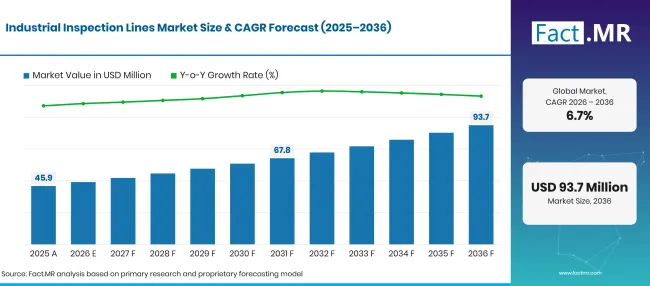
Industrial Inspection Lines Forecast Global | Source: Fact.MR
Category
| Category | Segments |
|---|---|
| Inspection modality | X-ray, Machine vision, Metal detection, Ultrasonic, Multimodal |
| Processing scale | Pilot / lab, Small commercial, Mid-scale, High-throughput, Ultra-high-throughput |
| Operating configuration | Batch, Semi-continuous, Continuous, Modular skid, Integrated line |
| Food / process application | Bakery / wafers, Confectionery / cocoa, Snacks / seasoning, Brewing / grains, Other food / industrial |
| Region | Germany; Japan; China; United States; Italy |
Source: Fact.MR analysis.
Segmental Analysis
What is driving X-ray demand and sales in the Industrial Inspection Lines Market?
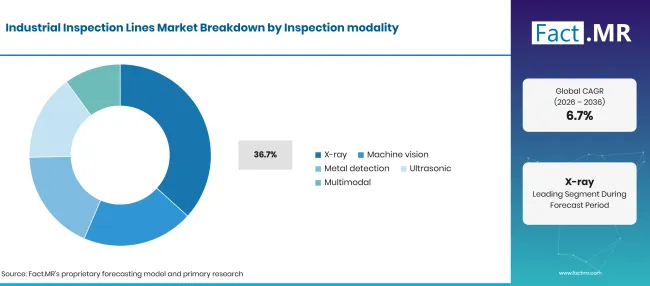
Industrial Inspection Lines Breakdown Inspection Modality | Source: Fact.MR
Demand for X-ray accounts for 36.7% of revenue in 2026, about USD 18.0 million, as it detects a wide range of foreign bodies and also checks fill levels, missing items and seal integrity. Ultrasonic inspection follows. The key players are offering dual-energy X-ray for better contrast. Food and Drug Administration (FDA) identifies X-ray technology as a method for detecting non-metallic foreign objects, including glass fragments, in food products. Its guidance also highlights the limitations of conventional metal detectors when inspecting certain materials. These requirements strengthen demand for advanced X-ray inspection equipment across food processing operations. Dual-energy systems are gaining supplier attention as manufacturers seek improved product differentiation and contamination detection capabilities.
Which production requirements are increasing high-throughput inspection line sales?
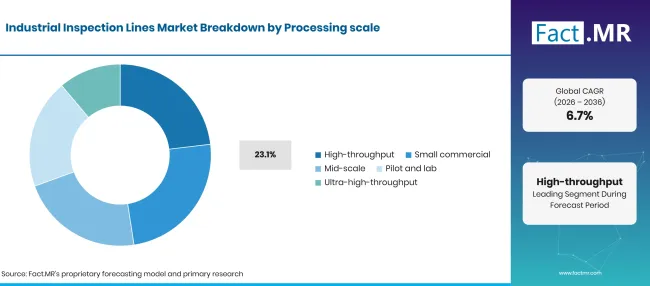
Industrial Inspection Lines Breakdown Processing Scale | Source: Fact.MR
The high-throughput segment accounts for 23.1% of revenue in 2026, about USD 11.3 million, as large plants ship to major retailers with strict inspection requirements. Small commercial plants follow. The manufacturing companies are offering high-speed inspection. According to the US Department of Agriculture's Food Safety and Inspection Service (USDA-FSIS), approximately 7,100 federally inspected establishments operate across the meat and poultry sector. This established industrial inspection environment supports demand for equipment capable of handling continuous production volumes. Federal inspection requirements also increase the importance of consistent product examination. Equipment suppliers are responding with high-speed inspection systems, automated rejection mechanisms and production-line integration to support larger manufacturing operations.
How are integrated configurations influencing industrial inspection line demand?
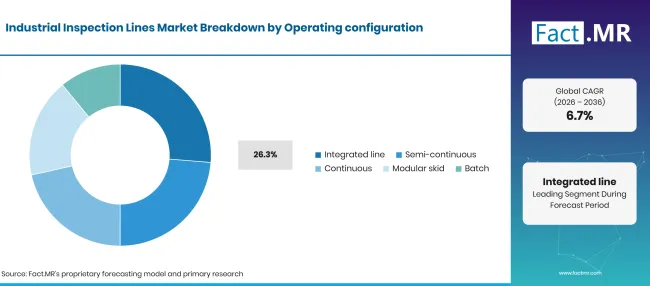
Industrial Inspection Lines Breakdown Operating Configuration | Source: Fact.MR
Integrated lines account for 26.3% of revenue in 2026, about USD 12.9 million, as inspection is built into new processing and packing lines with automatic reject and data logging. Modular skids follow closely. Manufacturers are offering inspection as part of line packages. The FDA's Food Safety Modernization Act (FSMA) requires covered food facilities to implement written food safety plans incorporating hazard analysis, preventive controls, monitoring, corrective actions and verification. These requirements create operational demand for inspection equipment that works alongside existing production processes and supports consistent monitoring. Integrated configurations offer manufacturers automated rejection, inspection records and coordinated production controls. Equipment suppliers are increasingly positioning complete inspection packages for processing and packaging line installations.
What is expanding inspection equipment sales across food and industrial applications?
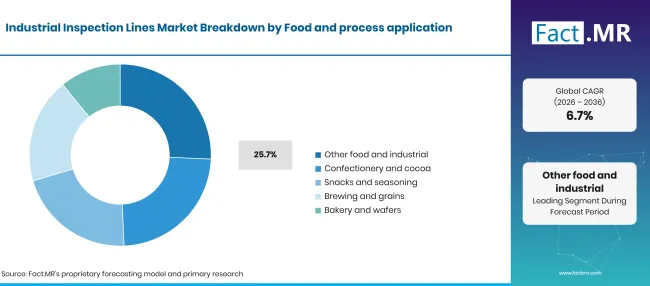
Industrial Inspection Lines Breakdown Food And Process Application | Source: Fact.MR
Other food / industrial accounts for 25.7% of revenue in 2026, about USD 12.6 million, covering meat, poultry, ready meals, pharmaceuticals and pet food. Brewing and grains follow closely. Manufacturers serve diverse plants. The USDA-FSIS confirms that all raw meat and poultry products sold in interstate and foreign commerce undergo federal inspection, demonstrating the extensive regulatory oversight within major food-processing applications. Separately, the FDA requires covered food facilities to evaluate biological, chemical and physical hazards and establish appropriate preventive controls. These requirements support inspection investment across diverse manufacturing environments, encouraging suppliers to develop application-specific inspection solutions for different product characteristics and production conditions.
Industrial Inspection Lines Market-Drivers, Restraints & Trends
Drivers: Rising Food Safety Requirements and Product Recall Prevention
Under the Food Safety Modernization Act, the FDA inspects covered domestic food facilities at least once every three years for high-risk facilities and once every five years for non-high-risk facilities. Manufacturers can use in-line inspection as one part of their food safety controls, with equipment and checks selected for the hazards in their processes. Source · FDA 2026 Food Code release
Restraints: Equipment Costs and Radiation Safety Compliance
OSHA's ionizing-radiation standard, 29 CFR 1910.1096, requires employers to make any surveys necessary to comply with the standard. Employers must provide personnel monitoring when the criteria in the standard are met and keep exposure records for employees who require monitoring. Source OSHA also confirms that most X-ray equipment may require registration with state or local radiation-control agencies, with requirements varying by jurisdiction. These obligations create additional implementation and operating responsibilities for manufacturing facilities. Smaller plants may face greater difficulty allocating resources to equipment installation, radiation protection, staff training and regulatory compliance, potentially slowing the adoption of industrial X-ray inspection lines.
Opportunity: Dual-Energy X-Ray Technology
The U.S. National Institutes of Health's PubMed Central database hosts research demonstrating the effectiveness of dual-energy X-ray absorptiometry in food inspection. The study evaluated 488 meat-product samples collected from a conveyor belt, with approximately 60% containing foreign objects. Its dual-energy detection methodology achieved 95% overall foreign-object detection accuracy, while correctly identifying 97% of uncontaminated samples. These findings demonstrate the potential of dual-energy imaging to distinguish contaminants from food products through differences in X-ray absorption. Although the study was published in 2021, its findings provide a measurable technical benchmark rather than a 2026 market statistic.
Trend: AI-Assisted Image Analysis
The U.S. National Institute of Standards and Technology (NIST), through its Manufacturing Extension Partnership, reports that 46% of U.S. manufacturers are using AI tools in their manufacturing operations, while more than 80% expect to increase AI usage over the following two years. Its manufacturing deployment data also identifies quality operations as an application area for 24% of manufacturers. Furthermore, 49% report using AI for quality improvement. These figures demonstrate increasing industrial interest in AI-enabled quality management and automated decision-making, supporting the adoption of intelligent image-analysis technologies in inspection systems to improve defect identification and manufacturing consistency.
Industrial Inspection Lines Market Analysis by Key Country
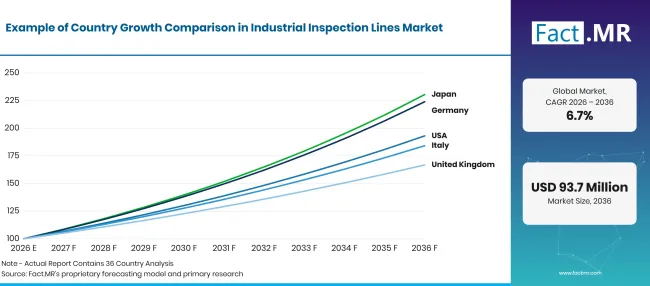
Industrial Inspection Lines Growth Index | Source: Fact.MR
| Country | CAGR (2026-2036) |
|---|---|
| Germany | 9.9% |
| Japan | 9.4% |
| China | 8.3% |
| United States | 6.8% |
| Italy | 6.3% |
Source: Fact.MR analysis.
How are German food manufacturers strengthening demand for industrial inspection lines?
Demand in Germany is projected to record a 9.9% CAGR, the fastest among the five key countries, as discount retailers require X-ray inspection from suppliers and German makers such as Wipotec develop technology.
Germany's industrial inspection line market is supported by investment in automated food quality control and foreign-body detection. Food manufacturers supplying discount retailers face pressure to demonstrate consistent product safety, traceability and inspection records. According to Germany's Federal Office of Consumer Protection and Food Safety (BVL), approximately one million food-business inspections and 400,000 laboratory food-sample examinations take place annually. This extensive monitoring environment supports demand for reliable inspection equipment. Wipotec's X-ray and weighing technologies also strengthen domestic supplier capabilities as processors upgrade production lines.
What is driving industrial inspection line demand in Japan?
Sales in Japan is estimated to increase at a 9.4% CAGR as Anritsu and Ishida lead in X-ray inspection and processors maintain strict quality standards.
Japanese food makers face strict retailer standards and recall costs, keeping inspection spending high. Japan's industrial inspection line demand is projected to shaped by stringent food safety expectations and extensive quality verification across processing operations. The Ministry of Health, Labour and Welfare reported approximately 2.53 million imported-food notifications and 214,030 inspections in fiscal 2025, with 791 violations requiring corrective action. Separately, Japan recorded 1,172 food poisoning incidents involving 24,727 people in 2025, according to the Ministry of Agriculture, Forestry and Fisheries. These figures reinforce the importance of preventive quality management. Anritsu and Ishida benefit from manufacturers investing in automated foreign-material detection and consistent inspection performance.
Which developments are accelerating industrial inspection line sales in China?
Sales in China are projected to grow at a 8.3% CAGR as exporters meet foreign retailer requirements and domestic food safety checks tighten.
Local X-ray makers compete with Mettler-Toledo and Anritsu. China's industrial inspection line market is reflecting stronger regulatory monitoring and increasing emphasis on food quality across manufacturing facilities. The State Administration for Market Regulation reported that national authorities completed 2,290,646 food safety sampling inspections during the first half of 2026, with an overall non-compliance rate of 2.22%. Fruit and vegetable samples recorded non-compliance rates of 5.18% and 4.92%, respectively. Such findings encourage processors to strengthen production-line monitoring and identify contamination before products reach distribution channels. Export-oriented manufacturers also require dependable inspection systems to satisfy overseas buyer specifications and retailer audits.
How are regulatory oversight and retailer expectations influencing United States sales?
Demand in the United States are anticipated to record at a 6.8% CAGR as FSMA and retailer audits push inspection, and foreign-material recalls appear regularly in USDA FSIS notices.
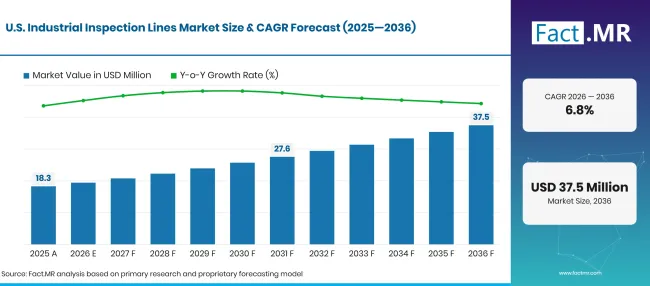
Industrial Inspection Lines Forecast Usa | Source: Fact.MR
Plants add X-ray and vision systems. Food manufacturers face pressure to strengthen preventive controls, document production quality and reduce contamination-related recalls. The USDA Office of Inspector General reported that FSIS conducted 7.7 million food safety and food defence procedures across approximately 7,100 regulated establishments during 2024. It also recorded 239 food safety recalls and public health alerts between 2022 and May 2025. These enforcement and recall figures reinforce investment in automated inspection. X-ray, metal detection and vision systems help processors identify foreign materials and improve quality assurance across production operations.
Why does Italy record comparatively moderate growth in inspection equipment demand?
Sales in Italy is estimated to grow at a 6.3% CAGR, the slowest among the five key countries, as many plants use metal detection only, as smaller food producers have limited budgets for X-ray.
Exporters supplying UK and US retailers are adding X-ray systems. Italy's industrial inspection line market is reflecting a comparatively gradual pace of equipment investment among food processors. The Italian Ministry of Health reported 26,920 samples and 419,571 analytical determinations under its 2025 National Residue Plan, with 36 non-compliant samples. Its official monitoring framework covers production, processing, distribution and import-export activities. Meanwhile, Istat recorded 47,863 food-industry enterprises in 2023, indicating a broad supplier base with differing investment capacities. Smaller processors may prioritise essential metal detection before adopting higher-cost X-ray systems, although exporters supplying demanding international retailers continue to create opportunities for advanced inspection upgrades.
Competitive Landscape for Industrial Inspection Lines Market
Competition in the industrial inspection lines market is shaped by integrated food-processing equipment manufacturers and specialised inspection technology suppliers. GEA, JBT Marel and Bühler compete through broad processing and production-line portfolios, while Heat and Control and tna solutions focus on food processing and snack production equipment. METTLER TOLEDO, Anritsu Corporation, Ishida, Loma Systems and Thermo Fisher Scientific strengthen competition through dedicated inspection technologies, including X-ray systems, metal detectors, checkweighers and quality-control solutions.
From 2024 onward, competition shifted toward X-ray and AI. Manufacturers with integrated inspection are best placed to grow. Competitive differentiation increasingly depends on contaminant detection accuracy, production speed, reduced false rejects and inspection data management. Manufacturers are expanding inspection capabilities beyond foreign-body detection to include product integrity, missing-item identification, fill-level verification and packaging checks. METTLER TOLEDO offers integrated inspection and data-management solutions, while Anritsu's latest X-ray systems emphasise detection performance and lower false rejects. Manufacturers with application-specific equipment, integration capabilities and dependable after-sales support are positioned to strengthen their competitive presence.
Recent Developments
- On September 23, 2026, tna solutions announced its partnership with Mohammed Riaz & Partner LLC to establish a new snack production line for Muscat Chips and Muscat Chips Crinklz in Oman. The project involved delivering an integrated production line with a capacity of 300 kg per hour and packaging speeds of up to 120 packs per minute. The equipment includes processing, seasoning, weighing, metal detection, date coding and packaging operations. This deployment demonstrates the integration of automated metal detection into complete high-speed snack manufacturing lines.
- On July 14, 2026, JBT Marel introduced SensorX Xpress, an advanced X-ray image-processing algorithm for its SensorX inspection systems. The software upgrade is designed to increase inspection capacity by up to 20% while maintaining bone-detection accuracy in high-speed poultry processing operations. JBT Marel also confirmed that the technology would be included as a standard feature in new SensorX systems and made available as a retrofit for SensorX 500 installations. This development supports higher production throughput without requiring processors to replace their entire inspection infrastructure.
- On August 1, 2025, Bühler announced the SORTEX R500, an optical sorting system developed specifically for rice processing. The system uses automation and precision sorting to reduce manual intervention and improve processing efficiency. Its launch addresses increasing pressure on rice processors to improve product quality, manage operating costs and reduce material losses. The development strengthens Bühler's position in automated optical inspection for agricultural processing applications.
- On May 15, 2025, Bühler launched the SORTEX AI700 optical sorter, incorporating deep-learning technology to improve impurity identification in food processing. Its initial application focuses on removing gluten-containing grains from oats, supporting manufacturers producing gluten-free food products. The system improves defect detection and impurity removal while helping processors increase product quality and yield. This launch represents a relevant development in automated optical inspection and sorting, particularly for agricultural ingredients and food processing lines.
- On March 18, 2025, Ishida announced the IX-PD-Poultry X-ray Inspection System, designed to improve bone detection accuracy in high-volume poultry processing operations. The system incorporates Photo-Counting Dual Energy technology to identify wishbone, rib and fan bones in poultry fillets and other cuts. Its twin-lane configuration supports inspection of multiple poultry products, while its product-recirculation arrangement helps reduce unnecessary rejection and manual rework. The development addresses the need for reliable contamination detection in large-scale poultry processing lines.
- On May 5, 2025, Loma Systems introduced two inspection technologies at IFFA 2025: the IQ4M Metal Detector and X5DE Dual Energy X-ray Inspection System. The IQ4M was developed to improve contaminant detection, connectivity and production efficiency, while the X5DE uses dual-energy technology to identify difficult contaminants, including bone, rubber and glass, in overlapping and multilayered products. The launch strengthens Loma's portfolio of automated food inspection equipment for high-demand meat and food processing lines.
- In January 2025, JBT Corporation completed its combination with Marel hf. on January 2, 2025, creating JBT Marel Corporation. The combined business provides food processing, automation, packaging and technology solutions across the food production value chain. The merger expanded its capabilities across protein processing and prepared food applications, strengthening its position in industrial food production equipment, including automated inspection technologies.
Key Players in Industrial Inspection Lines Market
Key companies operating in the market include GEA, JBT Marel, Heat and Control, Bühler, tna solutions, METTLER TOLEDO, Anritsu Corporation, Ishida Co., Ltd., Loma Systems, and Thermo Fisher Scientific Inc.
- GEA
- JBT Marel
- Heat and Control
- Bühler
- tna solutions
- METTLER TOLEDO
- Anritsu Corporation
- Ishida Co., Ltd.
- Loma Systems
- Thermo Fisher Scientific Inc.
- JBT Marel
Bibliography
- Anritsu Corporation. (2025). Integrated report 2025.
- Bühler Group. (2025a). Bühler launches new rice specialist SORTEX R500 to help combat challenges in rice processing.
- Bühler Group. (2025b). SORTEX AI700.
- Istituto Nazionale di Statistica. (2026). Rapporto sulla competitività dei settori produttivi: Edizione 2026.
- Ishida Co., Ltd. (2025). Ishida unveils next-level X-ray inspection system.
- JBT Marel Corporation. (2025). JBT Marel Corporation reports JBT standalone fourth quarter and full year 2024 results, provides highlights on Marel's 2024 results, and establishes 2025 guidance.
- JBT Marel Corporation. (2026, July 14). 20% capacity boost with SensorX Xpress.
- Loma Systems. (2025, May 5). Loma Systems launches the new IQ4M and X5DE food safety inspection technologies at IFFA 2025.
- Ministry of Agriculture, Forestry and Fisheries. (2026). Food poisoning occurs throughout the year.
- Ministry of Health, Labour and Welfare. (2026, August 28). Publication of the results of monitoring and guidance based on the FY2025 imported food monitoring and guidance plan and imported food monitoring statistics.
- Ministry of Health, Labour and Welfare. (2026, August 28). FY2025 imported food monitoring results and statistics [PDF].
- Ministry of Health. (2026, September 23). Piano nazionale per la ricerca dei residui (PNR): Risultati anno 2025.
- National Institute of Standards and Technology. (2026). The rise of artificial intelligence (AI) in U.S. manufacturing.
- State Administration for Market Regulation. (2026, August 4). 2026年上半年市场监管部门食品安全监督抽检情况通报 [Food safety sampling inspection results of market supervision departments for the first half of 2026].
- TNA Solutions. (2026, September 23). TNA Solutions helps Muscat Chips pioneer a greenfield snack production line in Oman.
Segmentation
Scope of Report
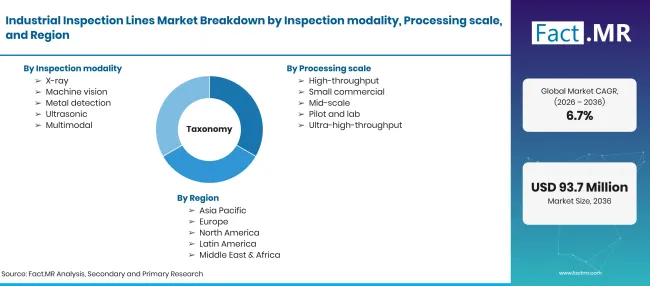
Industrial Inspection Lines Taxonomy 1 | Source: Fact.MR
| Items | Values |
|---|---|
| Quantitative Units (2026) | USD 49.0 Million |
| Inspection modality | X-ray, Machine vision, Metal detection, Ultrasonic, Multimodal |
| Processing scale | Pilot / lab, Small commercial, Mid-scale, High-throughput, Ultra-high-throughput |
| Operating configuration | Batch, Semi-continuous, Continuous, Modular skid, Integrated line |
| Food / process application | Bakery / wafers, Confectionery / cocoa, Snacks / seasoning, Brewing / grains, Other food / industrial |
| Regions Covered | North America, Latin America, Europe, East Asia, South Asia and Pacific, Middle East & Africa |
| Countries Covered | Germany, Japan, China, United States, Italy, and other countries |
| Key Companies Profiled | GEA JBT Marel Heat and Control Bühler tna solutions METTLER TOLEDO Anritsu Corporation Ishida Co., Ltd. Loma Systems Thermo Fisher Scientific Inc. JBT Marel |
| Additional Attributes | Dollar revenue in the Industrial Inspection Lines Market is segmented by inspection modality (X-ray, machine vision, metal detection, ultrasonic, multimodal); processing scale (pilot / lab, small commercial, mid-scale, high-throughput, ultra-high-throughput); operating configuration (batch, semi-continuous, continuous, modular skid, integrated line); food / process application (bakery / wafers, confectionery / cocoa, snacks / seasoning, brewing / grains, other food / industrial) and region. |
Source: Fact.MR analysis.
Industrial Inspection Lines Market by Segments
-
Inspection modality
- X-ray
- Machine vision
- Metal detection
- Ultrasonic
- Multimodal
-
Processing scale
- Pilot / lab
- Small commercial
- Mid-scale
- High-throughput
- Ultra-high-throughput
-
Operating configuration
- Batch
- Semi-continuous
- Continuous
- Modular skid
- Integrated line
-
Food / process application
- Bakery / wafers
- Confectionery / cocoa
- Snacks / seasoning
- Brewing / grains
- Other food / industrial
-
Region:
- North America
- United States
- Canada
- Mexico
- Europe
- Germany
- United Kingdom
- France
- Italy
- Spain
- Rest of Europe
- Asia Pacific
- China
- India
- Japan
- South Korea
- Australia
- Rest of Asia Pacific
- Latin America
- Brazil
- Argentina
- Rest of Latin America
- Middle East & Africa
- GCC Countries
- South Africa
- Rest of Middle East & Africa
- North America
Table of Contents
Key Takeaways
- Market Size and CAGR
- Top Growth Driver
- Fastest Growing Segment
- Leading Region
- Key Companies
- Emerging Opportunities

