- Base Value(2025): 27.0 Bn
- Estimated Value(2026): 28.2 Bn
- Forecast Value (2036): 43.8 Bn
- CAGR (2026 - 2036): 4.5%
Instant Noodles Market Analysis and Forecast by Fact.MR
- The Instant Noodles Market is projected to grow from USD 28.2 billion in 2026 to USD 43.8 billion by 2036 at a CAGR of 4.5%.
- The growth is driven by increased consumption in urbanizing Asian economies, the fast-growing premiumization trends in developed markets, the rise of quick-commerce and convenience retail, and greater cross-cultural adoption in western markets.
- Fried instant noodles account for 48.3% of the product segment, chicken flavor noodles hold 44.1% share of the flavor profile category, packet packaging has 51.6% share, and retail distribution holds 46.2% distribution channel share.
- Manufacturers are focusing on regional flavor localization, healthier non-fried product lines, and digital-first distribution strategies.
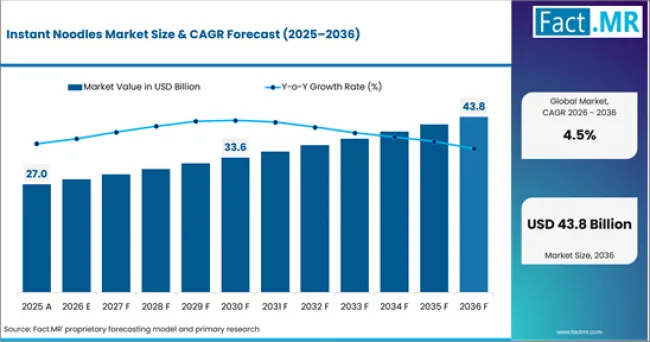
Instant Noodles Market Value Analysis | Source: Fact.MR
Summary of Instant Noodles Market
- Market Snapshot
- In 2025, the global Instant Noodles Market was valued at approximately USD 27.0 billion.
- The market is estimated to reach USD 28.2 billion in 2026 and is projected to attain USD 43.8 billion by 2036.
- The instant noodles market is likely to expand at a CAGR of 4.5% during the forecast period.
- The market is anticipated to create an absolute dollar opportunity of USD 15.6 billion between 2026 and 2036.
- Fried instant noodles account for 48.3% of product segment share in 2026.
- China (6.1%) and South Korea (5.8%) are the key growth markets during the forecast period.
- Demand and Growth Drivers
- The rapid urbanization of China, South Korea and Southeast Asia, as well as rising disposable incomes, are expanding the pool of consumers who could potentially use packaged meal solutions.
- Trends around premiumization are enabling higher price points through restaurant-style flavors, inclusion of premium ingredients and improved packaging formats.
- Quick-commerce and on-demand delivery platforms are shrinking the distance from discovery to purchase, fuelling impulse consumption and trial of new product variants.
- The cross-cultural taste adoption in Western markets is taking the category beyond Asian diaspora consumers into mainstream meal occasions.
- The rising demand for whole grain and non-fried options is attracting health-conscious consumers who had previously avoided the category.
- Product and Segment View
- In 2026, fried instant noodles is anticipated to maintain the product share of 48.3% supported by established manufacturing infrastructure and strong consumer preference towards texture and taste profile.
- Chicken flavor noodles is the most popular flavor profile with 44.1% flavor profile share, indicating broad consumer acceptance across geographies and occasions for a meal.
- Key segmentation includes:
- Product: Fried Instant Noodles, Non Fried Instant Noodles, Rice Noodles, Whole Grain Noodles
- Flavor Profile: Chicken Flavor Noodles, Seafood Flavor Noodles, Vegetable Flavor Noodles, and Regional Flavor Noodles
- Packaging Format: Packet, Cup, Bowl, Tray
- Processing Technology: Oil Frying Technology, Hot Air Drying Technology, Steam Processing Technology, and Freeze Drying Technology
- Distribution Channel: Retail, Online, Foodservice, Wholesale
- These products serve:
- Convenience food for urban consumers, students and working professionals in all income segments
- Convenience food choices for foodservice operators, institutional kitchens and disaster relief supply chains
- Non-fried, whole grain and fortified product formats providing premium and functional meal alternatives
- Geography and Competitive Outlook
- Asia Pacific is the largest market in terms of consumption and growth, with China achieving 6.1% CAGR, driven by per-capita consumption growth, premiumization, and quick-commerce distribution growth.
- South Korea 5.8% CAGR Robust export-led growth fueled by Korean wave cultural influence and premium product positioning.
- North America 4.6% (U.S.) – Increasing mainstream consumption, trends of Asian cuisine, and increasing retail shelf space for premium instant noodle brands.
- Major players include Nissin Food Holdings, Nestle India Limited, Toyo Suisan Kaisha Ltd., Ajinomoto Co. Inc., The Campbell Soup Company, Sco-Fro Foods Ltd., Capital Foods Pvt. Nongshim Co., Ltd. Ltd., Indomie (PT Indofood Sukses Makmur Tbk) and Ottogi Co. Ltd.
- Analyst Opinion
- Shambhu Nath Jha, Principal Consultant at Fact.MR, says, “The instant noodles market is seeing a structural shift from being a commodity staple to a segmented convenience food category. Fried noodles continue to account for half the market as they provide the taste and texture that consumers expect from the category, but the incremental margin opportunity is in non-fried and whole grain formats.”
Key Growth Drivers, Constraints, and Opportunities
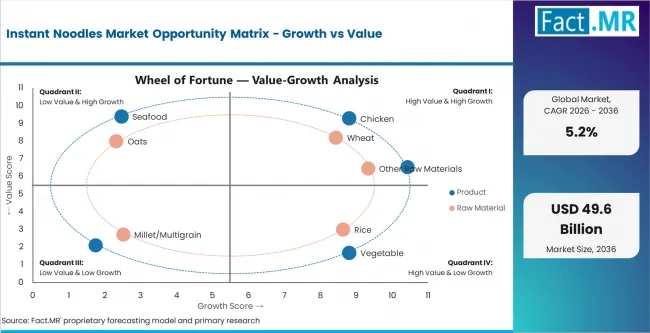
Instant Noodles Market Opportunity Matrix Growth Vs Value | Source: Fact.MR
Key Factors Driving Growth
- With continued urbanization, the consumer base for low-cost, long shelf-life meal solutions that require little or no prep work is growing in Asia, Africa and Latin America.
- Quick commerce platforms are shortening the purchase cycle and allowing for impulse buys, particularly for premium and new brands that lack a legacy shelf presence.
- Premiumization (restaurant-quality flavors, higher quality ingredients and improved nutritional profiles) is helping to reposition the category away from a commodity perception.
Key Market Constraints
- In some markets, health perceptions and regulatory scrutiny regarding sodium content, palm oil use and front of pack warning labels continue to limit purchase decisions.
- The volatility of raw material prices for wheat flour and palm oil creates margin pressure which restricts the manufacturer’s ability to invest in upgrading the product and marketing.
- Producers dependent on exports contend with irregular demand and compressed per-unit margins because of seasonal consumption and high price sensitivity in volume markets.
Key Opportunity Areas
- Non-fried and whole grain formats outpacing category average to appeal to health-conscious consumers willing to pay more for less health trade-offs.
- The African market, with per-capita consumption a fraction of Asian levels, provides significant volume growth potential with the improvement of distribution infrastructure.
- Korean cultural exports are popularizing spicy, complex instant noodle flavors and growing the addressable market in Western countries.
How Is Fried Instant Noodle Dominance Evolving?
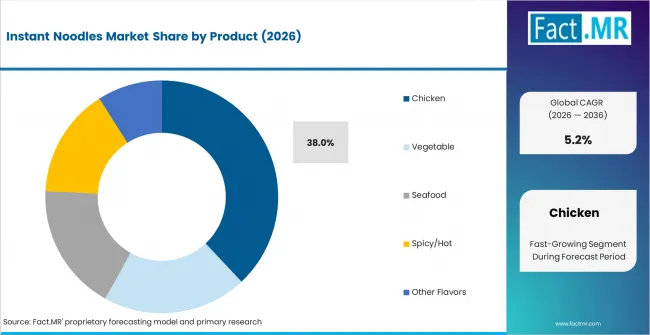
Instant Noodles Market Analysis By Product | Source: Fact.MR
Fried instant noodles hold a commanding 48.3% share of the product segment in 2026, a position cemented by decades of manufacturing optimization, consumer habit formation, and cost efficiency in oil frying production lines. The format continues to lead the way despite sustained criticism on health grounds because the frying process is still difficult to replicate at comparable cost in terms of texture, mouthfeel and rehydration properties.
The internal composition of the fried segment is shifting, with cup fried noodles gaining share from pack fried noodles in developed markets. The cup is the format of choice for workplace, travel and on-the-go consumption, providing single-serve portability and requiring only hot water. Pack formats remain dominant in household consumption in Asia where multi-packs offer better per-unit economics for family meal preparation.
Non-fried instant noodles, air-dried and steam-processed, are gaining traction as manufacturers invest in production technology that brings taste parity closer to fried products. Japan and South Korea are the leading non-fried markets where health-conscious consumers are willing to sacrifice some texture and taste differences for lower fat and calorie reduction.
What Role Is Chicken Flavor Dominance Playing in Market Strategy?
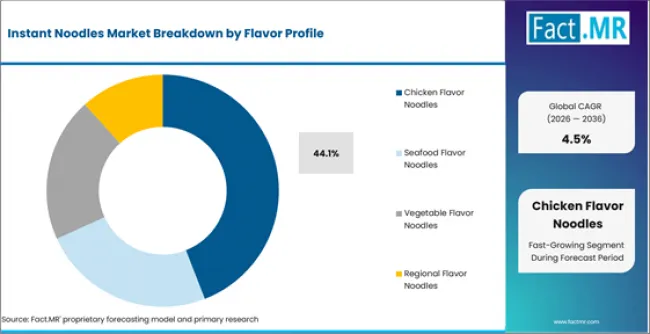
Instant Noodles Market Analysis By Flavor Profile | Source: Fact.MR
Chicken flavor noodles hold the largest share in the flavor profile segment, with 44.1% share, which is the most widely accepted flavor profile across geographies, religions and dietary preferences, except for vegetarian markets. The entry-point product for a consumer trying a brand for the first time is chicken flavor. Manufacturers use chicken flavor as the anchor SKU from which they market limited-edition and region-specific flavors.
Spicy flavor noodles are the fastest growing flavor category, driven by the global popularization of Korean fire noodle culture and the consumption challenge created by social media. Korean producers such as Nongshim and Samyang have taken advantage of this trend by launching ever-spicier versions that promote viral marketing and repeat purchases. Seafood flavor noodles still maintain strong positions in East Asia and Southeast Asia markets, where shrimp, crab and fish-based broths are aligned with local culinary traditions.
Vegetable and plant-based flavors are also gaining traction in Western markets and among younger consumers in Asia, thanks to flexitarian diet trends and increasing views of plant-based options as healthier. The flavor innovation pipeline is moving from simple seasoning packets to multi-component flavor systems that include dehydrated vegetables, topping sachets and separate oil or paste packets that enable consumers to tailor intensity.
Regional Outlook for the Instant Noodles Market
.webp "Top Country Growth Comparison Instant Noodles Market Cagr (2026 2036)")
Top Country Growth Comparison Instant Noodles Market Cagr (2026 2036) | Source: Fact.MR
| Country | CAGR (%) |
|---|---|
| China | 6.1% |
| South Korea | 5.8% |
| U.S. | 4.6% |
| Japan | 4.3% |
| ANZ | 4.0% |
| U.K. | 3.9% |
| Germany | 3.7% |
| France | 3.5% |
| Italy | 3.2% |
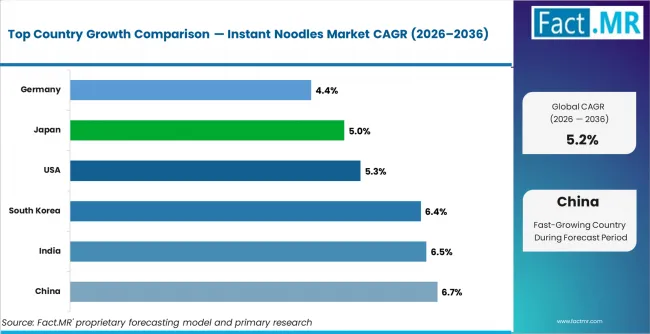
Instant Noodles Market Cagr Analysis By Country | Source: Fact.MR
China
The China Instant Noodles Market is expected to grow at a CAGR of over 6.1% during 2036. China’s demand will be supported by ongoing rural-urban migration, increased consumption of premium instant noodle formats by the middle-class and the rapid expansion of community group buying and quick-commerce platforms that are making branded products available in lower-tier cities.
- Premium instant noodle sub-brands from domestic producers are competing with imports on ingredient quality and packaging design.
- Non-fried products are gaining share in Tier 1 cities where health-conscious consumers are trading up from traditional fried formats.
- Community group buying and quick-commerce platforms are making branded products accessible in lower-tier cities.
South Korea
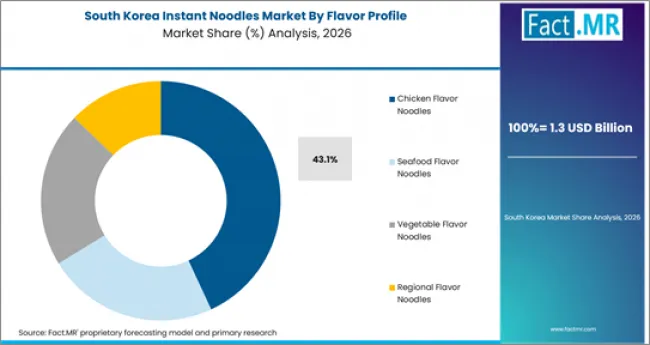
Instant Noodles Market South Korea Market Share Analysis By Flavor Profile | Source: Fact.MR
South Korea’s instant noodles market is set to grow at a CAGR of 5.8% through 2036. The global instant noodle industry is led by South Korea with a CAGR of 5.8% as manufacturers are taking advantage of Korean cultural exports to create brand recognition and demand in 60 to 70 markets. Nongshim, Samyang and Ottogi are all ramping up production to meet growing international orders.
- Korean cultural exports are building brand recognition and demand for domestic instant noodle brands across 60 to 70 markets globally.
- Rapid flavor turnover with limited-edition and seasonal releases drives repeat purchase cycles in the domestic market.
- Growing export manufacturing capacity in Busan and other facilities supports international order fulfillment at scale.
U.S.
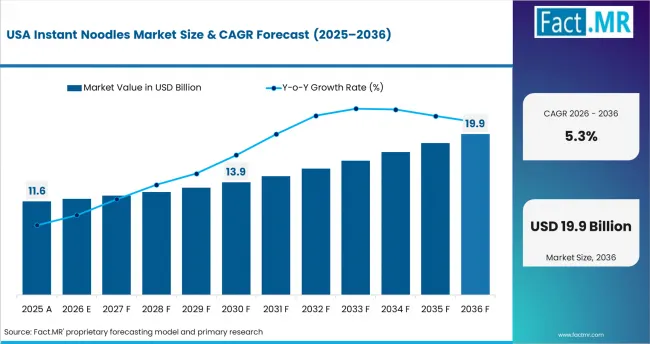
Instant Noodles Market Country Value Analysis | Source: Fact.MR
The U.S. Instant Noodles Market is projected to grow at a CAGR of 4.6% through 2036. The U.S. market at 4.6% CAGR is transitioning from a price-driven category dominated by Maruchan and Nissin economy packs to a premiumizing segment where Korean, Japanese, and Southeast Asian brands are capturing shelf space at higher price points. Mainstream grocery retailers are expanding their Asian food aisles to accommodate growing consumer interest in regional noodle varieties.
- Mainstream grocery retailers are expanding Asian food aisles to accommodate growing consumer interest in regional noodle varieties.
- Korean, Japanese, and Southeast Asian brands are capturing shelf space at higher price points than traditional economy products.
- Ramen restaurant culture is normalizing higher-quality instant noodle consumption among younger demographics.
Japan
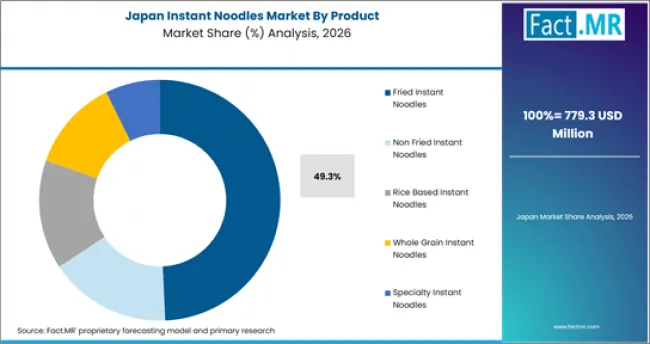
Instant Noodles Market Japan Market Share Analysis By Product | Source: Fact.MR
The Japan Instant Noodles Market is projected to grow at a CAGR of 4.3% through 2036. Japan at 4.3% CAGR is the most mature and product-diverse instant noodle market globally, where manufacturers compete through constant product renewal, limited-edition collaborations, and packaging format experimentation. Cup noodles originated in Japan, and the domestic market continues to serve as a test bed for product concepts that are later scaled to export markets.
- Cup noodle format continues to serve as a test bed for product concepts later scaled to export markets.
- Nissin and Toyo Suisan are investing in non-fried and functional formats for an aging consumer base with evolving nutritional requirements.
- Non-fried and functional formats, including protein-fortified and reduced-sodium variants, address an aging consumer base.
ANZ
The ANZ Instant Noodles Market is projected to grow at a CAGR of 4% through 2036. Australia and New Zealand at 4.0% CAGR are experiencing demand growth driven by the cultural influence of East Asian and Southeast Asian communities, rising mainstream consumer acceptance of Asian noodle flavors, and expanding retail distribution of imported Korean and Japanese premium brands.
- Cultural influence of East Asian and Southeast Asian communities is driving mainstream consumer acceptance of Asian noodle flavors.
- Premium pricing makes the market attractive for Asian manufacturers seeking to diversify beyond high-volume, low-margin domestic sales.
- Expanding retail distribution of imported Korean and Japanese premium brands supports category growth.
U.K.
The U.K. Instant Noodles Market is projected to grow at a CAGR of 3.9% through 2036. Regulatory pressure in the U.K. at 3.9% CAGR is shaping the instant noodle category as manufacturers reformulate products to comply with evolving front-of-pack nutrition labeling and HFSS advertising restrictions. Brands that have proactively reduced sodium and fat content are capturing share from traditional products.
- Manufacturers are reformulating products to comply with evolving front-of-pack nutrition labeling and HFSS advertising restrictions.
- Demand for premium instant noodles is growing in urban centers driven by Asian food culture influence.
- Proactive sodium and fat reduction positions reformulated brands ahead of evolving HFSS advertising restrictions.
Germany
The Germany Instant Noodles Market is expected to expand at a CAGR of 3.7% through 2036. Germany at 3.7% CAGR is the largest instant noodle market in continental Europe, fuelled by the growth of multicultural demographics and increasing penetration of Korean and Japanese brands in discount and mainstream retail channels. German consumers are more receptive to non-fried and whole grain variants than in other European markets.
- Expanding multicultural demographics and increasing acceptance of Asian culinary traditions support category growth.
- German consumers show stronger receptivity to non-fried and whole grain variants than other European markets.
- Private-label competition from discount retailers remains a constraint on branded manufacturer pricing power.
Competitive Benchmarking of the Instant Noodles Market
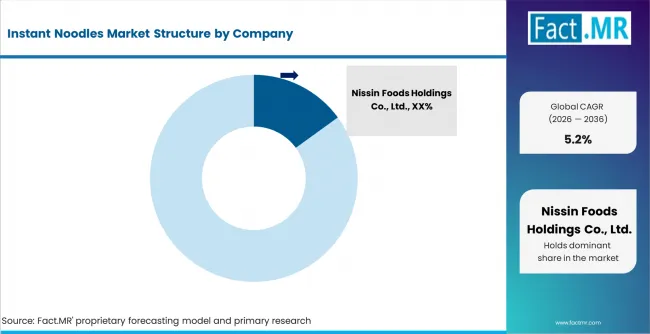
Instant Noodles Market Analysis By Company | Source: Fact.MR
- Nissin Food Holdings leads through its global manufacturing footprint, strong Cup Noodles and Top Ramen brands, and continued product innovation.
- Non-Korean players like Nongshim and Ottogi are gaining global share on the back of cultural export tailwinds, digital marketing and rapid international distribution expansion through dedicated export manufacturing facilities.
- In the Indian market, the leading brands are Maggi (Nestle India) and Ching Secret (Capital Foods), which use distribution reach in tier-2 and tier-3 cities and localized flavor development as key competitive advantages.
- Toyo Suisan Kaisha and Ajinomoto compete in Japan and selected international markets through premium product quality, manufacturing precision and strong foodservice relationships.
- Indomie (PT Indofood Sukses Makmur) is a dominant player in the Southeast Asian and African markets, thanks to aggressive pricing, high volume production, and deep distribution penetration in emerging economies.
The competitive landscape is concentrated at the top, with Nissin holding a strong global position through brand reach, manufacturing scale, and product innovation. The most dynamic competitors are Korean manufacturers, which are growing their international share faster than any other group of countries, a success driven by a combination of cultural relevance, product quality and aggressive market entry strategies. The industry is moving towards a bifurcated structure where mass market fried products compete on price and distribution, and premium, health and regionally authentic products compete on brand equity and product differentiation.
Key Companies in the Instant Noodles Market
Nissin Food Holdings, Nestle India Limited, Toyo Suisan Kaisha Ltd., Ajinomoto Co. Inc., The Campbell Soup Company, Sco-Fro Foods Ltd., Capital Foods Pvt. Ltd., Nongshim Co. Ltd., Indomie (PT Indofood Sukses Makmur Tbk), and Ottogi Co. Ltd. are the leading companies.
Recent Industry Developments
- Nissin Foods USA - Cup Noodles Dill Pickle Limited-Edition Launch (June 2025)
- In June 2025, Nissin Foods USA launched Cup Noodles Dill Pickle as a limited-edition flavor in the United States. The product targeted younger consumers seeking bold and unconventional instant noodle flavors.
- Nongshim - Busan Noksan Export-Oriented Instant Noodle Plant Construction (May 2025)
- In May 2025, Nongshim began construction of its Busan Noksan export-oriented instant noodle plant. The facility is planned to add three production lines and support annual export production of 500.0 million noodle packs after completion.
- Nongshim - Shin Ramyun Kimchi Stir Fry India Launch (May 2026)
- In May 2026, Nongshim launched Shin Ramyun Kimchi Stir Fry in India. The launch used quick-commerce availability through Blinkit and supported the company’s expansion in India’s premium Korean instant noodle segment.
Key Companies in the Instant Noodles Market
- Nissin Food Holdings
- Toyo Suisan Kaisha Ltd.
- Ajinomoto Co., Inc.
- Nongshim Co., Ltd.
- Ottogi Co., Ltd.
- Indofood Sukses Makmur
- Samyang Foods
- Uni-President Enterprises Corporation
- Acecook Vietnam JSC
Sources and Research References
- Food and Agriculture Organization of the United Nations. (2025, June 12). Food Outlook: Biannual report on global food markets, June 2025.
- OECD & Food and Agriculture Organization of the United Nations. (2025, July 15). OECD-FAO agricultural outlook 2025-2034. OECD Publishing.
- Ministry of Agriculture, Food and Rural Affairs. (2025, July 14). Exports of K-Food Plus in the first half of 2025.
- U.S. Census Bureau. (2026). Monthly retail trade: Sales report.
This bibliography is provided for reader reference and is not exhaustive. The full report contains the complete reference list and detailed citations.
Key Questions This Report Addresses
- What is the estimated size of the global Instant Noodles Market in 2026, and how is it projected to grow through the 2026 to 2036 forecast period?
- What incremental revenue opportunity is the Instant Noodles Market expected to create between 2026 and 2036, and what CAGR underpins this projection?
- Which product segment holds the largest share in 2026, and how is the balance between fried and non-fried formats expected to shift over the forecast period?
- How is premiumization reshaping the competitive landscape, and which manufacturers are best positioned to capture the premium instant noodle segment?
- What role is Korean cultural export playing in expanding the global addressable market, and how are Korean manufacturers scaling production to meet international demand?
- Which countries are projected to register the highest CAGR through 2036, and what consumption patterns are driving growth in each region?
- How is quick-commerce and digital distribution changing purchase behavior and competitive dynamics in high-growth markets like India and Southeast Asia?
- What regulatory constraints around sodium, HFSS labeling, and front-of-pack warnings are affecting manufacturer reformulation strategies?
- What supply-side factors including wheat flour prices, palm oil availability, and manufacturing capacity constraints could limit growth during the forecast period?
- Who are the leading companies, and how are they differentiating through manufacturing scale, brand portfolio, flavor localization, and distribution strategy?
- Which packaging format is gaining share fastest, and how is the shift from packet to cup and bowl formats influencing manufacturer capital investment?
- How does per-capita consumption in Africa and Latin America compare with Asia, and what infrastructure and distribution developments are needed to close the gap?
- What role is product renovation including functional fortification, reduced sodium, and plant-based ingredients playing in expanding the consumer base beyond traditional demographics?
- How is competition between global manufacturers and regional champions expected to evolve, and which companies are gaining share through export growth?
Instant Noodles Market Definition
The instant noodles market covers pre-cooked, dried, or preserved noodle products designed for rapid preparation through boiling, soaking, or microwaving. The category includes fried, non-fried, rice-based, and whole grain formats sold in packets, cups, bowls, and trays through retail, online, foodservice, and wholesale channels.
Instant Noodles Market Inclusions
- Global and regional market size and forecasts for 2026 to 2036 across product type, flavor profile, packaging format, processing technology, distribution channel, and region.
- Demand analysis on urbanization rates, trends in disposable income, quick commerce penetration, cross cultural consumption patterns, and premiumization dynamics.
- Competitive Landscape – Production Capacity, Brand Positioning, Strength of Distribution Network and Product Diversification Strategies.
Instant Noodles Market Exclusions
- Fresh, refrigerated, or frozen noodle products that require cold-chain logistics and are not shelf-stable.
- Traditional dried pasta products such as spaghetti, penne, or macaroni not marketed as instant preparation formats.
- Ready-to-eat canned noodle soups, frozen meal kits containing noodles, and restaurant-prepared noodle dishes.
Instant Noodles Market Research Methodology
Market sizing follows a hybrid demand-side and top-down methodology that triangulates national consumption volumes from trade associations, production output from major manufacturers, retail sell-through data from tracking services, and primary interviews with instant noodle producers, distributors, retailers, and foodservice operators. Regional estimates are calibrated against World Instant Noodles Association consumption statistics, import-export trade data, and per-capita consumption trends, with competitive positioning reviewed through manufacturer disclosures and retailer category data.
Scope of Analysis
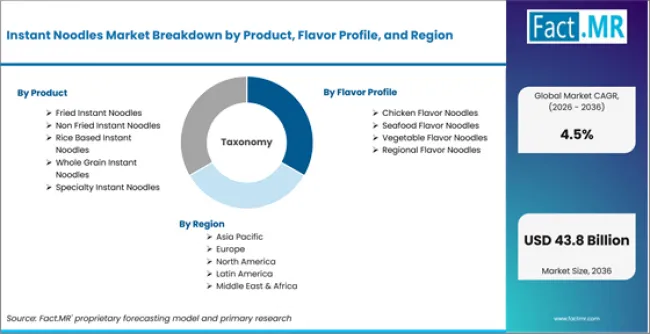
Instant Noodles Market Breakdown By Product, Flavor Profile, And Region | Source: Fact.MR
| Parameter | Details |
|---|---|
| Quantitative Units | USD 28.2 billion to USD 43.8 billion, at a CAGR of 4.5% |
| Market Definition | The Instant Noodles Market covers pre-cooked, dried, or preserved noodle products designed for rapid preparation, including fried, non-fried, rice-based, and whole grain formats sold through retail, online, foodservice, and wholesale channels. |
| Regions Covered | North America, Latin America, Europe, East Asia, South Asia and Pacific, Middle East and Africa |
| Countries Covered | China, South Korea, U.S., Japan, U.K., Italy, ANZ, France, Germany, 30 plus countries |
| Key Companies | Nissin Food Holdings, Nestle India, Toyo Suisan Kaisha, Ajinomoto, Campbell Soup Company, Sco-Fro Foods, Capital Foods, Nongshim, Indomie (Indofood Sukses Makmur), Ottogi |
| Forecast Period | 2026 to 2036 |
| Approach | Hybrid demand-side and top-down methodology built on World Instant Noodles Association consumption data, manufacturer production volumes, retail sell-through data, import-export trade statistics, and primary interviews |
Instant Noodles Market Segmentation
-
Instant Noodles Market Segmented by Product:
- Fried Instant Noodles
- Cup Fried Noodles
- Convenience Meal Applications
- Retail Ready To Eat Products
- Pack Fried Noodles
- Household Consumption Applications
- Mass Market Food Systems
- Cup Fried Noodles
- Non Fried Instant Noodles
- Air Dried Noodles
- Health Focused Applications
- Low Fat Meal Products
- Steam Processed Noodles
- Balanced Diet Applications
- Premium Convenience Systems
- Air Dried Noodles
- Rice Based Instant Noodles
- White Rice Noodles
- Gluten Free Applications
- Asian Cuisine Products
- Brown Rice Noodles
- Functional Nutrition Applications
- Healthy Meal Systems
- White Rice Noodles
- Whole Grain Instant Noodles
- Whole Wheat Noodles
- Fiber Rich Applications
- Healthy Convenience Products
- Multigrain Noodle Systems
- Balanced Nutrition Applications
- Premium Food Systems
- Whole Wheat Noodles
- Specialty Instant Noodles
- High Protein Noodles
- Fitness Nutrition Applications
- Functional Meal Products
- Vegan Instant Noodles
- Plant Based Applications
- Alternative Diet Systems
- High Protein Noodles
- Fried Instant Noodles
-
Instant Noodles Market Segmented by Flavor Profile:
- Chicken Flavor Noodles
- Classic Chicken Broth Systems
- Mass Market Applications
- Everyday Meal Products
- Spicy Chicken Noodles
- Snack Applications
- Youth Oriented Food Systems
- Classic Chicken Broth Systems
- Seafood Flavor Noodles
- Shrimp Flavor Noodles
- Asian Cuisine Applications
- Convenience Seafood Products
- Fish Broth Noodles
- Regional Food Applications
- Premium Meal Systems
- Shrimp Flavor Noodles
- Vegetable Flavor Noodles
- Mixed Vegetable Noodles
- Healthy Diet Applications
- Balanced Nutrition Products
- Mushroom Flavor Noodles
- Vegetarian Applications
- Natural Food Systems
- Mixed Vegetable Noodles
- Regional Flavor Noodles
- Kimchi Flavor Noodles
- Korean Cuisine Applications
- Fusion Meal Products
- Tom Yum Flavor Noodles
- Thai Cuisine Applications
- Ethnic Food Systems
- Kimchi Flavor Noodles
- Chicken Flavor Noodles
-
Instant Noodles Market Segmented by Packaging Format:
- Packet Packaging
- Single Pack Noodles
- Household Applications
- Everyday Meal Products
- Multipack Noodle Systems
- Family Consumption Applications
- Bulk Retail Products
- Single Pack Noodles
- Cup Packaging
- Foam Cup Noodles
- Portable Meal Applications
- On The Go Food Products
- Paper Cup Noodles
- Eco Friendly Applications
- Retail Convenience Systems
- Foam Cup Noodles
- Bowl Packaging
- Ready Bowl Noodles
- Microwave Meal Applications
- Convenience Food Systems
- Premium Bowl Noodles
- Restaurant Style Applications
- Gourmet Meal Products
- Ready Bowl Noodles
- Tray Packaging
- Compartment Tray Noodles
- Prepared Meal Applications
- Frozen Convenience Products
- Sauce Integrated Tray Systems
- Quick Serve Applications
- Modern Meal Systems
- Compartment Tray Noodles
- Packet Packaging
-
Instant Noodles Market Segmented by Processing Technology:
- Oil Frying Technology
- Deep Fried Processing
- Traditional Applications
- Mass Production Systems
- Quick Fry Processing
- Rapid Manufacturing Applications
- Commercial Noodle Products
- Deep Fried Processing
- Hot Air Drying Technology
- Low Oil Drying Systems
- Healthy Applications
- Reduced Fat Products
- Controlled Heat Drying
- Premium Applications
- Texture Retention Systems
- Low Oil Drying Systems
- Steam Processing Technology
- High Pressure Steaming
- Soft Texture Applications
- Balanced Meal Products
- Moisture Controlled Steaming
- Shelf Stability Applications
- Convenience Food Systems
- High Pressure Steaming
- Freeze Drying Technology
- Freeze Dried Ingredient Systems
- Premium Applications
- High Quality Meal Products
- Advanced Preservation Systems
- Long Shelf Life Applications
- Export Food Products
- Freeze Dried Ingredient Systems
- Oil Frying Technology
-
Instant Noodles Market Segmented by Distribution Channel:
- Retail Distribution
- Supermarket Distribution
- Mass Market Applications
- Everyday Meal Products
- Convenience Store Distribution
- Portable Meal Applications
- Impulse Purchase Products
- Supermarket Distribution
- Foodservice Distribution
- Canteen Supply Systems
- Institutional Applications
- Bulk Meal Products
- Restaurant Distribution
- Quick Serve Applications
- Asian Cuisine Systems
- Canteen Supply Systems
- Digital Commerce
- Ecommerce Grocery Platforms
- Direct Consumer Applications
- Subscription Meal Products
- Brand Owned Online Stores
- Customized Flavor Applications
- Premium Food Systems
- Ecommerce Grocery Platforms
- Wholesale Distribution
- Cash And Carry Distribution
- Bulk Purchase Applications
- Commercial Food Products
- Regional Distributor Networks
- Retail Applications
- Large Volume Supply Systems
- Cash And Carry Distribution
- Retail Distribution
-
Instant Noodles Market by Region:
- North America
- USA
- Canada
- Mexico
- Latin America
- Brazil
- Chile
- Rest of Latin America
- Western Europe
- Germany
- UK
- Italy
- Spain
- France
- Nordic
- BENELUX
- Rest of Western Europe
- Eastern Europe
- Russia
- Poland
- Hungary
- Balkan & Baltic
- Rest of Eastern Europe
- East Asia
- China
- Japan
- South Korea
- South Asia and Pacific
- India
- ASEAN
- Australia & New Zealand
- Rest of South Asia and Pacific
- Middle East & Africa
- Kingdom of Saudi Arabia
- Other GCC Countries
- Turkiye
- South Africa
- Other African Union
- Rest of Middle East & Africa
- North America