Intensive Care Consumables Market
Intensive Care Consumables Market Size and Share Forecast Outlook 2026 to 2036
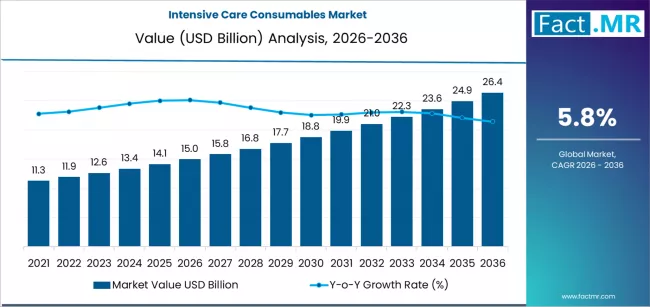
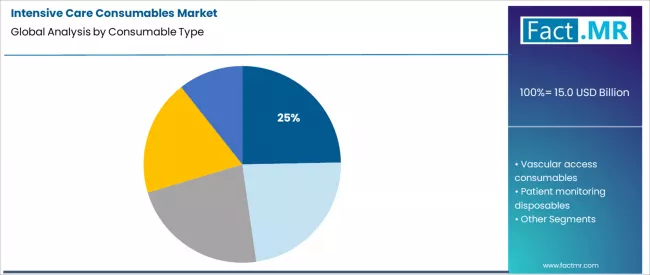
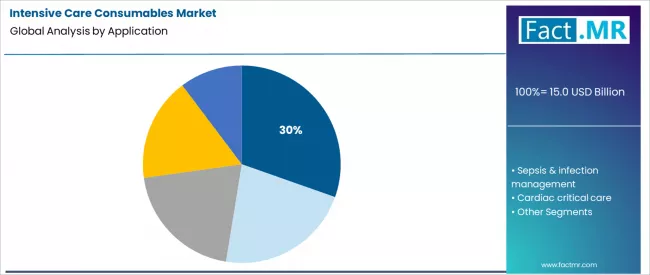
Intensive care consumables market is projected to grow from USD 15.0 billion in 2026 to USD 26.4 billion by 2036, at a CAGR of 5.8%. Respiratory consumables will dominate with a 24.7% market share, while critical respiratory care will lead the application segment with a 30.4% share.
Intensive Care Consumables Market Forecast and Outlook 2026 to 2036
The global intensive care consumables market is projected to total USD 14.97 billion in 2026, advancing to USD 26.39 billion by 2036, progressing at a 5.8% CAGR. This growth is fundamentally sustained by the inelastic demand for disposable medical products required for the continuous monitoring, life support, and infection prevention of critically ill patients.
Key Takeaways from the Intensive Care Consumables Market
- Market Value for 2026: USD 14.97 Billion
- Market Value for 2036: USD 26.39 Billion
- Forecast CAGR 2026 to 2036: 5.8%
- Leading Consumable Type Segment (2026): Respiratory Consumables (24.7%)
- Leading Application Segment (2026): Critical Respiratory Care (30.4%)
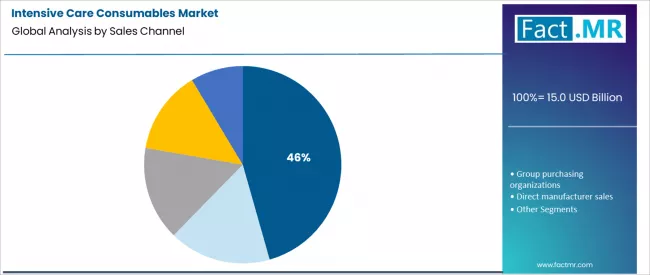
- Leading Sales Channel Segment (2026): Hospital Procurement (45.6%)
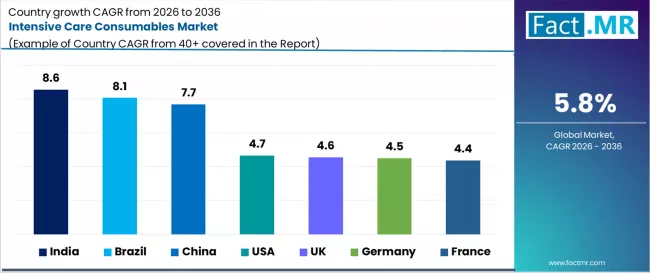
- Key Growth Countries: India (8.6% CAGR), Brazil (8.1% CAGR), China (7.7% CAGR), USA (4.7% CAGR), UK (4.6% CAGR), Germany (4.5% CAGR), France (4.4% CAGR)
- Key Players: Medtronic plc., Becton, Dickinson and Company (BD), Baxter International Inc., Fresenius Medical Care AG & Co. KGaA, Smiths Medical

The market is characterized by high-volume, recurring purchases of items ranging from respiratory tubing to vascular access catheters, with their usage dictated by patient acuity rather than economic cycles. Respiratory consumables lead the product segment, reflecting the critical and continuous need for ventilation and oxygenation support in ICUs. Hospital procurement channels dominate sales, consolidating immense purchasing power for these essential commodities.
While growth in mature markets remains steady, accelerated expansion in regions like India and Brazil is driven by the establishment of new critical care infrastructure and the rising incidence of conditions requiring intensive management, such as sepsis and complex post-operative recovery.
Intensive Care Consumables Market
| Metric | Value |
|---|---|
| Market Value (2026) | USD 14.97 Billion |
| Market Forecast Value (2036) | USD 26.39 Billion |
| Forecast CAGR 2026 to 2036 | 5.8% |
Category
| Category | Segments |
|---|---|
| Consumable Type | Respiratory Consumables, Vascular Access Consumables, Patient Monitoring Disposables, Infection Control Disposables, Nutrition & Feeding Consumables |
| Application | Critical Respiratory Care, Sepsis & Infection Management, Cardiac Critical Care, Neurological ICU Care, Post-Operative ICU Care |
| Sales Channel | Hospital Procurement, Group Purchasing Organizations, Direct Manufacturer Sales, Distributors, Emergency Stockpiles |
| Region | North America, Latin America, Western Europe, Eastern Europe, East Asia, South Asia & Pacific, Middle East & Africa |
How do Demographic and Operational Realities Shape ICU Supply Demand?
The persistent demographic shift toward an older global population directly increases the prevalence of chronic comorbidities that culminate in critical illness, ensuring a steady baseline demand for ICU resources and their associated disposables.
The growing challenge of antimicrobial resistance and hospital-acquired infections within ICUs mandates stringent, single-use protocols for a vast array of items, from protective gowns to invasive line kits, to break chains of transmission.
This operational reality transforms infection control disposables from optional safeguards into mandatory, volume-driven cost centers. Furthermore, the increasing clinical complexity of patients surviving into the ICU requires concurrent deployment of consumables for respiratory support, hemodynamic monitoring, vascular access, and specialized nutrition, multiplying the volume of products used per patient stay.
Segmental Analysis
By Consumable Type, Which Products are Ubiquitous in Life Support Delivery?

Respiratory consumables command a leading 24.7% share. This segment’s prominence is anchored in the universal requirement for oxygenation and ventilation support in critically ill patients. It encompasses a high-turnover range of items including ventilator circuits, endotracheal tubes, suction catheters, oxygen masks, and filters.
Their use is continuous for the duration of mechanical ventilation, and they are frequently changed to maintain hygiene and function, generating consistent, high-volume demand regardless of the specific underlying diagnosis.
By Application, Which Clinical Syndrome Demands the Broadest Array of Disposables?

Critical respiratory care constitutes the primary application segment at 30.4%. Conditions like acute respiratory distress syndrome, pneumonia, and post-operative respiratory failure not only drive the use of specialized respiratory consumables but also necessitate parallel disposables for vascular access for sedation and vasopressors, advanced monitoring, and infection control. The resource-intensive nature of managing severe respiratory failure makes it the most significant aggregator of consumable usage across multiple product categories.
By Sales Channel, Which Mechanism Leverages Scale for Essential Commodities?

Hospital procurement holds a decisive 45.6% share. Centralized hospital procurement departments, often guided by formulary committees, aggregate the massive purchasing power required for high-volume, low-margin disposable goods.
They negotiate directly with manufacturers or through Group Purchasing Organizations to secure favorable pricing and ensure reliable supply chains for these mission-critical items, making this channel the dominant conduit for market volume.
Attribute
| Attribute | Impact |
|---|---|
| Driver | The rising global burden of chronic diseases, traumatic injuries, and complex surgical interventions that increase patient admissions to intensive care units. |
| Restraint | Intense price pressure and cost-containment initiatives from hospital administrations and GPOs, which compress manufacturer margins on high-volume commodity items. |
| Opportunity | Development of smart consumables with embedded sensors for connectivity, enabling better inventory management, usage tracking, and integration with patient data systems. |
| Trend | Strategic diversification of supply chains and regional manufacturing for critical consumables to mitigate the risks exposed by global shortages during health emergencies. |
Analysis of the Intensive Care Consumables Market by Key Countries

| Country | CAGR 2026 to 2036 |
|---|---|
| USA | 4.7% |
| Germany | 4.5% |
| China | 7.7% |
| India | 8.6% |
| Brazil | 8.1% |
| France | 4.4% |
| UK | 4.6% |
How does the USA's Consolidated Healthcare Purchasing Model Influence the Market?
A 4.7% CAGR operates within a landscape dominated by large Group Purchasing Organizations and integrated health networks that exert significant downward pressure on pricing through volume contracts. Growth is driven by incremental increases in patient acuity and the expansion of ICU capacities, but market value growth is tempered by relentless cost-containment efforts, favoring manufacturers with the most efficient production and distribution scales.
What Drives Steady Demand in Germany's High-Acuity Care System?
Germany's 4.5% CAGR reflects a well-established, high-quality intensive care infrastructure with stringent standards for single-use devices to prevent nosocomial infections. Demand is consistent and quality-focused, with hospitals prioritizing product reliability and compliance. Growth is tied to demographic aging and technological upgrades in ICU equipment, which often require compatible proprietary consumables.
Which Factors Underpin China's Expansion in Critical Care Capacity?
The rapid scaling of tertiary hospital networks and the standardization of ICU protocols nationwide propel China’s 7.7% CAGR. The increase in the number of ICU beds and the rising capability to manage complex conditions domestically create substantial new demand for a full spectrum of consumables, from basic disposables to advanced monitoring accessories.
Why does India's Hospital Sector Development Catalyze High Growth?
India's leading 8.6% CAGR is directly linked to the construction of new private multi-specialty hospitals with advanced ICUs and the government's focus on strengthening critical care in public hospitals. This dual expansion creates a surge in first-time procurement and establishes ongoing high-volume consumption patterns for essential disposables.
How is Brazil's Focus on Reducing Healthcare Disparities Impacting Demand?
Brazil's 8.1% CAGR is connected to initiatives aimed at improving critical care access in underserved regions and urbanizing areas. The expansion and modernization of hospital ICUs, both public and private, to manage conditions like severe dengue, sepsis, and post-surgical care, generate growing volumes of consumable use, albeit within a cost-sensitive environment.
What Characterizes France's Centralized Procurement for Hospital Supplies?
France's 4.4% CAGR benefits from a highly centralized public hospital procurement system that standardizes consumable selection across regions. This model ensures consistent demand for contracted products and emphasizes value-based purchasing, balancing cost with quality and safety standards, leading to stable but price-competitive market growth.
How does the UK's NHS Procurement Strategy Shape Market Dynamics?
NHS Supply Chain frameworks that centralize purchasing for most disposable medical products guide the UK’s 4.6% CAGR. This creates a competitive tender environment where contracts are awarded based on a combination of price, sustainability credentials, and supply chain resilience, favoring large suppliers capable of meeting nationwide volume and delivery requirements.
Competitive Landscape of the Intensive Care Consumables Market
Large, diversified medical technology corporations dominate the competitive landscape with extensive portfolios spanning multiple consumable categories. These companies compete on the breadth of their offering, aiming to become single-source suppliers for hospital ICUs to streamline procurement and logistics.
Success is heavily dependent on securing long-term contracts with major GPOs and hospital networks, maintaining flawless quality and supply chain reliability, and continuously innovating to offer cost-effective products that meet evolving clinical protocols and infection control standards. Competition is intense on price, but differentiation is also achieved through product ergonomics, safety features such as needlestick prevention, and packaging that enhances clinician efficiency in high-stress environments.
Key Players in the Intensive Care Consumables Market
- Medtronic plc.
- Becton, Dickinson and Company (BD)
- Baxter International Inc.
- Fresenius Medical Care AG & Co. KGaA
- Smiths Medical
- Others
Scope of Report
| Items | Metrics |
|---|---|
| Quantitative Units | USD Billion |
| Consumable Type | Respiratory, Vascular Access, Monitoring Disposables, Infection Control, Nutrition & Feeding |
| Application | Respiratory Care, Sepsis Management, Cardiac Care, Neurological Care, Post-Operative Care |
| Sales Channel | Hospital Procurement, GPOs, Direct Sales, Distributors, Emergency Stockpiles |
| Key Countries | India, Brazil, China, USA, UK, Germany, France |
| Key Companies | Medtronic plc., Becton, Dickinson and Company (BD), Baxter International Inc., Fresenius Medical Care AG & Co. KGaA, Smiths Medical |
| Additional Analysis | Cost breakdown analysis of consumable usage per ICU patient day; impact of disposable versus reusable product debates on procurement; review of raw material price volatility (e.g., polymers) on manufacturing; analysis of just-in-time inventory models versus safety stockpiling in hospital supply chains. |
Market by Segments
-
Consumable Type :
- Respiratory Consumables
- Vascular Access Consumables
- Patient Monitoring Disposables
- Infection Control Disposables
- Nutrition & Feeding Consumables
-
Application :
- Critical Respiratory Care
- Sepsis & Infection Management
- Cardiac Critical Care
- Neurological ICU Care
- Post-Operative ICU Care
-
Sales Channel :
- Hospital Procurement
- Group Purchasing Organizations
- Direct Manufacturer Sales
- Distributors
- Emergency Stockpiles
-
Region :
-
North America
- USA
- Canada
-
Latin America
- Brazil
- Mexico
- Argentina
- Rest of Latin America
-
Western Europe
- Germany
- France
- UK
- Italy
- Spain
- BENELUX
- Rest of Western Europe
-
Eastern Europe
- Poland
- Russia
- Czech Republic
- Rest of Eastern Europe
-
East Asia
- China
- Japan
- South Korea
- Rest of East Asia
-
South Asia & Pacific
- India
- ASEAN
- Australia & New Zealand
- Rest of South Asia & Pacific
-
MEA
- GCC Countries
- South Africa
- Turkiye
- Rest of MEA
-
Bibliography
- Centers for Disease Control and Prevention (CDC). (2024). Guidelines for the Prevention of Healthcare-Associated Infections in Intensive Care Units.
- European Society of Intensive Care Medicine (ESICM). (2025). Core Standards for ICU Resources and Provision.
- Frost, S. A., & Alexandrou, E. (2023). Essential Equipment and Consumables for the Intensive Care Unit. In Management of the Critically Ill Patient. Springer.
- International Organization for Standardization (ISO). (2024). ISO 13485: Medical devices - Quality management systems.
- Society of Critical Care Medicine (SCCM). (2025). Guidelines for ICU Resource Allocation and Supply Chain Management.
- World Health Organization (WHO). (2024). Technical specifications for invasive and non-invasive medical devices for COVID-19: interim guidance.
Table of Content
- Executive Summary
- Global Market Outlook
- Demand to side Trends
- Supply to side Trends
- Technology Roadmap Analysis
- Analysis and Recommendations
- Market Overview
- Market Coverage / Taxonomy
- Market Definition / Scope / Limitations
- Market Background
- Market Dynamics
- Drivers
- Restraints
- Opportunity
- Trends
- Scenario Forecast
- Demand in Optimistic Scenario
- Demand in Likely Scenario
- Demand in Conservative Scenario
- Opportunity Map Analysis
- Product Life Cycle Analysis
- Supply Chain Analysis
- Investment Feasibility Matrix
- Value Chain Analysis
- PESTLE and Porter’s Analysis
- Regulatory Landscape
- Regional Parent Market Outlook
- Production and Consumption Statistics
- Import and Export Statistics
- Market Dynamics
- Global Market Analysis 2021 to 2025 and Forecast, 2026 to 2036
- Historical Market Size Value (USD Million) Analysis, 2021 to 2025
- Current and Future Market Size Value (USD Million) Projections, 2026 to 2036
- Y to o to Y Growth Trend Analysis
- Absolute $ Opportunity Analysis
- Global Market Pricing Analysis 2021 to 2025 and Forecast 2026 to 2036
- Global Market Analysis 2021 to 2025 and Forecast 2026 to 2036, By Consumable Type
- Introduction / Key Findings
- Historical Market Size Value (USD Million) Analysis By Consumable Type, 2021 to 2025
- Current and Future Market Size Value (USD Million) Analysis and Forecast By Consumable Type, 2026 to 2036
- Respiratory consumables
- Vascular access consumables
- Patient monitoring disposables
- Infection control disposables
- Nutrition & feeding consumables
- Respiratory consumables
- Y to o to Y Growth Trend Analysis By Consumable Type, 2021 to 2025
- Absolute $ Opportunity Analysis By Consumable Type, 2026 to 2036
- Global Market Analysis 2021 to 2025 and Forecast 2026 to 2036, By Application
- Introduction / Key Findings
- Historical Market Size Value (USD Million) Analysis By Application, 2021 to 2025
- Current and Future Market Size Value (USD Million) Analysis and Forecast By Application, 2026 to 2036
- Critical respiratory care
- Sepsis & infection management
- Cardiac critical care
- Neurological ICU care
- Post-operative ICU care
- Critical respiratory care
- Y to o to Y Growth Trend Analysis By Application, 2021 to 2025
- Absolute $ Opportunity Analysis By Application, 2026 to 2036
- Global Market Analysis 2021 to 2025 and Forecast 2026 to 2036, By Sales Channel
- Introduction / Key Findings
- Historical Market Size Value (USD Million) Analysis By Sales Channel, 2021 to 2025
- Current and Future Market Size Value (USD Million) Analysis and Forecast By Sales Channel, 2026 to 2036
- Hospital procurement
- Group purchasing organizations
- Direct manufacturer sales
- Distributors
- Emergency stockpiles
- Hospital procurement
- Y to o to Y Growth Trend Analysis By Sales Channel, 2021 to 2025
- Absolute $ Opportunity Analysis By Sales Channel, 2026 to 2036
- Global Market Analysis 2021 to 2025 and Forecast 2026 to 2036, By Region
- Introduction
- Historical Market Size Value (USD Million) Analysis By Region, 2021 to 2025
- Current Market Size Value (USD Million) Analysis and Forecast By Region, 2026 to 2036
- North America
- Latin America
- Western Europe
- Eastern Europe
- East Asia
- South Asia and Pacific
- Middle East & Africa
- Market Attractiveness Analysis By Region
- North America Market Analysis 2021 to 2025 and Forecast 2026 to 2036, By Country
- Historical Market Size Value (USD Million) Trend Analysis By Market Taxonomy, 2021 to 2025
- Market Size Value (USD Million) Forecast By Market Taxonomy, 2026 to 2036
- By Country
- USA
- Canada
- Mexico
- By Consumable Type
- By Application
- By Sales Channel
- By Country
- Market Attractiveness Analysis
- By Country
- By Consumable Type
- By Application
- By Sales Channel
- Key Takeaways
- Latin America Market Analysis 2021 to 2025 and Forecast 2026 to 2036, By Country
- Historical Market Size Value (USD Million) Trend Analysis By Market Taxonomy, 2021 to 2025
- Market Size Value (USD Million) Forecast By Market Taxonomy, 2026 to 2036
- By Country
- Brazil
- Chile
- Rest of Latin America
- By Consumable Type
- By Application
- By Sales Channel
- By Country
- Market Attractiveness Analysis
- By Country
- By Consumable Type
- By Application
- By Sales Channel
- Key Takeaways
- Western Europe Market Analysis 2021 to 2025 and Forecast 2026 to 2036, By Country
- Historical Market Size Value (USD Million) Trend Analysis By Market Taxonomy, 2021 to 2025
- Market Size Value (USD Million) Forecast By Market Taxonomy, 2026 to 2036
- By Country
- Germany
- UK
- Italy
- Spain
- France
- Nordic
- BENELUX
- Rest of Western Europe
- By Consumable Type
- By Application
- By Sales Channel
- By Country
- Market Attractiveness Analysis
- By Country
- By Consumable Type
- By Application
- By Sales Channel
- Key Takeaways
- Eastern Europe Market Analysis 2021 to 2025 and Forecast 2026 to 2036, By Country
- Historical Market Size Value (USD Million) Trend Analysis By Market Taxonomy, 2021 to 2025
- Market Size Value (USD Million) Forecast By Market Taxonomy, 2026 to 2036
- By Country
- Russia
- Poland
- Hungary
- Balkan & Baltic
- Rest of Eastern Europe
- By Consumable Type
- By Application
- By Sales Channel
- By Country
- Market Attractiveness Analysis
- By Country
- By Consumable Type
- By Application
- By Sales Channel
- Key Takeaways
- East Asia Market Analysis 2021 to 2025 and Forecast 2026 to 2036, By Country
- Historical Market Size Value (USD Million) Trend Analysis By Market Taxonomy, 2021 to 2025
- Market Size Value (USD Million) Forecast By Market Taxonomy, 2026 to 2036
- By Country
- China
- Japan
- South Korea
- By Consumable Type
- By Application
- By Sales Channel
- By Country
- Market Attractiveness Analysis
- By Country
- By Consumable Type
- By Application
- By Sales Channel
- Key Takeaways
- South Asia and Pacific Market Analysis 2021 to 2025 and Forecast 2026 to 2036, By Country
- Historical Market Size Value (USD Million) Trend Analysis By Market Taxonomy, 2021 to 2025
- Market Size Value (USD Million) Forecast By Market Taxonomy, 2026 to 2036
- By Country
- India
- ASEAN
- Australia & New Zealand
- Rest of South Asia and Pacific
- By Consumable Type
- By Application
- By Sales Channel
- By Country
- Market Attractiveness Analysis
- By Country
- By Consumable Type
- By Application
- By Sales Channel
- Key Takeaways
- Middle East & Africa Market Analysis 2021 to 2025 and Forecast 2026 to 2036, By Country
- Historical Market Size Value (USD Million) Trend Analysis By Market Taxonomy, 2021 to 2025
- Market Size Value (USD Million) Forecast By Market Taxonomy, 2026 to 2036
- By Country
- Kingdom of Saudi Arabia
- Other GCC Countries
- Turkiye
- South Africa
- Other African Union
- Rest of Middle East & Africa
- By Consumable Type
- By Application
- By Sales Channel
- By Country
- Market Attractiveness Analysis
- By Country
- By Consumable Type
- By Application
- By Sales Channel
- Key Takeaways
- Key Countries Market Analysis
- USA
- Pricing Analysis
- Market Share Analysis, 2025
- By Consumable Type
- By Application
- By Sales Channel
- Canada
- Pricing Analysis
- Market Share Analysis, 2025
- By Consumable Type
- By Application
- By Sales Channel
- Mexico
- Pricing Analysis
- Market Share Analysis, 2025
- By Consumable Type
- By Application
- By Sales Channel
- Brazil
- Pricing Analysis
- Market Share Analysis, 2025
- By Consumable Type
- By Application
- By Sales Channel
- Chile
- Pricing Analysis
- Market Share Analysis, 2025
- By Consumable Type
- By Application
- By Sales Channel
- Germany
- Pricing Analysis
- Market Share Analysis, 2025
- By Consumable Type
- By Application
- By Sales Channel
- UK
- Pricing Analysis
- Market Share Analysis, 2025
- By Consumable Type
- By Application
- By Sales Channel
- Italy
- Pricing Analysis
- Market Share Analysis, 2025
- By Consumable Type
- By Application
- By Sales Channel
- Spain
- Pricing Analysis
- Market Share Analysis, 2025
- By Consumable Type
- By Application
- By Sales Channel
- France
- Pricing Analysis
- Market Share Analysis, 2025
- By Consumable Type
- By Application
- By Sales Channel
- India
- Pricing Analysis
- Market Share Analysis, 2025
- By Consumable Type
- By Application
- By Sales Channel
- ASEAN
- Pricing Analysis
- Market Share Analysis, 2025
- By Consumable Type
- By Application
- By Sales Channel
- Australia & New Zealand
- Pricing Analysis
- Market Share Analysis, 2025
- By Consumable Type
- By Application
- By Sales Channel
- China
- Pricing Analysis
- Market Share Analysis, 2025
- By Consumable Type
- By Application
- By Sales Channel
- Japan
- Pricing Analysis
- Market Share Analysis, 2025
- By Consumable Type
- By Application
- By Sales Channel
- South Korea
- Pricing Analysis
- Market Share Analysis, 2025
- By Consumable Type
- By Application
- By Sales Channel
- Russia
- Pricing Analysis
- Market Share Analysis, 2025
- By Consumable Type
- By Application
- By Sales Channel
- Poland
- Pricing Analysis
- Market Share Analysis, 2025
- By Consumable Type
- By Application
- By Sales Channel
- Hungary
- Pricing Analysis
- Market Share Analysis, 2025
- By Consumable Type
- By Application
- By Sales Channel
- Kingdom of Saudi Arabia
- Pricing Analysis
- Market Share Analysis, 2025
- By Consumable Type
- By Application
- By Sales Channel
- Turkiye
- Pricing Analysis
- Market Share Analysis, 2025
- By Consumable Type
- By Application
- By Sales Channel
- South Africa
- Pricing Analysis
- Market Share Analysis, 2025
- By Consumable Type
- By Application
- By Sales Channel
- USA
- Market Structure Analysis
- Competition Dashboard
- Competition Benchmarking
- Market Share Analysis of Top Players
- By Regional
- By Consumable Type
- By Application
- By Sales Channel
- Competition Analysis
- Competition Deep Dive
- Medtronic plc.
- Overview
- Product Portfolio
- Profitability by Market Segments (Product/Age /Sales Channel/Region)
- Sales Footprint
- Strategy Overview
- Marketing Strategy
- Product Strategy
- Channel Strategy
- Becton, Dickinson and Company (BD)
- Baxter International Inc.
- Fresenius Medical Care AG & Co. KGaA
- Smiths Medical
- Others
- Medtronic plc.
- Competition Deep Dive
- Assumptions & Acronyms Used
- Research Methodology
List Of Table
- Table 1: Global Market Value (USD Million) Forecast by Region, 2021 to 2036
- Table 2: Global Market Value (USD Million) Forecast by Consumable Type, 2021 to 2036
- Table 3: Global Market Value (USD Million) Forecast by Application, 2021 to 2036
- Table 4: Global Market Value (USD Million) Forecast by Sales Channel, 2021 to 2036
- Table 5: North America Market Value (USD Million) Forecast by Country, 2021 to 2036
- Table 6: North America Market Value (USD Million) Forecast by Consumable Type, 2021 to 2036
- Table 7: North America Market Value (USD Million) Forecast by Application, 2021 to 2036
- Table 8: North America Market Value (USD Million) Forecast by Sales Channel, 2021 to 2036
- Table 9: Latin America Market Value (USD Million) Forecast by Country, 2021 to 2036
- Table 10: Latin America Market Value (USD Million) Forecast by Consumable Type, 2021 to 2036
- Table 11: Latin America Market Value (USD Million) Forecast by Application, 2021 to 2036
- Table 12: Latin America Market Value (USD Million) Forecast by Sales Channel, 2021 to 2036
- Table 13: Western Europe Market Value (USD Million) Forecast by Country, 2021 to 2036
- Table 14: Western Europe Market Value (USD Million) Forecast by Consumable Type, 2021 to 2036
- Table 15: Western Europe Market Value (USD Million) Forecast by Application, 2021 to 2036
- Table 16: Western Europe Market Value (USD Million) Forecast by Sales Channel, 2021 to 2036
- Table 17: Eastern Europe Market Value (USD Million) Forecast by Country, 2021 to 2036
- Table 18: Eastern Europe Market Value (USD Million) Forecast by Consumable Type, 2021 to 2036
- Table 19: Eastern Europe Market Value (USD Million) Forecast by Application, 2021 to 2036
- Table 20: Eastern Europe Market Value (USD Million) Forecast by Sales Channel, 2021 to 2036
- Table 21: East Asia Market Value (USD Million) Forecast by Country, 2021 to 2036
- Table 22: East Asia Market Value (USD Million) Forecast by Consumable Type, 2021 to 2036
- Table 23: East Asia Market Value (USD Million) Forecast by Application, 2021 to 2036
- Table 24: East Asia Market Value (USD Million) Forecast by Sales Channel, 2021 to 2036
- Table 25: South Asia and Pacific Market Value (USD Million) Forecast by Country, 2021 to 2036
- Table 26: South Asia and Pacific Market Value (USD Million) Forecast by Consumable Type, 2021 to 2036
- Table 27: South Asia and Pacific Market Value (USD Million) Forecast by Application, 2021 to 2036
- Table 28: South Asia and Pacific Market Value (USD Million) Forecast by Sales Channel, 2021 to 2036
- Table 29: Middle East & Africa Market Value (USD Million) Forecast by Country, 2021 to 2036
- Table 30: Middle East & Africa Market Value (USD Million) Forecast by Consumable Type, 2021 to 2036
- Table 31: Middle East & Africa Market Value (USD Million) Forecast by Application, 2021 to 2036
- Table 32: Middle East & Africa Market Value (USD Million) Forecast by Sales Channel, 2021 to 2036
List Of Figures
- Figure 1: Global Market Pricing Analysis
- Figure 2: Global Market Value (USD Million) Forecast 2021 to 2036
- Figure 3: Global Market Value Share and BPS Analysis by Consumable Type, 2026 and 2036
- Figure 4: Global Market Y to o to Y Growth Comparison by Consumable Type, 2026 to 2036
- Figure 5: Global Market Attractiveness Analysis by Consumable Type
- Figure 6: Global Market Value Share and BPS Analysis by Application, 2026 and 2036
- Figure 7: Global Market Y to o to Y Growth Comparison by Application, 2026 to 2036
- Figure 8: Global Market Attractiveness Analysis by Application
- Figure 9: Global Market Value Share and BPS Analysis by Sales Channel, 2026 and 2036
- Figure 10: Global Market Y to o to Y Growth Comparison by Sales Channel, 2026 to 2036
- Figure 11: Global Market Attractiveness Analysis by Sales Channel
- Figure 12: Global Market Value (USD Million) Share and BPS Analysis by Region, 2026 and 2036
- Figure 13: Global Market Y to o to Y Growth Comparison by Region, 2026 to 2036
- Figure 14: Global Market Attractiveness Analysis by Region
- Figure 15: North America Market Incremental Dollar Opportunity, 2026 to 2036
- Figure 16: Latin America Market Incremental Dollar Opportunity, 2026 to 2036
- Figure 17: Western Europe Market Incremental Dollar Opportunity, 2026 to 2036
- Figure 18: Eastern Europe Market Incremental Dollar Opportunity, 2026 to 2036
- Figure 19: East Asia Market Incremental Dollar Opportunity, 2026 to 2036
- Figure 20: South Asia and Pacific Market Incremental Dollar Opportunity, 2026 to 2036
- Figure 21: Middle East & Africa Market Incremental Dollar Opportunity, 2026 to 2036
- Figure 22: North America Market Value Share and BPS Analysis by Country, 2026 and 2036
- Figure 23: North America Market Value Share and BPS Analysis by Consumable Type, 2026 and 2036
- Figure 24: North America Market Y to o to Y Growth Comparison by Consumable Type, 2026 to 2036
- Figure 25: North America Market Attractiveness Analysis by Consumable Type
- Figure 26: North America Market Value Share and BPS Analysis by Application, 2026 and 2036
- Figure 27: North America Market Y to o to Y Growth Comparison by Application, 2026 to 2036
- Figure 28: North America Market Attractiveness Analysis by Application
- Figure 29: North America Market Value Share and BPS Analysis by Sales Channel, 2026 and 2036
- Figure 30: North America Market Y to o to Y Growth Comparison by Sales Channel, 2026 to 2036
- Figure 31: North America Market Attractiveness Analysis by Sales Channel
- Figure 32: Latin America Market Value Share and BPS Analysis by Country, 2026 and 2036
- Figure 33: Latin America Market Value Share and BPS Analysis by Consumable Type, 2026 and 2036
- Figure 34: Latin America Market Y to o to Y Growth Comparison by Consumable Type, 2026 to 2036
- Figure 35: Latin America Market Attractiveness Analysis by Consumable Type
- Figure 36: Latin America Market Value Share and BPS Analysis by Application, 2026 and 2036
- Figure 37: Latin America Market Y to o to Y Growth Comparison by Application, 2026 to 2036
- Figure 38: Latin America Market Attractiveness Analysis by Application
- Figure 39: Latin America Market Value Share and BPS Analysis by Sales Channel, 2026 and 2036
- Figure 40: Latin America Market Y to o to Y Growth Comparison by Sales Channel, 2026 to 2036
- Figure 41: Latin America Market Attractiveness Analysis by Sales Channel
- Figure 42: Western Europe Market Value Share and BPS Analysis by Country, 2026 and 2036
- Figure 43: Western Europe Market Value Share and BPS Analysis by Consumable Type, 2026 and 2036
- Figure 44: Western Europe Market Y to o to Y Growth Comparison by Consumable Type, 2026 to 2036
- Figure 45: Western Europe Market Attractiveness Analysis by Consumable Type
- Figure 46: Western Europe Market Value Share and BPS Analysis by Application, 2026 and 2036
- Figure 47: Western Europe Market Y to o to Y Growth Comparison by Application, 2026 to 2036
- Figure 48: Western Europe Market Attractiveness Analysis by Application
- Figure 49: Western Europe Market Value Share and BPS Analysis by Sales Channel, 2026 and 2036
- Figure 50: Western Europe Market Y to o to Y Growth Comparison by Sales Channel, 2026 to 2036
- Figure 51: Western Europe Market Attractiveness Analysis by Sales Channel
- Figure 52: Eastern Europe Market Value Share and BPS Analysis by Country, 2026 and 2036
- Figure 53: Eastern Europe Market Value Share and BPS Analysis by Consumable Type, 2026 and 2036
- Figure 54: Eastern Europe Market Y to o to Y Growth Comparison by Consumable Type, 2026 to 2036
- Figure 55: Eastern Europe Market Attractiveness Analysis by Consumable Type
- Figure 56: Eastern Europe Market Value Share and BPS Analysis by Application, 2026 and 2036
- Figure 57: Eastern Europe Market Y to o to Y Growth Comparison by Application, 2026 to 2036
- Figure 58: Eastern Europe Market Attractiveness Analysis by Application
- Figure 59: Eastern Europe Market Value Share and BPS Analysis by Sales Channel, 2026 and 2036
- Figure 60: Eastern Europe Market Y to o to Y Growth Comparison by Sales Channel, 2026 to 2036
- Figure 61: Eastern Europe Market Attractiveness Analysis by Sales Channel
- Figure 62: East Asia Market Value Share and BPS Analysis by Country, 2026 and 2036
- Figure 63: East Asia Market Value Share and BPS Analysis by Consumable Type, 2026 and 2036
- Figure 64: East Asia Market Y to o to Y Growth Comparison by Consumable Type, 2026 to 2036
- Figure 65: East Asia Market Attractiveness Analysis by Consumable Type
- Figure 66: East Asia Market Value Share and BPS Analysis by Application, 2026 and 2036
- Figure 67: East Asia Market Y to o to Y Growth Comparison by Application, 2026 to 2036
- Figure 68: East Asia Market Attractiveness Analysis by Application
- Figure 69: East Asia Market Value Share and BPS Analysis by Sales Channel, 2026 and 2036
- Figure 70: East Asia Market Y to o to Y Growth Comparison by Sales Channel, 2026 to 2036
- Figure 71: East Asia Market Attractiveness Analysis by Sales Channel
- Figure 72: South Asia and Pacific Market Value Share and BPS Analysis by Country, 2026 and 2036
- Figure 73: South Asia and Pacific Market Value Share and BPS Analysis by Consumable Type, 2026 and 2036
- Figure 74: South Asia and Pacific Market Y to o to Y Growth Comparison by Consumable Type, 2026 to 2036
- Figure 75: South Asia and Pacific Market Attractiveness Analysis by Consumable Type
- Figure 76: South Asia and Pacific Market Value Share and BPS Analysis by Application, 2026 and 2036
- Figure 77: South Asia and Pacific Market Y to o to Y Growth Comparison by Application, 2026 to 2036
- Figure 78: South Asia and Pacific Market Attractiveness Analysis by Application
- Figure 79: South Asia and Pacific Market Value Share and BPS Analysis by Sales Channel, 2026 and 2036
- Figure 80: South Asia and Pacific Market Y to o to Y Growth Comparison by Sales Channel, 2026 to 2036
- Figure 81: South Asia and Pacific Market Attractiveness Analysis by Sales Channel
- Figure 82: Middle East & Africa Market Value Share and BPS Analysis by Country, 2026 and 2036
- Figure 83: Middle East & Africa Market Value Share and BPS Analysis by Consumable Type, 2026 and 2036
- Figure 84: Middle East & Africa Market Y to o to Y Growth Comparison by Consumable Type, 2026 to 2036
- Figure 85: Middle East & Africa Market Attractiveness Analysis by Consumable Type
- Figure 86: Middle East & Africa Market Value Share and BPS Analysis by Application, 2026 and 2036
- Figure 87: Middle East & Africa Market Y to o to Y Growth Comparison by Application, 2026 to 2036
- Figure 88: Middle East & Africa Market Attractiveness Analysis by Application
- Figure 89: Middle East & Africa Market Value Share and BPS Analysis by Sales Channel, 2026 and 2036
- Figure 90: Middle East & Africa Market Y to o to Y Growth Comparison by Sales Channel, 2026 to 2036
- Figure 91: Middle East & Africa Market Attractiveness Analysis by Sales Channel
- Figure 92: Global Market - Tier Structure Analysis
- Figure 93: Global Market - Company Share Analysis
- FAQs -
How big is the intensive care consumables market in 2026?
The global intensive care consumables market is estimated to be valued at USD 15.0 billion in 2026.
What will be the size of intensive care consumables market in 2036?
The market size for the intensive care consumables market is projected to reach USD 26.4 billion by 2036.
How much will be the intensive care consumables market growth between 2026 and 2036?
The intensive care consumables market is expected to grow at a 5.8% CAGR between 2026 and 2036.
What are the key product types in the intensive care consumables market?
The key product types in intensive care consumables market are respiratory consumables, vascular access consumables, patient monitoring disposables, infection control disposables and nutrition & feeding consumables.
Which application segment to contribute significant share in the intensive care consumables market in 2026?
In terms of application, critical respiratory care segment to command 30.4% share in the intensive care consumables market in 2026.