- Base Value(2025): 3544 Mn
- Forecast Value (2035): 11715 Mn
- CAGR (2035): 17.4%
Skincare Diagnostics Market Outlook (2025 to 2035)
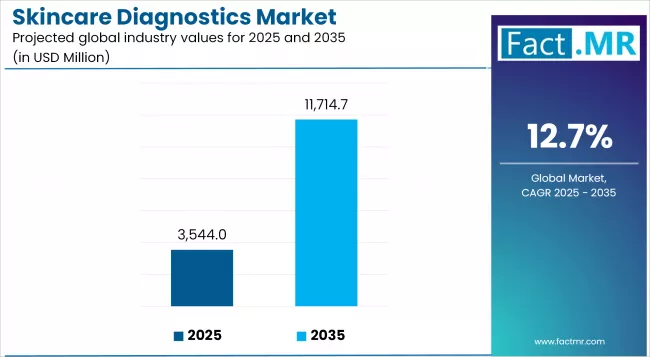
The global skincare diagnostics market is expected to reach USD 11,715 million by 2035, up from USD 3,544 million in 2025. During the forecast period (2025 to 2035), the industry is projected to expand at a CAGR of 12.7%.
The skincare diagnostics market is essential for precision skin health solutions, driven by rising chronic condition prevalence, fueled by consumer demand for personalized skin wellness, digital health integration, and teledermatology adoption. The convergence of AI imaging, biomarker assessment, and sensor platforms fuels commercial use in clinics, spas, telehealth services, and personalized treatment protocols.
Skincare Diagnostics Market | Source: Fact.MR
Quick Stats for Skincare Diagnostics Market
- Industry Value (2025): USD 3,544 Million
- Projected Value (2035): USD 11,715 Million
- Forecast CAGR (2025 to 2035): 12.7%
- Leading Segment (2025): Imaging & Device-Based Diagnostics (32.1% Market Share)
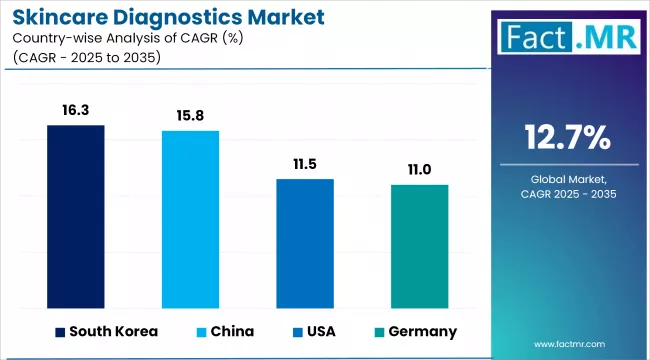
- Fastest Growing Country (2025-2035): S. Korea (16.3% CAGR)
- Top Key Players: Canfield Scientific, Inc., FotoFinder Systems GmbH, Courage + Khazaka Electronic GmbH, and Cortex Technology ApS
What are the drivers of the skincare diagnostics market?
Skincare diagnostics market driven by technological convergence, advanced AI driven imaging, biomarker interpretation, and sensor fusion to create unsurpassed diagnostic accuracy and personalization.
This solution equips clinicians and consumers with actionable skin health insights, enabling more accurate decisions, minimizing subjective assessment, and significantly improving efficiency in treatment planning. Designed delivery of high-fidelity analysis within seconds is being positioned to drive new commercial models within digital health and aesthetic care.
Patients and consumers show growing interest in early detection and preventative skin care, sparking adoption of modalities focused on assessments of acne, pigmentation, cancer, and aging. Teledermatology portals can extend market impact and access but also ramp up the desire to find portable or hybrid diagnostic devices or software with embedded AI analytics capable of scaling up remote monitoring and engagement.
Ecosystem growth through strategic alliances involving more dermatology practices, technology developers, and wellness brands. Investments in R&D on genomic or biomarker-powered tools further diversify and provide integration with the preventive healthcare infrastructure. Collaborative partnerships extend geographical market penetration and use cases through the joint effort of clinical credibility, data analytics advantage, and distribution volume.
What are the regional trends of the skincare diagnostics market?
North America is at the top of the market in skincare diagnostics because of a well-established technology development ecosystem, the presence of dermatology clinics, and favorable reimbursement systems. The regional dominance is based on high investment in AI-based skin assessment tools and regulatory support to telehealth models.
High adoption can be noted in Europe because of the presence of proactive regulatory frameworks and the high capabilities of clinical research. Such countries as Germany and France are powering the innovation in the field of genomic and biomarker diagnostics as applied in dermatology.
The Asia Pacific is fast becoming a high growth market due to the increase in consumer spending on skincare, increase in awareness on prevention health as well as fast penetration of digital health. Nations such as South Korea or Japan are at the forefront of hybrid and at-home diagnostic-model development, which is aided privately and by government efforts.
What are the challenges and restraining factors of the skincare diagnostics market?
One of the ongoing concerns in skincare diagnostics market is data privacy and adherence to health data regulations. Safety on how digital platforms connect to diagnostic tools is crucial in ensuring consumer trust and privacy requirement all around the world.
The cost of implementation is high and supply of dermatology professionals is limited limiting the adoption in large markets such as developing markets. This restricts innovative solutions of the advanced diagnosis to the customers with high income including specialized clinics.
Issues related to scalability including technical constraints where the accuracy of AI powered tools is not consistent and there exists no interoperability between platforms are faced. It has these concerns that slow down the rate of commercialization and the total mainstreaming of the industry.
Country-Wise Insights
Skincare Diagnostics Market Analysis By Country | Source: Fact.MR
Germany is Leading Clinical Research in Skin Diagnostics
Germany holds a strong foothold in the European diagnostics skincare market, with advanced clinical networks/infrastructure and regulatory, compliance experience. The country is also strong in the development of genomic, and biomarker driven diagnostic platforms with targeted focus on dermatologic applications.
Advanced in-clinic diagnostic solutions are adopted by high consumer preference to receive a premium level of services in dermatology and the high levels of insurance. The healthcare Ecosystem of Germany promotes the early application of the latest technological advances in both hospitals and dedicated clinics.
The export capability of the country is in precision imaging devices, sensor-based diagnostic equipment and clinical-grade AIs. Cooperation with European research institutes and international medtech companies consolidate the position of Germany as a skincare diagnostics leader producer and exporter.
South Korea is Setting Trends in At-Home Skincare Diagnostics
South Korea is a fast-growing participant in skincare diagnostics owing to its cosmetic innovation and consumer- inspired health technology leadership. The nation has led in developing hybrid and tele-diagnostic systems that connect AI and sensor-based devices with personalised skincare.
The beauty-conscious consumers with precision solution powering the domestic demand are interested in anti-aging, pigmentation and acne treatment. Luring dermatologists, local tech firms are partnering to provide pocket-friendly and easy to understand diagnostic systems.
Export Power South Korea has a good export potential, and its AI-cosmetics apps and portable diagnosis devices are in demand around the globe. The government encouragement to continue the development of digital health innovation allows South Korea to achieve the status of an international leader in the area of consumer-oriented skincare diagnosis.
The United States is Driving AI-Integrated Skincare Diagnostics
US Skincare Diagnostics Market Analysis By Value 2025 To 2035 | Source: Fact.MR
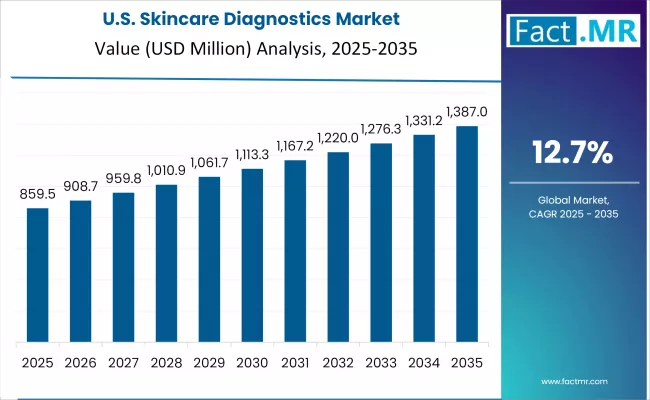
The US is the biggest base of technological advancement in skincare disease diagnosis and companies are on the forefront in developing AI-based imaging detection systems and biomarker detection platforms. High investment in research and development has positioned the country as a key driver of global market transformation.
With demand for high-quality dermatological care rising domestically, and the massive uptake of telehealth, there has been the commercialization of the AI-powered at-home diagnostic products. Wearable technologies have also broadened the scope of consumers through the combined use of the diagnostic tools.
Export orientation is notable, as the US companies provide AI platforms, imaging devices, and diagnostic software to other countries of the world. The strategic partnership that the country has with dermatology clinics, digital health providers, and technology giants, among others, have been giving the country an edge to remain competitive and enhance its innovation in the long run.
Category-Wise Analysis
AI-Powered and Software-Based Diagnostic Tools are Transforming Precision Dermatology
Skincare Diagnostics Market By Diagnostic Modality | Source: Fact.MR
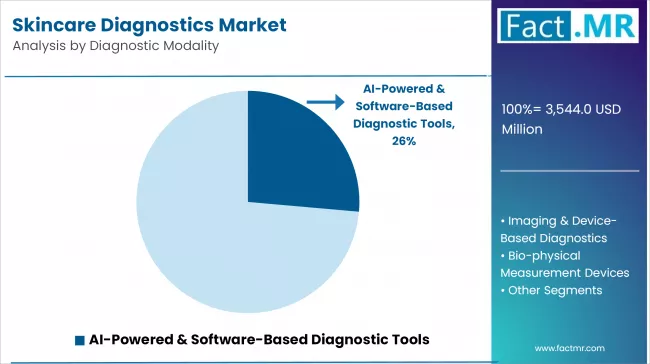
AI-based test tools are most powerful in the market as they can provide real-time and precise evaluations of skin conditions. Their combination with apps on phones and telehealth practices have transformed accessibility, where they make it possible to conduct consultations and diagnose skin diseases in advance.
The promising growth profile of the segment is supplemented with the consumer interest in customized applicable skincare and preventive care. More advanced algorithms with the involvement of predictive analytics and image recognition came to the forefront and enhanced the efficiency of diagnoses. The further growth is going to be provoked by the convergence between the AI methodologies and genomic data and connected devices that will make diagnostics more inclusive and customer centric.
Imaging and Device-Based Diagnostics are Redefining Clinical Accuracy
Imaging-based diagnostic devices maintain a strong position in dermatology clinics, where such a machine provides high quality images to analyse skin lesions, pigmentation changes and structural disorders. Such tools help a dermatologist evaluate comprehensi vely with increased precision.
This segment will continue increasing with the rise in the use of digital imaging alongside the use of AI to provide a solution to the automated interpretation. Developments in multispectral imaging and portable diagnostics solutions are contributing to an augmented role in clinical and hybrid models, thus promising to retain the use of multispectral imaging as a milestone of the skincare diagnostics space.
Competitive Analysis
Key players in the skincare diagnostics market including Canfield Scientific, Inc., FotoFinder Systems GmbH, Courage + Khazaka Electronic GmbH, Cortex Technology ApS, allegari Srl, BOMTECH Electronics Co., Ltd., GSD GmbH, Aram Huvis Co., Ltd., AESKU.GROUP, and Meicet Technology Co., Ltd.
Skincare diagnostics is a fierce market, and players have differentiated themselves in relation to technological innovations, platform integrations and optimizing user experience. The main swaying factors in the procurement of equipment are AI capabilities, unhindered telehealth connectivity, and compliance with regulations.
The number of competitors is on the rise, doing diagnostics and portable devices using AI. Companies are also investing heavily into research and development, making strategic alliances with dermatological clinics, and diversifying digital distribution outlets. This arms race, the impact of pricing, and the competition in interoperability, creates the competitive environment.
Recent Development
- In March 2025, MEICET introduced its Pro-A Skin Analyzer and 3D Skin Analyzer D9 to a captivated European audience. The Pro-A featured high-resolution imaging combined with AI-driven skin condition detection, while the D9 provided detailed 3D imaging that revealed sun damage and subsurface issues through UV-enhanced diagnostics. Both devices received widespread acclaim, highlighting MEICET's growing influence in global diagnostic innovation.
Fact.MR has provided detailed information about the price points of key manufacturers of Skincare Diagnostics Market positioned across regions, sales growth, production capacity, and speculative technological expansion, in the recently published report.
Methodology and Industry Tracking Approach
The 2025 skincare diagnostics market report by Fact.MR is based on insights gathered from 1,200 stakeholders across 12 countries, maintaining a minimum of 75 respondents per country. Among these participants, 65% represented end users such as direct-to-consumer service providers, dermatology practitioners, digital health startups, and diagnostic laboratories, while the remaining 35% included procurement leads, clinical research heads, regulatory consultants, and telehealth platform integrators.
Data collection occurred between June 2024 and May 2025, emphasizing parameters such as diagnostic accuracy, processing time, AI-driven personalization, compliance with global privacy regulations, and interoperability within preventive care ecosystems. A balanced regional calibration model ensured accurate representation across North America, Europe, and Asia Pacific.
The analysis incorporates over 95 validated references including clinical studies, market investment reports, dermatology research papers, product specifications, and regulatory filings. All sources underwent rigorous triangulation to provide actionable intelligence and credible market estimations for stakeholders across the value chain.
Fact.MR applied rigorous analytical tools such as multi-variable regression and scenario modeling to ensure data robustness. With continuous monitoring of the glass adhesives space since 2018, this report offers a comprehensive roadmap for firms seeking competitive advantage, innovation, and sustainable growth within the sector.
Segmentation
Segmentation of Skincare Diagnostics Market
-
By Diagnostic Modality :
- AI-Powered & Software-Based Diagnostic Tools
- Imaging & Device-Based Diagnostics
- Bio-physical Measurement Devices
- Genomic & Biomarker Diagnostics
- Traditional & In-Person Consultation
-
By Technology :
- Digital Imaging & Analysis
- Artificial Intelligence & Machine Learning
- Biometric & Sensor-Based Tools
-
By Application :
- Skin Condition Diagnosis (e.g., acne, eczema, psoriasis)
- Skin Cancer & Lesion Detection
- Anti-Aging & Wrinkle Assessment
- Pigmentation & Tone Analysis
-
By Deployment Model :
- In-Clinic Diagnostics
- At-Home Diagnostics
- Hybrid / Remote Tele-Diagnostics
-
By End-User :
- Dermatology Clinics & Hospitals
- Medspas & Aesthetic Centers
- Home Users / Consumers
- Pharmaceutical & Skincare Companies (R&D)
-
By Region :
- North America
- Latin America
- Western Europe
- Eastern Europe
- East Asia
- South Asia & Pacific
- Middle East & Africa
Frequently Asked Questions
What was the Global Skincare Diagnostics Market Size Reported by Fact.MR for 2025?
Who are the Major Players Operating in the Skincare Diagnostics Market?
What is the Estimated Valuation of the Skincare Diagnostics Market in 2035?
What Value CAGR did the Skincare Diagnostics Market Exhibit Over the Last Five Years?
Who worked on this report


Preview the report firsthand - request a free sample
Free SampleGet the brochure for pricing and purchase details
Download PDF