Kitchen Vent Hood and Duct Cleaning Chemicals Market (2026 - 2036)

Kitchen Vent Hood and Duct Cleaning Chemicals Market Size and Share Forecast Outlook 2026 to 2036

Core Findings

    Kitchen Vent Hood and Duct Cleaning Chemicals Market Forecast and Outlook 2026 to 2036

    The kitchen vent hood and duct cleaning chemicals market is expected to be valued at USD 778.6 million in 2026 and is projected to reach USD 1,503.2 million by 2036, growing at a 6.8% CAGR.

    Kitchen Vent Hood and Duct Cleaning Chemicals Market Key Takeaways

    • Market Value in 2026: USD 778.6 million
    • Market Forecast Value in 2036: USD 1,503.2 million
    • Market Forecast CAGR 2026 to 2036: 6.8%
    • Dominant Product Type: Heavy-Duty Degreasers (49.0% share)
    • Leading Application Method: Manual Spray & Brush (33.0% share)
    • Key Market Players: Ecolab, Diversey, Zep, Spartan Chemical, Betco, Clorox, SC Johnson Professional, Reckitt, Solenis.
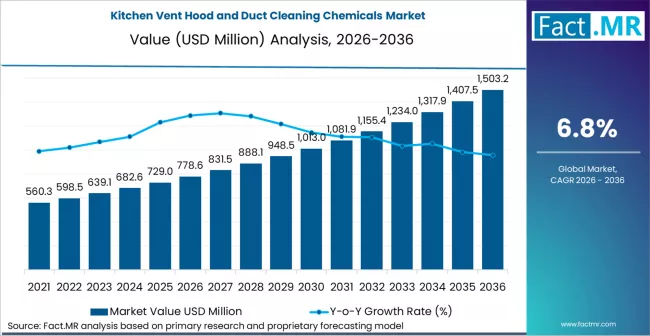
    Kitchen Vent Hood And Duct Cleaning Chemicals Market Market Value Analysis

    This market is witnessing a shift from “manual scrubbing” to “self-cleaning ecosystems” and “non-caustic bio-chemistry,” driven by increased fire-related liability concerns and updates to NFPA 96 fire safety standards. Strategic milestones from leading players emphasize automation and safety.

    Solenis/Diversey launched the Suma® D-GREAZEE D9.9, a caustic-free, aluminum-safe degreaser, reducing cleaning time and eliminating the need for PPE, targeting the QSR sector's demand for more frequent, safer cleaning. Ecolab integrated GreaseLift into robotic cleaning systems, progressing toward "lights-out cleaning" for commercial kitchens. The market is now characterized by smarter, safer cleaning systems that not only meet new regulatory requirements but also provide real-time grease monitoring and automatic cleaning without manual intervention. The industry is moving toward intelligent, preventive cleaning solutions, reducing both labor costs and fire risks in commercial kitchens.

    Kitchen Vent Hood and Duct Cleaning Chemicals Market

    Metric Value
    Estimated Value in (2026E) USD 778.6 million
    Forecast Value in (2036F) USD 1,503.2 million
    Forecast CAGR (2026 to 2036) 6.8%

    Category

    Category Segments
    Product Type Heavy-Duty Degreasers; Foaming Duct Cleaners; Enzymatic / Bio-Based Grease Treatments; Rinse Aids & Specialty
    Application Method Manual Spray & Brush; Foam Cannon Systems; Soak / Immersion; Other Methods
    End-Use Segment Restaurants & QSR Chains; Institutional Kitchens; Food Processing Facilities; Other Commercial Kitchens
    Compliance Need Fire Code / Grease Compliance Programs; Routine Maintenance Cleaning; Deep-Clean / Remediation
    Region North America; Europe; Asia Pacific; Latin America; Middle East & Africa

    Segmental Analysis

    What Is the Impact of Product Type on the Kitchen Vent Hood and Duct Cleaning Chemicals Market?
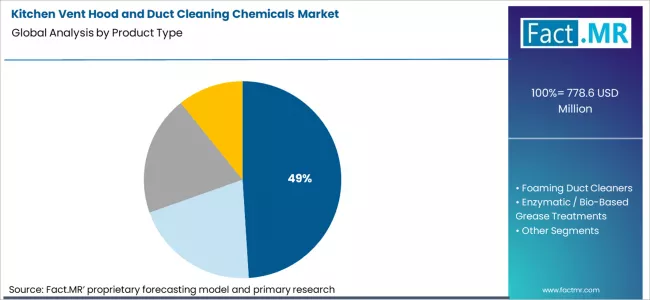
    Kitchen Vent Hood And Duct Cleaning Chemicals Market Analysis By Product Type

    In the kitchen vent hood and duct cleaning chemicals market, product type directly affects cleaning efficiency, material compatibility, and time requirements. Heavy-duty degreasers lead with a 49.0% share, as they are specifically formulated to break down stubborn grease, oils, and food residues that accumulate in commercial kitchen vents and ducts. Their strong performance in cutting through tough grease and their ability to work in high-fat environments make them the go-to solution for industrial kitchens, food processing plants, and commercial restaurants. As regulations on cleanliness and fire safety become stricter, the demand for heavy-duty degreasers remains high, driven by their efficacy in preventing grease buildup that can lead to fire hazards and maintenance issues.

    How Does Application Method Influence Demand in the Kitchen Vent Hood and Duct Cleaning Chemicals Market?
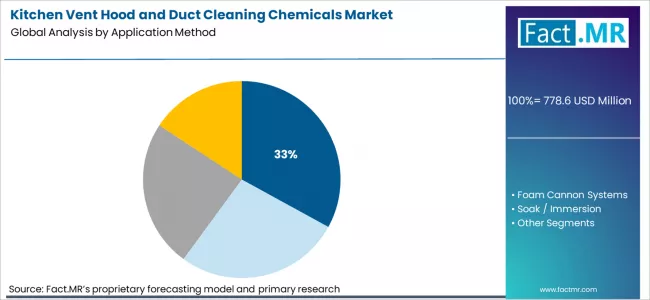
    Kitchen Vent Hood And Duct Cleaning Chemicals Market Analysis By Application Method

    The application method plays a significant role in determining the speed, ease, and effectiveness of cleaning processes. Manual spray and brush methods dominate with a 33.0% share, driven by their flexibility and suitability for kitchens with varying sizes and equipment configurations. This method allows for targeted application and thorough cleaning in specific areas where grease accumulation is the heaviest, such as in cornered ducts or complex vent systems. Despite being labor-intensive, manual spray and brush methods are still preferred due to their low upfront cost, ease of use, and the customization they offer for different cleaning needs.

    What are the Drivers, Restraints, and Key Trends in the Kitchen Vent Hood and Duct Cleaning Chemicals Market?

    Country Driver Restraint Trend
    USA Strict fire and health safety standards in commercial kitchens. Higher cost of specialty cleaning chemicals vs generic alternatives. Rising adoption of enzyme based and eco friendly hood cleaners.
    UK Strong regulatory focus on food safety and kitchen hygiene compliance. Budget pressure in small hospitality businesses. Growth in pre measured, ready to use cleaning solutions.
    Germany High standards for industrial kitchen maintenance and emissions control. Stringent chemical compliance and workplace safety requirements. Increased use of automated dosing and advanced surfactant chemistries.
    China Rapid expansion of foodservice and hotel sectors needing professional cleaning. Variability in enforcement of commercial kitchen hygiene practices. Growth in locally produced, cost competitive cleaning formulations.
    India Rising foodservice industry and chain restaurant expansion. Limited awareness and training on specialized hood and duct cleaning. Shift toward professional service contracts with specialized chemicals.

    Analysis of the Kitchen Vent Hood and Duct Cleaning Chemicals Market by Key Country
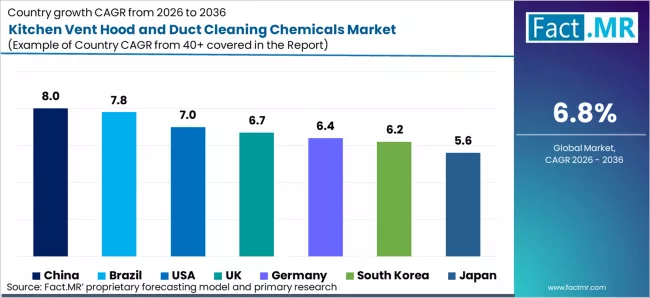
    Kitchen Vent Hood And Duct Cleaning Chemicals Market Cagr Analysis By Country

    Country CAGR (%)
    China 8.0%
    Brazil 7.8%
    USA 7.0%
    UK 6.7%
    Germany 6.4%
    South Korea 6.2%
    Japan 5.6%

    The report covers an in-depth analysis of 40+ countries; top-performing countries are highlighted below.

    What drives growth in China for kitchen vent hood and duct cleaning chemicals?

    China’s market is projected to grow at 8.0% CAGR, propelled by rapid expansion of the food service sector, increased urban dining activity, and heightened enforcement of sanitation and fire prevention regulations. In major cities, environmental health authorities and fire departments increasingly require regular deep cleaning of kitchen exhaust systems to reduce fire hazards and control odor and particulate accumulation. Domestic and international restaurant brands operating in China specify advanced degreasing and surfactant enhanced formulations designed to break down high viscosity grease at scale.

    “As commercial kitchen volume increases, operators demand efficient chemistries that accelerate grease removal and support compliance with evolving sanitation and fire safety codes,” explains Li Wei, Product Director at a Chinese specialty cleaning chemicals firm.

    This regulatory and operational demand drives adoption of stronger, safer cleaning products tailored for heavy use hood and duct systems.

    What fuels the rapid rise in Brazil?

    Brazil’s kitchen vent hood and duct cleaning chemicals market is forecast to grow at 7.8% CAGR, driven by a combination of a booming restaurant industry and increasing regulatory compliance expectations in major urban centers such as São Paulo and Rio de Janeiro. Local fire prevention codes and sanitation inspections emphasize removal of grease deposits to prevent fire hazards and maintain performance of ventilation systems. Operators of churrascarias, buffet operations, and busy multi concept kitchens require effective, fast acting degreasers capable of handling complex grease matrices.

    “In high usage kitchens, regular cleaning with specialty chemicals is indispensable to meet fire codes and maintain air flow efficiency,” notes Marcos Silva, Director of Operations at a Brazilian food service group.

    The broader hospitality sector’s growth supports a rising installed base of cleaning chemical protocols.

    How is the USA Market Evolving in the Kitchen Vent Hood and Duct Cleaning Chemicals Market?

    The USA market is forecast to grow at 7.0%, reflecting steady investment by commercial kitchens and institutional food service operations in products that improve grease removal efficacy while meeting safety and compliance requirements. Demand is driven by stringent fire codes and health regulations enforced by local authorities having jurisdiction (AHJs) and by the National Fire Protection Association (NFPA) standards, particularly NFPA 96, which requires regular removal of grease deposits that can compromise ventilation performance and increase fire risk. According to the Food Service Technology Center, kitchen ventilation systems that are regularly cleaned with targeted chemistries reduce operational downtime, lower energy consumption, and enhance indoor air quality.

    “Choosing the right cleaning chemistry for hood and duct systems is critical not only for fire safety compliance but also for maintaining high kitchen air flow and performance,” says Marcus Thomas, Senior Operations Manager at a major U.S. restaurant chain.

    Growth continues as food service operators balance worker safety, cleaning frequency, and environmental policies that favor biodegradable and low fume formulations.

    Why is the UK market critical for kitchen vent hood and duct cleaning chemicals?

    The UK market is expanding at 6.7%, supported by rigorous public health standards and the Food Standards Agency (FSA) guidelines governing commercial kitchen sanitation, which include effective removal of accumulated grease in hood and duct systems. Operators of restaurants, hospitality venues, and institutional kitchens increasingly adopt high performance degreasers that deliver rapid emulsification of complex fats and oils while minimizing worker contact with caustic solutions. The British Institute of Cleaning Science (BICSc) recommends evidence based cleaning chemistries that balance efficacy with material compatibility and operator safety.

    “Effective hood and duct cleaning products are essential components of commercial kitchen hygiene protocols and support both fire prevention and odor control,” says Emily Richards, Head of Hygiene Services at a UK facilities management organization.

    Procurement tends to prioritize products with robust safety data and proven performance records, reinforcing steady market growth.

    What is driving expansion in Germany?

    Germany is projected to grow at 6.4% CAGR, supported by disciplined facility management practices and stringent sanitation expectations in commercial and institutional kitchens. Operators in Germany emphasize products that deliver effective grease removal with minimized environmental and operator safety impacts, often aligned with EU regulatory preferences for reduced hazardous constituents and improved biodegradability. According to the German Hotel and Restaurant Association (DEHOGA), kitchen ventilation cleaning is integral to hygiene inspections and fire prevention protocols.

    “Kitchens in Germany increasingly specify degreasers that balance performance with material and operator safety, especially where regular cleaning cycles are mandated,” says Dr. Petra Müller, Head of Food Service Hygiene at a German industry consultancy.

    The focus on consistent cleaning efficacy and regulatory alignment sustains broader product adoption.

    How is South Korea shaping demand for kitchen vent hood and duct cleaning chemicals?

    South Korea’s market is growing at 6.2% CAGR, underpinned by a vibrant food service and franchised restaurant industry where kitchen ventilation cleaning is key to operational safety and odor control. National guidelines encourage regular cleaning of exhaust systems in commercial kitchens, and operators increasingly rely on tailored chemicals that efficiently break down grease deposits without damaging duct materials. South Korean cleaning providers emphasize formulations with strong emulsification properties and reduced fumes to improve worker safety and kitchen air quality.

    “In high turnover kitchens, degreasing chemistries that quickly and thoroughly remove complex fats improve both performance and compliance,” says Ji Hoon Park, Technical Manager at a South Korean facilities services firm.

    What fuels the gradual rise in Japan?

    Japan’s kitchen vent hood and duct cleaning chemicals market is forecast to grow at 5.6% CAGR, reflecting a disciplined approach to facility maintenance where chefs and kitchen managers emphasize precision and safety. National standards for sanitation and fire prevention require removal of grease accumulation in commercial kitchens, with product specifications often including low odor and low fume chemistries suited to enclosed environments. According to the Japan Food Service Association, frequent cleaning of ventilation systems with effective degreasers maintains compliance and reduces risk to patrons and staff.

    “In Japan, solutions that balance strong degreasing action with minimal health risk and ease of use are preferred in busy kitchen environments,” explains Hiroshi Tanaka, Senior Consultant at a Japanese hygiene solutions firm.

    Conservative purchasing behaviors temper rapid expansion, but ongoing emphasis on sanitation and safety supports sustained category growth.

    What Strategic Moves Are Defining Competitive Landscape?
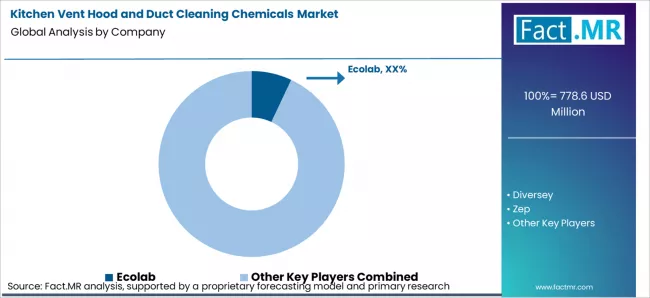
    Kitchen Vent Hood And Duct Cleaning Chemicals Market Analysis By Company

    The competitive landscape of the Kitchen Vent Hood and Duct Cleaning Chemicals market is defined by the race to dominate the autonomous degreasing segment while defending legacy manual-care franchises. Fact.MR analysis indicates that investment is intensifying as global leaders seek to align their heavy-duty chemical portfolios with the rise of robotic duct cleaning and smart sensors. The focus is no longer just on removing grease to prevent fire hazards but on the verifiable optimization of airflow and energy efficiency which represents the next frontier of value creation. Christophe Beck the Chairman and CEO of Ecolab emphasizes the urgency of this technological integration for the next generation of industrial growth.

    Companies like Ecolab and Diversey are leveraging their early lead in "system-based" hygiene to set the standard for high-throughput commercial kitchens. Meanwhile competitors like Zep and Spartan Chemical are focusing on self-emulsifying and enzyme-based formulas designed to work in synergy with automated misting units and robotic crawlers. The strategic focus for leadership has moved from periodic fire-risk mitigation toward a model of constant operational readiness. Success now depends on the ability to integrate cleaning workflows into the broader facility management system to turn hygiene data into a measurable lever for energy efficiency and insurance premium reduction.

    Key Players in the Kitchen Vent Hood and Duct Cleaning Chemicals Market

    • Ecolab
    • Diversey
    • Zep
    • Spartan Chemical
    • Betco
    • Clorox
    • SC Johnson Professional
    • Reckitt
    • Solenis

    Scope of the Report

    Items Values
    Quantitative Units USD million
    Product Type Heavy-Duty Degreasers; Foaming Duct Cleaners; Enzymatic / Bio-Based Grease Treatments; Rinse Aids & Specialty
    Application Method Manual Spray & Brush; Foam Cannon Systems; Soak / Immersion; Other Methods
    End-Use Segment Restaurants & QSR Chains; Institutional Kitchens; Food Processing Facilities; Other Commercial Kitchens
    Compliance Need Fire Code / Grease Compliance Programs; Routine Maintenance Cleaning; Deep-Clean / Remediation
    Regions Covered Asia Pacific, Europe, North America, Latin America, Middle East & Africa
    Countries Covered China, Brazil, USA, UK, Germany, South Korea, Japan, and 40+ countries
    Key Companies Profiled Ecolab; Diversey; Zep; Spartan Chemical; Betco; Clorox; SC Johnson Professional; Reckitt; Solenis
    Additional Attributes Dollar sales by product type, application method, and end-use segment; increasing demand for enzymatic and bio-based grease treatments due to eco-friendly trends; rising emphasis on compliance with fire and grease codes in commercial kitchens; growth in routine maintenance and deep-clean programs for commercial kitchens driven by food safety regulations; adoption of foam cannon systems for large-scale kitchen cleaning.

    Kitchen Vent Hood and Duct Cleaning Chemicals Market Key Segment

    • Product Type :

      • Heavy-Duty Degreasers
      • Foaming Duct Cleaners
      • Enzymatic / Bio-Based Grease Treatments
      • Rinse Aids & Specialty
    • Application Method :

      • Manual Spray & Brush
      • Foam Cannon Systems
      • Soak / Immersion
      • Other Methods
    • End-Use Segment :

      • Restaurants & QSR Chains
      • Institutional Kitchens
      • Food Processing Facilities
      • Other Commercial Kitchens
    • Compliance Need :

      • Fire Code / Grease Compliance Programs
      • Routine Maintenance Cleaning
      • Deep-Clean / Remediation
    • Region :

      • North America
        • USA
        • Canada
        • Mexico
      • Europe
        • Germany
        • UK
        • France
        • Italy
        • Spain
        • Nordic Countries
        • BENELUX
        • Rest of Europe
      • Asia Pacific
        • China
        • Japan
        • South Korea
        • India
        • Australia
        • Rest of Asia Pacific
      • Latin America
        • Brazil
        • Argentina
        • Rest of Latin America
      • Middle East and Africa
        • Kingdom of Saudi Arabia
        • United Arab Emirates
        • South Africa
        • Rest of Middle East and Africa
      • Other Regions
        • Oceania
        • Central Asia
        • Other Markets

    Bibliographies

    • National Fire Protection Association. (2024). NFPA 96: Standard for ventilation control and fire protection of commercial cooking operations (2024 ed.). National Fire Protection Association.
    • U.S. Occupational Safety and Health Administration. (2023). Hazard communication and chemical safety in commercial kitchen exhaust cleaning operations. U.S. Department of Labor.
    • Food Standards Agency. (2024). Food hygiene guidance for commercial kitchens: Ventilation and grease control requirements. Food Standards Agency.
    • European Chemicals Agency. (2023). REACH compliance guidance for alkaline and solvent-based degreasers used in professional cleaning. European Chemicals Agency.

    Table of Content

    1. Executive Summary
      • Global Market Outlook
      • Demand to side Trends
      • Supply to side Trends
      • Technology Roadmap Analysis
      • Analysis and Recommendations
    2. Market Overview
      • Market Coverage / Taxonomy
      • Market Definition / Scope / Limitations
    3. Research Methodology
      • Chapter Orientation
      • Analytical Lens and Working Hypotheses
        • Market Structure, Signals, and Trend Drivers
        • Benchmarking and Cross-market Comparability
        • Market Sizing, Forecasting, and Opportunity Mapping
      • Research Design and Evidence Framework
        • Desk Research Programme (Secondary Evidence)
          • Company Annual and Sustainability Reports
          • Peer-reviewed Journals and Academic Literature
          • Corporate Websites, Product Literature, and Technical Notes
          • Earnings Decks and Investor Briefings
          • Statutory Filings and Regulatory Disclosures
          • Technical White Papers and Standards Notes
          • Trade Journals, Industry Magazines, and Analyst Briefs
          • Conference Proceedings, Webinars, and Seminar Materials
          • Government Statistics Portals and Public Data Releases
          • Press Releases and Reputable Media Coverage
          • Specialist Newsletters and Curated Briefings
          • Sector Databases and Reference Repositories
          • FMR Internal Proprietary Databases and Historical Market Datasets
          • Subscription Datasets and Paid Sources
          • Social Channels, Communities, and Digital Listening Inputs
          • Additional Desk Sources
        • Expert Input and Fieldwork (Primary Evidence)
          • Primary Modes
            • Qualitative Interviews and Expert Elicitation
            • Quantitative Surveys and Structured Data Capture
            • Blended Approach
          • Why Primary Evidence is Used
          • Field Techniques
            • Interviews
            • Surveys
            • Focus Groups
            • Observational and In-context Research
            • Social and Community Interactions
          • Stakeholder Universe Engaged
            • C-suite Leaders
            • Board Members
            • Presidents and Vice Presidents
            • R&D and Innovation Heads
            • Technical Specialists
            • Domain Subject-matter Experts
            • Scientists
            • Physicians and Other Healthcare Professionals
          • Governance, Ethics, and Data Stewardship
            • Research Ethics
            • Data Integrity and Handling
        • Tooling, Models, and Reference Databases
      • Data Engineering and Model Build
        • Data Acquisition and Ingestion
        • Cleaning, Normalisation, and Verification
        • Synthesis, Triangulation, and Analysis
      • Quality Assurance and Audit Trail
    4. Market Background
      • Market Dynamics
        • Drivers
        • Restraints
        • Opportunity
        • Trends
      • Scenario Forecast
        • Demand in Optimistic Scenario
        • Demand in Likely Scenario
        • Demand in Conservative Scenario
      • Opportunity Map Analysis
      • Product Life Cycle Analysis
      • Supply Chain Analysis
      • Investment Feasibility Matrix
      • Value Chain Analysis
      • PESTLE and Porter’s Analysis
      • Regulatory Landscape
      • Regional Parent Market Outlook
      • Production and Consumption Statistics
      • Import and Export Statistics
    5. Global Market Analysis 2021 to 2025 and Forecast, 2026 to 2036
      • Historical Market Size Value (USD Million) Analysis, 2021 to 2025
      • Current and Future Market Size Value (USD Million) Projections, 2026 to 2036
        • Y to o to Y Growth Trend Analysis
        • Absolute $ Opportunity Analysis
    6. Global Market Pricing Analysis 2021 to 2025 and Forecast 2026 to 2036
    7. Global Market Analysis 2021 to 2025 and Forecast 2026 to 2036, By Product Type
      • Introduction / Key Findings
      • Historical Market Size Value (USD Million) Analysis By Product Type, 2021 to 2025
      • Current and Future Market Size Value (USD Million) Analysis and Forecast By Product Type, 2026 to 2036
        • Heavy-Duty Degreasers
        • Foaming Duct Cleaners
        • Enzymatic / Bio-Based Grease Treatments
        • Rinse Aids & Specialty
      • Y to o to Y Growth Trend Analysis By Product Type, 2021 to 2025
      • Absolute $ Opportunity Analysis By Product Type, 2026 to 2036
    8. Global Market Analysis 2021 to 2025 and Forecast 2026 to 2036, By Application Method
      • Introduction / Key Findings
      • Historical Market Size Value (USD Million) Analysis By Application Method, 2021 to 2025
      • Current and Future Market Size Value (USD Million) Analysis and Forecast By Application Method, 2026 to 2036
        • Manual Spray & Brush
        • Foam Cannon Systems
        • Soak / Immersion
        • Other Methods
      • Y to o to Y Growth Trend Analysis By Application Method, 2021 to 2025
      • Absolute $ Opportunity Analysis By Application Method, 2026 to 2036
    9. Global Market Analysis 2021 to 2025 and Forecast 2026 to 2036, By End-Use Segment
      • Introduction / Key Findings
      • Historical Market Size Value (USD Million) Analysis By End-Use Segment, 2021 to 2025
      • Current and Future Market Size Value (USD Million) Analysis and Forecast By End-Use Segment, 2026 to 2036
        • Restaurants & QSR Chains
        • Institutional Kitchens
        • Food Processing Facilities
        • Other Commercial Kitchens
      • Y to o to Y Growth Trend Analysis By End-Use Segment, 2021 to 2025
      • Absolute $ Opportunity Analysis By End-Use Segment, 2026 to 2036
    10. Global Market Analysis 2021 to 2025 and Forecast 2026 to 2036, By Compliance Need
      • Introduction / Key Findings
      • Historical Market Size Value (USD Million) Analysis By Compliance Need, 2021 to 2025
      • Current and Future Market Size Value (USD Million) Analysis and Forecast By Compliance Need, 2026 to 2036
        • Fire Code / Grease Compliance Programs
        • Routine Maintenance Cleaning
        • Deep-Clean / Remediation
      • Y to o to Y Growth Trend Analysis By Compliance Need, 2021 to 2025
      • Absolute $ Opportunity Analysis By Compliance Need, 2026 to 2036
    11. Global Market Analysis 2021 to 2025 and Forecast 2026 to 2036, By Region
      • Introduction
      • Historical Market Size Value (USD Million) Analysis By Region, 2021 to 2025
      • Current Market Size Value (USD Million) Analysis and Forecast By Region, 2026 to 2036
        • North America
        • Latin America
        • Western Europe
        • Eastern Europe
        • East Asia
        • South Asia and Pacific
        • Middle East & Africa
      • Market Attractiveness Analysis By Region
    12. North America Market Analysis 2021 to 2025 and Forecast 2026 to 2036, By Country
      • Historical Market Size Value (USD Million) Trend Analysis By Market Taxonomy, 2021 to 2025
      • Market Size Value (USD Million) Forecast By Market Taxonomy, 2026 to 2036
        • By Country
          • USA
          • Canada
          • Mexico
        • By Product Type
        • By Application Method
        • By End-Use Segment
        • By Compliance Need
      • Market Attractiveness Analysis
        • By Country
        • By Product Type
        • By Application Method
        • By End-Use Segment
        • By Compliance Need
      • Key Takeaways
    13. Latin America Market Analysis 2021 to 2025 and Forecast 2026 to 2036, By Country
      • Historical Market Size Value (USD Million) Trend Analysis By Market Taxonomy, 2021 to 2025
      • Market Size Value (USD Million) Forecast By Market Taxonomy, 2026 to 2036
        • By Country
          • Brazil
          • Chile
          • Rest of Latin America
        • By Product Type
        • By Application Method
        • By End-Use Segment
        • By Compliance Need
      • Market Attractiveness Analysis
        • By Country
        • By Product Type
        • By Application Method
        • By End-Use Segment
        • By Compliance Need
      • Key Takeaways
    14. Western Europe Market Analysis 2021 to 2025 and Forecast 2026 to 2036, By Country
      • Historical Market Size Value (USD Million) Trend Analysis By Market Taxonomy, 2021 to 2025
      • Market Size Value (USD Million) Forecast By Market Taxonomy, 2026 to 2036
        • By Country
          • Germany
          • UK
          • Italy
          • Spain
          • France
          • Nordic
          • BENELUX
          • Rest of Western Europe
        • By Product Type
        • By Application Method
        • By End-Use Segment
        • By Compliance Need
      • Market Attractiveness Analysis
        • By Country
        • By Product Type
        • By Application Method
        • By End-Use Segment
        • By Compliance Need
      • Key Takeaways
    15. Eastern Europe Market Analysis 2021 to 2025 and Forecast 2026 to 2036, By Country
      • Historical Market Size Value (USD Million) Trend Analysis By Market Taxonomy, 2021 to 2025
      • Market Size Value (USD Million) Forecast By Market Taxonomy, 2026 to 2036
        • By Country
          • Russia
          • Poland
          • Hungary
          • Balkan & Baltic
          • Rest of Eastern Europe
        • By Product Type
        • By Application Method
        • By End-Use Segment
        • By Compliance Need
      • Market Attractiveness Analysis
        • By Country
        • By Product Type
        • By Application Method
        • By End-Use Segment
        • By Compliance Need
      • Key Takeaways
    16. East Asia Market Analysis 2021 to 2025 and Forecast 2026 to 2036, By Country
      • Historical Market Size Value (USD Million) Trend Analysis By Market Taxonomy, 2021 to 2025
      • Market Size Value (USD Million) Forecast By Market Taxonomy, 2026 to 2036
        • By Country
          • China
          • Japan
          • South Korea
        • By Product Type
        • By Application Method
        • By End-Use Segment
        • By Compliance Need
      • Market Attractiveness Analysis
        • By Country
        • By Product Type
        • By Application Method
        • By End-Use Segment
        • By Compliance Need
      • Key Takeaways
    17. South Asia and Pacific Market Analysis 2021 to 2025 and Forecast 2026 to 2036, By Country
      • Historical Market Size Value (USD Million) Trend Analysis By Market Taxonomy, 2021 to 2025
      • Market Size Value (USD Million) Forecast By Market Taxonomy, 2026 to 2036
        • By Country
          • India
          • ASEAN
          • Australia & New Zealand
          • Rest of South Asia and Pacific
        • By Product Type
        • By Application Method
        • By End-Use Segment
        • By Compliance Need
      • Market Attractiveness Analysis
        • By Country
        • By Product Type
        • By Application Method
        • By End-Use Segment
        • By Compliance Need
      • Key Takeaways
    18. Middle East & Africa Market Analysis 2021 to 2025 and Forecast 2026 to 2036, By Country
      • Historical Market Size Value (USD Million) Trend Analysis By Market Taxonomy, 2021 to 2025
      • Market Size Value (USD Million) Forecast By Market Taxonomy, 2026 to 2036
        • By Country
          • Kingdom of Saudi Arabia
          • Other GCC Countries
          • Turkiye
          • South Africa
          • Other African Union
          • Rest of Middle East & Africa
        • By Product Type
        • By Application Method
        • By End-Use Segment
        • By Compliance Need
      • Market Attractiveness Analysis
        • By Country
        • By Product Type
        • By Application Method
        • By End-Use Segment
        • By Compliance Need
      • Key Takeaways
    19. Key Countries Market Analysis
      • USA
        • Pricing Analysis
        • Market Share Analysis, 2025
          • By Product Type
          • By Application Method
          • By End-Use Segment
          • By Compliance Need
      • Canada
        • Pricing Analysis
        • Market Share Analysis, 2025
          • By Product Type
          • By Application Method
          • By End-Use Segment
          • By Compliance Need
      • Mexico
        • Pricing Analysis
        • Market Share Analysis, 2025
          • By Product Type
          • By Application Method
          • By End-Use Segment
          • By Compliance Need
      • Brazil
        • Pricing Analysis
        • Market Share Analysis, 2025
          • By Product Type
          • By Application Method
          • By End-Use Segment
          • By Compliance Need
      • Chile
        • Pricing Analysis
        • Market Share Analysis, 2025
          • By Product Type
          • By Application Method
          • By End-Use Segment
          • By Compliance Need
      • Germany
        • Pricing Analysis
        • Market Share Analysis, 2025
          • By Product Type
          • By Application Method
          • By End-Use Segment
          • By Compliance Need
      • UK
        • Pricing Analysis
        • Market Share Analysis, 2025
          • By Product Type
          • By Application Method
          • By End-Use Segment
          • By Compliance Need
      • Italy
        • Pricing Analysis
        • Market Share Analysis, 2025
          • By Product Type
          • By Application Method
          • By End-Use Segment
          • By Compliance Need
      • Spain
        • Pricing Analysis
        • Market Share Analysis, 2025
          • By Product Type
          • By Application Method
          • By End-Use Segment
          • By Compliance Need
      • France
        • Pricing Analysis
        • Market Share Analysis, 2025
          • By Product Type
          • By Application Method
          • By End-Use Segment
          • By Compliance Need
      • India
        • Pricing Analysis
        • Market Share Analysis, 2025
          • By Product Type
          • By Application Method
          • By End-Use Segment
          • By Compliance Need
      • ASEAN
        • Pricing Analysis
        • Market Share Analysis, 2025
          • By Product Type
          • By Application Method
          • By End-Use Segment
          • By Compliance Need
      • Australia & New Zealand
        • Pricing Analysis
        • Market Share Analysis, 2025
          • By Product Type
          • By Application Method
          • By End-Use Segment
          • By Compliance Need
      • China
        • Pricing Analysis
        • Market Share Analysis, 2025
          • By Product Type
          • By Application Method
          • By End-Use Segment
          • By Compliance Need
      • Japan
        • Pricing Analysis
        • Market Share Analysis, 2025
          • By Product Type
          • By Application Method
          • By End-Use Segment
          • By Compliance Need
      • South Korea
        • Pricing Analysis
        • Market Share Analysis, 2025
          • By Product Type
          • By Application Method
          • By End-Use Segment
          • By Compliance Need
      • Russia
        • Pricing Analysis
        • Market Share Analysis, 2025
          • By Product Type
          • By Application Method
          • By End-Use Segment
          • By Compliance Need
      • Poland
        • Pricing Analysis
        • Market Share Analysis, 2025
          • By Product Type
          • By Application Method
          • By End-Use Segment
          • By Compliance Need
      • Hungary
        • Pricing Analysis
        • Market Share Analysis, 2025
          • By Product Type
          • By Application Method
          • By End-Use Segment
          • By Compliance Need
      • Kingdom of Saudi Arabia
        • Pricing Analysis
        • Market Share Analysis, 2025
          • By Product Type
          • By Application Method
          • By End-Use Segment
          • By Compliance Need
      • Turkiye
        • Pricing Analysis
        • Market Share Analysis, 2025
          • By Product Type
          • By Application Method
          • By End-Use Segment
          • By Compliance Need
      • South Africa
        • Pricing Analysis
        • Market Share Analysis, 2025
          • By Product Type
          • By Application Method
          • By End-Use Segment
          • By Compliance Need
    20. Market Structure Analysis
      • Competition Dashboard
      • Competition Benchmarking
      • Market Share Analysis of Top Players
        • By Regional
        • By Product Type
        • By Application Method
        • By End-Use Segment
        • By Compliance Need
    21. Competition Analysis
      • Competition Deep Dive
        • Ecolab
          • Overview
          • Product Portfolio
          • Profitability by Market Segments (Product/Age /Sales Channel/Region)
          • Sales Footprint
          • Strategy Overview
            • Marketing Strategy
            • Product Strategy
            • Channel Strategy
        • Diversey
        • Zep
        • Spartan Chemical
        • Betco
        • Clorox
        • SC Johnson Professional
        • Reckitt
        • Solenis
    22. Assumptions & Acronyms Used

    List Of Table

    • Table 1: Global Market Value (USD Million) Forecast by Region, 2021 to 2036
    • Table 2: Global Market Value (USD Million) Forecast by Product Type, 2021 to 2036
    • Table 3: Global Market Value (USD Million) Forecast by Application Method, 2021 to 2036
    • Table 4: Global Market Value (USD Million) Forecast by End-Use Segment, 2021 to 2036
    • Table 5: Global Market Value (USD Million) Forecast by Compliance Need, 2021 to 2036
    • Table 6: North America Market Value (USD Million) Forecast by Country, 2021 to 2036
    • Table 7: North America Market Value (USD Million) Forecast by Product Type, 2021 to 2036
    • Table 8: North America Market Value (USD Million) Forecast by Application Method, 2021 to 2036
    • Table 9: North America Market Value (USD Million) Forecast by End-Use Segment, 2021 to 2036
    • Table 10: North America Market Value (USD Million) Forecast by Compliance Need, 2021 to 2036
    • Table 11: Latin America Market Value (USD Million) Forecast by Country, 2021 to 2036
    • Table 12: Latin America Market Value (USD Million) Forecast by Product Type, 2021 to 2036
    • Table 13: Latin America Market Value (USD Million) Forecast by Application Method, 2021 to 2036
    • Table 14: Latin America Market Value (USD Million) Forecast by End-Use Segment, 2021 to 2036
    • Table 15: Latin America Market Value (USD Million) Forecast by Compliance Need, 2021 to 2036
    • Table 16: Western Europe Market Value (USD Million) Forecast by Country, 2021 to 2036
    • Table 17: Western Europe Market Value (USD Million) Forecast by Product Type, 2021 to 2036
    • Table 18: Western Europe Market Value (USD Million) Forecast by Application Method, 2021 to 2036
    • Table 19: Western Europe Market Value (USD Million) Forecast by End-Use Segment, 2021 to 2036
    • Table 20: Western Europe Market Value (USD Million) Forecast by Compliance Need, 2021 to 2036
    • Table 21: Eastern Europe Market Value (USD Million) Forecast by Country, 2021 to 2036
    • Table 22: Eastern Europe Market Value (USD Million) Forecast by Product Type, 2021 to 2036
    • Table 23: Eastern Europe Market Value (USD Million) Forecast by Application Method, 2021 to 2036
    • Table 24: Eastern Europe Market Value (USD Million) Forecast by End-Use Segment, 2021 to 2036
    • Table 25: Eastern Europe Market Value (USD Million) Forecast by Compliance Need, 2021 to 2036
    • Table 26: East Asia Market Value (USD Million) Forecast by Country, 2021 to 2036
    • Table 27: East Asia Market Value (USD Million) Forecast by Product Type, 2021 to 2036
    • Table 28: East Asia Market Value (USD Million) Forecast by Application Method, 2021 to 2036
    • Table 29: East Asia Market Value (USD Million) Forecast by End-Use Segment, 2021 to 2036
    • Table 30: East Asia Market Value (USD Million) Forecast by Compliance Need, 2021 to 2036
    • Table 31: South Asia and Pacific Market Value (USD Million) Forecast by Country, 2021 to 2036
    • Table 32: South Asia and Pacific Market Value (USD Million) Forecast by Product Type, 2021 to 2036
    • Table 33: South Asia and Pacific Market Value (USD Million) Forecast by Application Method, 2021 to 2036
    • Table 34: South Asia and Pacific Market Value (USD Million) Forecast by End-Use Segment, 2021 to 2036
    • Table 35: South Asia and Pacific Market Value (USD Million) Forecast by Compliance Need, 2021 to 2036
    • Table 36: Middle East & Africa Market Value (USD Million) Forecast by Country, 2021 to 2036
    • Table 37: Middle East & Africa Market Value (USD Million) Forecast by Product Type, 2021 to 2036
    • Table 38: Middle East & Africa Market Value (USD Million) Forecast by Application Method, 2021 to 2036
    • Table 39: Middle East & Africa Market Value (USD Million) Forecast by End-Use Segment, 2021 to 2036
    • Table 40: Middle East & Africa Market Value (USD Million) Forecast by Compliance Need, 2021 to 2036

    List Of Figures

    • Figure 1: Global Market Pricing Analysis
    • Figure 2: Global Market Value (USD Million) Forecast 2021 to 2036
    • Figure 3: Global Market Value Share and BPS Analysis by Product Type, 2026 and 2036
    • Figure 4: Global Market Y to o to Y Growth Comparison by Product Type, 2026 to 2036
    • Figure 5: Global Market Attractiveness Analysis by Product Type
    • Figure 6: Global Market Value Share and BPS Analysis by Application Method, 2026 and 2036
    • Figure 7: Global Market Y to o to Y Growth Comparison by Application Method, 2026 to 2036
    • Figure 8: Global Market Attractiveness Analysis by Application Method
    • Figure 9: Global Market Value Share and BPS Analysis by End-Use Segment, 2026 and 2036
    • Figure 10: Global Market Y to o to Y Growth Comparison by End-Use Segment, 2026 to 2036
    • Figure 11: Global Market Attractiveness Analysis by End-Use Segment
    • Figure 12: Global Market Value Share and BPS Analysis by Compliance Need, 2026 and 2036
    • Figure 13: Global Market Y to o to Y Growth Comparison by Compliance Need, 2026 to 2036
    • Figure 14: Global Market Attractiveness Analysis by Compliance Need
    • Figure 15: Global Market Value (USD Million) Share and BPS Analysis by Region, 2026 and 2036
    • Figure 16: Global Market Y to o to Y Growth Comparison by Region, 2026 to 2036
    • Figure 17: Global Market Attractiveness Analysis by Region
    • Figure 18: North America Market Incremental Dollar Opportunity, 2026 to 2036
    • Figure 19: Latin America Market Incremental Dollar Opportunity, 2026 to 2036
    • Figure 20: Western Europe Market Incremental Dollar Opportunity, 2026 to 2036
    • Figure 21: Eastern Europe Market Incremental Dollar Opportunity, 2026 to 2036
    • Figure 22: East Asia Market Incremental Dollar Opportunity, 2026 to 2036
    • Figure 23: South Asia and Pacific Market Incremental Dollar Opportunity, 2026 to 2036
    • Figure 24: Middle East & Africa Market Incremental Dollar Opportunity, 2026 to 2036
    • Figure 25: North America Market Value Share and BPS Analysis by Country, 2026 and 2036
    • Figure 26: North America Market Value Share and BPS Analysis by Product Type, 2026 and 2036
    • Figure 27: North America Market Y to o to Y Growth Comparison by Product Type, 2026 to 2036
    • Figure 28: North America Market Attractiveness Analysis by Product Type
    • Figure 29: North America Market Value Share and BPS Analysis by Application Method, 2026 and 2036
    • Figure 30: North America Market Y to o to Y Growth Comparison by Application Method, 2026 to 2036
    • Figure 31: North America Market Attractiveness Analysis by Application Method
    • Figure 32: North America Market Value Share and BPS Analysis by End-Use Segment, 2026 and 2036
    • Figure 33: North America Market Y to o to Y Growth Comparison by End-Use Segment, 2026 to 2036
    • Figure 34: North America Market Attractiveness Analysis by End-Use Segment
    • Figure 35: North America Market Value Share and BPS Analysis by Compliance Need, 2026 and 2036
    • Figure 36: North America Market Y to o to Y Growth Comparison by Compliance Need, 2026 to 2036
    • Figure 37: North America Market Attractiveness Analysis by Compliance Need
    • Figure 38: Latin America Market Value Share and BPS Analysis by Country, 2026 and 2036
    • Figure 39: Latin America Market Value Share and BPS Analysis by Product Type, 2026 and 2036
    • Figure 40: Latin America Market Y to o to Y Growth Comparison by Product Type, 2026 to 2036
    • Figure 41: Latin America Market Attractiveness Analysis by Product Type
    • Figure 42: Latin America Market Value Share and BPS Analysis by Application Method, 2026 and 2036
    • Figure 43: Latin America Market Y to o to Y Growth Comparison by Application Method, 2026 to 2036
    • Figure 44: Latin America Market Attractiveness Analysis by Application Method
    • Figure 45: Latin America Market Value Share and BPS Analysis by End-Use Segment, 2026 and 2036
    • Figure 46: Latin America Market Y to o to Y Growth Comparison by End-Use Segment, 2026 to 2036
    • Figure 47: Latin America Market Attractiveness Analysis by End-Use Segment
    • Figure 48: Latin America Market Value Share and BPS Analysis by Compliance Need, 2026 and 2036
    • Figure 49: Latin America Market Y to o to Y Growth Comparison by Compliance Need, 2026 to 2036
    • Figure 50: Latin America Market Attractiveness Analysis by Compliance Need
    • Figure 51: Western Europe Market Value Share and BPS Analysis by Country, 2026 and 2036
    • Figure 52: Western Europe Market Value Share and BPS Analysis by Product Type, 2026 and 2036
    • Figure 53: Western Europe Market Y to o to Y Growth Comparison by Product Type, 2026 to 2036
    • Figure 54: Western Europe Market Attractiveness Analysis by Product Type
    • Figure 55: Western Europe Market Value Share and BPS Analysis by Application Method, 2026 and 2036
    • Figure 56: Western Europe Market Y to o to Y Growth Comparison by Application Method, 2026 to 2036
    • Figure 57: Western Europe Market Attractiveness Analysis by Application Method
    • Figure 58: Western Europe Market Value Share and BPS Analysis by End-Use Segment, 2026 and 2036
    • Figure 59: Western Europe Market Y to o to Y Growth Comparison by End-Use Segment, 2026 to 2036
    • Figure 60: Western Europe Market Attractiveness Analysis by End-Use Segment
    • Figure 61: Western Europe Market Value Share and BPS Analysis by Compliance Need, 2026 and 2036
    • Figure 62: Western Europe Market Y to o to Y Growth Comparison by Compliance Need, 2026 to 2036
    • Figure 63: Western Europe Market Attractiveness Analysis by Compliance Need
    • Figure 64: Eastern Europe Market Value Share and BPS Analysis by Country, 2026 and 2036
    • Figure 65: Eastern Europe Market Value Share and BPS Analysis by Product Type, 2026 and 2036
    • Figure 66: Eastern Europe Market Y to o to Y Growth Comparison by Product Type, 2026 to 2036
    • Figure 67: Eastern Europe Market Attractiveness Analysis by Product Type
    • Figure 68: Eastern Europe Market Value Share and BPS Analysis by Application Method, 2026 and 2036
    • Figure 69: Eastern Europe Market Y to o to Y Growth Comparison by Application Method, 2026 to 2036
    • Figure 70: Eastern Europe Market Attractiveness Analysis by Application Method
    • Figure 71: Eastern Europe Market Value Share and BPS Analysis by End-Use Segment, 2026 and 2036
    • Figure 72: Eastern Europe Market Y to o to Y Growth Comparison by End-Use Segment, 2026 to 2036
    • Figure 73: Eastern Europe Market Attractiveness Analysis by End-Use Segment
    • Figure 74: Eastern Europe Market Value Share and BPS Analysis by Compliance Need, 2026 and 2036
    • Figure 75: Eastern Europe Market Y to o to Y Growth Comparison by Compliance Need, 2026 to 2036
    • Figure 76: Eastern Europe Market Attractiveness Analysis by Compliance Need
    • Figure 77: East Asia Market Value Share and BPS Analysis by Country, 2026 and 2036
    • Figure 78: East Asia Market Value Share and BPS Analysis by Product Type, 2026 and 2036
    • Figure 79: East Asia Market Y to o to Y Growth Comparison by Product Type, 2026 to 2036
    • Figure 80: East Asia Market Attractiveness Analysis by Product Type
    • Figure 81: East Asia Market Value Share and BPS Analysis by Application Method, 2026 and 2036
    • Figure 82: East Asia Market Y to o to Y Growth Comparison by Application Method, 2026 to 2036
    • Figure 83: East Asia Market Attractiveness Analysis by Application Method
    • Figure 84: East Asia Market Value Share and BPS Analysis by End-Use Segment, 2026 and 2036
    • Figure 85: East Asia Market Y to o to Y Growth Comparison by End-Use Segment, 2026 to 2036
    • Figure 86: East Asia Market Attractiveness Analysis by End-Use Segment
    • Figure 87: East Asia Market Value Share and BPS Analysis by Compliance Need, 2026 and 2036
    • Figure 88: East Asia Market Y to o to Y Growth Comparison by Compliance Need, 2026 to 2036
    • Figure 89: East Asia Market Attractiveness Analysis by Compliance Need
    • Figure 90: South Asia and Pacific Market Value Share and BPS Analysis by Country, 2026 and 2036
    • Figure 91: South Asia and Pacific Market Value Share and BPS Analysis by Product Type, 2026 and 2036
    • Figure 92: South Asia and Pacific Market Y to o to Y Growth Comparison by Product Type, 2026 to 2036
    • Figure 93: South Asia and Pacific Market Attractiveness Analysis by Product Type
    • Figure 94: South Asia and Pacific Market Value Share and BPS Analysis by Application Method, 2026 and 2036
    • Figure 95: South Asia and Pacific Market Y to o to Y Growth Comparison by Application Method, 2026 to 2036
    • Figure 96: South Asia and Pacific Market Attractiveness Analysis by Application Method
    • Figure 97: South Asia and Pacific Market Value Share and BPS Analysis by End-Use Segment, 2026 and 2036
    • Figure 98: South Asia and Pacific Market Y to o to Y Growth Comparison by End-Use Segment, 2026 to 2036
    • Figure 99: South Asia and Pacific Market Attractiveness Analysis by End-Use Segment
    • Figure 100: South Asia and Pacific Market Value Share and BPS Analysis by Compliance Need, 2026 and 2036
    • Figure 101: South Asia and Pacific Market Y to o to Y Growth Comparison by Compliance Need, 2026 to 2036
    • Figure 102: South Asia and Pacific Market Attractiveness Analysis by Compliance Need
    • Figure 103: Middle East & Africa Market Value Share and BPS Analysis by Country, 2026 and 2036
    • Figure 104: Middle East & Africa Market Value Share and BPS Analysis by Product Type, 2026 and 2036
    • Figure 105: Middle East & Africa Market Y to o to Y Growth Comparison by Product Type, 2026 to 2036
    • Figure 106: Middle East & Africa Market Attractiveness Analysis by Product Type
    • Figure 107: Middle East & Africa Market Value Share and BPS Analysis by Application Method, 2026 and 2036
    • Figure 108: Middle East & Africa Market Y to o to Y Growth Comparison by Application Method, 2026 to 2036
    • Figure 109: Middle East & Africa Market Attractiveness Analysis by Application Method
    • Figure 110: Middle East & Africa Market Value Share and BPS Analysis by End-Use Segment, 2026 and 2036
    • Figure 111: Middle East & Africa Market Y to o to Y Growth Comparison by End-Use Segment, 2026 to 2036
    • Figure 112: Middle East & Africa Market Attractiveness Analysis by End-Use Segment
    • Figure 113: Middle East & Africa Market Value Share and BPS Analysis by Compliance Need, 2026 and 2036
    • Figure 114: Middle East & Africa Market Y to o to Y Growth Comparison by Compliance Need, 2026 to 2036
    • Figure 115: Middle East & Africa Market Attractiveness Analysis by Compliance Need
    • Figure 116: Global Market - Tier Structure Analysis
    • Figure 117: Global Market - Company Share Analysis

    - FAQs -

    How big is the kitchen vent hood and duct cleaning chemicals market in 2026?

    The global kitchen vent hood and duct cleaning chemicals market is estimated to be valued at USD 778.6 million in 2026.

    What will be the size of kitchen vent hood and duct cleaning chemicals market in 2036?

    The market size for the kitchen vent hood and duct cleaning chemicals market is projected to reach USD 1,503.2 million by 2036.

    How much will be the kitchen vent hood and duct cleaning chemicals market growth between 2026 and 2036?

    The kitchen vent hood and duct cleaning chemicals market is expected to grow at a 6.8% CAGR between 2026 and 2036.

    What are the key product types in the kitchen vent hood and duct cleaning chemicals market?

    The key product types in kitchen vent hood and duct cleaning chemicals market are heavy-duty degreasers, foaming duct cleaners, enzymatic / bio-based grease treatments and rinse aids & specialty.

    Which application method segment to contribute significant share in the kitchen vent hood and duct cleaning chemicals market in 2026?

    In terms of application method, manual spray & brush segment to command 33.0% share in the kitchen vent hood and duct cleaning chemicals market in 2026.

    Kitchen Vent Hood and Duct Cleaning Chemicals Market