- Market Value (2025): USD 6.5 Bn
- Estimated Value (2026): USD 7.2 Bn
- Forecast Value (2036): USD 19.3 Bn
- CAGR (2026-2036): 10.4%
What is the Lab Automation Workstations Market forecast to be worth by 2036?
USD 7.2 billion in 2026 to USD 19.3 billion by 2036 at a 10.4% CAGR.
- The Lab Automation Workstations Market crossed a valuation of USD 6.5 billion in 2025.
- Demand is projected to increase from USD 7.2 billion in 2026 to USD 19.3 billion by 2036.
- The market is forecast to record 10.4% CAGR from 2026 to 2036 as pharma teams and diagnostic laboratories automate repeatable bench workflows.
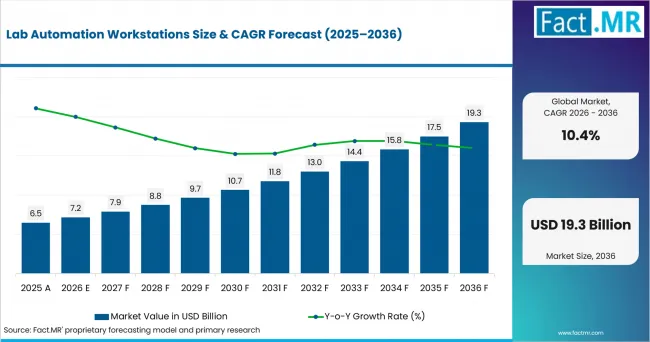
Lab Automation Workstations Value Analysis | Source: Fact.MR
What are the defining numbers behind Lab Automation Workstations Market growth?
An absolute opportunity of USD 12.1 billion is expected between 2026 and 2036.
- Demand Drivers in the Market
- Pharma and biotech laboratories need validated liquid handling when drug discovery programs handle repeated assays, plate transfers and compound screens under time pressure.
- Regulated development activity is strengthening workstation demand. The U.S. Food and Drug Administration's January 2026 CDER annual report states that 46 novel drugs were approved in 2025.
- Clinical diagnostics laboratories need walk-away decks that reduce manual pipetting and support consistent handling across molecular testing, immunoassay and sample normalization workflows.
- Materials and chemical laboratories require automated weighing and dosing when repeatability, operator safety and batch records influence method acceptance.
- Academic laboratories need modular workstations that can shift between genomics, screening and cell culture methods while preserving the same bench layout.
- Key Segments Analyzed
- By Workstation Type: Liquid handling is expected to hold 34.0% share in 2026 owing to its role in pipetting, dilution and assay plate preparation.
- By Automation Level: Benchtop automated is projected to account for 37.0% share in 2026 since many laboratories need automation within existing rooms.
- By Application: Pharma / biotech is anticipated to capture 41.0% share in 2026 supported by discovery, analytical testing and regulated method transfer.
- By Throughput: Medium throughput is estimated to represent 33.0% share in 2026 reflecting daily batch sizes in shared research and diagnostic laboratories.
- Analyst Opinion at Fact.MR
- Shambhu Nath Jha, Principal Consultant at Fact.MR, states, "The commercial test for this market is practical: a workstation must make a manual method easier to repeat. Demand is expected to move toward platforms that join liquid handling, scheduling and run records in one controlled workflow. Suppliers with local application teams and proven protocols are better placed than equipment sellers that rely on hardware breadth alone."
- Strategic Implications
- Workstation vendors should build application libraries around liquid handling, sample preparation and plate movement so laboratories can shorten method transfer work.
- Automation integrators should strengthen scheduling software and local service coverage. Hamilton announced in July 2025 that it acquired UK Robotics and Trisonic Discovery, expanding integration and liquid handling capability.
- Diagnostics laboratories should map daily sample volumes before choosing throughput, since oversized systems raise cost and undersized decks create queue pressure.
- Pharma teams should connect workstation records with laboratory informatics so run data, assay notes and quality checks remain easier to review.
Switzerland is projected to record 10.4% CAGR through 2036 supported by pharmaceutical R&D density and local automation capability. The USA is expected to advance at 10.0% CAGR due to drug development scale and clinical laboratory volume. Japan is forecast to post 9.7% CAGR with compact automated decks suited to space-conscious laboratories. Germany is anticipated to record 9.4% CAGR through industrial research and regulated quality laboratories. The UK is estimated to reach 8.4% CAGR supported by clinical trial modernization and life science research activity.
How does the Lab Automation Workstations Market break down by segment?
Liquid handling leads Workstation Type at 34.0%; pharma / biotech leads Application at 41.0%.
Which Workstation Type dominates?
Liquid handling is expected to hold 34.0% share in 2026.
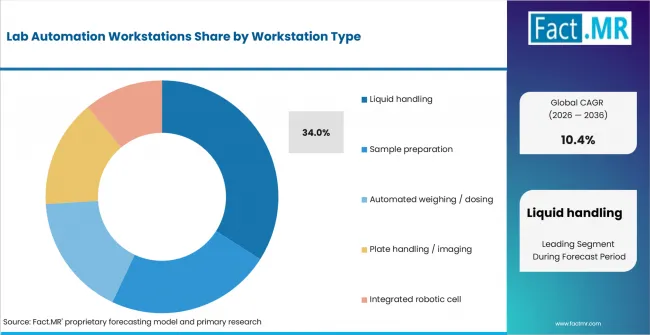
Lab Automation Workstations Analysis By Workstation Type | Source: Fact.MR
Liquid handling workstations lead since pipetting remains the task most often repeated across assays and sample preparation. Laboratories can automate dilution, reagent addition and plate setup while keeping the same method design. The segment fits diagnostics and pharma settings where accuracy records carry value.
Tecan and Hamilton maintain liquid handling portfolios with broad protocol coverage. Beckman Coulter Life Sciences and Agilent Technologies add further depth in automated workstations.
What leads the Automation Level segment?
Benchtop automated is projected to account for 37.0% share in 2026.
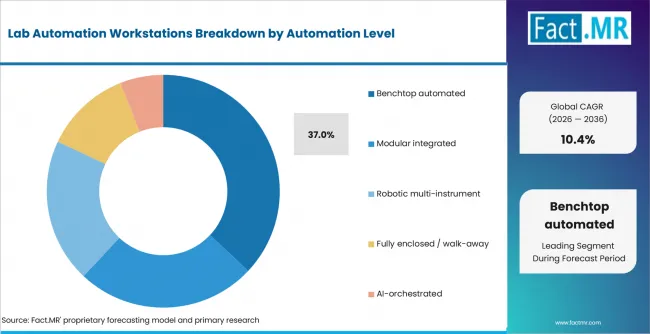
Lab Automation Workstations Analysis By Automation Level | Source: Fact.MR
Benchtop automated platforms lead where laboratories need controlled automation inside existing rooms. These systems can fit beside manual benches and support low to medium batch volumes. They also reduce the facility work required for larger enclosed cells.
Beckman Coulter Life Sciences launched the Biomek i3 Benchtop Liquid Handler in December 2025. The platform includes 15 standard pipettable positions and 5 flex positions, enabling flexible configuration for a wide range of labware and protocols within a compact benchtop format.
How does Application shape demand?
Pharma / biotech is anticipated to capture 41.0% share in 2026.
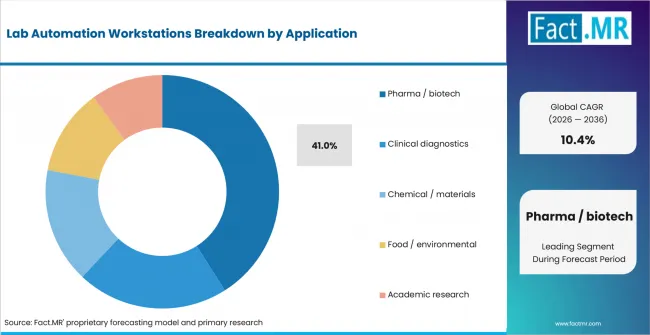
Lab Automation Workstations Analysis By Application | Source: Fact.MR
Pharma and biotech laboratories account for the largest application share since they use automation across discovery, assay development and analytical quality work. A single workstation can support compound transfer, nucleic acid preparation and cell-based assay setup when protocols are validated for the deck.
These users also place weight on service response and audit-ready run records. Workstations that reduce manual variance and preserve method steps are expected to gain preference in regulated laboratories where repeatability affects release decisions.
What supports Medium throughput within Throughput?
Medium throughput is estimated to represent 33.0% share in 2026.
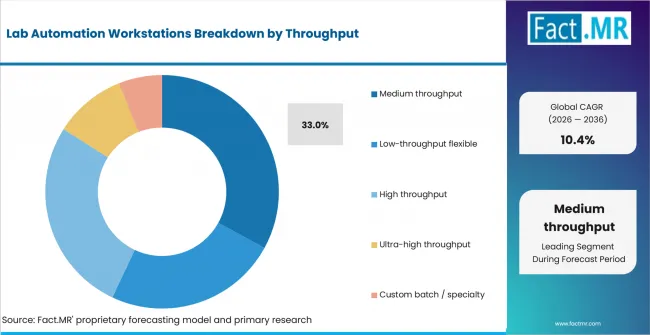
Lab Automation Workstations Analysis By Throughput | Source: Fact.MR
Medium throughput leads where laboratories run daily batches that exceed comfortable manual work but fall below industrial screening scale. A medium deck gives enough capacity for plates and reservoirs while preserving flexibility for changing methods.
The segment is expected to gain from shared research laboratories and diagnostic sites that need repeatable batches during normal working hours. It balances price, bench space and operator training more effectively than ultra-high-throughput robotic lines.
What is accelerating Lab Automation Workstations Market adoption, and what is holding it back?
Demand is expected to rise through workflow repeatability and validated automation. Growth is constrained by integration cost and method-transfer work.
Drivers Impact Analysis
| DRIVER | (~) % IMPACT ON CAGR | GEOGRAPHIC RELEVANCE | IMPACT TIMELINE |
|---|---|---|---|
| Validated liquid handling in pharma and biotech workflows | +1.7% | North America, Western Europe, East Asia | Short term (<= 2 years) |
| Clinical diagnostics need for repeatable sample preparation | +1.4% | North America, Europe, Japan | Medium term (2-4 years) |
| Modular benchtop automation for shared laboratories | +1.1% | Global | Medium term (2-4 years) |
| Connected scheduling and data capture across instruments | +0.8% | Global | Long term (>= 4 years) |
- Validated liquid handling in pharma and biotech workflows: Automated liquid transfer is expected to reduce manual variance in assay setup and sample preparation.
- Clinical diagnostics need for repeatable sample preparation: Diagnostic laboratories handle recurring molecular and immunoassay workflows. Workstations are expected to help these laboratories standardize sample preparation and reduce operator-to-operator variation.
- Modular benchtop automation for shared laboratories: Research teams often need flexible benches that support several assays. Modular workstations are projected to suit laboratories where a full robotic cell for one method is impractical.
Opportunity Impact Analysis
| OPPORTUNITY | (~) % IMPACT ON CAGR | GEOGRAPHIC RELEVANCE | IMPACT TIMELINE |
|---|---|---|---|
| Template-based automation for medium-throughput laboratories | +1.2% | Global | Short term (<= 2 years) |
| Integration with laboratory informatics and run records | +1.0% | North America, Europe | Medium term (2-4 years) |
| Automated weighing and dosing for materials laboratories | +0.7% | Germany, Japan, Switzerland | Long term (>= 4 years) |
- Template-based automation for medium-throughput laboratories: Prebuilt methods are expected to shorten the move from manual work to automated runs. This is valuable for laboratories that lack dedicated automation programmers.
- Integration with laboratory informatics and run records: Workstations that connect runs to data systems are projected to gain relevance where quality teams need traceable setup information. Linking methods and records also reduces repeated manual entry.
- Automated weighing and dosing for materials laboratories: Chemical and materials laboratories are anticipated to use automated dosing where operator exposure and small measurement errors affect the result. Specialty decks can extend automation beyond life science routines.
Restraints Impact Analysis
| RESTRAINT | (~) % IMPACT ON CAGR | GEOGRAPHIC RELEVANCE | IMPACT TIMELINE |
|---|---|---|---|
| High installation and validation cost | -0.6% | Global | Short term (<= 2 years) |
| Method transfer effort from manual protocols | -0.5% | North America, Europe, Japan | Medium term (2-4 years) |
| Training and service dependence for smaller laboratories | -0.4% | Global | Long term (>= 4 years) |
- High installation and validation cost: Automation projects require hardware, software, labware and service support. Smaller laboratories can delay purchases when existing manual methods still meet daily volume needs.
- Method transfer effort from manual protocols: Each protocol needs deck layout, pipetting parameters and acceptance checks before routine use. This effort can slow adoption even when the hardware is suitable.
- Training and service dependence for smaller laboratories: Workstations require operators who understand scripts and troubleshooting steps. Limited application support can delay broader use outside specialist automation teams.
Which countries are scaling the Lab Automation Workstations Market through 2036?
- The country comparison spans 2.0 percentage points and forms three practical growth bands across the forecast period.
- Switzerland remains 0.4 percentage point above the USA through R&D funding and pharmaceutical laboratory activity.
- The USA remains 0.3 percentage point above Japan as drug development and clinical study volume support automated sample preparation.
- Japan remains 0.3 percentage point above Germany through science and technology research expenditure and compact laboratory automation needs.
- Germany remains 1.0 percentage point above the UK as industrial research and life science laboratories automate repeatable methods.
- The UK closes the displayed range while clinical trial reforms and life science R&D support workstation replacement demand.
Comparable CAGRs create different entry conditions due to research funding, clinical laboratory scale, local service networks and validation practice. Full report coverage includes North America, Latin America, Western Europe, Eastern Europe, East Asia, South Asia & Pacific, Middle East & Africa.
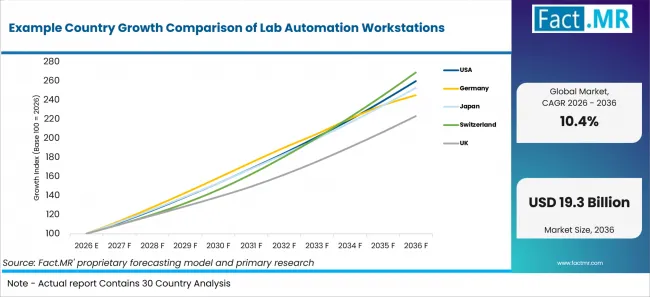
Example Country Growth Comparison Of Lab Automation Workstations | Source: Fact.MR
| Country | CAGR (2026-2036) |
|---|---|
| Switzerland | 10.4% |
| United States | 10.0% |
| Japan | 9.7% |
| Germany | 9.4% |
| United Kingdom | 8.4% |
What supports Switzerland adoption?
10.4% CAGR, supported by R&D funding and pharmaceutical laboratory automation.
Switzerland records the upper displayed CAGR through a research-heavy laboratory base. The Federal Statistical Office reported in June 2025 that Switzerland invested CHF 25.9 billion in R&D in 2023. This R&D funding base as favorable for liquid handling workstations and robotic sample preparation in pharmaceutical and academic laboratories.
What supports USA adoption?
10.0% CAGR, supported by drug development scale and clinical laboratory automation.
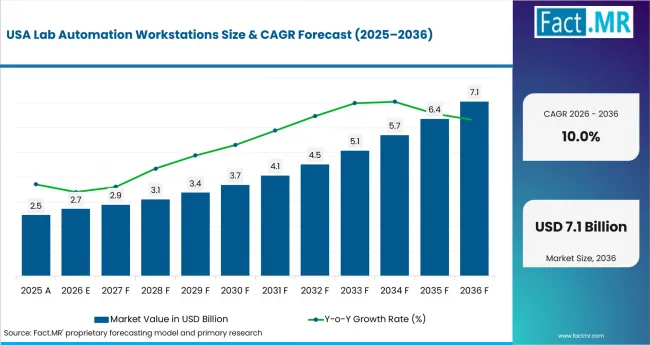
Lab Automation Workstations Country Value Analysis | Source: Fact.MR
The USA benefits from broad drug development and research spending. The National Center for Science and Engineering Statistics reported in September 2025 that U.S. business R&D performance reached USD 722 billion in 2023. The scale of U.S. business R&D as favorable for workstation programs in research organizations with repeated sample-preparation workflows.
How does Japan scale demand?
9.7% CAGR, supported by science spending and compact workstation needs.
Japan is suited to compact decks that fit space-conscious laboratories. The Statistics Bureau of Japan reported in its January 2026 bulletin that Japan’s science and technology R&D expenditure reached ¥23.79 trillion in FY2024. Japan’s R&D expenditure base as supportive of workstations used for genomics, assay preparation and analytical testing.
What is supporting Germany’s adoption?
9.4% CAGR, supported by R&D expenditure and regulated laboratory automation.
Germany combines industrial research with a deep life science laboratory base. Destatis reported in March 2026 that German R&D expenditure reached €137.1 billion in 2024. This R&D spending as supportive of automated weighing, dosing and liquid handling in repeatability-sensitive quality-control workflows.
What supports the United Kingdom’s growth?
8.4% CAGR, backed by clinical trial modernization and life science research.
The UK benefits from clinical research reform and laboratory modernization. GOV.UK reported in April 2026 that the set-up time for commercial interventional clinical trials had fallen to 122 days, according to UK Clinical Research Delivery data to March 2026. Faster trial setup as increasing the operational value of repeatable sample-preparation workflows in trial laboratories.
Who leads the Lab Automation Workstations Market?
Tecan supplies laboratory automation through its liquid handling, integrated automation and workflow software portfolio for life science laboratories. Its automation and service offerings emphasize regulatory compliance, reliable operation, maintenance and technical support in regulated laboratory environments.
Hamilton provides automated liquid handling, labware transport and integration capabilities. Its modular automation platforms support genomics, screening and sample preparation workflows.
Beckman Coulter Life Sciences provides Biomek automated workstations for applications including genomics, drug discovery, sample management and screening. Thermo Fisher Scientific supports laboratory automation through robotics, microplate movers, integrated instruments and workflow software.
Revvity and Agilent Technologies offer liquid handling, imaging and microplate automation solutions. Across these suppliers, portfolios emphasize application-specific workflows, service support, automation software, traceability and integration capabilities.
Which companies are the key providers?
Key companies include Tecan; Hamilton; Beckman Coulter Life Sciences; Thermo Fisher Scientific; Revvity; and Agilent Technologies.
- Tecan
- Hamilton
- Beckman Coulter Life Sciences
- Thermo Fisher Scientific
- Revvity
- Agilent Technologies
Bibliography
- U.S. Food and Drug Administration, Center for Drug Evaluation and Research. (2026, January). Advancing health through innovation: New drug therapy approvals 2025.
- National Center for Science and Engineering Statistics. (2025, September 29). Business R&D performance in the United States increases to $722 billion in 2023 (NSF 25-353). U.S. National Science Foundation.
- Federal Statistical Office. (2025, June 26). Almost CHF 26 billion invested in R&D in Switzerland in 2023.
- Statistics Bureau of Japan. (2026, January 28). News Bulletin January 28, 2026 (No. 375).
- Statistisches Bundesamt (Destatis). (2026, March 27). 3,8 % mehr Ausgaben für Forschung und Entwicklung im Jahr 2024.
- Department of Health and Social Care. (2026, April 15). Government drives forward its 150-day clinical trial target.
- Tecan. (2025, January 27). Tecan introduces Veya: Bringing digital, scalable automation to labs worldwide.
- Hamilton Company. (2025, July 16). Hamilton Company strengthens integration & liquid handling capabilities with the acquisition of UK Robotics and Trisonic Discovery.
- Beckman Coulter Life Sciences. (2025, December 2). Beckman Coulter Life Sciences introduces the Biomek i3 Benchtop Liquid Handler, a small but mighty addition to its portfolio of automated workstations.
This Report Answers
- The report explains where lab automation workstations are used across workstation type, automation level, application and throughput.
- Segment analysis identifies the leading subsegments and the operational reasons laboratories prioritize them.
- Country analysis examines the listed markets and the research or clinical mechanisms supporting workstation deployment.
- Competitive analysis reviews current providers across liquid handling and robotic integration. It also covers plate movement, imaging and connected workflow control.
- Application analysis assesses how repeatability, sample throughput and validation needs influence supplier selection.
What does the Lab Automation Workstations Market cover?
The Lab Automation Workstations Market covers instruments and integrated platforms that automate repeatable bench tasks. Coverage overlaps with lab automation systems when a workstation combines liquid handling, robotic motion and controlled software in one workflow.
The assessment includes automated decks for DNA and RNA sample preparation where extraction, normalization or library input preparation depends on accurate liquid transfer. It also covers lab workflow solutions when software schedules instruments or stores run records.
Connected workstation demand is evaluated alongside enterprise laboratory informatics where LIMS, ELN or SDMS links help laboratories track methods. NGS-focused workstations are covered where automated NGS library preparation requires validated pipetting and plate movement.
What is included in the scope?
The scope includes benchtop automated workstations, modular integrated decks and robotic multi-instrument cells. It includes related laboratory centrifuge systems only when they are part of an automated sample handling workflow.
It covers systems used with biotechnology instruments across pharma, biotech and academic research laboratories. Drug development use is included where drug discovery technologies rely on automated transfer, screening setup or sample preparation.
Plate handling and imaging workstations are included where automated microscopy links to robotic movement and assay workflows. Microplate-focused setups are included when microplate systems form part of a workstation rather than a standalone reader.
What is excluded from the scope?
The scope excludes general laboratory furniture and single-purpose manual pipettes. It excludes basic glassware, standalone consumables and software sold apart from automation control. Pure laboratory information systems are outside scope when they manage data apart from instrument operation.
Clinical analyzers sold as closed diagnostic systems are outside scope unless they are configured as open laboratory workstations. Full production robotics for manufacturing plants are outside scope when they are separate from laboratory workflows.
How Was the Analysis Built?
The analysis draws on 120+ sources, 35+ company portfolios, 25+ countries, and more than 20 industry interviews.
- Primary Research: Primary research includes discussions with manufacturers, service providers, technology developers, distributors, end users, and subject-matter experts. These conversations examine purchasing priorities, product adoption, operational challenges, approval requirements, competitive positioning, and the factors that influence wider market acceptance.
- Desk Research: Desk research covers government statistics, regulatory publications, company filings, trade data, technical studies, industry associations, standards, public policy, and other authoritative sources. Every source used in the analysis is documented in the bibliography.
- Market Sizing and Forecasting: Market estimates combine historical performance, demand indicators, pricing and volume trends, segment shares, company participation, country-level growth, adoption patterns, investment activity, and barriers to market expansion.
- Data Validation and Update Cycle: Findings are validated by comparing primary interviews with public data, company activity, regulatory changes, trade patterns, and industry developments. Regular updates review new product launches, capacity changes, partnerships, approvals, and shifts in commercial adoption.
What is the report’s scope and coverage?
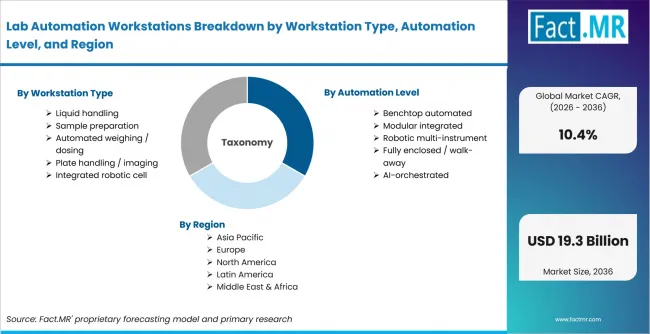
Lab Automation Workstations Breakdown By Workstation Type, Automation Level, And Region | Source: Fact.MR
| Attribute | Details |
|---|---|
| Quantitative Units | USD billion |
| Market Definition | Automated laboratory workstations that combine liquid handling, sample preparation, plate movement, imaging, weighing, dosing or integrated robotic cell functions for repeatable laboratory workflows. |
| Workstation Type | Liquid handling; Sample preparation; Automated weighing / dosing; Plate handling / imaging; Integrated robotic cell |
| Automation Level | Benchtop automated; Modular integrated; Robotic multi-instrument; Fully enclosed / walk-away; AI-orchestrated |
| Application | Pharma / biotech; Clinical diagnostics; Chemical / materials; Food / environmental; Academic research |
| Throughput | Low-throughput flexible; Medium throughput; High throughput; Ultra-high throughput; Custom batch / specialty |
| Key Companies Profiled | Tecan; Hamilton; Beckman Coulter Life Sciences; Thermo Fisher Scientific; Revvity; Agilent Technologies |
| Regions Covered | North America; Latin America; Western Europe; Eastern Europe; East Asia; South Asia & Pacific; Middle East & Africa |
| Countries Covered | Switzerland; United States; Japan; Germany; United Kingdom |
| Forecast Period | 2026 to 2036 |
| Approach | Hybrid top-down and bottom-up approach using laboratory R&D activity, clinical workflow needs, workstation portfolios, country adoption and provider participation. |
How is the market segmented?
-
By Workstation Type
- Liquid handling
- Sample preparation
- Automated weighing / dosing
- Plate handling / imaging
- Integrated robotic cell
-
By Automation Level
- Benchtop automated
- Modular integrated
- Robotic multi-instrument
- Fully enclosed / walk-away
- AI-orchestrated
-
By Application
- Pharma / biotech
- Clinical diagnostics
- Chemical / materials
- Food / environmental
- Academic research
-
By Throughput
- Low-throughput flexible
- Medium throughput
- High throughput
- Ultra-high throughput
- Custom batch / specialty
-
By Region
- North America
- Latin America
- Western Europe
- Eastern Europe
- East Asia
- South Asia & Pacific
- Middle East & Africa