- Market Value (2025): USD 4.6 Bn
- Estimated Value (2026): USD 4.9 Bn
- Forecast Value (2036): USD 9.0 Bn
- CAGR (2026-2036): 6.3%
What is the Laboratory Animal Medicine Market forecast to be worth by 2036?
USD 4.9 billion in 2026 to USD 9.0 billion by 2036, at 6.3% CAGR.
- The laboratory animal medicine market crossed a valuation of USD 4.6 billion in 2025 as research institutions and preclinical sponsors maintained animal-care and study-support programs.
- Demand is projected to increase from USD 4.9 billion in 2026 to USD 9.0 billion by 2036.
- The market is forecast to record a 6.3% CAGR from 2026 to 2036 as buyers place greater value on reproducibility, welfare compliance, and auditable supplier performance.
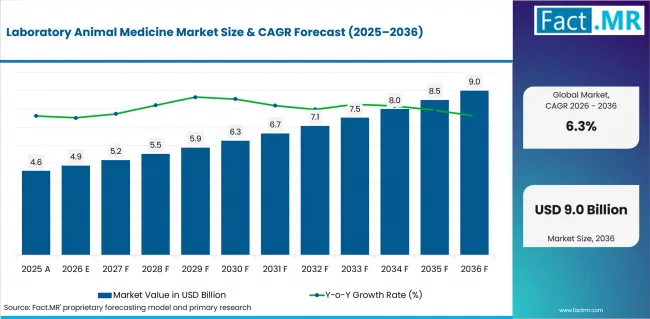
Laboratory Animal Medicine Market Value Analysis | Source: Fact.MR
What are the defining numbers behind Laboratory Animal Medicine Market growth?
USD 4.4 billion absolute opportunity by 2036, led by Pharmaceuticals, Biomedical Research; and Pharmaceutical & Biotechnology Companies.
- Demand Drivers in the Market
- Research sponsors need stable animal health because infection, uncontrolled pain, dietary variation; and inconsistent monitoring can introduce avoidable study noise.
- Protocol-linked anesthetics, antibiotics, vaccines; diagnostics; and procedure consumables create recurring demand even when animal-use volumes are flat or declining.
- Laboratory animal veterinarians and facility managers require species-specific documentation so products can be incorporated without weakening approved welfare or study procedures.
- Pharmaceutical companies, biotechnology companies, CRO buyers; and academic institutes value supply continuity because a product change can trigger retraining; requalification; or protocol amendments.
- Key Segments Analyzed
- By Product Type: Pharmaceuticals are projected to hold 34.0% share in 2026 because anesthesia, anti-infective control, vaccination; and condition-specific treatment sit inside recurring care protocols.
- By Application: Biomedical Research is projected to account for 36.0% share in 2026 due to its broad use across target validation, disease modeling, pharmacology; biomarker work; and proof-of-concept studies.
- By End User: Pharmaceutical & Biotechnology Companies are projected to represent 39.0% share in 2026 because they sponsor repeated preclinical programs and qualify suppliers across internal sites and external research partners.
- Analyst Opinion at Fact.MR
- Shambhu Nath Jha, Principal Consultant at Fact.MR, states: "Revenue capture depends on proving that a product improves animal care without weakening study control. Suppliers need species-specific validation; lot traceability; sanitary documentation; and technical support. Noninvasive monitoring and molecular diagnostics can gain ground when they reduce handling or detect a problem earlier. The strongest commercial positions will separate animal-care products from live-animal sales and downstream research services."
- Strategic Implications
- Product suppliers should validate dosing, handling, storage; and sanitary status for the intended species before seeking institution-wide adoption.
- Research sponsors should compare supply continuity and change-control procedures alongside product performance because mid-study substitution can disrupt approved protocols.
- Facility managers should test digital monitoring and precision diagnostics inside existing workflows so added data reduces manual burden instead of creating another review layer. Clinical workflow constraints remain relevant to the animal vaccines and animal antibiotics markets.
- Distributors should support local documentation, training, and service response because institutional buyers often require evidence before expanding a product across multiple sites.
How does the Laboratory Animal Medicine Market break down by segment?
Pharmaceuticals lead at 34.0%, Biomedical Research leads at 36.0%, and Pharmaceutical & Biotechnology Companies lead at 39.0%.
Why do Pharmaceuticals lead Product Type?
Pharmaceuticals hold 34.0% share in 2026.
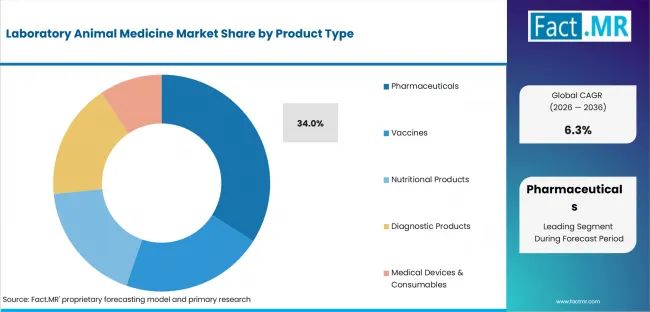
Laboratory Animal Medicine Market Analysis By Product Type | Source: Fact.MR
Pharmaceuticals lead because anesthetics, anti-infective products, vaccines; and other condition-specific treatments are written into approved animal-care and procedure plans. Many of these products are consumed per procedure or per treatment course. Demand therefore recurs even when institutions reduce overall animal use. Anesthetics support controlled procedures; antibiotics address approved infection-management needs; and vaccines protect colony health where preventive programs are permitted. The commercial test is not a broad veterinary label. Buyers need a defined species; dose form; quality file; storage condition; and reliable lot-to-lot performance.
Why does Biomedical Research lead Application?
Biomedical Research holds 36.0% share in 2026.
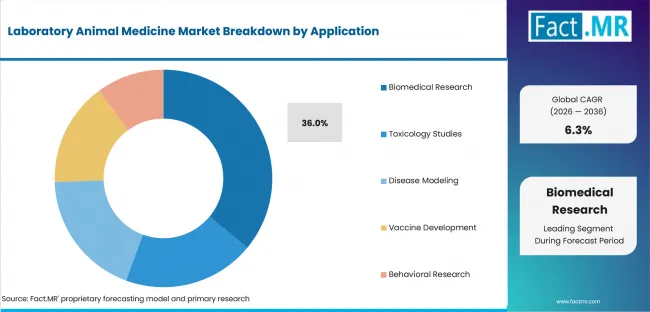
Laboratory Animal Medicine Market Analysis By Application | Source: Fact.MR
Biomedical Research covers the widest set of recurring in vivo tasks within the approved application structure. Target validation, disease progression, biomarker assessment; and proof-of-concept work may each require a different combination of medicines; diagnostics; nutrition; monitoring endpoints; and surgical consumables. Drug Discovery and Preclinical Research remain substantial because they connect experimental findings with development decisions. Toxicology Studies impose stricter documentation and repeatability requirements. The breadth of biomedical programs gives suppliers more opportunities to qualify products across several stages rather than depend on one study type.
Why do Pharmaceutical & Biotechnology Companies lead End User?
Pharmaceutical & Biotechnology Companies hold 39.0% share in 2026.
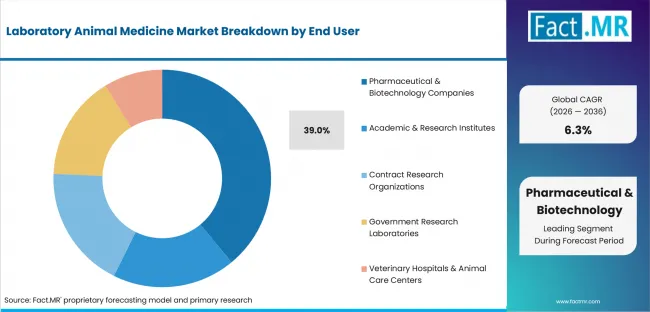
Laboratory Animal Medicine Market Analysis By End User | Source: Fact.MR
Pharmaceutical and biotechnology companies lead because they fund repeated programs, manage regulated development timelines, and coordinate work across internal laboratories and CRO partners. Procurement teams require consistent formulations; validated assays; health certificates; traceable lots; and service continuity. Pharmaceutical Companies bring portfolio scale and recurring study pipelines. Biotechnology Companies often need faster technical response for specialized models or narrower programs. Academic & Research Institutes remain important for fundamental science and disease research; but their purchasing can be more fragmented across grants; departments; and institutional contracts.
How do Distribution Channels shape purchasing?
Direct Sales and Institutional Contracts support high-control purchases, while Distributors extend local access.
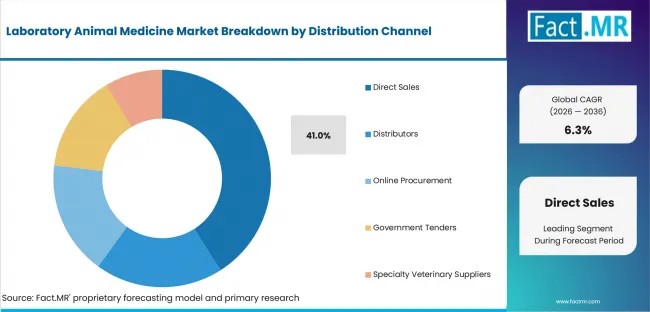
Laboratory Animal Medicine Market Analysis By Distribution Channel | Source: Fact.MR
Distribution choices depend on the risk attached to a product change. Direct Sales and Manufacturer Sales give large institutions closer access to technical teams, quality documents, and change-control notices. Institutional Contracts support repeated purchasing across defined sites; product lists; and service expectations. Distributors are important where buyers need local inventory; smaller order quantities; consolidated procurement; or faster replacement of routine consumables. A channel gains credibility when it can preserve documentation and product identity from the manufacturer to the research facility.
How does Animal Type affect product demand?
Species-specific care requirements shape dosing, handling, diagnostics; nutrition; and monitoring.
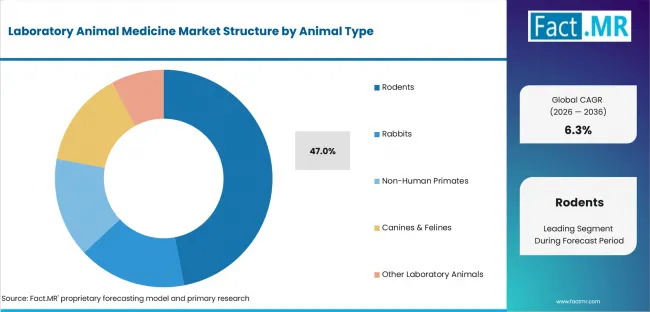
Laboratory Animal Medicine Market Analysis By Animal Type | Source: Fact.MR
The approved Animal Type taxonomy covers Rodents, Mice, Rats; and Rabbits. Mice are especially important within research activity. The Canadian Council on Animal Care reported that mice represented 36.8% of animals used in Canadian research; teaching; and testing during 2023. High use does not make products interchangeable across species. Mice; rats; and rabbits differ in body size; handling; procedure design; nutritional needs; and monitoring thresholds. Suppliers therefore need clear species applicability and practical guidance rather than generic laboratory-animal positioning.
What is accelerating Laboratory Animal Medicine Market adoption, and what is holding it back?
Reproducible and welfare-compliant in vivo research supports demand, while 3Rs scrutiny restricts eligible use and noninvasive monitoring creates the clearest product opportunity. Data governance connects this demand with the animal genetics and molecular diagnostic markets.
Drivers Impact Analysis
- Study reliability and animal condition: Colony infection, uncontrolled pain, dietary variation; or weak monitoring can add noise; force exclusions; and delay development decisions. Animal-care products gain commercial value when they reduce these avoidable sources of variation.
- Recurring protocol demand: Anesthetics, antibiotics, vaccines; diagnostics; nutritional controls; and procedure consumables are tied to approved work. Replenishment continues across active programs even when institutions pursue reduction in animal numbers.
| DRIVER | QUALITATIVE RELEVANCE | GEOGRAPHIC RELEVANCE | IMPACT TIMELINE |
|---|---|---|---|
| Study reliability and animal condition | High | Germany | 2026 to 2036 |
| Recurring protocol demand | High | Germany | 2026 to 2036 |
Source: Fact.MR analysis. Updated Aug 3, 2026
Opportunity Impact Analysis
- Noninvasive monitoring and precision diagnostics: Home-cage monitoring can reduce handling and capture longitudinal behavior. Molecular diagnostics can identify pathogens or biomarkers earlier. Standardized nutrition can control a major source of biological variation. The opportunity is strongest when these tools fit an approved protocol and produce a clear action for veterinarians or study teams.
| OPPORTUNITY | QUALITATIVE RELEVANCE | GEOGRAPHIC RELEVANCE | IMPACT TIMELINE |
|---|---|---|---|
| Noninvasive monitoring and precision diagnostics | High | Germany | 2026 to 2036 |
Source: Fact.MR analysis. Updated Aug 3, 2026
Restraints Impact Analysis
- 3Rs requirements and protocol scrutiny: The restraint appears during protocol justification and approval, not only at product price. The NIH announced in April 2025 that it would prioritize human-based research technologies and reduce animal use. Germany and the UK reported continuing declines in experimental activity. Australia requires ethics approval and compliance with a national code adopted through state and territory legislation.
- Qualification burden: A new medicine, diagnostic, diet; or monitoring device may require local review before use. Buyers must confirm species applicability; welfare impact; data quality; storage; training needs; and continuity. These checks slow conversion but also protect qualified suppliers from casual substitution.
| RESTRAINT | QUALITATIVE RELEVANCE | GEOGRAPHIC RELEVANCE | IMPACT TIMELINE |
|---|---|---|---|
| 3Rs requirements and protocol scrutiny | High | Germany | 2026 to 2036 |
| Qualification burden | High | Germany | 2026 to 2036 |
Source: Fact.MR analysis. Updated Aug 3, 2026
Which countries are scaling Laboratory Animal Medicine Market fastest?
Germany 7.2%, Brazil 6.6%, USA 6.3%; Australia 6.0%; Canada 5.7%; UK 5.4%; and Japan 4.7% through 2036.
Regional analysis covers North America, Latin America, Western Europe; Eastern Europe; East Asia; South Asia and Pacific; and the Middle East and Africa.
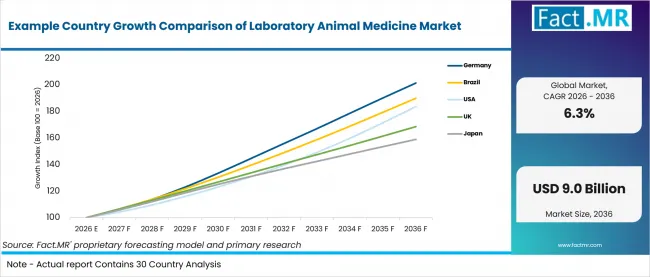
Example Country Growth Comparison Of Laboratory Animal Medicine Market | Source: Fact.MR
| COUNTRY | CAGR, 2026 TO 2036 |
|---|---|
| Germany | 7.2% |
| Brazil | 6.6% |
| USA | 6.3% |
| UK | 5.4% |
| Japan | 4.7% |
| Australia | 6.0% |
| Canada | 5.7% |
Source: Fact.MR analysis. Updated Aug 3, 2026
What is shaping Germany's outlook through 2036?
7.2% CAGR through 2036, supported by tightly controlled welfare and authorization requirements.
German research institutions buy within protocols that connect animal welfare, sanitary status, replacement testing; and authorization evidence. This environment does not reward broad claims. It favors products that help facilities document refinement; maintain consistent health conditions; and avoid preventable study variation. Germany is forecast to record the highest listed CAGR at 7.2% through 2036 because compliant care products and monitoring tools can earn a defined place inside controlled research workflows.
What is shaping Brazil's outlook through 2036?
6.6% CAGR through 2036, supported by institutional research and species-specific CONCEA requirements.
Brazilian universities, public institutes, and private research groups purchase through institutional systems that must reflect CONCEA rules for facilities and animal care. Species-specific requirements increase the need for training; documented handling; and locally supported supply. Buyers also need distributors or manufacturers that can provide consistent product identity and practical technical response. Demand is projected to expand at 6.6% CAGR through 2036 as research activity and compliance needs pull more care products into formal procurement. Provider adoption conditions also affect the molecular diagnostics reagent and anesthetics markets.
What is shaping USA's outlook through 2036?
6.3% CAGR through 2036, driven by large biopharma, CRO; university; and government laboratory demand.
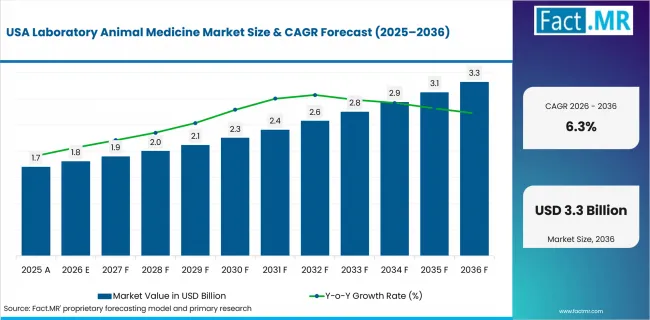
Laboratory Animal Medicine Market Country Value Analysis | Source: Fact.MR
USA buyers include pharmaceutical sponsors, biotechnology companies, CROs; universities; and government laboratories. Vendor qualification and institutional animal-care review shape purchasing before a product reaches an active study. Large programs value national availability; change control; lot traceability; technical support; and continuity across research partners. Demand is forecast to rise at 6.3% CAGR through 2036; although the shift toward human-based methods will keep protocol justification and product relevance under close review.
What is shaping the UK's outlook through 2036?
5.4% CAGR through 2036, shaped by project and establishment licensing systems.
UK establishments purchase within a licensing framework that tracks species, severity, and scientific purpose. The country has also reported declining numbers of scientific procedures; which limits volume-led expansion. Suppliers can still grow by improving welfare; supporting refinement; reducing manual monitoring; and strengthening study consistency within approved work. Demand is projected to expand at 5.4% CAGR through 2036 as buyers favor well-documented products that fit licensed procedures.
What is shaping Japan's outlook through 2036?
4.7% CAGR through 2036, supported by institution-led animal experiment governance and careful supplier control.
Japanese institutions rely on internal animal-experiment committees and facility procedures that implement national welfare and research guidance. Product adoption is therefore deliberate. Buyers assess intended use, species fit, handling; training; documentation; and supplier reliability before changing an established product. Demand is forecast to expand at 4.7% CAGR through 2036 as institutions add better diagnostics; monitoring; and care inputs without weakening internal governance.
What is shaping Australia's outlook through 2036?
6.0% CAGR through 2036, supported by ethics review and code-based institutional compliance.
Australian animal research requires ethics approval and compliance with a code adopted into state and territory legislation. This gives animal-care products a clear approval context but raises the evidence burden for new suppliers. Facilities need products that support refinement, staff training, and consistent monitoring within approved procedures. Demand is forecast to rise at 6.0% CAGR through 2036 as institutions invest in compliant care while limiting unnecessary animal use.
What is shaping Canada's outlook through 2036?
5.7% CAGR through 2036, supported by a large research base and formal animal-care oversight.
The Canadian Council on Animal Care reported 3,128,943 animals used in research; teaching; and testing during 2023. Mice represented 36.8%; while fundamental science accounted for 59.4% of reported use. This mix supports demand for species-specific medicines; diagnostics; nutrition; and monitoring tools. Canada is forecast to expand at 5.7% CAGR through 2036 as institutions balance research activity with welfare review; documentation; and the need to reduce avoidable variation.
Who leads the Laboratory Animal Medicine Market?
Competition is organized around integrated research support, model health, medicines; diagnostics; and direct institutional access. Charles River Laboratories; Inotiv Inc.; Labcorp; and Envigo connect preclinical workflows with health monitoring; diagnostics; or research services. Taconic Biosciences and The Jackson Laboratory compete through model genetics; sanitary status; colony management; and research-enabling platforms. These positions matter because buyers often evaluate the care environment and the research model together even when live-animal sales and CRO service fees remain outside the market boundary.
Merck Animal Health, Zoetis Inc., and Elanco Animal Health contribute animal-health medicines and preventive-care capabilities. Bio-Techne Corporation adds molecular diagnostics; reagents; and tissue-analysis tools that support preclinical interpretation. Competitive credibility through 2036 is expected to depend on species-specific evidence; quality documentation; lot traceability; technical response; and the ability to serve institutional procurement without blurring the revenue boundary.
In April 2024, Charles River Laboratories launched Patholytix Foresight with Deciphex as an AI-assisted decision-support tool for nonclinical toxicologic pathology. The platform combines organ-based lesion classifiers with whole-slide images to improve the consistency and speed of primary evaluation and peer review. Procurement scrutiny appears in the biomarkers and pharmaceuticals markets.
In January 2024, Bio-Techne Corporation announced a spatial multiomics workflow combining Lunaphore COMET technology with Advanced Cell Diagnostics RNAscope assays. The workflow supports automated same-slide protein and RNA detection in tissue, helping researchers connect disease biology with pathology findings from preclinical models.
In November 2024, Taconic Biosciences opened a USA West Coast production location for expanded mouse-model production and colony management. The site added standard and genetically modified models, shorter transit times; twice-weekly deliveries; universal health standards; and direct customer support.
Which companies are the key providers?
Charles River Laboratories and Inotiv Inc. are leading companies in the market.
- Charles River Laboratories
- Inotiv Inc.
- Labcorp
- Taconic Biosciences
- The Jackson Laboratory
- Merck Animal Health
- Zoetis Inc.
- Envigo
- Elanco Animal Health
- Bio-Techne Corporation
Bibliography
- National Institutes of Health. (2025, April 29). NIH to prioritize human-based research technologies.
- German Federal Institute for Risk Assessment. (2024, December 12). Animal testing: decline of previous years clearly continues.
- Ministry of Science, Technology and Innovation, Brazil. (2024, November 14). CONCEA publishes guideline and report on the use of animals in teaching and research.
- UK Home Office. (2024, September 11). Annual statistics of scientific procedures on living animals, Great Britain 2023.
- Canadian Council on Animal Care. (2024, December 17). Explore the CCAC Animal Data Report 2023.
This Report Addresses
- What is the Laboratory Animal Medicine Market worth in 2026, and what value is forecast for 2036?
- Which welfare, study-reliability, procurement; and regulatory pressures shape demand?
- Why do Pharmaceuticals, Biomedical Research, and Pharmaceutical & Biotechnology Companies lead their segments?
- How do country growth rates and purchasing conditions differ across the profiled markets?
- Which companies are profiled, and what determines competitive credibility?
- What scope boundary, segmentation, evidence base; and methodology support the market assessment?
What does the Laboratory Animal Medicine Market cover?
Animal-specific medicines, vaccines, nutrition; diagnostics; devices; and consumables used to care for and monitor laboratory animals.
The Laboratory Animal Medicine Market covers revenue from products sold for the care, treatment, prevention; diagnosis; and monitoring of laboratory animals. Coverage includes protocol-linked pharmaceuticals; vaccines; nutritional products; diagnostic kits and reagents; monitoring equipment; medical devices; surgical instruments; and related consumables when the purchased function is animal care or study support.
The market is distinct from research-model sales and outsourced study services. Commercial value comes from the animal-care product or consumable, not from the live animal, model-generation fee; CRO study fee; vivarium rental; or downstream human and veterinary product revenue.
What is included in the scope?
Products purchased for laboratory-animal care across approved research, testing, teaching; and preclinical environments.
The scope includes Pharmaceuticals, Anesthetics, Antibiotics; and Vaccines across Biomedical Research; Drug Discovery; Preclinical Research; and Toxicology Studies. It covers Pharmaceutical & Biotechnology Companies; Pharmaceutical Companies; Biotechnology Companies; and Academic & Research Institutes. Direct Sales; Manufacturer Sales; Institutional Contracts; and Distributors are included as purchase routes. The Animal Type taxonomy covers Rodents; Mice; Rats; and Rabbits. Regional coverage follows the seven-region structure shown in the scope table.
What is excluded from the scope?
Live-animal sales, model-generation fees, CRO study fees; and general laboratory infrastructure are outside the market boundary.
The scope excludes live-animal and research-model revenue, colony sales, model-generation fees; CRO and outsourced study services; vivarium construction or rental; and general-purpose laboratory equipment not sold specifically for laboratory-animal medicine. It also excludes downstream human or veterinary finished-product revenue and adjacent substitute categories that do not perform a defined animal-care; diagnostic; treatment; prevention; or monitoring function.
How was the analysis built?
- Primary Research
- Interviews with laboratory animal medicine manufacturers, research-model suppliers, distributors; laboratory animal veterinarians; facility managers; pharmaceutical and biotechnology procurement teams; CRO buyers; and subject-matter experts test product use; purchase criteria; channel structure; replacement cycles; and adoption.
- Desk Research
- The review covers official animal-use statistics, welfare regulations, government guidance; company filings; product documentation; public procurement information; peer-reviewed literature; and trade evidence relevant to the defined product and revenue boundary. Patient-monitoring needs also shape the biotechnology and ready to use laboratory test kits markets.
- Market-Sizing and Forecasting
- A hybrid bottom-up and top-down model combines supplier revenue indicators, institutional research activity, species mix; product utilization; replacement frequency; research funding; regulation; 3Rs adoption; procurement behavior; and product innovation.
- Data Validation and Update Cycle
- Cross-checking reconciles company, segment, country; and scope evidence while excluding double-counting; unsupported claims; live-animal sales; CRO study fees; downstream finished-product revenue; and adjacent categories outside the market definition.
Segmentation
What is the report’s scope and coverage?
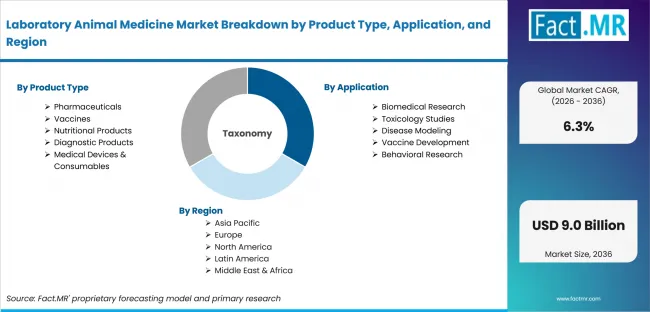
Laboratory Animal Medicine Market Breakdown By Product Type, Application, And Region | Source: Fact.MR
| Attribute | Details |
|---|---|
| Quantitative Units | USD Billion in 2026 to USD Billion by 2036 at CAGR |
| Market Definition | Revenue from animal-specific pharmaceuticals, vaccines, nutritional products; diagnostic products; medical devices; and consumables sold for the care; treatment; prevention; diagnosis; and monitoring of laboratory animals. |
| Product Type | Pharmaceuticals; Anesthetics; Antibiotics; Vaccines |
| Application | Biomedical Research; Drug Discovery; Preclinical Research; Toxicology Studies |
| End User | Pharmaceutical & Biotechnology Companies; Pharmaceutical Companies; Biotechnology Companies; Academic & Research Institutes |
| Distribution Channel | Direct Sales; Manufacturer Sales; Institutional Contracts; Distributors |
| Animal Type | Rodents; Mice; Rats; Rabbits |
| Regions Covered | North America; Latin America; Western Europe; Eastern Europe; East Asia; South Asia and Pacific; Middle East and Africa |
| Countries Covered | Germany; Brazil; USA; UK; Japan; Australia; Canada; more than twenty-five additional countries in the full report |
| Key Companies Profiled | Charles River Laboratories; Inotiv Inc.; Labcorp; Taconic Biosciences; The Jackson Laboratory; Merck Animal Health; Zoetis Inc.; Envigo; Elanco Animal Health; Bio-Techne Corporation |
| Forecast Period | 2026 to 2036 |
| Approach | Hybrid bottom-up and top-down sizing using supplier revenue signals, product utilization, institutional research activity; species mix; replacement frequency; procurement behavior; regulation; and country-level purchasing conditions. |
Source: Fact.MR analysis. Updated Aug 3, 2026
How is the market segmented?
-
By Product Type:
- Pharmaceuticals
- Anesthetics
- Antibiotics
- Vaccines
- Viral Vaccines
- Bacterial Vaccines
- Nutritional Products
- Dietary Supplements
- Specialized Feed Additives
- Diagnostic Products
- Diagnostic Kits
- Molecular Reagents
- Medical Devices & Consumables
- Surgical Instruments
- Monitoring Equipment
- Pharmaceuticals
-
By Application:
- Biomedical Research
- Drug Discovery
- Preclinical Research
- Toxicology Studies
- Safety Assessment
- Regulatory Toxicology
- Disease Modeling
- Oncology Models
- Genetic Disease Models
- Vaccine Development
- Preclinical Vaccine Testing
- Immunogenicity Studies
- Behavioral Research
- Neuroscience Studies
- Psychopharmacology Research
- Biomedical Research
-
By End User:
- Pharmaceutical & Biotechnology Companies
- Pharmaceutical Companies
- Biotechnology Companies
- Academic & Research Institutes
- Universities
- Public Research Institutes
- Contract Research Organizations
- Preclinical CROs
- Toxicology CROs
- Government Research Laboratories
- Public Health Laboratories
- Defense Research Facilities
- Veterinary Hospitals & Animal Care Centers
- Laboratory Animal Hospitals
- Specialized Veterinary Centers
- Pharmaceutical & Biotechnology Companies
-
By Distribution Channel:
- Direct Sales
- Manufacturer Sales
- Institutional Contracts
- Distributors
- National Distributors
- Regional Distributors
- Online Procurement
- E-Commerce Platforms
- Digital Procurement Portals
- Government Tenders
- Public Procurement
- Research Grants
- Specialty Veterinary Suppliers
- Laboratory Suppliers
- Veterinary Equipment Suppliers
- Direct Sales
-
By Animal Type:
- Rodents
- Mice
- Rats
- Rabbits
- New Zealand White Rabbits
- Dutch Rabbits
- Non-Human Primates
- Macaques
- Marmosets
- Canines & Felines
- Dogs
- Cats
- Other Laboratory Animals
- Guinea Pigs
- Zebrafish
- Rodents
-
By Region:
- North America
- Latin America
- Western Europe
- Eastern Europe
- East Asia
- South Asia and Pacific
- Middle East & Africa
Frequently Asked Questions
Which Product Type leads the Laboratory Animal Medicine Market?
Which Application leads the Laboratory Animal Medicine Market?
Which End User leads the Laboratory Animal Medicine Market?
How do Distribution Channels shape the market?
Why does Animal Type matter in this market?
Which country records the highest listed CAGR?
How does Brazil perform in the Laboratory Animal Medicine Market?
How does the USA perform in the Laboratory Animal Medicine Market?
How does Australia perform in the Laboratory Animal Medicine Market?
How does Canada perform in the Laboratory Animal Medicine Market?
How does the UK perform in the Laboratory Animal Medicine Market?
How does Japan perform in the Laboratory Animal Medicine Market?
What is the primary driver in the Laboratory Animal Medicine Market?
What is the main restraint in the Laboratory Animal Medicine Market?
What is the clearest opportunity in the Laboratory Animal Medicine Market?
Who worked on this report


Preview the report firsthand - request a free sample
Free SampleGet the brochure for pricing and purchase details
Download PDF