- Market Value (2025): USD 1.0 Bn
- Estimated Value (2026): USD 1.0 Bn
- Forecast Value (2036): USD 1.6 Bn
- CAGR (2026-2036): 5.1%
What is the Laboratory Andrology Equipment Market forecast to be worth by 2036?
USD 1.0 billion in 2026 to USD 1.6 billion by 2036 at a 5.1% CAGR.
- The Laboratory Andrology Equipment Market reached USD 1.0 billion in 2025.
- Demand is projected to increase from USD 1.0 billion in 2026 to USD 1.6 billion by 2036.
- The market is forecast to record 5.1% CAGR from 2026 to 2036 as hospitals, fertility centers and diagnostic laboratories standardize semen testing and sample handling.
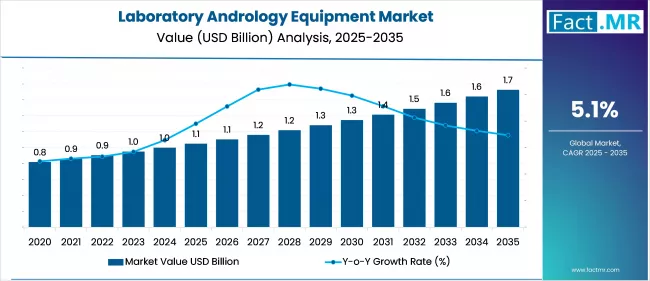
Laboratory Andrology Equipment Market Value Analysis | Source: Fact.MR
What are the defining numbers behind Laboratory Andrology Equipment Market growth?
An absolute opportunity of USD 0.6 billion is expected between 2026 and 2036.
- Demand Drivers in the Market
- Fertility clinics need repeatable semen assessment because WHO stated in November 2025 that infertility affects about one in six people of reproductive age worldwide during their lifetime.
- Hospitals need objective concentration, motility and morphology readings so reproductive medicine departments can align diagnostic review with treatment planning.
- Andrology laboratories need computer-assisted analysis to reduce operator variation when semen samples move from collection to reporting.
- Cryopreservation teams need controlled warming and storage equipment as sperm banking becomes part of fertility preservation pathways.
- Clinical laboratories need validation kits and documented quality controls to support repeat testing across routine and specialized semen analysis.
- Key Segments Analyzed
- By Product: Semen Analysis Equipment is expected to hold 33.60% share in 2026 owing to its direct role in concentration, motility and morphology evaluation.
- By Testing: Routine Semen Analysis is projected to account for 35.90% share in 2026 because baseline semen quality measurement is the starting point for most male fertility workups.
- By End User: Hospitals are anticipated to represent 56.90% share in 2026 supported by reproductive medicine departments and clinical laboratory infrastructure.
- Analyst Opinion at Fact.MR
- Shambhu Nath Jha, Principal Consultant at Fact.MR, states, “Andrology equipment is drawing attention because semen testing remains sensitive to timing, temperature and operator technique. Demand is expected to move toward systems that document sample handling and produce repeatable measurements. Suppliers that combine analyzers, preparation devices, warming systems and service support are aligned with how clinical laboratories operate.”
- Strategic Implications
- Equipment vendors should document analyzer performance for concentration, motility and morphology under WHO-aligned laboratory practice.
- CASA platform suppliers should support quality-control programs such as Hamilton Thorne announced in February 2025 that the new External Quality Control edition for SCA and SCA SCOPE was available to customers under maintenance.
- Hospitals should connect andrology outputs with reproductive medicine records so repeat semen testing remains traceable across consultations.
- Cryostorage suppliers should show temperature stability and inventory control for sperm banking and fertility preservation programs.
The USA is projected to record 5.5% CAGR through 2036 due to hospital-led fertility services and high-volume diagnostic testing. Germany is expected to post 5.1% CAGR as fertility centers operate within structured clinical documentation systems. Japan is anticipated to advance at 4.8% CAGR because ART activity keeps equipment utilization high. France is estimated to hold 4.4% CAGR as donor sperm demand expands clinic workflows. Italy is forecast to reach 3.9% CAGR as PMA centers maintain steady assisted reproduction activity.
How does the Laboratory Andrology Equipment Market break down by segment?
Semen Analysis Equipment is projected to lead Product at 33.6% share in 2026; Routine Semen Analysis leads Testing at 35.90% share; Hospitals lead End User at 56.9% share.
Which Product dominates?
Semen Analysis Equipment is expected to hold 33.6% share in 2026.
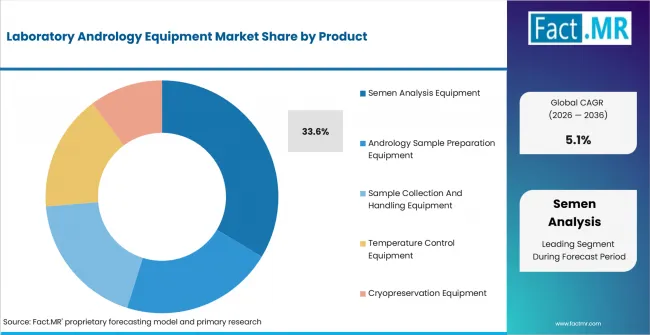
Laboratory Andrology Equipment Market Analysis By Product | Source: Fact.MR
Semen analysis equipment leads because the first laboratory decision in male-factor infertility usually depends on concentration, motility and morphology. Hamilton Thorne describes CASA systems for sperm motility, morphology and related reproductive-cell analysis. Analyzer depth gives clinics a practical reason to invest in measurement platforms before expanding into more specialized sperm function tests.
SCA extends this role through modules for concentration, motility, morphology, DNA fragmentation, vitality and acrosome reaction. Hamilton Thorne states that SCA is not for clinical diagnostic procedures in the USA and is for research purposes only there. Those functions match the way andrology laboratories move from a routine semen report toward deeper sample-quality review.
What leads the Testing segment?
Routine Semen Analysis is projected to account for 35.9% share in 2026.
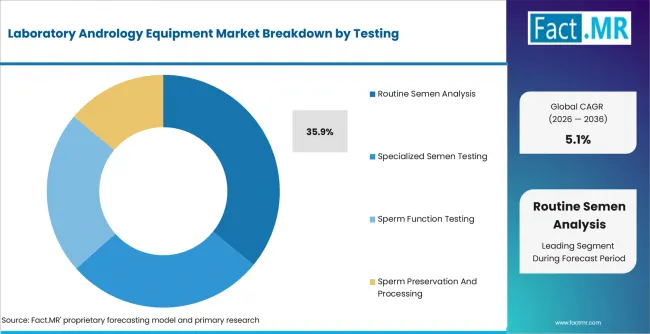
Laboratory Andrology Equipment Market Analysis By Testing | Source: Fact.MR
Routine semen analysis holds the main testing share because it is the entry point for male fertility evaluation. It supports first assessment, repeat testing and treatment planning before clinics use DNA fragmentation, acrosome reaction or sperm function testing. Medical Electronic Systems lists SQA-Vision for andrology labs and SQA-iO for hospitals and reference laboratories.
FDA listed Medical Electronic Systems Ltd.’s SQA-iOw Sperm Quality Analyzer as a semen analysis device with a May 2, 2025 decision date. The device received a substantially equivalent determination and is listed as CLIA-waived, providing a defined regulatory pathway for automated semen analysis.
What supports Hospitals within End User?
Hospitals are anticipated to represent 56.9% share in 2026.
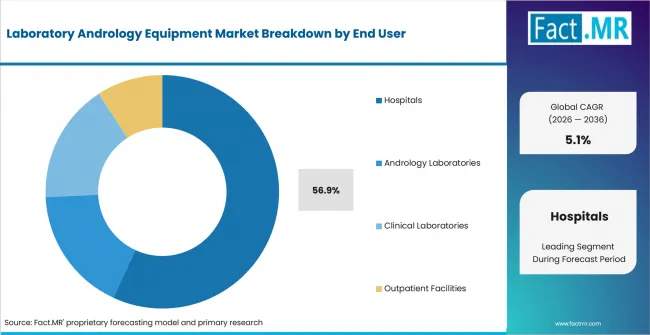
Laboratory Andrology Equipment Market Analysis By End User | Source: Fact.MR
Hospitals lead the end-user base because reproductive medicine departments often combine diagnostic testing with specialist consultation and ART referral. Their laboratories need reliable throughput when semen samples are time sensitive. Thermo Fisher lists medical-device versions of its Heracell 150i and 240i CO₂ incubators as FDA Class II Medical Devices for IVF, with optional oxygen control supporting low-oxygen and tri-gas workflows.
Hospital demand is also shaped by multidisciplinary workflows. Reproductive departments often need semen assessment, specimen warming and cryostorage access near clinical decision teams. This favors established suppliers that can support equipment uptime, training and documentation across laboratory and clinical interfaces.
What is accelerating Laboratory Andrology Equipment Market adoption, and what is holding it back?
Demand is expected to rise through standardized semen testing and ART laboratory workflow needs. Adoption is constrained by coverage limits, training needs and analyzer cost.
Drivers Impact Analysis
| DRIVER | (~) % IMPACT ON CAGR | GEOGRAPHIC RELEVANCE | IMPACT TIMELINE |
|---|---|---|---|
| Standardized semen analysis in fertility workups | +1.1% | Global | Short term (<= 2 years) |
| ART procedure workflows in fertility centers | +0.9% | North America, Europe, East Asia | Medium term (2-4 years) |
| Hospital quality control and traceability needs | +0.7% | North America, Western Europe | Medium term (2-4 years) |
| Cryopreservation and fertility preservation pathways | +0.5% | Global | Long term (>= 4 years) |
Source: Fact.MR analysis. Updated Sep 16, 2026
Opportunity Impact Analysis
| OPPORTUNITY | (~) % IMPACT ON CAGR | GEOGRAPHIC RELEVANCE | IMPACT TIMELINE |
|---|---|---|---|
| CASA upgrades for routine laboratories | +0.8% | Global | Short term (<= 2 years) |
| Integrated preparation and warming systems | +0.6% | North America, Europe | Medium term (2-4 years) |
| Cryopreservation workflow support | +0.5% | Global | Long term (>= 4 years) |
Source: Fact.MR analysis. Updated Sep 16, 2026
Restraints Impact Analysis
| RESTRAINT | (~) % IMPACT ON CAGR | GEOGRAPHIC RELEVANCE | IMPACT TIMELINE |
|---|---|---|---|
| Coverage and eligibility limits for fertility care | -0.5% | North America, Europe | Short term (<= 2 years) |
| Manual skill dependence in lower-volume laboratories | -0.4% | Global | Medium term (2-4 years) |
| Capital cost of automated analyzer systems | -0.3% | Global | Medium term (2-4 years) |
Source: Fact.MR analysis. Updated Sep 16, 2026
Which countries are scaling the Laboratory Andrology Equipment Market through 2036?
- The country comparison spans 1.6 percentage points across the forecast period.
- The USA remains 0.4 percentage point above Germany as hospital fertility services and laboratory automation support testing volume.
- Germany remains 0.3 percentage point above Japan due to structured clinical documentation and established fertility-center networks.
- Japan remains 0.4 percentage point above France as ART activity keeps analyzer use visible across registered facilities.
- France remains 0.5 percentage point above Italy as donor sperm demand expands sample handling and storage needs.
Comparable CAGRs can create different entry conditions due to hospital testing volume, clinic density, reimbursement rules and demographic pressure. Full report coverage includes North America, Latin America, Western Europe, Eastern Europe, East Asia, South Asia & Pacific, Middle East & Africa.
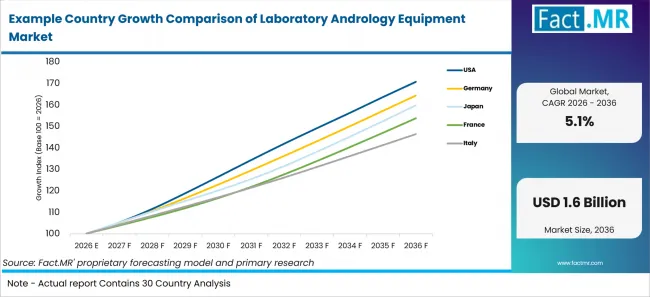
Example Country Growth Comparison Of Laboratory Andrology Equipment Market | Source: Fact.MR
| Country | CAGR (2026-2036) |
|---|---|
| USA | 5.5% |
| Germany | 5.1% |
| Japan | 4.8% |
| France | 4.4% |
| Italy | 3.9% |
Source: Fact.MR analysis. Updated Sep 16, 2026
What supports USA adoption?
5.5% CAGR, supported by hospital fertility services and standardized semen testing.
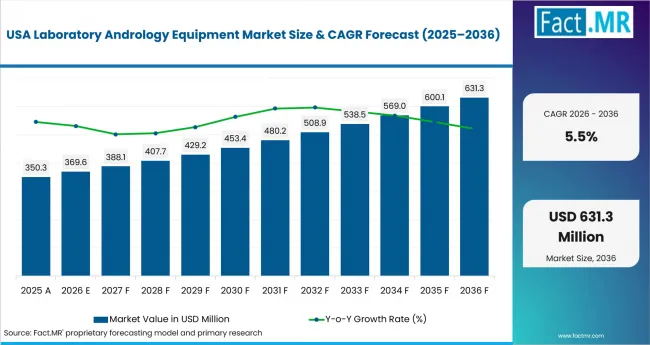
Laboratory Andrology Equipment Market Country Value Analysis | Source: Fact.MR
U.S. adoption is supported by current regulated semen-analysis equipment. FDA records the SQA-iOw Sperm Quality Analyzer under 510(k) K243114 with a May 2, 2025 substantially-equivalent decision, and FDA’s CLIA database lists the device as waived effective the same date.
What is supporting Germany’s adoption?
5.1% CAGR, reinforced by structured fertility care and clinic documentation.
Germany benefits from regulated reproductive care and a mature fertility-laboratory base. The German IVF Registry recorded 134,281 documented treatment cycles in 2024, including 131,801 plausible cycles. This treatment volume provides direct context for the scale of assisted-reproduction clinical and laboratory workflows in Germany.
How does Japan perform?
4.8% CAGR, led by ART utilization and domestic fertility-clinic activity.
Japan remains utilization-led because registered fertility care keeps laboratory equipment in steady use. A peer-reviewed report first published online in December 2025 and included in the 2026 volume of Reproductive Medicine and Biology documented 561,664 ART treatment cycles in 2023 using Japan Society of Obstetrics and Gynecology registry data. ART laboratories use semen assessment and preparation, cryopreservation, and controlled thawing and warming procedures as part of assisted-reproduction workflows.
What supports France adoption?
4.4% CAGR, driven by donor sperm demand and fertility preservation services.
France has a policy-linked demand base around sperm donation and preservation. Agence de la biomédecine reported in April 2026 that more than 12,000 requests for AMP with sperm donation were registered in 2025 among female couples and single women. This sustained level of activity provides context for laboratory requirements related to gamete processing, documentation and storage across reproductive-medicine centers.
How is Italy developing demand?
3.9% CAGR, supported by PMA coverage and fertility-center reporting.
Italy is shaped by PMA reporting and steady assisted reproduction activity. Italy’s Ministry of Health reported in February 2026 that PMA cycles increased from 109,755 in 2022 to 112,804 in 2023. The continued volume of activity across authorized PMA centers supports ongoing use of reproductive-laboratory processes including insemination, IVF and gamete or embryo cryopreservation.
Who leads the Laboratory Andrology Equipment Market?
Nexpring Health participates through the Hamilton Thorne and Microptic brands. Hamilton Thorne’s CEROS II and IVOS II platforms support sperm count, concentration, motility, kinematic assessment and morphology, while Microptic’s SCA software adds modules for DNA fragmentation, vitality, acrosome reaction and leukocytes. Hamilton Thorne states that its CEROS II and IVOS II CASA systems are not for clinical diagnostic procedures in the United States and are for research purposes only there.
Medical Electronic Systems LLC competes through SQA analyzers, testing supplies and validation kits. Its catalog lists SQA-Vision for andrology laboratories and SQA-iO for hospitals and reference laboratories. Shivani Scientific Industries supplies dedicated andrology products including Androstation, Androfuge, Androscope Basic and Advanced, Androblock and Androbox systems.
Thermo Fisher Scientific contributes adjacent controlled-environment equipment through CO₂ incubator platforms used in IVF and laboratory workflows. ZEISS supports microscope-based semen-analysis configurations through compatible clinical and laboratory microscopy hardware. Competitive differentiation is likely to center on analyzer accuracy, preanalytical and workflow documentation, service support and integration into time-sensitive semen-testing workflows.
Which companies are the key providers?
Key providers include Nexpring Health through Hamilton Thorne and Microptic; Medical Electronic Systems LLC; Shivani Scientific Industries Pvt. Ltd.; Thermo Fisher Scientific Inc.; and ZEISS.
- Nexpring Health (Hamilton Thorne and Microptic)
- Medical Electronic Systems LLC
- Shivani Scientific Industries Pvt. Ltd.
- Thermo Fisher Scientific Inc.
- Zeiss
Bibliography
- Agence de la biomédecine. (2026, April 14). Publication des derniers résultats d’activité nationale en AMP : un niveau toujours élevé en 2025.
- Deutsches IVF-Register e.V. (D·I·R). (2025, November 29). D·I·R® Annual 2024 – Tables.
- Hamilton Thorne. (2025a, January 21). Cook Medical Reproductive Health, Hamilton Thorne Ltd., and Fujifilm Irvine Scientific are joining forces!
- Hamilton Thorne. (2025b, February 18). External Quality Control 2025 for SCA and SCA SCOPE CASA Systems.
- Hamilton Thorne. (2025c, March 31). Introducing Nexpring Health.
- Katagiri, Y., Jwa, S. C., Kuwahara, A., Iwasa, T., Ono, M., Kato, K., Kishi, H., Kuwabara, Y., Taniguchi, F., Harada, M., Iwase, A., & Sugino, N. (2026). Assisted reproductive technology in Japan: A summary report for 2023 by the Committee on Professional Scientific Conduct and Clinical Ethics of the Japan Society of Obstetrics and Gynecology. Reproductive Medicine and Biology, 25(1), e70008.
- Ministero della Salute. (2026, February 4). Procreazione medicalmente assistita, Relazione al Parlamento 2025.
- U.S. Food and Drug Administration. (2025, May 2). 510(k) premarket notification: K243114, SQA-iOw Sperm Quality Analyzer [Database record].
- World Health Organization. (2025, November 28). WHO issues first global guideline on infertility.
This Report Answers
- The report explains where laboratory andrology equipment is used across product, testing and end-user settings.
- Segment analysis identifies the leading subsegments and the clinical reasons hospitals and fertility centers prioritize them.
- Country analysis examines the listed markets and the demographic, clinical and policy factors shaping equipment demand.
- Competitive analysis reviews current providers across semen analyzers, CASA systems, incubators and microscope-based configurations.
- Application analysis assesses how time-sensitive semen samples shape equipment selection, quality control and service expectations.
What does the Laboratory Andrology Equipment Market cover?
The Laboratory Andrology Equipment Market covers analyzers, preparation systems, collection and handling devices, warming equipment and cryostorage products used in clinical male fertility assessment. It overlaps with IVF devices when semen testing feeds assisted reproduction procedures, and with sperm processing media where sample preparation depends on controlled laboratory inputs.
The assessment covers equipment used in hospitals, fertility centers, reproductive medicine departments, andrology laboratories, clinical laboratories and outpatient facilities. It also considers CO2 incubators and cryopreservation equipment where laboratory conditions influence semen handling and preservation.
What is included in the scope?
The scope includes semen analysis equipment, andrology workstations, basic and advanced semen analysis microscopes, sperm counting chambers and sample preparation systems such as andrology centrifuges, temperature-controlled sperm centrifuges and micropipettes. It also includes sample collection room devices, andrology incubators, warming systems and cryogenic storage containers used inside laboratory andrology equipment workflows.
Testing coverage includes routine semen analysis, sperm concentration assessment, sperm motility assessment, semen quality evaluation and specialized semen testing. It also includes sperm morphology classification, viability testing, hypo osmotic swelling tests, anti sperm antibody testing, leukocytospermia testing and sperm function testing.
What is excluded from the scope?
The scope excludes general laboratory equipment sold for routine cell culture outside andrology, fertility testing or semen preservation. Standalone clinical services, procedure fees and patient-management software remain outside this equipment market. Adjacent fertility preservation concierge services are covered only when they create direct device demand.
Consumables are outside the equipment boundary when sold as standalone items. General cell culture systems and liquid nitrogen biological containers enter the scope only when configured for andrology sample handling, fertility laboratory work or sperm preservation.
How Was the Analysis Built?
The analysis draws on 120+ sources, 35+ company portfolios, 25+ countries, and more than 20 industry interviews.
- Primary Research: Primary research includes discussions with manufacturers, service providers, technology developers, distributors, end users, and subject-matter experts. These conversations examine purchasing priorities, product adoption, operational challenges, approval requirements, competitive positioning, and the factors that influence wider market acceptance.
- Desk Research: Desk research covers government statistics, regulatory publications, company filings, trade data, technical studies, industry associations, standards, public policy, and other authoritative sources. Every source used in the analysis is documented in the bibliography.
- Market Sizing and Forecasting: Market estimates combine historical performance, demand indicators, pricing and volume trends, segment shares, company participation, country-level growth, adoption patterns, investment activity, and barriers to market expansion.
- Data Validation and Update Cycle: Findings are validated by comparing primary interviews with public data, company activity, regulatory changes, trade patterns, and industry developments. Regular updates review new product launches, capacity changes, partnerships, approvals, and shifts in commercial adoption.
Segmentation
What is the report’s scope and coverage?
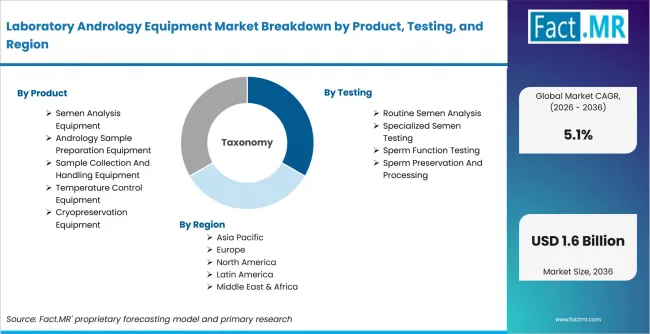
Laboratory Andrology Equipment Market Breakdown By Product, Testing, And Region | Source: Fact.MR
| Attribute | Details |
|---|---|
| Quantitative Units | USD billion |
| Market Definition | Equipment used to examine, prepare, warm, handle and preserve semen samples inside andrology laboratories, fertility centers, hospitals and reproductive medicine departments. |
| Product | Semen Analysis Equipment; Andrology Sample Preparation Equipment; Sample Collection and Handling Equipment; Temperature Control Equipment; Cryopreservation Equipment |
| Testing | Routine Semen Analysis; Specialized Semen Testing; Sperm Function Testing; Sperm Preservation and Processing |
| End User | Hospitals; Andrology Laboratories; Clinical Laboratories; Outpatient Facilities |
| Regions Covered | North America; Latin America; Western Europe; Eastern Europe; East Asia; South Asia & Pacific; Middle East & Africa |
| Countries Covered | USA; Germany; Japan; France; Italy |
| Key Companies Profiled | Nexpring Health (Hamilton Thorne and Microptic); Medical Electronic Systems LLC; Shivani Scientific Industries Pvt. Ltd.; Thermo Fisher Scientific Inc.; ZEISS |
| Forecast Period | 2026 to 2036 |
| Approach | Hybrid top-down and bottom-up approach using fertility-care indicators, semen testing workflows, segment shares, country CAGRs, provider portfolio review and official evidence checks. |
Source: Fact.MR analysis. Updated Sep 16, 2026
How is the market segmented?
-
By Product:
- Semen Analysis Equipment
- Andro Station
- Andro Scope Basic
- Andro Scope Advanced
- Sperm Counting Chamber
- Andrology Sample Preparation Equipment
- Androfuge
- Spermfuge
- Micropipettes
- Sample Collection And Handling Equipment
- Collection Room Device
- Androbox
- Temperature Control Equipment
- Micro CO2 Incubator
- Androblock
- Slide Warmer
- Aqua Warmer
- Cryopreservation Equipment
- Cryocans
- Semen Analysis Equipment
-
By Testing:
- Routine Semen Analysis
- Sperm Concentration Assessment
- Sperm Motility Assessment
- Semen Quality Evaluation
- Specialized Semen Testing
- Sperm Morphology Classification Using Kruger's Strict Criteria
- Sperm Viability Testing
- Hypo Osmotic Swelling Test
- Anti Sperm Antibody Testing
- Leukocytospermia Testing
- Sperm Function Testing
- Sperm Mucus Interaction Tests
- Capacitation Testing
- Acrosome Reaction Testing
- Zona Binding Assays
- Sperm Preservation And Processing
- Semen Cryopreservation
- Sperm DNA Fragmentation Testing
- Assisted Reproductive Procedure Preparation
- Surgical Sperm Processing
- Routine Semen Analysis
-
By End User:
- Hospitals
- Fertility Centers
- Reproductive Medicine Departments
- Andrology Laboratories
- Independent Andrology Laboratories
- Hospital Based Andrology Laboratories
- Clinical Laboratories
- Diagnostic Laboratories
- Specialty Clinical Laboratories
- Outpatient Facilities
- Fertility Clinics
- Ambulatory Care Centers
- Hospitals
-
By Region:
- North America
- Latin America
- Western Europe
- Eastern Europe
- East Asia
- South Asia & Pacific
- Middle East & Africa
Frequently Asked Questions
How big is the laboratory andrology equipment market in 2026?
What is the CAGR of the laboratory andrology equipment market from 2026 to 2036?
Which testing category leads the laboratory andrology equipment market?
Which end user leads the laboratory andrology equipment market?
Who are the leading companies in the laboratory andrology equipment market?
Who worked on this report


Preview the report firsthand - request a free sample
Free SampleGet the brochure for pricing and purchase details
Download PDF