- Base Value(2025): 2.8 Bn
- Estimated Value(2026): 3.1 Bn
- Forecast Value (2036): 8.2 Bn
- CAGR (2026 - 2036): 10.2%
Automated NGS Library Preparation Market Forecast and Outlook By Fact.MR
- The automated NGS library preparation market was valued at USD 2.8 billion in 2025.
- According to Fact.MR, demand is projected to reach USD 3.1 billion in 2026 and expand to USD 8.2 billion by 2036, reflecting a CAGR of 10.2% during the forecast period.
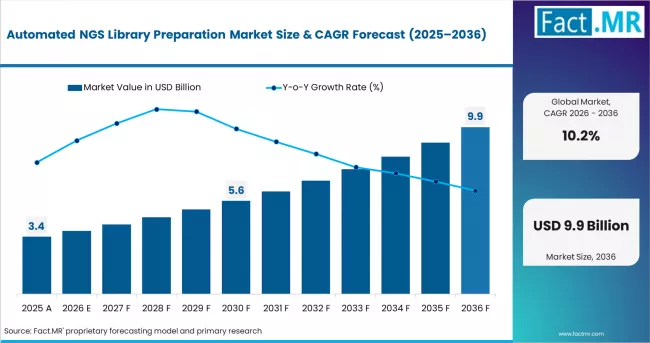
Automated Ngs Library Preparation Market Market Value Analysis | Source: Fact.MR
| Metric | Value |
|---|---|
| Estimated Value in 2026 | USD 3.1 billion |
| Forecast Value in 2036 | USD 8.2 billion |
| Forecast CAGR (2026 to 2036) | 10.2% |
Source: Fact.MR analysis. Updated May 14, 2026
Summary of Automated NGS Library Preparation Market
- Market Definition
- The market includes automated systems and kits used to create sequencing libraries with lower manual handling and more reproducible workflow execution. [1]
- Demand Drivers
- Library prep remains a central NGS workflow step, making prep automation commercially important in high-volume sequencing settings.
- Automation-ready library prep kits are being positioned around fewer manipulations and less hands-on time.
- Integrated targeted NGS platforms now automate library prep together with downstream sequencing steps. [5]
- Key Segments Analyzed
- By Workflow Type: DNA library preparation automation is estimated to lead with approximately 34% share in 2026, supported by broad use across WGS, WES, and targeted sequencing.
- By Product Type: Automated liquid handling platforms are expected to hold approximately 31% share in 2026, driven by their central role in scalable sample prep.
- By Application: Research sequencing is projected to account for approximately 37% share in 2026, supported by broad adoption in academic and translational labs.
- By Geography: India leads growth at 11.4% CAGR through 2036, supported by expanding genomics infrastructure.
- Analyst Opinion at FACT.MR
- Shambhu Nath Jha explains, “The market should be seen as a workflow efficiency and scaling category, not just a liquid-handling segment. Investment decisions are driven by consistency, reduced variability, and improved operational throughput.” This is a modeled analyst view and not a quoted external statement.
- Strategic Implications
- Invest in automation platforms that reduce reagent handling complexity and support multiple kit chemistries.
- Build technical sales capability around reproducibility, throughput, and total workflow integration rather than deck hardware alone.
- Position integrated library-prep solutions where labs want to reduce technician dependency and standardize output quality.
The market is expected to generate an absolute opportunity of USD 5.1 billion between 2026 and 2036, supported by increasing adoption of sequencing workflows across research and clinical settings. Growth is being driven by rising sample volumes, stronger demand for workflow standardization, and broader integration of automation in translational and clinical genomics. Roche states that its KAPA EvoPrep Kits are designed for streamlined, fully automatable workflows with reduced hands-on time and fewer reagent handling steps. As laboratories scale sequencing throughput, automation is becoming essential for improving reproducibility, minimizing human error, and supporting consistent data quality, reinforcing sustained market expansion. [3]
India is projected to lead with a CAGR of 11.4% through 2036, driven by expanding genomics infrastructure, stronger biopharma research activity, and rising adoption of automation in high-sample labs. China follows at 10.9%, supported by broad sequencing activity and scaling multi-sample workflows. The United States is expected to grow at 10.3%, underpinned by high clinical and translational sequencing volume. Germany records 9.6%, backed by structured lab automation adoption and precision-medicine research. South Korea grows at 9.2%, supported by strong life-science instrumentation uptake.
Segmental Analysis
Automated NGS Library Preparation Market Analysis by Workflow Type
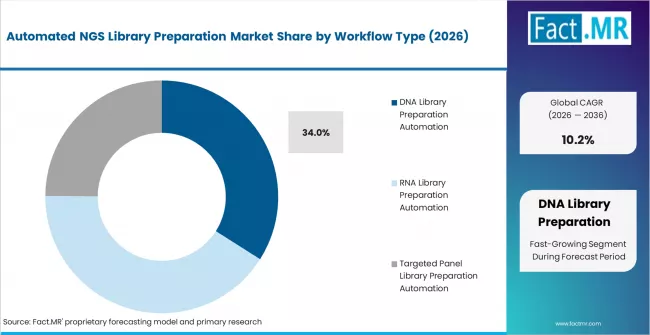
Automated Ngs Library Preparation Market Analysis By Workflow Type | Source: Fact.MR
DNA library preparation automation is estimated to hold approximately 34% share in 2026. This segment leads because fragmented DNA library preparation remains central across a wide range of sequencing applications, including whole-genome sequencing (WGS), whole-exome sequencing (WES), targeted panels, and circulating free DNA (cfDNA) workflows. Roche states that its KAPA EvoPrep Kits support these applications within a fully automatable workflow, reinforcing the importance of scalable and standardized DNA library preparation in high-throughput genomics.
- DNA library prep leads because it maps to the broadest range of sequencing applications.
- RNA library prep remains attractive where transcriptomics and expression workflows need automation-ready chemistry.
- Targeted panel prep gains relevance where labs want fast and repeatable oncology and mutation-testing workflows.
Automated NGS Library Preparation Market Analysis by Product Type
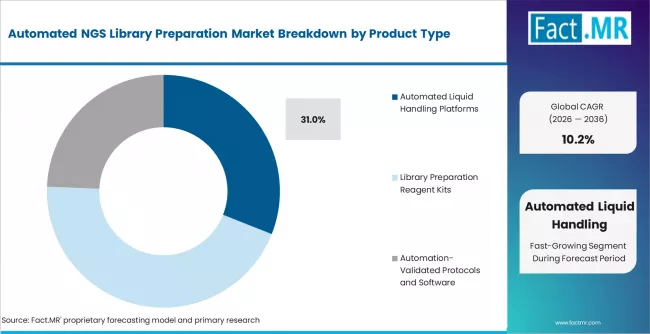
Automated Ngs Library Preparation Market Analysis By Product Type | Source: Fact.MR
Automated Liquid Handling Platforms are expected to hold approximately 31% share in 2026, as automated NGS library prep still depends heavily on configurable liquid handling and sample-transfer accuracy. Beckman Coulter states that its automated liquid handling systems support NGS library prep and custom lab automation. Illumina also notes that automation methods for many library prep assays are available through automation partners.
- Liquid handling platforms lead because they provide the broadest automation base across kit types and sample volumes.
- Automation-ready reagent kits remain important where hands-on time and protocol simplification drive buying decisions.
- Integrated end-to-end systems gain relevance where labs want fewer manual handoff points between prep and sequencing.
Automated NGS Library Preparation Market Analysis by Application
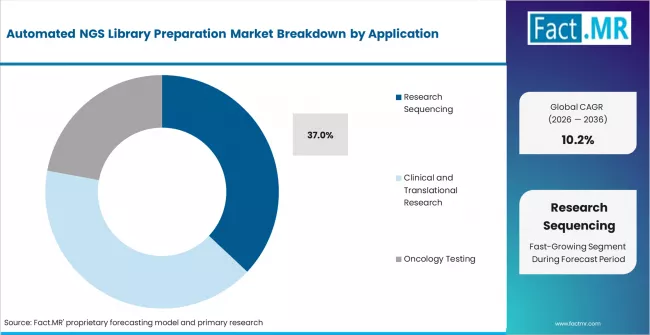
Automated Ngs Library Preparation Market Analysis By Application | Source: Fact.MR
Research sequencing continues to lead demand within automated NGS library preparation due to high sample throughput and the need for standardized workflows across diverse study types. This segment supports genomics cores and research labs handling varied applications, where consistency and scalability are critical for reliable results. Research sequencing is projected to account for approximately 37% share in 2026. Illumina positions automation around preparing large volumes of NGS libraries, which aligns directly with research-core requirements for throughput, reproducibility, and efficient processing.
- Research sequencing leads because it combines high sample variety with scaling pressure.
- Clinical and translational research remains attractive where automation supports consistent sample preparation across cohorts.
- Oncology testing gains relevance where targeted panel workflows need reproducible prep and shorter hands-on workflows.
Drivers, Restraints, and Opportunities
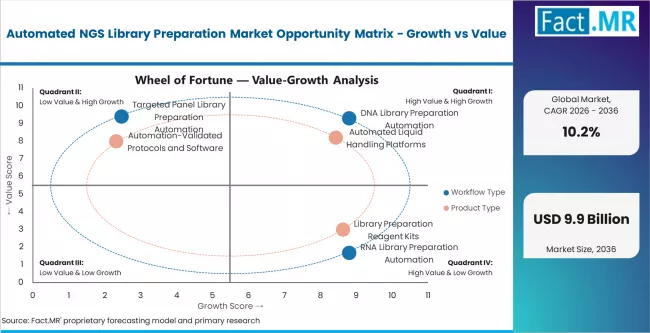
Automated Ngs Library Preparation Market Opportunity Matrix Growth Vs Value | Source: Fact.MR
The market is being shaped by the need to reduce hands-on steps, improve reproducibility, and maintain workflow continuity as sequencing volumes rise. Demand is structurally anchored in the fact that library preparation remains a core bottleneck in next-generation sequencing and is increasingly being redesigned for automation. Roche and Thermo Fisher Scientific both position automation around workflow streamlining, fewer manual interventions, and more consistent library output, reinforcing the shift toward standardized, high-throughput processing. [2]
The main restraint is workflow compatibility and capital intensity. Not every kit, sample type, or laboratory throughput profile aligns with a single automation platform, and labs still require validated protocols, instrument integration, and trained personnel. Beckman Coulter highlights the importance of liquid handling systems tailored to specific workflows, showing that value still lies in customization and integration. As a result, suppliers must demonstrate that automation delivers measurable gains in reproducibility and labor efficiency to justify investment in platforms and validation effort.
- Automation-ready library chemistries remain the clearest opportunity where labs want simpler prep without sacrificing library quality.
- End-to-end targeted NGS systems create stronger value where labs want fewer manual steps from sample to result.
- Compact and more accessible liquid handling systems offer higher-value opportunity where smaller labs want to automate without full-scale custom builds.
Regional Analysis
The market is assessed across North America, Europe, Asia Pacific, Latin America, and Middle East and Africa, covering 40+ countries with demand profiles shaped by sequencing adoption, translational research depth, automation budgets, and genomics infrastructure. The country growth rates below are model-based estimates.
.webp "Top Country Growth Comparison Automated Ngs Library Preparation Market Cagr (2026 2036)")
Top Country Growth Comparison Automated Ngs Library Preparation Market Cagr (2026 2036) | Source: Fact.MR
| Country | CAGR (2026 to 2036) |
|---|---|
| India | 11.4% |
| China | 10.9% |
| United States | 10.3% |
| Germany | 9.6% |
| South Korea | 9.2% |
Source: Fact.MR analysis. Updated May 14, 2026
North America Automated NGS Library Preparation Market Analysis
Top Country Growth Comparison Automated Ngs Library Preparation Market Cagr (2026 2036) | Source: Fact.MR
North America remains an important commercial region because it combines deep sequencing adoption, strong translational research activity, and wide use of automated lab workflows. Thermo Fisher’s integrated targeted NGS positioning and Beckman Coulter’s automation portfolio both support the region’s continued relevance for automation-led library prep expansion.
- United States: Strong translational sequencing demand and automation-ready laboratory infrastructure continue to support growth. The market is projected to expand at around 10.3% CAGR through 2036, driven by widespread use of high-throughput sequencing platforms and increasing reliance on standardized, automation-compatible library preparation workflows. Demand is particularly strong in oncology, rare disease research, and population genomics programs where consistency and scalability are critical.
Europe Automated NGS Library Preparation Market Analysis
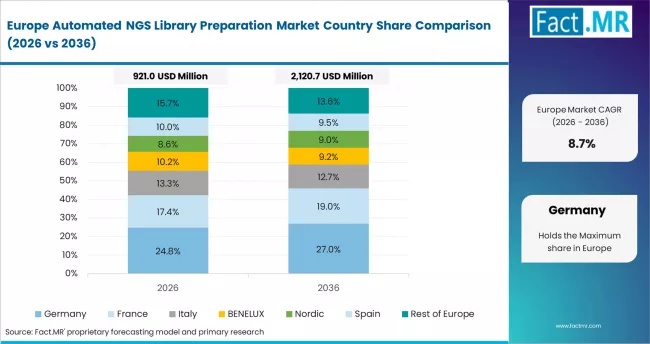
Automated Ngs Library Preparation Market Europe Country Market Share Analysis, 2026 & 2036 | Source: Fact.MR
Europe remains a technically structured region where adoption is closely tied to validated genomics workflows, regulatory discipline, and translational research integration. Laboratories in this region place strong emphasis on workflow standardization, data reproducibility, and automation compatibility.
- Germany: Germany plays a central role in European genomics and laboratory automation. The market is projected to grow at approximately 9.6% CAGR through 2036, supported by strong research infrastructure, biopharma collaboration, and increasing use of automated NGS library preparation systems. Demand is driven by clinical genomics, precision medicine initiatives, and structured laboratory environments that prioritize validated and scalable workflows. Automation is increasingly integrated into routine sequencing pipelines to improve throughput and reduce manual intervention.
Asia Pacific and Latin America Automated NGS Library Preparation Market Analysis
Asia Pacific offers the strongest long-term expansion potential due to rising genomics investment, expanding sequencing capacity, and increasing focus on automation in laboratory workflows. Adoption is accelerating as institutions transition from manual methods to high-throughput, kit-based automation systems.
- India: Rapid expansion of genomics infrastructure and growing interest in automation support strong growth. The market is projected to grow at close to 11.4% CAGR through 2036, driven by increasing research activity, government-backed genomics programs, and rising demand for scalable sequencing workflows.
- China: Broad sequencing activity and high throughput requirements continue to support growth. The market is expected to expand at around 10.9% CAGR through 2036, with strong investment in genomics research, clinical sequencing, and automation-enabled laboratory systems.
- South Korea: Advanced molecular research capabilities and strong adoption of precision medicine support steady growth. The market is projected to grow at approximately 9.2% CAGR through 2036, backed by well-developed research institutions and increasing use of automated sequencing workflows.
Competitive Aligners for Market Players
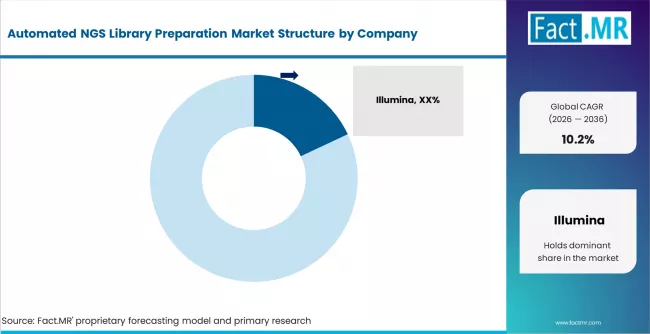
Automated Ngs Library Preparation Market Analysis By Company | Source: Fact.MR
The market is moderately concentrated at the automation-platform, chemistry, and integrated workflow level, while broader adoption remains lab- and application-dependent. Competitive strength comes from the ability to combine validated automation chemistry, reproducible liquid handling, and workflow simplicity. Suppliers need more than a robot claim. They need a clear explanation of how the system improves library consistency, reduces hands-on burden, and fits real sequencing throughput patterns.
Competitive advantage is defined by kit compatibility, protocol robustness, throughput flexibility, and level of end-to-end workflow integration. This competitive framing is an analytical view derived from current supplier disclosures rather than a published market-share table.
Key Players
- Illumina
- Thermo Fisher Scientific
- Roche
- Beckman Coulter Life Sciences
- Tecan automation ecosystem participants
- SPT Labtech automation ecosystem participants
- Agilent genomics automation ecosystem participants
Bibliography
- [1] Illumina. NGS technology and workflow materials describing library prep as a core sequencing step and pointing users to library prep automation.
- [2] Thermo Fisher Scientific. NGS library prep automation solutions materials describing reduced cost and improved efficiency.
- [3] Roche. KAPA EvoPrep kit materials describing a streamlined, fully automatable workflow with minimal hands-on time.
- [4] Roche. Sequencing automation program materials covering automated methods for KAPA workflows on non-Roche liquid handlers.
- [5] Thermo Fisher Scientific. Genexus system materials describing automated library preparation together with downstream targeted NGS workflow steps.
This Report Addresses
- Strategic intelligence on automated NGS library preparation demand across DNA, RNA, targeted, and integrated sequencing workflows.
- Market forecast from USD 3.1 billion in 2026 to USD 8.2 billion by 2036 at a CAGR of 10.2%.
- Growth opportunity mapping across automated liquid handlers, automation-ready library chemistries, integrated targeted NGS systems, and workflow-standardization platforms.
- Segment analysis by workflow type, product type, application, end use, and region.
- Regional outlook covering North America, Europe, Asia Pacific, Latin America, and Middle East and Africa.
- Competitive analysis of major participants serving genomics automation, library prep chemistry, and integrated sequencing workflow systems.
- Workflow-efficiency analysis covering hands-on time reduction, reproducibility, throughput scaling, and end-to-end automation potential.
- Market interpretation built around sequencing volume growth, prep bottleneck reduction, and broader lab demand for standardized genomic sample preparation.
Automated NGS Library Preparation Market Definition
The market covers automated systems, validated protocols, and reagent-platform combinations used to prepare sequencing-ready libraries for NGS workflows with reduced manual intervention. It includes liquid handling workstations, automation-ready library prep kits, integrated sequencing systems with automated prep capability, and associated software-guided workflow components.
Automated NGS Library Preparation Market Inclusions
Covers global and regional forecasts from 2026 to 2036. Includes automation-ready DNA and RNA library prep kits, automated liquid handlers configured for NGS sample prep, end-to-end targeted NGS platforms with automated library prep, and vendor-supported automated methods for third-party liquid handlers.
Automated NGS Library Preparation Market Exclusions
Excludes sequencing instruments where library preparation automation is not part of the main product role, stand-alone bioinformatics software without sample-prep automation role, and generic laboratory robotics not materially positioned for NGS library prep. This exclusion logic is an analytical market boundary rather than a quoted source definition.
Automated NGS Library Preparation Market Research Methodology
- Primary Research:Interviews with genomics lab managers, molecular workflow specialists, translational research teams, automation engineers, NGS core facility leaders, and reagent-platform suppliers.
- Desk Research:Uses current official materials from Illumina, Thermo Fisher, Roche, and Beckman Coulter tied to automation-ready library preparation, integrated sequencing workflows, and genomics liquid handling platforms. [4]
- Market-Sizing and Forecasting:Hybrid model using sequencing sample-volume growth, library-prep bottleneck reduction, automation adoption in translational labs, and integrated workflow demand.
- Data Validation and Update Cycle:Validated using supplier product disclosures, automation-program materials, and recurring checks on workflow simplification, hands-on time reduction, and integrated NGS workflow direction.
Segmentation
Scope of Report
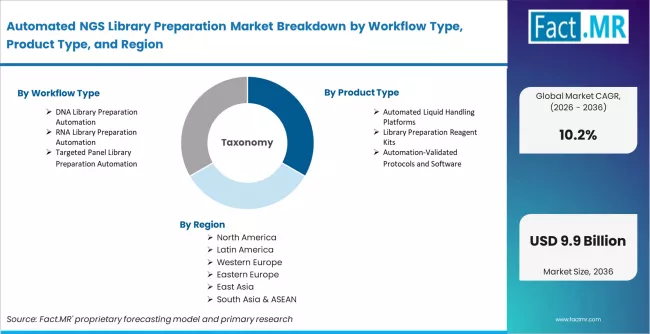
Automated Ngs Library Preparation Market Breakdown By Workflow Type, Product Type, And Region | Source: Fact.MR
| Attribute | Details |
|---|---|
| Quantitative Units | USD 3.1 billion (2026) to USD 8.2 billion (2036), at a CAGR of 10.2% |
| Market Definition | Automated systems, validated protocols, and reagent-platform combinations used to prepare sequencing-ready libraries for NGS workflows with reduced manual intervention |
| Workflow Type Segmentation | DNA Library Preparation Automation, RNA Library Preparation Automation, Targeted Panel Library Preparation Automation, Amplicon Library Preparation Automation, Multiomic and Specialty Library Preparation Automation, Others |
| Product Type Segmentation | Automated Liquid Handling Platforms, Library Preparation Reagent Kits, Automation-Validated Protocols and Software, Integrated End-to-End Sequencing Systems, Others |
| Application Segmentation | Research Sequencing, Clinical and Translational Research, Oncology Testing, Rare Disease and Inherited Disease Analysis, Infectious Disease and Microbiology, Others |
| Regions Covered | North America, Europe, Asia Pacific, Latin America, Middle East and Africa |
| Countries Covered | United States, Germany, China, India, South Korea, Japan, and 40+ countries |
| Forecast Period | 2026 to 2036 |
| Approach | Hybrid top-down and bottom-up model using sequencing sample growth, prep bottleneck reduction, automation adoption, and primary interviews with lab, supplier, and workflow specialists |
Source: Fact.MR analysis. Updated May 14, 2026
Automated NGS Library Preparation Market by Segments
-
By Workflow Type:
- DNA Library Preparation Automation
- RNA Library Preparation Automation
- Targeted Panel Library Preparation Automation
- Amplicon Library Preparation Automation
- Multiomic and Specialty Library Preparation Automation
- Others
-
By Product Type:
- Automated Liquid Handling Platforms
- Library Preparation Reagent Kits
- Automation-Validated Protocols and Software
- Integrated End-to-End Sequencing Systems
- Others
-
By Application:
- Research Sequencing
- Clinical and Translational Research
- Oncology Testing
- Rare Disease and Inherited Disease Analysis
- Infectious Disease and Microbiology
- Others
-
By Region:
- North America
- United States
- Canada
- Mexico
- Latin America
- Brazil
- Argentina
- Chile
- Rest of Latin America
- Western Europe
- Germany
- France
- United Kingdom
- Italy
- Spain
- Nordic Countries
- BENELUX
- Rest of Western Europe
- Eastern Europe
- Russia
- Poland
- Hungary
- Balkan and Baltic
- Rest of Eastern Europe
- East Asia
- China
- Japan
- South Korea
- South Asia and Pacific
- India
- ASEAN
- Australia and New Zealand
- Rest of South Asia and Pacific
- Middle East and Africa
- Kingdom of Saudi Arabia
- Other GCC Countries
- Turkey
- South Africa
- Rest of Middle East and Africa
- North America
Frequently Asked Questions
How large is the global automated NGS library preparation market in 2025?
What will the market size be in 2026?
What is the projected market size by 2036?
What is the expected CAGR from 2026 to 2036?
Which workflow type is poised to lead the market?
Which product type holds the largest share?
Which end-use segment is expected to remain strongest?
Which country shows the fastest growth?
What is driving demand for automated NGS library preparation?
What is the key challenge in this market?
Who worked on this report


Preview the report firsthand - request a free sample
Free SampleGet the brochure for pricing and purchase details
Download PDF