- Market Value (2025):USD 0.9 Bn
- Estimated Value (2026):USD 1.0 Bn
- Forecast Value (2036):USD 2.6 Bn
- CAGR (2026-2036): 10.0%
What is the LED scalp brushes market forecast to be worth by 2036?
USD 1.0 billion in 2026 to USD 2.6 billion by 2036, at 10.0% CAGR.
- The LED scalp brushes market crossed a valuation of USD 0.9 billion in 2025.
- Demand is expected to increase from USD 1.0 billion in 2026 to USD 2.6 billion by 2036.
- The market is forecast to record 10.0% CAGR from 2026 to 2036 because scalp-first haircare is moving into device-led routines.
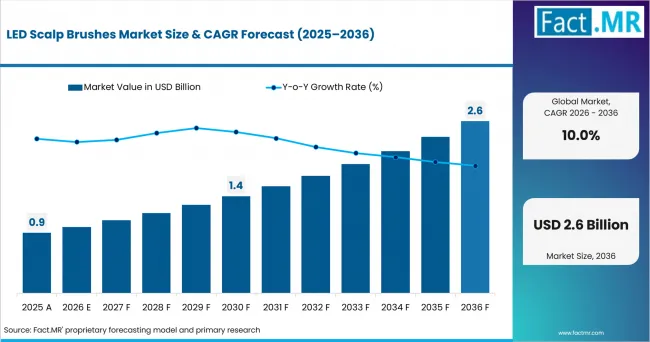
Led Scalp Brushes Market Market Value Analysis | Source: Fact.MR
What are the defining numbers behind LED scalp brushes growth?
USD 1.6 billion absolute opportunity by 2036, led by India and China.
- Demand Drivers in the Market
- Beauty device shoppers need clearer claim support before buying premium scalp tools online.
- Haircare brands use scalp-first routines to move brushes before shampoos and styling products.
- Salon operators use device demonstrations to introduce home continuation programs for clients.
- Dermocosmetic retailers prefer products that connect device use with barrier repair language.
- Key Segments Analyzed
- By Light Technology: Red LED is expected to hold 42.0% share in 2026 because density support is easier to explain at retail.
- By Active Base: Ceramides are projected to hold 27.0% share in 2026 because scalp barrier language mirrors skincare routines.
- By Hair Concern: Density is anticipated to hold 34.0% share in 2026 because thinning support justifies a higher device purchase.
- By Channel: Direct Brand Stores are forecast to hold 31.0% share in 2026 because brands control education and claim language.
- By Positioning: Scalp First is estimated to hold 32.0% share in 2026 as routines start before cleansing and styling.
- By Geography: India is projected to record 12.4% CAGR through 2036 as beauty marketplaces widen device discovery.
- Analyst Opinion at Fact.MR
- Shambhu Nath Jha, Senior Analyst at Fact.MR, states, “I do not see LED scalp brushes as a simple grooming accessory. I see them as a routine product that must earn consumer trust through treatment time, comfort and clear claim boundaries. Brands that explain use cases plainly are better placed than brands that sell light claims without guidance.”
- Strategic Implications
- Device brands should build claim files before launching density-led scalp brush programs.
- Haircare brands need companion serums that make the brush useful inside weekly routines.
- Retailers should separate LED scalp brushes from ordinary massage brushes inside product navigation.
- Salons need demonstration protocols that convert treatment trials into home-use purchases.
At-home scalp light therapy forms the core of this market. The United States Food and Drug Administration listed the CurrentBody Skin Dual Light Hair Growth Helmet under 510(k) number K251017 in June 2025. This supports claim discipline for hair growth devices before wider retail placement. The same buying logic connects LED brushes with the scalp health category because both rely on repeat routines and visible scalp benefits.
India is projected to record 12.4% CAGR through 2036 as online beauty access widens device discovery. China is forecast to expand at 11.7% CAGR through 2036 as online beauty channels support scalp-care devices. South Korea is expected to grow at 11.4% CAGR through 2036 because K-beauty routines support device testing. The United States is forecast at 10.6% CAGR through 2036 as Food and Drug Administration clearances shape buyer confidence. The United Kingdom is expected to post 10.2% CAGR through 2036 as premium beauty device retail remains active.
How does the LED scalp brushes market break down by segment?
Red LED leads at 42.0% and density-led hair concern leads at 34.0%.
Which light technology dominates?
Red LED holds 42.0% share in 2026.
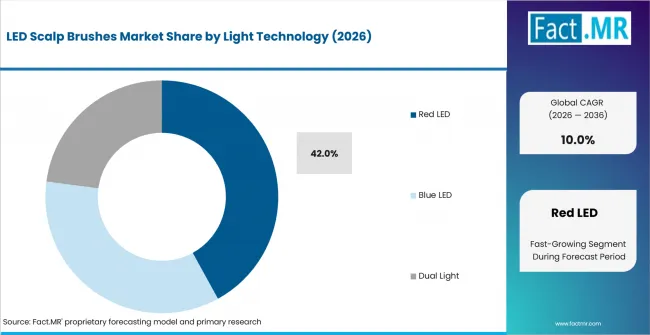
Led Scalp Brushes Market Analysis By Light Technology | Source: Fact.MR
Red LED leads because density support is the simplest light claim for consumers to understand. Buyers also compare helmets, combs and brushes before choosing a treatment format. The Food and Drug Administration listed Breo Laser Hair Growth Comb under 510(k) number K242620 in November 2024. This confirms that hair-growth light devices remain inside an active review pathway for retail products. The segment also borrows trust cues from phototherapy devices where treatment time and regular use affect buyer confidence.
Which active base dominates?
Ceramides lead with 27.0% share in 2026.
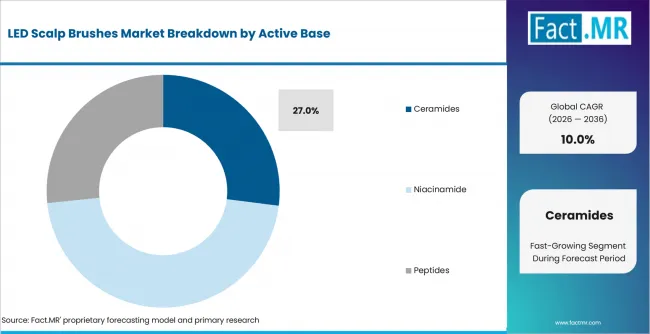
Led Scalp Brushes Market Analysis By Active Base | Source: Fact.MR
Ceramides lead because scalp barrier repair gives LED brushes a clearer connection to treatment-led beauty. The ingredient story helps brands explain why a device belongs before serum or leave-in care. This positioning links LED brushes with skin care ingredients because buyers now compare scalp claims with facial care routines. Peptide bases are likely to expand where shoppers accept higher-priced multi-step scalp programs.
Which hair concern dominates?
Density holds 34.0% share in 2026.
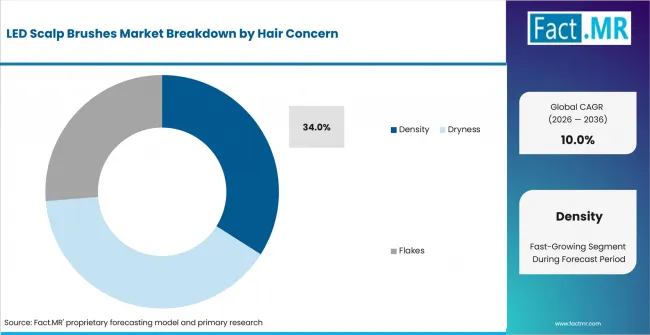
Led Scalp Brushes Market Analysis By Hair Concern | Source: Fact.MR
Density leads because thinning support gives buyers a stronger reason to pay for an electrical scalp tool. The Food and Drug Administration listed Hair Regrowth Cap under 510(k) number K253349 in December 2025. That listing reinforces the role of official device pathways in consumer hair-growth claims. The segment also overlaps with aesthetic laser systems because premium buyers compare wavelength language across adjacent light-based treatments.
Which channel dominates?
Direct Brand Stores account for 31.0% share in 2026.
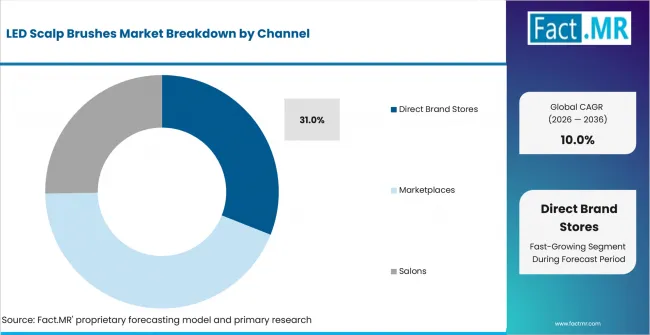
Led Scalp Brushes Market Analysis By Channel | Source: Fact.MR
Direct Brand Stores lead because brands need space to explain light type, treatment time and scalp routine fit. The United States Census Bureau estimated first-quarter retail e-commerce sales at USD 326.7 billion in May 2026. Online comparison supports device discovery because shoppers review claims, videos and price points before purchase. This behavior places LED brushes inside the wider beauty device category where education reduces purchase hesitation.
Which positioning dominates?
Scalp First holds 32.0% share in 2026.
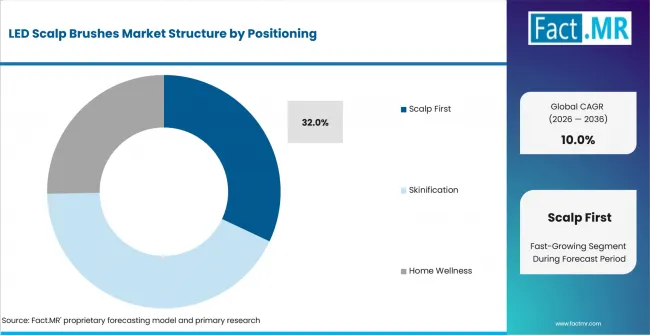
Led Scalp Brushes Market Analysis By Positioning | Source: Fact.MR
Scalp First leads because consumers are moving from styling-aftercare toward routines that begin at the scalp. Brands use this position to sell brushes with serums and usage guidance. The model works best when instructions make the device feel practical inside premium beauty routines instead of an occasional gadget purchase. It also supports higher basket value when refills and replacement accessories remain available.
What is accelerating LED scalp brush adoption, and what is holding it back?
Scalp-first routines and at-home light therapy drive it, while claim uncertainty and premium pricing restrain it.
Drivers Impact Analysis
| DRIVER | (~) % IMPACT ON CAGR |
GEOGRAPHIC RELEVANCE | IMPACT TIMELINE |
|---|---|---|---|
| Scalp-first routines replacing cleansing-only tools | +2.1% | Global, strongest in beauty device channels | Short term (≤ 2 years) |
| At-home light therapy moving into haircare | +1.8% | United States, China, South Korea | Medium term (2–4 years) |
| Direct brand stores improving claim education | +1.5% | North America, Europe, India | Short term (≤ 2 years) |
| Device-serum bundles lifting basket value | +1.3% | Global, strongest in premium channels | Medium term (2–4 years) |
| Rechargeable formats supporting routine use | +1.1% | Asia Pacific and North America | Long term (≥ 4 years) |
- Scalp-first routines replacing cleansing-only tools
- Consumers are putting scalp care before cleansing and styling inside haircare routines. This shift makes brushes useful as a preparation step instead of only a shower accessory. The shift also connects LED tools with anti-dandruff shampoos because flakes and buildup create repeat-use reasons.
- At-home light therapy moving into haircare
- Light therapy is moving from facial devices and helmets into handheld scalp formats. Buyers already understand charging, session time and visible-use discipline from facial tools. This familiarity lowers the education burden for brands selling LED scalp brushes. FOREO lists a ten-minute daily session for its hair-growth device on its official product page.
- Direct brand stores improving claim education
- Direct brand stores give device makers more control over before-use guidance and claim boundaries. Marketplaces create reach but can compress device differences into price and review scores. Brand-owned pages therefore remain important for premium tools that require routine explanation. This channel logic supports repeat purchases when brush heads and serums stay visible.
Opportunity Impact Analysis
| OPPORTUNITY | (~) % IMPACT ON CAGR |
GEOGRAPHIC RELEVANCE | IMPACT TIMELINE |
|---|---|---|---|
| Device-serum replenishment programs | +1.7% | United States, United Kingdom, India | Medium term (2–4 years) |
| Dual-light brushes for mixed scalp concerns | +1.4% | China, Japan, South Korea | Medium term (2–4 years) |
| Salon introduction with home continuation | +1.2% | Europe, Japan, North America | Short term (≤ 2 years) |
| Dermocosmetic retail education programs | +1.1% | Germany, France, United Kingdom | Medium term (2–4 years) |
| Rechargeable travel formats | +0.9% | Global, strongest in marketplaces | Long term (≥ 4 years) |
- Device-serum replenishment programs
- Brands can make LED scalp brushes more useful by linking device use with refillable serums. This creates a repeat-purchase path after the original tool sale. The opportunity fits shoppers who already follow organic hair care routines and are willing to add scalp-focused steps.
- Dual-light brushes for mixed scalp concerns
- Dual-light formats can address buyers who want one tool for density and sebum control. This matters in humid markets where oiliness and thinning concerns appear together. Brands can use separate usage modes to explain different scalp outcomes. The opportunity depends on clear instructions because vague multi-benefit claims reduce trust.
- Salon introduction with home continuation
- Salons can introduce LED scalp brushes during scalp checks and treatment conversations. This trial setting helps clients feel the massage and understand session time before buying. Japan and South Korea are well suited because scalp rituals already sit inside salon-led care. The model also gives salons a take-home product beyond shampoos and masks.
Restraints Impact Analysis
| RESTRAINT | (~) % IMPACT ON CAGR |
GEOGRAPHIC RELEVANCE | IMPACT TIMELINE |
|---|---|---|---|
| Claim language outpacing evidence | -1.4% | Global, strongest in marketplaces | Short term (≤ 2 years) |
| Premium price limiting mass conversion | -1.2% | India, Latin America, parts of Europe | Medium term (2–4 years) |
| Product safety checks slowing listings | -1.0% | Europe, United Kingdom, United States | Short term (≤ 2 years) |
| Consumer patience for visible results | -0.8% | Global | Medium term (2–4 years) |
| Crowded scalp-care assortment | -0.6% | North America and East Asia | Long term (≥ 4 years) |
- Claim language outpacing evidence
- Some device claims move faster than consumer proof and regulatory review. This creates a trust gap when brushes promise density, oil control and scalp repair together. Retailers may demand clearer disclaimers before listing premium devices. The restraint is stronger on marketplaces where product pages compare many claims quickly.
- Premium price limiting mass conversion
- Premium pricing limits conversion when shoppers compare brushes with lower-cost scalp serums. Device makers must explain why light exposure and massage justify the higher basket. Germany illustrates the pressure because IKW reported hair care growth of 8.1% in December 2025. That category strength does not automatically convert into device purchases without clear value proof.
- Product safety checks slowing listings
- Product safety checks can slow launches in regulated online channels. The European Commission said the General Product Safety Regulation applies from December 2024. That rule raises traceability expectations for consumer products sold in the European Union. Brush makers also need compatible formulations because hair-care surfactants and scalp actives can affect usage instructions near electrical devices.
Which countries are scaling LED scalp brushes fastest?
India 12.4%, China 11.7%, South Korea 11.4%, United States 10.6%, United Kingdom 10.2%.
Based on regional analysis, the LED scalp brushes market is segmented into North America, Latin America, Europe, East Asia, South Asia and Pacific, and Middle East and Africa. India leads due to wider online beauty access and price comparison. China follows as online retail scale and domestic device manufacturing support faster product testing. South Korea ranks third because K-beauty routines support device-led scalp care adoption.
| Country | CAGR |
|---|---|
| India | 12.4% |
| China | 11.7% |
| South Korea | 11.4% |
| United States | 10.6% |
| United Kingdom | 10.2% |
| Germany | 9.7% |
| Japan | 9.3% |
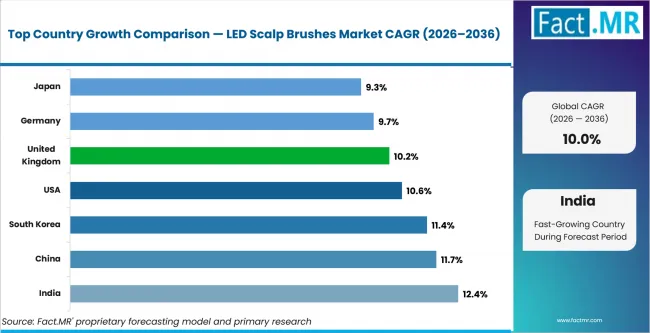
Led Scalp Brushes Market Cagr Analysis By Country | Source: Fact.MR
What is powering India’s lead?
12.4% CAGR, driven by online beauty access and price comparison.
India is projected to record 12.4% CAGR through 2036 as beauty marketplaces widen device discovery beyond metro buyers. Online channels make premium scalp devices easier to compare against serums and salon treatments. Device brands still need entry packs and financing cues because upfront price remains a barrier. Suppliers that localize education and charging formats are better placed here.
How is China scaling device-led scalp care?
11.7% CAGR, supported by online retail scale and domestic device manufacturing.
China is forecast to expand at 11.7% CAGR through 2036 as online beauty channels support scalp-care devices. The National Bureau of Statistics of China reported online retail sales of physical goods at 13,092.3 billion yuan in January 2026. Domestic manufacturing also helps brands test rechargeable designs and bundled accessories quickly. Local players that combine product safety files with marketplace education can defend premium price points.
Why is South Korea an important scalp device market?
11.4% CAGR, backed by K-beauty routines and beauty-tech funding.
South Korea is expected to grow at 11.4% CAGR through 2036 because scalp rituals already fit K-beauty routines. The Ministry of SMEs and Startups announced a KRW 40 billion K-Beauty Fund in April 2025. This supports beauty brands and beauty-tech startups across the cosmetics value chain. Device suppliers can use Korea as a test market for education-led bundles before export expansion.
What supports the UNITED STATES outlook?
10.6% CAGR, supported by device clearances and online comparison behavior.
The United States is forecast at 10.6% CAGR through 2036 as cleared hair-growth devices shape consumer expectations. Food and Drug Administration records help separate reviewed hair devices from ordinary grooming tools. Online discovery then helps shoppers compare brushes, helmets and combs before purchase. Brands with clear claim boundaries are better placed in direct stores and specialty retail.
How does the United Kingdom perform?
10.2% CAGR, due to premium beauty device retail and direct channels.
The United Kingdom is expected to post 10.2% CAGR through 2036 as premium beauty devices remain familiar to online shoppers. FOREO gives the country a strong consumer-device reference point for light-based home beauty. Device brands must still manage safety language and refund expectations because visible results take time. Retailers that explain usage cadence can reduce return pressure.
What underpins Germany’s growth?
9.7% CAGR, backed by haircare category growth and cautious product safety checks.
Germany is forecast to grow at 9.7% CAGR through 2036 as haircare buyers remain active but evidence requirements stay firm. Drugstore and specialty channels give scalp tools a route to structured education. The European product safety regime raises the need for traceability and responsible seller information. Suppliers that show compliance documents and easy instructions are better placed with retailers.
Why does Japan remain relevant?
9.3% CAGR, owing to salon routines and established haircare spending.
Japan is expected to expand at 9.3% CAGR through 2036 because scalp care fits salon-led routines and careful product evaluation. The Japan Cosmetic Industry Association reported hair care at 28.0% of cosmetics shipment value in October 2024. Buyers are likely to favor devices that explain comfort, treatment time and maintenance plainly. Brands with conservative claim language can gain stronger access to older consumers and salons.
Who leads the LED scalp brushes landscape?
FOREO, HairMax and Laduora lead through claim support and premium light therapy positioning.
LED scalp brushes are bought by consumers and retailers that need trusted treatment explanations before paying premium prices. FOREO provides a visible at-home light therapy reference point. HairMax offers laser hair regrowth devices with long-standing claim support. Laduora competes through helmet-based light therapy and consultation-led selling. Skin Gym, Solaris Laboratories NY and Briogeo support adjacent scalp-care and brush routines instead of direct LED scalp brush leadership.
Competition through 2036 is expected to depend on device proof, scalp contact design and education control. Direct sellers can win early demand because they explain treatment time and expected use clearly. Specialist brands can use skincare devices learning to improve user guidance and after-sales support. Retailers are likely to favor suppliers that separate reviewed hair-growth claims from general scalp-massage claims.
Providers that combine clear claim files with simple routine design are better placed. Brands with weak instructions may win trial purchases but face higher return risk. The better-positioned suppliers are those that connect light type, scalp comfort and refill routines without overstating results.
Which companies are the key players?
FOREO leads with HairMax and Laduora. Breo and Skin Gym and Solaris Laboratories NY also appear in the competitive set. Briogeo is listed under Wella Company.
- FOREO
- HairMax
- Laduora
- Breo
- Skin Gym
- Solaris Laboratories NY
- Alan Truman
Bibliography
- [1] U.S. Food and Drug Administration. (2025, June 17). 510(k) summary: CurrentBody Skin Dual Light Hair Growth Helmet, K251017. FDA.
- [2] U.S. Food and Drug Administration. (2024, November 1). 510(k) summary: Breo Laser Hair Growth Comb, K242620. FDA.
- [3] U.S. Food and Drug Administration. (2025, December 24). 510(k) summary: Hair Regrowth Cap, K253349. FDA.
- [4] U.S. Census Bureau. (2026, May 18). Quarterly retail e-commerce sales: First quarter 2026. U.S. Census Bureau.
- [5] National Bureau of Statistics of China. (2026, January 20). Total retail sales of consumer goods in December 2025. National Bureau of Statistics of China.
- [6] European Commission. (2025, January). EU’s General Product Safety Regulation: A new era of consumer protection. Access2Markets.
- [7] Industrieverband Körperpflege- und Waschmittel e. V. (2025, December). Market data for the beauty and home care industry. IKW.
- [8] Ministry of SMEs and Startups of the Republic of Korea. (2025, April 11). MSS holds K-Beauty Fund launch ceremony. MSS.
- [9] CurrentBody. (2026). LED hair growth helmet. CurrentBody.
- [10] HairMax. (2026). Hair regrowth laser treatments for hair loss. HairMax.
- [11] Theradome. (2026). FDA-cleared laser hair growth helmet. Theradome.
- [12] Japan Cosmetic Industry Association. (2024, October). Cosmetic shipments. JCIA.
This Report Addresses
- Strategic intelligence on LED scalp brushes across light technology, active base and hair concern.
- Segment analysis covering Red LED, Ceramides, Density, Direct Brand Stores, and Scalp First positioning.
- Regional outlook covering India, China, South Korea, the United States, the United Kingdom, Germany, and Japan.
- Competitive analysis of FOREO leads with HairMax and Laduora. Breo and Skin Gym and Solaris Laboratories NY& also appear in the competitive set. Briogeo is listed under Wella Company.
- Product assessment covering LED scalp brushes and rechargeable formats and device-serum kits and salon-led introduction.
- Channel assessment covering prestige beauty, salons, dermocosmetic retail, direct brand stores and marketplaces.
- Primary interviews, official source review, provider checks and channel validation support the forecast.
What does the LED scalp brushes market cover?
Handheld scalp devices that combine LED exposure with massage or companion treatment positioning.
The LED scalp brushes market covers handheld or brush-like devices that expose the scalp to light while supporting massage, serum application or routine guidance. It includes red LED and blue LED devices sold for consumer haircare routines. The market differs from ordinary hair brushes because the value focus is light exposure, scalp contact and repeat treatment positioning.
What is included in the scope?
Red LED brushes, blue LED brushes and rechargeable scalp devices with treatment positioning.
The scope includes red LED, blue LED and dual-light scalp brushes sold for home haircare routines. It covers vibration-assisted LED brushes and rechargeable scalp devices when light exposure is part of the product offer. It also includes device-serum kits sold through prestige beauty, salons and direct brand stores.
What is excluded from the scope?
Ordinary shampoo brushes and clinic-only phototherapy equipment without consumer retail sale.
The scope excludes ordinary shampoo brushes without LED or laser treatment functionality. It excludes prescription hair-loss therapies and clinic-only phototherapy equipment without consumer retail sale. It also excludes hair dryers and styling tools that do not contact the scalp during use.
How was the analysis built?
100+ sources. 40+ company portfolios. 25+ countries. 20+ interviews.
- Primary Research: Primary research includes interviews with beauty device buyers and salon operators. It includes input from online retail managers and scalp-care formulators.
- Desk Research: Desk research reviews Food and Drug Administration clearances and consumer product safety rules. It covers brand product lines and retail assortment signals.
- Market-Sizing and Forecasting: Forecasting uses internal market value anchors and device assortment checks. Price bands and online channel penetration support the market assessment.
- Data Validation and Update Cycle: Forecasts are validated through provider checks and channel signals. Official clearances and brand product updates help confirm market direction.
Segmentation
What is the report’s scope and coverage?
| Attribute | Details |
|---|---|
| Quantitative Units | USD Billion in 2026 to USD Billion by 2036 at CAGR |
| Market Definition | Handheld scalp devices that combine LED exposure, massage or companion treatment positioning for consumer scalp care |
| Light Technology | Red LED, Blue LED, Dual Light, Vibration LED, Rechargeable LED |
| Active Base | Ceramides, Niacinamide, Peptides, Prebiotics, Fermented Ingredients, Scalp Sunscreens |
| Hair Concern | Density, Dryness, Flakes, Sebum Control, Sensitivity, UV Exposure |
| Channel | Prestige Beauty, Salons, Dermocosmetic Retail, Direct Brand Stores, Marketplaces |
| Positioning | Scalp First, Skinification, Treatment Premiumization, Device Serum Bundles, Home Wellness |
| Regions Covered | North America, Latin America, Europe, East Asia, South Asia and Pacific, Middle East and Africa |
| Countries Covered | India, China, South Korea, United States, United Kingdom, Germany and Japan |
| Key Companies Profiled | FOREO, HairMax, Laduora, Breo, Skin Gym, Solaris Laboratories NY and Alan Truman |
| Forecast Period | 2026 to 2036 |
| Approach | Hybrid top-down and bottom-up approach using device assortment checks, retail pricing, official clearances and channel validation |
How is the market segmented?
-
By Light Technology:
- Red LED
- Blue LED
- Dual Light
- Vibration LED
- Rechargeable LED
-
By Active Base:
- Ceramides
- Niacinamide
- Peptides
- Prebiotics
- Fermented Ingredients
- Scalp Sunscreens
-
By Hair Concern:
- Density
- Dryness
- Flakes
- Sebum Control
- Sensitivity
- UV Exposure
-
By Channel:
- Prestige Beauty
- Salons
- Dermocosmetic Retail
- Direct Brand Stores
- Marketplaces
-
By Positioning:
- Scalp First
- Skinification
- Treatment Premiumization
- Device Serum Bundles
- Home Wellness
-
By Region:
- North America
- United States
- Canada
- Mexico
- Latin America
- Brazil
- Argentina
- Rest of Latin America
- Europe
- Germany
- United Kingdom
- France
- Italy
- Spain
- Rest of Europe
- Asia Pacific
- China
- India
- Japan
- South Korea
- ASEAN
- Middle East & Africa
- GCC Countries
- South Africa
- UAE
- Rest of Middle East & Africa
- North America
Frequently Asked Questions
Which light technology leads the LED Scalp Brushes Market?
Which active base leads the LED Scalp Brushes Market?
Which country expands fastest in the LED Scalp Brushes Market?
How does China perform in the LED Scalp Brushes Market?
How does South Korea perform in the LED Scalp Brushes Market?
How does the United States perform in the LED Scalp Brushes Market?
What is the primary driver in the LED Scalp Brushes Market?
What is the main restraint in the LED Scalp Brushes Market?
Why are direct brand stores important in this market?
Who worked on this report


Preview the report firsthand - request a free sample
Free SampleGet the brochure for pricing and purchase details
Download PDF