- Base Value(2025): 25.9 Bn
- Forecast Value (2035): 46.8 Bn
- CAGR (2035): 7%
Skin Care Ingredients Market Outlook 2025 to 2035
The global skin care ingredients market is expected to reach USD 46.8 Billion by 2035, up from USD 25.9 Billion in 2025. During the forecast period 2025 to 2035, the industry is projected to register at a CAGR of 6.1%.
Driven by greater consumer awareness about skin health, ingredient transparency, and personalized formulations, the skin care ingredients market is experiencing steady expansion. Growing preference for natural, multifunctional, and dermatologically-tested ingredients like botanical extracts, peptides, and vitamins further fuels demand.
Quick Stats for Skin Care Ingredients Market
- Industry Value(2025):USD 25.9 Billion
- Projected Value (2035):USD 46.8 Billion
- Forecast CAGR(2025 to 2035):6.1%
- Leading Segment(2025):Botanical-based (66% Market Share)
- Fastest Growing Country (2025-35):South Korea (6.2% CAGR)
- Top Key Players:L’Oreal S.A., Procter & Gamble Co., The Unilever Group, Estee Lauder, BASF, Akzo Nobel N.V., Evonik Industries AG, and Beiersdorf AG.
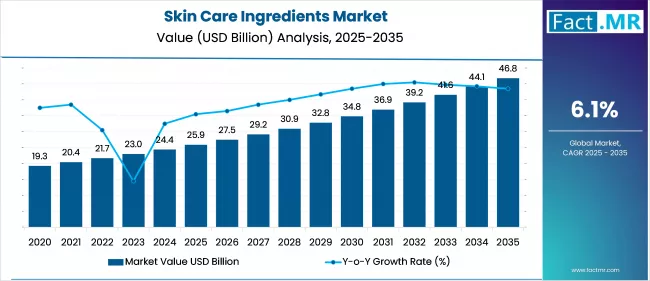
Skin Care Ingredients Market Market Value Analysis | Source: Fact.MR
What are the drivers of skin care ingredients market?
Natural, organic, and multifunctional formulation remains a key market driver in the skin care ingredients market. Growing consumer preferences of knowing product contents, skin health benefits and the long term effects has supported demand for botanical extract, vitamins, peptides and hyaluronic acid.
Younger consumers, including millennials and Gen Z demographics are seeking clean label formulations that are cruelty-free and enriched with active contents that have anti-aging effects, hydration, and skin barrier repair activity. Increasing occurrence of skin ailments owing to pollution, stress and lifestyle factors is driving the need to use dermatologically tried and tested ingredients with scientific backing.
Development of new biologically active compounds and the application of biotechnology in ingredient formulation are also acting as growth drivers. The growing encroachment of cosmeceutical products and digital diagnostics has also influenced manufacturers to design more targeted ingredient-driven formulas that suit different skin types and conditions.
What are the regional trends of skin care ingredients market?
The skin care ingredients market in Asia Pacific is led by South Korea, Japan and China. These nations are the hubs of innovation where developments such as fermented ingredients, K-beauty, and hybrid skincare drive product development evolution. Both the traditional and the cosmeceutical ingredient adoption are facilitated by the high population base of beauty-conscious individuals that are rapidly urbanizing across the region.
Consumer preferences in North America and Europe emphasize eco-friendly, vegan formulas, and clinically validated actives. EU regulatory frameworks also promote working with safe, standardized, and environment friendly ingredients, which stimulate innovation of upcycled or biodegradable substances.
The Middle East and Latin America are emerging as development markets, where increasing disposable income and a boom in online cosmetic retailing have opened the global skincare brands to consumers.
What are the challenges and restraining factors of skin care ingredients market?
Among the key significant obstacles is the complicated international norms of food safety and ingredients and labeling. Differences in U.S., EU and Asian regulations may delay market entry and increase the cost of compliance. Synthetic preservatives, parabens, or petrochemicals usage is also under scrutiny, prompting companies to develop alternative formulations that may be less effective or have shorter shelf-life.
Volatility of the supply chain is another significant limitation, particularly on raw materials of natural and organic foods. Availability of ingredients may be disrupted by climate change, geopolitical issues and ethical sourcing problems at an increasing price. Also, growing consumer awareness in the traceability of ingredients used by manufactures and the method used to prepare them has added pressure on manufacturers.
Innovation faces further constraints because of market saturation in the developed countries and the difficulty in developing products with multiple functions that correspond to the expectations of the consumers and yet still offer high safety and performance. The protection of intellectual properties and ingredient imitation in fast-paced markets continue to cast an unsettling effect to original developers.
Country-Wise Outlook
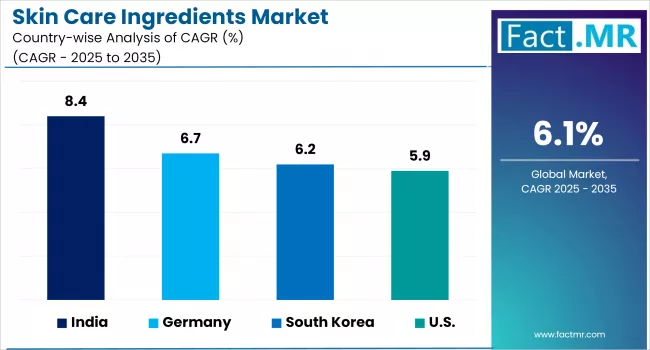
Skin Care Ingredients Market Cagr Analysis By Country | Source: Fact.MR
In the United States, Science-Led Formulations Fuel Market Dynamism
The U.S. skin care ingredients market is fueled by consumer spending on dermatological and cosmetic products with significant innovation. Multifunctional clean-label, and clinically validated ingredients including peptides, retinoids, and niacinamide will continue to experience a consistent demand.
Cosmeceuticals can be commercialized with relative ease, as it allows active ingredients to reach the market efficiently through established regulatory pathways created by the FDA. In addition, AI-driven formulation platforms, and biotech-derived actives are being popular among startup firms.
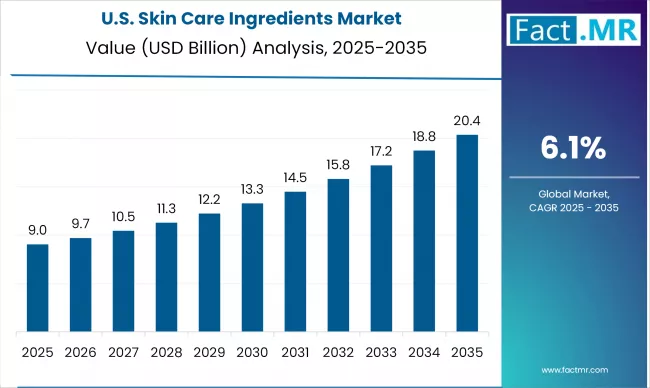
Skin Care Ingredients Market Country Value Analysis | Source: Fact.MR
DNA-based skin profiling and tele-dermatology have also contributed to more personalized skin assessments, reinforcing the need for tailored formulations. The increased consumer interest in control over preservatives and chemical agents, however, has led formulators to prioritize natural and microbiome-friendly options.
South Korea Emerges as the Epicenter of K-Beauty Ingredient Innovation
The beauty industry in South Korea is influencing the global market by prioritizing invention, thereby shaping ingredient demand through trend driven product development. R&D support of cosmeceuticals, consumer acceptance of new actives and domestic supply of fermented, botanical and encapsulated compounds are the current drivers of the skin care ingredient market in the country.
KFDA laws facilitate express-processing of new functional ingredients. Another area in which South Korea is leading the world is popularizing bio-tech skin care products, including growth factors and exosomes made of stem cells. Personalized serums and ampoules are integrated with mobile diagnostic applications and have gained popularity among the consumers towards dynamic ingredient solutions.
Germany Sets the Tone for Clean Beauty and Natural Ingredient Demand
The skin care ingredients market in Germany is a leading market in Europe with preference toward naturally-derived ingredients and strong regulatory practices of the EU. The increased demand for organic actives, essential oils, and phytochemicals reflects broader shift towards clean beauty and certified vegan products.
BfR (Federal Institute for Risk Assessment) recommendations influence the research and development and the release of products to which formulators are being forced to shift to allergens and clinically validated ingredients. Germany is also improving green chemistry through the extraction of ingredients by the use of CO2 based and solvent free procedures. With an aging population, the market has an increased demand in collagen enhancing supplements, ceramides, and protective barrier boosting ingredients which are backed by dermatological research.
Country Wise Insights
| Countries | CAGR (2025-2035) |
|---|---|
| U.S. | 5.9% |
| South Korea | 7.6% |
| Germany | 6.7% |
Source: Fact.MR analysis. Updated Aug 29, 2025
Category-Wise Analysis
Hyaluronic Acid Anchors Moisture Retention in Next-Gen Skin Formulations
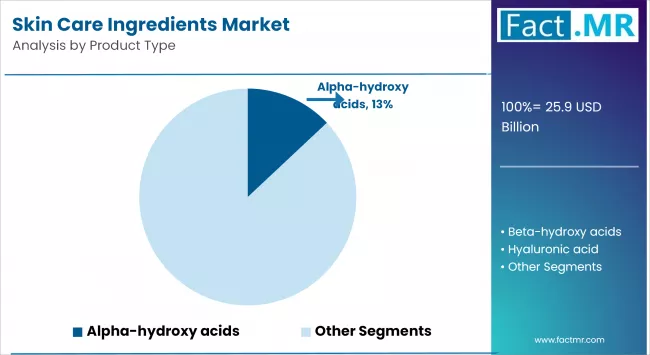
Skin Care Ingredients Market Analysis By Product Type | Source: Fact.MR
The hyaluronic acid has become a foundational ingredient in modern skincare because of its ability to bind moisture incredibly. As a humectant, it draws water into the skin, making it more elastic, lessens the onset of fine lines, resulting in increased plumpness, especially which is vital in anti-aging and moisturizing product line.
As consumers increasingly seek non-invasive and dermo-cosmetic solutions to maintain appearance, hyaluronic acid is now widely incorporated in serums, creams and sheet masks. The fact that it is biocompatible, as well as a skin barrier reparative, has made it a critical constituent in both dermatological and cosmeceutical skin care products.
Botanical-Based Sources Drive Clean Label Innovation in Skincare
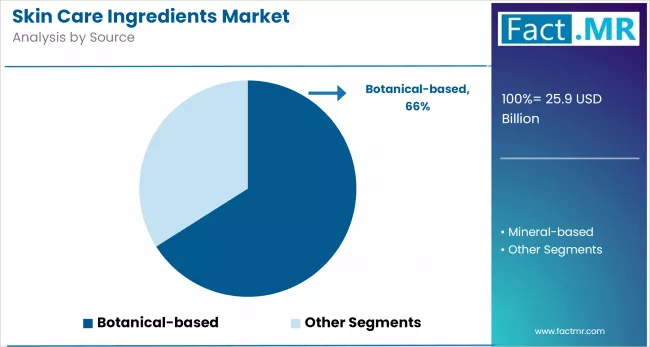
Skin Care Ingredients Market Analysis By Source | Source: Fact.MR
Ingredients of botanical origin are redefining skin care with their natural and plant-derived properties, appealing to clean beauty-conscious consumers. The sources are obtained through extracting herbs, roots, flowers as well as fruits and offer multifunctional benefits including antioxidant and soothing effects, while promoting skin rejuvenation.
With increasing restrictions in synthetic additives and greater consumer awareness, botanical sourcing is receiving regulatory and retail support particularly in Europe and North America. Companies are using such ingredients because of their effectiveness as well as their eco-friendly and ethical stance in the product labels.
Active Agents Power Targeted Skin Therapies for Diverse Needs
The active agents are the functional part of the skincare solutions providing specific effects, such as anti-aging, control of pigmentation, and acne regression. These ingredients have direct interaction with skin biology that causes observable and quantifiable reactions.
Active ingredients like peptides and retinoids, niacinamide and ceramides are already tailored to skin type, age, and concern. Advancement of skin health diagnostics and AI-based recommendation-related product platforms have increased the pace of innovation associated with active agents, resulting in high-performance, dermatology tested compositions, with clinically proven results.
Competitive Analysis
The skincare ingredients industry is highly competitive, shaped by continuous product innovations, advanced formulations, and sustainable strategies of ingredients sourcing. The primary focus for companies is the development of active ingredients, enhanced efficacy supported by scientific validation, and clean-label positioning to meet consumer expectations for transparency and accountability.
Differentiation is by means of specific ingredients that appeal to specific skincare concerns such as anti-aging, hydration, and brightening. Organizations are focusing more on the plant-based, organic, and cruelty-free certifications to target audiences that consider ethical purchasing. Biotechnology advancements are also enabling new entrants to introduce brands that challenge established players through novel formulations.
Market participants continue to pursue opportunities in distribution channels, strategic partnerships, and digital marketing to strengthen consumer engagement. The competitive environment in the skincare ingredients environment is also determined by the standards of regulatory compliance, quality assurance, and sustainability.
Key players in the market are L’Oreal S.A., BASF, Clariant AG, Akzo Nobel N.V., Croda International Plc., Evonik Industries AG, Procter & Gamble Co., The Unilever Group, Avon Products, Beiersdorf AG, Sederma Inc., Botanic Organic LLC, Eminence Organic Skincare, Estee Lauder, Mama Earth, and other players.
Recent Development
- In February 2025, The Estée Lauder Companies announced a partnership with Serpin Pharma to explore anti‑inflammatory biotech proteins (SERPINs) for skin care longevity and sensitivity solutions.
- In February 2025, Biotech startup Debut unveiled BeautyORB, a generative‑AI platform that formulates new skin bioactives targeting inflammaging and barrier repair aiming to create two novel biotech ingredients per year.
Methodology and Industry Tracking Approach
To produce research on the skin care ingredients market in 2025, Fact.MR gathered over 2,750 market players, including 21 countries. To reflect adequate industry changes, the interviews with more than 110 industry experts operating on a regional basis (i.e., dermatologists, cosmetic formulation experts, and sustainability specialists) took place in October 2025, reflecting intensified efforts towards choosing solutions with plant-based, free of allergens, and sustainable plant-based skincare ingredients.
The market showed a growth in July 2024- June 2025 with the aid of advanced biotechnology-based ingredients and AI-driven personalization measures. The enhancements involved the precision fermentation, actively grown ingredients in laboratory conditions, and computerized crime formulation platforms that would provide real-time customization, increased efficacy, and consumer disclosure.
Fact.MR analysts also observed an increase in demand of biodegradable as well as low-environmental-impact skincare ingredients since 2018, with manufacturers resorting to circular ingredient sourcing, green chemistry approach, formulations without water, etc., on a global level.
Fact.MR has provided detailed information about the price points of key manufacturers of Skin Care Ingredients Market positioned across regions, sales growth, production capacity, and speculative technological expansion, in the recently published report.
Segmentation
Segmentation of Skin care ingredients market
-
By Product Type :
- Alpha-hydroxy acids
- Beta-hydroxy acids
- Hydroquinone
- Retinol
- Ascorbic acid
- Hyaluronic acid
- Copper peptide
- Glyceryl stearate
- Lecithin
-
By Functionality :
- Active agents
- Additives
-
By Application :
- Cleansers
- Creams
- Face wash
- Peels and Scrubs
- Toners
- Lotions
- Face masks
- Face Serums and Gels
- Others
-
By Source :
- Botanical-based
- Mineral-based
-
By Region :
- North America
- Latin America
- Western Europe
- Eastern Europe
- East Asia
- South Asia & Pacific
- Middle East & Africa
Frequently Asked Questions
What was the global Skin care ingredients market size reported by Fact.MR for 2025?
Who are the major players operating in the skin care ingredients market?
What is the Estimated Valuation of the skin care ingredients market in 2035?
What value CAGR did the Skin care ingredients market exhibit over the last five years?
Who worked on this report


Preview the report firsthand - request a free sample
Free SampleGet the brochure for pricing and purchase details
Download PDF