Hair-Care Surfactants Market (2026 - 2036)

Hair-Care Surfactants Market is segmented by Surfactant Class (Anionic (sulfates, sulfonates), Amphoteric / Zwitterionic, Nonionic, Cationic (conditioning surfactants)), Product Format (Liquid Concentrates, Pastes, Powders / Flakes, Pre-Blends / Systems), Application (Shampoo, Conditioner / 2-in-1, Scalp Care & Anti-Dandruff, Co-Wash / Cleansing Conditioner), Positioning / Claim (Sulfate-Free Systems, Mild / Sensitive Scalp, Bio-Based / Naturally Derived, High-Foam / Sensory), and Region. Forecast for 2026 to 2036.

Core Findings

    Hair-Care Surfactants Market Forecast 2026 to 2036

    In 2025, the hair-care surfactants market was valued at USD 4.8 billion. Based on Fact MR's analysis, demand for hair-care surfactants is estimated to grow to USD 5.2 billion in 2026 and USD 7.6 billion by 2036. Fact MR projects a CAGR of 4.2% during the forecast period.

    The absolute dollar growth from 2026 to 2036 is USD 2.6 billion. This reflects steady market growth, driven by the ongoing demand for gentle and effective surfactants in hair-care formulations. Growth is expected to continue as consumers prioritize cleaner ingredients and eco-friendlier formulations. However, challenges such as rising raw material costs and regulatory changes could limit growth in some regions.

    China leads with a CAGR of 5.2%, driven by increasing consumer interest in personal care products. Brazil follows with a 5.0% CAGR, fueled by growing demand for high-performance hair-care solutions. The USA is projected to grow at 4.0%, supported by the strong consumer preference for quality and effective formulations. South Korea, with a 3.9% CAGR, benefits from its advanced beauty industry. Germany and the United Kingdom show CAGRs of 3.6% each, reflecting steady demand in mature markets. Japan experiences the slowest growth at 3.3%, influenced by market saturation and a focus on premium products.
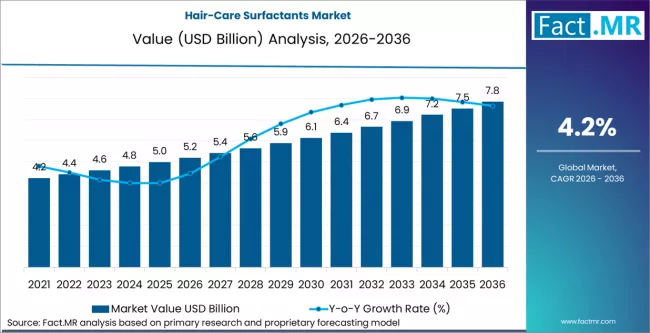
    Hair Care Surfactants Market Market Value Analysis

    Hair‑Care Surfactants Market Definition

    The Hair‑Care Surfactants Market refers to the production and sale of surface‑active agents specifically formulated for hair‑cleansing and conditioning products. These molecules reduce surface tension between liquids and solids, helping to remove oil, dirt, and buildup while supporting foam formation and product spreadability. They also influence texture, mildness, and lather quality in shampoos, conditioners, and treatment products. Key end users are cosmetic and personal care manufacturers that supply mass, premium, and professional hair‑care segments.

    Market Inclusions

    This report covers global and regional market sizes for hair‑care surfactants, with a defined forecast period. It includes segment breakdowns by surfactant type (anionic, amphoteric, nonionic, cationic), application (shampoos, conditioners, hair masks and serums), and end user. Pricing trends, raw material supply analysis, and trade flow data are included to reflect comprehensive market dynamics.

    Market Exclusions

    The scope excludes finished hair‑care products such as shampoos, conditioners, serums, and styling formulations containing surfactants. It also omits unrelated cosmetic ingredients like pigments, UV filters, and fragrances. Niche surfactants used exclusively in industrial cleaners or non‑hair‑care applications are not included, focusing strictly on surfactants intended for hair‑care formulas.

    Research Methodology

    • Primary Research: Interviews were conducted with formulation chemists, procurement specialists, and industry experts.
    • Desk Research: Data was sourced from industry reports, regulatory filings, and trade associations.
    • Market‑Sizing and Forecasting: A hybrid model was used, combining top‑down market analysis with bottom‑up shipment data.

    Data Validation and Update Cycle

    Outputs were validated through expert review and aligned with current production and trade figures, with periodic updates.

    Hair-Care Surfactants Market Summary

    Market Definition

    The hair-care surfactants market encompasses surface-active agents used in hair cleansing and conditioning products. These surfactants help in removing dirt, oil, and impurities from hair, providing foam, texture, and mildness. The market includes a variety of surfactant types and their application in products like shampoos, conditioners, and scalp care treatments.

    Demand Drivers

    • Gentle & Effective Cleansers: Growing consumer preference for mild yet efficient cleansing agents that are gentle on the scalp.
    • Consumer Focus on Hair Health: Increasing demand for shampoos and conditioners that support scalp health and nourishment.
    • Natural & Sustainable Products: A rising shift towards sulfate-free and eco-friendly formulations, boosting the demand for natural and biodegradable surfactants.

    Key Segments

    • Application: Shampoo is expected to dominate, holding 57% market share by 2026.
    • Product Format: Liquid concentrates (51% market share by 2026) due to cost-effectiveness and ease of use.
    • Surfactant Class: Anionic surfactants, including sulfates and sulfonates, dominate traditional formulations, but demand for milder surfactants is increasing.

    Regional Outlook

    • China: Leading with a 5.2% CAGR, driven by growing demand for personal care products.
    • Brazil: Expected growth at 5.0%, influenced by rising consumer spending in the beauty sector.
    • USA: Projected to grow at 4.0%, supported by the strong consumer preference for high-performance, eco-friendly products.

    Analyst Opinion

    The hair-care surfactants market is poised for steady growth through 2036. Consumer demand for milder, natural, and sustainable products is reshaping surfactant types and formulations. Despite challenges like rising raw material costs, innovations in product formats and formulations will drive market expansion.

    Strategic Takeaways

    • Shift Toward Mild & Natural Surfactants: Brands must adapt to the demand for sustainable, biodegradable, and gentle surfactants.
    • Regional Growth: Higher growth in Asia Pacific and Latin America due to increasing personal care consumption.
    • OEM Collaboration: OEM line-fit sales will dominate as manufacturers integrate surfactants into their hair-care formulations.

    Methodology

    This forecast is based on primary interviews with industry experts, market data, and trends in the hair-care and personal care industries.

    Segmental Analysis

    Hair-Care Surfactants Market Analysis by Application
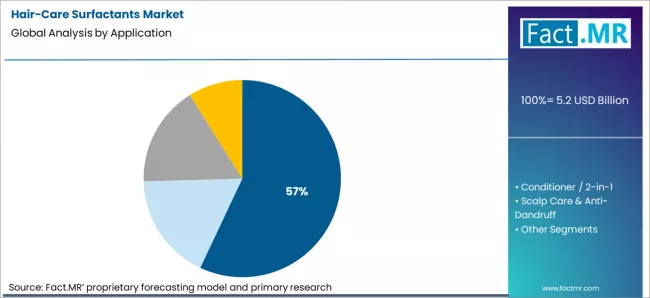
    Hair Care Surfactants Market Analysis By Application

    • Market Overview: Shampoo is expected to capture 57% of the hair-care surfactants market by 2026. Surfactants in shampoos are essential for their cleansing properties, as they help to remove oils, dirt, and impurities from the scalp and hair. The growing demand for effective yet gentle hair cleansing formulations is driving the use of surfactants in shampoo products.
    • Demand Drivers:
      • Increased Demand for Gentle and Effective Cleansers: Consumers are seeking shampoos that not only clean effectively but are also gentle on the scalp and hair. Surfactants play a key role in balancing cleansing performance with mildness, making them a key ingredient in modern formulations.
      • Consumer Focus on Hair Health: As hair care becomes a more personalized and health-focused category, the demand for shampoos that promote scalp health and hair nourishment increases, driving the need for innovative surfactant technologies.
      • Growth of Natural and Organic Products: The shift toward natural, sulfate-free, and eco-friendly products is also boosting the demand for mild surfactants that align with these consumer preferences.

    Hair-Care Surfactants Market Analysis by Product Format
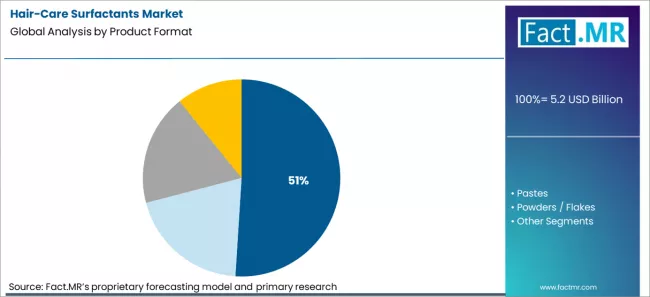
    Hair Care Surfactants Market Analysis By Product Format

    • Market Overview: Liquid concentrates are projected to hold 51% of the market share by 2026. These concentrates offer a high concentration of surfactants, which can be easily diluted to achieve the desired formulation. Liquid concentrates are widely used due to their ease of incorporation into various hair care products and their ability to deliver effective performance.
    • Demand Drivers:
      • Cost-Effectiveness and Ease of Use: Liquid concentrates are cost-effective and easy to use, making them the preferred choice for manufacturers who need scalable, efficient ingredients that can be incorporated into different formulations.
      • Customization and Versatility: Liquid concentrates offer flexibility in adjusting surfactant levels for different product formulations, allowing manufacturers to create products that cater to specific consumer needs such as volume, moisture, or shine.
      • Sustainability and Efficiency: The trend toward minimizing packaging waste and improving product performance has made liquid concentrates a preferred format, as they can be used to create highly concentrated formulations that require less packaging and offer greater product efficiency.

    Hair Care Surfactants Market Drivers, Restraints, and Opportunities

    FMR analysts observe that the hair‑care surfactants market is a mature, high‑volume segment anchored in basic cleansing and conditioning functions across shampoos, co‑washes, and treatment systems. Historically, anionic surfactants like sodium lauryl sulfate dominated due to cost and lather performance; over time, consumer preferences for milder and multifunctional formulations expanded demand for amphoteric and nonionic surfactants. The 2026 valuation reflects this structural reality, where foundational cleansing needs persist, but formulation trends and regulation are reshaping the mix of surfactant types.

    While demand for traditional high‑foaming sulfates is declining in many premium and “gentle care” products, newer mild and biodegradable surfactants are gaining share. These alternative surfactants typically command higher per‑unit costs, contributing to net value growth even as total volumes shift toward gentler systems. The market exists at its current size because basic cleansing remains essential, but performance expectations and regulatory pressures influence ingredient choice and value.

    • Gentle Formulation Shift: Consumer demand for milder cleansing systems is reducing reliance on traditional sulfates and increasing uptake of amphoteric and nonionic surfactants that offer lower irritation potential.
    • Regulatory Ingredient Standards: Regulations such as EU Cosmetic Regulation restrictions on certain ethoxylated impurities are pushing formulators toward compliant alternatives, raising ingredient costs.
    • Regional Preference Differences: In North America and Europe, premium mild surfactants are gaining faster adoption, while in many Asia‑Pacific markets cost‑effective traditional surfactants remain prevalent.

    Regional Analysis

    The market analysis covers key global regions, including North America, Latin America, Western Europe, Eastern Europe, South Asia and Pacific, East Asia, and Middle East & Africa. It is segmented geographically, with specific market dynamics for each region. The full report provides a detailed market attractiveness analysis.
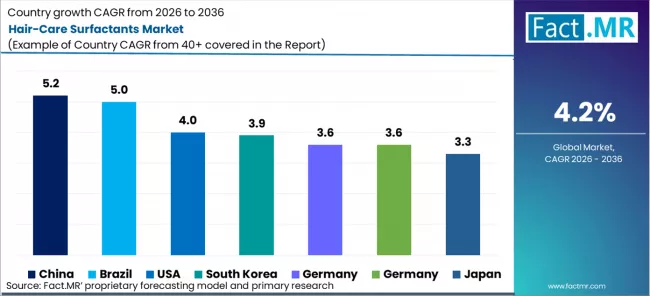
    Hair Care Surfactants Market Cagr Analysis By Country

    Country CAGR (2026-2036)
    USA 4.0%
    Japan 3.3%
    South Korea 3.9%
    Germany 3.6%
    China 5.2%
    United Kingdom 3.6%
    Brazil 5.0%

    Source: Fact MR (FMR) analysis, based on proprietary forecasting model and primary research.

    North America:

    North America is a "leader in cosmetic innovation," with the USA at the forefront of personal care and hair-care product demand. Surfactant use in hair-care formulations continues to grow due to increasing consumer demand for natural and effective products.

    • USA: Demand for hair-care surfactants in the U.S. is projected to rise at 4.0% CAGR through 2036. Growing consumer awareness around sustainable and clean beauty products, coupled with brand investments from companies like Procter & Gamble in hair-care technologies, continue to drive market growth.

    Asia Pacific:

    Asia Pacific continues to be a "growth center for personal care products," with increasing demand for innovative hair-care formulations that use surfactants in regions like China and South Korea.

    • China: Demand for hair-care surfactants in China is projected to rise at 5.2% CAGR through 2036. The growing beauty industry and consumer preferences for natural and sustainable hair-care solutions drive the market in the country.
    • Japan: Demand for hair-care surfactants in Japan is projected to rise at 3.3% CAGR through 2036. Japan’s strong skincare and hair-care market and focus on high-quality ingredients contribute to steady demand.
    • South Korea: Demand for hair-care surfactants in South Korea is projected to rise at 3.9% CAGR through 2036. The Korean beauty industry's global influence and continuous innovation in personal care products support market growth.

    Europe:

    Europe remains a key player in sustainable beauty and personal care, with ongoing efforts to use eco-friendly ingredients in hair-care formulations.

    • Germany: Demand for hair-care surfactants in Germany is projected to rise at 3.6% CAGR through 2036. The European Union’s sustainability initiatives and German consumer demand for environmentally conscious beauty products continue to support market growth.
    • United Kingdom: Demand for hair-care surfactants in the UK is projected to rise at 3.6% CAGR through 2036. Rising demand for natural hair-care solutions and growing interest in organic personal care products are key drivers in the UK.

    Latin America:

    In Latin America, especially Brazil, the market for hair-care surfactants is driven by an increasing preference for high-quality hair-care products and rapid growth in the beauty industry.

    • Brazil: Demand for hair-care surfactants in Brazil is projected to rise at 5.0% CAGR through 2036. Brazil’s expanding personal care market and strong demand for hair-care solutions contribute significantly to the market growth.

    Fact MR's analysis of the Hair-Care Surfactants Market in Asia Pacific, Europe, and Latin America consists of country-wise assessments that include China, Japan, South Korea, Germany, the United Kingdom, and Brazil. Readers can find detailed trends, regulatory updates, and company-specific investments shaping the market’s growth in these countries.

    How Are Key Players Competing in the Hair-Care Surfactants Market?
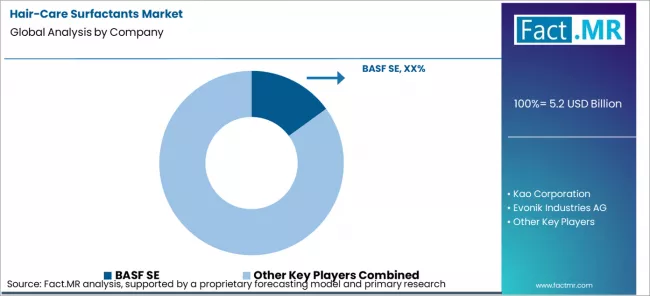
    Hair Care Surfactants Market Analysis By Company

    The hair-care surfactants market is driven by leading companies such as BASF SE, Kao Corporation, and Evonik Industries AG, focusing on developing sustainable, high-performance surfactants for improved cleansing, foaming, and conditioning. Stepan Company and Nouryon Chemicals Holding B.V. offer innovative solutions in surfactant technology, focusing on mild formulations for sensitive scalp care. Croda International Plc and Clariant AG are advancing bio-based and natural surfactants to meet the rising demand for environmentally friendly hair-care products. Solvay SA and Dow Inc. also contribute by emphasizing the efficacy and sustainability of their surfactant solutions. Galaxy Surfactants Limited caters to diverse consumer needs by providing customized surfactants for both premium and mass-market hair-care products.

    Recent Industry Developments

    • Product launch - Nouryon Structure® M3 co-surfactant (Announced Apr 16, 2024): Nouryon launched Structure® M3, a biodegradable co-surfactant designed to improve mildness and performance in surfactant systems used in shampoos and other rinse-off hair-care formulations.
    • Product launch - BASF Dehyton® PK45 GA/RA (Announced Apr 3, 2025): BASF introduced Dehyton® PK45 GA/RA (cocamidopropyl betaine), a readily biodegradable amphoteric surfactant derived from Rainforest Alliance-certified coconut oil for shampoos and cleansing applications.
    • Product launch - Nouryon Armocare® Aqua 12 (Announced Apr 8, 2025): Nouryon launched Armocare® Aqua 12, an ISCC PLUS-certified biodegradable (non-quat) conditioning surfactant/agent for high-performing hair-care formulations.

    Key Players of the Hair-Care Surfactants Market

    • BASF SE
    • Kao Corporation
    • Evonik Industries AG
    • Stepan Company
    • Nouryon Chemicals Holding B.V.
    • Croda International Plc
    • Clariant AG
    • Solvay SA
    • Dow Inc.
    • Galaxy Surfactants Limited

    Report Scope

    Metric Value
    Quantitative Units USD 5.0 billion (2026) to USD 7.6 billion (2036), at a CAGR of 4.2%
    Market Definition The hair-care surfactants market includes surfactants used in hair-care products, offering cleansing, conditioning, and other beneficial properties for shampoos, conditioners, and scalp care treatments.
    By Surfactant Class Anionic (sulfates, sulfonates), Amphoteric / Zwitterionic, Nonionic, Cationic (conditioning surfactants)
    By Product Format Liquid Concentrates, Pastes, Powders / Flakes, Pre-Blends / Systems
    By Application Shampoo, Conditioner / 2-in-1, Scalp Care & Anti-Dandruff, Co-Wash / Cleansing Conditioner
    By Positioning / Claim Sulfate-Free Systems, Mild / Sensitive Scalp, Bio-Based / Naturally Derived, High-Foam / Sensory
    Regions Covered North America, Latin America, Europe, East Asia, South Asia, Oceania, Middle East and Africa
    Countries Covered United States, Canada, Mexico, Brazil, Argentina, Germany, France, United Kingdom, Italy, Spain, China, India, Japan, South Korea, Indonesia, Australia, and 40+ countries
    Key Companies Profiled BASF SE, Kao Corporation, Evonik Industries AG, Stepan Company, Nouryon Chemicals Holding B.V., Croda International Plc, Clariant AG, Solvay SA, Dow Inc., Galaxy Surfactants Limited
    Forecast Period 2026 to 2036
    Approach Hybrid top-down and bottom-up market modeling validated through primary interviews with manufacturers and supported by trade data benchmarking and market research.

    Hair Care Surfactants Market Key Segments

    • By Surfactant Class :

      • Anionic (sulfates, sulfonates)
      • Amphoteric / Zwitterionic
      • Nonionic
      • Cationic (conditioning surfactants)
    • By Product Format :

      • Liquid Concentrates
      • Pastes
      • Powders / Flakes
      • Pre-Blends / Systems
    • By Application :

      • Shampoo
      • Conditioner / 2-in-1
      • Scalp Care & Anti-Dandruff
      • Co-Wash / Cleansing Conditioner
    • By Positioning / Claim :

      • Sulfate-Free Systems
      • Mild / Sensitive Scalp
      • Bio-Based / Naturally Derived
      • High-Foam / Sensory
    • Region :

      • North America
        • USA
        • Canada
        • Mexico
      • Europe
        • Germany
        • UK
        • France
        • Italy
        • Spain
        • Nordic Countries
        • BENELUX
        • Rest of Europe
      • Asia Pacific
        • China
        • Japan
        • South Korea
        • India
        • Australia
        • Rest of Asia Pacific
      • Latin America
        • Brazil
        • Argentina
        • Rest of Latin America
      • Middle East and Africa
        • Kingdom of Saudi Arabia
        • United Arab Emirates
        • South Africa
        • Rest of Middle East and Africa
      • Other Regions
        • Oceania
        • Central Asia
        • Other Markets

    Bibliographies

    • Product Launch - Nouryon Structure® M3 Co-Surfactant: Nouryon. (2024, April 16). Nouryon launches Structure® M3 co-surfactant. Nouryon. [1]
    • Product Launch - BASF Dehyton® PK45 GA/RA: BASF. (2025, April 3). BASF introduces Dehyton® PK45 GA/RA. BASF. [2]
    • Product Launch - Nouryon Armocare® Aqua 12: Nouryon. (2025, April 8). Nouryon launches Armocare® Aqua 12. Nouryon. [3]

    Table of Content

    1. Executive Summary
      • Global Market Outlook
      • Demand to side Trends
      • Supply to side Trends
      • Technology Roadmap Analysis
      • Analysis and Recommendations
    2. Market Overview
      • Market Coverage / Taxonomy
      • Market Definition / Scope / Limitations
    3. Research Methodology
      • Chapter Orientation
      • Analytical Lens and Working Hypotheses
        • Market Structure, Signals, and Trend Drivers
        • Benchmarking and Cross-market Comparability
        • Market Sizing, Forecasting, and Opportunity Mapping
      • Research Design and Evidence Framework
        • Desk Research Programme (Secondary Evidence)
          • Company Annual and Sustainability Reports
          • Peer-reviewed Journals and Academic Literature
          • Corporate Websites, Product Literature, and Technical Notes
          • Earnings Decks and Investor Briefings
          • Statutory Filings and Regulatory Disclosures
          • Technical White Papers and Standards Notes
          • Trade Journals, Industry Magazines, and Analyst Briefs
          • Conference Proceedings, Webinars, and Seminar Materials
          • Government Statistics Portals and Public Data Releases
          • Press Releases and Reputable Media Coverage
          • Specialist Newsletters and Curated Briefings
          • Sector Databases and Reference Repositories
          • FMR Internal Proprietary Databases and Historical Market Datasets
          • Subscription Datasets and Paid Sources
          • Social Channels, Communities, and Digital Listening Inputs
          • Additional Desk Sources
        • Expert Input and Fieldwork (Primary Evidence)
          • Primary Modes
            • Qualitative Interviews and Expert Elicitation
            • Quantitative Surveys and Structured Data Capture
            • Blended Approach
          • Why Primary Evidence is Used
          • Field Techniques
            • Interviews
            • Surveys
            • Focus Groups
            • Observational and In-context Research
            • Social and Community Interactions
          • Stakeholder Universe Engaged
            • C-suite Leaders
            • Board Members
            • Presidents and Vice Presidents
            • R&D and Innovation Heads
            • Technical Specialists
            • Domain Subject-matter Experts
            • Scientists
            • Physicians and Other Healthcare Professionals
          • Governance, Ethics, and Data Stewardship
            • Research Ethics
            • Data Integrity and Handling
        • Tooling, Models, and Reference Databases
      • Data Engineering and Model Build
        • Data Acquisition and Ingestion
        • Cleaning, Normalisation, and Verification
        • Synthesis, Triangulation, and Analysis
      • Quality Assurance and Audit Trail
    4. Market Background
      • Market Dynamics
        • Drivers
        • Restraints
        • Opportunity
        • Trends
      • Scenario Forecast
        • Demand in Optimistic Scenario
        • Demand in Likely Scenario
        • Demand in Conservative Scenario
      • Opportunity Map Analysis
      • Product Life Cycle Analysis
      • Supply Chain Analysis
      • Investment Feasibility Matrix
      • Value Chain Analysis
      • PESTLE and Porter’s Analysis
      • Regulatory Landscape
      • Regional Parent Market Outlook
      • Production and Consumption Statistics
      • Import and Export Statistics
    5. Global Market Analysis 2021 to 2025 and Forecast, 2026 to 2036
      • Historical Market Size Value (USD Million) Analysis, 2021 to 2025
      • Current and Future Market Size Value (USD Million) Projections, 2026 to 2036
        • Y to o to Y Growth Trend Analysis
        • Absolute $ Opportunity Analysis
    6. Global Market Pricing Analysis 2021 to 2025 and Forecast 2026 to 2036
    7. Global Market Analysis 2021 to 2025 and Forecast 2026 to 2036, By Application
      • Introduction / Key Findings
      • Historical Market Size Value (USD Million) Analysis By Application , 2021 to 2025
      • Current and Future Market Size Value (USD Million) Analysis and Forecast By Application , 2026 to 2036
        • Shampoo
        • Conditioner / 2-in-1
        • Scalp Care & Anti-Dandruff
        • Co-Wash / Cleansing Conditioner
      • Y to o to Y Growth Trend Analysis By Application , 2021 to 2025
      • Absolute $ Opportunity Analysis By Application , 2026 to 2036
    8. Global Market Analysis 2021 to 2025 and Forecast 2026 to 2036, By Product Format
      • Introduction / Key Findings
      • Historical Market Size Value (USD Million) Analysis By Product Format, 2021 to 2025
      • Current and Future Market Size Value (USD Million) Analysis and Forecast By Product Format, 2026 to 2036
        • Liquid Concentrates
        • Pastes
        • Powders / Flakes
        • Pre-Blends / Systems
      • Y to o to Y Growth Trend Analysis By Product Format, 2021 to 2025
      • Absolute $ Opportunity Analysis By Product Format, 2026 to 2036
    9. Global Market Analysis 2021 to 2025 and Forecast 2026 to 2036, By Region
      • Introduction
      • Historical Market Size Value (USD Million) Analysis By Region, 2021 to 2025
      • Current Market Size Value (USD Million) Analysis and Forecast By Region, 2026 to 2036
        • North America
        • Latin America
        • Western Europe
        • Eastern Europe
        • East Asia
        • South Asia and Pacific
        • Middle East & Africa
      • Market Attractiveness Analysis By Region
    10. North America Market Analysis 2021 to 2025 and Forecast 2026 to 2036, By Country
      • Historical Market Size Value (USD Million) Trend Analysis By Market Taxonomy, 2021 to 2025
      • Market Size Value (USD Million) Forecast By Market Taxonomy, 2026 to 2036
        • By Country
          • USA
          • Canada
          • Mexico
        • By Application
        • By Product Format
      • Market Attractiveness Analysis
        • By Country
        • By Application
        • By Product Format
      • Key Takeaways
    11. Latin America Market Analysis 2021 to 2025 and Forecast 2026 to 2036, By Country
      • Historical Market Size Value (USD Million) Trend Analysis By Market Taxonomy, 2021 to 2025
      • Market Size Value (USD Million) Forecast By Market Taxonomy, 2026 to 2036
        • By Country
          • Brazil
          • Chile
          • Rest of Latin America
        • By Application
        • By Product Format
      • Market Attractiveness Analysis
        • By Country
        • By Application
        • By Product Format
      • Key Takeaways
    12. Western Europe Market Analysis 2021 to 2025 and Forecast 2026 to 2036, By Country
      • Historical Market Size Value (USD Million) Trend Analysis By Market Taxonomy, 2021 to 2025
      • Market Size Value (USD Million) Forecast By Market Taxonomy, 2026 to 2036
        • By Country
          • Germany
          • UK
          • Italy
          • Spain
          • France
          • Nordic
          • BENELUX
          • Rest of Western Europe
        • By Application
        • By Product Format
      • Market Attractiveness Analysis
        • By Country
        • By Application
        • By Product Format
      • Key Takeaways
    13. Eastern Europe Market Analysis 2021 to 2025 and Forecast 2026 to 2036, By Country
      • Historical Market Size Value (USD Million) Trend Analysis By Market Taxonomy, 2021 to 2025
      • Market Size Value (USD Million) Forecast By Market Taxonomy, 2026 to 2036
        • By Country
          • Russia
          • Poland
          • Hungary
          • Balkan & Baltic
          • Rest of Eastern Europe
        • By Application
        • By Product Format
      • Market Attractiveness Analysis
        • By Country
        • By Application
        • By Product Format
      • Key Takeaways
    14. East Asia Market Analysis 2021 to 2025 and Forecast 2026 to 2036, By Country
      • Historical Market Size Value (USD Million) Trend Analysis By Market Taxonomy, 2021 to 2025
      • Market Size Value (USD Million) Forecast By Market Taxonomy, 2026 to 2036
        • By Country
          • China
          • Japan
          • South Korea
        • By Application
        • By Product Format
      • Market Attractiveness Analysis
        • By Country
        • By Application
        • By Product Format
      • Key Takeaways
    15. South Asia and Pacific Market Analysis 2021 to 2025 and Forecast 2026 to 2036, By Country
      • Historical Market Size Value (USD Million) Trend Analysis By Market Taxonomy, 2021 to 2025
      • Market Size Value (USD Million) Forecast By Market Taxonomy, 2026 to 2036
        • By Country
          • India
          • ASEAN
          • Australia & New Zealand
          • Rest of South Asia and Pacific
        • By Application
        • By Product Format
      • Market Attractiveness Analysis
        • By Country
        • By Application
        • By Product Format
      • Key Takeaways
    16. Middle East & Africa Market Analysis 2021 to 2025 and Forecast 2026 to 2036, By Country
      • Historical Market Size Value (USD Million) Trend Analysis By Market Taxonomy, 2021 to 2025
      • Market Size Value (USD Million) Forecast By Market Taxonomy, 2026 to 2036
        • By Country
          • Kingdom of Saudi Arabia
          • Other GCC Countries
          • Turkiye
          • South Africa
          • Other African Union
          • Rest of Middle East & Africa
        • By Application
        • By Product Format
      • Market Attractiveness Analysis
        • By Country
        • By Application
        • By Product Format
      • Key Takeaways
    17. Key Countries Market Analysis
      • USA
        • Pricing Analysis
        • Market Share Analysis, 2025
          • By Application
          • By Product Format
      • Canada
        • Pricing Analysis
        • Market Share Analysis, 2025
          • By Application
          • By Product Format
      • Mexico
        • Pricing Analysis
        • Market Share Analysis, 2025
          • By Application
          • By Product Format
      • Brazil
        • Pricing Analysis
        • Market Share Analysis, 2025
          • By Application
          • By Product Format
      • Chile
        • Pricing Analysis
        • Market Share Analysis, 2025
          • By Application
          • By Product Format
      • Germany
        • Pricing Analysis
        • Market Share Analysis, 2025
          • By Application
          • By Product Format
      • UK
        • Pricing Analysis
        • Market Share Analysis, 2025
          • By Application
          • By Product Format
      • Italy
        • Pricing Analysis
        • Market Share Analysis, 2025
          • By Application
          • By Product Format
      • Spain
        • Pricing Analysis
        • Market Share Analysis, 2025
          • By Application
          • By Product Format
      • France
        • Pricing Analysis
        • Market Share Analysis, 2025
          • By Application
          • By Product Format
      • India
        • Pricing Analysis
        • Market Share Analysis, 2025
          • By Application
          • By Product Format
      • ASEAN
        • Pricing Analysis
        • Market Share Analysis, 2025
          • By Application
          • By Product Format
      • Australia & New Zealand
        • Pricing Analysis
        • Market Share Analysis, 2025
          • By Application
          • By Product Format
      • China
        • Pricing Analysis
        • Market Share Analysis, 2025
          • By Application
          • By Product Format
      • Japan
        • Pricing Analysis
        • Market Share Analysis, 2025
          • By Application
          • By Product Format
      • South Korea
        • Pricing Analysis
        • Market Share Analysis, 2025
          • By Application
          • By Product Format
      • Russia
        • Pricing Analysis
        • Market Share Analysis, 2025
          • By Application
          • By Product Format
      • Poland
        • Pricing Analysis
        • Market Share Analysis, 2025
          • By Application
          • By Product Format
      • Hungary
        • Pricing Analysis
        • Market Share Analysis, 2025
          • By Application
          • By Product Format
      • Kingdom of Saudi Arabia
        • Pricing Analysis
        • Market Share Analysis, 2025
          • By Application
          • By Product Format
      • Turkiye
        • Pricing Analysis
        • Market Share Analysis, 2025
          • By Application
          • By Product Format
      • South Africa
        • Pricing Analysis
        • Market Share Analysis, 2025
          • By Application
          • By Product Format
    18. Market Structure Analysis
      • Competition Dashboard
      • Competition Benchmarking
      • Market Share Analysis of Top Players
        • By Regional
        • By Application
        • By Product Format
    19. Competition Analysis
      • Competition Deep Dive
        • BASF SE
          • Overview
          • Product Portfolio
          • Profitability by Market Segments (Product/Age /Sales Channel/Region)
          • Sales Footprint
          • Strategy Overview
            • Marketing Strategy
            • Product Strategy
            • Channel Strategy
        • Kao Corporation
        • Evonik Industries AG
        • Stepan Company
        • Nouryon Chemicals Holding B.V.
        • Croda International Plc
        • Clariant AG
        • Solvay SA
        • Dow Inc.
        • Galaxy Surfactants Limited
    20. Assumptions & Acronyms Used

    List Of Table

    • Table 1: Global Market Value (USD Million) Forecast by Region, 2021 to 2036
    • Table 2: Global Market Value (USD Million) Forecast by Application, 2021 to 2036
    • Table 3: Global Market Value (USD Million) Forecast by Product Format, 2021 to 2036
    • Table 4: North America Market Value (USD Million) Forecast by Country, 2021 to 2036
    • Table 5: North America Market Value (USD Million) Forecast by Application, 2021 to 2036
    • Table 6: North America Market Value (USD Million) Forecast by Product Format, 2021 to 2036
    • Table 7: Latin America Market Value (USD Million) Forecast by Country, 2021 to 2036
    • Table 8: Latin America Market Value (USD Million) Forecast by Application, 2021 to 2036
    • Table 9: Latin America Market Value (USD Million) Forecast by Product Format, 2021 to 2036
    • Table 10: Western Europe Market Value (USD Million) Forecast by Country, 2021 to 2036
    • Table 11: Western Europe Market Value (USD Million) Forecast by Application, 2021 to 2036
    • Table 12: Western Europe Market Value (USD Million) Forecast by Product Format, 2021 to 2036
    • Table 13: Eastern Europe Market Value (USD Million) Forecast by Country, 2021 to 2036
    • Table 14: Eastern Europe Market Value (USD Million) Forecast by Application, 2021 to 2036
    • Table 15: Eastern Europe Market Value (USD Million) Forecast by Product Format, 2021 to 2036
    • Table 16: East Asia Market Value (USD Million) Forecast by Country, 2021 to 2036
    • Table 17: East Asia Market Value (USD Million) Forecast by Application, 2021 to 2036
    • Table 18: East Asia Market Value (USD Million) Forecast by Product Format, 2021 to 2036
    • Table 19: South Asia and Pacific Market Value (USD Million) Forecast by Country, 2021 to 2036
    • Table 20: South Asia and Pacific Market Value (USD Million) Forecast by Application, 2021 to 2036
    • Table 21: South Asia and Pacific Market Value (USD Million) Forecast by Product Format, 2021 to 2036
    • Table 22: Middle East & Africa Market Value (USD Million) Forecast by Country, 2021 to 2036
    • Table 23: Middle East & Africa Market Value (USD Million) Forecast by Application, 2021 to 2036
    • Table 24: Middle East & Africa Market Value (USD Million) Forecast by Product Format, 2021 to 2036

    List Of Figures

    • Figure 1: Global Market Pricing Analysis
    • Figure 2: Global Market Value (USD Million) Forecast 2021 to 2036
    • Figure 3: Global Market Value Share and BPS Analysis by Application, 2026 and 2036
    • Figure 4: Global Market Y to o to Y Growth Comparison by Application, 2026 to 2036
    • Figure 5: Global Market Attractiveness Analysis by Application
    • Figure 6: Global Market Value Share and BPS Analysis by Product Format, 2026 and 2036
    • Figure 7: Global Market Y to o to Y Growth Comparison by Product Format, 2026 to 2036
    • Figure 8: Global Market Attractiveness Analysis by Product Format
    • Figure 9: Global Market Value (USD Million) Share and BPS Analysis by Region, 2026 and 2036
    • Figure 10: Global Market Y to o to Y Growth Comparison by Region, 2026 to 2036
    • Figure 11: Global Market Attractiveness Analysis by Region
    • Figure 12: North America Market Incremental Dollar Opportunity, 2026 to 2036
    • Figure 13: Latin America Market Incremental Dollar Opportunity, 2026 to 2036
    • Figure 14: Western Europe Market Incremental Dollar Opportunity, 2026 to 2036
    • Figure 15: Eastern Europe Market Incremental Dollar Opportunity, 2026 to 2036
    • Figure 16: East Asia Market Incremental Dollar Opportunity, 2026 to 2036
    • Figure 17: South Asia and Pacific Market Incremental Dollar Opportunity, 2026 to 2036
    • Figure 18: Middle East & Africa Market Incremental Dollar Opportunity, 2026 to 2036
    • Figure 19: North America Market Value Share and BPS Analysis by Country, 2026 and 2036
    • Figure 20: North America Market Value Share and BPS Analysis by Application, 2026 and 2036
    • Figure 21: North America Market Y to o to Y Growth Comparison by Application, 2026 to 2036
    • Figure 22: North America Market Attractiveness Analysis by Application
    • Figure 23: North America Market Value Share and BPS Analysis by Product Format, 2026 and 2036
    • Figure 24: North America Market Y to o to Y Growth Comparison by Product Format, 2026 to 2036
    • Figure 25: North America Market Attractiveness Analysis by Product Format
    • Figure 26: Latin America Market Value Share and BPS Analysis by Country, 2026 and 2036
    • Figure 27: Latin America Market Value Share and BPS Analysis by Application, 2026 and 2036
    • Figure 28: Latin America Market Y to o to Y Growth Comparison by Application, 2026 to 2036
    • Figure 29: Latin America Market Attractiveness Analysis by Application
    • Figure 30: Latin America Market Value Share and BPS Analysis by Product Format, 2026 and 2036
    • Figure 31: Latin America Market Y to o to Y Growth Comparison by Product Format, 2026 to 2036
    • Figure 32: Latin America Market Attractiveness Analysis by Product Format
    • Figure 33: Western Europe Market Value Share and BPS Analysis by Country, 2026 and 2036
    • Figure 34: Western Europe Market Value Share and BPS Analysis by Application, 2026 and 2036
    • Figure 35: Western Europe Market Y to o to Y Growth Comparison by Application, 2026 to 2036
    • Figure 36: Western Europe Market Attractiveness Analysis by Application
    • Figure 37: Western Europe Market Value Share and BPS Analysis by Product Format, 2026 and 2036
    • Figure 38: Western Europe Market Y to o to Y Growth Comparison by Product Format, 2026 to 2036
    • Figure 39: Western Europe Market Attractiveness Analysis by Product Format
    • Figure 40: Eastern Europe Market Value Share and BPS Analysis by Country, 2026 and 2036
    • Figure 41: Eastern Europe Market Value Share and BPS Analysis by Application, 2026 and 2036
    • Figure 42: Eastern Europe Market Y to o to Y Growth Comparison by Application, 2026 to 2036
    • Figure 43: Eastern Europe Market Attractiveness Analysis by Application
    • Figure 44: Eastern Europe Market Value Share and BPS Analysis by Product Format, 2026 and 2036
    • Figure 45: Eastern Europe Market Y to o to Y Growth Comparison by Product Format, 2026 to 2036
    • Figure 46: Eastern Europe Market Attractiveness Analysis by Product Format
    • Figure 47: East Asia Market Value Share and BPS Analysis by Country, 2026 and 2036
    • Figure 48: East Asia Market Value Share and BPS Analysis by Application, 2026 and 2036
    • Figure 49: East Asia Market Y to o to Y Growth Comparison by Application, 2026 to 2036
    • Figure 50: East Asia Market Attractiveness Analysis by Application
    • Figure 51: East Asia Market Value Share and BPS Analysis by Product Format, 2026 and 2036
    • Figure 52: East Asia Market Y to o to Y Growth Comparison by Product Format, 2026 to 2036
    • Figure 53: East Asia Market Attractiveness Analysis by Product Format
    • Figure 54: South Asia and Pacific Market Value Share and BPS Analysis by Country, 2026 and 2036
    • Figure 55: South Asia and Pacific Market Value Share and BPS Analysis by Application, 2026 and 2036
    • Figure 56: South Asia and Pacific Market Y to o to Y Growth Comparison by Application, 2026 to 2036
    • Figure 57: South Asia and Pacific Market Attractiveness Analysis by Application
    • Figure 58: South Asia and Pacific Market Value Share and BPS Analysis by Product Format, 2026 and 2036
    • Figure 59: South Asia and Pacific Market Y to o to Y Growth Comparison by Product Format, 2026 to 2036
    • Figure 60: South Asia and Pacific Market Attractiveness Analysis by Product Format
    • Figure 61: Middle East & Africa Market Value Share and BPS Analysis by Country, 2026 and 2036
    • Figure 62: Middle East & Africa Market Value Share and BPS Analysis by Application, 2026 and 2036
    • Figure 63: Middle East & Africa Market Y to o to Y Growth Comparison by Application, 2026 to 2036
    • Figure 64: Middle East & Africa Market Attractiveness Analysis by Application
    • Figure 65: Middle East & Africa Market Value Share and BPS Analysis by Product Format, 2026 and 2036
    • Figure 66: Middle East & Africa Market Y to o to Y Growth Comparison by Product Format, 2026 to 2036
    • Figure 67: Middle East & Africa Market Attractiveness Analysis by Product Format
    • Figure 68: Global Market - Tier Structure Analysis
    • Figure 69: Global Market - Company Share Analysis

    - FAQs -

    How large is the demand for Hair-Care Surfactants in the global market in 2026?

    Demand for Hair-Care Surfactants in the global market is estimated to be valued at USD 5.0 billion in 2026.

    What will be the market size of Hair-Care Surfactants in the global market by 2036?

    The market size for Hair-Care Surfactants is projected to reach USD 7.6 billion by 2036.

    What is the expected demand growth for Hair-Care Surfactants in the global market between 2026 and 2036?

    Demand for Hair-Care Surfactants in the global market is expected to grow at a CAGR of 4.2% - between 2026 and 2036.

    Which application is expected to dominate the market?

    The Shampoo application is expected to dominate the market, accounting for 57% of the market share in 2026, due to the widespread use of surfactants in cleansing and conditioning hair products.

    Which region is expected to show the highest growth rate for Hair-Care Surfactants?

    China is projected to show the highest regional CAGR at 5.2% during the forecast period, driven by the growing demand for personal care products and an expanding middle-class consumer base.

    How significant is the growth outlook for Brazil in this market?

    Brazil is expected to grow at a CAGR of 5.0%, reflecting increasing consumer spending on hair-care products and a growing beauty and personal care industry in the region.

    What is the growth outlook for the United States in this report?

    The United States is anticipated to grow at a CAGR of 4.0% from 2026 to 2036, supported by a large and mature personal care market and continued demand for high-quality hair-care products.

    What is the growth forecast for Japan in the Hair-Care Surfactants market?

    Japan is expected to grow at a CAGR of 3.3%, influenced by steady demand for premium and innovative hair-care formulations in the country.

    What is the growth forecast for South Korea in this market?

    South Korea is projected to expand at a CAGR of 3.9%, driven by the rising demand for advanced hair-care solutions and trends in personal grooming and beauty.

    Which European markets are highlighted in this analysis?

    Germany and the United Kingdom are key European markets, with projected CAGRs of 3.6% - which, reflecting strong demand for hair-care products and ingredients in the personal care sector.

    What is the leading sales channel for Hair-Care Surfactants?

    The OEM line-fit sales channel is expected to dominate the market, as manufacturers of hair-care products source surfactants to integrate into their formulations.

    Which company is identified as a leading player in the Hair-Care Surfactants market?

    BASF SE is recognized as a leading player in this market, providing a broad range of surfactant solutions for the hair-care industry.

    What are Hair-Care Surfactants used for?

    Hair-Care Surfactants are used in shampoos, conditioners, and other hair-care products to cleanse, moisturize, and improve the texture and manageability of hair by reducing surface tension.

    What does the Hair-Care Surfactants market include in this report?

    The market scope includes surfactants used in hair-care products such as shampoos, conditioners, and styling products, focusing on their role in cleansing and improving hair quality.

    How is the market forecast developed in this report?

    The forecast is developed using historical data on personal care product consumption, trends in the hair-care industry, and input from key industry players involved in surfactant production.

    What is meant by the Hair-Care Surfactants market in this report?

    The market refers to the global production, trade, and consumption of surfactants used in hair-care formulations, including products like shampoos, conditioners, and treatments that use surfactants for cleaning and conditioning purposes.

    Hair-Care Surfactants Market