Line-Level AI Optimization Market
Line-Level AI Optimization Market Size and Share Forecast Outlook 2026 to 2036
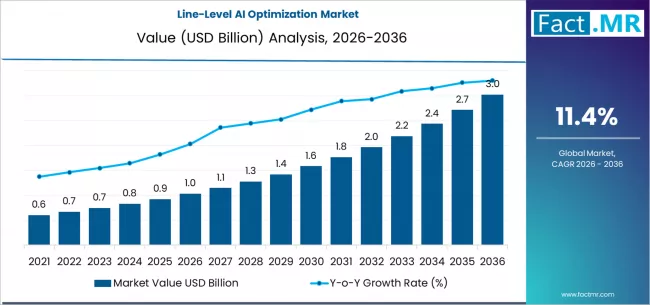
Line-level AI optimization market is projected to grow from USD 1.0 billion in 2026 to USD 3.0 billion by 2036, at a CAGR of 11.4%. High-speed packaging lines will dominate with a 47.3% market share, while throughput & downtime optimization will lead the optimization scope segment with a 52.5% share.
Line-Level AI Optimization Market Forecast and Outlook 2026 to 2036
The global line-level AI optimization market is projected to total USD 1.03 billion in 2026, and is projected to reach USD 3.02 billion by 2036, progressing at an 11.4% CAGR. This accelerated growth is driven by the critical need to extract maximum efficiency from existing capital-intensive production assets.
Key Takeaways from the Line-Level AI Optimization Market
- Market Value for 2026: USD 1.03 Billion
- Market Value for 2036: USD 3.02 Billion
- Forecast CAGR 2026 to 2036: 11.4%
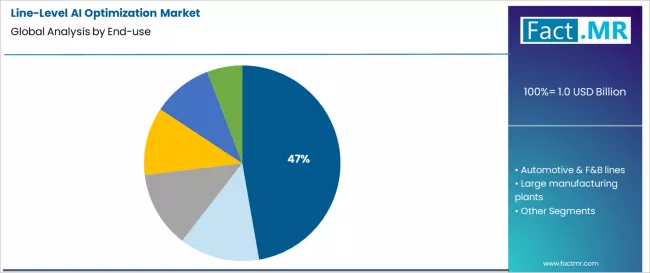
- Leading End-Use Segment (2026): High-speed Packaging Lines (47.3%)
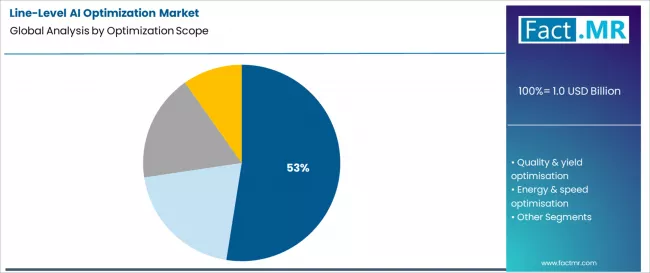
- Leading Optimization Scope (2026): Throughput & Downtime Optimization (52.5%)
- Leading Line Type (2026): Filling & Packing Lines (53.0%)
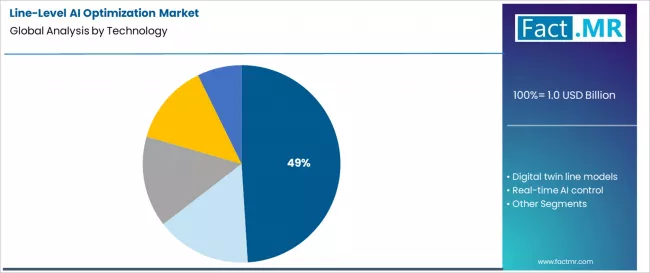
- Leading Technology Segment (2026): AI/ML-based Predictive Optimisation (49.0%)
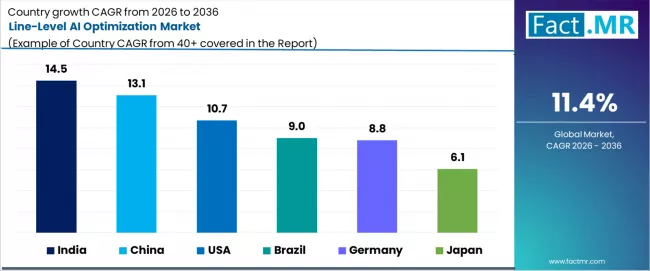
- Key Growth Countries: India (14.5% CAGR), China (13.1% CAGR), USA (10.7% CAGR), Brazil (9.0% CAGR), Germany (8.8% CAGR), Japan (6.1% CAGR)
- Key Players: Rockwell Automation, Siemens, Bosch, Huawei Industrial AI, Tata Technologies, Cognex

Manufacturers are transitioning from descriptive analytics to prescriptive and autonomous optimization, where artificial intelligence algorithms directly modulate machine parameters in real-time to elevate overall equipment effectiveness.
This represents a fundamental shift in industrial operations, moving beyond human-in-the-loop monitoring to closed-loop control systems. The value proposition is rooted in tangible financial metrics such as minimizing unplanned downtime, reducing energy and raw material waste, and ensuring peak throughput.
As a software-centric solution, adoption is scaling rapidly across discrete and process manufacturing, enabled by advancements in edge computing, industrial data platforms, and more accessible machine learning tools tailored for engineering teams.
Line-Level AI Optimization Market
| Metric | Value |
|---|---|
| Market Value (2026) | USD 1.03 Billion |
| Market Forecast Value (2036) | USD 3.02 Billion |
| Forecast CAGR 2026 to 2036 | 11.4% |
Category
| Category | Segments |
|---|---|
| End-Use | High-speed Packaging Lines, Automotive & F&B Lines, Large Manufacturing Plants, FMCG Plants, Industrial Operations, Precision Manufacturing |
| Optimization Scope | Throughput & Downtime Optimization, Quality & Yield Optimisation, Energy & Speed Optimisation, OEE Improvement, Others |
| Line Type | Filling & Packing Lines, Assembly & Packaging, Continuous Lines, Semi-Automated Lines, Others |
| Technology | AI/ML-based Predictive Optimisation, Digital Twin Line Models, Real-Time AI Control, Cloud-Based AI Analytics, Others |
How is Data Infrastructure a Critical Enabler for Line-Level AI Optimization Deployment?
The deployment of line-level AI optimization frameworks is less constrained by algorithmic sophistication and more by the maturity of operational technology data infrastructure. Effective line-level AI requires high-fidelity, time-synchronized data streams from sensors and controllers, which many legacy facilities lack.
The first trend includes greenfield plants design data collection into their architecture, while the second trend involves brownfield deployments requiring significant middleware and edge gateway investments.
Success hinges on partnerships between AI software vendors and industrial automation hardware providers to ensure seamless data ingestion. The shift from cloud-based to edge-AI models is accelerating to meet latency requirements for real-time control, placing a premium on solutions that can deliver insights directly on the factory floor.
Segmental Analysis
By Technology, Which Approach Forms the Foundational Layer for Advanced Optimization?

AI/ML-based predictive optimisation commands a leading 49.0% share. This technology serves as the foundational layer, analyzing historical and real-time operational data to forecast equipment failures or quality deviations before they occur. By moving from scheduled to condition-based maintenance, plants prevent catastrophic line stoppages.
This predictive capability is the essential first step that builds trust in AI systems, creating the data history and operational savings that justify subsequent investments in more complex real-time control and autonomous optimization algorithms.
By End-Use, Which Segment Presents the Most Compelling ROI Due to Extreme Velocity?

High-speed packaging lines constitute the primary end-use segment, with an expected share of 47.3% in 2026. The financial impact of a minute of downtime or a fractional percentage of waste on a line running thousands of units per hour is immense.
AI optimization directly targets the major losses on these lines, which are often invisible to human operators. The direct translation of optimized performance into quantifiable output gains delivers a rapid and measurable return on investment, making this segment the most aggressive adopter.
By Optimization Scope, Which Metric is the Universal Key Performance Indicator for Manufacturing?

Throughput and downtime optimization is forecasted to capture a 52.5% share in 2026. Overall equipment effectiveness remains the universal KPI for manufacturing productivity, and throughput along with availability are its most direct components.
AI solutions that can predict and prevent unplanned stops, or dynamically adjust line speed to avoid bottlenecks, provide the most immediate and universally understood performance uplift. This scope addresses the primary pain point for plant managers, making it the central focus of initial optimization projects.
What are the Principal Drivers, Constraints, and Evolving Dynamics of the Line-Level AI Optimization Market?
| Attribute | Expected Impact |
|---|---|
| Pressure to Maximize Capital Asset ROI | Drives adoption as manufacturers seek to extract every unit of output from existing lines, making AI optimization a strategic lever for margin improvement. |
| Legacy Data Infrastructure & Silos | Constrains deployment speed and scale, requiring significant upfront investment in data harmonization and connectivity before AI value is realized. |
| Rise of Industrial Edge Computing Platforms | Enables low-latency, real-time AI inference at the line level, bypassing cloud latency and allowing for closed-loop autonomous control decisions. |
| Shift from Analytics to Autonomous Operations | Transforms the vendor value proposition from providing insights to guaranteeing performance outcomes, leading to outcome-based business models. |
Analysis of the Line-Level AI Optimization Market by Key Countries

| Country | CAGR 2026 to 2036 |
|---|---|
| USA | 10.7% |
| Germany | 8.8% |
| China | 13.1% |
| India | 14.5% |
| Brazil | 9.0% |
| Japan | 6.1% |
How do Strategic Competitiveness and a Matured IIoT Landscape Influence the US Trajectory?
A 10.7% CAGR is supported by a focus on operational excellence and the presence of a mature Industrial Internet of Things ecosystem. The demand driver is strongly tied to the food & beverage and pharmaceutical sectors, where line efficiency directly impacts compliance and profitability.
Strategic partnerships between established automation incumbents like Rockwell Automation and pure-play AI software firms are common, combining domain expertise with algorithmic innovation to serve sophisticated end-users.
What Characterizes Germany's Integration-First Approach Within Industrie 4.0 Frameworks?
An 8.8% CAGR reflects Germany’s systematic approach to embedding AI within its broader Industrie 4.0 architecture. The market is driven by the need to integrate optimization data with digital product passports and higher-level enterprise systems.
Industry capacity for complex systems integration is high, with engineering firms and OEMs playing a pivotal role in deploying AI not as a standalone tool but as an embedded function of smart machinery and line control.
What Underpins China's Government-Led Drive for Intelligent Manufacturing Upgrades?
National policy directives like Made in China 2025 that subsidize and prioritize smart manufacturing upgrades fuel China’s 13.1% CAGR. This has spurred massive domestic industry capacity for industrial AI solutions, with technology conglomerates like Huawei Industrial AI offering full-stack platforms. Deployment is scaling rapidly within automotive and electronics assembly lines, where marginal gains yield significant competitive advantage in high-volume production.
How is India's Scale of Manufacturing Creating a Unique Laboratory for AI at Volume?
India’s leading 14.5% CAGR is propelled by the sheer scale and diversity of its large manufacturing plants, particularly in pharmaceuticals and FMCG. This vast installed base presents a unique laboratory for developing and scaling cost-optimized AI solutions that must perform reliably in varied conditions.
Domestic engineering and IT service leaders, such as Tata Technologies, are becoming crucial partners, offering localized implementation and support tailored to the operational realities of Indian plants.
Why is Brazil's Growth Linked to Operational Cost Reduction in Process Industries?
A 9.0% CAGR is closely tied to the need for operational cost containment within Brazil’s large FMCG and food processing plants. The primary demand driver is energy and yield optimization on semi-automated lines, where even small AI-driven improvements directly bolster thin margins. Growth is contingent on the availability of cloud-based AI analytics solutions that offer a lower barrier to entry, requiring less upfront capital in on-premise computing infrastructure.
How is the Pursuit for Perfection in Precision Manufacturing Environments Stimulating Line-Level AI Optimization Implementation in Japan?
Japan’s 6.1% CAGR represents an advanced market focused on achieving near-zero defect rates and perfect synchronization in precision manufacturing for electronics and automotive components.
Demand stems from the need for AI to perform ultra-high-accuracy predictive quality control and real-time synchronization of robotic cells. The ecosystem relies on deep collaborations between manufacturers and specialized technology providers like Cognex, focusing on seamless integration with high-precision sensing and control hardware.
Competitive Landscape of the Line-Level AI Optimization Market
The competitive frontier is defined by the race to build the most defensible industrial data ecosystem. Traditional industrial automation incumbents, including Siemens and Bosch, leverage their entrenched position within machine control systems to offer native AI optimization modules, competing on seamless integration and deep domain expertise. ICT and cloud giants, exemplified by Huawei Industrial AI, compete through scalable platform offerings, superior compute infrastructure, and advanced data science toolsets.
Success is determined by the ability to form strategic partnerships with vertical-specific OEMs and system integrators to embed AI logic directly into line design. Channel strategy focuses on cultivating partnerships with engineering firms and MES providers, while pricing models evolve toward subscription-based outcomes tied to demonstrated OEE improvement. A key differentiator is the attainment of industry-specific certifications for mission-critical applications, particularly in pharmaceuticals and food safety.
Key Players in the Line-Level AI Optimization Market
- Rockwell Automation, Inc.
- Siemens AG
- Bosch Rexroth AG
- Huawei Industrial AI
- Tata Technologies Limited
- Cognex Corporation
Scope of Report
| Items | Metrics |
|---|---|
| Quantitative Units | USD Billion |
| Technology | AI/ML-based Predictive Optimisation, Digital Twin Line Models, Real-Time AI Control, Cloud-Based AI Analytics, Others |
| Optimization Scope | Throughput & Downtime Optimization, Quality & Yield Optimisation, Energy & Speed Optimisation, OEE Improvement, Others |
| End-Use | High-speed Packaging Lines, Automotive & F&B Lines, Large Manufacturing Plants, FMCG Plants, Industrial Operations, Precision Manufacturing |
| Line Type | Filling & Packing Lines, Assembly & Packaging, Continuous Lines, Semi-Automated Lines, Others |
| Key Countries | India, China, USA, Brazil, Germany, Japan |
| Key Companies | Rockwell Automation, Siemens, Bosch, Huawei Industrial AI, Tata Technologies, Cognex |
| Additional Analysis | Comparative analysis of edge vs. cloud AI deployment architectures; total economic impact study of predictive vs. reactive maintenance; analysis of data governance and ownership in multi-vendor AI systems; benchmarking of optimization algorithms for specific loss categories (speed, quality, availability). |
Market by Segments
-
End-Use :
- High-speed Packaging Lines
- Automotive & F&B Lines
- Large Manufacturing Plants
- FMCG Plants
- Industrial Operations
- Precision Manufacturing
-
Optimization Scope :
- Throughput & Downtime Optimization
- Quality & Yield Optimisation
- Energy & Speed Optimisation
- OEE Improvement
- Others
-
Line Type :
- Filling & Packing Lines
- Assembly & Packaging
- Continuous Lines
- Semi-Automated Lines
- Others
-
Technology :
- AI/ML-based Predictive Optimisation
- Digital Twin Line Models
- Real-Time AI Control
- Cloud-Based AI Analytics
- Others
-
Region :
- North America
- USA
- Canada
- Latin America
- Brazil
- Mexico
- Argentina
- Rest of Latin America
- Western Europe
- Germany
- France
- Italy
- Spain
- UK
- BENELUX
- Rest of Western Europe
- Eastern Europe
- Russia
- Poland
- Czech Republic
- Rest of Eastern Europe
- East Asia
- China
- Japan
- South Korea
- Rest of East Asia
- South Asia & Pacific
- India
- ASEAN
- Australia
- Rest of South Asia & Pacific
- MEA
- GCC Countries
- South Africa
- Turkiye
- Rest of MEA
- North America
References
- International Society of Automation. (2025). AI at the Edge: A Framework for Real-Time Industrial Optimization.
- Lee, J., Bagheri, B., & Kao, H. (2024). A Cyber-Physical Systems architecture for Industry 4.0-based manufacturing systems. Manufacturing Letters.
- National Institute of Standards and Technology. (2024). Framework for Cyber-Physical Systems: Volume 2, Dependability and Performance.
- OECD. (2025). Artificial Intelligence in Science and Production: Enhancing Productivity and Innovation.
- World Economic Forum. (2024). The Future of Advanced Manufacturing: Scaling AI Across Production Networks.
- Zhou, K., Liu, T., & Zhou, L. (2023). Industry 4.0: Towards future industrial opportunities and challenges. Springer.
Table of Content
- Executive Summary
- Global Market Outlook
- Demand to side Trends
- Supply to side Trends
- Technology Roadmap Analysis
- Analysis and Recommendations
- Market Overview
- Market Coverage / Taxonomy
- Market Definition / Scope / Limitations
- Market Background
- Market Dynamics
- Drivers
- Restraints
- Opportunity
- Trends
- Scenario Forecast
- Demand in Optimistic Scenario
- Demand in Likely Scenario
- Demand in Conservative Scenario
- Opportunity Map Analysis
- Product Life Cycle Analysis
- Supply Chain Analysis
- Investment Feasibility Matrix
- Value Chain Analysis
- PESTLE and Porter’s Analysis
- Regulatory Landscape
- Regional Parent Market Outlook
- Production and Consumption Statistics
- Import and Export Statistics
- Market Dynamics
- Global Market Analysis 2021 to 2025 and Forecast, 2026 to 2036
- Historical Market Size Value (USD Million) Analysis, 2021 to 2025
- Current and Future Market Size Value (USD Million) Projections, 2026 to 2036
- Y to o to Y Growth Trend Analysis
- Absolute $ Opportunity Analysis
- Global Market Pricing Analysis 2021 to 2025 and Forecast 2026 to 2036
- Global Market Analysis 2021 to 2025 and Forecast 2026 to 2036, By End-use
- Introduction / Key Findings
- Historical Market Size Value (USD Million) Analysis By End-use, 2021 to 2025
- Current and Future Market Size Value (USD Million) Analysis and Forecast By End-use, 2026 to 2036
- High-speed packaging lines
- Automotive & F&B lines
- Large manufacturing plants
- FMCG plants
- Industrial operations
- Precision manufacturing
- High-speed packaging lines
- Y to o to Y Growth Trend Analysis By End-use, 2021 to 2025
- Absolute $ Opportunity Analysis By End-use, 2026 to 2036
- Global Market Analysis 2021 to 2025 and Forecast 2026 to 2036, By Optimization Scope
- Introduction / Key Findings
- Historical Market Size Value (USD Million) Analysis By Optimization Scope, 2021 to 2025
- Current and Future Market Size Value (USD Million) Analysis and Forecast By Optimization Scope, 2026 to 2036
- Throughput & downtime optimization
- Quality & yield optimisation
- Energy & speed optimisation
- OEE improvement
- Throughput & downtime optimization
- Y to o to Y Growth Trend Analysis By Optimization Scope, 2021 to 2025
- Absolute $ Opportunity Analysis By Optimization Scope, 2026 to 2036
- Global Market Analysis 2021 to 2025 and Forecast 2026 to 2036, By Line Type
- Introduction / Key Findings
- Historical Market Size Value (USD Million) Analysis By Line Type, 2021 to 2025
- Current and Future Market Size Value (USD Million) Analysis and Forecast By Line Type, 2026 to 2036
- Filling & packing lines
- Assembly & packaging
- Continuous lines
- Semi-automated lines
- Others
- Filling & packing lines
- Y to o to Y Growth Trend Analysis By Line Type, 2021 to 2025
- Absolute $ Opportunity Analysis By Line Type, 2026 to 2036
- Global Market Analysis 2021 to 2025 and Forecast 2026 to 2036, By Technology
- Introduction / Key Findings
- Historical Market Size Value (USD Million) Analysis By Technology, 2021 to 2025
- Current and Future Market Size Value (USD Million) Analysis and Forecast By Technology, 2026 to 2036
- AI/ML-based predictive optimisation
- Digital twin line models
- Real-time AI control
- Cloud-based AI analytics
- Others
- AI/ML-based predictive optimisation
- Y to o to Y Growth Trend Analysis By Technology, 2021 to 2025
- Absolute $ Opportunity Analysis By Technology, 2026 to 2036
- Global Market Analysis 2021 to 2025 and Forecast 2026 to 2036, By Region
- Introduction
- Historical Market Size Value (USD Million) Analysis By Region, 2021 to 2025
- Current Market Size Value (USD Million) Analysis and Forecast By Region, 2026 to 2036
- North America
- Latin America
- Western Europe
- Eastern Europe
- East Asia
- South Asia and Pacific
- Middle East & Africa
- Market Attractiveness Analysis By Region
- North America Market Analysis 2021 to 2025 and Forecast 2026 to 2036, By Country
- Historical Market Size Value (USD Million) Trend Analysis By Market Taxonomy, 2021 to 2025
- Market Size Value (USD Million) Forecast By Market Taxonomy, 2026 to 2036
- By Country
- USA
- Canada
- Mexico
- By End-use
- By Optimization Scope
- By Line Type
- By Technology
- By Country
- Market Attractiveness Analysis
- By Country
- By End-use
- By Optimization Scope
- By Line Type
- By Technology
- Key Takeaways
- Latin America Market Analysis 2021 to 2025 and Forecast 2026 to 2036, By Country
- Historical Market Size Value (USD Million) Trend Analysis By Market Taxonomy, 2021 to 2025
- Market Size Value (USD Million) Forecast By Market Taxonomy, 2026 to 2036
- By Country
- Brazil
- Chile
- Rest of Latin America
- By End-use
- By Optimization Scope
- By Line Type
- By Technology
- By Country
- Market Attractiveness Analysis
- By Country
- By End-use
- By Optimization Scope
- By Line Type
- By Technology
- Key Takeaways
- Western Europe Market Analysis 2021 to 2025 and Forecast 2026 to 2036, By Country
- Historical Market Size Value (USD Million) Trend Analysis By Market Taxonomy, 2021 to 2025
- Market Size Value (USD Million) Forecast By Market Taxonomy, 2026 to 2036
- By Country
- Germany
- UK
- Italy
- Spain
- France
- Nordic
- BENELUX
- Rest of Western Europe
- By End-use
- By Optimization Scope
- By Line Type
- By Technology
- By Country
- Market Attractiveness Analysis
- By Country
- By End-use
- By Optimization Scope
- By Line Type
- By Technology
- Key Takeaways
- Eastern Europe Market Analysis 2021 to 2025 and Forecast 2026 to 2036, By Country
- Historical Market Size Value (USD Million) Trend Analysis By Market Taxonomy, 2021 to 2025
- Market Size Value (USD Million) Forecast By Market Taxonomy, 2026 to 2036
- By Country
- Russia
- Poland
- Hungary
- Balkan & Baltic
- Rest of Eastern Europe
- By End-use
- By Optimization Scope
- By Line Type
- By Technology
- By Country
- Market Attractiveness Analysis
- By Country
- By End-use
- By Optimization Scope
- By Line Type
- By Technology
- Key Takeaways
- East Asia Market Analysis 2021 to 2025 and Forecast 2026 to 2036, By Country
- Historical Market Size Value (USD Million) Trend Analysis By Market Taxonomy, 2021 to 2025
- Market Size Value (USD Million) Forecast By Market Taxonomy, 2026 to 2036
- By Country
- China
- Japan
- South Korea
- By End-use
- By Optimization Scope
- By Line Type
- By Technology
- By Country
- Market Attractiveness Analysis
- By Country
- By End-use
- By Optimization Scope
- By Line Type
- By Technology
- Key Takeaways
- South Asia and Pacific Market Analysis 2021 to 2025 and Forecast 2026 to 2036, By Country
- Historical Market Size Value (USD Million) Trend Analysis By Market Taxonomy, 2021 to 2025
- Market Size Value (USD Million) Forecast By Market Taxonomy, 2026 to 2036
- By Country
- India
- ASEAN
- Australia & New Zealand
- Rest of South Asia and Pacific
- By End-use
- By Optimization Scope
- By Line Type
- By Technology
- By Country
- Market Attractiveness Analysis
- By Country
- By End-use
- By Optimization Scope
- By Line Type
- By Technology
- Key Takeaways
- Middle East & Africa Market Analysis 2021 to 2025 and Forecast 2026 to 2036, By Country
- Historical Market Size Value (USD Million) Trend Analysis By Market Taxonomy, 2021 to 2025
- Market Size Value (USD Million) Forecast By Market Taxonomy, 2026 to 2036
- By Country
- Kingdom of Saudi Arabia
- Other GCC Countries
- Turkiye
- South Africa
- Other African Union
- Rest of Middle East & Africa
- By End-use
- By Optimization Scope
- By Line Type
- By Technology
- By Country
- Market Attractiveness Analysis
- By Country
- By End-use
- By Optimization Scope
- By Line Type
- By Technology
- Key Takeaways
- Key Countries Market Analysis
- USA
- Pricing Analysis
- Market Share Analysis, 2025
- By End-use
- By Optimization Scope
- By Line Type
- By Technology
- Canada
- Pricing Analysis
- Market Share Analysis, 2025
- By End-use
- By Optimization Scope
- By Line Type
- By Technology
- Mexico
- Pricing Analysis
- Market Share Analysis, 2025
- By End-use
- By Optimization Scope
- By Line Type
- By Technology
- Brazil
- Pricing Analysis
- Market Share Analysis, 2025
- By End-use
- By Optimization Scope
- By Line Type
- By Technology
- Chile
- Pricing Analysis
- Market Share Analysis, 2025
- By End-use
- By Optimization Scope
- By Line Type
- By Technology
- Germany
- Pricing Analysis
- Market Share Analysis, 2025
- By End-use
- By Optimization Scope
- By Line Type
- By Technology
- UK
- Pricing Analysis
- Market Share Analysis, 2025
- By End-use
- By Optimization Scope
- By Line Type
- By Technology
- Italy
- Pricing Analysis
- Market Share Analysis, 2025
- By End-use
- By Optimization Scope
- By Line Type
- By Technology
- Spain
- Pricing Analysis
- Market Share Analysis, 2025
- By End-use
- By Optimization Scope
- By Line Type
- By Technology
- France
- Pricing Analysis
- Market Share Analysis, 2025
- By End-use
- By Optimization Scope
- By Line Type
- By Technology
- India
- Pricing Analysis
- Market Share Analysis, 2025
- By End-use
- By Optimization Scope
- By Line Type
- By Technology
- ASEAN
- Pricing Analysis
- Market Share Analysis, 2025
- By End-use
- By Optimization Scope
- By Line Type
- By Technology
- Australia & New Zealand
- Pricing Analysis
- Market Share Analysis, 2025
- By End-use
- By Optimization Scope
- By Line Type
- By Technology
- China
- Pricing Analysis
- Market Share Analysis, 2025
- By End-use
- By Optimization Scope
- By Line Type
- By Technology
- Japan
- Pricing Analysis
- Market Share Analysis, 2025
- By End-use
- By Optimization Scope
- By Line Type
- By Technology
- South Korea
- Pricing Analysis
- Market Share Analysis, 2025
- By End-use
- By Optimization Scope
- By Line Type
- By Technology
- Russia
- Pricing Analysis
- Market Share Analysis, 2025
- By End-use
- By Optimization Scope
- By Line Type
- By Technology
- Poland
- Pricing Analysis
- Market Share Analysis, 2025
- By End-use
- By Optimization Scope
- By Line Type
- By Technology
- Hungary
- Pricing Analysis
- Market Share Analysis, 2025
- By End-use
- By Optimization Scope
- By Line Type
- By Technology
- Kingdom of Saudi Arabia
- Pricing Analysis
- Market Share Analysis, 2025
- By End-use
- By Optimization Scope
- By Line Type
- By Technology
- Turkiye
- Pricing Analysis
- Market Share Analysis, 2025
- By End-use
- By Optimization Scope
- By Line Type
- By Technology
- South Africa
- Pricing Analysis
- Market Share Analysis, 2025
- By End-use
- By Optimization Scope
- By Line Type
- By Technology
- USA
- Market Structure Analysis
- Competition Dashboard
- Competition Benchmarking
- Market Share Analysis of Top Players
- By Regional
- By End-use
- By Optimization Scope
- By Line Type
- By Technology
- Competition Analysis
- Competition Deep Dive
- Rockwell Automation, Inc.
- Overview
- Product Portfolio
- Profitability by Market Segments (Product/Age /Sales Channel/Region)
- Sales Footprint
- Strategy Overview
- Marketing Strategy
- Product Strategy
- Channel Strategy
- Siemens AG
- Bosch Rexroth AG
- Huawei Industrial AI
- Tata Technologies Limited
- Cognex Corporation
- Rockwell Automation, Inc.
- Competition Deep Dive
- Assumptions & Acronyms Used
- Research Methodology
List Of Table
- Table 1: Global Market Value (USD Million) Forecast by Region, 2021 to 2036
- Table 2: Global Market Value (USD Million) Forecast by End-use, 2021 to 2036
- Table 3: Global Market Value (USD Million) Forecast by Optimization Scope, 2021 to 2036
- Table 4: Global Market Value (USD Million) Forecast by Line Type, 2021 to 2036
- Table 5: Global Market Value (USD Million) Forecast by Technology, 2021 to 2036
- Table 6: North America Market Value (USD Million) Forecast by Country, 2021 to 2036
- Table 7: North America Market Value (USD Million) Forecast by End-use, 2021 to 2036
- Table 8: North America Market Value (USD Million) Forecast by Optimization Scope, 2021 to 2036
- Table 9: North America Market Value (USD Million) Forecast by Line Type, 2021 to 2036
- Table 10: North America Market Value (USD Million) Forecast by Technology, 2021 to 2036
- Table 11: Latin America Market Value (USD Million) Forecast by Country, 2021 to 2036
- Table 12: Latin America Market Value (USD Million) Forecast by End-use, 2021 to 2036
- Table 13: Latin America Market Value (USD Million) Forecast by Optimization Scope, 2021 to 2036
- Table 14: Latin America Market Value (USD Million) Forecast by Line Type, 2021 to 2036
- Table 15: Latin America Market Value (USD Million) Forecast by Technology, 2021 to 2036
- Table 16: Western Europe Market Value (USD Million) Forecast by Country, 2021 to 2036
- Table 17: Western Europe Market Value (USD Million) Forecast by End-use, 2021 to 2036
- Table 18: Western Europe Market Value (USD Million) Forecast by Optimization Scope, 2021 to 2036
- Table 19: Western Europe Market Value (USD Million) Forecast by Line Type, 2021 to 2036
- Table 20: Western Europe Market Value (USD Million) Forecast by Technology, 2021 to 2036
- Table 21: Eastern Europe Market Value (USD Million) Forecast by Country, 2021 to 2036
- Table 22: Eastern Europe Market Value (USD Million) Forecast by End-use, 2021 to 2036
- Table 23: Eastern Europe Market Value (USD Million) Forecast by Optimization Scope, 2021 to 2036
- Table 24: Eastern Europe Market Value (USD Million) Forecast by Line Type, 2021 to 2036
- Table 25: Eastern Europe Market Value (USD Million) Forecast by Technology, 2021 to 2036
- Table 26: East Asia Market Value (USD Million) Forecast by Country, 2021 to 2036
- Table 27: East Asia Market Value (USD Million) Forecast by End-use, 2021 to 2036
- Table 28: East Asia Market Value (USD Million) Forecast by Optimization Scope, 2021 to 2036
- Table 29: East Asia Market Value (USD Million) Forecast by Line Type, 2021 to 2036
- Table 30: East Asia Market Value (USD Million) Forecast by Technology, 2021 to 2036
- Table 31: South Asia and Pacific Market Value (USD Million) Forecast by Country, 2021 to 2036
- Table 32: South Asia and Pacific Market Value (USD Million) Forecast by End-use, 2021 to 2036
- Table 33: South Asia and Pacific Market Value (USD Million) Forecast by Optimization Scope, 2021 to 2036
- Table 34: South Asia and Pacific Market Value (USD Million) Forecast by Line Type, 2021 to 2036
- Table 35: South Asia and Pacific Market Value (USD Million) Forecast by Technology, 2021 to 2036
- Table 36: Middle East & Africa Market Value (USD Million) Forecast by Country, 2021 to 2036
- Table 37: Middle East & Africa Market Value (USD Million) Forecast by End-use, 2021 to 2036
- Table 38: Middle East & Africa Market Value (USD Million) Forecast by Optimization Scope, 2021 to 2036
- Table 39: Middle East & Africa Market Value (USD Million) Forecast by Line Type, 2021 to 2036
- Table 40: Middle East & Africa Market Value (USD Million) Forecast by Technology, 2021 to 2036
List Of Figures
- Figure 1: Global Market Pricing Analysis
- Figure 2: Global Market Value (USD Million) Forecast 2021 to 2036
- Figure 3: Global Market Value Share and BPS Analysis by End-use, 2026 and 2036
- Figure 4: Global Market Y to o to Y Growth Comparison by End-use, 2026 to 2036
- Figure 5: Global Market Attractiveness Analysis by End-use
- Figure 6: Global Market Value Share and BPS Analysis by Optimization Scope, 2026 and 2036
- Figure 7: Global Market Y to o to Y Growth Comparison by Optimization Scope, 2026 to 2036
- Figure 8: Global Market Attractiveness Analysis by Optimization Scope
- Figure 9: Global Market Value Share and BPS Analysis by Line Type, 2026 and 2036
- Figure 10: Global Market Y to o to Y Growth Comparison by Line Type, 2026 to 2036
- Figure 11: Global Market Attractiveness Analysis by Line Type
- Figure 12: Global Market Value Share and BPS Analysis by Technology, 2026 and 2036
- Figure 13: Global Market Y to o to Y Growth Comparison by Technology, 2026 to 2036
- Figure 14: Global Market Attractiveness Analysis by Technology
- Figure 15: Global Market Value (USD Million) Share and BPS Analysis by Region, 2026 and 2036
- Figure 16: Global Market Y to o to Y Growth Comparison by Region, 2026 to 2036
- Figure 17: Global Market Attractiveness Analysis by Region
- Figure 18: North America Market Incremental Dollar Opportunity, 2026 to 2036
- Figure 19: Latin America Market Incremental Dollar Opportunity, 2026 to 2036
- Figure 20: Western Europe Market Incremental Dollar Opportunity, 2026 to 2036
- Figure 21: Eastern Europe Market Incremental Dollar Opportunity, 2026 to 2036
- Figure 22: East Asia Market Incremental Dollar Opportunity, 2026 to 2036
- Figure 23: South Asia and Pacific Market Incremental Dollar Opportunity, 2026 to 2036
- Figure 24: Middle East & Africa Market Incremental Dollar Opportunity, 2026 to 2036
- Figure 25: North America Market Value Share and BPS Analysis by Country, 2026 and 2036
- Figure 26: North America Market Value Share and BPS Analysis by End-use, 2026 and 2036
- Figure 27: North America Market Y to o to Y Growth Comparison by End-use, 2026 to 2036
- Figure 28: North America Market Attractiveness Analysis by End-use
- Figure 29: North America Market Value Share and BPS Analysis by Optimization Scope, 2026 and 2036
- Figure 30: North America Market Y to o to Y Growth Comparison by Optimization Scope, 2026 to 2036
- Figure 31: North America Market Attractiveness Analysis by Optimization Scope
- Figure 32: North America Market Value Share and BPS Analysis by Line Type, 2026 and 2036
- Figure 33: North America Market Y to o to Y Growth Comparison by Line Type, 2026 to 2036
- Figure 34: North America Market Attractiveness Analysis by Line Type
- Figure 35: North America Market Value Share and BPS Analysis by Technology, 2026 and 2036
- Figure 36: North America Market Y to o to Y Growth Comparison by Technology, 2026 to 2036
- Figure 37: North America Market Attractiveness Analysis by Technology
- Figure 38: Latin America Market Value Share and BPS Analysis by Country, 2026 and 2036
- Figure 39: Latin America Market Value Share and BPS Analysis by End-use, 2026 and 2036
- Figure 40: Latin America Market Y to o to Y Growth Comparison by End-use, 2026 to 2036
- Figure 41: Latin America Market Attractiveness Analysis by End-use
- Figure 42: Latin America Market Value Share and BPS Analysis by Optimization Scope, 2026 and 2036
- Figure 43: Latin America Market Y to o to Y Growth Comparison by Optimization Scope, 2026 to 2036
- Figure 44: Latin America Market Attractiveness Analysis by Optimization Scope
- Figure 45: Latin America Market Value Share and BPS Analysis by Line Type, 2026 and 2036
- Figure 46: Latin America Market Y to o to Y Growth Comparison by Line Type, 2026 to 2036
- Figure 47: Latin America Market Attractiveness Analysis by Line Type
- Figure 48: Latin America Market Value Share and BPS Analysis by Technology, 2026 and 2036
- Figure 49: Latin America Market Y to o to Y Growth Comparison by Technology, 2026 to 2036
- Figure 50: Latin America Market Attractiveness Analysis by Technology
- Figure 51: Western Europe Market Value Share and BPS Analysis by Country, 2026 and 2036
- Figure 52: Western Europe Market Value Share and BPS Analysis by End-use, 2026 and 2036
- Figure 53: Western Europe Market Y to o to Y Growth Comparison by End-use, 2026 to 2036
- Figure 54: Western Europe Market Attractiveness Analysis by End-use
- Figure 55: Western Europe Market Value Share and BPS Analysis by Optimization Scope, 2026 and 2036
- Figure 56: Western Europe Market Y to o to Y Growth Comparison by Optimization Scope, 2026 to 2036
- Figure 57: Western Europe Market Attractiveness Analysis by Optimization Scope
- Figure 58: Western Europe Market Value Share and BPS Analysis by Line Type, 2026 and 2036
- Figure 59: Western Europe Market Y to o to Y Growth Comparison by Line Type, 2026 to 2036
- Figure 60: Western Europe Market Attractiveness Analysis by Line Type
- Figure 61: Western Europe Market Value Share and BPS Analysis by Technology, 2026 and 2036
- Figure 62: Western Europe Market Y to o to Y Growth Comparison by Technology, 2026 to 2036
- Figure 63: Western Europe Market Attractiveness Analysis by Technology
- Figure 64: Eastern Europe Market Value Share and BPS Analysis by Country, 2026 and 2036
- Figure 65: Eastern Europe Market Value Share and BPS Analysis by End-use, 2026 and 2036
- Figure 66: Eastern Europe Market Y to o to Y Growth Comparison by End-use, 2026 to 2036
- Figure 67: Eastern Europe Market Attractiveness Analysis by End-use
- Figure 68: Eastern Europe Market Value Share and BPS Analysis by Optimization Scope, 2026 and 2036
- Figure 69: Eastern Europe Market Y to o to Y Growth Comparison by Optimization Scope, 2026 to 2036
- Figure 70: Eastern Europe Market Attractiveness Analysis by Optimization Scope
- Figure 71: Eastern Europe Market Value Share and BPS Analysis by Line Type, 2026 and 2036
- Figure 72: Eastern Europe Market Y to o to Y Growth Comparison by Line Type, 2026 to 2036
- Figure 73: Eastern Europe Market Attractiveness Analysis by Line Type
- Figure 74: Eastern Europe Market Value Share and BPS Analysis by Technology, 2026 and 2036
- Figure 75: Eastern Europe Market Y to o to Y Growth Comparison by Technology, 2026 to 2036
- Figure 76: Eastern Europe Market Attractiveness Analysis by Technology
- Figure 77: East Asia Market Value Share and BPS Analysis by Country, 2026 and 2036
- Figure 78: East Asia Market Value Share and BPS Analysis by End-use, 2026 and 2036
- Figure 79: East Asia Market Y to o to Y Growth Comparison by End-use, 2026 to 2036
- Figure 80: East Asia Market Attractiveness Analysis by End-use
- Figure 81: East Asia Market Value Share and BPS Analysis by Optimization Scope, 2026 and 2036
- Figure 82: East Asia Market Y to o to Y Growth Comparison by Optimization Scope, 2026 to 2036
- Figure 83: East Asia Market Attractiveness Analysis by Optimization Scope
- Figure 84: East Asia Market Value Share and BPS Analysis by Line Type, 2026 and 2036
- Figure 85: East Asia Market Y to o to Y Growth Comparison by Line Type, 2026 to 2036
- Figure 86: East Asia Market Attractiveness Analysis by Line Type
- Figure 87: East Asia Market Value Share and BPS Analysis by Technology, 2026 and 2036
- Figure 88: East Asia Market Y to o to Y Growth Comparison by Technology, 2026 to 2036
- Figure 89: East Asia Market Attractiveness Analysis by Technology
- Figure 90: South Asia and Pacific Market Value Share and BPS Analysis by Country, 2026 and 2036
- Figure 91: South Asia and Pacific Market Value Share and BPS Analysis by End-use, 2026 and 2036
- Figure 92: South Asia and Pacific Market Y to o to Y Growth Comparison by End-use, 2026 to 2036
- Figure 93: South Asia and Pacific Market Attractiveness Analysis by End-use
- Figure 94: South Asia and Pacific Market Value Share and BPS Analysis by Optimization Scope, 2026 and 2036
- Figure 95: South Asia and Pacific Market Y to o to Y Growth Comparison by Optimization Scope, 2026 to 2036
- Figure 96: South Asia and Pacific Market Attractiveness Analysis by Optimization Scope
- Figure 97: South Asia and Pacific Market Value Share and BPS Analysis by Line Type, 2026 and 2036
- Figure 98: South Asia and Pacific Market Y to o to Y Growth Comparison by Line Type, 2026 to 2036
- Figure 99: South Asia and Pacific Market Attractiveness Analysis by Line Type
- Figure 100: South Asia and Pacific Market Value Share and BPS Analysis by Technology, 2026 and 2036
- Figure 101: South Asia and Pacific Market Y to o to Y Growth Comparison by Technology, 2026 to 2036
- Figure 102: South Asia and Pacific Market Attractiveness Analysis by Technology
- Figure 103: Middle East & Africa Market Value Share and BPS Analysis by Country, 2026 and 2036
- Figure 104: Middle East & Africa Market Value Share and BPS Analysis by End-use, 2026 and 2036
- Figure 105: Middle East & Africa Market Y to o to Y Growth Comparison by End-use, 2026 to 2036
- Figure 106: Middle East & Africa Market Attractiveness Analysis by End-use
- Figure 107: Middle East & Africa Market Value Share and BPS Analysis by Optimization Scope, 2026 and 2036
- Figure 108: Middle East & Africa Market Y to o to Y Growth Comparison by Optimization Scope, 2026 to 2036
- Figure 109: Middle East & Africa Market Attractiveness Analysis by Optimization Scope
- Figure 110: Middle East & Africa Market Value Share and BPS Analysis by Line Type, 2026 and 2036
- Figure 111: Middle East & Africa Market Y to o to Y Growth Comparison by Line Type, 2026 to 2036
- Figure 112: Middle East & Africa Market Attractiveness Analysis by Line Type
- Figure 113: Middle East & Africa Market Value Share and BPS Analysis by Technology, 2026 and 2036
- Figure 114: Middle East & Africa Market Y to o to Y Growth Comparison by Technology, 2026 to 2036
- Figure 115: Middle East & Africa Market Attractiveness Analysis by Technology
- Figure 116: Global Market - Tier Structure Analysis
- Figure 117: Global Market - Company Share Analysis
- FAQs -
How big is the line-level AI optimization market in 2026?
The global line-level AI optimization market is estimated to be valued at USD 1.0 billion in 2026.
What will be the size of line-level AI optimization market in 2036?
The market size for the line-level AI optimization market is projected to reach USD 3.0 billion by 2036.
How much will be the line-level AI optimization market growth between 2026 and 2036?
The line-level AI optimization market is expected to grow at a 11.4% CAGR between 2026 and 2036.
What are the key product types in the line-level AI optimization market?
The key product types in line-level AI optimization market are high-speed packaging lines, automotive & f&b lines, large manufacturing plants, fmcg plants, industrial operations and precision manufacturing.
Which optimization scope segment to contribute significant share in the line-level AI optimization market in 2026?
In terms of optimization scope, throughput & downtime optimization segment to command 52.5% share in the line-level AI optimization market in 2026.