- Base Value(2025): 165.0 Mn
- Estimated Value(2026): 193.7 Mn
- Forecast Value (2036): 963.5 Mn
- CAGR (2026 - 2036): 17.4%
Longevity Bars Market Overview, Growth Outlook, and Forecast by Fact.MR
- In 2025, the longevity bars market was valued at USD 165.0 million.
- Demand for longevity bars is projected to grow to USD 193.7 million in 2026 and reach USD 963.5 million by 2036.
- The market is expected to expand at a CAGR of 17.4% during the forecast period.
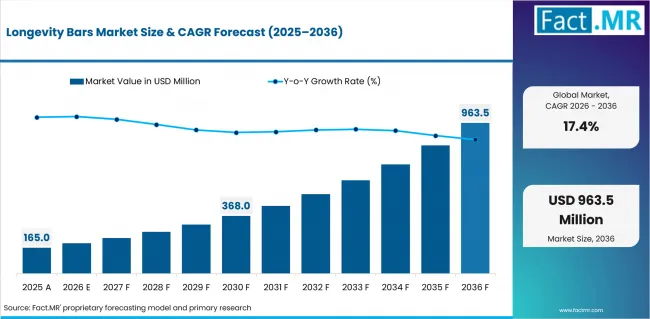
Longevity Bars Market Value Analysis | Source: Fact.MR
Summary of the Longevity Bars Market
- Market Snapshot
- Global longevity bars market revenue stood at USD 193.7 million in 2026 and is forecast to reach USD 963.5 million by 2036.
- At a 17.4% CAGR from 2026 to 2036, the market is expected to expand nearly 5.0x in value, creating an absolute dollar opportunity of USD 769.8 million.
- The market growth is expected to be driven by growing consumer awareness for aging well, preventive healthcare, metabolic wellness, and the rising demand for on-the-go protein rich functional nutrition products.
- Increasing demand for clean-label health and wellness snacks, plant-based proteins, meal replacement nutrition and personalized wellness solutions is driving market growth in both developed and developing countries.
- Increasing consumers interest in health and convenience, particularly the rise of e-commerce nutrition platforms, direct-to-consumer wellness brands, subscription nutrition models, and fitness-focused retail ecosystems are also contributing to establishing a global market presence.
- Demand and Growth Drivers
- Growing consciousness about healthy aging, active living, preventive healthcare and long term wellness among the general population
- Increasing consumer preference for functional high-protein snacks rather than traditional processed snacks
- The increase in functional ingredients including collagen peptides, probiotics, adaptogens, omega-3 fatty acids, and plant proteins in formulations for wellness nutrition
- Growth in meal-replacement products, personalized nutrition platforms and the burgeoning biohacking wellness category
- Global growth in sport nutrition, fitness and metabolic wellness program participation
- Need for solutions providing:
- Healthy aging and preventive nutrition support
- Convenient meal replacement and wellness snacking
- Muscle recovery and metabolic wellness benefits
- Gut health and digestive wellness support
- Clean-label and plant-based nutrition formulations
- High-protein and low-sugar functional snack options
- Personalized and subscription-based wellness nutrition formats
- Product and Segment View
- Protein-Based Ingredients account for 34.1% of ingredient type share in 2026, emerging as the leading segment due to strong global demand for protein-rich functional nutrition and healthy-aging formulations.
- Protein Longevity Bars hold 26.9% of product type share in 2026, supported by increasing fitness participation, demand for convenient wellness snacks, and rising adoption of meal replacement nutrition products.
- Conventional Longevity Bars represent 58.3% of nature share in 2026, reflecting broader affordability, stronger retail penetration, and large-scale commercial availability, although clean-label and plant-based products are witnessing faster growth.
- Geography and Competitive Outlook
- Rising healthy-aging awareness, increasing protein nutrition adoption, growing preventive healthcare spending, and expanding functional food consumption are driving strong market growth across East Asia, South Asia & Pacific, and North America.
- Major growth markets in the Longevity Bars Market include India (22.0% CAGR), Japan (20.4% CAGR), China (20.1% CAGR), Canada (18.0% CAGR), United States (16.2% CAGR), United Kingdom (15.4% CAGR), and Germany (14.9% CAGR) during the forecast period.
- Market growth is supported by:
- Rising consumer spending on healthy-aging and wellness nutrition products
- Increasing demand for protein-rich and functional snack products
- Growing popularity of clean-label and plant-based nutrition
- Expansion of premium wellness and meal replacement categories
- Increasing adoption of direct-to-consumer nutrition models
- Prominent players in the market include NOVOS, Huel, Bulletproof, L-Nutra, GoMacro.
- Analyst Opinion
- Shambhu Nath Jha, Principal Consultant at Fact.MR, opines, “CXOs need to acknowledge that future competitive advantage in the longevity bars market will be increasingly derived from scientific-based functional nutrition formulations, healthy-aging and protein- rich product portfolio development, clean-label and plant-based wellness trend utilization, and enhancement of direct-to-consumer, subscription-based and digital wellness distribution methods to meet growing global demand for preventive health care, metabolic wellness, active-aging nutrition and convenient functional snacking options."
Longevity Bars Market - At a Glance
| Attribute | Details |
|---|---|
| Market Value 2025 | USD 165.0 Million |
| Market Value 2026 | USD 193.7 Million |
| Market Value 2036 | USD 963.5 Million |
| Absolute Dollar Opportunity | USD 769.8 Million |
| Total Growth | 397.40% |
| CAGR | 17.40% |
| Growth Multiple | 5.0x |
| Key Demand Theme | Rising consumer focus on healthy aging, increasing demand for protein-rich functional snacks, growing preference for clean-label and plant-based nutrition products, expansion of preventive healthcare and wellness spending, and increasing adoption of convenient functional nutrition solutions |
| Leading Ingredient Type | Protein-Based Ingredients |
| Ingredient Type Share | 34.1% |
| Leading Product Type | Protein Longevity Bars |
| Product Type Share | 26.9% |
| Leading Distribution Channel | Online Retail & E-commerce |
| Distribution Channel Share | 32.1% |
| Leading Health Benefit | Healthy Aging |
| Health Benefit Share | 35.2% |
| Key Growth Regions | East Asia, South Asia & Pacific, North America |
| Key Companies | NOVOS, Huel, Bulletproof, L-Nutra, GoMacro |
| Segmentation by Product Type | Protein Longevity Bars, Functional Wellness Bars, Meal Replacement Bars, Keto Bars, Plant-Based/Vegan Bars, Collagen Bars, Adaptogenic Bars, Gut Health Bars |
| Segmentation by Ingredient Type | Protein-Based, Botanical/Adaptogen-Based, Functional Fiber-Based, Probiotic/Prebiotic-Based, Omega & Healthy Fat-Based, Vitamin & Mineral Fortified, Collagen-Based |
| Segmentation by Health Benefit | Healthy Aging, Energy & Stamina, Weight Management, Muscle Recovery, Gut Health, Cognitive Health, Immune Support, Metabolic Health |
| Segmentation by Dietary Preference | Vegan, Gluten-Free, Keto-Friendly, Paleo, Diabetic-Friendly, High-Protein |
| Segmentation by Distribution Channel | Supermarkets & Hypermarkets, Convenience Stores, Specialty Health Stores, Pharmacies & Drug Stores, Online Retail/E-commerce, Fitness Centers & Gyms |
| Segmentation by Region | North America, Latin America, East Asia, South Asia & Pacific, Western Europe, Eastern Europe, Middle East & Africa |
Source: Fact.MR analysis. Updated Jun 15, 2026
The longevity bars market is projected to create an absolute dollar opportunity of USD 769.8 million between 2026 and 2036. Market growth is driven by rising consumer awareness regarding healthy aging, increasing demand for protein-rich functional snacks, and growing adoption of preventive wellness and personalized nutrition solutions. Expanding interest in clean-label, plant-based, and high-protein nutrition products, along with increasing consumption of meal replacement bars, gut-health snacks, and functional wellness foods, is further supporting global market expansion. The rapid growth of e-commerce nutrition platforms, direct-to-consumer wellness brands, and fitness-oriented nutrition ecosystems is also accelerating adoption of longevity-focused functional snack products worldwide.
Key Growth Drivers, Constraints, and Opportunities
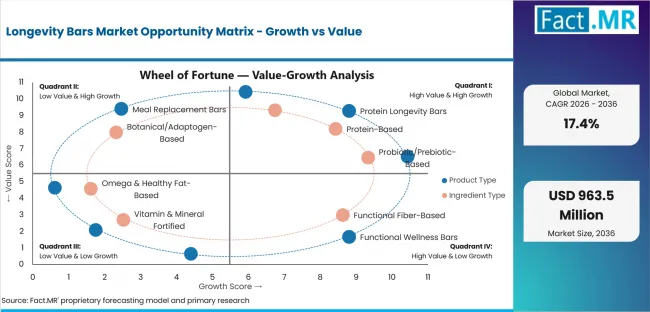
Longevity Bars Market Opportunity Matrix Growth Vs Value | Source: Fact.MR
Key Factors Driving Growth
- Rising global focus on healthy aging, preventive healthcare, and wellness optimization is accelerating the demand for longevity bars in functional nutrition and wellness industries.
- Increasing consumer preference for protein-based clean-label and convenience products in place of traditional processed snacks is driving the sales of the market globally.
- Increasing prevalence of functional ingredients such as collagen peptides, probiotics, adaptogens, omega-3 fatty acids and high-quality proteins in health snacks is propelling the innovation in the longevity bars market.
| Growth Driver | Demand Impact | Time Horizon | Key Impact Area | Fact.MR Insight |
|---|---|---|---|---|
| Rising consumer focus on healthy aging and preventive healthcare | High | Short–Long Term | Demand for longevity-focused functional nutrition products | Increasing awareness regarding metabolic wellness, active aging, and nutrition-based preventive healthcare is significantly driving adoption of longevity bars globally. |
| Growing preference for protein-rich, clean-label, and plant-based nutrition | High | Short–Mid Term | Functional snack demand & premium wellness positioning | Consumers are increasingly shifting toward clean-label, high-protein, and plant-based nutrition products, accelerating demand for wellness-oriented snack bars and meal replacement products. |
| Expanding adoption of functional ingredients in wellness snacks | Medium-High | Mid–Long Term | Product innovation & healthy-aging nutrition | Functional ingredients such as collagen peptides, probiotics, adaptogens, omega-3 fatty acids, and plant proteins are witnessing strong integration into longevity-focused nutrition bars for metabolic, gut-health, and cognitive wellness support. |
| Increasing penetration of e-commerce and direct-to-consumer nutrition platforms | Medium-High | Mid–Long Term | Digital wellness retail & consumer accessibility | Rapid growth of online nutrition ecosystems, subscription wellness models, and direct-to-consumer functional food brands is improving accessibility and accelerating global market penetration. |
| Rising demand for personalized nutrition and biohacking-focused wellness products | Medium-High | Mid–Long Term | Premium functional nutrition & consumer engagement | Increasing consumer interest in personalized wellness, active lifestyle nutrition, and science-backed healthy-aging solutions is strengthening demand for premium longevity bar formulations worldwide. |
Source: Fact.MR analysis. Updated Jun 15, 2026
Key Market Constraints
- Functional food claims, ingredients approvals and labelling requirements are heavily regulated which can limit the ability to commercialize and market in certain territories.
- The high cost of premium functional ingredients, clean-label formulations, collagen peptides and plant-based proteins may impact product affordability for value-conscious consumers.
- Variability in raw material availability, protein sourcing and supply chain interruptions could pose challenges to production and formulation for market players.
Key Opportunity Areas
- The attention on healthy aging, metabolic health, and nutritional prevention worldwide is anticipated to lead to many favorable long-term prospects for the longevity bar industry.
- Rising need for personalized nutrition, biohacking wellness products, and science-backed formulations to promote healthy aging is driving the opportunities in premium product innovation.
- Growing interests in plant-based protein, gut health, and clean-label functional snacks is anticipated to expand consumer acceptance beyond millennials into the fitness and aging well consumer group.
Segment-wise Analysis of the Longevity Bars Market
- Protein-Based Ingredients account for 34.1% share of the ingredient type segment in 2026, driven by increasing consumer demand for protein-rich functional snacks, rising awareness regarding muscle preservation and healthy aging, and growing adoption of whey, pea, soy, and collagen proteins in functional nutrition and preventive wellness products globally.
- Protein Longevity Bars represent 26.9% share of the product type segment in 2026, supported by rising fitness participation, growing demand for convenient meal replacement products, increasing healthy-aging awareness, and expanding consumer preference for high-protein wellness snacks across global markets.
- Online Retail/E-commerce accounts for 32.1% share of the distribution channel segment in 2026 and should be treated as the leading distribution channel, driven by rapid expansion of direct-to-consumer nutrition brands, increasing digital wellness purchases, subscription-based nutrition models, and wider accessibility of functional nutrition products through online platforms.
The longevity bars market is segmented by product type, ingredient type, health benefit, dietary preference, distribution channel, consumer group, and region.
Which Ingredient Type Segment Topped the Longevity Bars Market?
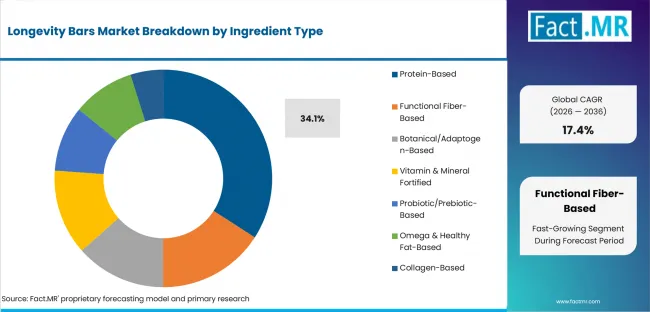
Longevity Bars Market Analysis By Ingredient Type | Source: Fact.MR
Protein-Based Ingredients are projected to account for 34.1% of the largest share by 2026 in the Longevity Bars Market. This dominance is driven by increasing global demand for protein-rich functional snacks, rising awareness regarding muscle preservation and healthy aging, and high adoption of whey, pea, soy, and collagen proteins in functional nutrition, sports recovery, and preventive wellness products.
Which Product Type Segment Accounts for the Highest Share in the Market?
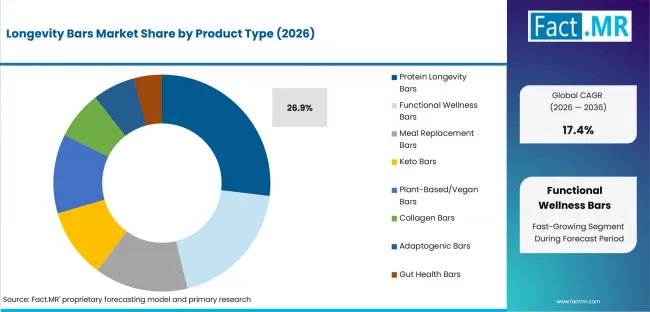
Longevity Bars Market Analysis By Product Type | Source: Fact.MR
Protein Longevity Bars are expected to hold the largest share of 26.9% in the product type segment in 2026. This growth is attributed to rising consumer demand for convenient high-protein nutrition products, increasing fitness participation, growing healthy-aging awareness, and expanding use of protein bars as meal replacement and functional wellness snacks across global markets.
Which Dietary Preference Segment Holds the Largest Share in the Market?
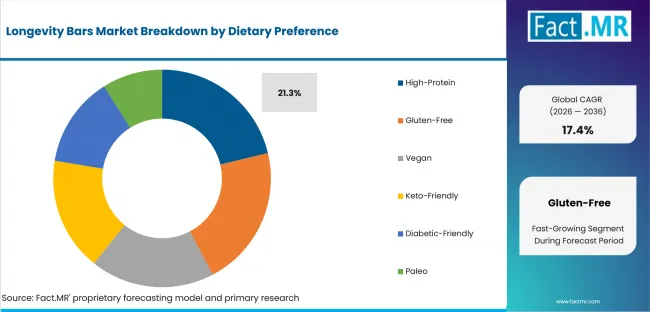
Longevity Bars Market Analysis By Dietary Preference | Source: Fact.MR
High-Protein Longevity Bars are projected to dominate the dietary preference segment, capturing 21.3% share in 2026. This leadership is driven by increasing consumer demand for protein-rich functional snacks, growing participation in fitness and active-aging lifestyles, rising awareness regarding muscle maintenance and metabolic wellness, and expanding adoption of convenient high-protein nutrition products among health-conscious consumers globally.
Which Distribution Channel Segment Holds the Largest Share in the Market?
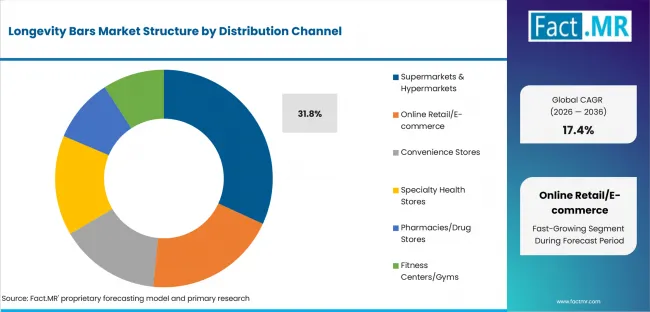
Longevity Bars Market Analysis By Distribution Channel | Source: Fact.MR
Supermarkets & Hypermarkets are projected to dominate the distribution channel segment, capturing 31.8% share in 2026. This leadership is driven by strong consumer preference for convenient in-store purchases, wider product visibility, increasing shelf penetration of functional nutrition brands, and growing availability of protein-rich and healthy-aging snack products across mainstream retail channels. Expanding consumer demand for accessible wellness foods, coupled with rising placement of longevity bars within health food aisles and premium snack categories, is further supporting segment growth globally.
Regional Outlook Across Key Markets
North America, Latin America, Western Europe, Eastern Europe, East Asia, South Asia & Pacific, and Middle East & Africa are the key geographies covered in this report. It comprises consumer insights analysis on healthy-aging awareness, preventive nutrition adoption, acceptance of functional and protein-rich snack products, growth of clean-label and plant-based nutrition trends, expansion of e-commerce and direct-to-consumer wellness platforms, increasing demand for convenient meal replacement and wellness foods, rising sports nutrition consumption, and regulatory developments related to functional foods and nutraceutical products across global longevity nutrition and preventive healthcare markets.
.webp "Top Country Growth Comparison Longevity Bars Market Cagr (2026 2036)")
Top Country Growth Comparison Longevity Bars Market Cagr (2026 2036) | Source: Fact.MR
CAGR Table
| Country | CAGR (%) |
|---|---|
| India | 22.0% |
| Japan | 20.4% |
| China | 20.1% |
| United Kingdom | 15.4% |
| United States | 16.2% |
| Germany | 14.9% |
| Canada | 18.0% |
Source: Fact.MR analysis. Updated Jun 15, 2026
Source: Fact.MR analysis, based on proprietary forecasting model and primary research.
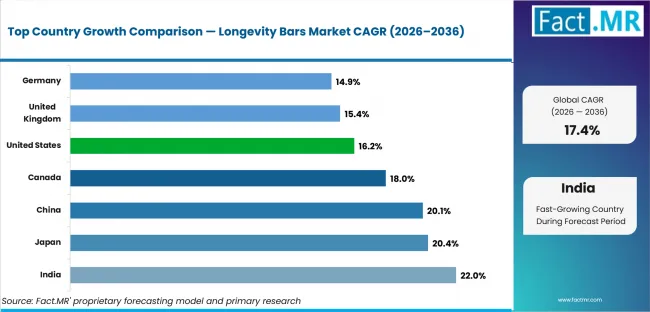
Longevity Bars Market Cagr Analysis By Country | Source: Fact.MR
North America Longevity Bars Market
North America is estimated to hold the largest share of the longevity bars market owing to high demand for functional nutrition products, increased healthy-aging awareness, rising preventive healthcare expenditure, and higher adoption of protein-rich wellness snacks. Growth in e-commerce nutrition platforms, clean-label food products and personalized wellness solutions is driving the market in other parts of the world as well. Leading companies such as NOVOS, and Bulletproof are deepening their market penetration with longevity-centric formulas, high-protein functional snacks, and direct-to-consumer wellness strategies.
- United States: Demand for longevity bars in the United States is projected to rise at 16.2% CAGR through 2036. Growth is driven by increasing consumer interest in healthy aging, expansion of functional nutrition categories, rising protein snack consumption, and growing adoption of preventive wellness products.
- Canada: Demand for longevity bars in Canada is projected to grow at 18.0% CAGR through 2036, supported by rising wellness spending, increasing demand for plant-based nutrition products, and expanding consumer preference for clean-label functional snacks.
Europe Longevity Bars Market
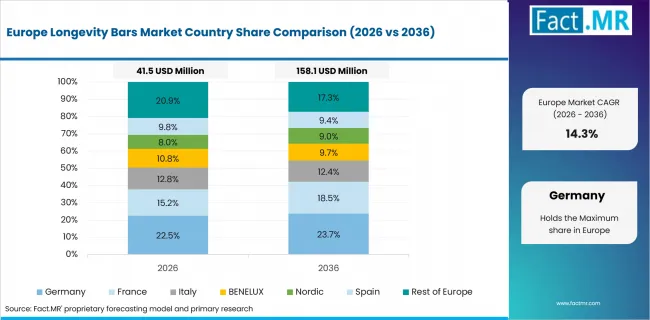
Longevity Bars Market Europe Country Market Share Analysis, 2026 & 2036 | Source: Fact.MR
Europe has a considerable share in the longevity bars market owing to accelerating demand for healthy-aging nutrition products, high penetration of clean-label functional food products, and increasing consumer awareness on preventive care solutions. The region is witnessing strong demand for plant-based, protein-fortified snacks and personalized wellness products. Brands such as Huel, GoMacro as well as local functional nutrition labels to name just a few are expanding their market share within premium wellness snacks and sustainable product innovation.
- Germany: Germany demand for longevity bars is projected to rise at 14.9% CAGR through 2036, supported by functional protein snacks, clean-label wellness foods, and healthy-aging nutrition products.
- United Kingdom: Demand for longevity bars in the United Kingdom is projected to rise at 15.4% CAGR through 2036, driven by growing demand for meal replacement nutrition, plant-based functional snacks, and personalized wellness products.
East Asia Longevity Bars Market
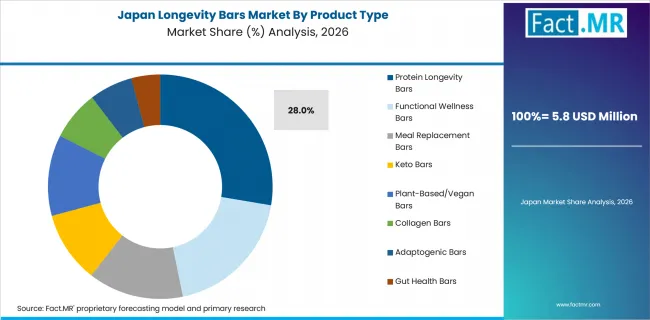
Longevity Bars Market Japan Market Share Analysis By Product Type | Source: Fact.MR
East Asia is likely to become a prominent growth area for longevity bars on account of growing health-conscious population, heightened demand for functional foods, expanding sports nutrition industry and consumers focus in preventive healthcare and healthy aging. Regional producers are also making more strides in protein-rich snacks, gut-health offerings and solutions for metabolic health nutrition.
- China: Demand for longevity bars in China is projected to rise at 20.1% CAGR through 2036, driven by growing functional food consumption, rising middle-class wellness spending, increasing protein intake trends, and expansion of preventive nutrition awareness.
- Japan: Demand for longevity bars in Japan is expected to grow at 20.4% CAGR through 2036 due to increasing healthy-aging awareness, rising demand for convenient nutrition products, growing active-aging populations, and expanding premium wellness food consumption.
South Asia & Pacific Longevity Bars Market
South Asia & Pacific is expected to be one of the rapidly growing regions in the longevity bars market due to factors such as rapid urbanization, increasing participation in fitness activities, growing demand for protein-rich snacks, and awareness about preventive nutrition and healthy aging. The companies operating in the region are aggressively introducing plant-based bars, functional wellness snacks and cost-effective protein nutrition solutions.
- India: Demand for longevity bars in India is projected to rise at 22.0% CAGR through 2036, driven by growing health and wellness awareness, increasing adoption of protein nutrition products, rapid expansion of fitness and nutraceutical industries, and rising consumer preference for convenient functional food solutions.
Latin America Longevity Bars Market
The growth of the longevity bars market in Latin America is supported by increasing awareness regarding healthy lifestyles, rising demand for functional snacks, and growing adoption of preventive wellness products. Urban consumers are increasingly shifting toward protein bars, meal replacement products, and clean-label nutrition solutions.
- Brazil: Demand for longevity bars in Brazil is projected to rise steadily through 2036, supported by increasing fitness participation, growing protein snack demand, and rising wellness product consumption.
Middle East & Africa Longevity Bars Market
The Middle East & Africa longevity bars market is witnessing gradual growth due to increasing urban wellness trends, expanding premium nutrition product availability, and growing consumer interest in healthy-aging and fitness-oriented nutrition. Rising penetration of modern retail and e-commerce wellness platforms is further supporting market expansion across the region.
The Fact.MR report analyzes market trends, competitive benchmarking, consumer nutrition behavior, ingredient innovation patterns, product development strategies, distribution channel expansion, and long-term growth opportunities across individual countries in North America, Latin America, Europe, East Asia, South Asia & Pacific, and Middle East & Africa. Readers gain detailed insights into functional nutrition industry expansion, healthy-aging food adoption trends, protein snack consumption patterns, clean-label product penetration, personalized wellness nutrition growth, e-commerce expansion, and future opportunities across longevity-focused functional foods and preventive wellness markets in both developed and emerging global economies.
Competitive Benchmarking and Company Positioning
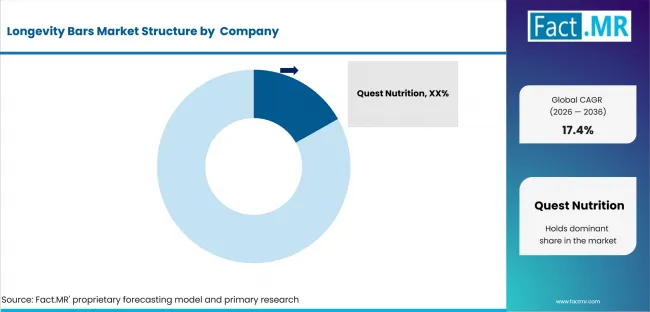
Longevity Bars Market Analysis By Company | Source: Fact.MR
Leading Companies Shaping the Longevity Bars Market
The longevity bar market is moderately consolidated with major players include NOVOS, Huel, Bulletproof, L-Nutra, and GoMacro. Functional ingredients innovation, the inclusion of quality protein, clean-label perception, healthy-aging benefits, and an expanded direct-to-consumer and e-commerce channel are expected to have a positive impact on the competition. Leading players are creating longevity-centric formulations with plant-based proteins, collagen peptides, adaptogens, probiotics and metabolic wellness ingredients to drive their high-end functional nutrition portfolios.
Companies are also expanding their portfolios to incorporate gut-health support, meal replacement nutrition and wellness solutions tailored to the person in a bid to win over health-conscious consumers. There, budding brands battle with products geared toward biohacking, inexpensive functional snack options, sustainable packaging efforts, influencer-oriented marketing campaigns, and custom nutrition ideas for millennials, fitness devotees, aging populations, and consumers of preventive healthcare in markets for global wellness and functional food industries.
Recent Industry Developments
- In July 2025, NOVOS launched NOVOS Bar as a functional nutrition bar formulated to support longevity and healthy aging. The product includes 15 g of protein, five longevity-focused ingredients, and 20 superfoods for consumers seeking convenient daily nutrition.
- In August 2025, L-Nutra launched the Prolon L-Protein Bar to support muscle health and healthy aging. The plant-based bar uses proteins from black beans, chickpeas, and peas, while its formulation targets consumers seeking age-supportive protein snacks.
- In September 2025, L-Nutra and Parsley Health formed a partnership to integrate Prolon products into Parsley Health’s physician-led care platform. The collaboration expands access to L-Protein and Fasting Bars, which supports wider use of nutrition-led healthy aging products.
Leading Companies Shaping the Longevity Bars Market
- NOVOS
- Bulletproof
- Huel
- Outlive
- L-Nutra
- GoMacro
Sources and Research References
- NOVOS. (2025, August 6). Why we created the first longevity bar. NOVOS.
- NOVOS. (2026). Buy longevity & anti-aging supplements & tests. NOVOS.
- Prolon. (2025, August 6). What to look for in a healthy protein bar. Prolon.
- Prolon. (2025, July 30). How protein may accelerate your aging — and what you can do about it. Prolon.
- L-Nutra Inc. (2026). Official corporate website. L-Nutra Inc.
Longevity Bars Market Definition
Longevity Bar market is a part of the functional nutrition and healthy-aging focused market, and it includes protein bars, wellness snack bars, meal replacement bars, and form similar products that are designed to support metabolic health, muscle recovery, cognitive wellness, gut health, immunity, and overall healthy aging. These range of products generally consist of proteins, collagen peptides, probiotics, adaptogens, omega fatty acids, vitamins, minerals and other plant based functional materials are offered in easy to consume snack and meal solutions. Longevity bars are popular functional snacks in sports nutrition, weight control, preventive health care and active aging lifestyles.
Longevity Bars Market Inclusions
The report presents a detailed picture of the market from 2026 to 2036 at global and regional levels. It provides insights at the country level for each region along with the analysis of market trends, competitive landscape, consumer wellness behavior, functional ingredients innovations, health aging nutrition developments and regional consumption patterns. The report also highlights emerging trends such as plant-based protein bars, clean-label wellness snacks, gut-health nutrition, personalized wellness products, biohacking-focused nutrition, subscription-based wellness models and new D2C and e-commerce functional nutrition platforms.
Longevity Bars Market Exclusions
The scope includes functional nutrition bars, protein-fortified wellness snacks, meal replacement solutions, and formulations for healthy-aging designed for use in preventive wellness, metabolic health, sports recovery, cognitive wellness, and gut health. But the analysis does not consider traditional sweet snack bars without functional health claims, pharmaceutical anti-aging drugs, prescription medical nutrition products, sports supplements that are not available in bar format, and general packaged food that are not longevity focused or wellness driven. The report does not include dietary supplements, beverages and nutraceutical capsules unless they are closely related to the longevity bars and functional wellness snacks ecosystems.
Longevity Bars Market Research Methodology
- Primary Research
- The longevity bars market value estimation was based on the Fact.MR analysis on the basis of the bottom-up and top-down approaches. Comprehensive primary research was conducted with leading functional food manufacturers, protein bar manufacturers, ingredient suppliers, sports nutrition companies, wellness retailers, e-commerce distributors, fitness industry professional, nutrition consultants and preventive healthcare experts to corroborate market trends, pattern of consumer adoption, price dynamics, innovation strategies and potential demand scenario within the categories of healthy-aging and functional nutrition.
- Desk Research
- This report incorporates intelligence collected from company annual reports, investor presentations, functional food industry publications, sports nutrition reports, healthy-aging research papers, wellness industry databases, scientific journals related to protein and functional ingredients, government nutrition statistics, retail and e-commerce trend analyses, and nutraceutical market studies. Additional references include reports on preventive healthcare, clean-label food products, plant-based nutrition, personalized wellness, and global functional snack consumption trends.
- Market-Sizing and Forecasting
- Fact.MR’s market estimation approach is based on a robust methodology where revenue generated by manufacturers of functional bars, protein snacks, meal replacement products, and wellness nutrition companies is analyzed using a bottom-up approach and further validated through a top-down assessment of the broader functional food, sports nutrition, and preventive wellness ecosystem across major regional and application markets globally.
- Data Validation and Update Cycle
- Market estimates were validated with the help of primary interviews, analysis of company financials, trends in demand for ingredients, retail sales performance, penetration of e-commerce, regional patterns of wellness consumption, and historical growth in the levels of interest for functional nutrition and food categories for healthy aging. The forecasts are reviewed and updated from time to time to reflect changes in consumer wellness behavior, regulatory environment, functional ingredient innovations, adoption of personalized nutrition, proliferation of digital health platforms, and trends in global expenditure on preventive healthcare.
Segmentation
Scope of Analysis

Longevity Bars Market Breakdown By Product Type, Ingredient Type, And Region | Source: Fact.MR
Parameter |
Details |
|---|---|
| Quantitative Units | USD million (2025) to USD million (2036), at a CAGR |
| Market Definition | The longevity bars market covers functional nutrition bars, protein bars, meal replacement bars, and wellness snack products formulated to support healthy aging, metabolic health, muscle recovery, cognitive wellness, gut health, immunity, and overall preventive nutrition. These products include protein-based bars, adaptogenic bars, collagen bars, gut-health bars, keto bars, and plant-based functional bars formulated using ingredients such as whey protein, pea protein, collagen peptides, probiotics, adaptogens, omega fatty acids, vitamins, minerals, and botanical extracts used across functional food, nutraceutical, sports nutrition, preventive healthcare, and healthy-aging wellness industries. |
| Product | Protein Longevity Bars, Functional Wellness Bars, Meal Replacement Bars, Keto Bars, Plant-Based/Vegan Bars, Collagen Bars, Adaptogenic Bars, Gut Health Bars |
| By Ingredient Type |
Source: Fact.MR analysis. Updated Jun 15, 2026 Protein-Based, Botanical/Adaptogen-Based, Functional Fiber-Based, Probiotic/Prebiotic-Based, Omega & Healthy Fat-Based, Vitamin & Mineral Fortified, Collagen-BasedSource: Fact.MR analysis. Updated Jun 15, 2026 |
| By Health Benefit | Healthy Aging, Energy & Stamina, Weight Management, Muscle Recovery, Gut Health, Cognitive Health, Immune Support, Metabolic Health |
| By Dietary Preference | Vegan, Gluten-Free, Keto-Friendly, Paleo, Diabetic-Friendly, High-Protein |
| By Distribution Channel | Supermarkets & Hypermarkets, Convenience Stores, Specialty Health Stores, Pharmacies & Drug Stores, Online Retail/E-commerce, Fitness Centers & Gyms |
| Regions Covered | North America, Eastern Europe, Western Europe, East Asia, South Asia & Pacific, Latin America, Middle East & Africa |
| Countries Covered | USA, Canada, Germany, United Kingdom, France, China, Japan, India, South Korea, Australia, Brazil, UAE, South Africa, and 20+ countries |
| Key Companies |
NOVOS, Outlive, L-Nutra / Prolon, Huel, Bulletproof, GoMacro |
| Forecast Period | 2026 to 2036 |
| Approach | Hybrid demand-side and top-down methodology based on functional nutrition consumption trends, healthy-aging product adoption, protein snack demand, preventive healthcare spending, sports nutrition expansion, clean-label food trends, e-commerce penetration, plant-based nutrition growth, and increasing investments in personalized wellness and longevity-focused nutrition products, validated through primary interviews with functional food manufacturers, nutrition brands, ingredient suppliers, wellness retailers, fitness industry participants, distributors, and industry experts across key global regions. |
Source: Fact.MR analysis. Updated Jun 15, 2026
Longevity Bars Market Segmentation
-
Longevity Bars Market by Product Type
- Protein Longevity Bars
- Functional Wellness Bars
- Meal Replacement Bars
- Keto Bars
- Plant-Based/Vegan Bars
- Collagen Bars
- Adaptogenic Bars
- Gut Health Bars
-
Longevity Bars Market by Ingredient Type
- Protein-Based
- Botanical/Adaptogen-Based
- Functional Fiber-Based
- Probiotic/Prebiotic-Based
- Omega & Healthy Fat-Based
- Vitamin & Mineral Fortified
- Collagen-Based
-
Longevity Bars Market by Health Benefit
- Healthy Aging
- Energy & Stamina
- Weight Management
- Muscle Recovery
- Gut Health
- Cognitive Health
- Immune Support
- Metabolic Health
-
Longevity Bars Market by Dietary Preference
- Vegan
- Gluten-Free
- Keto-Friendly
- Paleo
- Diabetic-Friendly
- High-Protein
-
Longevity Bars Market by Distribution Channel
- Supermarkets & Hypermarkets
- Convenience Stores
- Specialty Health Stores
- Pharmacies & Drug Stores
- Online Retail/E-commerce
- Fitness Centers & Gyms
-
Longevity Bars Market by Region
- North America
- USA
- Canada
- Latin America
- Brazil
- Mexico
- Chile
- Rest of LATAM
- East Asia
- China
- Japan
- South Korea
- Taiwan
- South Asia & Pacific
- India
- Singapore
- Australia
- ASEAN
- Western Europe
- Germany
- France
- United Kingdom
- Italy
- Spain
- BENELUX
- Nordic
- Rest of Western Europe
- Eastern Europe
- Poland
- Hungary
- Czech Republic
- Balkan & Baltics
- Rest of Eastern Europe
- Middle East and Africa
- Kingdom of Saudi Arabia
- United Arab Emirates
- South Africa
- Rest of Middle East and Africa
- North America
Frequently Asked Questions
How significant is the growth outlook for India in this market?
Which company is identified as a leading player in the Longevity Bars Market?
Which ingredient type holds the largest share of the Longevity Bars Market?
What is driving demand for protein-based longevity bars?
Which protein ingredients are widely used in longevity bars?
Who worked on this report


Preview the report firsthand - request a free sample
Free SampleGet the brochure for pricing and purchase details
Download PDF