Low-Cadmium, Premium Food-Grade Phosphate Fertilizer Market
Low-Cadmium, Premium Food-Grade Phosphate Fertilizer Market Size and Share Forecast Outlook 2026 to 2036
Low-cadmium, premium food-grade phosphate fertilizer market is projected to grow from USD 407.9 million in 2026 to USD 872.4 million by 2036, at a CAGR of 7.9%. Dairy/Alt-Dairy will dominate with a 45.0% market share, while powder will lead the form segment with a 45.9% share.
Low-Cadmium, Premium Food-Grade Phosphate Fertilizer Market Forecast and Outlook 2026 to 2036
The global market for low-cadmium, premium food-grade phosphate fertilizer is projected to grow from USD 407.87 million in 2026 to USD 872.44 million by 2036, advancing at a CAGR of 7.9%. This market addresses a critical intersection of agricultural productivity and food safety, supplying purified phosphate sources that meet stringent regulatory and compositional standards for contaminants, specifically the heavy metal cadmium.
Key Takeaways from the Low-Cadmium, Premium Food-Grade Phosphate Fertilizer Market
- Market Value for 2026: USD 407.87 Million
- Market Value for 2036: USD 872.44 Million
- Forecast CAGR (2026-2036): 7.9%
- Leading Application Segment (2026): Dairy/Alt-Dairy (45%)
- Leading Form Segment (2026): Powder (46%)
- Leading Channel Segment (2026): Direct-to-B2B (57%)
- Key Growth Countries: India (13.6% CAGR), China (12.9% CAGR), USA (12.1% CAGR), Poland (11.4% CAGR)
- Key Players in the Market: Yara International, The Mosaic Company, OCP Group, PhosAgro, ICL Group Ltd.
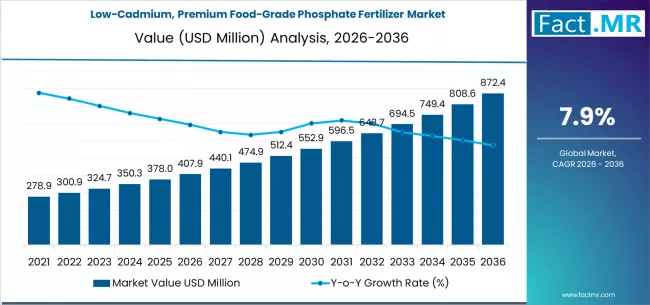
Growth is driven by escalating global food safety regulations, consumer demand for clean-label products, and the need for crop nutrition that supports the production of ingredients for human food and infant formula without introducing toxic element risks. Unlike conventional phosphate fertilizers, these premium products are manufactured from select, low-cadmium phosphate rock or undergo advanced purification processes to drastically reduce cadmium and other harmful impurities.
Their use is essential in supply chains for crops destined for direct human consumption, dairy and alt-dairy production, and premium beverage and bakery sectors, where ingredient purity is non-negotiable. The market’s expansion represents a fundamental shift from viewing phosphate solely as a source of phosphorus to recognizing it as a potential vector for contaminants that must be managed from the mine to the final food product.
The evolution of this market centers on securing low-cadmium rock sources, advancing purification technologies, and establishing chain-of-custody certifications. Success depends on the ability to provide verifiably clean, agronomically effective phosphate fertilizers that enable growers and food companies to meet progressively stricter international standards, thereby transforming a basic input into a guarantor of food safety and brand integrity.
Metric
| Metric | Value |
|---|---|
| Market Value (2026) | USD 407.87 Million |
| Market Forecast Value (2036) | USD 872.44 Million |
| Forecast CAGR (2026-2036) | 7.9% |
Category
| Category | Segments |
|---|---|
| Application | Dairy/Alt-Dairy, Beverages, Bakery/Snacks, Meat/Alt-Meat |
| Form | Powder, Liquid, Encapsulated, Paste |
| Channel | Direct-to-B2B, Distributors, Online B2B, Contract Manufacturing |
| Region | North America, Latin America, Western Europe, Eastern Europe, East Asia, South Asia & Pacific, MEA |
Segmental Analysis
By Application, Which Industry Has the Highest Purity Threshold?
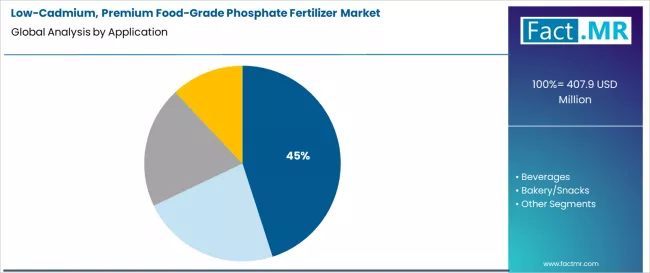
The dairy/alt-dairy segment leads with a 45% share. This sector, including infant formula and nutritional beverages, operates under some of the most rigorous global standards for heavy metals in final products.
Phosphate is a key mineral fortificant. Using low-cadmium, food-grade phosphate fertilizers at the agricultural stage for crops like oats and soy that feed into these supply chains is a critical preventative control point, ensuring the safety of the raw agricultural material and simplifying downstream processing.
By Form, Which is best for Precision Blending and Fortification?
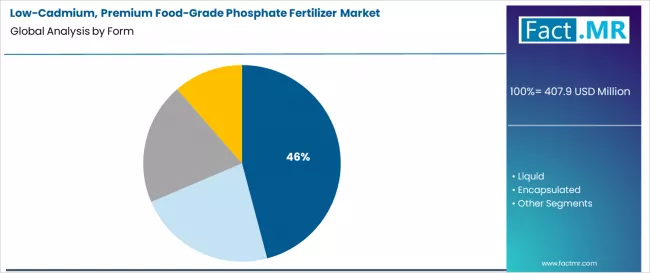
Powder form dominates with a 46% share. Powdered, highly soluble phosphate fertilizers like MAP or MKP are preferred for their ease of integration into specialized fertigation programs for high-value crops and for use in controlled-environment agriculture.
The fine, consistent particle size allows for precise measurement and homogeneous blending, which is essential for meeting exacting nutrient and contaminant specifications in premium crop production.
By Channel, How are These Certified Products Integrated into Secure Supply Chains?
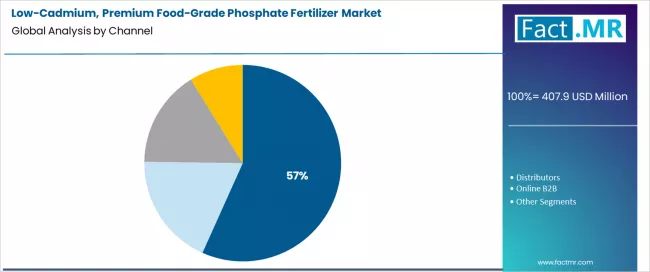
Direct-to-B2B sales constitute the leading channel at 57%. The procurement of low-cadmium phosphate is a strategic supply chain decision for integrated food companies, dairy cooperatives, and processors of specialty crops.
Direct relationships between fertilizer producers and these end-users ensure transparency, facilitate the transfer of certification documentation, and enable the development of customized fertilizer blends that align with specific crop and soil requirements for contracted growers.
What are the Drivers, Restraints, and Key Trends of the Low-Cadmium, Premium Food-Grade Phosphate Fertilizer Market?
The paramount driver is the global tightening of regulations on cadmium in foodstuffs, exemplified by EU Commission regulations setting maximum levels for cadmium in various foods and infant formula. Brand protection and the rising incidence of consumer-led product testing further compel food manufacturers to secure ultra-clean ingredient streams from the origin. The growth of organic and clean-label food movements, which often implicitly demand lower contaminant levels, also supports market growth.
A primary restraint is the higher cost of mining, beneficiating, and processing low-cadmium phosphate rock compared to conventional sources. This cost premium can be a significant barrier for commodity crop producers unless a direct price premium or contracted offtake agreement is in place. Geopolitical factors and the geographical concentration of low-cadmium rock reserves can also create supply vulnerabilities and price volatility. Furthermore, the agronomic performance must match conventional fertilizers to ensure grower adoption.
Key trends include the expansion of cadmium limits in fertilizers themselves, with jurisdictions like the EU and some US states enacting laws that will phase out high-cadmium phosphate fertilizers, creating a regulatory push. Blockchain and digital passports for fertilizer batches are emerging to provide immutable proof of origin and cadmium content throughout the supply chain. There is also a trend toward developing alternative, bio-based phosphate sources with intrinsically low heavy metal content, though these remain nascent.
Analysis of the Low-Cadmium, Premium Food-Grade Phosphate Fertilizer Market by Key Countries
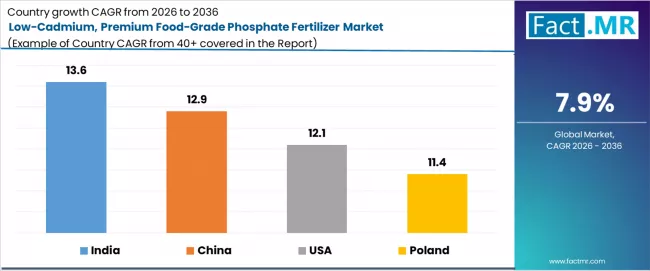
| Country | CAGR (2026-2036) |
|---|---|
| India | 13.6% |
| China | 12.9% |
| USA | 12.1% |
| Poland | 11.4% |
How is India's Evolving Food Safety Ecosystem and Dairy Sector Driving Demand?
India’s leading CAGR of 13.6% is linked to its position as the world’s largest milk producer and a growing exporter of dairy and agricultural products. The implementation of stricter Food Safety and Standards Authority of India (FSSAI) regulations and the need to access premium export markets are driving awareness of input quality.
Large dairy cooperatives and food processors are beginning to mandate cleaner agricultural inputs, creating a new and rapidly growing market for fertilizers that help ensure the safety of the massive domestic food supply.
What is the Impact of China's Healthy China 2030 and Food Safety Laws?
China’s 12.9% growth is propelled by its Healthy China 2030 plan and a well-documented public and governmental focus on food safety. National standards for contaminants in food are stringent and actively enforced.
For domestic infant formula producers and exporters seeking to rebuild global trust, sourcing agricultural raw materials grown with certified low-cadmium inputs is becoming a competitive necessity, driving demand within its vast agricultural system.
Why is the USA's Differentiated Market and Regulatory Landscape Influential?
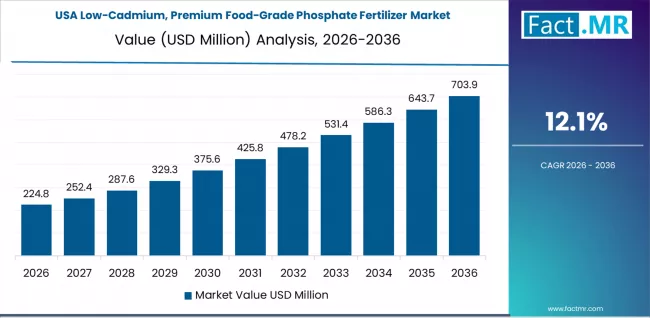
The USA’s 12.1% growth is characterized by a two-tier market. While bulk agriculture continues, a robust segment of identity-preserved, non-GMO, and organic production for premium brands demands high-purity inputs.
Several states are considering cadmium limits in fertilizers. Leading food and beverage corporations with proactive responsible sourcing policies are creating significant market pull for verified low-cadmium phosphate in their supply chains.
How is Poland's Role in EU Food Production a Key Market Factor?
Poland’s 11.4% CAGR is anchored in its status as a major agricultural producer and exporter within the European Union. Polish growers supplying the EU market must comply with the bloc’s progressive cadmium regulations.
Access to low-cadmium fertilizers is essential for maintaining market access and competitiveness. Poland’s significant dairy and meat processing sectors further amplify the need for safe feed and forage produced with clean inputs.
Competitive Landscape of the Low-Cadmium, Premium Food-Grade Phosphate Fertilizer Market
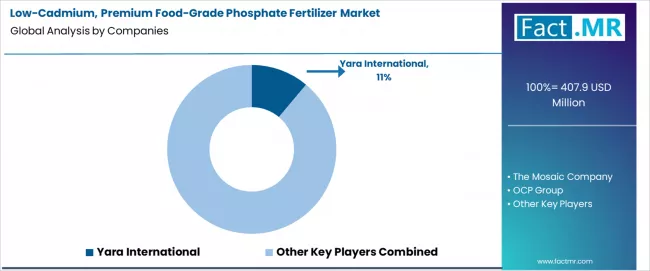
Global phosphate mining and processing companies that control access to premium, low-cadmium rock reserves, dominate the competitive landscape. Competition is based on the certified cadmium content of products, the reliability and scale of supply, and the ability to provide comprehensive documentation and traceability.
Strategic alliances with food conglomerates and commodity traders are critical for securing long-term offtake agreements. Success also depends on continuous investment in mining and processing technologies to further reduce impurities and meet evolving regulatory thresholds.
Key Players in the Low-Cadmium, Premium Food-Grade Phosphate Fertilizer Market
- Yara International
- The Mosaic Company
- OCP Group
- PhosAgro
- ICL Group Ltd.
Scope of Report
| Items | Values |
|---|---|
| Quantitative Units | USD Million |
| Application | Dairy/Alt-Dairy, Beverages, Bakery/Snacks, Meat/Alt-Meat |
| Form | Powder, Liquid, Encapsulated, Paste |
| Channel | Direct-to-B2B, Distributors, Online B2B, Contract Manufacturing |
| Key Countries | China, India, USA, Poland |
| Key Companies | Yara International, The Mosaic Company, OCP Group, PhosAgro, ICL Group Ltd. |
| Additional Analysis | Comparative analysis of cadmium levels in global phosphate rock deposits; review of international and national regulatory limits for cadmium in food and fertilizers; agronomic bioavailability studies of phosphorus from purified sources; economic model of premium pricing for food-grade vs. commodity phosphate; supply chain traceability and certification system analysis. |
Market by Segments
-
Application :
- Dairy/Alt-Dairy
- Beverages
- Bakery/Snacks
- Meat/Alt-Meat
-
Form :
- Powder
- Liquid
- Encapsulated
- Paste
-
Channel :
- Direct-to-B2B
- Distributors
- Online B2B
- Contract Manufacturing
-
Region :
-
North America
- USA
- Canada
-
Latin America
- Brazil
- Mexico
- Argentina
- Rest of Latin America
-
Western Europe
- Germany
- UK
- France
- Spain
- Italy
- BENELUX
- Rest of Western Europe
-
Eastern Europe
- Russia
- Poland
- Czech Republic
- Rest of Eastern Europe
-
East Asia
- China
- Japan
- South Korea
- Rest of East Asia
-
South Asia & Pacific
- India
- ASEAN
- Australia
- Rest of South Asia & Pacific
-
MEA
- Saudi Arabia
- UAE
- Turkiye
- Rest of MEA
-
Table of Content
- Executive Summary
- Global Market Outlook
- Demand to side Trends
- Supply to side Trends
- Technology Roadmap Analysis
- Analysis and Recommendations
- Market Overview
- Market Coverage / Taxonomy
- Market Definition / Scope / Limitations
- Market Background
- Market Dynamics
- Drivers
- Restraints
- Opportunity
- Trends
- Scenario Forecast
- Demand in Optimistic Scenario
- Demand in Likely Scenario
- Demand in Conservative Scenario
- Opportunity Map Analysis
- Product Life Cycle Analysis
- Supply Chain Analysis
- Investment Feasibility Matrix
- Value Chain Analysis
- PESTLE and Porter’s Analysis
- Regulatory Landscape
- Regional Parent Market Outlook
- Production and Consumption Statistics
- Import and Export Statistics
- Market Dynamics
- Global Market Analysis 2021 to 2025 and Forecast, 2026 to 2036
- Historical Market Size Value (USD Million) Analysis, 2021 to 2025
- Current and Future Market Size Value (USD Million) Projections, 2026 to 2036
- Y to o to Y Growth Trend Analysis
- Absolute $ Opportunity Analysis
- Global Market Pricing Analysis 2021 to 2025 and Forecast 2026 to 2036
- Global Market Analysis 2021 to 2025 and Forecast 2026 to 2036, By Application
- Introduction / Key Findings
- Historical Market Size Value (USD Million) Analysis By Application, 2021 to 2025
- Current and Future Market Size Value (USD Million) Analysis and Forecast By Application, 2026 to 2036
- Dairy/Alt-Dairy
- Beverages
- Bakery/Snacks
- Meat/Alt-Meat
- Dairy/Alt-Dairy
- Y to o to Y Growth Trend Analysis By Application, 2021 to 2025
- Absolute $ Opportunity Analysis By Application, 2026 to 2036
- Global Market Analysis 2021 to 2025 and Forecast 2026 to 2036, By Form
- Introduction / Key Findings
- Historical Market Size Value (USD Million) Analysis By Form, 2021 to 2025
- Current and Future Market Size Value (USD Million) Analysis and Forecast By Form, 2026 to 2036
- Powder
- Liquid
- Encapsulated
- Paste
- Powder
- Y to o to Y Growth Trend Analysis By Form, 2021 to 2025
- Absolute $ Opportunity Analysis By Form, 2026 to 2036
- Global Market Analysis 2021 to 2025 and Forecast 2026 to 2036, By Channel
- Introduction / Key Findings
- Historical Market Size Value (USD Million) Analysis By Channel, 2021 to 2025
- Current and Future Market Size Value (USD Million) Analysis and Forecast By Channel, 2026 to 2036
- Direct-to-B2B
- Distributors
- Online B2B
- Contract Manufacturing
- Direct-to-B2B
- Y to o to Y Growth Trend Analysis By Channel, 2021 to 2025
- Absolute $ Opportunity Analysis By Channel, 2026 to 2036
- Global Market Analysis 2021 to 2025 and Forecast 2026 to 2036, By Region
- Introduction
- Historical Market Size Value (USD Million) Analysis By Region, 2021 to 2025
- Current Market Size Value (USD Million) Analysis and Forecast By Region, 2026 to 2036
- North America
- Latin America
- Western Europe
- Eastern Europe
- East Asia
- South Asia and Pacific
- Middle East & Africa
- Market Attractiveness Analysis By Region
- North America Market Analysis 2021 to 2025 and Forecast 2026 to 2036, By Country
- Historical Market Size Value (USD Million) Trend Analysis By Market Taxonomy, 2021 to 2025
- Market Size Value (USD Million) Forecast By Market Taxonomy, 2026 to 2036
- By Country
- USA
- Canada
- Mexico
- By Application
- By Form
- By Channel
- By Country
- Market Attractiveness Analysis
- By Country
- By Application
- By Form
- By Channel
- Key Takeaways
- Latin America Market Analysis 2021 to 2025 and Forecast 2026 to 2036, By Country
- Historical Market Size Value (USD Million) Trend Analysis By Market Taxonomy, 2021 to 2025
- Market Size Value (USD Million) Forecast By Market Taxonomy, 2026 to 2036
- By Country
- Brazil
- Chile
- Rest of Latin America
- By Application
- By Form
- By Channel
- By Country
- Market Attractiveness Analysis
- By Country
- By Application
- By Form
- By Channel
- Key Takeaways
- Western Europe Market Analysis 2021 to 2025 and Forecast 2026 to 2036, By Country
- Historical Market Size Value (USD Million) Trend Analysis By Market Taxonomy, 2021 to 2025
- Market Size Value (USD Million) Forecast By Market Taxonomy, 2026 to 2036
- By Country
- Germany
- UK
- Italy
- Spain
- France
- Nordic
- BENELUX
- Rest of Western Europe
- By Application
- By Form
- By Channel
- By Country
- Market Attractiveness Analysis
- By Country
- By Application
- By Form
- By Channel
- Key Takeaways
- Eastern Europe Market Analysis 2021 to 2025 and Forecast 2026 to 2036, By Country
- Historical Market Size Value (USD Million) Trend Analysis By Market Taxonomy, 2021 to 2025
- Market Size Value (USD Million) Forecast By Market Taxonomy, 2026 to 2036
- By Country
- Russia
- Poland
- Hungary
- Balkan & Baltic
- Rest of Eastern Europe
- By Application
- By Form
- By Channel
- By Country
- Market Attractiveness Analysis
- By Country
- By Application
- By Form
- By Channel
- Key Takeaways
- East Asia Market Analysis 2021 to 2025 and Forecast 2026 to 2036, By Country
- Historical Market Size Value (USD Million) Trend Analysis By Market Taxonomy, 2021 to 2025
- Market Size Value (USD Million) Forecast By Market Taxonomy, 2026 to 2036
- By Country
- China
- Japan
- South Korea
- By Application
- By Form
- By Channel
- By Country
- Market Attractiveness Analysis
- By Country
- By Application
- By Form
- By Channel
- Key Takeaways
- South Asia and Pacific Market Analysis 2021 to 2025 and Forecast 2026 to 2036, By Country
- Historical Market Size Value (USD Million) Trend Analysis By Market Taxonomy, 2021 to 2025
- Market Size Value (USD Million) Forecast By Market Taxonomy, 2026 to 2036
- By Country
- India
- ASEAN
- Australia & New Zealand
- Rest of South Asia and Pacific
- By Application
- By Form
- By Channel
- By Country
- Market Attractiveness Analysis
- By Country
- By Application
- By Form
- By Channel
- Key Takeaways
- Middle East & Africa Market Analysis 2021 to 2025 and Forecast 2026 to 2036, By Country
- Historical Market Size Value (USD Million) Trend Analysis By Market Taxonomy, 2021 to 2025
- Market Size Value (USD Million) Forecast By Market Taxonomy, 2026 to 2036
- By Country
- Kingdom of Saudi Arabia
- Other GCC Countries
- Turkiye
- South Africa
- Other African Union
- Rest of Middle East & Africa
- By Application
- By Form
- By Channel
- By Country
- Market Attractiveness Analysis
- By Country
- By Application
- By Form
- By Channel
- Key Takeaways
- Key Countries Market Analysis
- USA
- Pricing Analysis
- Market Share Analysis, 2025
- By Application
- By Form
- By Channel
- Canada
- Pricing Analysis
- Market Share Analysis, 2025
- By Application
- By Form
- By Channel
- Mexico
- Pricing Analysis
- Market Share Analysis, 2025
- By Application
- By Form
- By Channel
- Brazil
- Pricing Analysis
- Market Share Analysis, 2025
- By Application
- By Form
- By Channel
- Chile
- Pricing Analysis
- Market Share Analysis, 2025
- By Application
- By Form
- By Channel
- Germany
- Pricing Analysis
- Market Share Analysis, 2025
- By Application
- By Form
- By Channel
- UK
- Pricing Analysis
- Market Share Analysis, 2025
- By Application
- By Form
- By Channel
- Italy
- Pricing Analysis
- Market Share Analysis, 2025
- By Application
- By Form
- By Channel
- Spain
- Pricing Analysis
- Market Share Analysis, 2025
- By Application
- By Form
- By Channel
- France
- Pricing Analysis
- Market Share Analysis, 2025
- By Application
- By Form
- By Channel
- India
- Pricing Analysis
- Market Share Analysis, 2025
- By Application
- By Form
- By Channel
- ASEAN
- Pricing Analysis
- Market Share Analysis, 2025
- By Application
- By Form
- By Channel
- Australia & New Zealand
- Pricing Analysis
- Market Share Analysis, 2025
- By Application
- By Form
- By Channel
- China
- Pricing Analysis
- Market Share Analysis, 2025
- By Application
- By Form
- By Channel
- Japan
- Pricing Analysis
- Market Share Analysis, 2025
- By Application
- By Form
- By Channel
- South Korea
- Pricing Analysis
- Market Share Analysis, 2025
- By Application
- By Form
- By Channel
- Russia
- Pricing Analysis
- Market Share Analysis, 2025
- By Application
- By Form
- By Channel
- Poland
- Pricing Analysis
- Market Share Analysis, 2025
- By Application
- By Form
- By Channel
- Hungary
- Pricing Analysis
- Market Share Analysis, 2025
- By Application
- By Form
- By Channel
- Kingdom of Saudi Arabia
- Pricing Analysis
- Market Share Analysis, 2025
- By Application
- By Form
- By Channel
- Turkiye
- Pricing Analysis
- Market Share Analysis, 2025
- By Application
- By Form
- By Channel
- South Africa
- Pricing Analysis
- Market Share Analysis, 2025
- By Application
- By Form
- By Channel
- USA
- Market Structure Analysis
- Competition Dashboard
- Competition Benchmarking
- Market Share Analysis of Top Players
- By Regional
- By Application
- By Form
- By Channel
- Competition Analysis
- Competition Deep Dive
- Yara International
- Overview
- Product Portfolio
- Profitability by Market Segments (Product/Age /Sales Channel/Region)
- Sales Footprint
- Strategy Overview
- Marketing Strategy
- Product Strategy
- Channel Strategy
- The Mosaic Company
- OCP Group
- PhosAgro
- ICL Group Ltd.
- Yara International
- Competition Deep Dive
- Assumptions & Acronyms Used
- Research Methodology
List Of Table
- Table 1: Global Market Value (USD Million) Forecast by Region, 2021 to 2036
- Table 2: Global Market Value (USD Million) Forecast by Application, 2021 to 2036
- Table 3: Global Market Value (USD Million) Forecast by Form, 2021 to 2036
- Table 4: Global Market Value (USD Million) Forecast by Channel, 2021 to 2036
- Table 5: North America Market Value (USD Million) Forecast by Country, 2021 to 2036
- Table 6: North America Market Value (USD Million) Forecast by Application, 2021 to 2036
- Table 7: North America Market Value (USD Million) Forecast by Form, 2021 to 2036
- Table 8: North America Market Value (USD Million) Forecast by Channel, 2021 to 2036
- Table 9: Latin America Market Value (USD Million) Forecast by Country, 2021 to 2036
- Table 10: Latin America Market Value (USD Million) Forecast by Application, 2021 to 2036
- Table 11: Latin America Market Value (USD Million) Forecast by Form, 2021 to 2036
- Table 12: Latin America Market Value (USD Million) Forecast by Channel, 2021 to 2036
- Table 13: Western Europe Market Value (USD Million) Forecast by Country, 2021 to 2036
- Table 14: Western Europe Market Value (USD Million) Forecast by Application, 2021 to 2036
- Table 15: Western Europe Market Value (USD Million) Forecast by Form, 2021 to 2036
- Table 16: Western Europe Market Value (USD Million) Forecast by Channel, 2021 to 2036
- Table 17: Eastern Europe Market Value (USD Million) Forecast by Country, 2021 to 2036
- Table 18: Eastern Europe Market Value (USD Million) Forecast by Application, 2021 to 2036
- Table 19: Eastern Europe Market Value (USD Million) Forecast by Form, 2021 to 2036
- Table 20: Eastern Europe Market Value (USD Million) Forecast by Channel, 2021 to 2036
- Table 21: East Asia Market Value (USD Million) Forecast by Country, 2021 to 2036
- Table 22: East Asia Market Value (USD Million) Forecast by Application, 2021 to 2036
- Table 23: East Asia Market Value (USD Million) Forecast by Form, 2021 to 2036
- Table 24: East Asia Market Value (USD Million) Forecast by Channel, 2021 to 2036
- Table 25: South Asia and Pacific Market Value (USD Million) Forecast by Country, 2021 to 2036
- Table 26: South Asia and Pacific Market Value (USD Million) Forecast by Application, 2021 to 2036
- Table 27: South Asia and Pacific Market Value (USD Million) Forecast by Form, 2021 to 2036
- Table 28: South Asia and Pacific Market Value (USD Million) Forecast by Channel, 2021 to 2036
- Table 29: Middle East & Africa Market Value (USD Million) Forecast by Country, 2021 to 2036
- Table 30: Middle East & Africa Market Value (USD Million) Forecast by Application, 2021 to 2036
- Table 31: Middle East & Africa Market Value (USD Million) Forecast by Form, 2021 to 2036
- Table 32: Middle East & Africa Market Value (USD Million) Forecast by Channel, 2021 to 2036
List Of Figures
- Figure 1: Global Market Pricing Analysis
- Figure 2: Global Market Value (USD Million) Forecast 2021 to 2036
- Figure 3: Global Market Value Share and BPS Analysis by Application, 2026 and 2036
- Figure 4: Global Market Y to o to Y Growth Comparison by Application, 2026 to 2036
- Figure 5: Global Market Attractiveness Analysis by Application
- Figure 6: Global Market Value Share and BPS Analysis by Form, 2026 and 2036
- Figure 7: Global Market Y to o to Y Growth Comparison by Form, 2026 to 2036
- Figure 8: Global Market Attractiveness Analysis by Form
- Figure 9: Global Market Value Share and BPS Analysis by Channel, 2026 and 2036
- Figure 10: Global Market Y to o to Y Growth Comparison by Channel, 2026 to 2036
- Figure 11: Global Market Attractiveness Analysis by Channel
- Figure 12: Global Market Value (USD Million) Share and BPS Analysis by Region, 2026 and 2036
- Figure 13: Global Market Y to o to Y Growth Comparison by Region, 2026 to 2036
- Figure 14: Global Market Attractiveness Analysis by Region
- Figure 15: North America Market Incremental Dollar Opportunity, 2026 to 2036
- Figure 16: Latin America Market Incremental Dollar Opportunity, 2026 to 2036
- Figure 17: Western Europe Market Incremental Dollar Opportunity, 2026 to 2036
- Figure 18: Eastern Europe Market Incremental Dollar Opportunity, 2026 to 2036
- Figure 19: East Asia Market Incremental Dollar Opportunity, 2026 to 2036
- Figure 20: South Asia and Pacific Market Incremental Dollar Opportunity, 2026 to 2036
- Figure 21: Middle East & Africa Market Incremental Dollar Opportunity, 2026 to 2036
- Figure 22: North America Market Value Share and BPS Analysis by Country, 2026 and 2036
- Figure 23: North America Market Value Share and BPS Analysis by Application, 2026 and 2036
- Figure 24: North America Market Y to o to Y Growth Comparison by Application, 2026 to 2036
- Figure 25: North America Market Attractiveness Analysis by Application
- Figure 26: North America Market Value Share and BPS Analysis by Form, 2026 and 2036
- Figure 27: North America Market Y to o to Y Growth Comparison by Form, 2026 to 2036
- Figure 28: North America Market Attractiveness Analysis by Form
- Figure 29: North America Market Value Share and BPS Analysis by Channel, 2026 and 2036
- Figure 30: North America Market Y to o to Y Growth Comparison by Channel, 2026 to 2036
- Figure 31: North America Market Attractiveness Analysis by Channel
- Figure 32: Latin America Market Value Share and BPS Analysis by Country, 2026 and 2036
- Figure 33: Latin America Market Value Share and BPS Analysis by Application, 2026 and 2036
- Figure 34: Latin America Market Y to o to Y Growth Comparison by Application, 2026 to 2036
- Figure 35: Latin America Market Attractiveness Analysis by Application
- Figure 36: Latin America Market Value Share and BPS Analysis by Form, 2026 and 2036
- Figure 37: Latin America Market Y to o to Y Growth Comparison by Form, 2026 to 2036
- Figure 38: Latin America Market Attractiveness Analysis by Form
- Figure 39: Latin America Market Value Share and BPS Analysis by Channel, 2026 and 2036
- Figure 40: Latin America Market Y to o to Y Growth Comparison by Channel, 2026 to 2036
- Figure 41: Latin America Market Attractiveness Analysis by Channel
- Figure 42: Western Europe Market Value Share and BPS Analysis by Country, 2026 and 2036
- Figure 43: Western Europe Market Value Share and BPS Analysis by Application, 2026 and 2036
- Figure 44: Western Europe Market Y to o to Y Growth Comparison by Application, 2026 to 2036
- Figure 45: Western Europe Market Attractiveness Analysis by Application
- Figure 46: Western Europe Market Value Share and BPS Analysis by Form, 2026 and 2036
- Figure 47: Western Europe Market Y to o to Y Growth Comparison by Form, 2026 to 2036
- Figure 48: Western Europe Market Attractiveness Analysis by Form
- Figure 49: Western Europe Market Value Share and BPS Analysis by Channel, 2026 and 2036
- Figure 50: Western Europe Market Y to o to Y Growth Comparison by Channel, 2026 to 2036
- Figure 51: Western Europe Market Attractiveness Analysis by Channel
- Figure 52: Eastern Europe Market Value Share and BPS Analysis by Country, 2026 and 2036
- Figure 53: Eastern Europe Market Value Share and BPS Analysis by Application, 2026 and 2036
- Figure 54: Eastern Europe Market Y to o to Y Growth Comparison by Application, 2026 to 2036
- Figure 55: Eastern Europe Market Attractiveness Analysis by Application
- Figure 56: Eastern Europe Market Value Share and BPS Analysis by Form, 2026 and 2036
- Figure 57: Eastern Europe Market Y to o to Y Growth Comparison by Form, 2026 to 2036
- Figure 58: Eastern Europe Market Attractiveness Analysis by Form
- Figure 59: Eastern Europe Market Value Share and BPS Analysis by Channel, 2026 and 2036
- Figure 60: Eastern Europe Market Y to o to Y Growth Comparison by Channel, 2026 to 2036
- Figure 61: Eastern Europe Market Attractiveness Analysis by Channel
- Figure 62: East Asia Market Value Share and BPS Analysis by Country, 2026 and 2036
- Figure 63: East Asia Market Value Share and BPS Analysis by Application, 2026 and 2036
- Figure 64: East Asia Market Y to o to Y Growth Comparison by Application, 2026 to 2036
- Figure 65: East Asia Market Attractiveness Analysis by Application
- Figure 66: East Asia Market Value Share and BPS Analysis by Form, 2026 and 2036
- Figure 67: East Asia Market Y to o to Y Growth Comparison by Form, 2026 to 2036
- Figure 68: East Asia Market Attractiveness Analysis by Form
- Figure 69: East Asia Market Value Share and BPS Analysis by Channel, 2026 and 2036
- Figure 70: East Asia Market Y to o to Y Growth Comparison by Channel, 2026 to 2036
- Figure 71: East Asia Market Attractiveness Analysis by Channel
- Figure 72: South Asia and Pacific Market Value Share and BPS Analysis by Country, 2026 and 2036
- Figure 73: South Asia and Pacific Market Value Share and BPS Analysis by Application, 2026 and 2036
- Figure 74: South Asia and Pacific Market Y to o to Y Growth Comparison by Application, 2026 to 2036
- Figure 75: South Asia and Pacific Market Attractiveness Analysis by Application
- Figure 76: South Asia and Pacific Market Value Share and BPS Analysis by Form, 2026 and 2036
- Figure 77: South Asia and Pacific Market Y to o to Y Growth Comparison by Form, 2026 to 2036
- Figure 78: South Asia and Pacific Market Attractiveness Analysis by Form
- Figure 79: South Asia and Pacific Market Value Share and BPS Analysis by Channel, 2026 and 2036
- Figure 80: South Asia and Pacific Market Y to o to Y Growth Comparison by Channel, 2026 to 2036
- Figure 81: South Asia and Pacific Market Attractiveness Analysis by Channel
- Figure 82: Middle East & Africa Market Value Share and BPS Analysis by Country, 2026 and 2036
- Figure 83: Middle East & Africa Market Value Share and BPS Analysis by Application, 2026 and 2036
- Figure 84: Middle East & Africa Market Y to o to Y Growth Comparison by Application, 2026 to 2036
- Figure 85: Middle East & Africa Market Attractiveness Analysis by Application
- Figure 86: Middle East & Africa Market Value Share and BPS Analysis by Form, 2026 and 2036
- Figure 87: Middle East & Africa Market Y to o to Y Growth Comparison by Form, 2026 to 2036
- Figure 88: Middle East & Africa Market Attractiveness Analysis by Form
- Figure 89: Middle East & Africa Market Value Share and BPS Analysis by Channel, 2026 and 2036
- Figure 90: Middle East & Africa Market Y to o to Y Growth Comparison by Channel, 2026 to 2036
- Figure 91: Middle East & Africa Market Attractiveness Analysis by Channel
- Figure 92: Global Market - Tier Structure Analysis
- Figure 93: Global Market - Company Share Analysis
- FAQs -
How big is the low-cadmium, premium food-grade phosphate fertilizer market in 2026?
The global low-cadmium, premium food-grade phosphate fertilizer market is estimated to be valued at USD 407.9 million in 2026.
What will be the size of low-cadmium, premium food-grade phosphate fertilizer market in 2036?
The market size for the low-cadmium, premium food-grade phosphate fertilizer market is projected to reach USD 872.4 million by 2036.
How much will be the low-cadmium, premium food-grade phosphate fertilizer market growth between 2026 and 2036?
The low-cadmium, premium food-grade phosphate fertilizer market is expected to grow at a 7.9% CAGR between 2026 and 2036.
What are the key product types in the low-cadmium, premium food-grade phosphate fertilizer market?
The key product types in low-cadmium, premium food-grade phosphate fertilizer market are dairy/alt-dairy, beverages, bakery/snacks and meat/alt-meat.
Which form segment to contribute significant share in the low-cadmium, premium food-grade phosphate fertilizer market in 2026?
In terms of form, powder segment to command 45.9% share in the low-cadmium, premium food-grade phosphate fertilizer market in 2026.