Low-Carbon Concrete Shrinkage-Reduction Additives Market (2026 - 2036)
Low-Carbon Concrete Shrinkage-Reduction Additives Market Size and Share Forecast Outlook 2026 to 2036
Core Findings
Low-Carbon Concrete Shrinkage-Reduction Additives Market Forecast Outlook 2026 to 2036
The low-carbon concrete shrinkage-reduction additives market is anticipated to reach USD 794.8 million in 2026 and grow to USD 1,622.9 million by 2036, reflecting a CAGR of 7.4%.
Key Takeaways from Low-Carbon Concrete Shrinkage-Reduction Additives Market
- Low-Carbon Concrete Shrinkage-Reduction Additives Market Value (2026): USD 794.8 million
- Low-Carbon Concrete Shrinkage-Reduction Additives Market Forecast Value (2036): USD 1,622.9 million
- Low-Carbon Concrete Shrinkage-Reduction Additives Market Forecast CAGR 2026 to 2036: 7.4%
- Leading Segment in Low-Carbon Concrete Shrinkage-Reduction Additives Market: Shrinkage-reducing admixtures (SRA) (51%)
- Key Growth Region in Low-Carbon Concrete Shrinkage-Reduction Additives Market: China (8.8% CAGR)
- Key Players in Low-Carbon Concrete Shrinkage-Reduction Additives Market: Sika AG, Compagnie de Saint-Gobain S.A., MAPEI S.p.A., Fosroc, RPM International Inc., CEMEX, S.A.B. de C.V., Holcim Ltd, CICO Technologies Limited, GCP Applied Technologies Inc., BASF SE
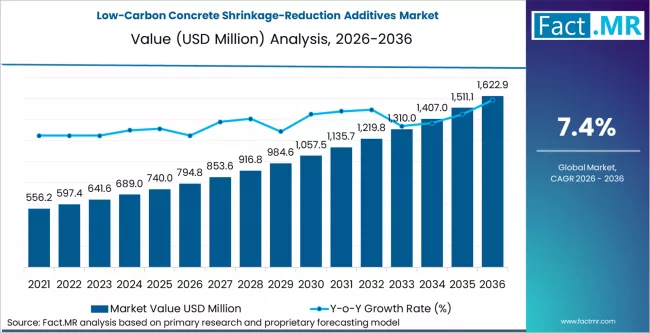
The market’s growth quality is significantly influenced by application concentration, with the construction sector being the primary driver. This concentration means that shifts in construction demand, particularly for sustainable building materials, will directly impact market dynamics.
End-use dependency also plays a key role; the construction industry's reliance on shrinkage-reduction additives in high-performance concrete limits exposure to other sectors, thus influencing adoption rates. Volume stability will be affected by fluctuations in infrastructure projects and green construction trends. As governments and private developers prioritize low-carbon solutions, growth may experience variability based on regional regulatory environments and construction activity cycles. For market players, strategic investments in supply chains and product development are crucial to ensuring consistent demand through these dependencies.
Low-Carbon Concrete Shrinkage-Reduction Additives Market
| Metric | Value |
|---|---|
| Estimated Value in (2026E) | USD 794.8 million |
| Forecast Value in (2036F) | USD 1,622.9 million |
| Forecast CAGR 2026 to 2036 | 7.4% |
Category
| Category | Sub-Segment |
|---|---|
| By Additive Type | Shrinkage-reducing admixtures (SRA); Internal curing agents; Expansive agents; Fiber-based shrinkage control; Hybrid systems |
| By Concrete Type | Ready-mix concrete; Precast concrete; High-performance concrete; Self-compacting concrete; Low-carbon SCM blends |
| By Application | Slabs & industrial floors; Bridges & infrastructure; Commercial buildings; Residential construction; Other applications |
| By Route to Market | Direct to ready-mix producers; Through admixture distributors; Direct to precast plants; Contractor-led procurement |
| Region | North America; Europe; Asia Pacific; Latin America; Middle East & Africa |
Segmental Analysi
What is Driving the Dominance of Shrinkage-Reducing Admixtures (SRA) in the Low-Carbon Concrete Shrinkage-Reduction Additives Market?
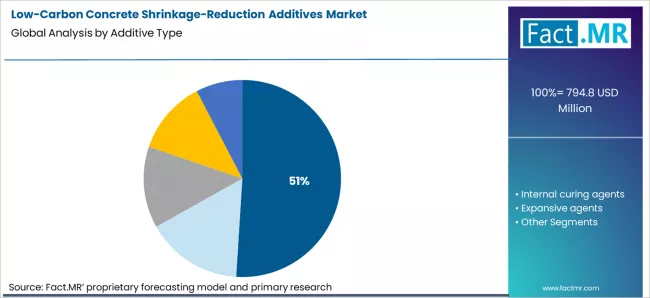
Shrinkage-reducing admixtures (SRA) lead the low-carbon concrete shrinkage-reduction additives market with 51% of the market share in 2026. SRAs are widely used to mitigate the shrinkage of concrete, reducing cracking and improving durability, especially in low-carbon concrete formulations. Their ability to improve the performance of concrete while maintaining or reducing carbon emissions in the production process makes them essential in modern construction projects focused on sustainability. These admixtures are particularly valuable in environments where minimizing concrete cracking and enhancing long-term stability are critical.
What is the Role of Ready-Mix Concrete in the Low-Carbon Concrete Shrinkage-Reduction Additives Market?
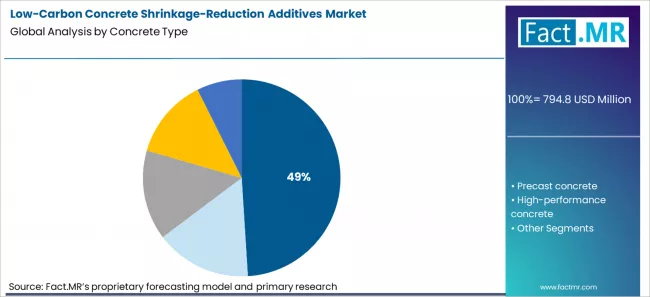
Ready-mix concrete accounts for 49% of the market share in 2026. Ready-mix concrete is the most common form of concrete used in construction, and its widespread use is driving the demand for shrinkage-reduction additives. The convenience, consistency, and cost-effectiveness of ready-mix concrete make it the preferred choice for large-scale and commercial construction projects. The incorporation of low-carbon and shrinkage-reduction additives into ready-mix concrete enhances the material’s performance, making it more durable and sustainable, in line with growing environmental standards and regulations in the construction industry.
What are the Drivers, Restraints, and Key Trends in the LowCarbon Concrete ShrinkageReduction Additives Market?
Demand for low carbon concrete shrinkage reduction additives is shaped by construction and infrastructure requirements to improve dimensional stability, reduce cracking, and enhance long term durability of low carbon concrete mixes in buildings, bridges, and pavements. Materials engineers and specifiers choose additives that minimize drying and thermal shrinkage while supporting lower clinker content and supplementary cementitious materials to reduce embodied carbon. Procurement teams prioritize solutions that deliver consistent performance across varied mix designs, maintain workability, and comply with specifications for sustainable construction practices and green building standards. Higher costs compared with conventional shrinkage reducers constrain adoption in budget sensitive projects, and variability in performance with different low carbon binders affects formulation optimization. Key trends include development of tailored chemistries that balance shrinkage control with low emissions, and expansion of technical support to help concrete producers integrate additives into high volume, sustainable mix designs with predictable curing behaviour and reduced cracking risk.
Analysis of the Low-Carbon Concrete Shrinkage-Reduction Additives Market by Key Country
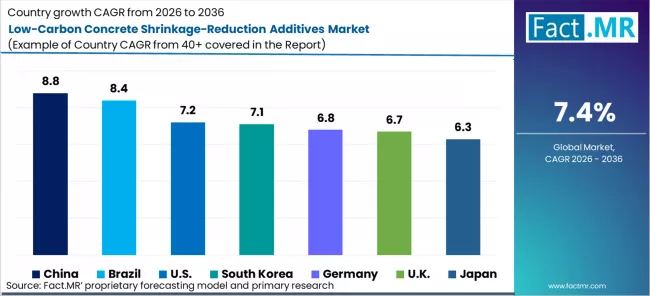
| Country | CAGR 2026 to 2036 |
|---|---|
| U.S. | 7.2% |
| Japan | 6.3% |
| South Korea | 7.1% |
| Germany | 6.8% |
| China | 8.8% |
| U.K. | 6.7% |
| Brazil | 8.4% |
The report covers an in-depth analysis of 40+ countries; top-performing countries are highlighted below.
What is Driving the Growth of the Low-Carbon Concrete Shrinkage-Reduction Additives Market in the U.S.?
The U.S. Low-Carbon Concrete Shrinkage-Reduction Additives market is projected to grow at 7.2%, driven by increasing demand for sustainable construction materials. As the construction industry faces pressure to reduce its carbon footprint, the adoption of low-carbon concrete solutions is rising. Shrinkage-reduction additives play a crucial role in improving concrete durability and performance while minimizing environmental impact. The growing focus on green building standards and sustainability, coupled with stricter regulations on emissions, supports the market’s growth in the U.S. Additionally, the government’s push for infrastructure projects that prioritize sustainability further accelerates the demand for these additives.
How is the Low-Carbon Concrete Shrinkage-Reduction Additives Market Expanding in Japan?
Japan’s Low-Carbon Concrete Shrinkage-Reduction Additives market is growing at 6.3%, supported by the country’s emphasis on sustainability in construction. Japan’s construction industry, known for its high-quality standards and focus on innovation, increasingly incorporates low-carbon concrete solutions to reduce environmental impact. Shrinkage-reduction additives are essential for improving concrete's long-term durability, especially in earthquake-resistant structures. With stringent regulations aimed at reducing carbon emissions and enhancing material efficiency, the demand for sustainable concrete additives continues to rise, contributing to steady market growth in Japan.
What Factors Are Fueling the Growth of the Low-Carbon Concrete Shrinkage-Reduction Additives Market in South Korea?
South Korea’s Low-Carbon Concrete Shrinkage-Reduction Additives market is projected to grow at 7.1%, driven by the country’s growing infrastructure development and commitment to sustainability. South Korea’s construction industry is adopting low-carbon solutions in response to government regulations and consumer demand for environmentally friendly building practices. Shrinkage-reduction additives are increasingly used to enhance concrete’s performance, reduce cracking, and improve durability. As South Korea continues to prioritize green construction technologies and builds towards more sustainable urban environments, the market for these additives is expected to grow steadily.
How is the Low-Carbon Concrete Shrinkage-Reduction Additives Market Evolving in Germany?
Germany’s Low-Carbon Concrete Shrinkage-Reduction Additives market is growing at 6.8%, supported by the country’s leadership in sustainable construction practices. Germany has a strong focus on reducing carbon emissions in the building sector, and low-carbon concrete solutions are gaining widespread adoption. Shrinkage-reduction additives help meet the increasing demand for durable, eco-friendly materials in the construction of buildings, infrastructure, and transportation networks. Germany’s regulatory framework and green building initiatives further encourage the use of these additives in new construction projects, contributing to the steady expansion of the market.
What is Contributing to the Growth of the Low-Carbon Concrete Shrinkage-Reduction Additives Market in China?
China’s Low-Carbon Concrete Shrinkage-Reduction Additives market is expanding at 8.8%, driven by the country’s large-scale construction projects and focus on sustainability. As one of the largest construction markets globally, China is increasingly adopting low-carbon concrete solutions to reduce the environmental impact of its infrastructure development. Shrinkage-reduction additives are becoming an essential part of concrete formulations, improving durability and minimizing environmental impact. The Chinese government’s commitment to sustainable development, coupled with the growing demand for green building certifications, drives the adoption of these additives across commercial, residential, and infrastructure projects.
What is Driving the Growth of the Low-Carbon Concrete Shrinkage-Reduction Additives Market in the U.K.?
The U.K.’s Low-Carbon Concrete Shrinkage-Reduction Additives market is growing at 6.7%, driven by the country’s commitment to achieving net-zero carbon emissions in construction. The U.K. government has introduced policies and regulations aimed at reducing the carbon footprint of construction materials, and low-carbon concrete is a key part of this effort. Shrinkage-reduction additives help meet the demand for high-quality, durable, and sustainable concrete solutions in residential, commercial, and infrastructure sectors. As the construction industry in the U.K. adapts to green building standards and sustainability goals, the adoption of these additives is expected to continue increasing.
What is Contributing to the Growth of the Low-Carbon Concrete Shrinkage-Reduction Additives Market in Brazil?
Brazil’s Low-Carbon Concrete Shrinkage-Reduction Additives market is expanding at 8.4%, supported by the country’s growing construction industry and focus on sustainable development. As Brazil continues to urbanize and expand its infrastructure, the demand for low-carbon, high-performance concrete solutions is increasing. Shrinkage-reduction additives are essential for improving the durability and stability of concrete, especially in tropical climates where thermal variations can cause shrinkage. The Brazilian government’s commitment to reducing carbon emissions and improving construction standards is further driving the demand for low-carbon concrete additives, contributing to market growth in Brazil.
How Are Key Players Competing in the Low-Carbon Concrete Shrinkage-Reduction Additives Market?
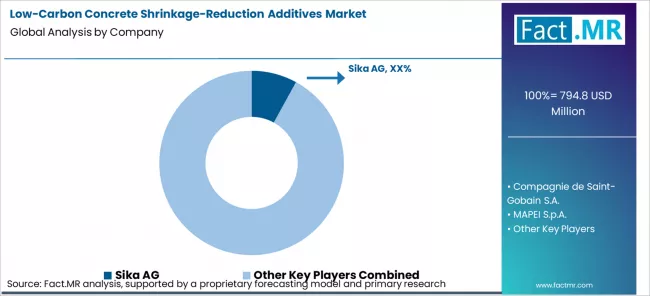
The low-carbon concrete shrinkage-reduction additives market is seeing growing competition as companies innovate to meet sustainability demands in the construction industry. Sika AG and Compagnie de Saint-Gobain S.A. are at the forefront, developing high-performance additives that reduce concrete shrinkage while enhancing sustainability. MAPEI S.p.A. and Fosroc focus on advancing shrinkage control technologies that also address low-carbon concrete needs. RPM International Inc. and CEMEX, S.A.B. de C.V. aim to leverage eco-friendly innovations in their products for both performance and environmental benefits. Other key players like Holcim Ltd, CICO Technologies Limited, GCP Applied Technologies Inc., and BASF SE are focusing on improving concrete durability, reducing shrinkage, and lowering the carbon footprint of their additives.
Key Players of the Low-Carbon Concrete Shrinkage-Reduction Additives Market
- Sika AG
- Compagnie de Saint-Gobain S.A.
- MAPEI S.p.A.
- Fosroc
- RPM International Inc.
- CEMEX, S.A.B. de C.V.
- Holcim Ltd
- CICO Technologies Limited
- GCP Applied Technologies Inc.
- BASF SE
Scope of the Report
| Items | Values |
|---|---|
| Quantitative Units (2026) | USD 794.8 Million |
| By Additive Type | Shrinkage-Reducing Admixtures (SRA), Internal Curing Agents, Expansive Agents, Fiber-based Shrinkage Control, Hybrid Systems |
| By Concrete Type | Ready-mix Concrete, Precast Concrete, High-performance Concrete, Self-compacting Concrete, Low-carbon SCM Blends |
| By Application | Slabs & Industrial Floors, Bridges & Infrastructure, Commercial Buildings, Residential Construction, Other Applications |
| By Route to Market | Direct to Ready-mix Producers, Through Admixture Distributors, Direct to Precast Plants, Contractor-led Procurement |
| Regions Covered | North America, Europe, Asia Pacific, Latin America, Middle East & Africa |
| Countries Covered | United States, Canada, Mexico, Germany, United Kingdom, France, Japan, South Korea, China, India, Brazil, and other countries |
| Key Companies Profiled | Sika AG, Compagnie de Saint-Gobain S.A., MAPEI S.p.A., Fosroc, RPM International Inc., CEMEX, S.A.B. de C.V., Holcim Ltd, CICO Technologies Limited, GCP Applied Technologies Inc., BASF SE |
| Additional Attributes | Dollar revenue by additive type, concrete type, application, route to market, and region; regional demand trends, competitive landscape, technological advancements in low-carbon concrete shrinkage-reduction additives, operational performance optimization initiatives, and product development strategies |
Low-Carbon Concrete Shrinkage-Reduction Additives Market Key Segments
-
By Additive Type :
- Shrinkage-reducing admixtures (SRA)
- Internal curing agents
- Expansive agents
- Fiber-based shrinkage control
- Hybrid systems
-
By Concrete Type :
- Ready-mix concrete
- Precast concrete
- High-performance concrete
- Self-compacting concrete
- Low-carbon SCM blends
-
By Application :
- Slabs & industrial floors
- Bridges & infrastructure
- Commercial buildings
- Residential construction
- Other applications
-
By Route to Market :
- Direct to ready-mix producers
- Through admixture distributors
- Direct to precast plants
- Contractor-led procurement
-
Region :
- North America
- USA
- Canada
- Mexico
- Europe
- Germany
- UK
- France
- Italy
- Spain
- Nordic Countries
- BENELUX
- Rest of Europe
- Asia Pacific
- China
- Japan
- South Korea
- India
- Australia
- Rest of Asia Pacific
- Latin America
- Brazil
- Argentina
- Rest of Latin America
- Middle East and Africa
- Kingdom of Saudi Arabia
- United Arab Emirates
- South Africa
- Rest of Middle East and Africa
- Other Regions
- Oceania
- Central Asia
- Other Markets
- North America
Bibliographies
- International Energy Agency (IEA). (2023). Low-carbon cement and concrete technology roadmap. IEA.
- United Nations Environment Programme (UNEP). (2023). 2023 Global Status Report for Buildings and Construction: Materials and embodied carbon. UNEP.
- U.S. National Institute of Standards and Technology (NIST). (2024). Drying shrinkage and durability performance of cementitious materials. NIST Engineering Laboratory.
- European Commission Joint Research Centre (JRC). (2024). Low-carbon construction materials and performance assessment of cement alternatives. European Commission.
- International Organization for Standardization (ISO). (2023). ISO 1920-8: Testing of concrete - Drying shrinkage of concrete for samples prepared in the field or in laboratory. ISO.
Table of Content
- Executive Summary
- Global Market Outlook
- Demand to side Trends
- Supply to side Trends
- Technology Roadmap Analysis
- Analysis and Recommendations
- Market Overview
- Market Coverage / Taxonomy
- Market Definition / Scope / Limitations
- Research Methodology
- Chapter Orientation
- Analytical Lens and Working Hypotheses
- Market Structure, Signals, and Trend Drivers
- Benchmarking and Cross-market Comparability
- Market Sizing, Forecasting, and Opportunity Mapping
- Research Design and Evidence Framework
- Desk Research Programme (Secondary Evidence)
- Company Annual and Sustainability Reports
- Peer-reviewed Journals and Academic Literature
- Corporate Websites, Product Literature, and Technical Notes
- Earnings Decks and Investor Briefings
- Statutory Filings and Regulatory Disclosures
- Technical White Papers and Standards Notes
- Trade Journals, Industry Magazines, and Analyst Briefs
- Conference Proceedings, Webinars, and Seminar Materials
- Government Statistics Portals and Public Data Releases
- Press Releases and Reputable Media Coverage
- Specialist Newsletters and Curated Briefings
- Sector Databases and Reference Repositories
- FMR Internal Proprietary Databases and Historical Market Datasets
- Subscription Datasets and Paid Sources
- Social Channels, Communities, and Digital Listening Inputs
- Additional Desk Sources
- Expert Input and Fieldwork (Primary Evidence)
- Primary Modes
- Qualitative Interviews and Expert Elicitation
- Quantitative Surveys and Structured Data Capture
- Blended Approach
- Why Primary Evidence is Used
- Field Techniques
- Interviews
- Surveys
- Focus Groups
- Observational and In-context Research
- Social and Community Interactions
- Stakeholder Universe Engaged
- C-suite Leaders
- Board Members
- Presidents and Vice Presidents
- R&D and Innovation Heads
- Technical Specialists
- Domain Subject-matter Experts
- Scientists
- Physicians and Other Healthcare Professionals
- Governance, Ethics, and Data Stewardship
- Research Ethics
- Data Integrity and Handling
- Primary Modes
- Tooling, Models, and Reference Databases
- Desk Research Programme (Secondary Evidence)
- Data Engineering and Model Build
- Data Acquisition and Ingestion
- Cleaning, Normalisation, and Verification
- Synthesis, Triangulation, and Analysis
- Quality Assurance and Audit Trail
- Market Background
- Market Dynamics
- Drivers
- Restraints
- Opportunity
- Trends
- Scenario Forecast
- Demand in Optimistic Scenario
- Demand in Likely Scenario
- Demand in Conservative Scenario
- Opportunity Map Analysis
- Product Life Cycle Analysis
- Supply Chain Analysis
- Investment Feasibility Matrix
- Value Chain Analysis
- PESTLE and Porter’s Analysis
- Regulatory Landscape
- Regional Parent Market Outlook
- Production and Consumption Statistics
- Import and Export Statistics
- Market Dynamics
- Global Market Analysis 2021 to 2025 and Forecast, 2026 to 2036
- Historical Market Size Value (USD Million) Analysis, 2021 to 2025
- Current and Future Market Size Value (USD Million) Projections, 2026 to 2036
- Y to o to Y Growth Trend Analysis
- Absolute $ Opportunity Analysis
- Global Market Pricing Analysis 2021 to 2025 and Forecast 2026 to 2036
- Global Market Analysis 2021 to 2025 and Forecast 2026 to 2036, By Additive Type
- Introduction / Key Findings
- Historical Market Size Value (USD Million) Analysis By Additive Type, 2021 to 2025
- Current and Future Market Size Value (USD Million) Analysis and Forecast By Additive Type, 2026 to 2036
- Shrinkage-reducing admixtures (SRA)
- Internal curing agents
- Expansive agents
- Fiber-based shrinkage control
- Hybrid systems
- Shrinkage-reducing admixtures (SRA)
- Y to o to Y Growth Trend Analysis By Additive Type, 2021 to 2025
- Absolute $ Opportunity Analysis By Additive Type, 2026 to 2036
- Global Market Analysis 2021 to 2025 and Forecast 2026 to 2036, By Concrete Type
- Introduction / Key Findings
- Historical Market Size Value (USD Million) Analysis By Concrete Type, 2021 to 2025
- Current and Future Market Size Value (USD Million) Analysis and Forecast By Concrete Type, 2026 to 2036
- Ready-mix concrete
- Precast concrete
- High-performance concrete
- Self-compacting concrete
- Low-carbon SCM blends
- Ready-mix concrete
- Y to o to Y Growth Trend Analysis By Concrete Type, 2021 to 2025
- Absolute $ Opportunity Analysis By Concrete Type, 2026 to 2036
- Global Market Analysis 2021 to 2025 and Forecast 2026 to 2036, By Region
- Introduction
- Historical Market Size Value (USD Million) Analysis By Region, 2021 to 2025
- Current Market Size Value (USD Million) Analysis and Forecast By Region, 2026 to 2036
- North America
- Latin America
- Western Europe
- Eastern Europe
- East Asia
- South Asia and Pacific
- Middle East & Africa
- Market Attractiveness Analysis By Region
- North America Market Analysis 2021 to 2025 and Forecast 2026 to 2036, By Country
- Historical Market Size Value (USD Million) Trend Analysis By Market Taxonomy, 2021 to 2025
- Market Size Value (USD Million) Forecast By Market Taxonomy, 2026 to 2036
- By Country
- USA
- Canada
- Mexico
- By Additive Type
- By Concrete Type
- By Country
- Market Attractiveness Analysis
- By Country
- By Additive Type
- By Concrete Type
- Key Takeaways
- Latin America Market Analysis 2021 to 2025 and Forecast 2026 to 2036, By Country
- Historical Market Size Value (USD Million) Trend Analysis By Market Taxonomy, 2021 to 2025
- Market Size Value (USD Million) Forecast By Market Taxonomy, 2026 to 2036
- By Country
- Brazil
- Chile
- Rest of Latin America
- By Additive Type
- By Concrete Type
- By Country
- Market Attractiveness Analysis
- By Country
- By Additive Type
- By Concrete Type
- Key Takeaways
- Western Europe Market Analysis 2021 to 2025 and Forecast 2026 to 2036, By Country
- Historical Market Size Value (USD Million) Trend Analysis By Market Taxonomy, 2021 to 2025
- Market Size Value (USD Million) Forecast By Market Taxonomy, 2026 to 2036
- By Country
- Germany
- UK
- Italy
- Spain
- France
- Nordic
- BENELUX
- Rest of Western Europe
- By Additive Type
- By Concrete Type
- By Country
- Market Attractiveness Analysis
- By Country
- By Additive Type
- By Concrete Type
- Key Takeaways
- Eastern Europe Market Analysis 2021 to 2025 and Forecast 2026 to 2036, By Country
- Historical Market Size Value (USD Million) Trend Analysis By Market Taxonomy, 2021 to 2025
- Market Size Value (USD Million) Forecast By Market Taxonomy, 2026 to 2036
- By Country
- Russia
- Poland
- Hungary
- Balkan & Baltic
- Rest of Eastern Europe
- By Additive Type
- By Concrete Type
- By Country
- Market Attractiveness Analysis
- By Country
- By Additive Type
- By Concrete Type
- Key Takeaways
- East Asia Market Analysis 2021 to 2025 and Forecast 2026 to 2036, By Country
- Historical Market Size Value (USD Million) Trend Analysis By Market Taxonomy, 2021 to 2025
- Market Size Value (USD Million) Forecast By Market Taxonomy, 2026 to 2036
- By Country
- China
- Japan
- South Korea
- By Additive Type
- By Concrete Type
- By Country
- Market Attractiveness Analysis
- By Country
- By Additive Type
- By Concrete Type
- Key Takeaways
- South Asia and Pacific Market Analysis 2021 to 2025 and Forecast 2026 to 2036, By Country
- Historical Market Size Value (USD Million) Trend Analysis By Market Taxonomy, 2021 to 2025
- Market Size Value (USD Million) Forecast By Market Taxonomy, 2026 to 2036
- By Country
- India
- ASEAN
- Australia & New Zealand
- Rest of South Asia and Pacific
- By Additive Type
- By Concrete Type
- By Country
- Market Attractiveness Analysis
- By Country
- By Additive Type
- By Concrete Type
- Key Takeaways
- Middle East & Africa Market Analysis 2021 to 2025 and Forecast 2026 to 2036, By Country
- Historical Market Size Value (USD Million) Trend Analysis By Market Taxonomy, 2021 to 2025
- Market Size Value (USD Million) Forecast By Market Taxonomy, 2026 to 2036
- By Country
- Kingdom of Saudi Arabia
- Other GCC Countries
- Turkiye
- South Africa
- Other African Union
- Rest of Middle East & Africa
- By Additive Type
- By Concrete Type
- By Country
- Market Attractiveness Analysis
- By Country
- By Additive Type
- By Concrete Type
- Key Takeaways
- Key Countries Market Analysis
- USA
- Pricing Analysis
- Market Share Analysis, 2025
- By Additive Type
- By Concrete Type
- Canada
- Pricing Analysis
- Market Share Analysis, 2025
- By Additive Type
- By Concrete Type
- Mexico
- Pricing Analysis
- Market Share Analysis, 2025
- By Additive Type
- By Concrete Type
- Brazil
- Pricing Analysis
- Market Share Analysis, 2025
- By Additive Type
- By Concrete Type
- Chile
- Pricing Analysis
- Market Share Analysis, 2025
- By Additive Type
- By Concrete Type
- Germany
- Pricing Analysis
- Market Share Analysis, 2025
- By Additive Type
- By Concrete Type
- UK
- Pricing Analysis
- Market Share Analysis, 2025
- By Additive Type
- By Concrete Type
- Italy
- Pricing Analysis
- Market Share Analysis, 2025
- By Additive Type
- By Concrete Type
- Spain
- Pricing Analysis
- Market Share Analysis, 2025
- By Additive Type
- By Concrete Type
- France
- Pricing Analysis
- Market Share Analysis, 2025
- By Additive Type
- By Concrete Type
- India
- Pricing Analysis
- Market Share Analysis, 2025
- By Additive Type
- By Concrete Type
- ASEAN
- Pricing Analysis
- Market Share Analysis, 2025
- By Additive Type
- By Concrete Type
- Australia & New Zealand
- Pricing Analysis
- Market Share Analysis, 2025
- By Additive Type
- By Concrete Type
- China
- Pricing Analysis
- Market Share Analysis, 2025
- By Additive Type
- By Concrete Type
- Japan
- Pricing Analysis
- Market Share Analysis, 2025
- By Additive Type
- By Concrete Type
- South Korea
- Pricing Analysis
- Market Share Analysis, 2025
- By Additive Type
- By Concrete Type
- Russia
- Pricing Analysis
- Market Share Analysis, 2025
- By Additive Type
- By Concrete Type
- Poland
- Pricing Analysis
- Market Share Analysis, 2025
- By Additive Type
- By Concrete Type
- Hungary
- Pricing Analysis
- Market Share Analysis, 2025
- By Additive Type
- By Concrete Type
- Kingdom of Saudi Arabia
- Pricing Analysis
- Market Share Analysis, 2025
- By Additive Type
- By Concrete Type
- Turkiye
- Pricing Analysis
- Market Share Analysis, 2025
- By Additive Type
- By Concrete Type
- South Africa
- Pricing Analysis
- Market Share Analysis, 2025
- By Additive Type
- By Concrete Type
- USA
- Market Structure Analysis
- Competition Dashboard
- Competition Benchmarking
- Market Share Analysis of Top Players
- By Regional
- By Additive Type
- By Concrete Type
- Competition Analysis
- Competition Deep Dive
- Sika AG
- Overview
- Product Portfolio
- Profitability by Market Segments (Product/Age /Sales Channel/Region)
- Sales Footprint
- Strategy Overview
- Marketing Strategy
- Product Strategy
- Channel Strategy
- Compagnie de Saint-Gobain S.A.
- MAPEI S.p.A.
- Fosroc
- RPM International Inc.
- CEMEX, S.A.B. de C.V.
- Holcim Ltd
- CICO Technologies Limited
- GCP Applied Technologies Inc.
- BASF SE
- Sika AG
- Competition Deep Dive
- Assumptions & Acronyms Used
List Of Table
- Table 1: Global Market Value (USD Million) Forecast by Region, 2021 to 2036
- Table 2: Global Market Value (USD Million) Forecast by Additive Type, 2021 to 2036
- Table 3: Global Market Value (USD Million) Forecast by Concrete Type, 2021 to 2036
- Table 4: North America Market Value (USD Million) Forecast by Country, 2021 to 2036
- Table 5: North America Market Value (USD Million) Forecast by Additive Type, 2021 to 2036
- Table 6: North America Market Value (USD Million) Forecast by Concrete Type, 2021 to 2036
- Table 7: Latin America Market Value (USD Million) Forecast by Country, 2021 to 2036
- Table 8: Latin America Market Value (USD Million) Forecast by Additive Type, 2021 to 2036
- Table 9: Latin America Market Value (USD Million) Forecast by Concrete Type, 2021 to 2036
- Table 10: Western Europe Market Value (USD Million) Forecast by Country, 2021 to 2036
- Table 11: Western Europe Market Value (USD Million) Forecast by Additive Type, 2021 to 2036
- Table 12: Western Europe Market Value (USD Million) Forecast by Concrete Type, 2021 to 2036
- Table 13: Eastern Europe Market Value (USD Million) Forecast by Country, 2021 to 2036
- Table 14: Eastern Europe Market Value (USD Million) Forecast by Additive Type, 2021 to 2036
- Table 15: Eastern Europe Market Value (USD Million) Forecast by Concrete Type, 2021 to 2036
- Table 16: East Asia Market Value (USD Million) Forecast by Country, 2021 to 2036
- Table 17: East Asia Market Value (USD Million) Forecast by Additive Type, 2021 to 2036
- Table 18: East Asia Market Value (USD Million) Forecast by Concrete Type, 2021 to 2036
- Table 19: South Asia and Pacific Market Value (USD Million) Forecast by Country, 2021 to 2036
- Table 20: South Asia and Pacific Market Value (USD Million) Forecast by Additive Type, 2021 to 2036
- Table 21: South Asia and Pacific Market Value (USD Million) Forecast by Concrete Type, 2021 to 2036
- Table 22: Middle East & Africa Market Value (USD Million) Forecast by Country, 2021 to 2036
- Table 23: Middle East & Africa Market Value (USD Million) Forecast by Additive Type, 2021 to 2036
- Table 24: Middle East & Africa Market Value (USD Million) Forecast by Concrete Type, 2021 to 2036
List Of Figures
- Figure 1: Global Market Pricing Analysis
- Figure 2: Global Market Value (USD Million) Forecast 2021 to 2036
- Figure 3: Global Market Value Share and BPS Analysis by Additive Type, 2026 and 2036
- Figure 4: Global Market Y to o to Y Growth Comparison by Additive Type, 2026 to 2036
- Figure 5: Global Market Attractiveness Analysis by Additive Type
- Figure 6: Global Market Value Share and BPS Analysis by Concrete Type, 2026 and 2036
- Figure 7: Global Market Y to o to Y Growth Comparison by Concrete Type, 2026 to 2036
- Figure 8: Global Market Attractiveness Analysis by Concrete Type
- Figure 9: Global Market Value (USD Million) Share and BPS Analysis by Region, 2026 and 2036
- Figure 10: Global Market Y to o to Y Growth Comparison by Region, 2026 to 2036
- Figure 11: Global Market Attractiveness Analysis by Region
- Figure 12: North America Market Incremental Dollar Opportunity, 2026 to 2036
- Figure 13: Latin America Market Incremental Dollar Opportunity, 2026 to 2036
- Figure 14: Western Europe Market Incremental Dollar Opportunity, 2026 to 2036
- Figure 15: Eastern Europe Market Incremental Dollar Opportunity, 2026 to 2036
- Figure 16: East Asia Market Incremental Dollar Opportunity, 2026 to 2036
- Figure 17: South Asia and Pacific Market Incremental Dollar Opportunity, 2026 to 2036
- Figure 18: Middle East & Africa Market Incremental Dollar Opportunity, 2026 to 2036
- Figure 19: North America Market Value Share and BPS Analysis by Country, 2026 and 2036
- Figure 20: North America Market Value Share and BPS Analysis by Additive Type, 2026 and 2036
- Figure 21: North America Market Y to o to Y Growth Comparison by Additive Type, 2026 to 2036
- Figure 22: North America Market Attractiveness Analysis by Additive Type
- Figure 23: North America Market Value Share and BPS Analysis by Concrete Type, 2026 and 2036
- Figure 24: North America Market Y to o to Y Growth Comparison by Concrete Type, 2026 to 2036
- Figure 25: North America Market Attractiveness Analysis by Concrete Type
- Figure 26: Latin America Market Value Share and BPS Analysis by Country, 2026 and 2036
- Figure 27: Latin America Market Value Share and BPS Analysis by Additive Type, 2026 and 2036
- Figure 28: Latin America Market Y to o to Y Growth Comparison by Additive Type, 2026 to 2036
- Figure 29: Latin America Market Attractiveness Analysis by Additive Type
- Figure 30: Latin America Market Value Share and BPS Analysis by Concrete Type, 2026 and 2036
- Figure 31: Latin America Market Y to o to Y Growth Comparison by Concrete Type, 2026 to 2036
- Figure 32: Latin America Market Attractiveness Analysis by Concrete Type
- Figure 33: Western Europe Market Value Share and BPS Analysis by Country, 2026 and 2036
- Figure 34: Western Europe Market Value Share and BPS Analysis by Additive Type, 2026 and 2036
- Figure 35: Western Europe Market Y to o to Y Growth Comparison by Additive Type, 2026 to 2036
- Figure 36: Western Europe Market Attractiveness Analysis by Additive Type
- Figure 37: Western Europe Market Value Share and BPS Analysis by Concrete Type, 2026 and 2036
- Figure 38: Western Europe Market Y to o to Y Growth Comparison by Concrete Type, 2026 to 2036
- Figure 39: Western Europe Market Attractiveness Analysis by Concrete Type
- Figure 40: Eastern Europe Market Value Share and BPS Analysis by Country, 2026 and 2036
- Figure 41: Eastern Europe Market Value Share and BPS Analysis by Additive Type, 2026 and 2036
- Figure 42: Eastern Europe Market Y to o to Y Growth Comparison by Additive Type, 2026 to 2036
- Figure 43: Eastern Europe Market Attractiveness Analysis by Additive Type
- Figure 44: Eastern Europe Market Value Share and BPS Analysis by Concrete Type, 2026 and 2036
- Figure 45: Eastern Europe Market Y to o to Y Growth Comparison by Concrete Type, 2026 to 2036
- Figure 46: Eastern Europe Market Attractiveness Analysis by Concrete Type
- Figure 47: East Asia Market Value Share and BPS Analysis by Country, 2026 and 2036
- Figure 48: East Asia Market Value Share and BPS Analysis by Additive Type, 2026 and 2036
- Figure 49: East Asia Market Y to o to Y Growth Comparison by Additive Type, 2026 to 2036
- Figure 50: East Asia Market Attractiveness Analysis by Additive Type
- Figure 51: East Asia Market Value Share and BPS Analysis by Concrete Type, 2026 and 2036
- Figure 52: East Asia Market Y to o to Y Growth Comparison by Concrete Type, 2026 to 2036
- Figure 53: East Asia Market Attractiveness Analysis by Concrete Type
- Figure 54: South Asia and Pacific Market Value Share and BPS Analysis by Country, 2026 and 2036
- Figure 55: South Asia and Pacific Market Value Share and BPS Analysis by Additive Type, 2026 and 2036
- Figure 56: South Asia and Pacific Market Y to o to Y Growth Comparison by Additive Type, 2026 to 2036
- Figure 57: South Asia and Pacific Market Attractiveness Analysis by Additive Type
- Figure 58: South Asia and Pacific Market Value Share and BPS Analysis by Concrete Type, 2026 and 2036
- Figure 59: South Asia and Pacific Market Y to o to Y Growth Comparison by Concrete Type, 2026 to 2036
- Figure 60: South Asia and Pacific Market Attractiveness Analysis by Concrete Type
- Figure 61: Middle East & Africa Market Value Share and BPS Analysis by Country, 2026 and 2036
- Figure 62: Middle East & Africa Market Value Share and BPS Analysis by Additive Type, 2026 and 2036
- Figure 63: Middle East & Africa Market Y to o to Y Growth Comparison by Additive Type, 2026 to 2036
- Figure 64: Middle East & Africa Market Attractiveness Analysis by Additive Type
- Figure 65: Middle East & Africa Market Value Share and BPS Analysis by Concrete Type, 2026 and 2036
- Figure 66: Middle East & Africa Market Y to o to Y Growth Comparison by Concrete Type, 2026 to 2036
- Figure 67: Middle East & Africa Market Attractiveness Analysis by Concrete Type
- Figure 68: Global Market - Tier Structure Analysis
- Figure 69: Global Market - Company Share Analysis
- FAQs -
How big is the low-carbon concrete shrinkage-reduction additives market in 2026?
The global low-carbon concrete shrinkage-reduction additives market is estimated to be valued at USD 794.8 million in 2026.
What will be the size of low-carbon concrete shrinkage-reduction additives market in 2036?
The market size for the low-carbon concrete shrinkage-reduction additives market is projected to reach USD 1,622.9 million by 2036.
How much will be the low-carbon concrete shrinkage-reduction additives market growth between 2026 and 2036?
The low-carbon concrete shrinkage-reduction additives market is expected to grow at a 7.4% CAGR between 2026 and 2036.
What are the key product types in the low-carbon concrete shrinkage-reduction additives market?
The key product types in low-carbon concrete shrinkage-reduction additives market are shrinkage-reducing admixtures (sra), internal curing agents, expansive agents, fiber-based shrinkage control and hybrid systems.
Which concrete type segment to contribute significant share in the low-carbon concrete shrinkage-reduction additives market in 2026?
In terms of concrete type, ready-mix concrete segment to command 49.0% share in the low-carbon concrete shrinkage-reduction additives market in 2026.