Low-Impact Asphat Additives and Warm-Mix Agents Market
Low-Impact Asphat Additives and Warm-Mix Agents Market Size and Share Forecast Outlook 2026 to 2036
Low-impact asphat additives and warm-mix agents market is projected to grow from USD 1.5 billion in 2026 to USD 2.6 billion by 2036, at a CAGR of 5.8%. Organic wax WMA additives (Fischer–Tropsch, bio-waxes) will dominate with a 24.0% market share, while road construction will lead the application segment with a 36.0% share.
Low-Impact Asphalt Additives and Warm-Mix Agents Market Forecast and Outlook 2026 to 2036
The global low-impact asphalt additives and warm-mix agents market is projected to reach USD 2.56 billion by 2036. The market is valued at USD 1.46 billion in 2026 and is set to rise at a CAGR of 5.8% during the assessment period.
By additive type, organic wax WMA additives (Fischer–Tropsch, bio-waxes) hold a leading 24% share. Road construction represents the dominant application at 36%, while viscosity reduction for warm-mix asphalt is the primary material function at 32.00%. Road construction contractors are the leading end user, accounting for 40.0% market share.
Key Takeaways from the Low-Impact Asphalt Additives and Warm-Mix Agents Market
- Market Value for 2026: USD 1.46 Billion
- Market Value for 2036: USD 2.56 Billion
- Forecast CAGR (2026-2036): 5.8%
- Leading Additive Type Share (2026): Organic wax WMA additives (Fischer–Tropsch, bio-waxes) (24%)
- Leading Application Share (2026): Road construction (36%)
- Leading Material Function Share (2026): Viscosity reduction for warm-mix asphalt (32.00%)
- Leading End User Share (2026): Road construction contractors (40.0%)
- Key Players in the Market: Ingevity, Evonik, Nouryon, Dow Chemical, Arkema, Cargill (bio-based additives)
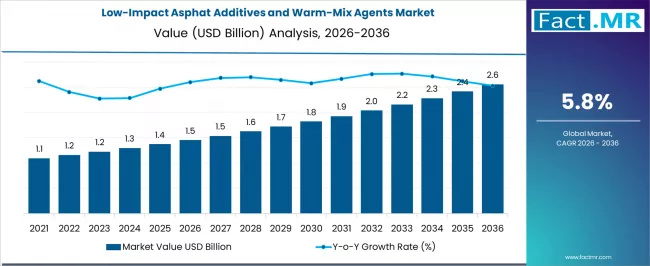
Defining trends involve the integration of multiple functionalities, such as compaction aid, moisture resistance, and recycling compatibility, into single additive systems to simplify green paving operations. Innovation is rapidly advancing in high-performance bio-based rejuvenators and modifiers derived from lignin and tall oils. The synchronization of these additives with lower plant mixing temperatures is critical for reducing energy consumption, emissions, and improving worker conditions, all while maintaining or enhancing pavement performance.
Regulatory and owner-agency specifications mandating lower greenhouse gas emissions from construction projects and promoting the use of recycled asphalt pavement (RAP) are the primary market catalysts. Warm-mix technologies are increasingly a prerequisite for qualifying for infrastructure bids and achieving sustainability certifications, making these additives essential for market access.
Low-Impact Asphalt Additives and Warm-Mix Agents Market
| Metric | Value |
|---|---|
| Market Value (2026) | USD 1.46 Billion |
| Market Forecast Value (2036) | USD 2.56 Billion |
| Forecast CAGR (2026-2036) | 5.8% |
Category
| Category | Segments |
|---|---|
| Additive Type | Organic wax WMA additives (Fischer–Tropsch, bio-waxes), Chemical WMA additives (surfactants, emulsifiers), Bio-based rejuvenators (tall oils, lignin blends), Polymer modifiers (low-temperature performance enhancers), Anti-strip & adhesion promoters (low-impact formulations), Recycled asphalt compatibility enhancers |
| Application | Road construction, Urban roads & municipal resurfacing, Airport pavements, Industrial/commercial pavements, Low-temperature paving & night operations, Rural road development |
| Material Function | Viscosity reduction for warm-mix asphalt, Compaction improvement & energy savings, Moisture damage mitigation (anti-strip), Durability & cracking resistance, Workability & extended hauling flexibility |
| End User | Road construction contractors, Municipal & highway agencies, Asphalt mix producers, Airport authorities, Industrial/real-estate developers |
| Region | North America, Latin America, Western Europe, Eastern Europe, East Asia, South Asia & Pacific, MEA |
Segmental Analysis
By Additive Type, Which Technology Provides a Direct Physical Mechanism for Temperature Reduction?
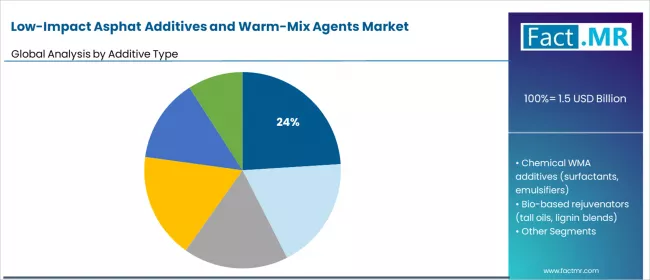
Organic wax WMA additives (Fischer–Tropsch, bio-waxes) lead the segment with a 24% share. This dominance is due to their well-understood mechanism of action: these waxes melt at high temperatures to lubricate the mix during production and compaction, then solidify upon cooling, potentially enhancing stiffness. They offer a reliable, often plant-injected solution for achieving the significant temperature reductions (20-40°C) required for warm-mix asphalt, balancing performance with ease of use.
By Application, Which Sector Represents the Core Volume Driver for Infrastructure Development?
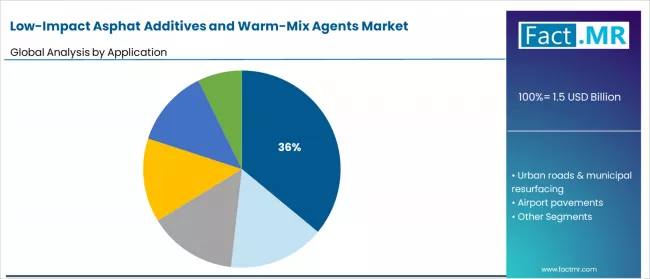
Road construction commands the largest application share at 36%. This encompasses new highway builds, expansions, and major rehabilitations, which consume the highest volumes of asphalt mix. The scale of these projects maximizes the environmental and economic benefits of warm-mix technologies including fuel savings, lower emissions, and the ability to haul mix longer distances—making it the primary application for low-impact additives.
By Material Function, What is the Foundational Engineering Principle of Warm-Mix Asphalt?

Viscosity reduction for warm-mix asphalt is the leading material function at 32.00%. This represents the core technological goal: to lower the viscosity of the asphalt binder at given temperatures, enabling adequate coating of aggregates and workability for compaction at significantly lower production temperatures than traditional hot-mix asphalt. Achieving this function is the direct enabler of all subsequent environmental and operational benefits.
By End User, Who is the Direct Specifier and Applier on Most Major Projects?
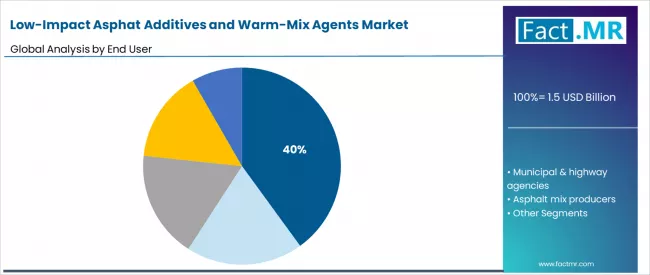
Road construction contractors are the dominant end user at 40.0%. While agencies specify the use of warm-mix asphalt, contractors are responsible for selecting the specific additive technology and methodology to meet the project specs efficiently. Their choice is driven by the additive's impact on workability, compaction window, fuel costs, and ultimately, the long-term performance and durability of the paved surface for which they often hold warranties.
What are the Drivers, Restraints, and Key Trends of the Low-Impact Asphalt Additives and Warm-Mix Agents Market?
Market growth is driven by stringent environmental regulations targeting reduction of volatile organic compounds (VOCs) and greenhouse gases from asphalt plants. Government infrastructure spending with "green" procurement policies mandates or incentivizes low-emission techniques. The economic imperative for contractors to reduce fuel costs and increase plant production efficiency further propels adoption. Growing use of high RAP content also requires compatibility enhancers that often dovetail with warm-mix technologies.
A significant restraint is the higher upfront cost of additives compared to standard hot-mix asphalt, requiring clear demonstration of lifecycle value. Perceived or real trade-offs in performance, particularly in moisture susceptibility or long-term durability in some early formulations, created hesitation. Variability in additive performance across different binder sources and aggregate types necessitates thorough mix design testing, potentially slowing adoption.
Key trends include the development of multi-functional "hybrid" additives that combine warm-mix, anti-strip, and recycling compatibility in one product. There is a strong shift towards bio-based and renewable raw materials for additives (e.g., plant-based waxes, lignin). The market is also seeing tighter integration of additive systems with asphalt plant control software for precise dosing and the growing use of warm-mix for night-time and low-temperature seasonal paving to extend the construction window.
Analysis of the Low-Impact Asphalt Additives and Warm-Mix Agents Market by Key Countries
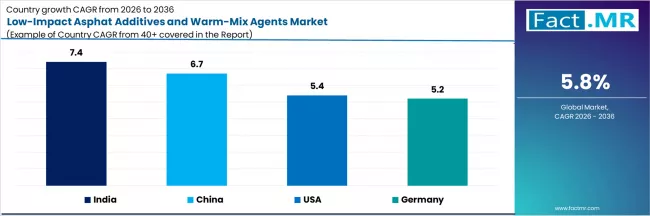
| Country | CAGR (2026-2036) |
|---|---|
| India | 7.40% |
| China | 6.70% |
| USA | 5.40% |
| Germany | 5.20% |
| Brazil | 5.00% |
How does India's Massive Infrastructure Push and Urbanization Drive High Growth?
India leads with a 7.40% CAGR, driven by an unprecedented national focus on road and highway construction such as Bharatmala Pariyojana and urban development. The need to build resilient infrastructure quickly, while managing costs and environmental impact in dense urban areas, makes warm-mix asphalt technologies highly attractive. Government mandates promoting sustainable construction practices in new projects are accelerating adoption.
Why is China's Sustainable Infrastructure Development and Emission Control a Key Driver?
China's 6.70% growth is anchored in its "Beautiful China" and "Blue Sky" initiatives, which enforce strict air pollution control around construction activities. The widespread adoption of warm-mix asphalt is a direct response to these regulations. Furthermore, China's vast network of high-speed roads and airports undergoing maintenance and expansion provides a massive application base for low-impact, durable paving solutions.
What Role does the USA's Mature but Innovation-Driven Road Network Play?
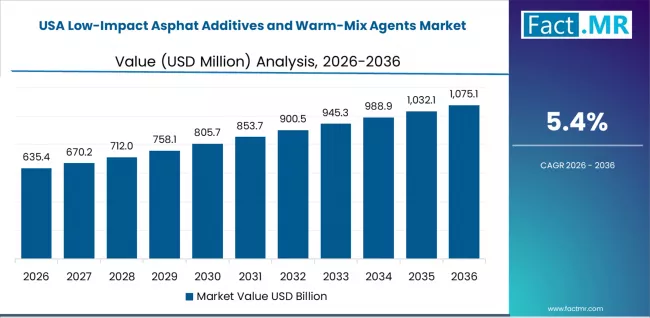
The USA's 5.40% growth is sustained by a large, aging infrastructure requiring continuous rehabilitation. Warm-mix asphalt has become a well-established standard, driven by both state DOT specifications and the economic benefits for contractors. The focus is on next-generation additives that facilitate higher RAP usage, improve compaction in challenging conditions, and further reduce energy consumption, supported by robust industry research (e.g., NAPA, FHWA).
How does Germany's Engineering Leadership and Green Deal Compliance Influence the Market?
Germany's 5.20% growth reflects its engineering precision and leadership in meeting EU Green Deal objectives. German specifications for road construction are among the most stringent, requiring high performance and environmental compliance. The adoption of advanced warm-mix technologies, often combined with high RAP rates, is standard practice to achieve durability while minimizing the carbon footprint of infrastructure projects.
What Factors Underpin Brazil's Focus on Cost-Effective and Climate-Adaptive Paving?
Brazil's 5.00% growth is motivated by the need for cost-effective road construction and maintenance across vast geographic and climatic zones. Warm-mix technologies allow for longer hauling distances—critical in a large country—and enable paving in cooler, humid regions like the south. The use of bio-based additives derived from local feedstocks (e.g., sugarcane, pine) aligns with both economic and sustainability goals.
Competitive Landscape of the Low-Impact Asphalt Additives and Warm-Mix Agents Market
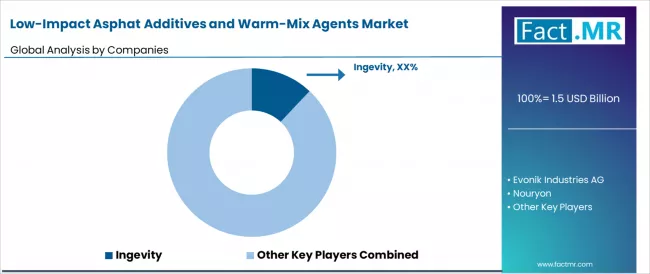
The competitive landscape is characterized by competition between specialty chemical formulators and large diversified chemical companies. Specialty players like Ingevity and Nouryon compete with deep expertise in specific chemistries like tall oil derivatives and surfactants, offering targeted solutions for warm-mix, rejuvenation, and adhesion.
Global chemical giants like Evonik Industries AG, Dow lnc., and Arkema leverage their broad polymer and chemical synthesis capabilities to develop advanced, multi-functional modifier packages. Cargill represents the growing segment of bio-based innovators. Competition centers on providing proven field performance data, technical support for mix design, and the ability to offer a system of compatible additives that address the full spectrum of paving challenges from recycling to durability.
Key Players in the Low-Impact Asphalt Additives and Warm-Mix Agents Market
- Ingevity
- Evonik Industries AG
- Nouryon
- Dow Inc.
- Arkema
- Cargill (bio-based additives)
Scope of Report
| Items | Values |
|---|---|
| Quantitative Units | USD Billion |
| Additive Type | Organic wax WMA additives (Fischer–Tropsch, bio-waxes), Chemical WMA additives (surfactants, emulsifiers), Bio-based rejuvenators (tall oils, lignin blends), Polymer modifiers (low-temperature performance enhancers), Anti-strip & adhesion promoters (low-impact formulations), Recycled asphalt compatibility enhancers |
| Application | Road construction, Urban roads & municipal resurfacing, Airport pavements, Industrial/commercial pavements, Low-temperature paving & night operations, Rural road development |
| Material Function | Viscosity reduction for warm-mix asphalt, Compaction improvement & energy savings, Moisture damage mitigation (anti-strip), Durability & cracking resistance, Workability & extended hauling flexibility |
| End User | Road construction contractors, Municipal & highway agencies, Asphalt mix producers, Airport authorities, Industrial/real-estate developers |
| Key Countries | India, China, USA, Germany, Brazil |
| Key Companies | Ingevity, Evonik, Nouryon, Dow Chemical, Arkema, Cargill (bio-based additives) |
| Additional Analysis | Analysis of temperature reduction efficacy, impact on binder PG grade, compatibility with various RAP percentages, emissions reduction quantification, and lifecycle cost analysis versus traditional hot-mix asphalt. |
Low-Impact Asphalt Additives and Warm-Mix Agents Market by Segments
-
Additive Type :
- Organic wax WMA additives (Fischer–Tropsch, bio-waxes)
- Chemical WMA additives (surfactants, emulsifiers)
- Bio-based rejuvenators (tall oils, lignin blends)
- Polymer modifiers (low-temperature performance enhancers)
- Anti-strip & adhesion promoters (low-impact formulations)
- Recycled asphalt compatibility enhancers
-
Application :
- Road Construction
- Urban Roads & Municipal Resurfacing
- Airport Pavements
- Industrial and Commercial Pavements
- Low-temperature Paving & Night Operations
- Rural Road Development
-
Material Function :
- Viscosity reduction for warm-mix asphalt
- Compaction improvement & energy savings
- Moisture damage mitigation (anti-strip)
- Durability & cracking resistance
- Workability & extended hauling flexibility
-
End User :
- Road construction contractors
- Municipal & highway agencies
- Asphalt mix producers
- Airport authorities
- Industrial and real-estate developers
-
Region :
-
North America
- USA
- Canada
-
Latin America
- Brazil
- Mexico
- Rest of Latin America
-
Western Europe
- Germany
- France
- UK
- Italy
- Spain
- BENELUX
- Rest of Western Europe
-
Eastern Europe
- Russia
- Poland
- Rest of Eastern Europe
-
East Asia
- China
- Japan
- South Korea
- Rest of East Asia
-
South Asia & Pacific
- India
- Indonesia
- Australia
- Rest of South Asia & Pacific
-
MEA
- GCC Countries
- South Africa
- Rest of MEA
-
Table of Content
- Executive Summary
- Global Market Outlook
- Demand to side Trends
- Supply to side Trends
- Technology Roadmap Analysis
- Analysis and Recommendations
- Market Overview
- Market Coverage / Taxonomy
- Market Definition / Scope / Limitations
- Market Background
- Market Dynamics
- Drivers
- Restraints
- Opportunity
- Trends
- Scenario Forecast
- Demand in Optimistic Scenario
- Demand in Likely Scenario
- Demand in Conservative Scenario
- Opportunity Map Analysis
- Product Life Cycle Analysis
- Supply Chain Analysis
- Investment Feasibility Matrix
- Value Chain Analysis
- PESTLE and Porter’s Analysis
- Regulatory Landscape
- Regional Parent Market Outlook
- Production and Consumption Statistics
- Import and Export Statistics
- Market Dynamics
- Global Market Analysis 2021 to 2025 and Forecast, 2026 to 2036
- Historical Market Size Value (USD Million) Analysis, 2021 to 2025
- Current and Future Market Size Value (USD Million) Projections, 2026 to 2036
- Y to o to Y Growth Trend Analysis
- Absolute $ Opportunity Analysis
- Global Market Pricing Analysis 2021 to 2025 and Forecast 2026 to 2036
- Global Market Analysis 2021 to 2025 and Forecast 2026 to 2036, By Additive Type
- Introduction / Key Findings
- Historical Market Size Value (USD Million) Analysis By Additive Type, 2021 to 2025
- Current and Future Market Size Value (USD Million) Analysis and Forecast By Additive Type, 2026 to 2036
- Organic wax WMA additives (Fischer–Tropsch, bio-waxes)
- Chemical WMA additives (surfactants, emulsifiers)
- Bio-based rejuvenators (tall oils, lignin blends)
- Polymer modifiers (low-temperature performance enhancers)
- Anti-strip & adhesion promoters (low-impact formulations)
- Recycled asphalt compatibility enhancers
- Organic wax WMA additives (Fischer–Tropsch, bio-waxes)
- Y to o to Y Growth Trend Analysis By Additive Type, 2021 to 2025
- Absolute $ Opportunity Analysis By Additive Type, 2026 to 2036
- Global Market Analysis 2021 to 2025 and Forecast 2026 to 2036, By Application
- Introduction / Key Findings
- Historical Market Size Value (USD Million) Analysis By Application, 2021 to 2025
- Current and Future Market Size Value (USD Million) Analysis and Forecast By Application, 2026 to 2036
- Road construction
- Urban roads & municipal resurfacing
- Airport pavements
- Industrial and commercial pavements
- Low-temperature paving & night operations
- Rural road development
- Road construction
- Y to o to Y Growth Trend Analysis By Application, 2021 to 2025
- Absolute $ Opportunity Analysis By Application, 2026 to 2036
- Global Market Analysis 2021 to 2025 and Forecast 2026 to 2036, By Material Function
- Introduction / Key Findings
- Historical Market Size Value (USD Million) Analysis By Material Function, 2021 to 2025
- Current and Future Market Size Value (USD Million) Analysis and Forecast By Material Function, 2026 to 2036
- Viscosity reduction for warm-mix asphalt
- Compaction improvement & energy savings
- Moisture damage mitigation (anti-strip)
- Durability & cracking resistance
- Workability & extended hauling flexibility
- Viscosity reduction for warm-mix asphalt
- Y to o to Y Growth Trend Analysis By Material Function, 2021 to 2025
- Absolute $ Opportunity Analysis By Material Function, 2026 to 2036
- Global Market Analysis 2021 to 2025 and Forecast 2026 to 2036, By End User
- Introduction / Key Findings
- Historical Market Size Value (USD Million) Analysis By End User, 2021 to 2025
- Current and Future Market Size Value (USD Million) Analysis and Forecast By End User, 2026 to 2036
- Road construction contractors
- Municipal & highway agencies
- Asphalt mix producers
- Airport authorities
- Industrial and real-estate developers
- Road construction contractors
- Y to o to Y Growth Trend Analysis By End User, 2021 to 2025
- Absolute $ Opportunity Analysis By End User, 2026 to 2036
- Global Market Analysis 2021 to 2025 and Forecast 2026 to 2036, By Region
- Introduction
- Historical Market Size Value (USD Million) Analysis By Region, 2021 to 2025
- Current Market Size Value (USD Million) Analysis and Forecast By Region, 2026 to 2036
- North America
- Latin America
- Western Europe
- Eastern Europe
- East Asia
- South Asia and Pacific
- Middle East & Africa
- Market Attractiveness Analysis By Region
- North America Market Analysis 2021 to 2025 and Forecast 2026 to 2036, By Country
- Historical Market Size Value (USD Million) Trend Analysis By Market Taxonomy, 2021 to 2025
- Market Size Value (USD Million) Forecast By Market Taxonomy, 2026 to 2036
- By Country
- USA
- Canada
- Mexico
- By Additive Type
- By Application
- By Material Function
- By End User
- By Country
- Market Attractiveness Analysis
- By Country
- By Additive Type
- By Application
- By Material Function
- By End User
- Key Takeaways
- Latin America Market Analysis 2021 to 2025 and Forecast 2026 to 2036, By Country
- Historical Market Size Value (USD Million) Trend Analysis By Market Taxonomy, 2021 to 2025
- Market Size Value (USD Million) Forecast By Market Taxonomy, 2026 to 2036
- By Country
- Brazil
- Chile
- Rest of Latin America
- By Additive Type
- By Application
- By Material Function
- By End User
- By Country
- Market Attractiveness Analysis
- By Country
- By Additive Type
- By Application
- By Material Function
- By End User
- Key Takeaways
- Western Europe Market Analysis 2021 to 2025 and Forecast 2026 to 2036, By Country
- Historical Market Size Value (USD Million) Trend Analysis By Market Taxonomy, 2021 to 2025
- Market Size Value (USD Million) Forecast By Market Taxonomy, 2026 to 2036
- By Country
- Germany
- UK
- Italy
- Spain
- France
- Nordic
- BENELUX
- Rest of Western Europe
- By Additive Type
- By Application
- By Material Function
- By End User
- By Country
- Market Attractiveness Analysis
- By Country
- By Additive Type
- By Application
- By Material Function
- By End User
- Key Takeaways
- Eastern Europe Market Analysis 2021 to 2025 and Forecast 2026 to 2036, By Country
- Historical Market Size Value (USD Million) Trend Analysis By Market Taxonomy, 2021 to 2025
- Market Size Value (USD Million) Forecast By Market Taxonomy, 2026 to 2036
- By Country
- Russia
- Poland
- Hungary
- Balkan & Baltic
- Rest of Eastern Europe
- By Additive Type
- By Application
- By Material Function
- By End User
- By Country
- Market Attractiveness Analysis
- By Country
- By Additive Type
- By Application
- By Material Function
- By End User
- Key Takeaways
- East Asia Market Analysis 2021 to 2025 and Forecast 2026 to 2036, By Country
- Historical Market Size Value (USD Million) Trend Analysis By Market Taxonomy, 2021 to 2025
- Market Size Value (USD Million) Forecast By Market Taxonomy, 2026 to 2036
- By Country
- China
- Japan
- South Korea
- By Additive Type
- By Application
- By Material Function
- By End User
- By Country
- Market Attractiveness Analysis
- By Country
- By Additive Type
- By Application
- By Material Function
- By End User
- Key Takeaways
- South Asia and Pacific Market Analysis 2021 to 2025 and Forecast 2026 to 2036, By Country
- Historical Market Size Value (USD Million) Trend Analysis By Market Taxonomy, 2021 to 2025
- Market Size Value (USD Million) Forecast By Market Taxonomy, 2026 to 2036
- By Country
- India
- ASEAN
- Australia & New Zealand
- Rest of South Asia and Pacific
- By Additive Type
- By Application
- By Material Function
- By End User
- By Country
- Market Attractiveness Analysis
- By Country
- By Additive Type
- By Application
- By Material Function
- By End User
- Key Takeaways
- Middle East & Africa Market Analysis 2021 to 2025 and Forecast 2026 to 2036, By Country
- Historical Market Size Value (USD Million) Trend Analysis By Market Taxonomy, 2021 to 2025
- Market Size Value (USD Million) Forecast By Market Taxonomy, 2026 to 2036
- By Country
- Kingdom of Saudi Arabia
- Other GCC Countries
- Turkiye
- South Africa
- Other African Union
- Rest of Middle East & Africa
- By Additive Type
- By Application
- By Material Function
- By End User
- By Country
- Market Attractiveness Analysis
- By Country
- By Additive Type
- By Application
- By Material Function
- By End User
- Key Takeaways
- Key Countries Market Analysis
- USA
- Pricing Analysis
- Market Share Analysis, 2025
- By Additive Type
- By Application
- By Material Function
- By End User
- Canada
- Pricing Analysis
- Market Share Analysis, 2025
- By Additive Type
- By Application
- By Material Function
- By End User
- Mexico
- Pricing Analysis
- Market Share Analysis, 2025
- By Additive Type
- By Application
- By Material Function
- By End User
- Brazil
- Pricing Analysis
- Market Share Analysis, 2025
- By Additive Type
- By Application
- By Material Function
- By End User
- Chile
- Pricing Analysis
- Market Share Analysis, 2025
- By Additive Type
- By Application
- By Material Function
- By End User
- Germany
- Pricing Analysis
- Market Share Analysis, 2025
- By Additive Type
- By Application
- By Material Function
- By End User
- UK
- Pricing Analysis
- Market Share Analysis, 2025
- By Additive Type
- By Application
- By Material Function
- By End User
- Italy
- Pricing Analysis
- Market Share Analysis, 2025
- By Additive Type
- By Application
- By Material Function
- By End User
- Spain
- Pricing Analysis
- Market Share Analysis, 2025
- By Additive Type
- By Application
- By Material Function
- By End User
- France
- Pricing Analysis
- Market Share Analysis, 2025
- By Additive Type
- By Application
- By Material Function
- By End User
- India
- Pricing Analysis
- Market Share Analysis, 2025
- By Additive Type
- By Application
- By Material Function
- By End User
- ASEAN
- Pricing Analysis
- Market Share Analysis, 2025
- By Additive Type
- By Application
- By Material Function
- By End User
- Australia & New Zealand
- Pricing Analysis
- Market Share Analysis, 2025
- By Additive Type
- By Application
- By Material Function
- By End User
- China
- Pricing Analysis
- Market Share Analysis, 2025
- By Additive Type
- By Application
- By Material Function
- By End User
- Japan
- Pricing Analysis
- Market Share Analysis, 2025
- By Additive Type
- By Application
- By Material Function
- By End User
- South Korea
- Pricing Analysis
- Market Share Analysis, 2025
- By Additive Type
- By Application
- By Material Function
- By End User
- Russia
- Pricing Analysis
- Market Share Analysis, 2025
- By Additive Type
- By Application
- By Material Function
- By End User
- Poland
- Pricing Analysis
- Market Share Analysis, 2025
- By Additive Type
- By Application
- By Material Function
- By End User
- Hungary
- Pricing Analysis
- Market Share Analysis, 2025
- By Additive Type
- By Application
- By Material Function
- By End User
- Kingdom of Saudi Arabia
- Pricing Analysis
- Market Share Analysis, 2025
- By Additive Type
- By Application
- By Material Function
- By End User
- Turkiye
- Pricing Analysis
- Market Share Analysis, 2025
- By Additive Type
- By Application
- By Material Function
- By End User
- South Africa
- Pricing Analysis
- Market Share Analysis, 2025
- By Additive Type
- By Application
- By Material Function
- By End User
- USA
- Market Structure Analysis
- Competition Dashboard
- Competition Benchmarking
- Market Share Analysis of Top Players
- By Regional
- By Additive Type
- By Application
- By Material Function
- By End User
- Competition Analysis
- Competition Deep Dive
- Ingevity
- Overview
- Product Portfolio
- Profitability by Market Segments (Product/Age /Sales Channel/Region)
- Sales Footprint
- Strategy Overview
- Marketing Strategy
- Product Strategy
- Channel Strategy
- Evonik Industries AG
- Nouryon
- Dow Inc.
- Arkema
- Cargill (bio-based additives)
- Ingevity
- Competition Deep Dive
- Assumptions & Acronyms Used
- Research Methodology
List Of Table
- Table 1: Global Market Value (USD Million) Forecast by Region, 2021 to 2036
- Table 2: Global Market Value (USD Million) Forecast by Additive Type, 2021 to 2036
- Table 3: Global Market Value (USD Million) Forecast by Application, 2021 to 2036
- Table 4: Global Market Value (USD Million) Forecast by Material Function, 2021 to 2036
- Table 5: Global Market Value (USD Million) Forecast by End User, 2021 to 2036
- Table 6: North America Market Value (USD Million) Forecast by Country, 2021 to 2036
- Table 7: North America Market Value (USD Million) Forecast by Additive Type, 2021 to 2036
- Table 8: North America Market Value (USD Million) Forecast by Application, 2021 to 2036
- Table 9: North America Market Value (USD Million) Forecast by Material Function, 2021 to 2036
- Table 10: North America Market Value (USD Million) Forecast by End User, 2021 to 2036
- Table 11: Latin America Market Value (USD Million) Forecast by Country, 2021 to 2036
- Table 12: Latin America Market Value (USD Million) Forecast by Additive Type, 2021 to 2036
- Table 13: Latin America Market Value (USD Million) Forecast by Application, 2021 to 2036
- Table 14: Latin America Market Value (USD Million) Forecast by Material Function, 2021 to 2036
- Table 15: Latin America Market Value (USD Million) Forecast by End User, 2021 to 2036
- Table 16: Western Europe Market Value (USD Million) Forecast by Country, 2021 to 2036
- Table 17: Western Europe Market Value (USD Million) Forecast by Additive Type, 2021 to 2036
- Table 18: Western Europe Market Value (USD Million) Forecast by Application, 2021 to 2036
- Table 19: Western Europe Market Value (USD Million) Forecast by Material Function, 2021 to 2036
- Table 20: Western Europe Market Value (USD Million) Forecast by End User, 2021 to 2036
- Table 21: Eastern Europe Market Value (USD Million) Forecast by Country, 2021 to 2036
- Table 22: Eastern Europe Market Value (USD Million) Forecast by Additive Type, 2021 to 2036
- Table 23: Eastern Europe Market Value (USD Million) Forecast by Application, 2021 to 2036
- Table 24: Eastern Europe Market Value (USD Million) Forecast by Material Function, 2021 to 2036
- Table 25: Eastern Europe Market Value (USD Million) Forecast by End User, 2021 to 2036
- Table 26: East Asia Market Value (USD Million) Forecast by Country, 2021 to 2036
- Table 27: East Asia Market Value (USD Million) Forecast by Additive Type, 2021 to 2036
- Table 28: East Asia Market Value (USD Million) Forecast by Application, 2021 to 2036
- Table 29: East Asia Market Value (USD Million) Forecast by Material Function, 2021 to 2036
- Table 30: East Asia Market Value (USD Million) Forecast by End User, 2021 to 2036
- Table 31: South Asia and Pacific Market Value (USD Million) Forecast by Country, 2021 to 2036
- Table 32: South Asia and Pacific Market Value (USD Million) Forecast by Additive Type, 2021 to 2036
- Table 33: South Asia and Pacific Market Value (USD Million) Forecast by Application, 2021 to 2036
- Table 34: South Asia and Pacific Market Value (USD Million) Forecast by Material Function, 2021 to 2036
- Table 35: South Asia and Pacific Market Value (USD Million) Forecast by End User, 2021 to 2036
- Table 36: Middle East & Africa Market Value (USD Million) Forecast by Country, 2021 to 2036
- Table 37: Middle East & Africa Market Value (USD Million) Forecast by Additive Type, 2021 to 2036
- Table 38: Middle East & Africa Market Value (USD Million) Forecast by Application, 2021 to 2036
- Table 39: Middle East & Africa Market Value (USD Million) Forecast by Material Function, 2021 to 2036
- Table 40: Middle East & Africa Market Value (USD Million) Forecast by End User, 2021 to 2036
List Of Figures
- Figure 1: Global Market Pricing Analysis
- Figure 2: Global Market Value (USD Million) Forecast 2021 to 2036
- Figure 3: Global Market Value Share and BPS Analysis by Additive Type, 2026 and 2036
- Figure 4: Global Market Y to o to Y Growth Comparison by Additive Type, 2026 to 2036
- Figure 5: Global Market Attractiveness Analysis by Additive Type
- Figure 6: Global Market Value Share and BPS Analysis by Application, 2026 and 2036
- Figure 7: Global Market Y to o to Y Growth Comparison by Application, 2026 to 2036
- Figure 8: Global Market Attractiveness Analysis by Application
- Figure 9: Global Market Value Share and BPS Analysis by Material Function, 2026 and 2036
- Figure 10: Global Market Y to o to Y Growth Comparison by Material Function, 2026 to 2036
- Figure 11: Global Market Attractiveness Analysis by Material Function
- Figure 12: Global Market Value Share and BPS Analysis by End User, 2026 and 2036
- Figure 13: Global Market Y to o to Y Growth Comparison by End User, 2026 to 2036
- Figure 14: Global Market Attractiveness Analysis by End User
- Figure 15: Global Market Value (USD Million) Share and BPS Analysis by Region, 2026 and 2036
- Figure 16: Global Market Y to o to Y Growth Comparison by Region, 2026 to 2036
- Figure 17: Global Market Attractiveness Analysis by Region
- Figure 18: North America Market Incremental Dollar Opportunity, 2026 to 2036
- Figure 19: Latin America Market Incremental Dollar Opportunity, 2026 to 2036
- Figure 20: Western Europe Market Incremental Dollar Opportunity, 2026 to 2036
- Figure 21: Eastern Europe Market Incremental Dollar Opportunity, 2026 to 2036
- Figure 22: East Asia Market Incremental Dollar Opportunity, 2026 to 2036
- Figure 23: South Asia and Pacific Market Incremental Dollar Opportunity, 2026 to 2036
- Figure 24: Middle East & Africa Market Incremental Dollar Opportunity, 2026 to 2036
- Figure 25: North America Market Value Share and BPS Analysis by Country, 2026 and 2036
- Figure 26: North America Market Value Share and BPS Analysis by Additive Type, 2026 and 2036
- Figure 27: North America Market Y to o to Y Growth Comparison by Additive Type, 2026 to 2036
- Figure 28: North America Market Attractiveness Analysis by Additive Type
- Figure 29: North America Market Value Share and BPS Analysis by Application, 2026 and 2036
- Figure 30: North America Market Y to o to Y Growth Comparison by Application, 2026 to 2036
- Figure 31: North America Market Attractiveness Analysis by Application
- Figure 32: North America Market Value Share and BPS Analysis by Material Function, 2026 and 2036
- Figure 33: North America Market Y to o to Y Growth Comparison by Material Function, 2026 to 2036
- Figure 34: North America Market Attractiveness Analysis by Material Function
- Figure 35: North America Market Value Share and BPS Analysis by End User, 2026 and 2036
- Figure 36: North America Market Y to o to Y Growth Comparison by End User, 2026 to 2036
- Figure 37: North America Market Attractiveness Analysis by End User
- Figure 38: Latin America Market Value Share and BPS Analysis by Country, 2026 and 2036
- Figure 39: Latin America Market Value Share and BPS Analysis by Additive Type, 2026 and 2036
- Figure 40: Latin America Market Y to o to Y Growth Comparison by Additive Type, 2026 to 2036
- Figure 41: Latin America Market Attractiveness Analysis by Additive Type
- Figure 42: Latin America Market Value Share and BPS Analysis by Application, 2026 and 2036
- Figure 43: Latin America Market Y to o to Y Growth Comparison by Application, 2026 to 2036
- Figure 44: Latin America Market Attractiveness Analysis by Application
- Figure 45: Latin America Market Value Share and BPS Analysis by Material Function, 2026 and 2036
- Figure 46: Latin America Market Y to o to Y Growth Comparison by Material Function, 2026 to 2036
- Figure 47: Latin America Market Attractiveness Analysis by Material Function
- Figure 48: Latin America Market Value Share and BPS Analysis by End User, 2026 and 2036
- Figure 49: Latin America Market Y to o to Y Growth Comparison by End User, 2026 to 2036
- Figure 50: Latin America Market Attractiveness Analysis by End User
- Figure 51: Western Europe Market Value Share and BPS Analysis by Country, 2026 and 2036
- Figure 52: Western Europe Market Value Share and BPS Analysis by Additive Type, 2026 and 2036
- Figure 53: Western Europe Market Y to o to Y Growth Comparison by Additive Type, 2026 to 2036
- Figure 54: Western Europe Market Attractiveness Analysis by Additive Type
- Figure 55: Western Europe Market Value Share and BPS Analysis by Application, 2026 and 2036
- Figure 56: Western Europe Market Y to o to Y Growth Comparison by Application, 2026 to 2036
- Figure 57: Western Europe Market Attractiveness Analysis by Application
- Figure 58: Western Europe Market Value Share and BPS Analysis by Material Function, 2026 and 2036
- Figure 59: Western Europe Market Y to o to Y Growth Comparison by Material Function, 2026 to 2036
- Figure 60: Western Europe Market Attractiveness Analysis by Material Function
- Figure 61: Western Europe Market Value Share and BPS Analysis by End User, 2026 and 2036
- Figure 62: Western Europe Market Y to o to Y Growth Comparison by End User, 2026 to 2036
- Figure 63: Western Europe Market Attractiveness Analysis by End User
- Figure 64: Eastern Europe Market Value Share and BPS Analysis by Country, 2026 and 2036
- Figure 65: Eastern Europe Market Value Share and BPS Analysis by Additive Type, 2026 and 2036
- Figure 66: Eastern Europe Market Y to o to Y Growth Comparison by Additive Type, 2026 to 2036
- Figure 67: Eastern Europe Market Attractiveness Analysis by Additive Type
- Figure 68: Eastern Europe Market Value Share and BPS Analysis by Application, 2026 and 2036
- Figure 69: Eastern Europe Market Y to o to Y Growth Comparison by Application, 2026 to 2036
- Figure 70: Eastern Europe Market Attractiveness Analysis by Application
- Figure 71: Eastern Europe Market Value Share and BPS Analysis by Material Function, 2026 and 2036
- Figure 72: Eastern Europe Market Y to o to Y Growth Comparison by Material Function, 2026 to 2036
- Figure 73: Eastern Europe Market Attractiveness Analysis by Material Function
- Figure 74: Eastern Europe Market Value Share and BPS Analysis by End User, 2026 and 2036
- Figure 75: Eastern Europe Market Y to o to Y Growth Comparison by End User, 2026 to 2036
- Figure 76: Eastern Europe Market Attractiveness Analysis by End User
- Figure 77: East Asia Market Value Share and BPS Analysis by Country, 2026 and 2036
- Figure 78: East Asia Market Value Share and BPS Analysis by Additive Type, 2026 and 2036
- Figure 79: East Asia Market Y to o to Y Growth Comparison by Additive Type, 2026 to 2036
- Figure 80: East Asia Market Attractiveness Analysis by Additive Type
- Figure 81: East Asia Market Value Share and BPS Analysis by Application, 2026 and 2036
- Figure 82: East Asia Market Y to o to Y Growth Comparison by Application, 2026 to 2036
- Figure 83: East Asia Market Attractiveness Analysis by Application
- Figure 84: East Asia Market Value Share and BPS Analysis by Material Function, 2026 and 2036
- Figure 85: East Asia Market Y to o to Y Growth Comparison by Material Function, 2026 to 2036
- Figure 86: East Asia Market Attractiveness Analysis by Material Function
- Figure 87: East Asia Market Value Share and BPS Analysis by End User, 2026 and 2036
- Figure 88: East Asia Market Y to o to Y Growth Comparison by End User, 2026 to 2036
- Figure 89: East Asia Market Attractiveness Analysis by End User
- Figure 90: South Asia and Pacific Market Value Share and BPS Analysis by Country, 2026 and 2036
- Figure 91: South Asia and Pacific Market Value Share and BPS Analysis by Additive Type, 2026 and 2036
- Figure 92: South Asia and Pacific Market Y to o to Y Growth Comparison by Additive Type, 2026 to 2036
- Figure 93: South Asia and Pacific Market Attractiveness Analysis by Additive Type
- Figure 94: South Asia and Pacific Market Value Share and BPS Analysis by Application, 2026 and 2036
- Figure 95: South Asia and Pacific Market Y to o to Y Growth Comparison by Application, 2026 to 2036
- Figure 96: South Asia and Pacific Market Attractiveness Analysis by Application
- Figure 97: South Asia and Pacific Market Value Share and BPS Analysis by Material Function, 2026 and 2036
- Figure 98: South Asia and Pacific Market Y to o to Y Growth Comparison by Material Function, 2026 to 2036
- Figure 99: South Asia and Pacific Market Attractiveness Analysis by Material Function
- Figure 100: South Asia and Pacific Market Value Share and BPS Analysis by End User, 2026 and 2036
- Figure 101: South Asia and Pacific Market Y to o to Y Growth Comparison by End User, 2026 to 2036
- Figure 102: South Asia and Pacific Market Attractiveness Analysis by End User
- Figure 103: Middle East & Africa Market Value Share and BPS Analysis by Country, 2026 and 2036
- Figure 104: Middle East & Africa Market Value Share and BPS Analysis by Additive Type, 2026 and 2036
- Figure 105: Middle East & Africa Market Y to o to Y Growth Comparison by Additive Type, 2026 to 2036
- Figure 106: Middle East & Africa Market Attractiveness Analysis by Additive Type
- Figure 107: Middle East & Africa Market Value Share and BPS Analysis by Application, 2026 and 2036
- Figure 108: Middle East & Africa Market Y to o to Y Growth Comparison by Application, 2026 to 2036
- Figure 109: Middle East & Africa Market Attractiveness Analysis by Application
- Figure 110: Middle East & Africa Market Value Share and BPS Analysis by Material Function, 2026 and 2036
- Figure 111: Middle East & Africa Market Y to o to Y Growth Comparison by Material Function, 2026 to 2036
- Figure 112: Middle East & Africa Market Attractiveness Analysis by Material Function
- Figure 113: Middle East & Africa Market Value Share and BPS Analysis by End User, 2026 and 2036
- Figure 114: Middle East & Africa Market Y to o to Y Growth Comparison by End User, 2026 to 2036
- Figure 115: Middle East & Africa Market Attractiveness Analysis by End User
- Figure 116: Global Market - Tier Structure Analysis
- Figure 117: Global Market - Company Share Analysis
- FAQs -
How big is the low-impact asphat additives and warm-mix agents market in 2026?
The global low-impact asphat additives and warm-mix agents market is estimated to be valued at USD 1.5 billion in 2026.
What will be the size of low-impact asphat additives and warm-mix agents market in 2036?
The market size for the low-impact asphat additives and warm-mix agents market is projected to reach USD 2.6 billion by 2036.
How much will be the low-impact asphat additives and warm-mix agents market growth between 2026 and 2036?
The low-impact asphat additives and warm-mix agents market is expected to grow at a 5.8% CAGR between 2026 and 2036.
What are the key product types in the low-impact asphat additives and warm-mix agents market?
The key product types in low-impact asphat additives and warm-mix agents market are organic wax wma additives (fischer–tropsch, bio-waxes), chemical wma additives (surfactants, emulsifiers), bio-based rejuvenators (tall oils, lignin blends), polymer modifiers (low-temperature performance enhancers), anti-strip & adhesion promoters (low-impact formulations) and recycled asphalt compatibility enhancers.
Which application segment to contribute significant share in the low-impact asphat additives and warm-mix agents market in 2026?
In terms of application, road construction segment to command 36.0% share in the low-impact asphat additives and warm-mix agents market in 2026.