Low-Noise Anti-Squeak Additives Market (2026 - 2036)
Low-Noise Anti-Squeak Additives Market Size and Share Forecast Outlook 2026 to 2036
Core Findings
Low-Noise Anti-Squeak Additives Market Forecast Outlook 2026 to 2036
The low-noise anti-squeak additives market is projected to reach USD 459.5 million in 2026 and grow to USD 1,128.3 million by 2036, reflecting a CAGR of 9.4%.
Key Takeaways from Low-Noise Anti-Squeak Additives Market
- Low-Noise Anti-Squeak Additives Market Value (2026): USD 459.5 million
- Low-Noise Anti-Squeak Additives Market Forecast Value (2036): USD 1,128.3 million
- Low-Noise Anti-Squeak Additives Market Forecast CAGR 2026 to 2036: 9.4%
- Leading Segment in Low-Noise Anti-Squeak Additives Market: Automotive OEMs & Tier-1s (51%)
- Key Growth Region in Low-Noise Anti-Squeak Additives Market: China (10.9% CAGR)
- Key Players in Low-Noise Anti-Squeak Additives Market: The Lubrizol Corporation, Afton Chemical Corporation, BASF SE, Evonik Industries AG, Clariant AG, DuPont de Nemours, Inc., LANXESS AG, Croda International Plc, Dow Inc., Infineum International Limited
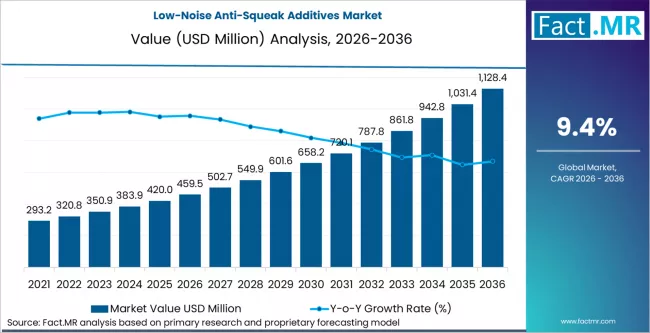
These figures signal increasing confidence among suppliers and a clear shift toward the adoption of high-performance additives across automotive and consumer goods sectors. The consistent growth rate indicates strong purchasing behavior, driven by a need for enhanced product quality and consumer satisfaction.
Manufacturers are likely to invest in innovative solutions that address noise reduction while maintaining cost-effectiveness. The market's long-term commitment is reflected in the rising demand for reliable, durable additives that contribute to product differentiation. For suppliers, these figures represent both an opportunity and a challenge to meet evolving consumer expectations while ensuring scalability. As demand for noise reduction in automotive parts and household appliances strengthens, stakeholders will need to remain adaptable to capitalize on the market's expanding potential.
Low-Noise Anti-Squeak Additives Market
| Metric | Value |
|---|---|
| Estimated Value in (2026E) | USD 459.5 million |
| Forecast Value in (2036F) | USD 1,128.3 million |
| Forecast CAGR 2026 to 2036 | 9.4% |
Category
| Category | Sub-Segment |
|---|---|
| By Application Area | Automotive interior trims; Seals & weatherstrips; Appliance & white goods; Industrial machinery components; Others |
| By Additive Type | Friction modifiers; Polymeric lubricants; Solid lubricant concentrates; Silicone lubricants; Others |
| By Substrate/System | Thermoplastics compounds; Elastomers & rubber; Coatings & tapes; Metal-to-metal lubricants; Foams & others |
| By Customer Type | Automotive OEMs & Tier-1s; Industrial OEMs; Appliance manufacturers; Aftermarket lubricants; Others |
| Region | North America; Europe; Asia Pacific; Latin America; Middle East & Africa |
Segmental Analysis
What is Driving the Dominance of Automotive OEMs & Tier-1s in the Low-Noise Anti-Squeak Additives Market?
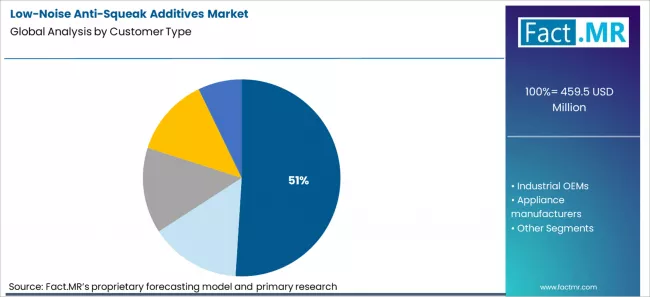
Automotive OEMs & Tier-1s hold 51% of the market share in 2026. This dominance is driven by the high demand for low-noise anti-squeak additives in the automotive industry, where maintaining a quiet and comfortable ride is crucial for both premium and mass-market vehicles. Automotive OEMs and Tier-1 suppliers are key customers in the market, as they require high-performance additives to enhance the quality of vehicle interiors and meet consumer expectations for low-noise, squeak-free experiences. The trend toward quieter cabin environments continues to drive the demand for these additives in new vehicle models.
What is the Role of Automotive Interior Trims in the Low-Noise Anti-Squeak Additives Market?
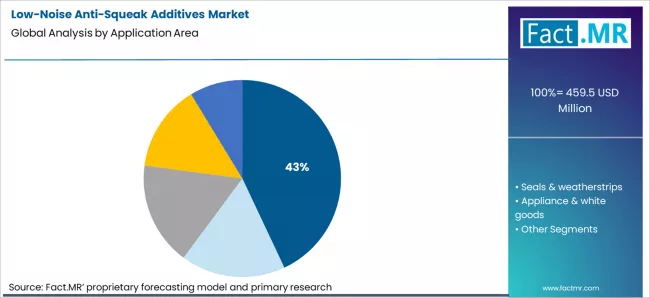
Automotive Interior Trims account for 43% of the market share in 2026. The application of low-noise anti-squeak additives in automotive interior trims, such as dashboards, door panels, and consoles, is essential for reducing friction between materials and preventing noise during vehicle operation. These additives help maintain the integrity of interior components by preventing wear and tear while improving overall driving comfort. As the automotive industry focuses on enhancing in-vehicle experiences, the demand for anti-squeak additives in interior trims continues to grow, especially in vehicles aiming to offer premium and quiet cabin environments.
What are the Drivers, Restraints, and Key Trends in the LowNoise AntiSqueak Additives Market?
Demand for low noise anti squeak additives is shaped by automotive OEM and tier 1 supplier requirements to reduce friction induced noise, vibration, and harshness in interior trim, seating, door panels, and moving interfaces. Engineers specify additives that improve lubricity, reduce stick slip behavior, and support consistent tactile performance across polymers, elastomers, and fiber composites used in vehicle cabins and consumer products. Procurement teams prioritize solutions that integrate with existing resin systems, deliver consistent dispersion and stability, and enable compliance with quality and durability standards. Higher additive costs and potential interactions with base materials constrain adoption in cost sensitive segments and require formulation validation. Variability in part geometries and service conditions affects additive selection and dosing strategies. Key trends include development of multifunctional additive systems that combine anti squeak with improved wear resistance and expansion of tailored solutions optimized for electrified and lightweight vehicle interiors where refined NVH performance is critical.
Analysis of the Low-Noise Anti-Squeak Additives Market by Key Country
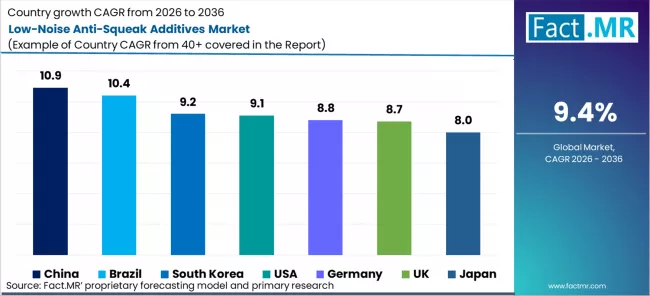
| Country | CAGR 2026 to 2036 |
|---|---|
| USA | 9.1% |
| Japan | 8.0% |
| South Korea | 9.2% |
| Germany | 8.8% |
| China | 10.9% |
| UK | 8.7% |
| Brazil | 10.4% |
The report covers an in-depth analysis of 40+ countries; top-performing countries are highlighted below.
What is Driving the Growth of the Low-Noise Anti-Squeak Additives Market in the USA?
The USA’s Low-Noise Anti-Squeak Additives market is projected to grow at 9.1%, driven by the rising demand for noise reduction solutions in the automotive, consumer goods, and industrial sectors. As manufacturers increasingly focus on enhancing product quality and improving customer experience, the demand for additives that reduce squeaks and enhance noise performance is on the rise. The automotive industry, in particular, continues to be a key driver, as stricter noise regulations and consumer expectations for quieter, high-performance vehicles fuel the demand for low-noise additives in plastic and rubber components.
How is the Low-Noise Anti-Squeak Additives Market Expanding in Japan?
Japan’s Low-Noise Anti-Squeak Additives market is growing at 8.0%, supported by the country’s strong automotive and electronics sectors. Japan’s automotive manufacturers are focused on improving vehicle comfort, and low-noise additives play a critical role in achieving this by reducing squeaks in automotive components such as interior parts and suspension systems. Furthermore, Japan’s emphasis on high-quality, innovative solutions in the consumer electronics and manufacturing sectors contributes to the steady adoption of these additives. As demand for quieter products grows, the low-noise anti-squeak additives market in Japan continues to see growth.
What is Fueling the Growth of the Low-Noise Anti-Squeak Additives Market in South Korea?
South Korea’s Low-Noise Anti-Squeak Additives market is projected to grow at 9.2%, driven by the country's robust automotive and manufacturing industries. As South Korea’s automotive sector strives to meet consumer demands for more comfortable, quieter vehicles, the demand for low-noise additives in automotive components increases. Additionally, the electronics and industrial sectors in South Korea, known for their advanced manufacturing capabilities, are increasingly adopting noise-reducing additives in consumer electronics and machinery. With a strong emphasis on quality and innovation, South Korea continues to be a major market for these additives in both automotive and non-automotive applications.
What is Contributing to the Growth of the Low-Noise Anti-Squeak Additives Market in Germany?
Germany’s Low-Noise Anti-Squeak Additives market is growing at 8.8%, fueled by the country’s high standards in automotive engineering and consumer goods manufacturing. As the automotive industry in Germany continues to prioritize comfort and luxury, the demand for low-noise additives to reduce squeaks and vibrations in interior components and suspension systems rises. Furthermore, Germany’s consumer goods and industrial sectors, focused on high-quality products, are increasingly incorporating these additives in various applications to improve product performance. The country’s strong emphasis on innovation, quality, and noise regulation further drives the growth of low-noise anti-squeak additives in the market.
How is the Low-Noise Anti-Squeak Additives Market Evolving in China?
China’s Low-Noise Anti-Squeak Additives market is expanding at 10.9%, driven by the country’s rapidly growing automotive, consumer electronics, and industrial sectors. As China becomes a major player in automotive production, the demand for noise-reducing solutions in vehicles is increasing. This growth is complemented by rising consumer expectations for quieter, more comfortable vehicles. Furthermore, China’s electronics industry, which is a global leader, is adopting low-noise additives in consumer electronics and industrial equipment to meet noise control requirements. The country’s large manufacturing base and increasing focus on product quality and consumer satisfaction contribute to the rapid growth of the low-noise anti-squeak additives market.
What is Driving the Growth of the Low-Noise Anti-Squeak Additives Market in the UK?
The UK’s Low-Noise Anti-Squeak Additives market is growing at 8.7%, driven by demand in the automotive and consumer goods sectors. As the automotive industry strives to provide a quieter driving experience, the use of low-noise additives to reduce squeaks in interior components, suspension systems, and other vehicle parts is on the rise. Additionally, the UK’s growing focus on sustainable manufacturing and product quality in consumer goods, electronics, and machinery boosts the adoption of these additives. With increasing regulatory requirements for noise reduction in various industries, the demand for low-noise anti-squeak additives continues to rise steadily in the UK.
What is Contributing to the Growth of the Low-Noise Anti-Squeak Additives Market in Brazil?
Brazil’s Low-Noise Anti-Squeak Additives market is expanding at 10.4%, driven by the growth of the automotive and consumer goods sectors. As the Brazilian automotive industry modernizes and focuses on improving vehicle comfort, the demand for additives that reduce noise and vibration in vehicles is increasing. Additionally, the growing manufacturing base in Brazil, particularly in electronics and industrial machinery, requires efficient noise-reduction solutions to meet both consumer and regulatory expectations. The country’s focus on improving the quality of consumer goods, combined with the rising demand for noise-free products, is propelling the growth of the low-noise anti-squeak additives market.
How Are Key Players Competing in the Low-Noise Anti-Squeak Additives Market?
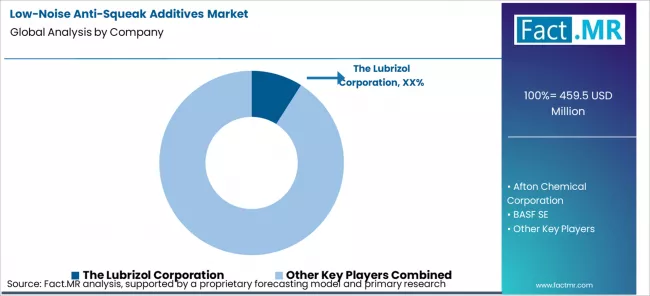
In the Low-Noise Anti-Squeak Additives market, leading companies such as The Lubrizol Corporation, Afton Chemical Corporation, and BASF SE are advancing their portfolios with high-performance additives aimed at reducing friction and noise in automotive and industrial applications. Evonik Industries AG and Clariant AG are focusing on environmentally friendly formulations, catering to the increasing demand for sustainable, low-impact products. DuPont de Nemours, Inc. and LANXESS AG are strengthening their positions with innovative solutions that improve durability and noise reduction, particularly in automotive interiors. Croda International Plc and Infineum International Limited are leveraging their chemical engineering expertise to provide efficient anti-squeak solutions for a variety of materials, while Dow Inc. focuses on performance enhancement in diverse sectors. The market sees a shift toward additives that not only reduce noise but also improve long-term material performance and environmental compatibility.
Recent Industry Developments
- Product Development / OEM Approval - ELIX Polymers anti-squeak ABS and PC/ABS grades approved by a premium Automotive OEM (Published Jun 20, 2023)ELIX Polymers announced specialty ABS and PC/ABS grades engineered to reduce squeak and rattle from plastic-to-plastic and plastic-to-trim contact in automotive interiors, with approvals secured from a German premium OEM for use in future vehicle programs.
- Technology Update - OSIXO® ANTI-SQUEAK series product brochure (Published May 2024)A formal product-series update outlining OSIXO anti-squeak oils, greases, suspensions, and coatings aimed at long-lasting prevention of friction-induced interior noises (NVH) in vehicles, with application guidance and product positioning.
- Technology / PFAS-Transition Enablement - LATI webinar on PTFE-free self-lubricating polymers (Published Dec 18, 2024)LATI published a technical webinar detailing PTFE-free alternatives (including UHMWPE-based approaches) for self-lubricating compounds designed to reduce friction and stick-slip, supporting quieter polymer-to-polymer and polymer-to-metal interfaces.
Key Players of the Low-Noise Anti-Squeak Additives Market
- The Lubrizol Corporation
- Afton Chemical Corporation
- BASF SE
- Evonik Industries AG
- Clariant AG
- DuPont de Nemours, Inc.
- LANXESS AG
- Croda International Plc
- Dow Inc.
- Infineum International Limited
Scope of the Report
| Items | Values |
|---|---|
| Quantitative Units (2026) | USD 459.5 Million |
| By Application Area | Automotive Interior Trims, Seals & Weatherstrips, Appliance & White Goods, Industrial Machinery Components, Others |
| By Additive Type | Friction Modifiers, Polymeric Lubricants, Solid Lubricant Concentrates, Silicone Lubricants, Others |
| By Substrate/System | Thermoplastics Compounds, Elastomers & Rubber, Coatings & Tapes, Metal-to-Metal Lubricants, Foams & Others |
| By Customer Type | Automotive OEMs & Tier-1s, Industrial OEMs, Appliance Manufacturers, Aftermarket Lubricants, Others |
| Regions Covered | North America, Europe, Asia Pacific, Latin America, Middle East & Africa |
| Countries Covered | United States, Canada, Mexico, Germany, United Kingdom, France, Japan, South Korea, China, India, Brazil, and other countries |
| Key Companies Profiled | The Lubrizol Corporation, Afton Chemical Corporation, BASF SE, Evonik Industries AG, Clariant AG, DuPont de Nemours, Inc., LANXESS AG, Croda International Plc, Dow Inc., Infineum International Limited |
| Additional Attributes | Dollar revenue by application area, additive type, substrate/system, customer type, and region; regional demand trends, competitive landscape, technological advancements in low-noise anti-squeak additives, operational performance optimization initiatives, and product development strategies |
Low-Noise Anti-Squeak Additives Market Key Segments
-
By Application Area :
- Automotive interior trims
- Seals & weatherstrips
- Appliance & white goods
- Industrial machinery components
- Others
-
By Additive Type :
- Friction modifiers
- Polymeric lubricants
- Solid lubricant concentrates
- Silicone lubricants
- Others
-
By Substrate/System :
- Thermoplastics compounds
- Elastomers & rubber
- Coatings & tapes
- Metal-to-metal lubricants
- Foams & others
-
By Customer Type :
- Automotive OEMs & Tier-1s
- Industrial OEMs
- Appliance manufacturers
- Aftermarket lubricants
- Others
-
Region :
- North America
- USA
- Canada
- Mexico
- Europe
- Germany
- UK
- France
- Italy
- Spain
- Nordic Countries
- BENELUX
- Rest of Europe
- Asia Pacific
- China
- Japan
- South Korea
- India
- Australia
- Rest of Asia Pacific
- Latin America
- Brazil
- Argentina
- Rest of Latin America
- Middle East and Africa
- Kingdom of Saudi Arabia
- United Arab Emirates
- South Africa
- Rest of Middle East and Africa
- Other Regions
- Oceania
- Central Asia
- Other Markets
- North America
Bibliographies
- International Organization for Standardization (ISO). (2023). ISO 362-3: Measurement of noise emitted by accelerating road vehicles - Engineering method. ISO.
- Society of Automotive Engineers (SAE International). (2023). SAE J2521: Squeak and Rattle Test Procedure for Interior Materials. SAE.
- U.S. National Highway Traffic Safety Administration (NHTSA). (2024). Vehicle interior noise, vibration, and harshness (NVH) research overview. U.S. Department of Transportation.
- European Commission Joint Research Centre (JRC). (2024). Materials performance and friction behavior in automotive polymer interfaces. European Commission.
- National Institute of Standards and Technology (NIST). (2023). Tribology and friction reduction in polymeric materials. NIST Engineering Laboratory.
Table of Content
- Executive Summary
- Global Market Outlook
- Demand to side Trends
- Supply to side Trends
- Technology Roadmap Analysis
- Analysis and Recommendations
- Market Overview
- Market Coverage / Taxonomy
- Market Definition / Scope / Limitations
- Research Methodology
- Chapter Orientation
- Analytical Lens and Working Hypotheses
- Market Structure, Signals, and Trend Drivers
- Benchmarking and Cross-market Comparability
- Market Sizing, Forecasting, and Opportunity Mapping
- Research Design and Evidence Framework
- Desk Research Programme (Secondary Evidence)
- Company Annual and Sustainability Reports
- Peer-reviewed Journals and Academic Literature
- Corporate Websites, Product Literature, and Technical Notes
- Earnings Decks and Investor Briefings
- Statutory Filings and Regulatory Disclosures
- Technical White Papers and Standards Notes
- Trade Journals, Industry Magazines, and Analyst Briefs
- Conference Proceedings, Webinars, and Seminar Materials
- Government Statistics Portals and Public Data Releases
- Press Releases and Reputable Media Coverage
- Specialist Newsletters and Curated Briefings
- Sector Databases and Reference Repositories
- FMR Internal Proprietary Databases and Historical Market Datasets
- Subscription Datasets and Paid Sources
- Social Channels, Communities, and Digital Listening Inputs
- Additional Desk Sources
- Expert Input and Fieldwork (Primary Evidence)
- Primary Modes
- Qualitative Interviews and Expert Elicitation
- Quantitative Surveys and Structured Data Capture
- Blended Approach
- Why Primary Evidence is Used
- Field Techniques
- Interviews
- Surveys
- Focus Groups
- Observational and In-context Research
- Social and Community Interactions
- Stakeholder Universe Engaged
- C-suite Leaders
- Board Members
- Presidents and Vice Presidents
- R&D and Innovation Heads
- Technical Specialists
- Domain Subject-matter Experts
- Scientists
- Physicians and Other Healthcare Professionals
- Governance, Ethics, and Data Stewardship
- Research Ethics
- Data Integrity and Handling
- Primary Modes
- Tooling, Models, and Reference Databases
- Desk Research Programme (Secondary Evidence)
- Data Engineering and Model Build
- Data Acquisition and Ingestion
- Cleaning, Normalisation, and Verification
- Synthesis, Triangulation, and Analysis
- Quality Assurance and Audit Trail
- Market Background
- Market Dynamics
- Drivers
- Restraints
- Opportunity
- Trends
- Scenario Forecast
- Demand in Optimistic Scenario
- Demand in Likely Scenario
- Demand in Conservative Scenario
- Opportunity Map Analysis
- Product Life Cycle Analysis
- Supply Chain Analysis
- Investment Feasibility Matrix
- Value Chain Analysis
- PESTLE and Porter’s Analysis
- Regulatory Landscape
- Regional Parent Market Outlook
- Production and Consumption Statistics
- Import and Export Statistics
- Market Dynamics
- Global Market Analysis 2021 to 2025 and Forecast, 2026 to 2036
- Historical Market Size Value (USD Million) Analysis, 2021 to 2025
- Current and Future Market Size Value (USD Million) Projections, 2026 to 2036
- Y to o to Y Growth Trend Analysis
- Absolute $ Opportunity Analysis
- Global Market Pricing Analysis 2021 to 2025 and Forecast 2026 to 2036
- Global Market Analysis 2021 to 2025 and Forecast 2026 to 2036, By Application Area
- Introduction / Key Findings
- Historical Market Size Value (USD Million) Analysis By Application Area, 2021 to 2025
- Current and Future Market Size Value (USD Million) Analysis and Forecast By Application Area, 2026 to 2036
- Automotive interior trims
- Seals & weatherstrips
- Appliance & white goods
- Industrial machinery components
- Others
- Automotive interior trims
- Y to o to Y Growth Trend Analysis By Application Area, 2021 to 2025
- Absolute $ Opportunity Analysis By Application Area, 2026 to 2036
- Global Market Analysis 2021 to 2025 and Forecast 2026 to 2036, By Customer Type
- Introduction / Key Findings
- Historical Market Size Value (USD Million) Analysis By Customer Type, 2021 to 2025
- Current and Future Market Size Value (USD Million) Analysis and Forecast By Customer Type, 2026 to 2036
- Automotive OEMs & Tier-1s
- Industrial OEMs
- Appliance manufacturers
- Aftermarket lubricants
- Others
- Automotive OEMs & Tier-1s
- Y to o to Y Growth Trend Analysis By Customer Type, 2021 to 2025
- Absolute $ Opportunity Analysis By Customer Type, 2026 to 2036
- Global Market Analysis 2021 to 2025 and Forecast 2026 to 2036, By Region
- Introduction
- Historical Market Size Value (USD Million) Analysis By Region, 2021 to 2025
- Current Market Size Value (USD Million) Analysis and Forecast By Region, 2026 to 2036
- North America
- Latin America
- Western Europe
- Eastern Europe
- East Asia
- South Asia and Pacific
- Middle East & Africa
- Market Attractiveness Analysis By Region
- North America Market Analysis 2021 to 2025 and Forecast 2026 to 2036, By Country
- Historical Market Size Value (USD Million) Trend Analysis By Market Taxonomy, 2021 to 2025
- Market Size Value (USD Million) Forecast By Market Taxonomy, 2026 to 2036
- By Country
- USA
- Canada
- Mexico
- By Application Area
- By Customer Type
- By Country
- Market Attractiveness Analysis
- By Country
- By Application Area
- By Customer Type
- Key Takeaways
- Latin America Market Analysis 2021 to 2025 and Forecast 2026 to 2036, By Country
- Historical Market Size Value (USD Million) Trend Analysis By Market Taxonomy, 2021 to 2025
- Market Size Value (USD Million) Forecast By Market Taxonomy, 2026 to 2036
- By Country
- Brazil
- Chile
- Rest of Latin America
- By Application Area
- By Customer Type
- By Country
- Market Attractiveness Analysis
- By Country
- By Application Area
- By Customer Type
- Key Takeaways
- Western Europe Market Analysis 2021 to 2025 and Forecast 2026 to 2036, By Country
- Historical Market Size Value (USD Million) Trend Analysis By Market Taxonomy, 2021 to 2025
- Market Size Value (USD Million) Forecast By Market Taxonomy, 2026 to 2036
- By Country
- Germany
- UK
- Italy
- Spain
- France
- Nordic
- BENELUX
- Rest of Western Europe
- By Application Area
- By Customer Type
- By Country
- Market Attractiveness Analysis
- By Country
- By Application Area
- By Customer Type
- Key Takeaways
- Eastern Europe Market Analysis 2021 to 2025 and Forecast 2026 to 2036, By Country
- Historical Market Size Value (USD Million) Trend Analysis By Market Taxonomy, 2021 to 2025
- Market Size Value (USD Million) Forecast By Market Taxonomy, 2026 to 2036
- By Country
- Russia
- Poland
- Hungary
- Balkan & Baltic
- Rest of Eastern Europe
- By Application Area
- By Customer Type
- By Country
- Market Attractiveness Analysis
- By Country
- By Application Area
- By Customer Type
- Key Takeaways
- East Asia Market Analysis 2021 to 2025 and Forecast 2026 to 2036, By Country
- Historical Market Size Value (USD Million) Trend Analysis By Market Taxonomy, 2021 to 2025
- Market Size Value (USD Million) Forecast By Market Taxonomy, 2026 to 2036
- By Country
- China
- Japan
- South Korea
- By Application Area
- By Customer Type
- By Country
- Market Attractiveness Analysis
- By Country
- By Application Area
- By Customer Type
- Key Takeaways
- South Asia and Pacific Market Analysis 2021 to 2025 and Forecast 2026 to 2036, By Country
- Historical Market Size Value (USD Million) Trend Analysis By Market Taxonomy, 2021 to 2025
- Market Size Value (USD Million) Forecast By Market Taxonomy, 2026 to 2036
- By Country
- India
- ASEAN
- Australia & New Zealand
- Rest of South Asia and Pacific
- By Application Area
- By Customer Type
- By Country
- Market Attractiveness Analysis
- By Country
- By Application Area
- By Customer Type
- Key Takeaways
- Middle East & Africa Market Analysis 2021 to 2025 and Forecast 2026 to 2036, By Country
- Historical Market Size Value (USD Million) Trend Analysis By Market Taxonomy, 2021 to 2025
- Market Size Value (USD Million) Forecast By Market Taxonomy, 2026 to 2036
- By Country
- Kingdom of Saudi Arabia
- Other GCC Countries
- Turkiye
- South Africa
- Other African Union
- Rest of Middle East & Africa
- By Application Area
- By Customer Type
- By Country
- Market Attractiveness Analysis
- By Country
- By Application Area
- By Customer Type
- Key Takeaways
- Key Countries Market Analysis
- USA
- Pricing Analysis
- Market Share Analysis, 2025
- By Application Area
- By Customer Type
- Canada
- Pricing Analysis
- Market Share Analysis, 2025
- By Application Area
- By Customer Type
- Mexico
- Pricing Analysis
- Market Share Analysis, 2025
- By Application Area
- By Customer Type
- Brazil
- Pricing Analysis
- Market Share Analysis, 2025
- By Application Area
- By Customer Type
- Chile
- Pricing Analysis
- Market Share Analysis, 2025
- By Application Area
- By Customer Type
- Germany
- Pricing Analysis
- Market Share Analysis, 2025
- By Application Area
- By Customer Type
- UK
- Pricing Analysis
- Market Share Analysis, 2025
- By Application Area
- By Customer Type
- Italy
- Pricing Analysis
- Market Share Analysis, 2025
- By Application Area
- By Customer Type
- Spain
- Pricing Analysis
- Market Share Analysis, 2025
- By Application Area
- By Customer Type
- France
- Pricing Analysis
- Market Share Analysis, 2025
- By Application Area
- By Customer Type
- India
- Pricing Analysis
- Market Share Analysis, 2025
- By Application Area
- By Customer Type
- ASEAN
- Pricing Analysis
- Market Share Analysis, 2025
- By Application Area
- By Customer Type
- Australia & New Zealand
- Pricing Analysis
- Market Share Analysis, 2025
- By Application Area
- By Customer Type
- China
- Pricing Analysis
- Market Share Analysis, 2025
- By Application Area
- By Customer Type
- Japan
- Pricing Analysis
- Market Share Analysis, 2025
- By Application Area
- By Customer Type
- South Korea
- Pricing Analysis
- Market Share Analysis, 2025
- By Application Area
- By Customer Type
- Russia
- Pricing Analysis
- Market Share Analysis, 2025
- By Application Area
- By Customer Type
- Poland
- Pricing Analysis
- Market Share Analysis, 2025
- By Application Area
- By Customer Type
- Hungary
- Pricing Analysis
- Market Share Analysis, 2025
- By Application Area
- By Customer Type
- Kingdom of Saudi Arabia
- Pricing Analysis
- Market Share Analysis, 2025
- By Application Area
- By Customer Type
- Turkiye
- Pricing Analysis
- Market Share Analysis, 2025
- By Application Area
- By Customer Type
- South Africa
- Pricing Analysis
- Market Share Analysis, 2025
- By Application Area
- By Customer Type
- USA
- Market Structure Analysis
- Competition Dashboard
- Competition Benchmarking
- Market Share Analysis of Top Players
- By Regional
- By Application Area
- By Customer Type
- Competition Analysis
- Competition Deep Dive
- The Lubrizol Corporation
- Overview
- Product Portfolio
- Profitability by Market Segments (Product/Age /Sales Channel/Region)
- Sales Footprint
- Strategy Overview
- Marketing Strategy
- Product Strategy
- Channel Strategy
- Afton Chemical Corporation
- BASF SE
- Evonik Industries AG
- Clariant AG
- DuPont de Nemours, Inc.
- LANXESS AG
- Croda International Plc
- Dow Inc.
- Infineum International Limited
- The Lubrizol Corporation
- Competition Deep Dive
- Assumptions & Acronyms Used
List Of Table
- Table 1: Global Market Value (USD Million) Forecast by Region, 2021 to 2036
- Table 2: Global Market Value (USD Million) Forecast by Application Area, 2021 to 2036
- Table 3: Global Market Value (USD Million) Forecast by Customer Type, 2021 to 2036
- Table 4: North America Market Value (USD Million) Forecast by Country, 2021 to 2036
- Table 5: North America Market Value (USD Million) Forecast by Application Area, 2021 to 2036
- Table 6: North America Market Value (USD Million) Forecast by Customer Type, 2021 to 2036
- Table 7: Latin America Market Value (USD Million) Forecast by Country, 2021 to 2036
- Table 8: Latin America Market Value (USD Million) Forecast by Application Area, 2021 to 2036
- Table 9: Latin America Market Value (USD Million) Forecast by Customer Type, 2021 to 2036
- Table 10: Western Europe Market Value (USD Million) Forecast by Country, 2021 to 2036
- Table 11: Western Europe Market Value (USD Million) Forecast by Application Area, 2021 to 2036
- Table 12: Western Europe Market Value (USD Million) Forecast by Customer Type, 2021 to 2036
- Table 13: Eastern Europe Market Value (USD Million) Forecast by Country, 2021 to 2036
- Table 14: Eastern Europe Market Value (USD Million) Forecast by Application Area, 2021 to 2036
- Table 15: Eastern Europe Market Value (USD Million) Forecast by Customer Type, 2021 to 2036
- Table 16: East Asia Market Value (USD Million) Forecast by Country, 2021 to 2036
- Table 17: East Asia Market Value (USD Million) Forecast by Application Area, 2021 to 2036
- Table 18: East Asia Market Value (USD Million) Forecast by Customer Type, 2021 to 2036
- Table 19: South Asia and Pacific Market Value (USD Million) Forecast by Country, 2021 to 2036
- Table 20: South Asia and Pacific Market Value (USD Million) Forecast by Application Area, 2021 to 2036
- Table 21: South Asia and Pacific Market Value (USD Million) Forecast by Customer Type, 2021 to 2036
- Table 22: Middle East & Africa Market Value (USD Million) Forecast by Country, 2021 to 2036
- Table 23: Middle East & Africa Market Value (USD Million) Forecast by Application Area, 2021 to 2036
- Table 24: Middle East & Africa Market Value (USD Million) Forecast by Customer Type, 2021 to 2036
List Of Figures
- Figure 1: Global Market Pricing Analysis
- Figure 2: Global Market Value (USD Million) Forecast 2021 to 2036
- Figure 3: Global Market Value Share and BPS Analysis by Application Area, 2026 and 2036
- Figure 4: Global Market Y to o to Y Growth Comparison by Application Area, 2026 to 2036
- Figure 5: Global Market Attractiveness Analysis by Application Area
- Figure 6: Global Market Value Share and BPS Analysis by Customer Type, 2026 and 2036
- Figure 7: Global Market Y to o to Y Growth Comparison by Customer Type, 2026 to 2036
- Figure 8: Global Market Attractiveness Analysis by Customer Type
- Figure 9: Global Market Value (USD Million) Share and BPS Analysis by Region, 2026 and 2036
- Figure 10: Global Market Y to o to Y Growth Comparison by Region, 2026 to 2036
- Figure 11: Global Market Attractiveness Analysis by Region
- Figure 12: North America Market Incremental Dollar Opportunity, 2026 to 2036
- Figure 13: Latin America Market Incremental Dollar Opportunity, 2026 to 2036
- Figure 14: Western Europe Market Incremental Dollar Opportunity, 2026 to 2036
- Figure 15: Eastern Europe Market Incremental Dollar Opportunity, 2026 to 2036
- Figure 16: East Asia Market Incremental Dollar Opportunity, 2026 to 2036
- Figure 17: South Asia and Pacific Market Incremental Dollar Opportunity, 2026 to 2036
- Figure 18: Middle East & Africa Market Incremental Dollar Opportunity, 2026 to 2036
- Figure 19: North America Market Value Share and BPS Analysis by Country, 2026 and 2036
- Figure 20: North America Market Value Share and BPS Analysis by Application Area, 2026 and 2036
- Figure 21: North America Market Y to o to Y Growth Comparison by Application Area, 2026 to 2036
- Figure 22: North America Market Attractiveness Analysis by Application Area
- Figure 23: North America Market Value Share and BPS Analysis by Customer Type, 2026 and 2036
- Figure 24: North America Market Y to o to Y Growth Comparison by Customer Type, 2026 to 2036
- Figure 25: North America Market Attractiveness Analysis by Customer Type
- Figure 26: Latin America Market Value Share and BPS Analysis by Country, 2026 and 2036
- Figure 27: Latin America Market Value Share and BPS Analysis by Application Area, 2026 and 2036
- Figure 28: Latin America Market Y to o to Y Growth Comparison by Application Area, 2026 to 2036
- Figure 29: Latin America Market Attractiveness Analysis by Application Area
- Figure 30: Latin America Market Value Share and BPS Analysis by Customer Type, 2026 and 2036
- Figure 31: Latin America Market Y to o to Y Growth Comparison by Customer Type, 2026 to 2036
- Figure 32: Latin America Market Attractiveness Analysis by Customer Type
- Figure 33: Western Europe Market Value Share and BPS Analysis by Country, 2026 and 2036
- Figure 34: Western Europe Market Value Share and BPS Analysis by Application Area, 2026 and 2036
- Figure 35: Western Europe Market Y to o to Y Growth Comparison by Application Area, 2026 to 2036
- Figure 36: Western Europe Market Attractiveness Analysis by Application Area
- Figure 37: Western Europe Market Value Share and BPS Analysis by Customer Type, 2026 and 2036
- Figure 38: Western Europe Market Y to o to Y Growth Comparison by Customer Type, 2026 to 2036
- Figure 39: Western Europe Market Attractiveness Analysis by Customer Type
- Figure 40: Eastern Europe Market Value Share and BPS Analysis by Country, 2026 and 2036
- Figure 41: Eastern Europe Market Value Share and BPS Analysis by Application Area, 2026 and 2036
- Figure 42: Eastern Europe Market Y to o to Y Growth Comparison by Application Area, 2026 to 2036
- Figure 43: Eastern Europe Market Attractiveness Analysis by Application Area
- Figure 44: Eastern Europe Market Value Share and BPS Analysis by Customer Type, 2026 and 2036
- Figure 45: Eastern Europe Market Y to o to Y Growth Comparison by Customer Type, 2026 to 2036
- Figure 46: Eastern Europe Market Attractiveness Analysis by Customer Type
- Figure 47: East Asia Market Value Share and BPS Analysis by Country, 2026 and 2036
- Figure 48: East Asia Market Value Share and BPS Analysis by Application Area, 2026 and 2036
- Figure 49: East Asia Market Y to o to Y Growth Comparison by Application Area, 2026 to 2036
- Figure 50: East Asia Market Attractiveness Analysis by Application Area
- Figure 51: East Asia Market Value Share and BPS Analysis by Customer Type, 2026 and 2036
- Figure 52: East Asia Market Y to o to Y Growth Comparison by Customer Type, 2026 to 2036
- Figure 53: East Asia Market Attractiveness Analysis by Customer Type
- Figure 54: South Asia and Pacific Market Value Share and BPS Analysis by Country, 2026 and 2036
- Figure 55: South Asia and Pacific Market Value Share and BPS Analysis by Application Area, 2026 and 2036
- Figure 56: South Asia and Pacific Market Y to o to Y Growth Comparison by Application Area, 2026 to 2036
- Figure 57: South Asia and Pacific Market Attractiveness Analysis by Application Area
- Figure 58: South Asia and Pacific Market Value Share and BPS Analysis by Customer Type, 2026 and 2036
- Figure 59: South Asia and Pacific Market Y to o to Y Growth Comparison by Customer Type, 2026 to 2036
- Figure 60: South Asia and Pacific Market Attractiveness Analysis by Customer Type
- Figure 61: Middle East & Africa Market Value Share and BPS Analysis by Country, 2026 and 2036
- Figure 62: Middle East & Africa Market Value Share and BPS Analysis by Application Area, 2026 and 2036
- Figure 63: Middle East & Africa Market Y to o to Y Growth Comparison by Application Area, 2026 to 2036
- Figure 64: Middle East & Africa Market Attractiveness Analysis by Application Area
- Figure 65: Middle East & Africa Market Value Share and BPS Analysis by Customer Type, 2026 and 2036
- Figure 66: Middle East & Africa Market Y to o to Y Growth Comparison by Customer Type, 2026 to 2036
- Figure 67: Middle East & Africa Market Attractiveness Analysis by Customer Type
- Figure 68: Global Market - Tier Structure Analysis
- Figure 69: Global Market - Company Share Analysis
- FAQs -
How big is the low-noise anti-squeak additives market in 2026?
The global low-noise anti-squeak additives market is estimated to be valued at USD 459.5 million in 2026.
What will be the size of low-noise anti-squeak additives market in 2036?
The market size for the low-noise anti-squeak additives market is projected to reach USD 1,128.4 million by 2036.
How much will be the low-noise anti-squeak additives market growth between 2026 and 2036?
The low-noise anti-squeak additives market is expected to grow at a 9.4% CAGR between 2026 and 2036.
What are the key product types in the low-noise anti-squeak additives market?
The key product types in low-noise anti-squeak additives market are automotive interior trims, seals & weatherstrips, appliance & white goods, industrial machinery components and others.
Which customer type segment to contribute significant share in the low-noise anti-squeak additives market in 2026?
In terms of customer type, automotive oems & tier-1s segment to command 51.0% share in the low-noise anti-squeak additives market in 2026.