- Market Value (2025): USD 342.8 Mn
- Estimated Value (2026): USD 375.0 Mn
- Forecast Value (2036): USD 920.9 Mn
- CAGR (2026-2036): 9.4%
What is the Low Outgassing Epoxies Market forecast to be worth by 2036?
USD 920.9 million by 2036 at 9.4% CAGR.
- The Low Outgassing Epoxies Market reached USD 342.8 million in 2025.
- Demand is projected to increase from USD 375.0 million in 2026 to USD 920.9 million by 2036.
- The market is forecast to record a 9.4% CAGR from 2026 to 2036.
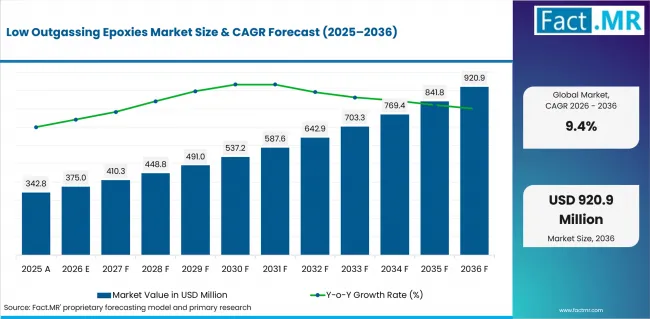
Low Outgassing Epoxies Market Value Analysis | Source: Fact.MR
What are the defining numbers behind Low Outgassing Epoxies Market growth?
An absolute opportunity of USD 545.0 million is expected between 2026 and 2036.
- Demand Drivers in the Market
- Spacecraft materials are screened for total mass loss and collected volatile condensable material under ASTM E595. NASA maintains an outgassing database for material selection.
- One-part heat cure reduces mixing variation and supports a controlled cure schedule in qualified assemblies.
- Thermally conductive moves heat while fixing components in place where convection is unavailable.
- Spacecraft/satellite creates recurring demand because volatile contamination can impair optics and sensitive surfaces.
- Vacuum stability also matters in analytical and semiconductor equipment, extending demand beyond space programmes.
- Key Segments Analyzed
- One-part heat cure accounts for 37.0% of Formulation in 2026 because the supplier controls resin-to-hardener ratio before delivery.
- Thermally conductive holds 42.0% of Filler/Property in 2026 because the adhesive creates a solid heat path where convection is limited.
- Spacecraft/satellite represents 39.0% of Application in 2026 because volatile contamination can impair optics and sensitive surfaces.
- Aerospace & defense captures 30.0% of End User in 2026 because users combine vacuum, cycling and reliability requirements.
- Analyst Opinion at Fact.MR
- Shambhu Nath Jha, Senior Consultant at Fact.MR, states, "Buyer decisions in the Low Outgassing Epoxies Market will centre on qualification evidence for spacecraft and vacuum users that cannot accept volatile contamination. Buyers will compare the 2026 segment leaders with qualification evidence and the operating cost of the full process. Suppliers that support application trials and preserve formulation or equipment consistency can move more quickly into repeat production."
- Strategic Implications
- Suppliers should document the process conditions that allow One-part heat cure to deliver repeatable performance.
- Customer trials should use the intended substrate, fluid path or process stream before commercial qualification.
- Regional technical support is important in USA and France because adoption depends on local production or infrastructure conditions.
- Commercial positioning should distinguish qualified application performance from general material or equipment capability.
- LORD Corporation was acquired by Parker Hannifin; the Resin Designs or LORD reference is treated under Parker ownership.
How does the Low Outgassing Epoxies Market break down by segment?
The market is segmented by Formulation, Filler/Property, Application and End User.
Why does One-part heat cure lead Formulation?
One-part heat cure is projected to account for a 36.6% share in 2026.
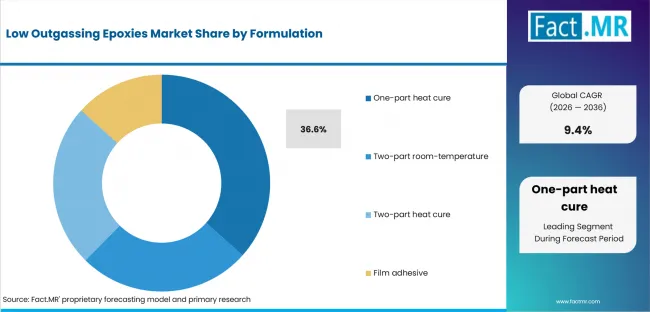
Low Outgassing Epoxies Market Analysis By Formulation | Source: Fact.MR
One-part systems reduce mixing variability because the resin and curing components are supplied in a predetermined formulation. This is useful in aerospace assembly, where repeatability between adhesive batches and bonded parts matters during qualification.
Elevated-temperature curing also gives manufacturers a defined process window for developing the required mechanical and thermal properties. Commercial one-part epoxies are available with NASA low-outgassing performance and controlled heat-cure schedules, showing how this format can combine processing consistency with vacuum-compatible material requirements.
Why does Thermally conductive lead Filler/Property?
Thermally conductive is projected to account for a 41.6% share in 2026.
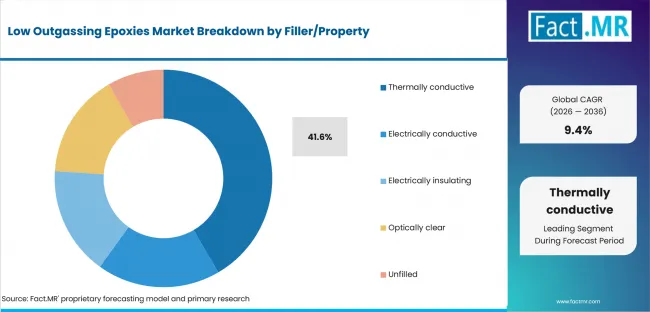
Low Outgassing Epoxies Market Analysis By Filler Property | Source: Fact.MR
Spacecraft electronics and other enclosed aerospace systems cannot rely on atmospheric convection to remove heat. Thermally conductive adhesives therefore provide a solid path between heat-generating components and adjoining structures while also performing the bonding or encapsulation function.
Material selection still depends on vacuum compatibility. NASA evaluates spacecraft materials through ASTM E595 measurements of total mass loss and collected volatile condensable material, so conductive fillers and the surrounding resin system must achieve thermal performance without introducing unacceptable outgassing.
Why does Spacecraft/satellite lead Application?
Spacecraft/satellite is projected to account for a 38.7% share in 2026.
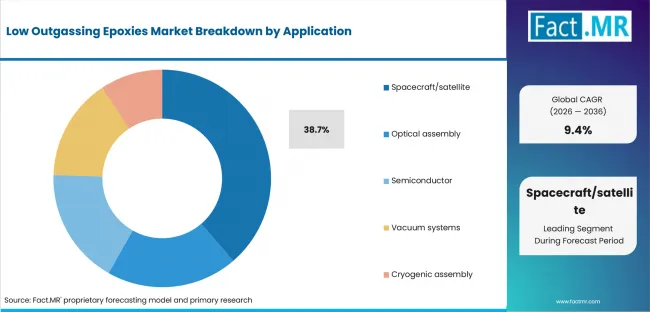
Low Outgassing Epoxies Market Analysis By Application | Source: Fact.MR
Spacecraft place unusually strict limits on volatile materials because molecules released in vacuum can migrate and condense on colder surfaces. ESA identifies outgassing as a contamination risk for delicate spacecraft surfaces such as optical lenses, while NASA maintains a dedicated database of materials tested under vacuum conditions.
This makes documented material performance part of the qualification process rather than an optional product characteristic. Adhesives used around instruments and electronic assemblies must therefore be selected for bonding performance alongside outgassing behaviour and resistance to the thermal cycling encountered in orbit.
Why does Aerospace & defense lead End User?
Aerospace & defense is projected to account for a 30.1% share in 2026.
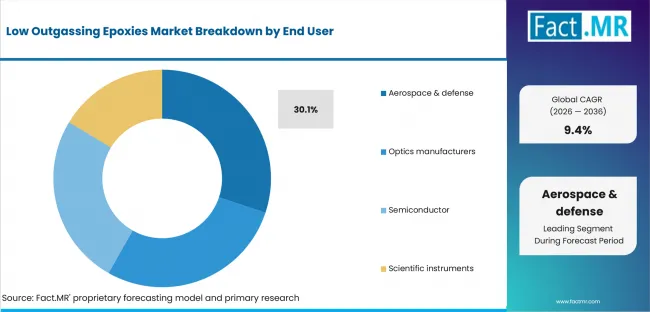
Low Outgassing Epoxies Market Analysis By End User | Source: Fact.MR
Aerospace and defense users qualify adhesive systems against several operating stresses before approving them for production. ESA notes that spacecraft materials are evaluated for effects including vacuum exposure and thermal cycling, where repeated temperature changes can induce stress and cracking.
These requirements favour specialist formulations with documented test history and controlled processing conditions. Once a material has passed the required vacuum, thermal and reliability assessments for a specific assembly, changing suppliers can trigger additional qualification work, supporting continued demand for established aerospace-grade adhesive systems.
What is accelerating Low Outgassing Epoxies Market adoption, and what is holding it back?
Drivers Impact Analysis
| Factor | (~) % Impact on CAGR | Geographic Relevance | Impact Timeline |
|---|---|---|---|
| Space-material qualification for low-outgassing performance | +2.5% | USA, France, Germany, Japan and UK | Short term (<= 2 years) |
| Controlled processing with one-part heat-cure epoxies | +2.1% | USA, France, Germany, Japan and UK | Medium term (2-4 years) |
| Thermal management in spacecraft and vacuum electronics | +1.5% | USA, Germany, France, Japan and UK | Long term (>= 4 years) |
Opportunity Impact Analysis
| Factor | (~) % Impact on CAGR | Geographic Relevance | Impact Timeline |
|---|---|---|---|
| Low-outgassing thermally conductive adhesive systems | +1.3% | USA, France, Germany, Japan and UK | Short term (<= 2 years) |
| Adhesives qualified for small-satellite production | +1.0% | USA, France, UK, Japan and Germany | Medium term (2-4 years) |
| Wider use of standardized outgassing test databases | +0.8% | Global | Long term (>= 4 years) |
Restraints Impact Analysis
| Factor | (~) % Impact on CAGR | Geographic Relevance | Impact Timeline |
|---|---|---|---|
| Long material and process qualification cycles | -1.2% | Global | Short term (<= 2 years) |
| Volatile contamination of optical and sensitive surfaces | -0.9% | Global | Medium term (2-4 years) |
| Limited tolerance for formulation changes after approval | -0.7% | Global | Long term (>= 4 years) |
NASA tests materials under ASTM E595 to measure total mass loss and collected volatile condensable material, while ESA uses dedicated thermal-vacuum outgassing screening for spacecraft materials. These requirements make low outgassing a global qualification issue rather than a restraint tied to one country.
Which countries are scaling the Low Outgassing Epoxies Market through 2036?
- USA: NASA maintains an outgassing database containing more than 13,000 material-test records and uses ASTM E595 data to assess suitability for spaceflight. This formal screening infrastructure supports specialist epoxies with documented TML and CVCM performance for satellites, instruments and spacecraft electronics.
- France: France 2030 is supporting satellite constellations and spacecraft components, including sensors and platforms, as part of its domestic space strategy. More satellite development increases qualification activity for adhesives used near electronics, optical hardware and structural interfaces where contamination control matters.
- Germany: Germany has dedicated thermal-vacuum qualification infrastructure for spacecraft hardware. DLR operates facilities for testing complete systems and a Micro-VCM test stand specifically for outgassing assessment under the ESA ECSS standard, creating a direct technical environment for qualifying low-outgassing adhesives.
- Japan: JAXA maintains its own spacecraft organic-material outgassing data programme based on methods derived from ASTM E595. This gives Japanese spacecraft developers an established framework for screening adhesives and other organic materials before use in flight hardware.
- UK: The UK Space Agency continues to support satellite manufacturing and space-instrument programmes, including lunar communications and Earth-observation hardware. These programmes create demand for qualified bonding materials used in electronics and instruments exposed to vacuum and thermal cycling.
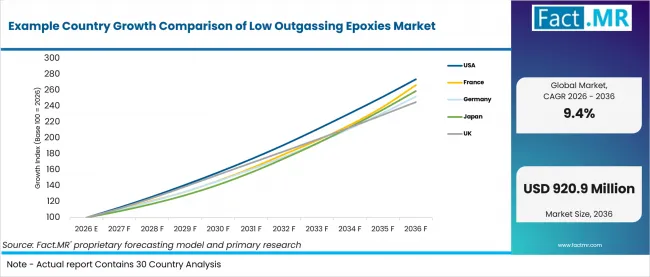
Example Country Growth Comparison Of Low Outgassing Epoxies Market | Source: Fact.MR
Country CAGR (2026-2036)
| Country | CAGR (2026-2036) |
|---|---|
| USA | 10.9% |
| France | 9.8% |
| Germany | 9.7% |
| Japan | 9.8% |
| UK | 9.7% |
What is driving the USA's growth through 2036?
The USA is forecast to expand at a 10.9% CAGR from 2026 to 2036.
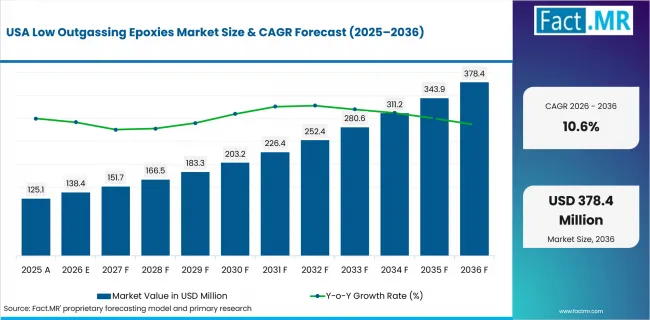
Low Outgassing Epoxies Market Country Value Analysis | Source: Fact.MR
The USA has an established spacecraft-material qualification system in which outgassing is measured before organic materials are accepted for sensitive flight applications. NASA's Goddard database applies ASTM E595 to determine total mass loss and collected volatile condensable material, giving programme teams a common screening reference for adhesives and other materials.
This benefits low-outgassing epoxy suppliers because qualification evidence can be evaluated against recognized spacecraft criteria. Adhesives that combine low volatile release with thermal conductivity or controlled heat cure are relevant to satellite electronics and instruments where both contamination and heat transfer must be managed.
What is driving France's growth through 2036?
France is forecast to expand at a 9.8% CAGR from 2026 to 2036.
France 2030 is supporting domestic satellite constellations and the industrialization of spacecraft components, including sensors and platforms. The programme explicitly targets faster development of satellite systems for communications and Earth observation, increasing the number of flight assemblies requiring qualified materials.
France 2030 also supports more than 100 space projects across launchers, constellations and emerging orbital services. As additional hardware moves from development into production, adhesive suppliers gain more opportunities to qualify formulations against vacuum, thermal and contamination requirements.
What is driving Germany's growth through 2036?
Germany is forecast to expand at a 9.7% CAGR from 2026 to 2036.
Germany's space sector is supported by dedicated materials and environmental-testing infrastructure. DLR operates large-scale facilities where spacecraft components and complete systems undergo thermal-vacuum qualification, directly supporting the validation of adhesives used in flight hardware.
DLR also operates a Micro-VCM facility specifically for material outgassing tests under ECSS-Q-ST-70-02C. The facility notes that condensed volatile material can contaminate neighbouring spacecraft surfaces, making outgassing qualification especially important for adhesives used near optical and electronic hardware.
What is driving Japan's growth through 2036?
Japan is forecast to expand at a 9.8% CAGR from 2026 to 2036.
Japan has an established domestic framework for evaluating organic spacecraft materials. JAXA developed its outgassing measurement capability using NASA's ASTM E595 approach and maintains data covering materials proposed for use in space systems.
JAXA technical documentation also incorporates spacecraft-material outgassing data into its qualification framework. This creates a defined approval pathway for low-outgassing epoxies used in satellite electronics and other flight assemblies, where formulation consistency must be maintained after qualification.
What is driving the UK's growth through 2036?
The UK is forecast to expand at a 9.7% CAGR from 2026 to 2036.
The UK Space Agency is supporting satellite and instrument programmes that require qualified materials for flight hardware. Its 2025-26 corporate plan includes work on satellite communications and the ESA Moonlight lunar navigation programme, creating commercial opportunities for UK satellite manufacturers and suppliers.
The agency's 2025-26 annual report also records UK-funded instruments on active spacecraft missions. Instrument electronics and optical assemblies require materials capable of surviving vacuum and thermal cycling without releasing contaminants onto sensitive surfaces.
Who leads the Low Outgassing Epoxies Market?
Master Bond is positioned as a leading supplier through its portfolio of low-outgassing epoxy systems for aerospace, electronics and vacuum applications. Epoxy Technology, operating through the EPO-TEK product portfolio, and Henkel compete through application-specific materials designed for electronics and high-reliability assembly.
Competition depends heavily on qualification evidence. NASA and ESA screening frameworks measure volatile mass loss and condensable material, so suppliers must demonstrate vacuum compatibility alongside the required thermal, dielectric or mechanical properties.
Once an epoxy has been qualified for a spacecraft assembly, formulation consistency and lot control become commercially important because material changes can trigger additional evaluation. This gives established suppliers with documented test histories and application support an advantage in repeat programmes.
LORD Corporation was acquired by Parker Hannifin, so LORD or Resin Designs references associated with that business should be treated under Parker ownership rather than counted as a separate current supplier.
Which companies are the key providers?
Key companies include Master Bond; Epoxy Technology (Epo-Tek); Henkel; AI Technology; Aremco Products; and Resin Designs (Lord/Parker).
- Master Bond
- Epoxy Technology (Epo-Tek)
- Henkel
- AI Technology
- Aremco Products
- Resin Designs (Lord/Parker)
Bibliography
- NASA Goddard Space Flight Center. (2026). Outgassing Data for Selecting Spacecraft Materials. NASA.
- ASTM International. (2021). ASTM E595: Outgassing in a Vacuum Environment. ASTM International.
- NASA. (2020). NASA-HDBK-6024: Outgassing and Vacuum Stability Requirements. NASA.
- UK Space Agency. (2025). Space Industrial Plan and Technology Priorities. UK Government.
- Government of France. (2025). France 2030 Space Industry Programmes. Government of France.
- U.S. Department of Commerce. (2025). CHIPS for America Advanced Packaging Manufacturing Program. U.S. Government.
- Government of France. (2025). France 2030 Electronics and Space Industry Programmes. Government of France.
- Federal Ministry for Economic Affairs and Climate Action, Germany. (2025). Industrial and Automotive Transformation Programmes. Government of Germany.
- Ministry of Economy, Trade and Industry, Japan. (2025). Strategy for Semiconductor and Digital Industry Revitalization. Government of Japan.
- Parker Hannifin. (2019). Parker Completes Acquisition of LORD Corporation. Parker Hannifin.
- Master Bond. (2026). Low-Outgassing Epoxy Systems. Master Bond.
This Report Answers
- The report examines demand across Formulation, Filler/Property, Application, End User.
- Segment analysis explains the operating reason behind each leading category.
- Country analysis evaluates the listed markets and adoption conditions through 2036.
- Competitive analysis reviews the listed companies and clarifies ownership or research roles where relevant.
- The analysis considers qualification, process control and application fit that influence purchasing decisions
What does the Low Outgassing Epoxies Market cover?
Low-outgassing epoxy adhesives and potting compounds meeting ASTM E595/NASA specs for spacecraft, optical, vacuum and semiconductor assemblies requiring minimal volatiles.
The assessment follows the stated segmentation by Formulation, Filler/Property, Application, End User. Revenue is counted only where the stated product or equipment is sold for the listed applications.
What is included in the scope?
The scope includes One-part heat cure, Two-part room-temperature, Two-part heat cure, Film adhesive.
It also covers Thermally conductive, Electrically conductive, Electrically insulating, Optically clear, Unfilled.
Demand is assessed across Application: Spacecraft/satellite, Optical assembly, Semiconductor, Vacuum systems, Cryogenic assembly; End User: Aerospace & defense, Optics manufacturers, Semiconductor, Scientific instruments.
What is excluded from the scope?
Materials that do not meet the defined viscosity, electrical, thermal, vacuum or chemistry requirement are excluded.
Standalone mixers, dispensers and curing equipment are excluded from material revenue.
General construction resins are outside the market unless sold into the listed application.
How Was the Analysis Built?
The analysis combines product scope, segment demand, country outlook and supplier coverage.
- Primary Research: Interviews focus on formulators, distributors, equipment suppliers and end users responsible for bonding, potting or thermal management.
- Desk Research: The review covers technical standards, government manufacturing programmes and company product literature.
- Market Sizing and Forecasting: Estimates combine application volume, material use per part, formulation mix, pack size and realized pricing.
- Data Validation and Update Cycle: Findings are checked against public evidence and supplier portfolios. Updates review formulation changes, ownership changes and manufacturing shifts.
What is the report's scope and coverage?
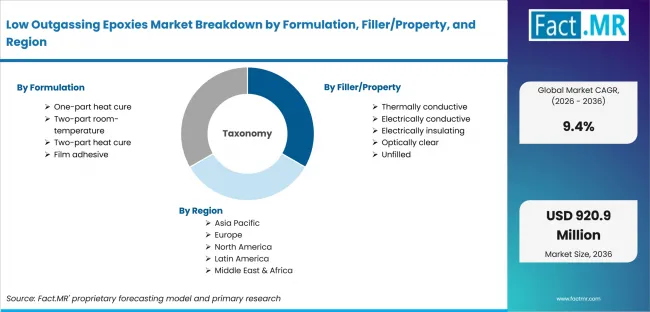
Low Outgassing Epoxies Market Breakdown By Formulation, Filler Property, And Region | Source: Fact.MR
| Attribute | Details |
|---|---|
| Quantitative Units | USD Million |
| Market Definition | Low-outgassing epoxy adhesives and potting compounds meeting ASTM E595/NASA specs for spacecraft, optical, vacuum and semiconductor assemblies requiring minimal volatiles. |
| Segments Covered | Formulation; Filler/Property; Application; End User |
| Regions Covered | North America; Latin America; Europe; East Asia; South Asia and Oceania; Middle East and Africa |
| Countries Covered | USA; France; Germany; Japan; UK |
| Key Companies Profiled | Master Bond; Epoxy Technology (Epo-Tek); Henkel; AI Technology; Aremco Products; Resin Designs (Lord/Parker) |
| Forecast Period | 2026 to 2036 |
| Base Year | 2025 |
| Market Value, 2026 | USD 375.0 million |
| Market Value, 2036 | USD 920.0 million |
| CAGR, 2026-2036 | 9.4% |
| Absolute Opportunity | USD 545.0 million |
| Approach | Combines application volume, material use per part, formulation mix, pack size and realized pricing. |
How is the market segmented?
-
By Formulation
- One-part heat cure
- Two-part room-temperature
- Two-part heat cure
- Film adhesive
-
By Filler/Property
- Thermally conductive
- Electrically conductive
- Electrically insulating
- Optically clear
- Unfilled
-
By Application
- Spacecraft/satellite
- Optical assembly
- Semiconductor
- Vacuum systems
- Cryogenic assembly
-
By End User
- Aerospace & defense
- Optics manufacturers
- Semiconductor
- Scientific instruments