- Market Value (2025): USD 485.5 Mn
- Estimated Value (2026): USD 514.2 Mn
- Forecast Value (2036): USD 910.7 Mn
- CAGR (2026-2036): 5.9%
What is the Manganese Carbonate Market forecast to be worth by 2036?
USD 514.2 million in 2026 to USD 910.7 million by 2036 at a 5.9% CAGR.
- As per Fact.MR analysis, the manganese carbonate market was valued at USD 485.5 million in 2025.
- Demand is projected to increase from USD 514.2 million in 2026 to USD 910.7 million by 2036.
- The forecast records a 5.9% CAGR from 2026 to 2036 as industrial users and selected downstream applications require consistent manganese-containing raw materials.
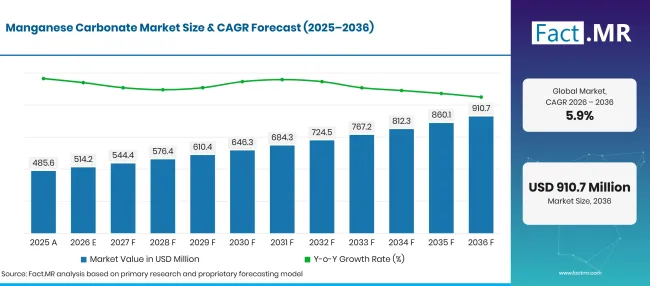
Manganese Carbonate Market Forecast Global | Source: Fact.MR
| Year | Basis | Market Value (USD million) |
|---|---|---|
| 2025 | Actual | 485.5 |
| 2026 | Estimate | 514.2 |
| 2036 | Forecast | 910.7 |
| CAGR 2026 to 2036 | Forecast period | 5.9% |
Source: Fact.MR analysis. Updated Oct 26, 2026
What are the defining numbers behind Manganese Carbonate Market growth?
USD 396.5 million absolute opportunity between 2026 and 2036.
- Demand Drivers in the Market
- Industrial users require manganese-containing materials for chemical processing and manufacturing. The U.S. Geological Survey identifies iron and steel production as the largest use of manganese, while manganese-bearing materials also serve fertilizers, animal feed and brick coloration. Manganese carbonate suppliers address a specialized part of these downstream chemical markets . [1]
- Agricultural applications create opportunities for manganese-containing micronutrient products used to address crop deficiencies. The suitability of manganese carbonate depends on its formulation and nutrient availability. In November 2025, Punjab Agricultural University (PAU) advised farmers to manage manganese deficiency in wheat grown in deficient soils, particularly under sandy-soil and paddy–wheat cropping conditions. The advisory recommends a 0.5% manganese sulphate solution, prepared using 1 kg of manganese sulphate in 200 litres of water, when soil-test results indicate manganese content below 3.5 kg per acre. It also recommends follow-up sprays at weekly intervals [6].
- Chemical manufacturers and specialty-material suppliers require dependable purity and impurity control. Manganese carbonate can serve as a chemical intermediate or raw material for selected manganese compounds. Consistent specifications, reliable supply, and application-specific quality controls influence supplier qualification and purchasing decisions.
- Key Segments Analyzed
- By Grade: Industrial Grade is leading with 58.4% of the market in 2026, shaped by its position within the grade segmentation.
- By Application: Agriculture will account for 31.7% of the market in 2026.
- Analyst Opinion at Fact.MR
- Shambhu Nath Jha, Principal Consultant at Fact.MR, states, “Manganese carbonate suppliers are likely to compete on product consistency, purity, and dependable supply. Producers that align grade specifications with the requirements of chemical manufacturers and agricultural customers can strengthen their position in specialized applications.”
- Strategic Implications
- Manufacturers need to specify manganese content, impurity limits, particle characteristics, and intended applications in technical documentation.
- Agricultural input suppliers must verify nutrient suitability and applicable regulatory requirements before incorporating manganese carbonate into formulations.
- Chemical manufacturers are advised to qualify suppliers based on batch consistency, impurity profiles, delivery reliability, and conversion requirements.
- Procurement teams can evaluate feedstock availability and processing costs when negotiating long-term supply agreements.
Germany is set to record a 6.8% CAGR through 2036. Brazil is projected to post 6.2%, followed by the USA at 5.6%. The UK is estimated to advance at 5.0%, while Japan is forecast to record 4.4%.
How does the Manganese Carbonate Market break down by segment?
Fact.MR finds that Industrial Grade leads Grade at 58.4%; Agriculture leads Application at 31.7%.
Which Grade dominates?
Industrial Grade is set to hold a 58.4% share in 2026.
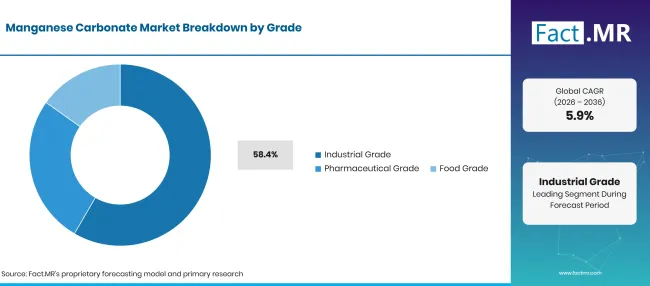
Manganese Carbonate Market Breakdown Grade | Source: Fact.MR
| Grade | Share (2026) |
|---|---|
| Industrial Grade (Leading segment) | 58.4% |
| Other segments combined | 41.6%* |
| Total | 100.0% |
Source: Fact.MR analysis. Updated Oct 26, 2026
Industrial Grade manganese carbonate serves buyers that require a specified manganese content and controlled impurity levels for industrial processing. Its suitability depends on the intended chemical reaction and the required properties of the resulting material. Pharmaceutical Grade products require tighter controls appropriate to their intended uses, while Food Grade products must meet applicable food-related purity and safety requirements.
What leads the Application segment?
Agriculture represent a 31.7% share in 2026.
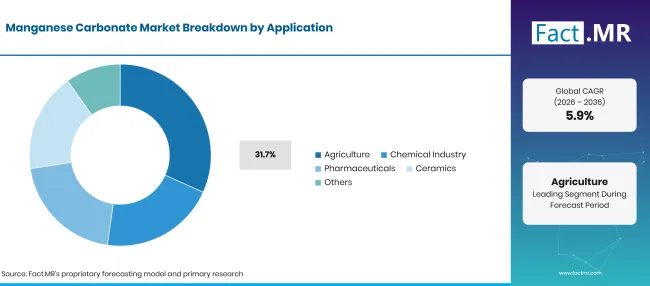
Manganese Carbonate Market Breakdown Application | Source: Fact.MR
| Application | Share (2026) |
|---|---|
| Agriculture (Leading segment) | 31.7% |
| Other segments combined | 68.3%* |
| Total | 100.0% |
Source: Fact.MR analysis. Updated Oct 26, 2026
Agricultural applications include the use of suitable manganese compounds in crop-nutrition formulations and related products. Manganese is an essential plant micronutrient, but the suitability of manganese carbonate depends on its solubility, formulation, soil conditions, and intended application. Manufacturers must establish that the final product delivers the required nutrient availability and complies with applicable fertilizer standards.
What is accelerating Manganese Carbonate Market adoption, and what is holding it back?
Demand from chemical manufacturing and agricultural formulations supports market development, while grade-specific quality requirements, material handling, and application suitability create constraints.
Drivers Impact Analysis
| DRIVER | (~) % IMPACT ON CAGR | Geographic Relevance | Impact Timeline |
|---|---|---|---|
| Demand for industrial manganese compounds | +1.0% | Global | Medium term (2–4 years) |
| Agricultural micronutrient formulations | +0.9% | Americas, Asia | Medium term (2–4 years) |
| Chemical intermediate requirements | +0.7% | Global | Short term (≤ 2 years) |
| Grade consistency and purity control | +0.5% | Global | Short term (≤ 2 years) |
| Supplier qualification and technical support | +0.4% | Global | Long term (≥ 4 years) |
Source: Fact.MR analysis. Updated Oct 26, 2026
Opportunity Impact Analysis
| OPPORTUNITY | (~) % IMPACT ON CAGR | Geographic Relevance | Impact Timeline |
|---|---|---|---|
| Application-specific industrial grades | +0.8% | Global | Medium term (2–4 years) |
| Agricultural formulation development | +0.6% | Brazil, Asia | Medium term (2–4 years) |
| Improved batch traceability | +0.5% | Europe, North America | Short term (≤ 2 years) |
| Reliable supply arrangements | +0.4% | Global | Long term (≥ 4 years) |
Source: Fact.MR analysis. Updated Oct 26, 2026
Restraints Impact Analysis
| RESTRAINT | (~) % IMPACT ON CAGR | Geographic Relevance | Impact Timeline |
|---|---|---|---|
| Purity and quality-control costs | -0.8% | Global | Short term (≤ 2 years) |
| Variable raw material and energy costs | -0.6% | Global | Medium term (2–4 years) |
| Application-specific solubility constraints | -0.5% | Global | Medium term (2–4 years) |
| Supply chain and transport uncertainty | -0.4% | Global | Short term (≤ 2 years) |
Source: Fact.MR analysis. Updated Oct 26, 2026
Which countries are scaling the Manganese Carbonate Market through 2036?
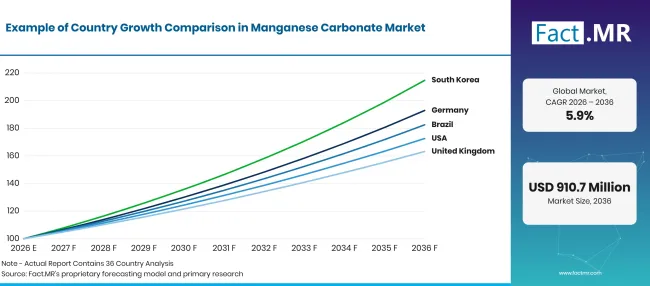
Manganese Carbonate Market Growth Index | Source: Fact.MR
| Country | CAGR (2026–2036) |
|---|---|
| Germany | 6.8% |
| Brazil | 6.2% |
| USA | 5.6% |
| UK | 5.0% |
| Japan | 4.4% |
Source: Fact.MR analysis. Updated Oct 26, 2026
What supports Germany adoption?
6.8% CAGR, supported by industrial chemical manufacturing and demand for application-specific inorganic compounds.
Germany's chemical manufacturing and ceramics industries provide relevant downstream markets for specialty inorganic materials. Destatis publishes monthly production indices covering chemical products, metal processing, and ceramics. In April 2026, German chemical industry production increased by 2.1% compared with March, after seasonal and calendar adjustment, according to the Federal Statistical Office [2]. Market expansion will depend on chemical manufacturers' material requirements and the ability of suppliers to deliver consistent grades.
How is Brazil developing manganese carbonate adoption?
6.2% CAGR, shaped by mineral resource base and potential demand from agricultural and industrial applications.
Brazil has manganese deposits and an established mineral industry. The Brazilian Geological Survey identifies manganese resources and discusses the relevance of agricultural applications alongside traditional industrial uses [3]. The country's industrial production also provides context for downstream chemical demand. IBGE reported that Brazilian industrial production increased 0.7% month over month in April 2026, with output in the chemical products sector declining 3.9% that month [4]. These mixed indicators demonstrate why manganese carbonate demand should be evaluated using both mineral supply conditions and downstream industry activity.
What supports United States adoption?
5.6% CAGR, driven by demand from chemical manufacturing and established industrial supply chains.
The United States market for manganese carbonate gains momentum from its use as a chemical feedstock and manganese source in industrial formulations. Dependence on imported manganese-bearing materials reinforces the importance of reliable sourcing, supplier diversification, and efficient material processing. Demand is supported by the potential use of manganese carbonate in chemical manufacturing, agricultural formulations, and specialized applications where suitable manganese content and controlled impurity levels are essential. Consistent product quality, processing efficiency, and supply-chain reliability influence procurement decisions among manufacturers seeking dependable raw materials for industrial production.
How is the United Kingdom building adoption?
5.0% CAGR, shaped by specialty chemical demand and requirements across industrial applications.
The UK market can be assessed through activity in chemical manufacturing, agriculture-related supply chains, and ceramic production. Demand for manganese carbonate depends on whether industrial buyers require it as a raw material or intermediate and whether suitable alternatives are available. Supplier reliability, material specifications, import costs, and compliance with the relevant product standards will influence purchasing decisions.
What supports Japan adoption?
4.4% CAGR, led by demand from chemical manufacturing and industrial materials processing.
Japan's Ministry of Economy, Trade and Industry publishes a Current Survey of Production covering manufactured chemical products, ceramics, and mineral-related categories. Its 2026 interim production statistics provide a current official framework for assessing manufacturing activity [5]. Future demand will depend on specific industrial formulations, product qualification requirements, and the competitiveness of domestic and imported supplies.
Who leads the Manganese Carbonate Market?
Fact.MR identifies Navadia Group of Companies, TOPLUS, Hunan QingChong New Materials Co., Ltd., Anmol Chemicals Private Limited, and ProChem, Inc. within the competitive landscape of the manganese carbonate market.
Navadia Group of Companies and Anmol Chemicals Private Limited are associated with manganese carbonate and specialty chemical products. TOPLUS offers manganese carbonate for industrial and specialized applications, while Hunan QingChong New Materials Co., Ltd. and ProChem, Inc. are identified in manganese carbonate product documentation.
These companies represent potential participants in the manganese carbonate market. Their competitive positioning depends on current manufacturing activity, commercial product availability, chemical purity, impurity limits, and the ability to supply grades suited to specific applications. Agricultural input suppliers prioritize nutrient suitability and applicable fertilizer requirements, whereas industrial customers focus on chemical consistency, process compatibility, and supply reliability.
Which companies are the key providers?
Key companies profiled include Navadia Group of Companies; TOPLUS; Hunan QingChong New Materials Co., Ltd.; Anmol Chemicals Private Limited; and ProChem, Inc.
- Navadia Group of Companies
- TOPLUS
- Hunan QingChong New Materials Co., Ltd.
- Anmol Chemicals Private Limited
- ProChem, Inc.
Bibliography
- [1] U.S. Geological Survey. (2026). Mineral commodity summaries 2026 (Version 1.3). U.S. Geological Survey.
- [2] Statistisches Bundesamt (Destatis). (n.d.). Produktionsindex: Konjunkturindikatoren
- [3] Cunha, I. de A., Almeida, R. C. de, Brod, E. R., Santos, N. P. de S., Cabral Neto, I., Queiroz, L. C., Silva, G. F. da, Silva, A. D. R. da, & Gaia, S. M. de S. (2025). An overview of critical and strategic minerals potential of Brazil: 2025 edition. Geological Survey of Brazil.
- [4] Instituto Brasileiro de Geografia e Estatística. (2026, June 3). Produção industrial brasileira variou 0,7% em abril. https://agenciadenoticias.ibge.gov.br/agencia-sala-de-imprensa/2013-agencia-de-noticias/releases/46988-producao-industrial-brasileira-variou-0-7-em-abril
- [5] Ministry of Economy, Trade and Industry. (2026, March 19). Current Survey of Production: 2026 interim total computation
- [6] Punjab Agricultural University. (2025, November 16). To manage manganese deficiency in wheat, farmers should start spraying manganese sulphate from the first irrigation: PAU-FASC Sangrur organized a camp at village Sheikhupur Kalan.
- [7] Ding, X., Cheng, X., Cao, Z., Zhong, H., Cai, H., Xiao, G., Ma, X., & Wang, S. (2025). Green process for the preparation of MnCO₃ and recovery of by-product Mg-containing (NH₄)₂SO₄ solution. Minerals, 15(3), Article 304.
- [8] Vair Systems. (n.d.). Integrated manganese sulphate plant.
- [9] Pan Chem Corporation. (n.d.). Manganese carbonate: Technical data sheet.
This Report Answers
- The report describes manganese carbonate demand across industrial and specialized applications.
- Segment analysis compares Industrial Grade, Pharmaceutical Grade, and Food Grade products.
- Application analysis covers agriculture, chemical manufacturing, pharmaceuticals, ceramics, and other uses.
- Country analysis discusses Germany, Brazil, the USA, the UK, and Japan alongside official mineral and manufacturing indicators.
- The competitive overview identifies the manganese producers and specialty materials companies.
- Market analysis considers grade consistency, raw material availability, application suitability, and downstream manufacturing demand.
What does the Manganese Carbonate Market cover?
The market covers manganese carbonate use as an industrial chemical, processing intermediate, or ingredient in suitable downstream formulations. It examines demand across the grade, application. Purchasing decisions depend on chemical purity, manganese content, impurity limits, product specifications, and the suitability of the material for its intended use.
What is included in the scope?
Included products are manganese carbonate materials sold for the specified industrial and specialized applications.
The analysis covers Industrial Grade, Pharmaceutical Grade, and Food Grade classifications where applicable product specifications and regulatory requirements are satisfied. It also considers agricultural formulations, chemical manufacturing, pharmaceuticals, ceramics, and other applications.
What is excluded from the scope?
The analysis excludes manganese ore, manganese metal, manganese dioxide, and manganese sulfate sold as separate products unless they are explicitly included in the defined manganese carbonate revenue boundary.
Other manganese compounds are not treated as interchangeable with manganese carbonate. Mining equipment, processing machinery, and unrelated chemical products are excluded. Companies active in manganese mining or processing are not assumed to generate manganese carbonate revenue without verification of the relevant product offering.
How Was the Analysis Built?
The analysis considers market forecasts, industry developments, company activities, technical requirements and relevant government statistics to assess market conditions and growth opportunities.
- Primary Research: Discussions with chemical manufacturers, mineral suppliers, distributors, agricultural input producers, and industrial customers examine product specifications, purchasing priorities, quality requirements, supply risks, and competitive positioning.
- Desk Research: Research covers official mineral statistics, government industrial production data, company publications, regulatory standards, technical literature, and industry reports. Relevant references are documented in the bibliography.
- Market Sizing and Forecasting: Estimates combine historical performance, demand indicators, pricing and volume trends, segment shares, company participation, country-level growth estimates, downstream industry activity, and barriers to market expansion.
- Data Validation and Update Cycle: Findings are assessed against official statistics, company portfolios, product documentation, regulatory requirements, and industry developments. Updates consider supply availability, product qualification, changes in downstream demand, and developments in manufacturing capacity.
Segmentation
What is the report's scope and coverage?
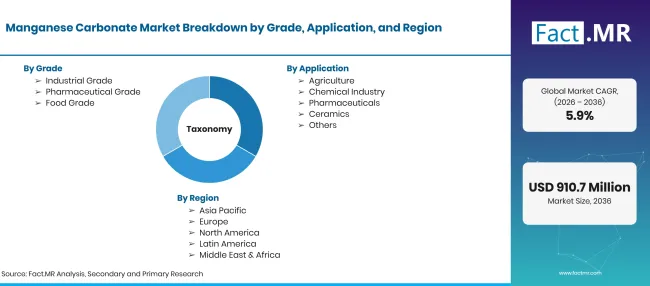
Manganese Carbonate Market Taxonomy | Source: Fact.MR
| Attribute | Details |
|---|---|
| Quantitative Units | USD million |
| Market Definition | The Manganese Carbonate Market covers the production and supply of it for agricultural micronutrient formulations and industrial chemical processing. |
| Grade | Industrial Grade; Pharmaceutical Grade; Food Grade |
| Application | Agriculture; Chemical Manufacturing; Pharmaceuticals; Ceramics; Others |
| Regions Covered | North America; Latin America; Western Europe; Eastern Europe; East Asia; South Asia & Pacific; Middle East & Africa |
| Countries Covered | Germany; Brazil; USA; UK; Japan |
| Companies Profiled | Navadia Group of Companies, TOPLUS, Hunan QingChong New Materials Co., Ltd., Anmol Chemicals Private Limited, and ProChem, Inc. |
| Forecast Period | 2026 to 2036 |
| Approach | Market segmentation and scenario-based analysis supported by official mineral statistics and industrial production indicators |
Source: Fact.MR analysis. Updated Oct 26, 2026
How is the market segmented?
-
By Grade
- Industrial Grade
- Pharmaceutical Grade
- Food Grade
-
By Application
- Agriculture
- Chemical Manufacturing
- Pharmaceuticals
- Ceramics
- Others
-
By Region
- North America
- Latin America
- Western Europe
- Eastern Europe
- East Asia
- South Asia & Pacific
- Middle East & Africa
Frequently Asked Questions
How big is the Manganese Carbonate Market in 2026?
What is the CAGR from 2026 to 2036?
Which Grade has the largest share?
Which Application leads the market?
Which companies are covered?
Who worked on this report


Preview the report firsthand - request a free sample
Free SampleGet the brochure for pricing and purchase details
Download PDF