- Base Value(2025): 412.6 Mn
- Estimated Value(2026): 438.9 Mn
- Forecast Value (2036): 792.3 Mn
- CAGR (2026 - 2036): 6.1%
Glycerol Carbonate Market Forecast and Outlook Fact.MR
In 2025, the glycerol carbonate market was valued at USD 412.6 million. Based on Fact MR analysis, demand for glycerol carbonate is estimated to grow to USD 438.9 million in 2026 and USD 792.3 million by 2036. FMR projects a CAGR of 6.1% during the forecast period.
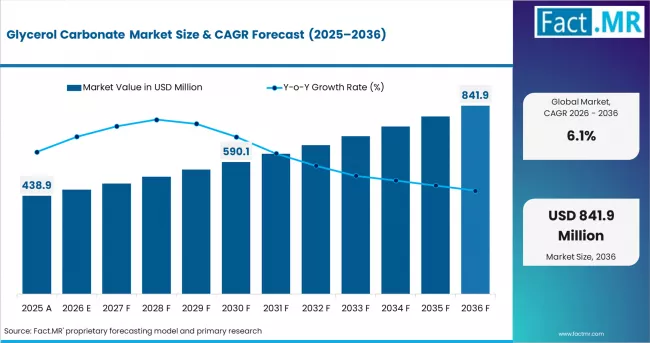
Glycerol Carbonate Market Value Analysis | Source: Fact.MR
Summary of the Glycerol Carbonate Market
- Market Definition
- The market comprises glycerol carbonate, a bio based cyclic carbonate derived from glycerol and used as solvent, intermediate, plasticizer, and stabilizer across coatings, polymers, electrolytes, personal care, and specialty chemical formulations. The compound demonstrates high polarity, low volatility, and compatibility with multifunctional formulation systems requiring stable solvency performance across industrial processing environments.
- Demand Drivers
- Rising utilization of bio based solvents across coatings and polymer synthesis supporting compatibility with polar formulation environments.
- Expansion of lithium battery manufacturing requiring carbonate based electrolyte intermediates supporting electrochemical stability.
- Increasing demand for multifunctional intermediates across specialty chemical synthesis workflows requiring stable reaction environments.
- Growth in personal care formulations incorporating low toxicity solvent components supporting formulation consistency.
- Preference for high polarity solvent systems enabling improved solubility and dispersion characteristics across complex chemical mixtures.
- Continued availability of glycerol feedstock from biodiesel production supporting value chain integration across carbonate derivatives.
- Key Segments Analyzed
- Application: Solvents maintain leading share due to compatibility with polymer dissolution, electrolyte formulation, and specialty chemical processing requirements.
- Function: Solvent function accounts for 39% share in 2026, supported by polarity balance and controlled evaporation characteristics.
- End Use Industry: Chemicals industry leads with 37% share driven by integration of glycerol carbonate as intermediate and reactive solvent.
- Material Role: Intermediate and plasticizer functions support polymer modification and formulation stability across specialty materials.
- Geography: Asia Pacific leads volume consumption driven by battery material demand, while Europe maintains value share linked to regulatory compliant solvents.
- Analyst Opinion at Fact MR
- Shambhu Nath Jha, Principal Consultant, Fact MR, opines, 'In this updated edition of the Glycerol Carbonate Market report, industry participants observe continued transition toward multifunctional carbonate intermediates supporting formulation efficiency across specialty chemical systems. Market expansion remains linked to electrolyte material demand, polymer synthesis integration, and bio based solvent substitution patterns. Producers emphasizing purity consistency, process efficiency, and compatibility across coating and electrochemical applications are positioned to maintain stable value growth through 2036.'
- Strategic Implications/Executive Takeaways
- Strengthen production capabilities aligned with demand for bio based carbonate intermediates across specialty chemical applications.
- Focus on high purity grades supporting electrolyte formulation and polymer synthesis compatibility requirements.
- Expand collaboration with battery material manufacturers requiring carbonate based solvent intermediates.
- Enhance supply chain integration linked to glycerol feedstock availability from biodiesel processing value chains.
- Develop application expertise across coatings, polymers, and personal care formulations requiring multifunctional solvent characteristics.
- Monitor substitution competition from conventional carbonate solvents influencing formulation selection criteria.
- Methodology
- Built on primary interviews with specialty chemical manufacturers, electrolyte producers, polymer formulators, and raw material distributors.
- Benchmarked against biodiesel production indicators influencing glycerol feedstock availability across carbonate synthesis pathways.
- Evaluated demand patterns across coatings, polymer intermediates, and electrochemical formulation environments.
- Applied hybrid modeling combining top down specialty chemical demand assessment with bottom up consumption analysis.
- Validated through cross comparison of supplier production data, regulatory documentation, and formulation level adoption trends.
- Peer reviewed using Fact MR analytical frameworks integrating supply side capacity evaluation and end use consumption mapping.
Glycerol Carbonate Market
| Metric | Details |
|---|---|
| Industry Size (2026E) | USD 438.9 million |
| Industry Value (2036F) | USD 792.3 million |
| CAGR (2026 to 2036) | 6.1% |
Source: Fact.MR analysis. Updated Apr 15, 2026
An increase of USD 353.4 million indicates moderate expansion supported by utilization as a bio-based solvent and electrolyte intermediate in coatings, polymers, and energy storage applications. Growth remains driven by preference for low-toxicity solvents, while constraints persist from feedstock glycerol price variability and substitution competition from alternative carbonate chemistries.
China leads with a projected CAGR of 7.2%, supported by increasing utilization of cyclic carbonate intermediates across lithium battery electrolyte formulation processes. India follows with a CAGR of 6.9%, driven by expanding demand for bio-based solvent intermediates across chemical synthesis applications. The United Kingdom records a CAGR of 6.7%, reflecting stable incorporation of carbonate-based intermediates across specialty chemical formulation systems. Germany shows a CAGR of 6.4%, supported by consistent use of multifunctional solvent components across polymer and coating synthesis pathways. South Korea records the slowest growth at 6.3%, reflecting a mature market where demand is largely tied to replacement procurement cycles within established specialty chemical production environments. Mature markets generate a significant share of replacement demand as formulation requirements remain aligned with stability performance, solubility compatibility, and process efficiency across chemical manufacturing applications.
Segmental Analysis
Glycerol Carbonate Market Analysis by Function
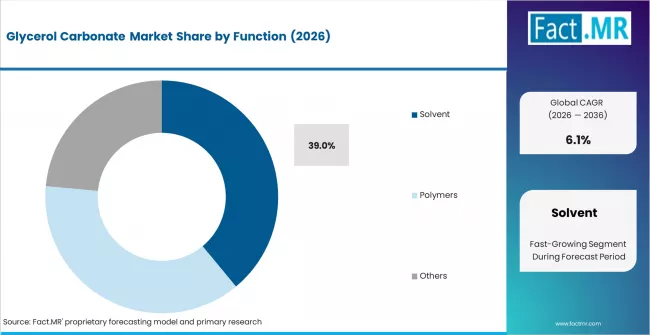
Glycerol Carbonate Market Analysis By Function | Source: Fact.MR
- Market Overview: Based on Fact MR assessment, solvent functionality is projected to account for 39% share of the glycerol carbonate market in 2026. Polar aprotic solvent characteristics support dissolution of polymers, electrolytes, and specialty intermediates requiring controlled viscosity and stability across formulation systems. Glycerol carbonate demonstrates compatibility with high polarity compounds enabling uniform dispersion across coatings, electrolyte formulations, and chemical synthesis environments. Chemical structure stability supports controlled evaporation profile and reduced volatility characteristics across applications requiring consistent solvency performance across processing conditions.
- Demand Drivers:
- Polarity Balance Requirements: Glycerol carbonate supports dissolution of polar compounds requiring stable interaction across formulation environments.
- Viscosity Control Parameters: Solvent functionality supports controlled flow behavior across liquid formulation systems requiring stable rheological characteristics.
- Chemical Stability Needs: Molecular structure demonstrates resistance to degradation across varied temperature and processing conditions applied in specialty chemical formulations.
Glycerol Carbonate Market Analysis by End Use Industry
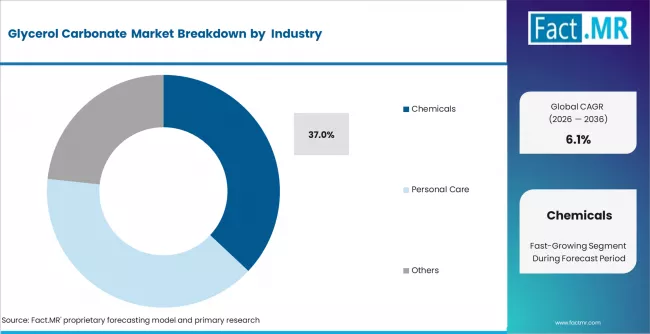
Glycerol Carbonate Market Analysis By End Use Industry | Source: Fact.MR
- Market Overview: Chemicals industry is estimated to hold 37% share of the glycerol carbonate market in 2026, supported by utilization as an intermediate solvent across polymer synthesis, electrolyte formulation, and specialty chemical processing workflows. Chemical manufacturers incorporate glycerol carbonate across reaction environments requiring stable solvency behavior and controlled interaction with reactive intermediates. Processing compatibility supports integration across laboratory scale synthesis and industrial scale production systems requiring defined solvent performance parameters aligned with formulation stability requirements.
- Demand Drivers:
- Reaction Environment Requirements: Chemical manufacturers utilize glycerol carbonate to maintain homogeneous reaction mixtures requiring controlled compound solubility characteristics.
- Intermediate Processing Parameters: Solvent compatibility supports stability of reactive species across multi step chemical synthesis workflows.
- Formulation Versatility Needs: Glycerol carbonate demonstrates applicability across coatings, polymer processing, and electrolyte formulation systems requiring consistent solvent performance characteristics.
Key Dynamics
Glycerol Carbonate Market Drivers, Restraints, and Opportunities
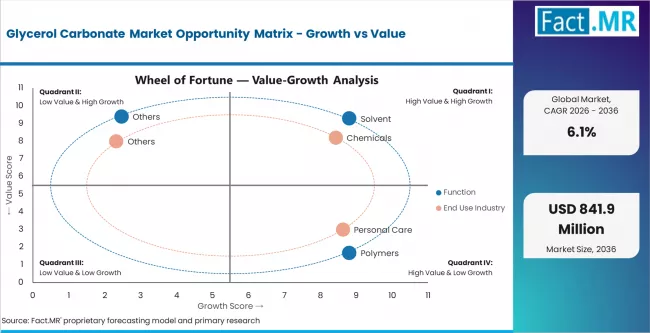
Glycerol Carbonate Market Opportunity Matrix Growth Vs Value | Source: Fact.MR
Fact MR analysis indicates that the glycerol carbonate market developed from glycerin valorization pathways linked to biodiesel production, where excess glycerol feedstock required higher-value downstream applications. Early demand was concentrated in specialty solvents and polymer intermediates where glycerol carbonate provided high polarity and chemical stability. The current market valuation reflects expanded application across coatings, adhesives, lithium battery electrolytes, and personal care formulations where multifunctional solvent and reactive intermediate properties are required. Demand persists because glycerol carbonate supports polymer crosslinking, solubility enhancement, and formulation stability in specialty chemical systems.
A structural shift is occurring as conventional petrochemical solvents face partial substitution from bio-derived carbonate solvents integrated into coatings and electrochemical formulations. Traditional carbonate solvents remain widely used in industrial applications where cost efficiency and established synthesis pathways support large-scale production. Glycerol carbonate production involves transesterification or glycerol conversion processes that depend on biodiesel supply chain economics, influencing raw material availability and pricing stability. These specialty intermediates command higher pricing due to multifunctional performance in polymer synthesis and battery electrolyte formulations. Even with moderate adoption volumes, higher-value bio-derived solvent systems support gradual market value expansion.
- Bio-Based Solvent Integration: Manufacturers use glycerol carbonate as a reactive solvent and intermediate in coatings, polymers, and electrolyte formulations.
- Chemical Safety Regulation: Frameworks such as European Union REACH regulation influence solvent selection and environmental compliance in specialty chemical formulations.
- Asia Battery Material Demand: China, Japan, and South Korea maintain expanding lithium battery manufacturing sectors utilizing carbonate-based electrolyte components.
Regional Analysis
The glycerol carbonate market is assessed across North America, Europe, Asia Pacific, Latin America, and Middle East & Africa, segmented by country-level demand in electrolyte solvents, coatings intermediates, polymers, and specialty chemical synthesis. Regional demand reflects bio-based chemical adoption, battery material innovation, and green solvent formulation requirements. The full report offers market attractiveness analysis.
.webp "Top Country Growth Comparison Glycerol Carbonate Market Cagr (2026 2036)")
Top Country Growth Comparison Glycerol Carbonate Market Cagr (2026 2036) | Source: Fact.MR
CAGR Table of Glycerol Carbonate Market
| Country | CAGR (2026–2036) |
|---|---|
| China | 7.2% |
| India | 6.9% |
| United Kingdom | 6.7% |
| Germany | 6.4% |
| South Korea | 6.3% |
Source: Fact.MR analysis. Updated Apr 15, 2026
Source: Fact MR analysis, based on proprietary forecasting model and primary research
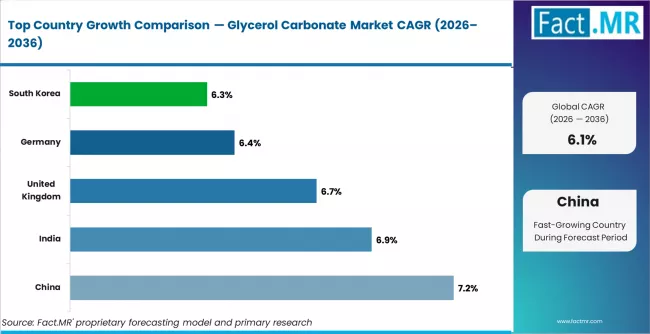
Glycerol Carbonate Market Cagr Analysis By Country | Source: Fact.MR
Asia Pacific
Glycerol Carbonate Market Country Value Analysis | Source: Fact.MR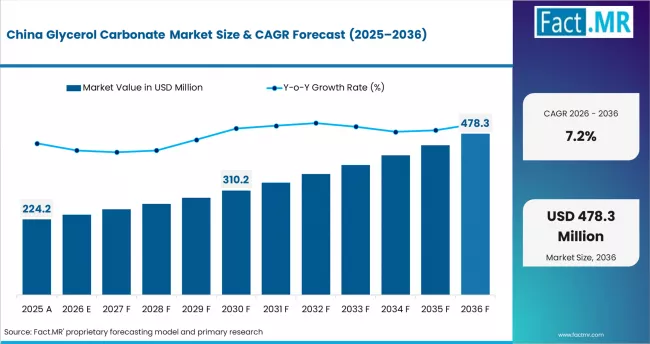
Asia Pacific functions as the bio-based solvent and battery electrolyte material production hub, supported by strong chemical manufacturing capacity and lithium-ion battery material innovation demand. Huntsman Corporation strengthens specialty carbonate chemical development capabilities. Lotte Chemical Corporation expands specialty solvent manufacturing portfolio. UBE Corporation supports electrolyte material innovation.
- China: Demand for glycerol carbonate in China is projected to rise at 7.2% CAGR through 2036. The New Materials Industry Development Plan (Ministry of Industry and Information Technology, 2021) supports specialty chemical production expansion. Lotte Chemical Corporation expanded specialty carbonate material production capacity (April 2023), supporting supply growth.
- India: Demand for glycerol carbonate in India is projected to rise at 6.9% CAGR through 2036. The National Chemical Policy framework (Ministry of Chemicals and Fertilizers, updated 2021) supports bio-based chemical manufacturing expansion. Huntsman Corporation expanded specialty chemical product offerings (May 2023), supporting market development.
- South Korea: Demand for glycerol carbonate in South Korea is projected to rise at 6.3% CAGR through 2036. The K-Battery Strategy initiative (Ministry of Trade, Industry and Energy, 2021) supports electrolyte material demand growth. UBE Corporation expanded carbonate solvent material production capabilities (March 2023), supporting industry demand
Glycerol Carbonate Market South Korea Market Share Analysis By End Use Industry | Source: Fact.MR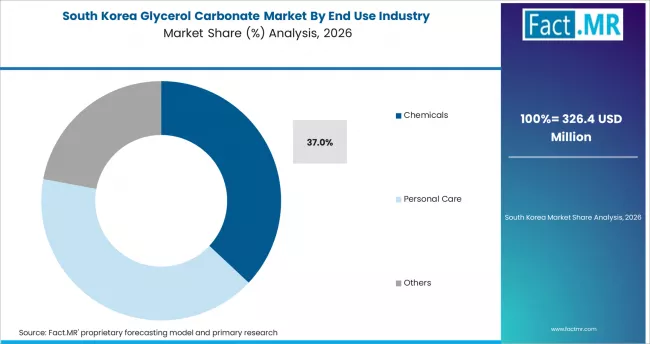
Europe
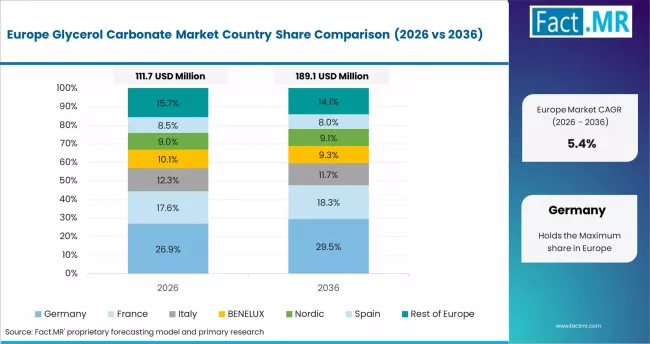
Glycerol Carbonate Market Europe Country Market Share Analysis, 2026 & 2036 | Source: Fact.MR
Europe functions as the green solvent regulatory laboratory for bio-based chemical intermediates, supported by structured chemical safety frameworks and advanced specialty chemical innovation ecosystems. BASF SE strengthens specialty carbonate chemical production capabilities. Arkema S.A. expands bio-based chemical intermediate portfolio. Solvay S.A. supports specialty solvent formulation innovation.
- United Kingdom: Demand for glycerol carbonate in United Kingdom is projected to rise at 6.7% CAGR through 2036. The UK REACH regulatory framework (Health and Safety Executive, updated 2021) supports environmentally compliant solvent production. Arkema S.A. expanded bio-based solvent innovation initiatives (February 2023), supporting market expansion.
- Germany: Demand for glycerol carbonate in Germany is projected to rise at 6.4% CAGR through 2036. EU REACH chemical safety framework (European Chemicals Agency, ongoing) supports specialty carbonate solvent compliance. BASF SE expanded specialty carbonate chemical manufacturing capacity (January 2023), supporting adoption.
Fact MR's analysis of glycerol carbonate market in global regions consists of country-wise assessment that includes China, India, United Kingdom, Germany, and South Korea. Readers can find specialty carbonate demand trends, bio-based solvent developments, regulatory frameworks, and competitive positioning across key markets.
Competitive Landscape
Competitive Structure and Buyer Dynamics in the Glycerol Carbonate Market
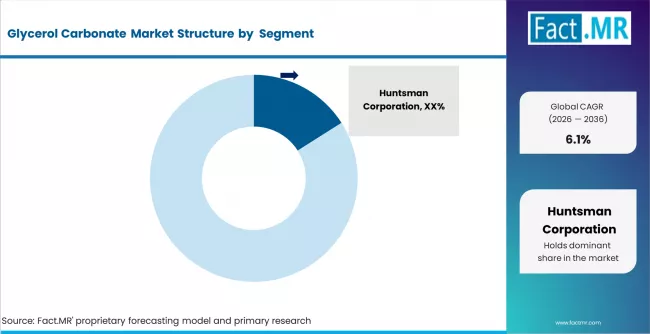
Glycerol Carbonate Market Analysis By Company | Source: Fact.MR
The competitive structure of the Glycerol Carbonate Market is moderately fragmented, with specialty chemical manufacturers and laboratory reagent suppliers participating across solvent and intermediate applications. Companies such as Huntsman Corporation, UBE Corporation, Merck KGaA, Tokyo Chemical Industry Co. Ltd., and Alfa Aesar maintain strong positions through established fine chemical synthesis capabilities and global distribution networks. Additional participants including Loba Chemie Pvt. Ltd., Parchem Fine and Specialty Chemicals, TCI America, Shandong Senjie Cleantech Co. Ltd., and Haihang Industry Co. Ltd. contribute through reagent grade production and regional chemical supply operations. Competition is primarily influenced by product purity, synthesis efficiency, formulation compatibility, and supply reliability across coatings, personal care, and polymer applications.
Several companies maintain structural advantages through integrated specialty chemical manufacturing and strong distribution infrastructure serving industrial and laboratory customers. Firms such as Huntsman Corporation and UBE Corporation benefit from established chemical production capabilities supporting consistent raw material availability. Merck KGaA and Tokyo Chemical Industry Co. Ltd. maintain advantages through extensive laboratory chemical portfolios and global logistics networks. Buyers typically adopt multi supplier sourcing strategies to reduce dependence on a single supplier and maintain procurement flexibility. Procurement decisions evaluate suppliers based on purity standards, regulatory compliance, and long term supply stability, moderating supplier pricing leverage across the market.
Key Players of the Glycerol Carbonate Market
- Huntsman Corporation
- UBE Corporation
- Tokyo Chemical Industry Co. Ltd.
- Merck KGaA
- Alfa Aesar
- Loba Chemie Pvt. Ltd.
- Parchem Fine and Specialty Chemicals
- Shandong Senjie Cleantech Co. Ltd.
- Haihang Industry Co. Ltd.
- TCI America
Bibliographies
- [1] Studio, S. N., et al. (2021). Sustainable glycerol carbonate electrolytes for Li-ion supercapacitors. Materials Advances, 2(17), 5596–5607.
- [2] UBE Corporation. (2024). DAXSOL® glycerol carbonate – 76% bio-based, low-toxicity solvent for batteries, coatings, and industrial formulations. UBE sustainable chemistry.
- [3] Huntsman Corporation. (2012). JEFFSOL® glycerol carbonate (JEFFSOL GC) – Material safety and biodegradability data sheet. Huntsman.
- [4] Sci-Verse Green Chemistry Group. (2021). Green and facile synthesis of glycerol carbonate from bio-glycerol: From biodiesel glycerol by-product to circular-economy intermediates. Green Chemistry, 23(18), 7012–7024.
- [5] Franco-Cisterna, P., et al. (2024). Glycerol carbonate and solketal carbonate as circular-economy electrolyte solvents for batteries and supercapacitors. ChemSusChem, 17(24), e202402178
This Report Addresses
- Market size estimation and revenue forecasts from 2026 to 2036, supported by validated specialty chemical consumption benchmarks and carbonate intermediate demand indicators.
- Growth opportunity mapping across solvent, intermediate, plasticizer, and stabilizer functional roles applied in polymers, coatings, and electrolyte formulations.
- Segment and regional revenue forecasts covering solvents, polymers, electrolytes, coatings, and personal care applications across North America, Europe, and Asia Pacific.
- Competition strategy assessment including vertically integrated specialty chemical production models and supplier capability benchmarking across purity grades and formulation performance parameters.
- Regulatory impact analysis covering REACH aligned chemical safety frameworks, bio based solvent compliance requirements, and material classification standards affecting specialty carbonate adoption.
- Market report delivery in PDF, Excel, PPT, and interactive dashboard formats structured for procurement teams, formulation specialists, and strategic planning functions.
- Supply chain vulnerability assessments identifying glycerol feedstock dependency linked to biodiesel production pathways and regional concentration of cyclic carbonate manufacturing capacity.
Market Definition
The glycerol carbonate market includes the production and sale of glycerol carbonate, a bio based organic compound derived from glycerol and used as a solvent, intermediate, plasticizer, and reactive component in polymers, coatings, personal care products, electrolytes, and specialty chemical formulations.
Glycerol Carbonate Market Inclusions
The report includes global and regional market size estimates, forecast analysis, and segmentation by purity grade, application area, end use industry, formulation role, pricing structure, and supply chain distribution patterns across specialty chemical markets.
Glycerol Carbonate Market Exclusions
The scope excludes conventional petrochemical solvents not based on carbonate chemistry, finished consumer products containing blended formulations without identifiable glycerol carbonate content, and chemical intermediates unrelated to glycerol derived carbonate compounds.
Glycerol Carbonate MarketResearch Methodology
- Primary Research
- Interviews were conducted with specialty chemical manufacturers, polymer producers, coating formulators, personal care product developers, and raw material distributors.
- Desk Research
- Public sources included chemical technical literature, patent filings, regulatory documentation, company technical datasheets, and publications related to carbonate based solvents and intermediates.
- Market-Sizing and Forecasting
- A hybrid model combining top-down specialty chemical demand assessment and bottom-up analysis of glycerol carbonate consumption across application segments was applied.
- Data Validation and Update Cycle
- Estimates were validated through cross comparison of supplier data, expert consultation, and periodic monitoring of application development trends.
Segmentation
Report Scope
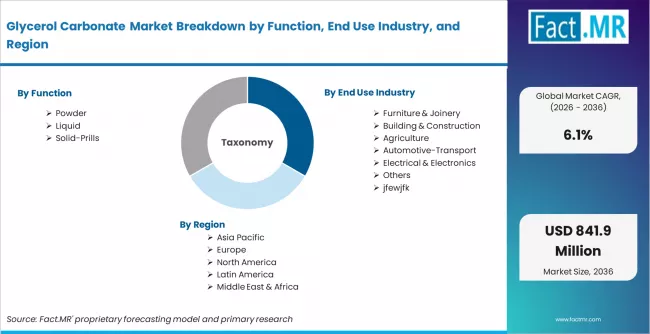
Glycerol Carbonate Market Breakdown By Function, End Use Industry, And Region | Source: Fact.MR
| Metric | Value |
|---|---|
| Quantitative Units | USD 438.9 million (2026) to USD 792.3 million (2036), at a CAGR of 6.1% |
| Market Definition | The glycerol carbonate market includes production and commercialization of cyclic carbonate compounds derived from glycerol, used as bio-based solvents, intermediates, plasticizers, and electrolyte components across chemical processing, coatings, energy storage, and personal care formulations. |
| Application Segmentation | Solvents, Polymers, Electrolytes, Coatings, Personal care |
| Function Segmentation | Solvent, Intermediate, Plasticizer, Stabilizer |
| End Use Industry Segmentation | Chemicals, Personal care, Energy storage, Coatings, Pharma |
| Regions Covered | North America, Latin America, Europe, East Asia, South Asia, Oceania, Middle East and Africa |
| Countries Covered | United States, Canada, Mexico, Brazil, Germany, France, United Kingdom, Italy, Spain, Netherlands, China, Japan, South Korea, India, Singapore, Thailand, Australia, United Arab Emirates, and 40+ countries |
| Key Companies Profiled | Huntsman Corporation, UBE Corporation, Tokyo Chemical Industry Co. Ltd., Merck KGaA, Alfa Aesar, Loba Chemie Pvt. Ltd., Parchem Fine and Specialty Chemicals, Shandong Senjie Cleantech Co. Ltd., Haihang Industry Co. Ltd., TCI America |
| Forecast Period | 2026 to 2036 |
| Approach | Hybrid top-down and bottom-up market estimation based on bio-based solvent demand benchmarking, intermediate chemical consumption ratios, polymer additive formulation trends, electrolyte material usage analysis, and validation through primary interviews with chemical manufacturers, specialty material suppliers, and formulation developers. |
Source: Fact.MR analysis. Updated Apr 15, 2026
Glycerol Carbonate Market Key Segments
-
Application:
- Solvents
- Polymers
- Electrolytes
- Coatings
- Personal Care
-
Function:
- Solvent
- Intermediate
- Plasticizer
- Stabilizer
-
End Use Industry:
- Chemicals
- Personal Care
- Energy Storage
- Coatings
- Pharma
-
Region:
- North America
- USA
- Canada
- Mexico
- Europe
- Germany
- UK
- France
- Italy
- Spain
- Nordic Countries
- BENELUX
- Rest of Europe
- Asia Pacific
- China
- Japan
- South Korea
- India
- Australia
- Rest of Asia Pacific
- Latin America
- Brazil
- Argentina
- Rest of Latin America
- Middle East and Africa
- Kingdom of Saudi Arabia
- United Arab Emirates
- South Africa
- Rest of Middle East and Africa
- Other Regions
- Oceania
- Central Asia
- Other Markets
- North America
Frequently Asked Questions
How large is the demand for Glycerol Carbonate in the global market in 2026?
What will be the market size of Glycerol Carbonate in the global market by 2036?
What is the expected demand growth for Glycerol Carbonate in the global market between 2026 and 2036?
Which company is identified as a leading manufacturer in the Glycerol Carbonate market?
Which function segment is projected to dominate Glycerol Carbonate demand by 2026?
Why is Glycerol Carbonate widely used as a solvent in industrial applications?
What is driving demand for Glycerol Carbonate in China?
What is the growth outlook for the Glycerol Carbonate market in China?
Why is India an important market for glycerol carbonate consumption?
What is the growth outlook for the Glycerol Carbonate market in India?
How is demand for Glycerol Carbonate evolving in the United Kingdom?
What is the growth outlook for the Glycerol Carbonate market in the United Kingdom?
What is the growth outlook for the Glycerol Carbonate market in Germany?
How is South Korea positioned in the Glycerol Carbonate market?
What is the growth outlook for the Glycerol Carbonate market in South Korea?
What is Glycerol Carbonate and what is it mainly used for?
What does the Glycerol Carbonate market include in this report?
What applications are included in the scope of the Glycerol Carbonate market?
What is excluded from the scope of the Glycerol Carbonate market report?
What does market forecast mean in the Glycerol Carbonate market report?
How is the Glycerol Carbonate market forecast developed in this report?
What does primary validation indicate in the Glycerol Carbonate market analysis?
Who worked on this report


Preview the report firsthand - request a free sample
Free SampleGet the brochure for pricing and purchase details
Download PDF