CO2-Based Polycarbonate Polyols Market (2026 - 2036)
CO2-Based Polycarbonate Polyols Market Size and Share Forecast Outlook 2026 to 2036
Core Findings
CO2-Based Polycarbonate Polyols Market Forecast and Outlook 2026 to 2036
The CO₂-based polycarbonate polyols market is expected to reach USD 920.0 million in 2026 and USD 2,004.7 million by 2036, with a 7.5% CAGR. This market is undergoing a major transformation, moving from a niche sustainable alternative to a competitive, high-performance feedstock in the global polyurethane industry.
CO2-Based Polycarbonate Polyols Market Key Takeaways
- Market Value in 2026: USD 920.0 million
- Market Forecast Value in 2036: USD 2,004.7 million
- Market Forecast CAGR 2026 to 2036: 8.1%
- Dominant Carbonate Content: Medium Carbonate Content Grades with 48.0% share
- Leading Application: Flexible & Rigid Foams at 41.0% market share
- Key Market Players: Covestro, Asahi Kasei, BASF SE, Dow, Mitsui Chemicals, Wanhua Chemical, Huntsman, Repsol, Tosoh Corporation, SK Polyols
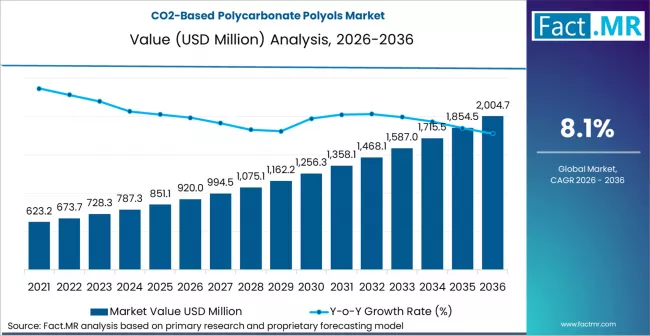
Strategic consolidation in the sector is evident, with key players making significant advancements. One notable development is the licensing agreement between Econic Technologies and a global energy company, enabling the integration of CO₂ into polyol production. Another major player, Covestro, is expanding its production capacity, focusing on CO₂-based polyols under its cardyon® brand, which are now being used in large-scale polyurethane applications. Similarly, advancements in catalyst technologies are enabling the use of CO₂ with greater efficiency, making these polyols more cost-competitive.
The strategy has shifted from catalytic validation to supply chain integration, as manufacturers prove that CO₂ polyols offer superior hydrolysis resistance and load-bearing strength. The market is moving towards AI-driven optimization, enabling faster customization for a wide range of applications, including electric vehicles, sustainable apparel, and mattresses. As the industry scales, CO₂ is becoming a low-cost, abundant raw material, offering a competitive edge over petroleum-based products. By 2026, the industry will be defined by AI-optimized, drop-in compatible solutions that support a circular, sustainable economy.
CO2-Based Polycarbonate Polyols Market
| Metric | Value |
|---|---|
| Estimated Value in (2026E) | USD 920.0 million |
| Forecast Value in (2036F) | USD 2,004.7 million |
| Forecast CAGR (2026 to 2036) | 8.1% |
Category
| Category | Segments |
|---|---|
| Carbonate Content | Medium Carbonate Content Grades; Low Carbonate Content Grades; High Carbonate Content Grades; Customized/Other Grades |
| Application | Flexible & Rigid Foams; Coatings, Adhesives, Sealants & Elastomers (CASE); TPU & Thermoplastic Elastomers; Other Uses |
| End-Use Sector | Construction & Buildings; Automotive & Transport; Furniture & Bedding; Industrial & Other Sectors |
| Supply Model | Mass-Balance / Drop-In Polyols; Direct CO2-Based Polyols; Blended/Bi-Content Polyols |
| Region | North America; Europe; Asia Pacific; Latin America; Middle East & Africa |
Segmental Analysis
What Is the Impact of Carbonate Content on the CO2-Based Polycarbonate Polyols Market?
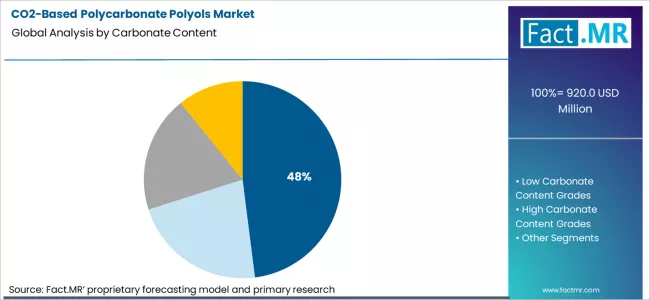
In the CO2-based polycarbonate polyols market, carbonate content plays a significant role in determining the performance characteristics, applications, and end-user preferences. Medium carbonate content grades lead the market with a 48.0% share due to their balanced mechanical properties and processing flexibility. These grades are widely used in applications such as flexible foams and thermoplastic elastomers (TPU), where a moderate degree of carbonate incorporation provides optimal resilience, cushioning, and durability. The demand for medium carbonate content grades is driven by the need for versatile polyols that can meet the varying requirements of automotive, furniture, and consumer goods industries. Their customizable properties allow manufacturers to achieve the desired balance between hardness and elasticity, which makes them essential in multiple foam formulations.
How Does Application Influence Demand in the CO2-Based Polycarbonate Polyols Market?
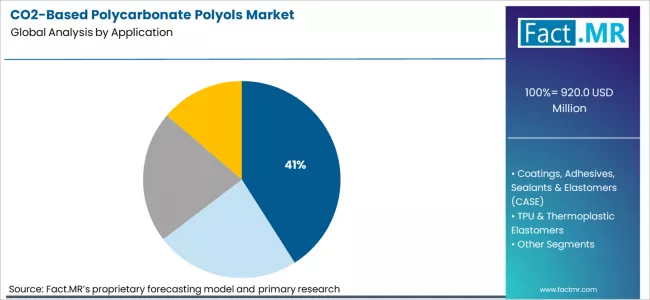
Application area plays a critical role in driving product demand, as each application requires specific polyol characteristics to optimize performance. Flexible and rigid foams account for 41.0% of the market due to their widespread use in insulation, cushioning, and molding applications. These polyols are essential for thermal insulation, soundproofing, and comfort materials in industries like automotive, construction, and furniture. The increasing focus on energy-efficient buildings, green construction, and automotive lightweighting is propelling the demand for CO2-based polycarbonate polyols, which offer high-performance properties with lower environmental impact compared to traditional polyols.
What are the Drivers, Restraints, and Key Trends in the CO2-Based Polycarbonate Polyols Market?
| Country | Driver | Restraint | Trend |
|---|---|---|---|
| USA | Growing demand for sustainable polymers and CO2 utilization in elastomers, adhesives, and coatings. | Higher production and integration costs compared to conventional polyols. | Increasing industrial adoption of carbon-capture-based polyols for eco-friendly materials. |
| UK | Rising focus on low-carbon materials in automotive and construction sectors. | Limited domestic production scale for advanced CO2-based polyols. | Shift toward partnerships for green polymer development. |
| Germany | Strong industrial base and regulations promoting sustainable chemicals. | Complex compliance and certification standards for CO2-derived products. | Growth in specialized applications like high-performance coatings. |
| China | Significant investment in CO2-based polycarbonate polyol production infrastructure. | Regional disparity in technology adoption and quality standards. | Rapid scaling of CO2-based polyol capacity and local innovations. |
| India | Growing interest in sustainable chemical adoption in manufacturing. | Limited awareness and industrial use of CO2-derived polyols. | Early adoption with focus on imports and technology transfer. |
Analysis of the CO2-Based Polycarbonate Polyols Market by Key Country
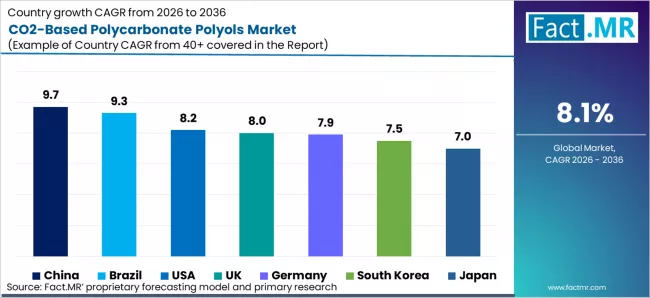
| Country | CAGR (%) |
|---|---|
| China | 9.7% |
| Brazil | 9.3% |
| USA | 8.2% |
| UK | 8.0% |
| Germany | 7.9% |
| South Korea | 7.5% |
| Japan | 7.0% |
The report covers an in-depth analysis of 40+ countries; top-performing countries are highlighted below.
What drives growth in China for CO₂ based polycarbonate polyols?
China is projected to grow at 9.7% CAGR, the highest among major markets, propelled by rapid industrialization and government policies favoring carbon reduction and advanced material innovation. China’s chemical manufacturers are scaling production of CO₂ based polyols to serve domestic PU markets in coatings, footwear, automotive interiors, and flexible foams. National initiatives such as the 14th Five Year Plan emphasize carbon utilization technologies, making CO₂ based polycarbonate polyols a strategic priority for both state backed research and commercial adoption.
“In China, we see increasing momentum behind carbon utilization chemistries because they help meet both performance benchmarks and national decarbonization commitments,” says Li Wei, Head of Sustainable Materials at a leading Chinese specialty chemicals company.
Infrastructure growth in metropolitan regions and rising demand for high performance polymers reinforce strong uptake.
What fuels the rapid rise in Brazil?
Brazil’s CO₂ based polycarbonate polyols market is expected to grow at 9.3% CAGR, anchored in expanding PU consumption in footwear, automotive parts, furniture, and construction sectors where performance requirements drive demand for high quality polyols. Brazil’s petrochemical industry is exploring CCU pathways to add value to abundant feedstocks while reducing greenhouse gas emissions. Local sustainability policies and corporate ESG targets encourage formulators to adopt CO₂ derived polycarbonate polyols that deliver improved hydrolytic stability and durability.
“In Brazil, material performance and environmental credentials increasingly guide procurement decisions in polymers,” explains Carlos Santos, Head of Materials Innovation at a Brazilian specialty chemicals supplier.
Urbanization trends and growth in mid market PU applications support healthy category expansion.
How is the USA market evolving in the CO₂ Based Polycarbonate Polyols sector?
The USA market is forecast to grow at 8.2%, driven by increasing adoption of sustainable polyol technologies in polyurethane (PU) applications where performance and environmental impact both matter. CO₂ based polycarbonate polyols are gaining traction as manufacturers seek to reduce reliance on fossil feedstocks and enhance carbon utilization without sacrificing mechanical and thermal properties. According to Wood Mackenzie, CO₂ derived polyols are increasingly specified in high performance elastomers, coatings, adhesives, sealants, and flexible foam formulations due to their improved hydrolytic and heat resistance compared to conventional polyether polyols.
“CO₂ based polycarbonate polyols offer a compelling balance of performance and sustainability, enabling formulators to reduce carbon footprint while meeting demanding application requirements,” says Dr. Rebecca Allen, Polyurethane Product Director at a major North American materials firm.
Adoption in the USA is supported by corporate sustainability targets and regulatory focus on lifecycle emissions reductions, particularly in automotive and construction sectors where durable PU products are critical.
Why is the UK market important for CO₂ based polycarbonate polyols?
The UK market is expanding at 8.0%, supported by strong sustainability mandates and innovation ecosystems that prioritize carbon capture and utilization (CCU) technologies. UK manufacturers and formulators are early adopters of CO₂ based polycarbonate polyols in premium PU applications where reduced lifecycle emissions and product performance are differentiators. Academic and industrial collaborations, particularly around green chemistry platforms, drive commercial deployments in coatings and elastomers.“The UK’s proactive stance on decarbonization and materials innovation accelerates adoption of sustainable polyols that support circular economy objectives,” says Dr. Sarah Thompson, Senior Researcher in Sustainable Polymers at a UK research institute.Demand is underpinned by both regulatory drivers and corporate net zero commitments.
What is driving expansion in Germany?
Germany is projected to grow at 7.9% CAGR, supported by its advanced automotive, construction, and industrial manufacturing sectors that emphasize high performance materials with reduced environmental impact. German formulators are specifying CO₂ based polycarbonate polyols in elastomers, coatings, and flexible PU systems because these materials offer superior hydrolytic and thermal stability compared to traditional polyether and polyester polyols. Compliance with EU chemical and climate regulations, including REACH and the European Green Deal, reinforces demand for sustainable polymer alternatives.
“CO₂ derived polycarbonate polyols align with both performance expectations and stringent environmental standards in the EU,” says Dr. Petra Müller, Technical Director at a German polymer innovation network.
How is South Korea shaping demand for CO₂ based polycarbonate polyols?
South Korea’s market is growing at 7.5% CAGR, driven by high adoption of advanced materials in electronics, automotive components, and high performance coatings where CO₂ based polycarbonate polyols contribute improved durability and moisture resistance. South Korean chemical manufacturers are investing in carbon utilization platforms, and end users are prioritizing sustainable raw materials that align with national climate goals and export competitiveness.
“South Korean formulators appreciate CO₂ based polycarbonate polyols for their enhanced properties and sustainability attributes in high tech applications,” notes Min Jae Kim, Materials Scientist at a Korean specialty chemicals firm.
Export oriented manufacturing further reinforces demand for performance materials with lower lifecycle emissions.
What fuels the gradual rise in Japan?
Japan’s CO₂ based polycarbonate polyols market is forecast to grow at 7.0% CAGR, reflecting careful but sustained adoption in sectors such as automotive interiors, industrial elastomers, and high end coatings where material performance and environmental credentials both influence procurement. Japanese manufacturers are emphasizing formulation compatibility and long term stability alongside carbon reduction goals, aligning with national policies on decarbonization and advanced materials. Preferred product attributes include improved hydrolytic stability, mechanical robustness, and broad formulation latitude.
“In Japan, incremental adoption of CO₂ derived polyols is guided by stringent performance benchmarks and sustainability requirements in demanding applications,” explains Hiroshi Tanaka, Senior Materials Engineer at a Japanese polymer research institute.
Conservative capital spending moderates rapid adoption, but sustained emphasis on both performance and environmental impact supports steady growth.
What Strategic Moves Are Defining Competitive Landscape?
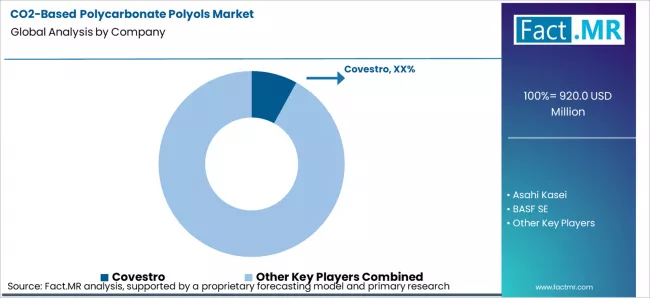
The CO2-based polycarbonate polyols market is transitioning from a period of pilot-scale sustainability experiments to a high-volume race for carbon-integrated asset productivity. Between 2020 and 2024, the landscape was defined by the first commercial breakthroughs in using captured emissions as a feedstock to replace fossil-based propylene oxide. Fact.MR analysis indicates that the focus is shifting from simply reducing carbon footprints to a deeper integration of CO2 into high-performance digital twins and advanced battery supply chains. This represents a fundamental move where the strategic value resides in decoupling high-performance polymer production from crude oil volatility. Eric Saks, E&E Market Manager at Covestro, notes the following regarding the acceleration in material innovation for next-generation technology.
Companies like Covestro and Asahi Kasei are leveraging their early lead in licensing and "Return on Carbon Employed" metrics to set the global standard for circular manufacturing. Meanwhile, competitors like BASF and Wanhua Chemical are focusing on digital transparency and large-scale capacity expansions in Asia to dominate the polyurethane and EV battery sectors. This strategic pivot ensures they remain indispensable as the market moves away from niche green ingredients toward a fully orchestrated and carbon-neutral industrial ecosystem.
Key Players in the CO2-Based Polycarbonate Polyols Market
- Covestro
- Asahi Kasei
- BASF SE
- Dow
- Mitsui Chemicals
- Wanhua Chemical
- Huntsman
- Repsol
- Tosoh Corporation
- SK (polyols portfolio)
Scope of the Report
| Items | Values |
|---|---|
| Quantitative Units | USD million |
| Carbonate Content | Medium Carbonate Content Grades; Low Carbonate Content Grades; High Carbonate Content Grades; Customized/Other Grades |
| Application | Flexible & Rigid Foams; Coatings, Adhesives, Sealants & Elastomers (CASE); TPU & Thermoplastic Elastomers; Other Uses |
| End-Use Sector | Construction & Buildings; Automotive & Transport; Furniture & Bedding; Industrial & Other Sectors |
| Supply Model | Mass-Balance / Drop-In Polyols; Direct CO2-Based Polyols; Blended/Bi-Content Polyols |
| Regions Covered | Asia Pacific, Europe, North America, Latin America, Middle East & Africa |
| Countries Covered | China, Brazil, USA, UK, Germany, South Korea, Japan, and 40+ countries |
| Key Companies Profiled | Covestro; Asahi Kasei; BASF SE; Dow; Mitsui Chemicals; Wanhua Chemical; Huntsman; Repsol; Tosoh Corporation; SK (polyols portfolio) |
| Additional Attributes | Dollar sales by carbonate content grades, applications, end-use sectors, and supply models; increasing adoption of CO2-based polyols in the production of sustainable foams and CASE products; advancements in polyol formulations for automotive and construction applications; growing demand for high-carbonate content polyols for thermoplastic elastomers and TPU production; focus on reducing carbon footprints and reliance on fossil-derived polyols. |
CO2-Based Polycarbonate Polyols Market Key Segment
-
Carbonate Content :
- Medium Carbonate Content Grades
- Low Carbonate Content Grades
- High Carbonate Content Grades
- Customized/Other Grades
-
Application :
- Flexible & Rigid Foams
- Coatings, Adhesives, Sealants & Elastomers (CASE)
- TPU & Thermoplastic Elastomers
- Other Uses
-
End-Use Sector :
- Construction & Buildings
- Automotive & Transport
- Furniture & Bedding
- Industrial & Other Sectors
-
Supply Model :
- Mass-Balance / Drop-In Polyols
- Direct CO2-Based Polyols
- Blended/Bi-Content Polyols
-
Region :
- North America
- USA
- Canada
- Mexico
- Europe
- Germany
- UK
- France
- Italy
- Spain
- Nordic Countries
- BENELUX
- Rest of Europe
- Asia Pacific
- China
- Japan
- South Korea
- India
- Australia
- Rest of Asia Pacific
- Latin America
- Brazil
- Argentina
- Rest of Latin America
- Middle East and Africa
- Kingdom of Saudi Arabia
- United Arab Emirates
- South Africa
- Rest of Middle East and Africa
- Other Regions
- Oceania
- Central Asia
- Other Markets
- North America
Bibliographies
- International Energy Agency. (2023). Carbon capture, utilisation and storage: Technology outlook and industrial pathways. International Energy Agency.
- European Commission. (2023). Carbon capture and utilisation in the EU chemicals sector under the European Green Deal. Publications Office of the European Union.
- U.S. Department of Energy. (2024). Carbon utilization for polymer and materials manufacturing. Office of Fossil Energy and Carbon Management.
- International Organization for Standardization. (2023). ISO 14067: Greenhouse gases - Carbon footprint of products - Requirements and guidelines for quantification. ISO.
Table of Content
- Executive Summary
- Global Market Outlook
- Demand to side Trends
- Supply to side Trends
- Technology Roadmap Analysis
- Analysis and Recommendations
- Market Overview
- Market Coverage / Taxonomy
- Market Definition / Scope / Limitations
- Research Methodology
- Chapter Orientation
- Analytical Lens and Working Hypotheses
- Market Structure, Signals, and Trend Drivers
- Benchmarking and Cross-market Comparability
- Market Sizing, Forecasting, and Opportunity Mapping
- Research Design and Evidence Framework
- Desk Research Programme (Secondary Evidence)
- Company Annual and Sustainability Reports
- Peer-reviewed Journals and Academic Literature
- Corporate Websites, Product Literature, and Technical Notes
- Earnings Decks and Investor Briefings
- Statutory Filings and Regulatory Disclosures
- Technical White Papers and Standards Notes
- Trade Journals, Industry Magazines, and Analyst Briefs
- Conference Proceedings, Webinars, and Seminar Materials
- Government Statistics Portals and Public Data Releases
- Press Releases and Reputable Media Coverage
- Specialist Newsletters and Curated Briefings
- Sector Databases and Reference Repositories
- FMR Internal Proprietary Databases and Historical Market Datasets
- Subscription Datasets and Paid Sources
- Social Channels, Communities, and Digital Listening Inputs
- Additional Desk Sources
- Expert Input and Fieldwork (Primary Evidence)
- Primary Modes
- Qualitative Interviews and Expert Elicitation
- Quantitative Surveys and Structured Data Capture
- Blended Approach
- Why Primary Evidence is Used
- Field Techniques
- Interviews
- Surveys
- Focus Groups
- Observational and In-context Research
- Social and Community Interactions
- Stakeholder Universe Engaged
- C-suite Leaders
- Board Members
- Presidents and Vice Presidents
- R&D and Innovation Heads
- Technical Specialists
- Domain Subject-matter Experts
- Scientists
- Physicians and Other Healthcare Professionals
- Governance, Ethics, and Data Stewardship
- Research Ethics
- Data Integrity and Handling
- Primary Modes
- Tooling, Models, and Reference Databases
- Desk Research Programme (Secondary Evidence)
- Data Engineering and Model Build
- Data Acquisition and Ingestion
- Cleaning, Normalisation, and Verification
- Synthesis, Triangulation, and Analysis
- Quality Assurance and Audit Trail
- Market Background
- Market Dynamics
- Drivers
- Restraints
- Opportunity
- Trends
- Scenario Forecast
- Demand in Optimistic Scenario
- Demand in Likely Scenario
- Demand in Conservative Scenario
- Opportunity Map Analysis
- Product Life Cycle Analysis
- Supply Chain Analysis
- Investment Feasibility Matrix
- Value Chain Analysis
- PESTLE and Porter’s Analysis
- Regulatory Landscape
- Regional Parent Market Outlook
- Production and Consumption Statistics
- Import and Export Statistics
- Market Dynamics
- Global Market Analysis 2021 to 2025 and Forecast, 2026 to 2036
- Historical Market Size Value (USD Million) Analysis, 2021 to 2025
- Current and Future Market Size Value (USD Million) Projections, 2026 to 2036
- Y to o to Y Growth Trend Analysis
- Absolute $ Opportunity Analysis
- Global Market Pricing Analysis 2021 to 2025 and Forecast 2026 to 2036
- Global Market Analysis 2021 to 2025 and Forecast 2026 to 2036, By Carbonate Content
- Introduction / Key Findings
- Historical Market Size Value (USD Million) Analysis By Carbonate Content, 2021 to 2025
- Current and Future Market Size Value (USD Million) Analysis and Forecast By Carbonate Content, 2026 to 2036
- Medium Carbonate Content Grades
- Low Carbonate Content Grades
- High Carbonate Content Grades
- Customized/Other Grades
- Medium Carbonate Content Grades
- Y to o to Y Growth Trend Analysis By Carbonate Content, 2021 to 2025
- Absolute $ Opportunity Analysis By Carbonate Content, 2026 to 2036
- Global Market Analysis 2021 to 2025 and Forecast 2026 to 2036, By Application
- Introduction / Key Findings
- Historical Market Size Value (USD Million) Analysis By Application, 2021 to 2025
- Current and Future Market Size Value (USD Million) Analysis and Forecast By Application, 2026 to 2036
- Flexible & Rigid Foams
- Coatings, Adhesives, Sealants & Elastomers (CASE)
- TPU & Thermoplastic Elastomers
- Other Uses
- Flexible & Rigid Foams
- Y to o to Y Growth Trend Analysis By Application, 2021 to 2025
- Absolute $ Opportunity Analysis By Application, 2026 to 2036
- Global Market Analysis 2021 to 2025 and Forecast 2026 to 2036, By End-Use Sector
- Introduction / Key Findings
- Historical Market Size Value (USD Million) Analysis By End-Use Sector, 2021 to 2025
- Current and Future Market Size Value (USD Million) Analysis and Forecast By End-Use Sector, 2026 to 2036
- Construction & Buildings
- Automotive & Transport
- Furniture & Bedding
- Industrial & Other Sectors
- Construction & Buildings
- Y to o to Y Growth Trend Analysis By End-Use Sector, 2021 to 2025
- Absolute $ Opportunity Analysis By End-Use Sector, 2026 to 2036
- Global Market Analysis 2021 to 2025 and Forecast 2026 to 2036, By Supply Model
- Introduction / Key Findings
- Historical Market Size Value (USD Million) Analysis By Supply Model, 2021 to 2025
- Current and Future Market Size Value (USD Million) Analysis and Forecast By Supply Model, 2026 to 2036
- Mass-Balance / Drop-In Polyols
- Direct CO2-Based Polyols
- Blended/Bi-Content Polyols
- Mass-Balance / Drop-In Polyols
- Y to o to Y Growth Trend Analysis By Supply Model, 2021 to 2025
- Absolute $ Opportunity Analysis By Supply Model, 2026 to 2036
- Global Market Analysis 2021 to 2025 and Forecast 2026 to 2036, By Region
- Introduction
- Historical Market Size Value (USD Million) Analysis By Region, 2021 to 2025
- Current Market Size Value (USD Million) Analysis and Forecast By Region, 2026 to 2036
- North America
- Latin America
- Western Europe
- Eastern Europe
- East Asia
- South Asia and Pacific
- Middle East & Africa
- Market Attractiveness Analysis By Region
- North America Market Analysis 2021 to 2025 and Forecast 2026 to 2036, By Country
- Historical Market Size Value (USD Million) Trend Analysis By Market Taxonomy, 2021 to 2025
- Market Size Value (USD Million) Forecast By Market Taxonomy, 2026 to 2036
- By Country
- USA
- Canada
- Mexico
- By Carbonate Content
- By Application
- By End-Use Sector
- By Supply Model
- By Country
- Market Attractiveness Analysis
- By Country
- By Carbonate Content
- By Application
- By End-Use Sector
- By Supply Model
- Key Takeaways
- Latin America Market Analysis 2021 to 2025 and Forecast 2026 to 2036, By Country
- Historical Market Size Value (USD Million) Trend Analysis By Market Taxonomy, 2021 to 2025
- Market Size Value (USD Million) Forecast By Market Taxonomy, 2026 to 2036
- By Country
- Brazil
- Chile
- Rest of Latin America
- By Carbonate Content
- By Application
- By End-Use Sector
- By Supply Model
- By Country
- Market Attractiveness Analysis
- By Country
- By Carbonate Content
- By Application
- By End-Use Sector
- By Supply Model
- Key Takeaways
- Western Europe Market Analysis 2021 to 2025 and Forecast 2026 to 2036, By Country
- Historical Market Size Value (USD Million) Trend Analysis By Market Taxonomy, 2021 to 2025
- Market Size Value (USD Million) Forecast By Market Taxonomy, 2026 to 2036
- By Country
- Germany
- UK
- Italy
- Spain
- France
- Nordic
- BENELUX
- Rest of Western Europe
- By Carbonate Content
- By Application
- By End-Use Sector
- By Supply Model
- By Country
- Market Attractiveness Analysis
- By Country
- By Carbonate Content
- By Application
- By End-Use Sector
- By Supply Model
- Key Takeaways
- Eastern Europe Market Analysis 2021 to 2025 and Forecast 2026 to 2036, By Country
- Historical Market Size Value (USD Million) Trend Analysis By Market Taxonomy, 2021 to 2025
- Market Size Value (USD Million) Forecast By Market Taxonomy, 2026 to 2036
- By Country
- Russia
- Poland
- Hungary
- Balkan & Baltic
- Rest of Eastern Europe
- By Carbonate Content
- By Application
- By End-Use Sector
- By Supply Model
- By Country
- Market Attractiveness Analysis
- By Country
- By Carbonate Content
- By Application
- By End-Use Sector
- By Supply Model
- Key Takeaways
- East Asia Market Analysis 2021 to 2025 and Forecast 2026 to 2036, By Country
- Historical Market Size Value (USD Million) Trend Analysis By Market Taxonomy, 2021 to 2025
- Market Size Value (USD Million) Forecast By Market Taxonomy, 2026 to 2036
- By Country
- China
- Japan
- South Korea
- By Carbonate Content
- By Application
- By End-Use Sector
- By Supply Model
- By Country
- Market Attractiveness Analysis
- By Country
- By Carbonate Content
- By Application
- By End-Use Sector
- By Supply Model
- Key Takeaways
- South Asia and Pacific Market Analysis 2021 to 2025 and Forecast 2026 to 2036, By Country
- Historical Market Size Value (USD Million) Trend Analysis By Market Taxonomy, 2021 to 2025
- Market Size Value (USD Million) Forecast By Market Taxonomy, 2026 to 2036
- By Country
- India
- ASEAN
- Australia & New Zealand
- Rest of South Asia and Pacific
- By Carbonate Content
- By Application
- By End-Use Sector
- By Supply Model
- By Country
- Market Attractiveness Analysis
- By Country
- By Carbonate Content
- By Application
- By End-Use Sector
- By Supply Model
- Key Takeaways
- Middle East & Africa Market Analysis 2021 to 2025 and Forecast 2026 to 2036, By Country
- Historical Market Size Value (USD Million) Trend Analysis By Market Taxonomy, 2021 to 2025
- Market Size Value (USD Million) Forecast By Market Taxonomy, 2026 to 2036
- By Country
- Kingdom of Saudi Arabia
- Other GCC Countries
- Turkiye
- South Africa
- Other African Union
- Rest of Middle East & Africa
- By Carbonate Content
- By Application
- By End-Use Sector
- By Supply Model
- By Country
- Market Attractiveness Analysis
- By Country
- By Carbonate Content
- By Application
- By End-Use Sector
- By Supply Model
- Key Takeaways
- Key Countries Market Analysis
- USA
- Pricing Analysis
- Market Share Analysis, 2025
- By Carbonate Content
- By Application
- By End-Use Sector
- By Supply Model
- Canada
- Pricing Analysis
- Market Share Analysis, 2025
- By Carbonate Content
- By Application
- By End-Use Sector
- By Supply Model
- Mexico
- Pricing Analysis
- Market Share Analysis, 2025
- By Carbonate Content
- By Application
- By End-Use Sector
- By Supply Model
- Brazil
- Pricing Analysis
- Market Share Analysis, 2025
- By Carbonate Content
- By Application
- By End-Use Sector
- By Supply Model
- Chile
- Pricing Analysis
- Market Share Analysis, 2025
- By Carbonate Content
- By Application
- By End-Use Sector
- By Supply Model
- Germany
- Pricing Analysis
- Market Share Analysis, 2025
- By Carbonate Content
- By Application
- By End-Use Sector
- By Supply Model
- UK
- Pricing Analysis
- Market Share Analysis, 2025
- By Carbonate Content
- By Application
- By End-Use Sector
- By Supply Model
- Italy
- Pricing Analysis
- Market Share Analysis, 2025
- By Carbonate Content
- By Application
- By End-Use Sector
- By Supply Model
- Spain
- Pricing Analysis
- Market Share Analysis, 2025
- By Carbonate Content
- By Application
- By End-Use Sector
- By Supply Model
- France
- Pricing Analysis
- Market Share Analysis, 2025
- By Carbonate Content
- By Application
- By End-Use Sector
- By Supply Model
- India
- Pricing Analysis
- Market Share Analysis, 2025
- By Carbonate Content
- By Application
- By End-Use Sector
- By Supply Model
- ASEAN
- Pricing Analysis
- Market Share Analysis, 2025
- By Carbonate Content
- By Application
- By End-Use Sector
- By Supply Model
- Australia & New Zealand
- Pricing Analysis
- Market Share Analysis, 2025
- By Carbonate Content
- By Application
- By End-Use Sector
- By Supply Model
- China
- Pricing Analysis
- Market Share Analysis, 2025
- By Carbonate Content
- By Application
- By End-Use Sector
- By Supply Model
- Japan
- Pricing Analysis
- Market Share Analysis, 2025
- By Carbonate Content
- By Application
- By End-Use Sector
- By Supply Model
- South Korea
- Pricing Analysis
- Market Share Analysis, 2025
- By Carbonate Content
- By Application
- By End-Use Sector
- By Supply Model
- Russia
- Pricing Analysis
- Market Share Analysis, 2025
- By Carbonate Content
- By Application
- By End-Use Sector
- By Supply Model
- Poland
- Pricing Analysis
- Market Share Analysis, 2025
- By Carbonate Content
- By Application
- By End-Use Sector
- By Supply Model
- Hungary
- Pricing Analysis
- Market Share Analysis, 2025
- By Carbonate Content
- By Application
- By End-Use Sector
- By Supply Model
- Kingdom of Saudi Arabia
- Pricing Analysis
- Market Share Analysis, 2025
- By Carbonate Content
- By Application
- By End-Use Sector
- By Supply Model
- Turkiye
- Pricing Analysis
- Market Share Analysis, 2025
- By Carbonate Content
- By Application
- By End-Use Sector
- By Supply Model
- South Africa
- Pricing Analysis
- Market Share Analysis, 2025
- By Carbonate Content
- By Application
- By End-Use Sector
- By Supply Model
- USA
- Market Structure Analysis
- Competition Dashboard
- Competition Benchmarking
- Market Share Analysis of Top Players
- By Regional
- By Carbonate Content
- By Application
- By End-Use Sector
- By Supply Model
- Competition Analysis
- Competition Deep Dive
- Covestro
- Overview
- Product Portfolio
- Profitability by Market Segments (Product/Age /Sales Channel/Region)
- Sales Footprint
- Strategy Overview
- Marketing Strategy
- Product Strategy
- Channel Strategy
- Asahi Kasei
- BASF SE
- Dow
- Mitsui Chemicals
- Wanhua Chemical
- Huntsman
- Repsol
- Tosoh Corporation
- SK (polyols portfolio)
- Covestro
- Competition Deep Dive
- Assumptions & Acronyms Used
List Of Table
- Table 1: Global Market Value (USD Million) Forecast by Region, 2021 to 2036
- Table 2: Global Market Value (USD Million) Forecast by Carbonate Content, 2021 to 2036
- Table 3: Global Market Value (USD Million) Forecast by Application, 2021 to 2036
- Table 4: Global Market Value (USD Million) Forecast by End-Use Sector, 2021 to 2036
- Table 5: Global Market Value (USD Million) Forecast by Supply Model, 2021 to 2036
- Table 6: North America Market Value (USD Million) Forecast by Country, 2021 to 2036
- Table 7: North America Market Value (USD Million) Forecast by Carbonate Content, 2021 to 2036
- Table 8: North America Market Value (USD Million) Forecast by Application, 2021 to 2036
- Table 9: North America Market Value (USD Million) Forecast by End-Use Sector, 2021 to 2036
- Table 10: North America Market Value (USD Million) Forecast by Supply Model, 2021 to 2036
- Table 11: Latin America Market Value (USD Million) Forecast by Country, 2021 to 2036
- Table 12: Latin America Market Value (USD Million) Forecast by Carbonate Content, 2021 to 2036
- Table 13: Latin America Market Value (USD Million) Forecast by Application, 2021 to 2036
- Table 14: Latin America Market Value (USD Million) Forecast by End-Use Sector, 2021 to 2036
- Table 15: Latin America Market Value (USD Million) Forecast by Supply Model, 2021 to 2036
- Table 16: Western Europe Market Value (USD Million) Forecast by Country, 2021 to 2036
- Table 17: Western Europe Market Value (USD Million) Forecast by Carbonate Content, 2021 to 2036
- Table 18: Western Europe Market Value (USD Million) Forecast by Application, 2021 to 2036
- Table 19: Western Europe Market Value (USD Million) Forecast by End-Use Sector, 2021 to 2036
- Table 20: Western Europe Market Value (USD Million) Forecast by Supply Model, 2021 to 2036
- Table 21: Eastern Europe Market Value (USD Million) Forecast by Country, 2021 to 2036
- Table 22: Eastern Europe Market Value (USD Million) Forecast by Carbonate Content, 2021 to 2036
- Table 23: Eastern Europe Market Value (USD Million) Forecast by Application, 2021 to 2036
- Table 24: Eastern Europe Market Value (USD Million) Forecast by End-Use Sector, 2021 to 2036
- Table 25: Eastern Europe Market Value (USD Million) Forecast by Supply Model, 2021 to 2036
- Table 26: East Asia Market Value (USD Million) Forecast by Country, 2021 to 2036
- Table 27: East Asia Market Value (USD Million) Forecast by Carbonate Content, 2021 to 2036
- Table 28: East Asia Market Value (USD Million) Forecast by Application, 2021 to 2036
- Table 29: East Asia Market Value (USD Million) Forecast by End-Use Sector, 2021 to 2036
- Table 30: East Asia Market Value (USD Million) Forecast by Supply Model, 2021 to 2036
- Table 31: South Asia and Pacific Market Value (USD Million) Forecast by Country, 2021 to 2036
- Table 32: South Asia and Pacific Market Value (USD Million) Forecast by Carbonate Content, 2021 to 2036
- Table 33: South Asia and Pacific Market Value (USD Million) Forecast by Application, 2021 to 2036
- Table 34: South Asia and Pacific Market Value (USD Million) Forecast by End-Use Sector, 2021 to 2036
- Table 35: South Asia and Pacific Market Value (USD Million) Forecast by Supply Model, 2021 to 2036
- Table 36: Middle East & Africa Market Value (USD Million) Forecast by Country, 2021 to 2036
- Table 37: Middle East & Africa Market Value (USD Million) Forecast by Carbonate Content, 2021 to 2036
- Table 38: Middle East & Africa Market Value (USD Million) Forecast by Application, 2021 to 2036
- Table 39: Middle East & Africa Market Value (USD Million) Forecast by End-Use Sector, 2021 to 2036
- Table 40: Middle East & Africa Market Value (USD Million) Forecast by Supply Model, 2021 to 2036
List Of Figures
- Figure 1: Global Market Pricing Analysis
- Figure 2: Global Market Value (USD Million) Forecast 2021 to 2036
- Figure 3: Global Market Value Share and BPS Analysis by Carbonate Content, 2026 and 2036
- Figure 4: Global Market Y to o to Y Growth Comparison by Carbonate Content, 2026 to 2036
- Figure 5: Global Market Attractiveness Analysis by Carbonate Content
- Figure 6: Global Market Value Share and BPS Analysis by Application, 2026 and 2036
- Figure 7: Global Market Y to o to Y Growth Comparison by Application, 2026 to 2036
- Figure 8: Global Market Attractiveness Analysis by Application
- Figure 9: Global Market Value Share and BPS Analysis by End-Use Sector, 2026 and 2036
- Figure 10: Global Market Y to o to Y Growth Comparison by End-Use Sector, 2026 to 2036
- Figure 11: Global Market Attractiveness Analysis by End-Use Sector
- Figure 12: Global Market Value Share and BPS Analysis by Supply Model, 2026 and 2036
- Figure 13: Global Market Y to o to Y Growth Comparison by Supply Model, 2026 to 2036
- Figure 14: Global Market Attractiveness Analysis by Supply Model
- Figure 15: Global Market Value (USD Million) Share and BPS Analysis by Region, 2026 and 2036
- Figure 16: Global Market Y to o to Y Growth Comparison by Region, 2026 to 2036
- Figure 17: Global Market Attractiveness Analysis by Region
- Figure 18: North America Market Incremental Dollar Opportunity, 2026 to 2036
- Figure 19: Latin America Market Incremental Dollar Opportunity, 2026 to 2036
- Figure 20: Western Europe Market Incremental Dollar Opportunity, 2026 to 2036
- Figure 21: Eastern Europe Market Incremental Dollar Opportunity, 2026 to 2036
- Figure 22: East Asia Market Incremental Dollar Opportunity, 2026 to 2036
- Figure 23: South Asia and Pacific Market Incremental Dollar Opportunity, 2026 to 2036
- Figure 24: Middle East & Africa Market Incremental Dollar Opportunity, 2026 to 2036
- Figure 25: North America Market Value Share and BPS Analysis by Country, 2026 and 2036
- Figure 26: North America Market Value Share and BPS Analysis by Carbonate Content, 2026 and 2036
- Figure 27: North America Market Y to o to Y Growth Comparison by Carbonate Content, 2026 to 2036
- Figure 28: North America Market Attractiveness Analysis by Carbonate Content
- Figure 29: North America Market Value Share and BPS Analysis by Application, 2026 and 2036
- Figure 30: North America Market Y to o to Y Growth Comparison by Application, 2026 to 2036
- Figure 31: North America Market Attractiveness Analysis by Application
- Figure 32: North America Market Value Share and BPS Analysis by End-Use Sector, 2026 and 2036
- Figure 33: North America Market Y to o to Y Growth Comparison by End-Use Sector, 2026 to 2036
- Figure 34: North America Market Attractiveness Analysis by End-Use Sector
- Figure 35: North America Market Value Share and BPS Analysis by Supply Model, 2026 and 2036
- Figure 36: North America Market Y to o to Y Growth Comparison by Supply Model, 2026 to 2036
- Figure 37: North America Market Attractiveness Analysis by Supply Model
- Figure 38: Latin America Market Value Share and BPS Analysis by Country, 2026 and 2036
- Figure 39: Latin America Market Value Share and BPS Analysis by Carbonate Content, 2026 and 2036
- Figure 40: Latin America Market Y to o to Y Growth Comparison by Carbonate Content, 2026 to 2036
- Figure 41: Latin America Market Attractiveness Analysis by Carbonate Content
- Figure 42: Latin America Market Value Share and BPS Analysis by Application, 2026 and 2036
- Figure 43: Latin America Market Y to o to Y Growth Comparison by Application, 2026 to 2036
- Figure 44: Latin America Market Attractiveness Analysis by Application
- Figure 45: Latin America Market Value Share and BPS Analysis by End-Use Sector, 2026 and 2036
- Figure 46: Latin America Market Y to o to Y Growth Comparison by End-Use Sector, 2026 to 2036
- Figure 47: Latin America Market Attractiveness Analysis by End-Use Sector
- Figure 48: Latin America Market Value Share and BPS Analysis by Supply Model, 2026 and 2036
- Figure 49: Latin America Market Y to o to Y Growth Comparison by Supply Model, 2026 to 2036
- Figure 50: Latin America Market Attractiveness Analysis by Supply Model
- Figure 51: Western Europe Market Value Share and BPS Analysis by Country, 2026 and 2036
- Figure 52: Western Europe Market Value Share and BPS Analysis by Carbonate Content, 2026 and 2036
- Figure 53: Western Europe Market Y to o to Y Growth Comparison by Carbonate Content, 2026 to 2036
- Figure 54: Western Europe Market Attractiveness Analysis by Carbonate Content
- Figure 55: Western Europe Market Value Share and BPS Analysis by Application, 2026 and 2036
- Figure 56: Western Europe Market Y to o to Y Growth Comparison by Application, 2026 to 2036
- Figure 57: Western Europe Market Attractiveness Analysis by Application
- Figure 58: Western Europe Market Value Share and BPS Analysis by End-Use Sector, 2026 and 2036
- Figure 59: Western Europe Market Y to o to Y Growth Comparison by End-Use Sector, 2026 to 2036
- Figure 60: Western Europe Market Attractiveness Analysis by End-Use Sector
- Figure 61: Western Europe Market Value Share and BPS Analysis by Supply Model, 2026 and 2036
- Figure 62: Western Europe Market Y to o to Y Growth Comparison by Supply Model, 2026 to 2036
- Figure 63: Western Europe Market Attractiveness Analysis by Supply Model
- Figure 64: Eastern Europe Market Value Share and BPS Analysis by Country, 2026 and 2036
- Figure 65: Eastern Europe Market Value Share and BPS Analysis by Carbonate Content, 2026 and 2036
- Figure 66: Eastern Europe Market Y to o to Y Growth Comparison by Carbonate Content, 2026 to 2036
- Figure 67: Eastern Europe Market Attractiveness Analysis by Carbonate Content
- Figure 68: Eastern Europe Market Value Share and BPS Analysis by Application, 2026 and 2036
- Figure 69: Eastern Europe Market Y to o to Y Growth Comparison by Application, 2026 to 2036
- Figure 70: Eastern Europe Market Attractiveness Analysis by Application
- Figure 71: Eastern Europe Market Value Share and BPS Analysis by End-Use Sector, 2026 and 2036
- Figure 72: Eastern Europe Market Y to o to Y Growth Comparison by End-Use Sector, 2026 to 2036
- Figure 73: Eastern Europe Market Attractiveness Analysis by End-Use Sector
- Figure 74: Eastern Europe Market Value Share and BPS Analysis by Supply Model, 2026 and 2036
- Figure 75: Eastern Europe Market Y to o to Y Growth Comparison by Supply Model, 2026 to 2036
- Figure 76: Eastern Europe Market Attractiveness Analysis by Supply Model
- Figure 77: East Asia Market Value Share and BPS Analysis by Country, 2026 and 2036
- Figure 78: East Asia Market Value Share and BPS Analysis by Carbonate Content, 2026 and 2036
- Figure 79: East Asia Market Y to o to Y Growth Comparison by Carbonate Content, 2026 to 2036
- Figure 80: East Asia Market Attractiveness Analysis by Carbonate Content
- Figure 81: East Asia Market Value Share and BPS Analysis by Application, 2026 and 2036
- Figure 82: East Asia Market Y to o to Y Growth Comparison by Application, 2026 to 2036
- Figure 83: East Asia Market Attractiveness Analysis by Application
- Figure 84: East Asia Market Value Share and BPS Analysis by End-Use Sector, 2026 and 2036
- Figure 85: East Asia Market Y to o to Y Growth Comparison by End-Use Sector, 2026 to 2036
- Figure 86: East Asia Market Attractiveness Analysis by End-Use Sector
- Figure 87: East Asia Market Value Share and BPS Analysis by Supply Model, 2026 and 2036
- Figure 88: East Asia Market Y to o to Y Growth Comparison by Supply Model, 2026 to 2036
- Figure 89: East Asia Market Attractiveness Analysis by Supply Model
- Figure 90: South Asia and Pacific Market Value Share and BPS Analysis by Country, 2026 and 2036
- Figure 91: South Asia and Pacific Market Value Share and BPS Analysis by Carbonate Content, 2026 and 2036
- Figure 92: South Asia and Pacific Market Y to o to Y Growth Comparison by Carbonate Content, 2026 to 2036
- Figure 93: South Asia and Pacific Market Attractiveness Analysis by Carbonate Content
- Figure 94: South Asia and Pacific Market Value Share and BPS Analysis by Application, 2026 and 2036
- Figure 95: South Asia and Pacific Market Y to o to Y Growth Comparison by Application, 2026 to 2036
- Figure 96: South Asia and Pacific Market Attractiveness Analysis by Application
- Figure 97: South Asia and Pacific Market Value Share and BPS Analysis by End-Use Sector, 2026 and 2036
- Figure 98: South Asia and Pacific Market Y to o to Y Growth Comparison by End-Use Sector, 2026 to 2036
- Figure 99: South Asia and Pacific Market Attractiveness Analysis by End-Use Sector
- Figure 100: South Asia and Pacific Market Value Share and BPS Analysis by Supply Model, 2026 and 2036
- Figure 101: South Asia and Pacific Market Y to o to Y Growth Comparison by Supply Model, 2026 to 2036
- Figure 102: South Asia and Pacific Market Attractiveness Analysis by Supply Model
- Figure 103: Middle East & Africa Market Value Share and BPS Analysis by Country, 2026 and 2036
- Figure 104: Middle East & Africa Market Value Share and BPS Analysis by Carbonate Content, 2026 and 2036
- Figure 105: Middle East & Africa Market Y to o to Y Growth Comparison by Carbonate Content, 2026 to 2036
- Figure 106: Middle East & Africa Market Attractiveness Analysis by Carbonate Content
- Figure 107: Middle East & Africa Market Value Share and BPS Analysis by Application, 2026 and 2036
- Figure 108: Middle East & Africa Market Y to o to Y Growth Comparison by Application, 2026 to 2036
- Figure 109: Middle East & Africa Market Attractiveness Analysis by Application
- Figure 110: Middle East & Africa Market Value Share and BPS Analysis by End-Use Sector, 2026 and 2036
- Figure 111: Middle East & Africa Market Y to o to Y Growth Comparison by End-Use Sector, 2026 to 2036
- Figure 112: Middle East & Africa Market Attractiveness Analysis by End-Use Sector
- Figure 113: Middle East & Africa Market Value Share and BPS Analysis by Supply Model, 2026 and 2036
- Figure 114: Middle East & Africa Market Y to o to Y Growth Comparison by Supply Model, 2026 to 2036
- Figure 115: Middle East & Africa Market Attractiveness Analysis by Supply Model
- Figure 116: Global Market - Tier Structure Analysis
- Figure 117: Global Market - Company Share Analysis
- FAQs -
How big is the co2-based polycarbonate polyols market in 2026?
The global co2-based polycarbonate polyols market is estimated to be valued at USD 920.0 million in 2026.
What will be the size of co2-based polycarbonate polyols market in 2036?
The market size for the co2-based polycarbonate polyols market is projected to reach USD 2,004.7 million by 2036.
How much will be the co2-based polycarbonate polyols market growth between 2026 and 2036?
The co2-based polycarbonate polyols market is expected to grow at a 8.1% CAGR between 2026 and 2036.
What are the key product types in the co2-based polycarbonate polyols market?
The key product types in co2-based polycarbonate polyols market are medium carbonate content grades, low carbonate content grades, high carbonate content grades and customized/other grades.
Which application segment to contribute significant share in the co2-based polycarbonate polyols market in 2026?
In terms of application, flexible & rigid foams segment to command 41.0% share in the co2-based polycarbonate polyols market in 2026.